Discussion: How to Avoid Racial Discrimination and Labeling Pitfalls
“[The EAS] is going to reflect the biases that are out there. Just because it's technology does not mean it's going to be immune from biases.”
— Community college leader interviewee, spring 2022
Although many of the community college leaders and third-party EAS vendors we spoke with had not previously evaluated EAS data by race/ethnicity, they all believe it is critical to do so in order to avoid the inherent potential of EAS to racially discriminate and label. Yet many campus leaders were unsure how to use their EAS tool to mitigate such biases.
One of the community college administrators we spoke with admitted that their school recently witnessed an increase in flags for Black male students. To find out whether this disproportionate increase of flags reveals disparate low-academic performance among Black males in need of additional student support services or the perpetuation of implicit biases and racial stigma, this college plans to evaluate the nature of the flags, the faculty triggering the flags, and student outcomes. Interestingly, this particular college is not new to the adoption of alerts and intervention systems, having gone through years of various EAS iterations. Yet after a decade of familiarity with EAS, this college is finally taking a step back to ask whether its systems are potentially perpetuating racial discrimination and labeling.
Many of the community colleges participating in this study have been implementing EAS for at least six years, with some adopting for a little over a decade, but it was not until our conversations that they had the opportunity and space to think about the racial implications of their EAS tool. This reveals the complexity of mission-driven community colleges. They are often strapped for resources and staff time, that many lack the capacity to evaluate their EAS data to ensure the predictive analytic tool, fed by faculty input, is not computing systemic discrimination.
Although many of our interviews turned out to be the beginning of future conversations for college leaders and vendors to start thinking of ways to ensure their systems serve all students and are not a disservice to students of color, there is a collective appetite from both community colleges and vendors to implement EAS through an equity-conscious approach.
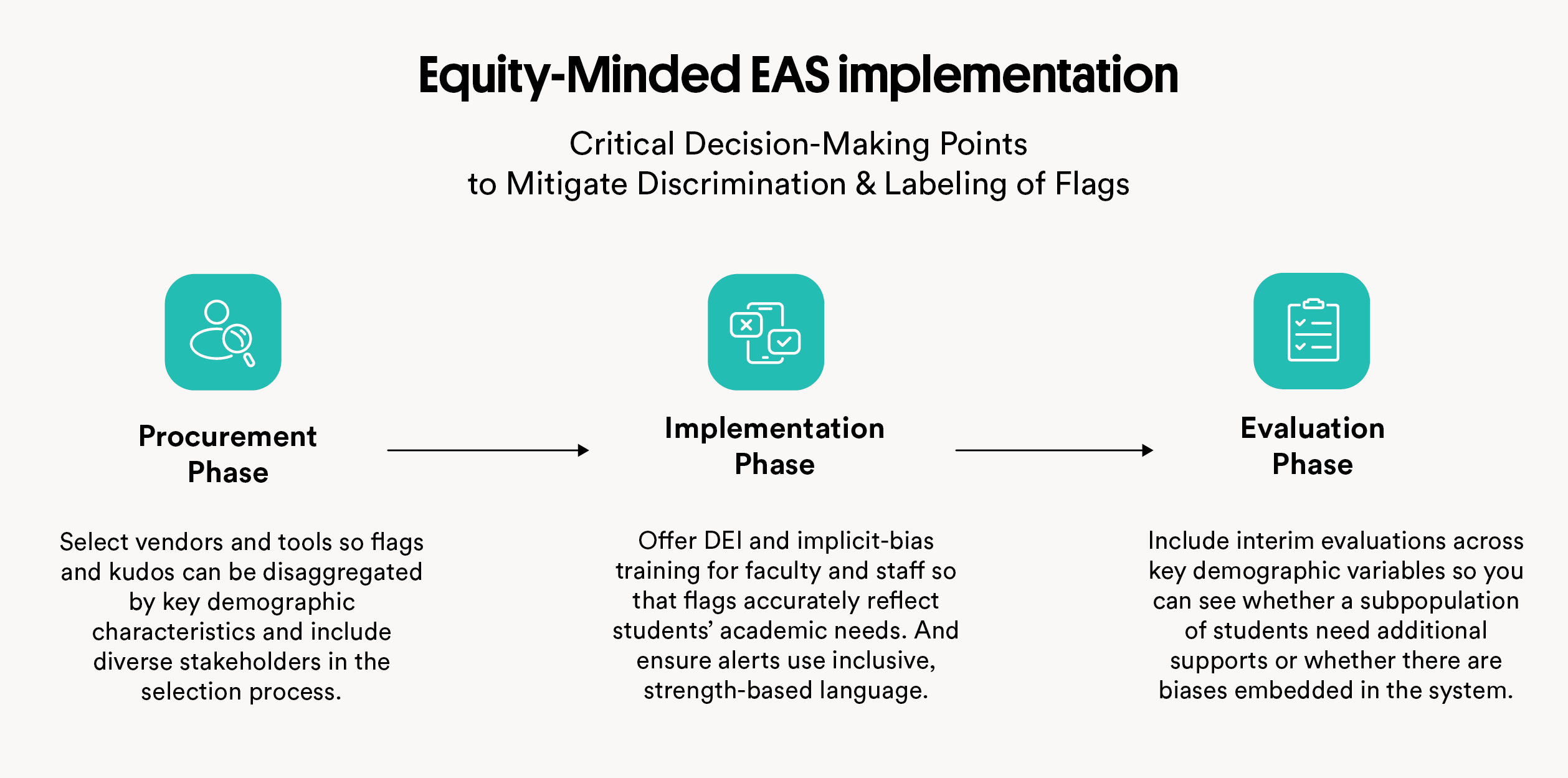
To guide campus leaders and vendors through an equity-minded implementation of EAS, we created a framework (see Figure 1) for community colleges and vendors. The tool highlights three major decision-making phases in the adoption and implementation processes, where taking additional care around issues of equity can mitigate the inherent biases of technology.
This framework is a culmination of our five recommendations in this report, in a cohesive visual format. Community colleges and vendors must activate student perspectives in design, configuration, testing, and implementation to ensure an equitable student-centered approach. If they use a critical lens on the equity implications of the procurement phase, implementation phase, and evaluation phase, colleges have the opportunity to mitigate biases.