Laura Bornfreund
Senior Fellow, Early & Elementary Education
These bright spots show what's possible when leaders begin to establish the right conditions for young learners.
On June 1, Gryphon House published Rediscovering Kindergarten: Embracing Play and Joy in Learning. My book draws on more than 50 kindergarten classroom visits and more than a decade of preK-3rd grade research and conversations. I wrote it to call on educators, decision-makers, and families to transform kindergarten into a year where play-based, joyful learning and challenging academic content go hand in hand. We know that kindergartners and early grade students learn best through play, relationships, and interactions. They need well-rounded learning opportunities that connect literacy, math, science, and social studies. They need activities and engaging discussions that help them learn about the world and cultures around them. For children to become strong readers and lifelong learners, they need teachers who build their background knowledge and vocabulary and create whole-child learning opportunities. The kindergartens that most children experience these days, however, do not meet these needs. In this blog series, I delve into some key ideas from my book and what I learned about kindergarten. This third post focuses on bright spots across the country that are beginning to take steps to make kindergarten work better for all students.
When I talk with education leaders about transforming kindergarten, they want to know about the places already doing the work. In researching my book, I visited classrooms and spoke with leaders across the country who are proving that play-based, joyful learning and academic rigor are partners, not opponents. Some of these efforts are led by state legislatures, some by superintendents, some by state education agencies, and at least one by parents.
None of these bright spots are finished, and none of them are perfect. But together, they show what’s possible when leaders begin to establish the right conditions for young learners. Here are five places I’m watching closely.
Something is happening in the Northeast, and it’s worth watching as a region because four neighboring states are pulling four different policy levers toward the same goal.
New Hampshire wrote play into law. After fully funding full-day kindergarten in 2017, State Representative Victoria Sullivan, a mother who watched her younger son get a far less playful kindergarten than her older son, succeeded in amending the state’s definition of an adequate education to require learning environments built on early childhood best practices and play-based learning. Following the signing of the law, state leaders partnered with Dr. Kimberly Nesbitt at the University of New Hampshire to define play-based learning operationally and coach teachers and administrators across the state. When I visited, I saw high-quality teaching and joyful learning, but the work runs primarily on philanthropic and federal grant dollars, and its sustainability and expansion depend on whether the state decides it’s a priority worth funding.
Maine shows what a state agency can do even without dedicated funding. Its law requires district education plans to address developmentally appropriate practice in K–2, and Lee Anne Larsen’s team at the Maine Department of Education used that opening — plus federal Preschool Development Grant dollars — to adapt Boston’s celebrated Focus on K curriculum into the For ME Early Learning Instructional Programs, steadily expanding the number of classrooms using it each year and equipping teachers with materials for play-based learning while providing coaching and networking opportunities.
Connecticut passed its play-based learning law in 2023. And, as of July 2024, every district must provide play-based learning during the instructional day for all kindergartners and preschoolers, must permit it in grades one through five, and must provide related professional development. The law defines play-based learning as a pedagogical approach used with the state’s learning standards, which is the right framing for linking play and academics. Connecticut legislators did not provide new funding, nor did they define a role for the state agency, so implementation is primarily falling to districts to determine how to connect guided play with their curricula. The Connecticut Education Association is offering professional learning and the University of Hartford and the Lego Foundation are hosting a Play-based Learning Summit in March 2027.
Massachusetts’ Playful Learning Institute, a partnership between the Department of Elementary and Secondary Education and Boston Public Schools’ Early Childhood Department, is bringing Boston’s playful learning practices and coaches directly into other districts. Early evaluation findings are encouraging: educators report highly engaged students, richer vocabulary and language use across the day, and more equitable learning experiences for students across socioeconomic, cultural, and learning differences. The Institute starts its fourth year this school year.
Oklahoma’s 2021 Play to Learn Act, championed by State Representative Joseph Rosecrants, is short and simple: school districts cannot prohibit a teacher from using play-based learning in pre-K through third grade. Like the New Hampshire law that inspired it, it came without funding or accountability measures.
When I visited Oklahoma kindergarten classrooms in the fall of 2021, principals told me the law hadn’t changed how most teachers teach, but it provided essential cover and affirmation for the principals and teachers who were already using play, or wanted to. That matters more than it might sound. In too many schools, teachers who know how young children learn are often overruled by pacing guides and worksheet expectations. A state law that says you may not prohibit this changes the conversation. I’m watching Oklahoma because the State Department of Education has begun training on playing with purpose, connecting play to the state’s pre-K–3 standards, and identifying promising examples around the state. I’m excited about at least a couple of Oklahoma districts that have really embraced play-based learning, including Edmond Public Schools (here is the district’s helpful, purposeful play guidance for grades K-2) and Oklahoma City. The next step for state leadership is moving from opt-in training to real incentives and support.
If you’ve read my book, you know I argue that we parents helped push kindergarten toward worksheets and drilling. And, guess what, parents can push it back. Charlotte-Mecklenburg Schools (CMS) is proof of that. After months of organizing by Mollie Auerbach and the parent-founded group K Needs Play, this fall, CMS launched K-Play pilots at seven elementary schools, restoring an hour of daily, choice-based, screen-free play to kindergarten classrooms in a district that stopped resourcing play-based learning centers around 2010.
North Carolina was the first state to require children to attend kindergarten. Now one of its largest districts could help define what that kindergarten year should actually look like. Its neighboring district, Cabarrus County Schools, rolled out district-wide play-based instruction this year, using a similar model. What I’m watching for in CMS is sustainability. The difference between a feel-good pilot and lasting change comes down to a clear, shared definition of play-based learning, professional development for teachers and principals, and a district budget commitment that outlives donor enthusiasm.
Ferndale is a small district along Puget Sound, and it’s my favorite example of what happens when a superintendent treats early learning as a district priority rather than an afterthought. When Kristi Dominguez became superintendent, she started by listening and, in December 2022, directed her staff to form an early learning task force of teachers, parents, principals, district staff, and community members. Five months later, she adopted their recommendations as the district’s P–3 plan, with child-centered pedagogy as a core strategy.
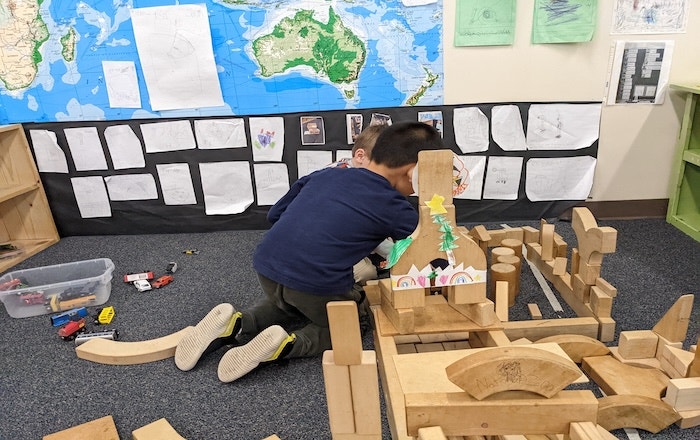
Then Ferndale actually resourced it. Every kindergarten classroom received new materials and furniture — blocks, wooden kitchen sets, sensory tables, books, puzzles — to outfit the centers children choose from during “children’s work time,” an hour of uninterrupted play, creation, and choice. Dominguez was deliberate about scheduling it during the school day, not at the end, where it could get shortened or cut. And, Ferndale prioritized professional learning and coaching for principals and teachers. When I visited in spring 2024, I watched kindergartners build stadiums and magnetic-tile houses while their teachers wove in oral language, vocabulary, math, and spatial reasoning. I’m most interested in watching as Ferndale expands into first and second grade, which is the goal. If district leaders stop their work at kindergarten, the gap between grade levels simply shifts later rather than closing.
Nevada has been quietly working on this for more than a decade. The Department of Education’s Office of Early Learning and Development has embedded birth through third-grade work throughout the state: developmentally appropriate kindergarten cohorts where teachers learn strategies and visit classrooms to see play-based learning in action, P–3 Leadership Academy cohorts for principals, and federal funds that sent twenty elementary principals and district administrators through the National P–3 Center’s leadership certificate program.
In Nevada, leadership buy-in goes to the top. The state superintendent and deputy superintendent attended a P–3 institute and set goals, including model schools in every district that reflect the science of learning and development. Second, the work is reaching classrooms. In Washoe County, where I visited, many kindergarten classrooms are moving toward play-based instruction, including Connie Hall’s classroom, the 2023 Nevada Teacher of the Year, who left kindergarten when it became less playful in the late 1990s and came back because of efforts in Nevada to transform kindergarten.
Different levers, same lesson. Whether the spark is a legislator, a superintendent, a state agency, or a group of determined parents, the efforts that last share the same ingredients:
A law with funding and monitoring can lead to transformation. A pilot with a budget line and evaluation can do the same. And a superintendent who protects the schedule and invests in training principals and teachers can change what kindergarten feels like for every child in the district.
If your school, district, or state belongs on a future version of this list, I’d love to learn about what you’re building.
Senior Fellow, Early & Elementary Education