
Table of Contents
- Introduction
- Pre-K Teachers and In-Service Professional Learning
- Our Approach
- Strengthening STEM Instruction in Passaic, New Jersey
- Building a Cohort of Early Childhood Technology Leaders in Chicago, Illinois
- Partnering to Connect Research to Practice in Nashville, Tennessee
- Explicitly Teaching Social and Emotional Skills in San Jose, California
- Improving Language and Literacy Across Texas
- Five Lessons for Growing Strong Pre-K Teachers
Strengthening STEM Instruction in Passaic, New Jersey
SciMath-DLL serves a cohort of pre-K teachers in Passaic, NJ who work in both public schools and Head Start centers. All teachers are required to have a bachelor’s degree and teaching certification. Over 90 percent of Passaic students qualify for free and reduced-price lunch and more than 98 percent of students are non-white.1
Before they disseminate into small groups to make orange juice, approximately two dozen pre-K teachers and coaches gather in the library for coffee at MLK No. 6 before a full Saturday of professional learning. The group is participating in its second of four SciMath-DLL workshops with researchers from NIEER and East Tennessee State University. SciMath-DLL uses a three-pronged approach to improve STEM education for young children: hands-on workshops, individualized coaching, and participation in PLCs.
Director Alissa Lange leads the workshop with her colleagues Hagit Mano and Irena Nayfeld. They begin with a whole group reflection of a math lesson called “Roll and Build” involving large, colorful dice and Legos that teachers took back to their classrooms after the last workshop. Teachers and coaches share their successes and challenges with implementation. One teacher admits, “the first time I did it, it was really hard. My students were a little overwhelmed. I was focusing on two objectives instead of one. When I did it the second time I only had one objective and it worked really well.” Mano warmly affirms, “as teachers, we try something the first time and then wonder, ‘what was I thinking?!’ And then we try again.”
Then the SciMath-DLL team plays short videos of two teachers implementing the lesson plan. The videos show two different methods for teaching “Roll and Build” because teachers are encouraged to adapt the lessons to fit the needs of their students. In both videos the teachers are asking higher-order thinking questions, testing students’ understanding, following their leads, and differentiating instruction. The group analyzes the instruction and explains why these methods would or would not work in their own classrooms. One teacher admits, “at first I didn’t know that I could tweak the lesson, and I did it exactly as it was demonstrated [in the workshop] and it was a mess. But after getting suggestions from my PLC, I did it again differently, and I liked it that way better because I had more time to reach the children who were struggling.”
Filling a Void of STEM in Pre-K
High-quality professional learning focused on STEM instruction is hard to come by. According to the Transforming the Workforce report, children from low-income families are less likely to be exposed to math in the early years, and achievement gaps in math and science are already evident when children enter kindergarten.2 A 2009 study of Head Start enrollees found that “children arrived in kindergarten with lower science readiness scores than in any other subject area or developmental domain.”3
Math and science knowledge in pre-K are strong predictors of later achievement in multiple subject areas, yet few early educators spend adequate time on math and science instruction.4
A 2017 study from Michigan State University offers some insight. Researchers analyzed Head Start teachers’ self-efficacy in literacy, math, and science, and found that teachers were most confident in their ability to teach literacy, and that they lacked confidence in teaching both math and science.5 When STEM is taught in teacher preparation programs or in-service professional learning, it is not usually taught well, translating to low-quality STEM instruction for students.6 SciMath-DLL is helping educators understand how to teach higher-level concepts in math and science and recognize children’s learning trajectories in these subject areas.
A Morning of “Change and Transformation”
After reviewing “Roll and Build,” Lange switches to the topic of the morning: “Change and Transformation.” This can encompass earth science, life sciences, and physical sciences. But Lange reminds the teachers that “learning math and science requires language,” and thus, one of the main strategies they focus on is questioning with DLLs. There are certain technical words and vocabulary needed when teaching science and math, and this can be especially challenging for DLLs. Over 90 percent of students in Passaic City School District are Hispanic or Latino, and in pre-K many of them are just starting to learn English.7 Lange explains that “trying to learn both languages, DLLs often start to fall behind in the content. Some of these strategies can help make sure they don’t feel so lost in science and math.”
Lange calls her colleague Nayfeld up to the front of the room, where the screen has a picture of a jar of food labeled with an apple and words written in an unfamiliar language. Nayfeld starts speaking to the teachers in Russian. While no one can understand what she is saying, she points to the picture, picks up an apple off the table, uses hand motions to signal the relationship between the real apple and the picture, uses inflection in her voice that lets the audience know she is asking a question, and repeats herself numerous times. Despite the language barrier, the teachers catch on that it has something to do with applesauce.
Nayfeld has given the teachers a taste of what it feels like to be a DLL. While showing how frustrating the language barrier can be, she demonstrates multiple techniques for communicating effectively. She explains that “even if you were not 100 percent sure what I was getting at, I was able to scaffold it, so you at least started to understand what I meant.” The researchers discuss the stages through which DLLs tend to progress and explain the importance of adapting questions based on their developmental level. While the content is focused on STEM, developing children’s literacy and early language is a key component of SciMath-DLL.
Lange gives the remainder of the lesson in English. They are exploring change and transformation of food, and Lange walks through how they might teach students about how apples are transformed into applesauce. While the ultimate objective is to explore changes in matter by making applesauce, Lange acknowledges that this lesson should be spread out over several days and adapted to students’ interests and development. Lange says, “let the kids try things out! You value their ideas….That is inquiry! We want them to be scientists.”
The National Academies emphasized in its report that science is “more than teaching facts,” and that children need opportunities to explore in a way that supports science learning and also fosters school readiness in all other developmental domains.8 This is precisely the kind of instruction that Lange and her team are fostering.
Teachers Get in on the Action
After Lange finishes with the whole group instruction, the teachers and coaches are divided into three small groups. They rotate between stations, participating in the other lessons related to “Change and Transformation.” One table is making playdough, the second is exploring mixtures, and the third is making the orange juice depicted in the opening of this report.
In addition to the materials needed to make juice, the teachers will be sent home with binders containing the day’s PowerPoint slides, lesson plans, and additional handouts, all of which are translated into Spanish. Over the next month or so, teachers will make orange juice with their students while their coach, who attended the workshop with them, and a SciMath-DLL team member observe the lesson. They will reflect in an individualized meeting and exchange ideas with their PLC.
Preliminary Results Show Success
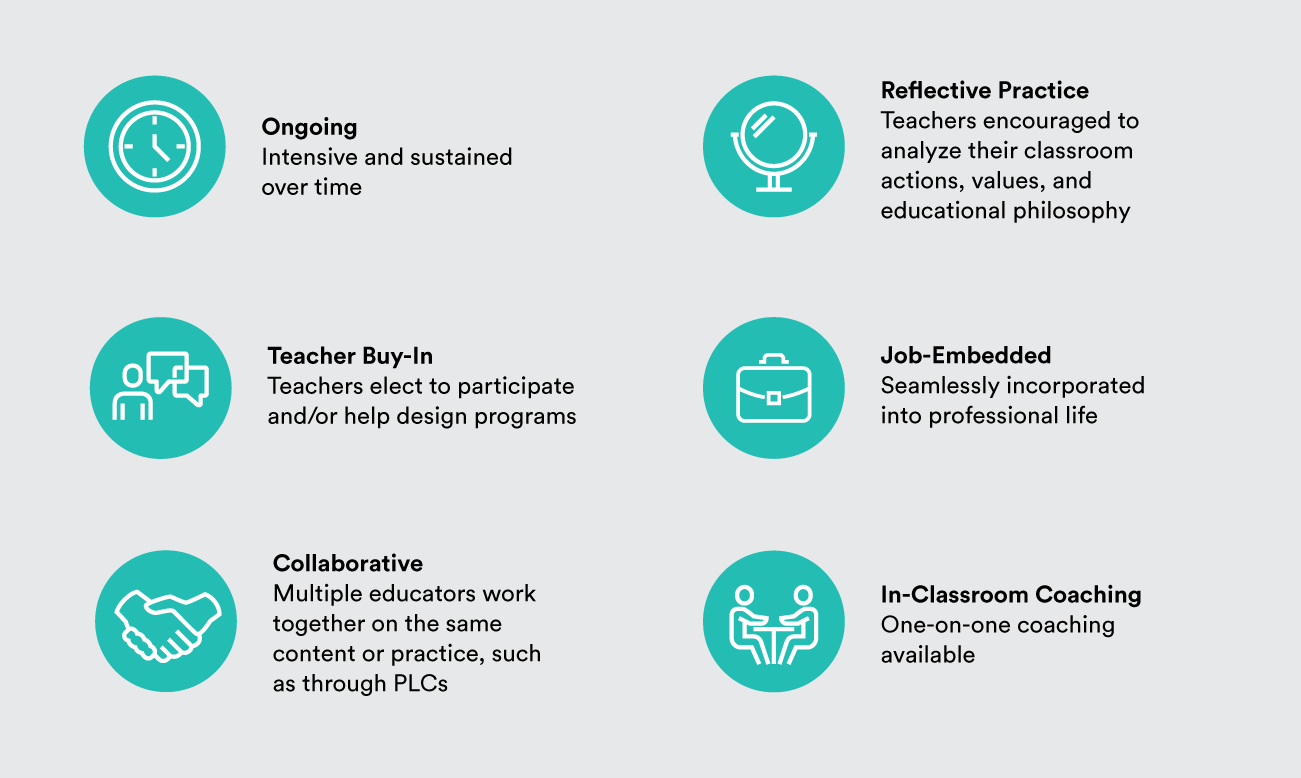
The SciMath-DLL model was developed with teachers and has evolved in response to teacher feedback. It incorporates numerous components of high-quality professional learning. Throughout the workshop, teachers are asked probing questions to help them analyze their practice and the coaches aid in drawing connections. Teachers are constantly reflecting on their practice, whether it is informally during the workshop, one-on-one with their coach, or with peers in their PLC.
This is the second cohort of Passaic teachers to go through SciMath-DLL training. SciMath-DLL was made possible with funding from the National Science Foundation. An initial grant led to the development of the program and a second grant is being used to support an experimental evaluation of the program in Passaic and an online technology pilot.
In 2015, 43 certified pre-K teachers in Passaic agreed to be randomly placed in the experimental or control group. The first experimental cohort participated in eight SciMath-DLL training sessions over two years, for a total of approximately 40 to 60 hours. From 2014 to 2016, the control group participated in regular professional development provided by the school district. Researchers evaluated teachers’ beliefs and attitudes about math, science, and DLL instruction. While all teachers “began the project with more positive attitudes towards teaching science and math and DLLs than expected,” the experimental group “showed marked improvements in their attitudes and beliefs compared to controls,” according to director Lange.9
Researchers have not yet been able to evaluate the impact of the program on student outcomes. But Nicole Arvenda Aguilo, a teacher from the first cohort, feels confident that her students benefited from her participation. Aguilo chose to participate in SciMath-DLL because she wanted to grow professionally. Despite having a bachelor’s degree in math, she was not using math effectively in her pre-K classroom. “It was my 14th year teaching and I learned a lot,” she said, and “I thought it was such a good experience that I brought it back to my school even after the program was over.” She asked her principal to keep the PLC in place, and her principal allowed her to design STEM workshops to share what she had learned with her colleagues. She recalls that being in the experimental group was difficult because “it was really hard not to share what we were learning with everyone in our school.”
Now the control group, or second cohort, is receiving a more condensed version of SciMath-DLL over one year. Part of the program’s success may be attributed to teacher buy-in. As Maria Lanni, a pre-K teacher who works at Lesley Head Start center, explained: “Coming on a Saturday after working all week is a sacrifice. But then I come and it’s worth it. It helps you think about new ways to do things. There are so many things to bring back.” Teachers are paid for their time, but it is still a commitment outside of regular work hours.
Scaling Up the Program
The SciMath-DLL team is exploring options for extending the reach of its work. One option is delivering the content in one year instead of two, as it is doing with the second cohort in Passaic. The group is also piloting an online version of the workshops with the Passaic teachers. The next workshop for this cohort will be available online, and teachers will have two weeks to complete the module, which does not have to be done in one sitting. Lange says that SciMath-DLL is also considering a “train the trainer” model where participants would go back to their schools and share what they have learned, as Aguilo did after participating in Passaic’s first cohort. Finally, the team recently secured an I-Corps grant from the National Science Foundation to evaluate the commercial potential of the work. The grant will support the team’s efforts to assess further options for scale-up and technological innovation, combining what the team already has and knows with what teachers and districts need right now.
These are all part of the effort to make SciMath-DLL more sustainable. Because SciMath-DLL is not tied to a specific curriculum, the program can be easily adapted to meet the needs of teachers in different settings or districts. In the Passaic workshops, Lange makes sure to show teachers how each lesson relates to their standards and curriculum, but the same can be done for all developmentally appropriate curricula. Lange is also working on adapting the program to meet the needs of teachers with varying qualifications and levels of expertise.
All children—including DLLs who can easily get left behind—can benefit from higher quality and more frequent STEM instruction. By helping more teachers overcome their anxiety around teaching STEM, SciMath-DLL is empowering teachers and bringing high-quality STEM instruction into more pre-K classrooms.
Citations
- Passaic Public Schools (website), “Passaic Public Schools,” source.
- LaRue Allen and Bridget B. Kelly, eds., Transforming the Workforce for Children Birth Through Age 8: A Unifying Foundation (Washington, DC: National Academies Press, 2015), 260, source.
- LaRue Allen and Bridget B. Kelly, eds., Transforming the Workforce for Children Birth Through Age 8: A Unifying Foundation (Washington, DC: National Academies Press, 2015), 268, source transforming-theworkforce-for-children-birth-throughage-8-a.
- Foundations for Success: The Final Report of the National Mathematics Advisory Panel (Washington, DC: U.S. Department of Education, 2008), source.; Paul L. Morgan, George Farkas, Marianne M. Hillemeier, and Steve Maczuga, “Science Achievement Gaps Begin Very Early, Persist, and Are Largely Explained by Modifiable Factors,” Educational Researcher 45, no. 1 (2016): 18–35, source.
- Hope K. Gerde, Steven J. Pierce, Kyungsook Lee, and Laurie A. Van Egeren, “Early Childhood Educators’ Self-Efficacy in Science, Math, and Literacy Instruction and Science Practice in the Classroom,” Early Education and Development 29, no. 1 (2018): 70–90, source.
- LaRue Allen and Bridget B. Kelly, eds., Transforming the Workforce for Children Birth Through Age 8: A Unifying Foundation (Washington, DC: National Academies Press, 2015), 260, source.
- Passaic Public Schools, “District Information,” source.
- LaRue Allen and Bridget B. Kelly, eds., Transforming the Workforce for Children Birth Through Age 8: A Unifying Foundation (Washington, DC: National Academies Press, 2015), 269, source.
- Alissa A. Lange, K. Jung, Irena Nayfeld, Hebbah El-Moslimany, Hagit Mano & A. Figueras-Daniel, “Preliminary Effects of a Preschool STEM Professional Development Model on Teachers’ Attitudes and Beliefs.” Proposal accepted to the annual meeting of the American Educational Research Association, (New York, NY: April 13-17, 2018).