
Table of Contents
- Introduction
- Pre-K Teachers and In-Service Professional Learning
- Our Approach
- Strengthening STEM Instruction in Passaic, New Jersey
- Building a Cohort of Early Childhood Technology Leaders in Chicago, Illinois
- Partnering to Connect Research to Practice in Nashville, Tennessee
- Explicitly Teaching Social and Emotional Skills in San Jose, California
- Improving Language and Literacy Across Texas
- Five Lessons for Growing Strong Pre-K Teachers
Pre-K Teachers and In-Service Professional Learning
Improving access to quality, relevant training for pre-K teachers requires an understanding of what constitutes an effective professional learning program and what the current barriers to access are, such as lack of funding or minimal buy-in from teachers. The research-based components of professional learning discussed in this paper will help administrators, policymakers, and other stakeholders understand what is needed to create a high-quality professional learning program. These components also help to inform successful implementation of a professional learning program that will lead to better child outcomes.
In 2015, the National Academies Press published a landmark report, Transforming the Workforce for Children from Birth Through Age 8: A Unifying Foundation. It explains that while professional learning can serve multiple purposes, its ultimate goal is to improve quality of practice and support child outcomes. For pre-K teachers, professional learning during ongoing practice comes in many forms (e.g., workshops, coaching and mentoring, learning networks) and can be delivered in numerous ways (e.g., in the workplace, offsite, via technology).
Researchers and policymakers in both birth-to-5 and K–12 education have been trying to determine which methods are most effective for improving practice. Many research groups, professional organizations, and policymakers have created definitions of high-quality professional learning in recent years to incorporate research findings.1 These definitions all overlap at least partially.
Based on the research, the National Academies report concludes that effective professional learning is “ongoing, intentional, reflective, goal-oriented, based on specific curricula and materials, focused on content knowledge and children’s thinking, and situated in the classroom.”2 Teachers who have a continuous improvement mindset may be more likely to alter their practice. It is also helpful when professional learning is relevant and useful to their work. Collaboration, such as through PLCs or one-on-one coaching, has also been shown to be effective when implemented well. Combining different methods of professional learning, such as workshops, coaching, and PLCs, around a specific content area may more effectively influence teacher practice than isolated methods.3
Multiple definitions stress the importance of using data to drive professional learning, both to determine where teachers need to strengthen their practice and to measure student progress.4 Learning Forward, an organization devoted to educator professional development, suggests that educators be committed to continuous improvement and acknowledges that professional learning must “meet the individual needs of educators, because all learners learn at different rates and in different ways.”5 In addition, educators need their program and school leaders to value continuous learning and development by allocating adequate funding and time for staff to participate. Leaders should reinforce what teachers are learning through professional development by giving them the space to practice new skills and incorporate developmentally appropriate practice. This may be challenging because leaders do not always have formal training in or experience teaching young children.6
While most components of quality professional learning resonate across pre-K and K–12 education, there are certain challenges unique to supporting pre-K teachers. The patchwork system of early childhood education in which pre-K children are served in different settings, in programs that adhere to different standards, and taught by teachers with different qualifications, can make pre-K professional learning more complex.7 When pre-service requirements for teachers vary, they come to the classroom with different competencies and knowledge of educational content and pedagogy, making it difficult to deliver and scale effective professional learning programs.
Professional learning for pre-K teachers tends to differ based on practice setting. Those working in public elementary schools usually have specific requirements around professional learning set by their school district and may have access to larger doses of professional development. But while they may have access to more hours, many of these pre-K teachers end up in school- or district-wide professional learning that is not focused specifically on teaching young children.8 According to the National Academies’ report, educators in publicly-funded programs like state pre-K or the federal Head Start program, where the government has set requirements and dedicated funding for professional learning, are more likely to participate in professional learning during paid work hours.
Expectations and resources for professional learning in other settings are often more varied because many pre-K teachers work in nonprofit and for-profit centers that are not affiliated with public school systems and therefore require few if any formal credentials. For those educators, ongoing professional learning may be the most formal training an educator receives. Early learning programs that seek accreditation or participate in a Quality Rating and Improvement System,9 a systemic approach to assess, improve, and communicate the level of program quality, may be incentivized to adopt professional learning standards for their teachers. Educators in privately operated programs that do not seek accreditation may be more likely to face barriers like limited funding, unsupportive leadership, and scheduling challenges.
Publicly funded pre-K programs have challenges of their own. Public pre-K programs often receive less funding than later grades. Many spend the few resources available on ineffective, one-off professional development sessions that are not aligned with the latest research.10 Effective professional learning is expensive, especially when it includes hiring additional personnel, such as mentors, coaches, and substitutes to cover classrooms during paid release time.
Researchers from the Curry School of Education at the University of Virginia created a framework for effective professional learning for pre-K teachers. The framework recognizes the program and policy conditions necessary for the effective implementation of a well-designed professional development program. For instance, the researchers note that regulations must focus on the quality of professional learning and that programs must allocate sufficient funds, staff, and time for effective implementation. All of these conditions lay the groundwork for effective professional development, which does three things:
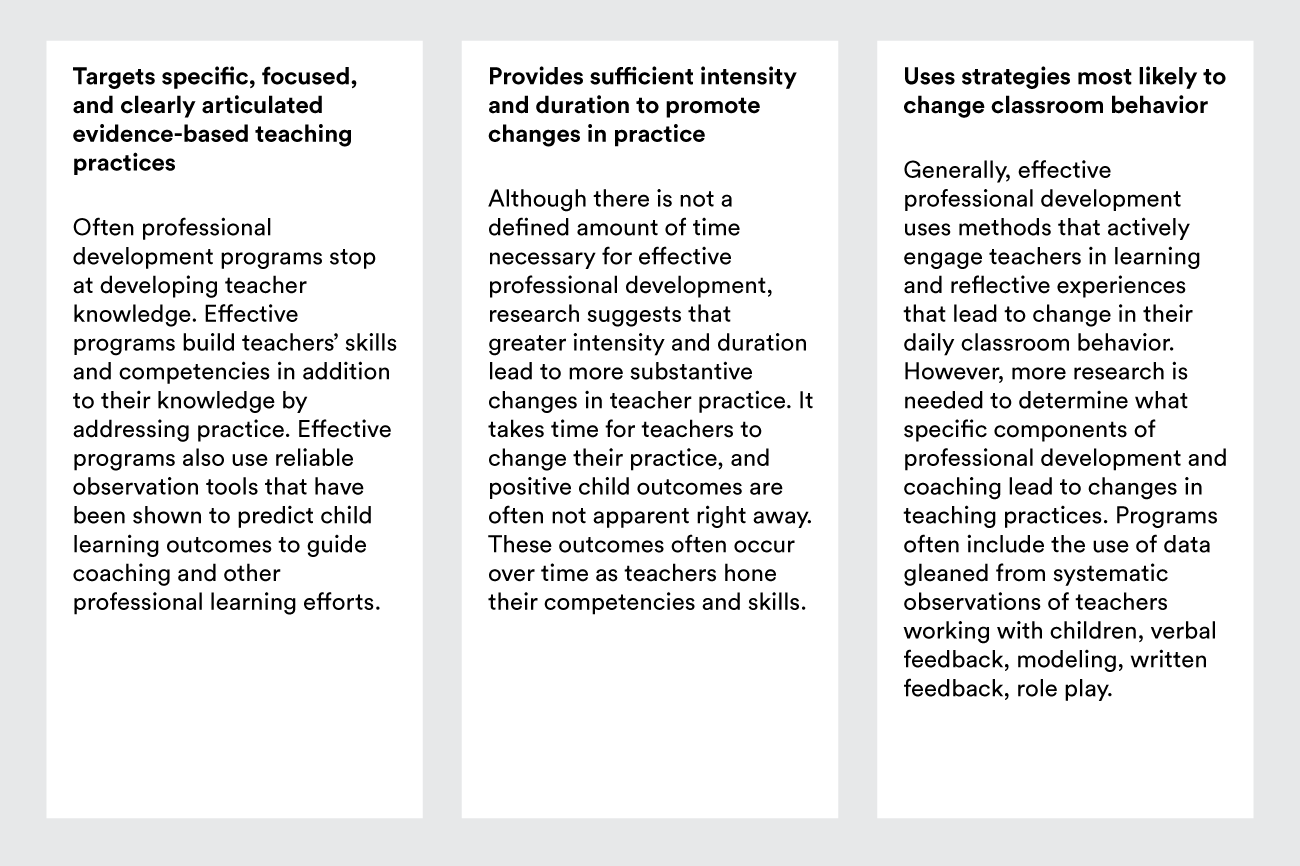
Successful models have both the policy and program conditions necessary to implement all three components of effective professional development. Strong programs have implementation plans that are clearly articulated, scoped, and sequenced.
A Closer Look at a Growing Trend: Coaching Pre-K Teachers
Many professional development methods in early education produce outcomes that fall short of expectations; however, increasing evidence implies that well-implemented and high-quality instructional coaching can yield positive outcomes for teachers and students.11
As a result, coaching is becoming a more popular form of professional learning for early childhood educators. In 2016, the U.S. Department of Health and Human Services released updated Head Start performance standards that require all programs to implement a “research-based, coordinated coaching strategy” and provide intensive coaching for staff identified as likely to benefit the most.12 Many states have also leveraged the federal Race to the Top–Early Learning Challenge and Preschool Development Grants funding to introduce coaching into early education programs in recent years.13 States were also encouraged by NIEER’s preschool quality standards benchmarks, which recommend that teachers and assistant teachers be provided with coaching. Twenty-five states now require coaching for educators in at least one of their publicly funded early education programs.14
But not all coaching is created equal. A 2017 paper by Bellwether Education Partners dives into the existing research on coaching in early childhood education and stresses that not all coaching models have proven to be effective and that small-scale coaching programs, where implementation can be carefully controlled, often produce better results than large-scale coaching programs.15 The National Academies explain that effective coaching “must be intensive, ongoing, and conducted by knowledgeable coaches.”16 Coaches are often former teachers and usually have extensive experience in early childhood education.17 Bellwether says that the effectiveness of coaching might be attributed to its individualized, ongoing, and job-embedded nature, which differs from the one-time lecture-style training educators often experience. Coaching concentrates on skills that can be practiced in the classroom in real time.
Approximately one-third of pre-K teachers reported receiving coaching, mentoring, or consultation in the last year according to the National Survey of Early Care and Education.18 While more states are mandating or encouraging coaching, there are challenges with implementation. As Bellwether notes, many states loosely define coaching, causing some providers to implement low-quality models just to meet state requirements.19 Successful coaching depends on quality coaches who can align their work with classroom curriculum. Coaches should have the expertise to teach adults and also children and be able to track progress accurately. Teachers tend to be more responsive to professional learning when they choose to participate, as opposed to when it is required. Coaching requires a substantial stream of funding and time. Its high cost can make it prohibitive for many programs.
Citations
- Linda Darling-Hammond, Marla E. Hyler, and Madelyn Gardner, “Effective Teacher Professional Development,” summary of report from Learning Policy Institute, June 5, 2017, source; Standards for Professional Learning (Learning Forward, August 2011) source.; Non-Regulatory Guidance for Title II, Part A: Building Systems of Support for Excellent Teaching and Leading (Washington, DC: U.S. Department of Education, September 27, 2016), source; U.S. Department of Health & Human Services, “Head Start Policy & Regulations, 1302.92 Training and Professional Development,” source; A Conceptual Framework for Early Childhood Professional Development (Washington, DC: National Association for the Education of Young Children, 1993), source.
- LaRue Allen and Bridget B. Kelly, eds., Transforming the Workforce for Children Birth Through Age 8: A Unifying Foundation (Washington, DC: National Academies Press, 2015), 396, source.
- LaRue Allen and Bridget B. Kelly, eds., Transforming the Workforce for Children Birth Through Age 8: A Unifying Foundation (Washington, DC: National Academies Press, 2015), 398, source.
- Standards for Professional Learning (Learning Forward, August 2011) source; Non-Regulatory Guidance for Title II, Part A: Building Systems of Support for Excellent Teaching and Leading (Washington, DC: U.S. Department of Education, September 27, 2016), source.
- LaRue Allen and Bridget B. Kelly, eds., Transforming the Workforce for Children Birth Through Age 8: A Unifying Foundation (Washington, DC: National Academies Press, 2015), 396, source.
- Bridget K. Hamre, Ann Partee, and Christina Mulcahy, “Enhancing the Impact of Professional Development in the Context of Preschool Expansion,” American Educational Research Association 3, no. 4 (2017): 1–16, source.
- Bridget K. Hamre, Ann Partee, and Christina Mulcahy, “Enhancing the Impact of Professional Development in the Context of Preschool Expansion,” American Educational Research Association 3, no. 4 (2017): 1–16, source; LaRue Allen and Bridget B. Kelly, eds., Transforming the Workforce for Children Birth Through Age 8: A Unifying Foundation (Washington, DC: National Academies Press, 2015), 393, source.
- Bridget K. Hamre, Ann Partee, and Christina Mulcahy, “Enhancing the Impact of Professional Development in the Context of Preschool Expansion,” American Educational Research Association 3, no. 4 (2017): 1–16, source.
- For more information, see “QRIS Resource Guide,” source.
- Bridget K. Hamre, Ann Partee, and Christina Mulcahy, “Enhancing the Impact of Professional Development in the Context of Preschool Expansion,” American Educational Research Association 3, no. 4 (2017): 1–16, source.
- LaRue Allen and Bridget B. Kelly, eds., Transforming the Workforce for Children Birth Through Age 8: A Unifying Foundation (Washington, DC: National Academies Press, 2015), 406, source.
- Head Start Program Performance Standards (Washington, DC: U.S. Department of Health & Human Services, Administration for Children and Families Office of Head Start, 2016), source.
- Bonnie O’Keefe, Primetime for Coaching Improving Instructional Coaching in Early Childhood Education, (Washington, DC: Bellwether Education Partners, 2017), source.
- Bonnie O’Keefe, Primetime for Coaching Improving Instructional Coaching in Early Childhood Education, (Washington, DC: Bellwether Education Partners, 2017), source.
- Bonnie O’Keefe, Primetime for Coaching Improving Instructional Coaching in Early Childhood Education, (Washington, DC: Bellwether Education Partners, 2017), source.
- LaRue Allen and Bridget B. Kelly, eds., Transforming the Workforce for Children Birth Through Age 8: A Unifying Foundation (Washington, DC: National Academies Press, 2015), 400, source.
- LaRue Allen and Bridget B. Kelly, eds., Transforming the Workforce for Children Birth Through Age 8: A Unifying Foundation (Washington, DC: National Academies Press, 2015), 406, source transforming-theworkforce-for-children-birth-throughage-8-a.
- Bridget K. Hamre, Ann Partee, and Christina Mulcahy, “Enhancing the Impact of Professional Development in the Context of Preschool Expansion,” American Educational Research Association 3, no. 4 (2017): 1–16, source.
- Bonnie O’Keefe, Primetime for Coaching Improving Instructional Coaching in Early Childhood Education, (Washington, DC: Bellwether Education Partners, 2017), source.