
Table of Contents
- Introduction
- Pre-K Teachers and In-Service Professional Learning
- Our Approach
- Strengthening STEM Instruction in Passaic, New Jersey
- Building a Cohort of Early Childhood Technology Leaders in Chicago, Illinois
- Partnering to Connect Research to Practice in Nashville, Tennessee
- Explicitly Teaching Social and Emotional Skills in San Jose, California
- Improving Language and Literacy Across Texas
- Five Lessons for Growing Strong Pre-K Teachers
Introduction
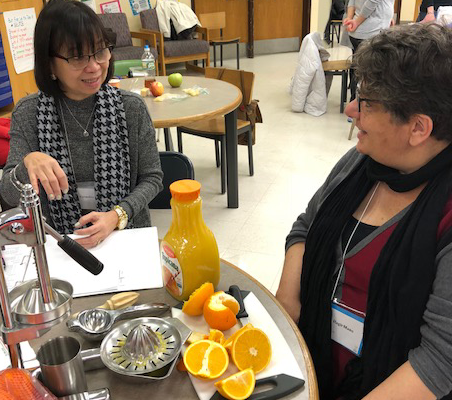
On a cold and rainy Saturday morning in Passaic, New Jersey, a handful of pre-K teachers and their instructional coaches crowd around a small table in the library at Dr. Martin Luther King, Jr. School No. 6, each holding an orange. Hagit Mano, an early childhood STEM (science, technology, engineering, and math) specialist, is talking about how to make orange juice. This small group lesson will help them understand how to teach young children about physical changes in matter.
Abbie Lieberman
Mano asks the teachers to look at the orange through the eyes of a four-year-old. “What is this?” she asks. “Has anyone seen one of these before?” Taking on the role of the child, one coach chimes in, “yes, we had these for snack!” Another teacher makes a connection to home life: “My mommy buys these at the bodega.” Mano encourages her “students” to examine the orange. “What does it feel like? How does it smell? What color is it?” The teachers and coaches fully embrace their roles, pointing out that it’s round, bumpy, and squishy but also hard, and that it doesn’t really have a smell.
Then Mano cuts the orange in half, and they observe it with all their senses. Now it is wet and juicy and has a distinctly sweet smell. Mano explains how over the course of a week, the pre-K class will go from exploring the oranges to understanding how they can be transformed into juice. Activities might include reading a story about orange juice, investigating where oranges come from, singing a song, recording observations about oranges, or doing a taste test with store-bought juice and class-made juice. Mano explains the importance of asking questions that require children to analyze and evaluate information and explain their thought process, as well as making appropriate modifications for dual language learners (DLLs).1
Mano asks the teachers, once they have stepped out of their role as students, to suggest additional lessons and activities they could do related to physical change. One suggests peeling the orange and letting the peel slowly decompose, another type of transformation. Another teacher wants to ask a parent to come in and teach about the transformation of beans from uncooked to cooked, making the lesson culturally relevant to her predominantly Latino school population. On this cold winter day, transforming a chocolate bar into hot chocolate is an idea that appeals to the entire group.
At the end of the day, the teachers will be sent home with a small juicer, a children’s book on making orange juice, and a few oranges. They will adapt the lesson to fit the needs of their students and conduct it while being observed by their district coach and an early childhood STEM specialist. After the lesson, they will meet to reflect, and later, they will discuss what worked with others in their professional learning communities (PLCs). Teachers will then return to their classrooms and repeat the cycle using a revised lesson.
These moments in New Jersey are an example of how a skilled professional development expert can guide teachers in turning a seemingly simple lesson like juicing oranges into an exploratory, language-rich science experiment that challenges children to think critically about how food changes and how people play a role in transforming it. This illustration incorporates multiple aspects of high-quality professional learning: developmentally appropriate instruction, opportunities for reflection and collaboration with peers, and one-on-one coaching. Research shows that these types of opportunities strengthen teacher practice.2
Unfortunately, professional learning of this caliber can be difficult for pre-K teachers to come by. Many pre-K programs do not have the resources, in time or funding, for professional learning that is aligned with the research on how adults learn best or tailored to building the knowledge and skills needed to work with young children.
Mano’s orange juice lesson is part of the SciMath-DLL professional learning program, which focuses on strengthening STEM instruction. It is one of five innovative programs providing high-quality in-service professional learning to pre-K teachers that we profile in this report. In Illinois, two dozen pre-K through third grade teachers in the Archdiocese of Chicago are bringing technology into their classrooms thanks to a mentoring program. In Nashville, Tennessee, researchers and coaches are working together using real-time teacher and student data to tailor professional learning to pre-K teachers’ needs. A program in San Jose, California is responding to teachers’ requests for help managing challenging classroom behavior with training on social-emotional skill development, paired with ongoing coaching and peer collaboration. And in Texas, a literacy program launched by former first lady Laura Bush has been scaled to reach pre-K teachers across the state working in various settings.
All of these programs are responding to an acute and growing need. There is more research than ever showing that a strong pre-K program can ensure kindergarten readiness and also support children’s long-term success.3 Access to and investment in public pre-K has been slowly expanding throughout the United States in recent years as a result. In 2016, 1.5 million children had access to state-funded pre-K programs, and more than 700,000 children attended the federal Head Start program, which serves three- and four-year-olds from low-income families.4 And many cities, like Seattle, San Antonio, and Philadelphia are expanding access with local funding sources. Hundreds of thousands of other families pay for pre-K out-of-pocket, although the cost of quality programs can be prohibitive.
But for pre-K to effectively set children on the path to success, it needs to be high quality. And while numerous factors are associated with higher quality, such as smaller class sizes and program alignment to early learning standards, research finds that teachers are the most important in-school factor impacting outcomes for young children.5 Young children learn through their interactions with adults.6 As Marcy Whitebook, founder of the Center for the Study of Child Care Employment, explained in a recent New York Times Magazine article, “an older kid might be able to learn about math or history from a teacher they don’t like. But a young child, a preschool-aged child, is going to have a very hard time learning anything from an adult that they feel averse to.”7 To effectively work with young children, pre-K teachers need a strong understanding of child development and early learning and the ability to provide age-appropriate instruction. Unfortunately, many early childhood educators are not equipped with the knowledge and skills needed to best support their students.
There are multiple explanations for why many children do not have access to well-prepared pre-K teachers. For one, qualification requirements for pre-K teachers and programs that prepare teachers are highly varied. Unlike in K–12 education, where all teachers are usually expected to have a bachelor’s degree and teaching credential, many pre-K programs have lower requirements for their educators. According to the National Institute for Early Education Research (NIEER), only 35 state-funded programs require pre-K teachers to have a bachelor’s degree.8 Head Start requires 50 percent of lead teachers to have a bachelor’s degree with specialized training in early childhood education. While more education and specialized training are associated with better instruction in early childhood education,9 a bachelor’s degree is no guarantee that teachers enter the classroom prepared to work with young children. A 2016 review of preparation programs certifying pre-K teachers from the National Council on Teacher Quality found that most programs are not covering the knowledge and competencies needed to work with young children.10 Teaching licenses certifying teachers in broader grade spans, such as pre-K through eighth grade, may exacerbate the problem when they do not require teachers to complete any coursework related to early learning and child development.
The five programs we profile in this report show that it is possible to give pre-K teachers rich, research-based training that prepares them to work with young children. However, there is a scarcity of opportunities focused on the developmental needs of young children and most programs lack the funding to execute them well.
Citations
- We use the term dual language learners (DLLs) to refer to children from birth through age eight who are learning English in addition to their native languages. Learn more about New America’s Dual Language Learners National Work Group at source.
- LaRue Allen and Bridget B. Kelly, eds., Transforming the Workforce for Children Birth Through Age 8: A Unifying Foundation (Washington, DC: National Academies Press, 2015), 362, source.
- Jill S. Cannon, M. Rebecca Kilburn, Lynn A. Karoly, Teryn Mattox, Ashley N. Muchow, and Maya Buenaventura, Decades of Evidence Demonstrate That Early Childhood Programs Can Benefit Children and Provide Economic Returns (Santa Monica, CA: RAND Corporation, 2017), source.
- W. Steven Barnett, Allison H. Friedman-Krauss, G. G. Weisenfeld, Michelle Horowitz, Richard Kasmin, and James H. Squires, The State of Preschool 2016: State Preschool Yearbook (New Brunswick, NJ: National Institute for Early Education Research, 2017), source.
- Francisco Palermo, Laura D. Hanish, Carol Lynn Martin, Richard A. Fabes, and Mark Reiser, “Preschoolers’ Academic Readiness: What Role Does the Teacher–Child Relationship Play?” Early Childhood Research Quarterly 22, no. 4 (2007), source.
- LaRue Allen and Bridget B. Kelly, eds., Transforming the Workforce for Children Birth Through Age 8: A Unifying Foundation (Washington, DC: National Academies Press, 2015), source.
- Jeneen Interlandi, "Why Are Our Most Important Teachers Paid the Least?" New York Times Magazine, January 8, 2018, source.
- W. Steven Barnett, Allison H. Friedman-Krauss, G. G. Weisenfeld, Michelle Horowitz, Richard Kasmin, and James H. Squires, The State of Preschool 2016: State Preschool Yearbook (New Brunswick, NJ: National Institute for Early Education Research, 2017), source.
- Emily Workman, Lisa Guernsey, and Sara Mead. Pre-K Teachers and Bachelor’s Degrees: Envisioning Equitable Access to High-Quality Preparation Programs (Washington DC: New America, 2018), 7–8, source.
- Hannah Putman, Amber Moorer, and Kate Walsh, Some Assembly Required: Piecing Together the Preparation Preschool Teachers Need (Washington, DC: National Council on Teacher Quality, June 2016), source.