Table of Contents
- Executive Summary
- Why This Moment Is Ripe for Direct Democracy
- What Are Citizen-Initiated Ballot Measures?
- A Short History of Citizen-Initiated Ballot Measures
- Lessons from Reform Leaders and Coalitions
- Analysis of Adoption Trends: Strategic Takeaways from History
- Assessing State Readiness: Preliminary Criteria and Methodology
- Conclusion: The Future of Citizen-Initiated Ballot Measures
- Appendix
A Short History of Citizen-Initiated Ballot Measures
To understand where and how to expand citizen-initiated ballot measures today, it is essential to understand when, where, and why they have been adopted or resisted in the past. The inception and broad adoption of ballot initiative rights in the United States was neither linear nor inevitable. Instead, it followed clear regional patterns, political shifts, and moments of partisan and socioeconomic realignment.
Progressive Era Origins
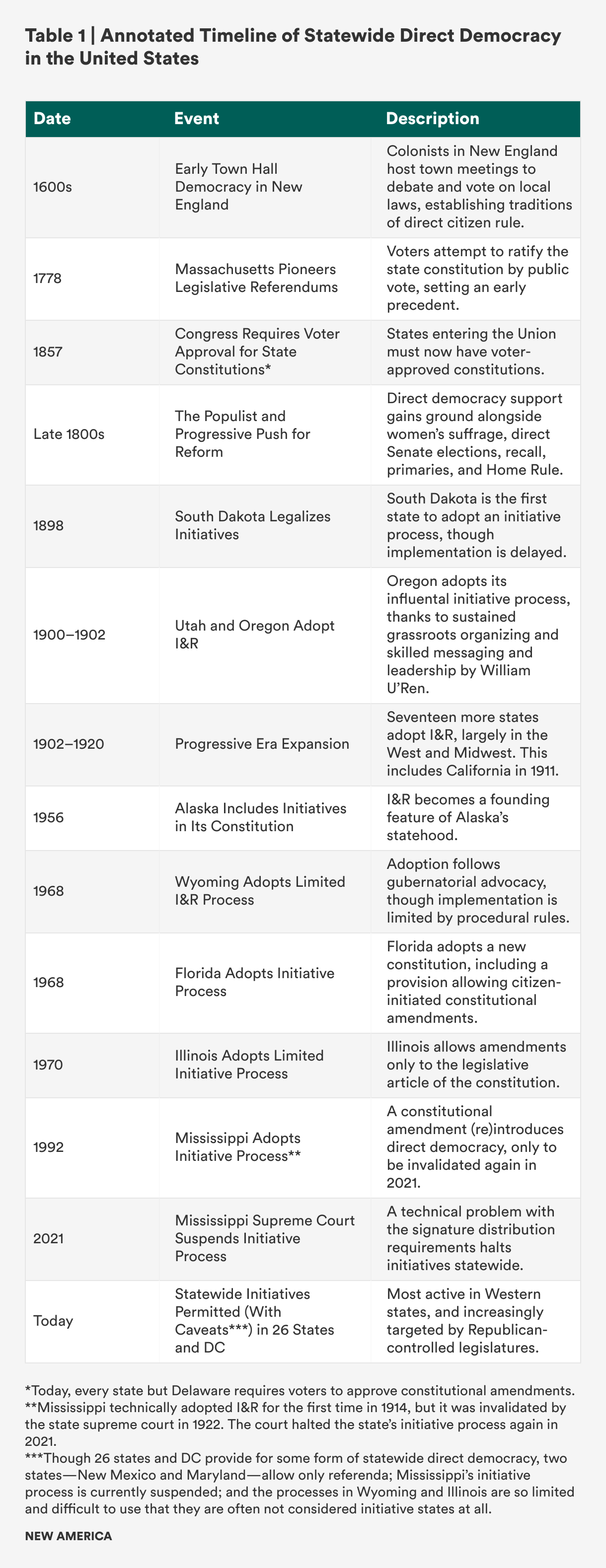
The desire for direct public input into governance has long been a feature of American political life. Colonial-era town meetings in New England, Jeffersonian calls for U.S. constitutional ratification by public vote, and early statewide referendums in Massachusetts (1778) and Rhode Island (1788) reflected an early American instinct toward popular sovereignty.
But it was the upheaval of the Gilded Age—marked by rampant legislative corruption, monopolistic corporate influences, and little or no public investment—that catalyzed the formalization of the initiative process. At the heart of this reform was a widespread belief that ordinary citizens needed a way to bypass legislatures captured by special interests. It was part and parcel of the Progressives’ push to expand democratic participation, including women’s suffrage, the direct election of U.S. senators, direct primaries, the secret ballot, and the establishment of Home Rule. In other words, the initiative was one tool among many aimed at cleaning up government and shifting public policy power to the public itself.
“It was the upheaval of the Gilded Age—marked by rampant legislative corruption, monopolistic corporate influences, and little or no public investment—that catalyzed the formalization of the initiative process.”
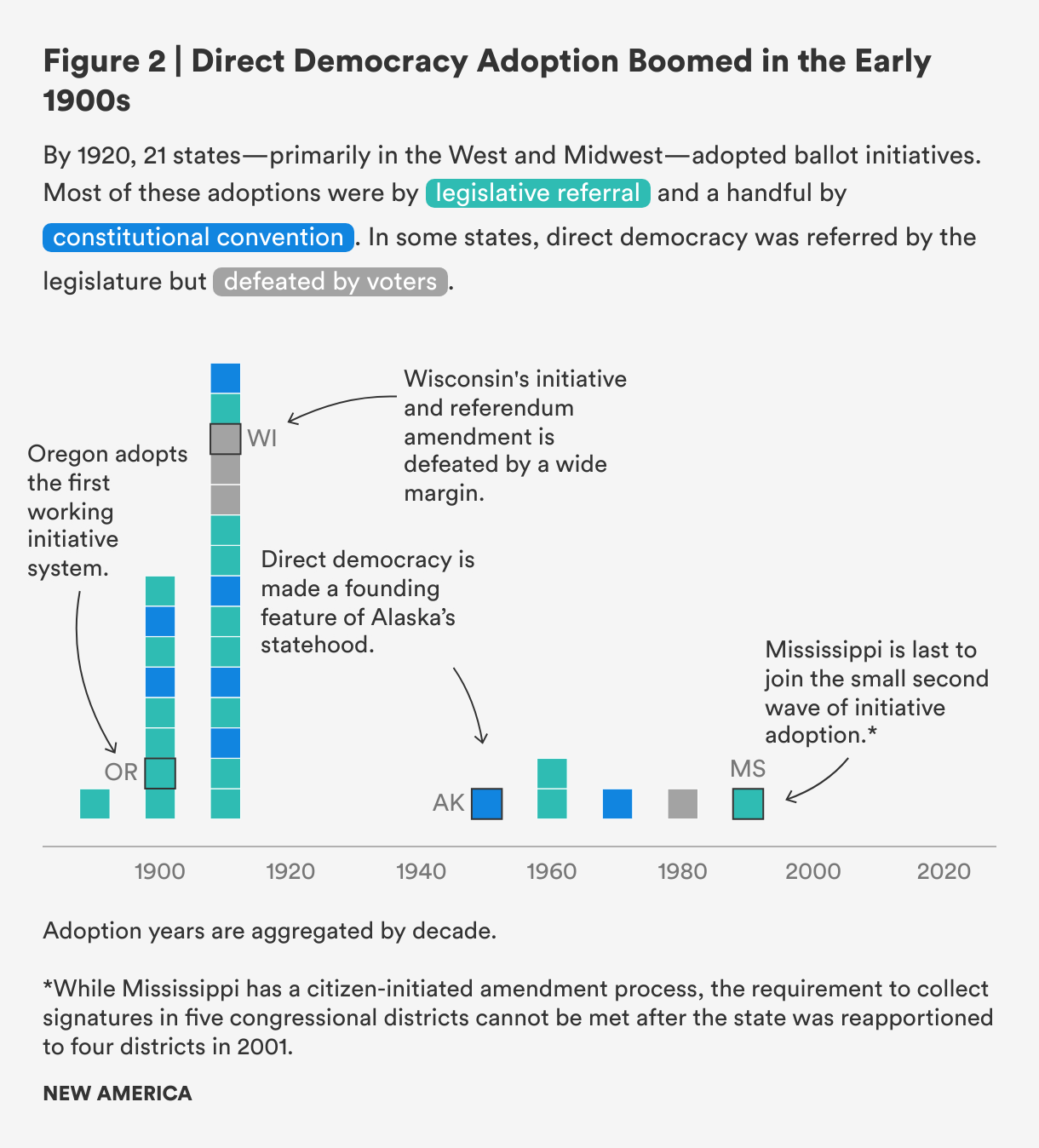
Between 1898 and 1919, 20 states, primarily in the West and Midwest, integrated ballot initiatives into their political systems through a mix of constitutional conventions or legislatively-referred amendments.1 The history of these reforms offers both a lesson and a blueprint.
South Dakota became the first state to adopt initiatives in 1898, fueled by anti-monopoly and anti-corruption sentiments and cross-sector economic grievances that found a home in the South Dakota Referendum and Initiative League. The legislature approved initiative and referendum after years of sustained efforts by a coalition of Populists, labor and farmer organizers, and Socialist leaders like Rev. Robert Haire and Walter E. Kidd, with the Populists ultimately collaborating with Democrats (“Popocrats”) to enact the bill.2 Utah followed in 1900, and in 1902, Oregon became the third but arguably most important of the early states to adopt I&R. As in South Dakota, Oregon’s success resulted from the long-term advocacy of organized workers and public intellectuals inside and outside of government. Key advocates included the Knights of Labor, the Farmers’ Alliance, and the Oregon Direct Legislation League under the leadership of William Simon U’Ren.
Western states were the earliest and most enthusiastic adopters of initiatives, and they remain the leaders in initiative use to this day. Around the turn of the twentieth century, many of these states had recently written constitutions, making them more open to democratic experimentation. Some, like New Mexico, included an initiative process in their constitutions at the moment of statehood. Their political cultures were often shaped by frontier values of individualism, local control, and skepticism of centralized power. Western legislatures were also more likely to be fragmented and politically weak—conditions that made lawmakers more open to sharing power with voters.
States like Oregon, California, Colorado, and Montana integrated initiatives into their political systems as tools to combat corporate influence, particularly railroads and mining interests. In California, for example, voters saw the Southern Pacific Railroad as a corrupting force in state politics, and they embraced the initiative as a check on the company’s power.
Political scientist Daniel Elazar classified Western states as “moralistic” at this time, meaning they valued citizen participation and public-interest governance. This culture meshed well with the principles of direct democracy. Reformers in these states often succeeded by framing initiatives as necessary correctives to legislative malapportionment and machine politics. As Thomas Goebel noted, the spread of initiatives across the West resembled a form of “democratic contagion,” where the success of reforms in one state spurred others to follow suit.3
Of course, Western politicians were not all idealists. For instance, Montana’s adoption of initiatives in 1906 was more reactive. Amid labor unrest and a shutdown in the state’s copper industry, major and minor party elites, fearing social upheaval, endorsed the initiative at once and led the legislature to refer the initiative amendment to voters as a pressure-release valve.
While the West embraced these reforms early, Midwestern lawmakers and voters proved more ambivalent. Ohio, Missouri,4 and Michigan eventually adopted initiatives. Others, like Illinois, adopted very limited statewide initiative processes that are practically useless. These states often had strong urban-rural divides and more entrenched political parties, which, like many Eastern states, resisted reforms that might upset delicate power balances. States where political elites and the median voter were already aligned and relatively satisfied with the status quo, such as Indiana at that time, might have had an easier time passing an amendment to enshrine direct democracy but lacked the urgency and incentive to push for it, a scenario Amy Bridges and Thad Kousser refer to as “Complacent Consensus.”5
Still, Populist and Socialist movements had some success pushing for direct democracy and other experiments with alternative governance structures in the Midwest. Nebraska, for instance, adopted an initiative process and the nation’s only unicameral and nonpartisan legislature. Wisconsin lawmakers twice referred I&R adoption measures to voters in 1914; both were defeated. Nevertheless, Progressive Republicans like Robert M. La Follette helped pioneer other innovations like direct primaries and industry regulatory commissions, and the state is still known as the cradle of progressivism.
In the Eastern states, resistance to direct democracy was rooted in older, more conservative political cultures, deeply embedded parties, and other institutional norms. The original states had long-standing constitutional traditions emphasizing checks and balances, and officials, party bosses, and industry leaders feared the volatility of voter-driven lawmaking. Efforts to adopt initiatives often stalled due to inherited concerns about policy instability and innate distrust of common people. In addition, strict urban-rural divides posed significant structural barriers. Despite reformist energy in states like New York, driven by urban coalitions of Catholics and other demographic minorities, reform-friendly lawmakers worried their policy ambitions were not aligned closely enough with those of the average voter to guarantee desirable outcomes.6 Of the original 13 colonies, only Massachusetts adopted a full I&R system (Maryland allows veto referendums but not initiated statutes or amendments).
In the South, meanwhile, the rejection of initiatives was even more deeply entwined with race, class, and the politics of exclusion. During the same period that Western states were expanding voter power, Southern states were actively disenfranchising Black citizens through Jim Crow laws like poll taxes and literacy tests. Lawmakers in the South saw no advantage in empowering a broader electorate and feared that direct democracy could become a tool for racial or class-based insurgency.
In a 2011 article exploring the reasons politicians chose to delegate power through direct democracy, Bridges and Kousser posit that Black voters were largely irrelevant to Southern politicians’ calculus around I&R adoption, as Jim Crow laws had already effectively removed them from the electorate. Their analysis suggests that Southern elites at the time were more afraid of how poor white farmers might use direct democracy.7 Yet this fear of economic populism and its redistributive implications was never separate from racial control and subjugation. The systems of voter suppression that had all but eliminated Black political participation also served to entrench a racial caste system in which the political power of poor white communities was tightly managed. As such, the rejection of statewide direct democracy in the South in the twentieth century served a dual purpose: to guard against class rebellion and to maintain white supremacy by preserving elite control over both poor Black and white communities. This logic has endured in various forms, with modern voter suppression efforts in many Southern states continuing to reflect an effort to contain multiracial democratic coalitions, especially when those coalitions threaten traditional economic or political power.
Post-Progressive Era Adoption Successes—and Multiple Failures
Since 1918, only five additional states have adopted citizen-initiated ballot measures, and most have done so with severe limitations. The few post-1918 adoptions (Alaska, Wyoming, Illinois, Florida, and Mississippi) were often driven by specific political crises, calls for constitutional reform, or a change in partisan tides (see Figure 2). But even where initiatives were technically legalized, in practice, they’ve been hard to use or, in Mississippi’s case, rendered inoperable.8
Alaska included the initiative process in its constitution upon achieving statehood in 1959. Delegates at Alaska’s constitutional convention were notably open to direct legislation and built structural support into the new framework. Voters in Wyoming approved an amendment to enable initiated statutes in 1968 (after a 50-year delay). Yet lawmakers made it nearly impossible to qualify measures under the adopted rules, which require the highest signature threshold in the nation for qualifying not only statutes but also amendments. Two years later, Illinois adopted an extremely limited initiative process that has rarely been used since.
Florida and Mississippi followed in the late twentieth century, both adopting citizen-initiated amendment processes as part of broader constitutional overhauls. Florida’s malapportionment and outdated 1885 constitution had long frustrated voters, especially as political power remained concentrated in rural areas. Florida’s new constitution, adopted by voters in 1968 following the creation of a constitution revision commission in 1965, added four new amendment pathways, including citizen initiatives. Surprisingly, according to Christopher Emmanuel’s 2020 law review article, the inclusion of an initiative process in the new constitution was largely uncontroversial.9
In Mississippi, the process was more contentious. The state already had some experience with the initiative, having adopted initiatives in 1914 before a state supreme court decision suspended the process a few years later. Democratic governor Bill Allain, elected in 1983, launched a constitutional review that ultimately failed to produce a new constitution. Still, public interest in initiatives grew. By 1992, voters overwhelmingly approved a ballot initiative process during the term of the state’s first Republican governor since Reconstruction, reflecting a partisan realignment and the type of political shift that often accompanies major reform. However, this victory was short-lived. In 2021, the Mississippi Supreme Court (again) struck down the state’s initiative process, citing outdated signature distribution requirements that no longer aligned with the state’s reduced number of congressional districts.
Despite these isolated gains, other legislative proposals to create or expand initiative rights have been rare, and successful efforts even rarer. Legislative inertia, combined with lawmakers’ unsurprising reluctance to cede power, has kept initiative powers largely concentrated in the West, with a smattering of successes across other U.S. regions.
See Table A2 in the Appendix for further detail on constitutional provisions governing initiatives, adoption methods, vote totals, and more.
Since the Progressive Era, adoption efforts appear to track with research indicating that surging interparty competition correlates with legislative referrals for direct democracy amendments.10 In 1980, for example, Minnesota advocates nearly succeeded in securing an initiative process for the state. The direct democracy amendment proposal won more “yes” than “no” votes but still failed because Minnesota state law requires a majority of all voters (not just those voting on the measure) to approve constitutional changes. The idea has resurfaced periodically since but has never advanced past committee. This pattern held in Minnesota, New Jersey, New York, and Pennsylvania through the late 1990s and early 2000s. Yet only Minnesota came close to passage.
As a firm “Blue Wall” state since the Great Depression, Rhode Island’s recent efforts toward I&R adoption present something of an outlier. In 1986, voters narrowly rejected an initiative proposal following a constitutional convention. A 1996 advisory vote (nonbinding ballot question) demonstrated support for initiatives, but legislators declined to act. Subsequent proposals in 2014 and 2018 died in committee.
The few expansions that have occurred in recent decades have largely come from within the initiative process itself. Nevada created a direct petition-to-ballot path in 1962. In 2004, Nebraska voters raised the legislative threshold required to amend citizen-initiated laws, thereby reinforcing initiative power. However, these adjustments are only possible in states that already allow initiatives; for everyone else, reform depends on legislative action.
The dearth of contemporary expansion efforts is not due to a lack of basic public support for direct democracy. However, experts suggest that most residents of non-initiative states may not be aware that they lack I&R tools. In addition, structural barriers—like high amendment thresholds, permanent supermajority parties, and legislative bottlenecks—combined with civil society leaders’ sense of political nonviability block progress.
Indeed, many democracy reform advocates in states without initiative policies express enthusiastic support for adopting I&R but lament that any bill would be a nonstarter in their legislatures, especially those with Republican supermajorities in the South. Southern legislatures often refer tax-related questions to the ballot for public vote but remain opposed to citizen initiatives. Formal surveys in select states would confirm or contextualize the intensity and conditions of this opposition. But historical evidence and discussions with state experts concur that supermajority states are the least ripe for disrupting the policymaking status quo.
“The historical record is clear: Direct democracy is not inherently partisan. Adoption efforts are nearly always driven by whichever party is in the minority.”
The historical record is clear: Direct democracy is not inherently partisan. Adoption efforts are nearly always driven by whichever party is in the minority. Proposals have failed in deep red states like Wyoming (despite nominal adoption) and blue states like New Jersey, New York, and Hawaii. On average, around 65 lawmakers—mainly representing their chamber’s minority party—have sponsored bills or resolutions to establish statewide direct democracy in their state each year since 2018.11 (There are 4,185 state legislative seats across non-initiative states.) Initiative adoption bills have been about as likely to come from Republicans as Democrats in the years we examined.12 Regarding anti-initiative legislation, most of the recent attacks on the initiative process have come from Republican-majority legislatures. On the other hand, few Democrats in non-initiative or limited initiative states are actively advocating for expansion. Our early findings suggest that most legislators serving in non-initiative states feel somewhere between indifferent and resistant toward the idea of expanding direct democracy in their state. These sentiments reflect, in part, a lack of public pressure on the issue.
While further research, such as a legislator questionnaire, is needed to confirm, we can infer from our early data that even lawmakers who support I&R in principle have little incentive to delegate power or empower potential rivals absent a concerted inside–outside education and advocacy campaign.
Initiative Policy Trends over Time
Despite the challenges of adopting and implementing citizen-initiated ballot measures, they’ve played a pivotal role in American political reform, evolving from Progressive Era tools of democratic empowerment to instruments for both policy innovation and ideological retrenchment. Many of the earliest uses of initiatives aimed to regulate monopolies, enhance worker protections and well-being, democratize electoral institutions, and combat political corruption.
For instance, between 1904 and 1912, Oregon voters deployed their initiative powers to pass sweeping democratic reforms, including women’s suffrage, campaign finance rules, direct primaries, and even proportional representation. Spearheaded by William Simon U’Ren and the Direct Legislation League, these early successes established Oregon as a national model for institutional reform and solidified initiatives as a feature of its political system. In 1912, Colorado used the initiative to enact landmark labor reforms, including an eight-hour workday for miners and support for single mothers. These gains came despite corporate opposition, demonstrating the capacity of ballot initiatives to empower working-class movements in the face of legislative inaction.
“These gains came despite corporate opposition, demonstrating the capacity of ballot initiatives to empower working-class movements in the face of legislative inaction.”
After a quiet few decades, a “second wave” of ballot initiatives emerged in the late twentieth century, reshaping both the content and tone of direct democracy. California’s Proposition 13 (1978) capped property taxes and triggered a national “tax revolt,” shifting the use of the initiative process toward fiscal conservatism and revealing its power to lock in long-term policy change. In the 1990s, initiatives fueled the term limits movement, enabling voters in 17 states to impose legislative term limits, often over the objections of incumbents and party leaders.
By the early 2000s, initiatives became sites of intense cultural conflict. LGBTQ rights were rolled back through citizen-initiated constitutional amendments in multiple states, including Oregon and Ohio, revealing how direct democracy could also be weaponized against civil rights. These setbacks prompted modern progressive groups to view initiatives as battlegrounds worth contesting more proactively.
After Republicans swept the 2010 elections, particularly at the state level, the following decade saw a resurgence of progressive statewide initiatives. Medicaid expansion efforts passed in Republican-led states, bridging partisan divides by emphasizing pragmatic benefits. In 2018, a new wave of reforms tackled redistricting, voting rights, and campaign finance, echoing the Progressive Era’s structural ambitions. Most recently, after the fall of Roe v. Wade, voters in initiative states like Missouri and Michigan protected or expanded abortion rights through initiatives, in several cases outperforming candidates on the same ballot.
Today, initiatives are more widely used and contested than ever. Western states continue to dominate the use of ballot initiatives. Six states—Arizona, California, Colorado, North Dakota, Oregon, and Washington—account for over 60 percent of all initiative activity.13 Initiatives address a broad spectrum of issues, from health care to civil rights, but also face mounting legislative and judicial resistance. Legislatures in Republican-controlled states like Florida, Missouri, Arkansas, Ohio, and Utah have moved to restrict the process, while courts and administrative bottlenecks increasingly undermine implementation.14
Sometimes, legislative attempts to restrict ballot measures come from within the process itself. For example, in 2023, in anticipation of an initiated vote to protect reproductive freedom, the Ohio legislature referred to the ballot a measure that would have raised the approval threshold for constitutional amendments from a simple majority to a 60 percent supermajority.
In spite of these challenges, a new generation of nationally coordinated efforts, led by groups like the Ballot Initiative Strategy Center and the Fairness Project, have emerged to protect direct democracy.
Citations
- “History of Initiative and Referendum in the U.S.,” Ballotpedia, accessed May 12, 2025, source.
- H. Roger Grant, “Origins of a Progressive Reform: The Initiative and Referendum Movement in South Dakota,” South Dakota History 3 (Fall 1973): 390–407, source.
- Thomas Goebel, “A Case of Democratic Contagion: Direct Democracy in the American West, 1890–1920,” Pacific Historical Review 66 no. 2 (1997): 213–221, source.
- It took two attempts for Missouri voters to approve a constitutional amendment to establish I&R.
- Amy Bridges and Thad Kousser, “Where Politicians Gave Power to the People: Adoption of the Citizen Initiative in the U.S. States,” State Politics & Policy Quarterly, 11 no. 2 (2011): 167–197, source.
- Bridges and Kousser, “Where Politicians Gave Power to the People,” source; Patrick L. Baude, “A Comment on the Evolution of Direct Democracy in Western State Constitutions,” Indiana Law Journal 73 (1998), source.
- Bridges and Kousser, “Where Politicians Gave Power to the People,” source.
- Ashton Pittman, “‘Democracy Dies Blow By Blow’: How Mississippi’s Supreme Court Killed the Ballot Initiative Twice in 99 Years,” Mississippi Free Press, June 1, 2021, source.
- Christopher Emmanuel, “A Critical Look at the First 50 Years of Florida's 'Citizen' Initiative Process,” Stetson Law Review 51 (July 2020), source.
- Daniel A. Smith and Dustin Fridkin, “Delegating Direct Democracy: Interparty Legislative Competition and the Adoption of the Initiative in the American States,” American Political Science Review 102 no. 3 (2008): 333–50, source.
- Texas has a biennial legislature that meets only in odd-numbered years, though special sessions can be called in even-numbered years. All other non-initiative states’ legislatures convene annually.
- Lawmakers in non-initiative states have introduced a total of 161 bills and resolutions to adopt I&R between 2018 and April 2025. Including Mississippi, where the state legislature is working to restore the process after it was suspended in 2021, the total is 217.
- “Initiative States Compared by Number of Initiatives on Their Ballot,” Ballotpedia, accessed May 12, 2025, source; Thom Reilly, “Dissatisfaction with One-Party Control Leads to More Ballot Initiatives, 60% of Them in Six States,” Ohio Capital Journal, March 25, 2024, source.
- “Attacks + Threats,” Ballot Initiative Strategy Center, source.