Expanding Citizen-Led Policymaking in the Twenty-First Century
Table of Contents
- Executive Summary
- Why This Moment Is Ripe for Direct Democracy
- What Are Citizen-Initiated Ballot Measures?
- A Short History of Citizen-Initiated Ballot Measures
- Lessons from Reform Leaders and Coalitions
- Analysis of Adoption Trends: Strategic Takeaways from History
- Assessing State Readiness: Preliminary Criteria and Methodology
- Conclusion: The Future of Citizen-Initiated Ballot Measures
- Appendix
Abstract
In the face of deepening political dysfunction and disaffection, ballot initiatives offer a time-tested mechanism for democratic renewal. This report examines the uneven landscape of citizen-led policymaking in the United States, where fewer than half of states provide access to usable initiative processes, leaving millions without a direct channel to shape public policy when other paths are blocked. Drawing on extensive historical and contemporary research and expert interviews, this report suggests that now may be an opportune moment to expand ballot initiative access. It also presents strategic recommendations for future initiative adoption efforts and introduces a methodology for assessing states’ readiness for direct democracy based on political, legal, and civic indicators.
Acknowledgments
This report wouldn’t have been possible without our research assistants, Seanna Pieper-Jordan and Alex Walker, and the dozens of scholars and practitioners who took the time to share their knowledge about direct democracy and their state’s political climate and policy landscape. We are so grateful to Madison Schroder, Joseph Cerrone, Lee Drutman, Justine Sarver, and Elena Souris for their valuable comments and edits.
We would also like to thank Liz Cory, Kelley Gardner, Heidi Lewis, Jodi Narde, Carly Anderson, and Elena Gooray for their communications, editorial, and graphics support.
Editorial disclosure: The views expressed in this report are solely those of the authors and do not reflect the views of New America, its staff, fellows, funders, or board of directors.
Downloads
Executive Summary
In an era marked by rising authoritarianism and political dysfunction, as well as a growing disconnect between voters and their representatives, citizen-initiated ballot measures—also known as ballot initiatives, initiative and referendum (I&R), and direct democracy, among other names—offer a compelling, time-tested mechanism for democratic renewal. Originally adopted during the Populist and Progressive movements of the early twentieth century, these processes were designed to give citizens a direct voice in policymaking, especially when legislatures were captured by special interests and out of step with public opinion. That rationale remains as compelling today as it was a century ago.
Despite their proven utility, access to ballot initiatives remains highly uneven. Currently, 26 states and Washington, DC (which this report does not count as a state) have laws on the books allowing for some form of initiative, leaving millions of voters without a direct voice in state policymaking. Of those 26 states, 24 allow citizen-initiated legislating through statutes or amendments. New Mexico and Maryland allow for citizen-led referendums, but citizens cannot initiate statutes or amendments. States without initiative processes—home to a majority of Americans—lack any means for citizens to propose or repeal state laws independently of the legislature. As our institutions struggle to deliver on basic public demands and faith in institutions crumbles, now may be a uniquely ripe moment to expand direct democracy.
In states that don’t permit initiatives, there’s only one path to achieve policy change that matches public preferences, and often that path is blocked. Particularly in heavily gerrymandered states, a legislative majority or supermajority representing a minority of voters can block policy change or enact policies that majorities would not support. In divided states, much as in the federal government, the veto points in the system prevent change. When there’s no other path to change that aligns with public preferences, voters’ distrust and cynicism about the system deepen.
In states where the initiative process functions as it should, voters can join the governing process. They’ve passed measures on health care, elections, and civil liberties—often in the face of legislative resistance. In other cases, the mere prospect of an initiative can nudge a legislature or governor to take up an issue or idea even where they might prefer inaction or find the issue too polarizing. That is, ballot initiatives can encourage compromise and negotiation, helping to overcome political paralysis.
“Ballot initiatives can encourage compromise and negotiation, helping to overcome political paralysis.”
But these recent successes have drawn backlash to direct democracy. Legislators in several initiative states are actively working to restrict or dismantle the process.1 As a result, the reform community faces a dual challenge: defending direct democracy where it already exists and building it where it doesn’t. This report focuses on the latter. It makes the case for and offers early strategic guidance on expanding citizen-led policymaking access to new states.
To be sure, initiatives are not a panacea. They come with risks—oversimplification, inequitable access, elite manipulation, and legislative sabotage—and often fall short of their democratic ideal.2 But when well designed and properly defended, they serve as critical pressure valves in democratic systems. They enable states to live up to their reputation as “laboratories of democracy,” advancing reforms that reflect the public will and often prefigure national change.
This report explores the opportunities (and obstacles) in bringing initiatives to new states, drawing from the historical and recent literature on initiative and referendum adoption, expert interviews, and contemporary case studies. We provide an overview of how the initiative process developed, strategic lessons from the historical and contemporary I&R literature, and background interviews with key informants. Finally, we present our state readiness methodology, which will guide future phases of this work. We hope this will be useful to reformers, funders, and institutional partners who share an interest in rebuilding the legitimacy and responsiveness of American democracy from the ground up.
Citations
- “Attacks + Threats,” Ballot Initiative Strategy Center, accessed May 12, 2025, source; Alice Clapman, “Direct Democracy Under Attack,” Brennan Center For Justice, September 17, 2024, source.
- Maresa Strano, A Case for (Responsibly) Expanding Citizen-Led Policymaking Access in the United States (New America, 2025), source; Richard Ellis, Democratic Delusions: The Initiative Process in America (University Press of Kansas, 2002).
Why This Moment Is Ripe for Direct Democracy
The structural ailments that prompted the first wave of initiative adoption during the Progressive Era—elite capture of legislatures, lack of responsiveness to public needs, sky-high economic inequality, and widespread mistrust of representative institutions—have returned or taken new form, creating renewed demand for direct democracy.
Across the country, state legislatures are increasingly insulated from public accountability due to gerrymandering, partisan supermajorities, and low electoral competition. Simultaneously, public confidence in representative government is at historic lows.1
Recent research underscores that citizen-initiated ballot measures offer a reliable corrective in such environments. States with active initiative processes show greater policy alignment with public preferences, especially on issues like Medicaid expansion, minimum wage increases, marijuana legalization, and reproductive rights.2 Even when initiatives do not pass, their mere presence on the ballot can pressure lawmakers to act. Similarly, the sound rejection of citizen-initiated referendums may induce moderation, especially among extremely conservative legislators.3
“States with active initiative processes show greater policy alignment with public preferences, especially on issues like Medicaid expansion, minimum wage increases, marijuana legalization, and reproductive rights.”
Initiatives are not only effective—they are popular. A 2017 Pew survey found that 67 percent of Americans support giving citizens the power to vote directly on laws.4 Support is especially high among voters who feel alienated from state legislatures, making initiatives both a democratic outlet and a tool for restoring civic trust.
These findings suggest that initiatives serve a deeper purpose than delivering individual policy wins: The process itself can be a structural corrective to legislative drift. Initiatives allow broadly held public preferences to reassert themselves, not only by passing new laws but by pressuring unresponsive lawmakers to pay attention to issues that matter to ordinary voters and by legitimizing citizen voice.
They also serve a vital function in democratic resilience and legitimacy. In recent years, initiatives have played a pivotal role in safeguarding rights in states where legislatures have moved in the opposite direction. Since the fall of Roe v. Wade, voters in states like Missouri, Michigan, Arizona, and Ohio used the initiative process to protect or expand abortion access—often defying the preferences of entrenched legislative majorities. These were not isolated cases but part of a broader pattern: Where other branches of government fail or falter, direct democracy can offer a constitutional release valve for public discontent.
“Where other branches of government fail or falter, direct democracy can offer a constitutional release valve for public discontent.”
Today, as authoritarianism distorts and dismantles core democratic norms, this release valve matters more than ever. By sharing power and allowing voters to set policy agendas and enact laws, initiatives help inoculate democratic systems against capture by both elites and demagogues. They offer a channel for political energy that illiberal movements might otherwise co-opt.
While imperfect, initiatives remain among the few tools available to ordinary citizens to recalibrate policy and check electoral and governance deficiencies in moments of institutional weakness or failure. For that reason alone, their expansion to every corner of the United States deserves serious attention from democracy defenders and reformers alike.
Citations
- “Public Trust in Government Near Historic Lows,” Pew Research Center, June 24, 2024, source.
- John G. Matsusaka, “Popular Control of Public Policy: A Quantitative Approach,” Quarterly Journal of Political Science 5 no. 2 (2010): 133–167; Mary Ellen Klas and Carolyn Silverman, “This Is Why You Don’t Recognize Your State Government,” Bloomberg, October 22, 2024, source; Maresa Strano, A Case for (Responsibly) Expanding Citizen-Led Policymaking in the United States (New America, 2025), source.
- Elisabeth R. Gerber, “Legislative Response to the Threat of Popular Initiatives,” American Journal of Political Science 40 no. 1 (1996): 99–128; John G. Matsusaka, “Fiscal Effects of the Voter Initiative: Evidence from the Last 30 Years,” Journal of Political Economy 103 no. 3 (1995): 587–623, source; John G. Matsusaka and Nolan M. McCarty, “Political Resource Allocation: Benefits and Costs of Voter Initiatives,” Journal of Law, Economics, and Organization 17 (October 2001): 413–448, source; Vladimir Kogan, “When Voters Pull the Trigger: Can Direct Democracy Restrain Legislative Excesses?,” Legislative Studies Quarterly 41 no. 2 (2016): 297–325, source.
- Richard Wike, Katie Simmons, Bruce Stokes, and Janell Fetterolf, “Globally, Broad Support for Representative and Direct Democracy,” Pew Research Center, October 16, 2017, source.
What Are Citizen-Initiated Ballot Measures?
For more than a century, citizen-initiated ballot measures—sometimes called ballot initiatives, initiative and referendum (I&R), or direct democracy1—have given voters in many states a direct path to policymaking. Initiatives allow citizens to propose laws, amend constitutions, or repeal legislation, placing these actions on the ballot for a public vote.
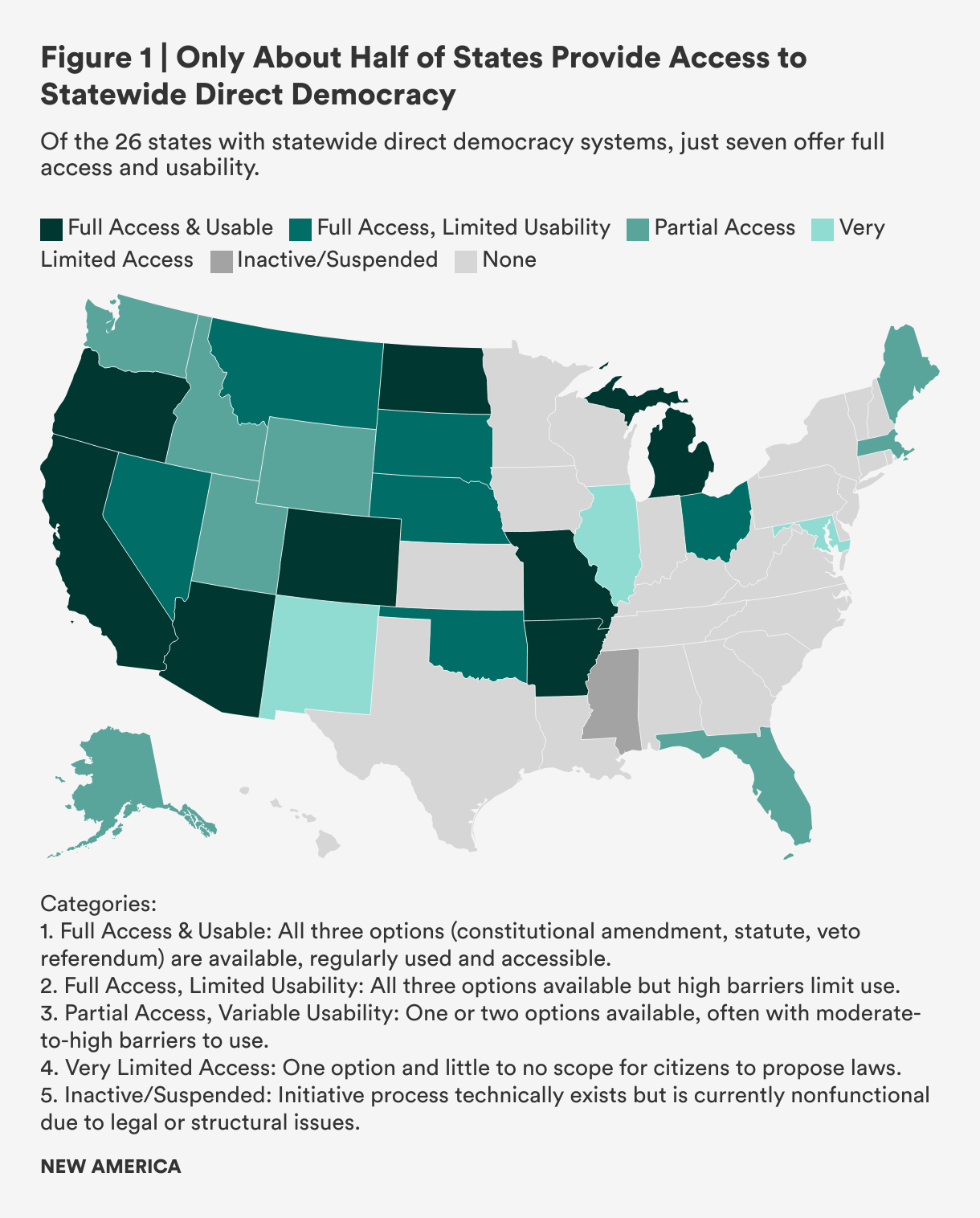
Unlike legislatively referred measures (measures placed on the ballot by the state legislature), which exist in all 50 states, only 26 states provide for some form of statewide citizen-led ballot measure.2 The details vary: Twenty-one allow statutory initiatives, 18 permit constitutional amendments, and only 15 allow both. Twenty-three states allow veto referendums, which allow citizens to overturn recently passed laws, but not proactive lawmaking. Maryland and New Mexico allow veto referendums only. Illinois, Mississippi, and Florida provide for initiated constitutional amendments but not referendums. Though technically still in the state constitution, Mississippi’s initiative process has been inactive since a 2021 state supreme court decision.3
There are two primary models of statewide ballot initiatives in use today: (1) direct, which go directly to the ballot, and (2) indirect, which are first submitted to the legislature. Though the mechanics of indirect initiated statutes and amendments vary across states, typically, lawmakers can adopt the citizens’ proposal outright, ignore it (sending it to voters to approve or reject in the next election), or propose a competing measure to appear on the ballot alongside the initiated measure.4
In each of the 25 active initiative states, getting a measure on the ballot requires clearing several procedural hurdles (see Figure 1). These hurdles include requiring the collection of a certain number of signatures within a fixed period, often with rules about geographic distribution to ensure statewide support. Signature thresholds range from as low as 2 percent of voters in North Dakota to as high as 15 percent in Wyoming.5
After an initiative’s passage, implementation can still be contested. Some measures are executed smoothly; others face resistance from elected officials, especially when the measure challenges special interests or social values held by a powerful legislative faction, or it necessitates significant new funding. Even initiatives that receive overwhelming voter support can still face bureaucratic, legislative, or judicial obstruction, as was the case during voter-led efforts to expand Medicaid and marijuana legalization.6
Despite these variations, all initiative processes share a democratic promise: They give people a way to act when representative institutions will not. In doing so, they reaffirm that democracy is not just about people choosing representatives. It’s also about reserving the right to make and shape policy when those representatives fail to legislate in the interests of the majority of their constituents. As Teddy Roosevelt said about initiatives in a speech to the 1912 Ohio constitutional convention, they “should be used not to destroy representative government, but to correct it whenever it becomes misrepresentative.”7
Citations
- Recall of public officials is sometimes treated as the third leg of the direct democracy stool, alongside initiative and referendum. The scope of this investigation, however, is limited to citizen-initiated legislating and referendums.
- In addition to Washington, DC, states that allow some form of statewide citizen-initiated ballot measure include: Alaska, Arizona, Arkansas, California, Colorado, Florida, Idaho, Illinois, Maine, Maryland, Massachusetts, Michigan, Missouri, Montana, Nebraska, Nevada, New Mexico, North Dakota, Ohio, Oklahoma, Oregon, South Dakota, Utah, Washington, and Wyoming. Mississippi’s constitution provides for citizen-initiated amendments, but the process is currently inactive.
- In a 2021 decision, the Mississippi Supreme Court struck down Initiative 65, a medical marijuana measure that had passed with 73 percent of the popular vote, ruling that the state’s ballot initiative process had been unworkable since redistricting reduced Mississippi’s congressional districts from five to four in 2001. The court found that the signature distribution requirement in the state constitution made it impossible for any petition to qualify for the ballot, sending the issue back to the state legislature to resolve.
- Some states, including Ohio, require two rounds of signatures to qualify an initiated statute for the ballot. Meanwhile, in Massachusetts, a petition to amend the constitution must be approved by one-fourth of the legislature in two joint sessions before it is sent to the ballot.
- “Signature Requirements for Ballot Measures,” Ballotpedia, accessed May 12, 2025, source.
- See, for example, efforts to override ballot initiatives or significantly revise the text of the initiatives: Anne Whitesell, “The Increasing Trend of Lawmakers Overriding Ballot Initiatives,” Governing, January 30, 2024, source; Jeremy Kohler, “Red State Voters Approved Progressive Measures. GOP Lawmakers Are Trying to Undermine Them,” ProPublica, May 30, 2025; Election Reformers Network, Partisan Control of Ballot MeasuresHow to Stop Manipulation of Citizen Initiatives (Washington, DC: Election Reformers Network, 2025), source.
- Theodore Roosevelt, “A Charter of Democracy” (address before the Ohio Constitutional Convention, Columbus, Ohio, February 21, 1912), Ohio State University Library, accessed May 12, 2025, source.
A Short History of Citizen-Initiated Ballot Measures
To understand where and how to expand citizen-initiated ballot measures today, it is essential to understand when, where, and why they have been adopted or resisted in the past. The inception and broad adoption of ballot initiative rights in the United States was neither linear nor inevitable. Instead, it followed clear regional patterns, political shifts, and moments of partisan and socioeconomic realignment.
Progressive Era Origins
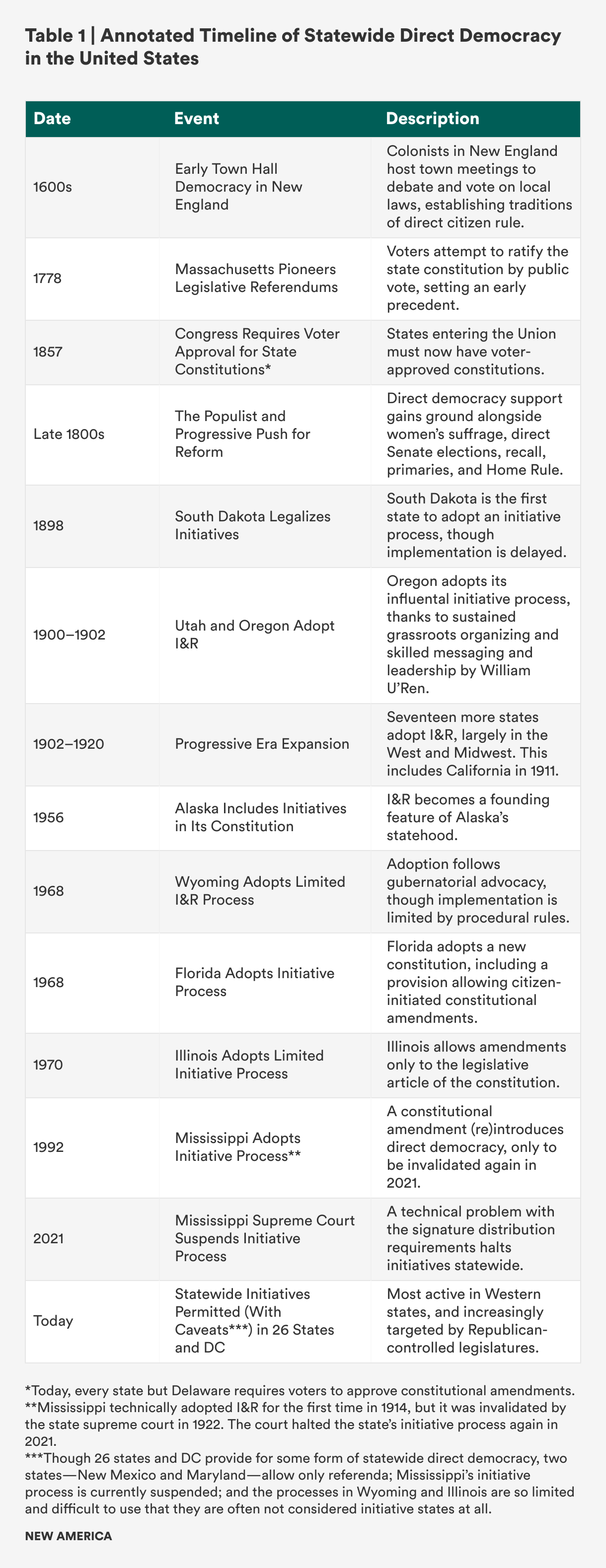
The desire for direct public input into governance has long been a feature of American political life. Colonial-era town meetings in New England, Jeffersonian calls for U.S. constitutional ratification by public vote, and early statewide referendums in Massachusetts (1778) and Rhode Island (1788) reflected an early American instinct toward popular sovereignty.
But it was the upheaval of the Gilded Age—marked by rampant legislative corruption, monopolistic corporate influences, and little or no public investment—that catalyzed the formalization of the initiative process. At the heart of this reform was a widespread belief that ordinary citizens needed a way to bypass legislatures captured by special interests. It was part and parcel of the Progressives’ push to expand democratic participation, including women’s suffrage, the direct election of U.S. senators, direct primaries, the secret ballot, and the establishment of Home Rule. In other words, the initiative was one tool among many aimed at cleaning up government and shifting public policy power to the public itself.
“It was the upheaval of the Gilded Age—marked by rampant legislative corruption, monopolistic corporate influences, and little or no public investment—that catalyzed the formalization of the initiative process.”
Between 1898 and 1919, 20 states, primarily in the West and Midwest, integrated ballot initiatives into their political systems through a mix of constitutional conventions or legislatively-referred amendments.1 The history of these reforms offers both a lesson and a blueprint.
South Dakota became the first state to adopt initiatives in 1898, fueled by anti-monopoly and anti-corruption sentiments and cross-sector economic grievances that found a home in the South Dakota Referendum and Initiative League. The legislature approved initiative and referendum after years of sustained efforts by a coalition of Populists, labor and farmer organizers, and Socialist leaders like Rev. Robert Haire and Walter E. Kidd, with the Populists ultimately collaborating with Democrats (“Popocrats”) to enact the bill.2 Utah followed in 1900, and in 1902, Oregon became the third but arguably most important of the early states to adopt I&R. As in South Dakota, Oregon’s success resulted from the long-term advocacy of organized workers and public intellectuals inside and outside of government. Key advocates included the Knights of Labor, the Farmers’ Alliance, and the Oregon Direct Legislation League under the leadership of William Simon U’Ren.
Western states were the earliest and most enthusiastic adopters of initiatives, and they remain the leaders in initiative use to this day. Around the turn of the twentieth century, many of these states had recently written constitutions, making them more open to democratic experimentation. Some, like New Mexico, included an initiative process in their constitutions at the moment of statehood. Their political cultures were often shaped by frontier values of individualism, local control, and skepticism of centralized power. Western legislatures were also more likely to be fragmented and politically weak—conditions that made lawmakers more open to sharing power with voters.
States like Oregon, California, Colorado, and Montana integrated initiatives into their political systems as tools to combat corporate influence, particularly railroads and mining interests. In California, for example, voters saw the Southern Pacific Railroad as a corrupting force in state politics, and they embraced the initiative as a check on the company’s power.
Political scientist Daniel Elazar classified Western states as “moralistic” at this time, meaning they valued citizen participation and public-interest governance. This culture meshed well with the principles of direct democracy. Reformers in these states often succeeded by framing initiatives as necessary correctives to legislative malapportionment and machine politics. As Thomas Goebel noted, the spread of initiatives across the West resembled a form of “democratic contagion,” where the success of reforms in one state spurred others to follow suit.3
Of course, Western politicians were not all idealists. For instance, Montana’s adoption of initiatives in 1906 was more reactive. Amid labor unrest and a shutdown in the state’s copper industry, major and minor party elites, fearing social upheaval, endorsed the initiative at once and led the legislature to refer the initiative amendment to voters as a pressure-release valve.
While the West embraced these reforms early, Midwestern lawmakers and voters proved more ambivalent. Ohio, Missouri,4 and Michigan eventually adopted initiatives. Others, like Illinois, adopted very limited statewide initiative processes that are practically useless. These states often had strong urban-rural divides and more entrenched political parties, which, like many Eastern states, resisted reforms that might upset delicate power balances. States where political elites and the median voter were already aligned and relatively satisfied with the status quo, such as Indiana at that time, might have had an easier time passing an amendment to enshrine direct democracy but lacked the urgency and incentive to push for it, a scenario Amy Bridges and Thad Kousser refer to as “Complacent Consensus.”5
Still, Populist and Socialist movements had some success pushing for direct democracy and other experiments with alternative governance structures in the Midwest. Nebraska, for instance, adopted an initiative process and the nation’s only unicameral and nonpartisan legislature. Wisconsin lawmakers twice referred I&R adoption measures to voters in 1914; both were defeated. Nevertheless, Progressive Republicans like Robert M. La Follette helped pioneer other innovations like direct primaries and industry regulatory commissions, and the state is still known as the cradle of progressivism.
In the Eastern states, resistance to direct democracy was rooted in older, more conservative political cultures, deeply embedded parties, and other institutional norms. The original states had long-standing constitutional traditions emphasizing checks and balances, and officials, party bosses, and industry leaders feared the volatility of voter-driven lawmaking. Efforts to adopt initiatives often stalled due to inherited concerns about policy instability and innate distrust of common people. In addition, strict urban-rural divides posed significant structural barriers. Despite reformist energy in states like New York, driven by urban coalitions of Catholics and other demographic minorities, reform-friendly lawmakers worried their policy ambitions were not aligned closely enough with those of the average voter to guarantee desirable outcomes.6 Of the original 13 colonies, only Massachusetts adopted a full I&R system (Maryland allows veto referendums but not initiated statutes or amendments).
In the South, meanwhile, the rejection of initiatives was even more deeply entwined with race, class, and the politics of exclusion. During the same period that Western states were expanding voter power, Southern states were actively disenfranchising Black citizens through Jim Crow laws like poll taxes and literacy tests. Lawmakers in the South saw no advantage in empowering a broader electorate and feared that direct democracy could become a tool for racial or class-based insurgency.
In a 2011 article exploring the reasons politicians chose to delegate power through direct democracy, Bridges and Kousser posit that Black voters were largely irrelevant to Southern politicians’ calculus around I&R adoption, as Jim Crow laws had already effectively removed them from the electorate. Their analysis suggests that Southern elites at the time were more afraid of how poor white farmers might use direct democracy.7 Yet this fear of economic populism and its redistributive implications was never separate from racial control and subjugation. The systems of voter suppression that had all but eliminated Black political participation also served to entrench a racial caste system in which the political power of poor white communities was tightly managed. As such, the rejection of statewide direct democracy in the South in the twentieth century served a dual purpose: to guard against class rebellion and to maintain white supremacy by preserving elite control over both poor Black and white communities. This logic has endured in various forms, with modern voter suppression efforts in many Southern states continuing to reflect an effort to contain multiracial democratic coalitions, especially when those coalitions threaten traditional economic or political power.
Post-Progressive Era Adoption Successes—and Multiple Failures
Since 1918, only five additional states have adopted citizen-initiated ballot measures, and most have done so with severe limitations. The few post-1918 adoptions (Alaska, Wyoming, Illinois, Florida, and Mississippi) were often driven by specific political crises, calls for constitutional reform, or a change in partisan tides (see Figure 2). But even where initiatives were technically legalized, in practice, they’ve been hard to use or, in Mississippi’s case, rendered inoperable.8
Alaska included the initiative process in its constitution upon achieving statehood in 1959. Delegates at Alaska’s constitutional convention were notably open to direct legislation and built structural support into the new framework. Voters in Wyoming approved an amendment to enable initiated statutes in 1968 (after a 50-year delay). Yet lawmakers made it nearly impossible to qualify measures under the adopted rules, which require the highest signature threshold in the nation for qualifying not only statutes but also amendments. Two years later, Illinois adopted an extremely limited initiative process that has rarely been used since.
Florida and Mississippi followed in the late twentieth century, both adopting citizen-initiated amendment processes as part of broader constitutional overhauls. Florida’s malapportionment and outdated 1885 constitution had long frustrated voters, especially as political power remained concentrated in rural areas. Florida’s new constitution, adopted by voters in 1968 following the creation of a constitution revision commission in 1965, added four new amendment pathways, including citizen initiatives. Surprisingly, according to Christopher Emmanuel’s 2020 law review article, the inclusion of an initiative process in the new constitution was largely uncontroversial.9
In Mississippi, the process was more contentious. The state already had some experience with the initiative, having adopted initiatives in 1914 before a state supreme court decision suspended the process a few years later. Democratic governor Bill Allain, elected in 1983, launched a constitutional review that ultimately failed to produce a new constitution. Still, public interest in initiatives grew. By 1992, voters overwhelmingly approved a ballot initiative process during the term of the state’s first Republican governor since Reconstruction, reflecting a partisan realignment and the type of political shift that often accompanies major reform. However, this victory was short-lived. In 2021, the Mississippi Supreme Court (again) struck down the state’s initiative process, citing outdated signature distribution requirements that no longer aligned with the state’s reduced number of congressional districts.
Despite these isolated gains, other legislative proposals to create or expand initiative rights have been rare, and successful efforts even rarer. Legislative inertia, combined with lawmakers’ unsurprising reluctance to cede power, has kept initiative powers largely concentrated in the West, with a smattering of successes across other U.S. regions.
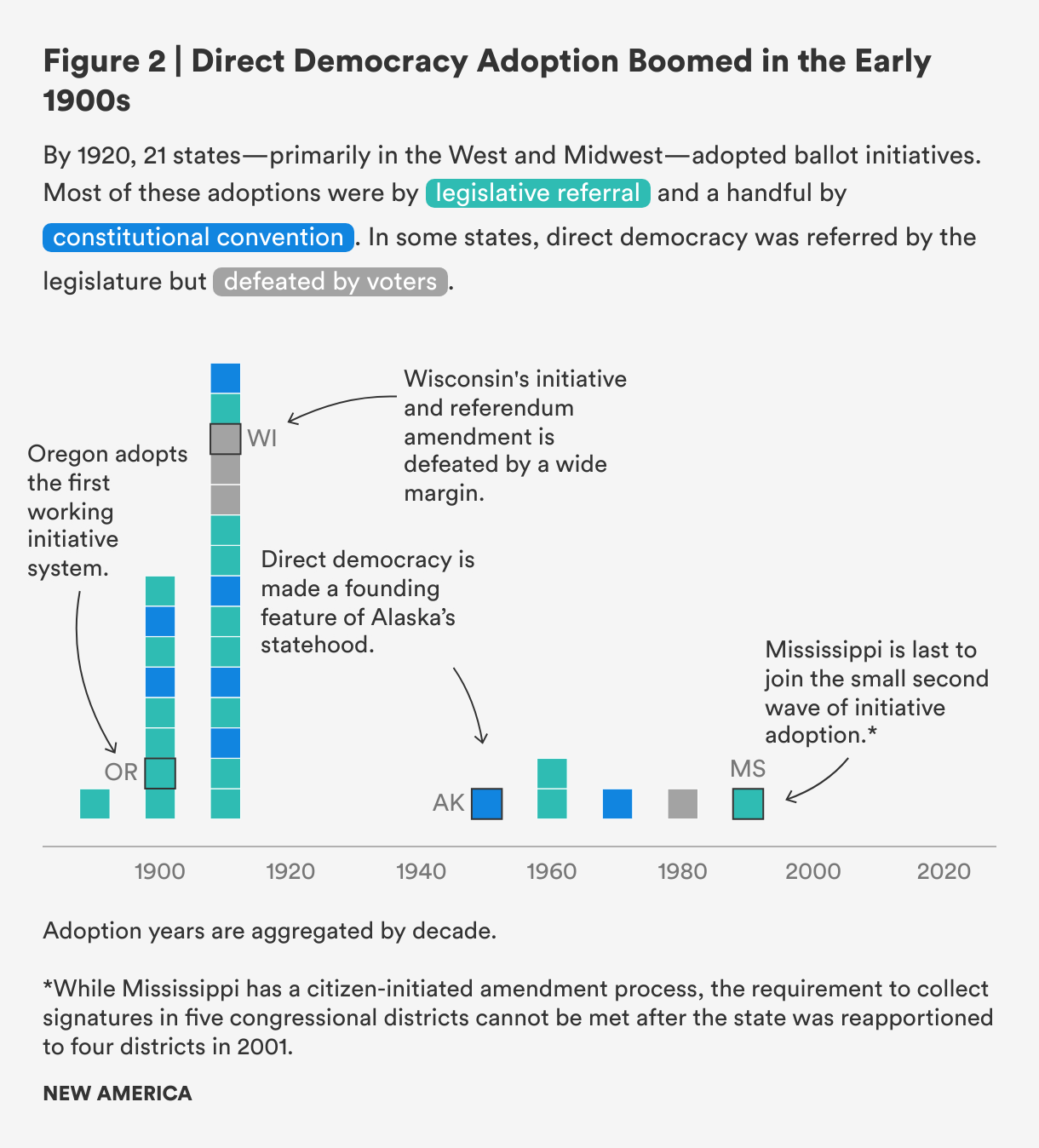
See Table A2 in the Appendix for further detail on constitutional provisions governing initiatives, adoption methods, vote totals, and more.
Since the Progressive Era, adoption efforts appear to track with research indicating that surging interparty competition correlates with legislative referrals for direct democracy amendments.10 In 1980, for example, Minnesota advocates nearly succeeded in securing an initiative process for the state. The direct democracy amendment proposal won more “yes” than “no” votes but still failed because Minnesota state law requires a majority of all voters (not just those voting on the measure) to approve constitutional changes. The idea has resurfaced periodically since but has never advanced past committee. This pattern held in Minnesota, New Jersey, New York, and Pennsylvania through the late 1990s and early 2000s. Yet only Minnesota came close to passage.
As a firm “Blue Wall” state since the Great Depression, Rhode Island’s recent efforts toward I&R adoption present something of an outlier. In 1986, voters narrowly rejected an initiative proposal following a constitutional convention. A 1996 advisory vote (nonbinding ballot question) demonstrated support for initiatives, but legislators declined to act. Subsequent proposals in 2014 and 2018 died in committee.
The few expansions that have occurred in recent decades have largely come from within the initiative process itself. Nevada created a direct petition-to-ballot path in 1962. In 2004, Nebraska voters raised the legislative threshold required to amend citizen-initiated laws, thereby reinforcing initiative power. However, these adjustments are only possible in states that already allow initiatives; for everyone else, reform depends on legislative action.
The dearth of contemporary expansion efforts is not due to a lack of basic public support for direct democracy. However, experts suggest that most residents of non-initiative states may not be aware that they lack I&R tools. In addition, structural barriers—like high amendment thresholds, permanent supermajority parties, and legislative bottlenecks—combined with civil society leaders’ sense of political nonviability block progress.
Indeed, many democracy reform advocates in states without initiative policies express enthusiastic support for adopting I&R but lament that any bill would be a nonstarter in their legislatures, especially those with Republican supermajorities in the South. Southern legislatures often refer tax-related questions to the ballot for public vote but remain opposed to citizen initiatives. Formal surveys in select states would confirm or contextualize the intensity and conditions of this opposition. But historical evidence and discussions with state experts concur that supermajority states are the least ripe for disrupting the policymaking status quo.
“The historical record is clear: Direct democracy is not inherently partisan. Adoption efforts are nearly always driven by whichever party is in the minority.”
The historical record is clear: Direct democracy is not inherently partisan. Adoption efforts are nearly always driven by whichever party is in the minority. Proposals have failed in deep red states like Wyoming (despite nominal adoption) and blue states like New Jersey, New York, and Hawaii. On average, around 65 lawmakers—mainly representing their chamber’s minority party—have sponsored bills or resolutions to establish statewide direct democracy in their state each year since 2018.11 (There are 4,185 state legislative seats across non-initiative states.) Initiative adoption bills have been about as likely to come from Republicans as Democrats in the years we examined.12 Regarding anti-initiative legislation, most of the recent attacks on the initiative process have come from Republican-majority legislatures. On the other hand, few Democrats in non-initiative or limited initiative states are actively advocating for expansion. Our early findings suggest that most legislators serving in non-initiative states feel somewhere between indifferent and resistant toward the idea of expanding direct democracy in their state. These sentiments reflect, in part, a lack of public pressure on the issue.
While further research, such as a legislator questionnaire, is needed to confirm, we can infer from our early data that even lawmakers who support I&R in principle have little incentive to delegate power or empower potential rivals absent a concerted inside–outside education and advocacy campaign.
Initiative Policy Trends over Time
Despite the challenges of adopting and implementing citizen-initiated ballot measures, they’ve played a pivotal role in American political reform, evolving from Progressive Era tools of democratic empowerment to instruments for both policy innovation and ideological retrenchment. Many of the earliest uses of initiatives aimed to regulate monopolies, enhance worker protections and well-being, democratize electoral institutions, and combat political corruption.
For instance, between 1904 and 1912, Oregon voters deployed their initiative powers to pass sweeping democratic reforms, including women’s suffrage, campaign finance rules, direct primaries, and even proportional representation. Spearheaded by William Simon U’Ren and the Direct Legislation League, these early successes established Oregon as a national model for institutional reform and solidified initiatives as a feature of its political system. In 1912, Colorado used the initiative to enact landmark labor reforms, including an eight-hour workday for miners and support for single mothers. These gains came despite corporate opposition, demonstrating the capacity of ballot initiatives to empower working-class movements in the face of legislative inaction.
“These gains came despite corporate opposition, demonstrating the capacity of ballot initiatives to empower working-class movements in the face of legislative inaction.”
After a quiet few decades, a “second wave” of ballot initiatives emerged in the late twentieth century, reshaping both the content and tone of direct democracy. California’s Proposition 13 (1978) capped property taxes and triggered a national “tax revolt,” shifting the use of the initiative process toward fiscal conservatism and revealing its power to lock in long-term policy change. In the 1990s, initiatives fueled the term limits movement, enabling voters in 17 states to impose legislative term limits, often over the objections of incumbents and party leaders.
By the early 2000s, initiatives became sites of intense cultural conflict. LGBTQ rights were rolled back through citizen-initiated constitutional amendments in multiple states, including Oregon and Ohio, revealing how direct democracy could also be weaponized against civil rights. These setbacks prompted modern progressive groups to view initiatives as battlegrounds worth contesting more proactively.
After Republicans swept the 2010 elections, particularly at the state level, the following decade saw a resurgence of progressive statewide initiatives. Medicaid expansion efforts passed in Republican-led states, bridging partisan divides by emphasizing pragmatic benefits. In 2018, a new wave of reforms tackled redistricting, voting rights, and campaign finance, echoing the Progressive Era’s structural ambitions. Most recently, after the fall of Roe v. Wade, voters in initiative states like Missouri and Michigan protected or expanded abortion rights through initiatives, in several cases outperforming candidates on the same ballot.
Today, initiatives are more widely used and contested than ever. Western states continue to dominate the use of ballot initiatives. Six states—Arizona, California, Colorado, North Dakota, Oregon, and Washington—account for over 60 percent of all initiative activity.13 Initiatives address a broad spectrum of issues, from health care to civil rights, but also face mounting legislative and judicial resistance. Legislatures in Republican-controlled states like Florida, Missouri, Arkansas, Ohio, and Utah have moved to restrict the process, while courts and administrative bottlenecks increasingly undermine implementation.14
Sometimes, legislative attempts to restrict ballot measures come from within the process itself. For example, in 2023, in anticipation of an initiated vote to protect reproductive freedom, the Ohio legislature referred to the ballot a measure that would have raised the approval threshold for constitutional amendments from a simple majority to a 60 percent supermajority.
In spite of these challenges, a new generation of nationally coordinated efforts, led by groups like the Ballot Initiative Strategy Center and the Fairness Project, have emerged to protect direct democracy.
Citations
- “History of Initiative and Referendum in the U.S.,” Ballotpedia, accessed May 12, 2025, source.
- H. Roger Grant, “Origins of a Progressive Reform: The Initiative and Referendum Movement in South Dakota,” South Dakota History 3 (Fall 1973): 390–407, source.
- Thomas Goebel, “A Case of Democratic Contagion: Direct Democracy in the American West, 1890–1920,” Pacific Historical Review 66 no. 2 (1997): 213–221, source.
- It took two attempts for Missouri voters to approve a constitutional amendment to establish I&R.
- Amy Bridges and Thad Kousser, “Where Politicians Gave Power to the People: Adoption of the Citizen Initiative in the U.S. States,” State Politics & Policy Quarterly, 11 no. 2 (2011): 167–197, source.
- Bridges and Kousser, “Where Politicians Gave Power to the People,” source; Patrick L. Baude, “A Comment on the Evolution of Direct Democracy in Western State Constitutions,” Indiana Law Journal 73 (1998), source.
- Bridges and Kousser, “Where Politicians Gave Power to the People,” source.
- Ashton Pittman, “‘Democracy Dies Blow By Blow’: How Mississippi’s Supreme Court Killed the Ballot Initiative Twice in 99 Years,” Mississippi Free Press, June 1, 2021, source.
- Christopher Emmanuel, “A Critical Look at the First 50 Years of Florida's 'Citizen' Initiative Process,” Stetson Law Review 51 (July 2020), source.
- Daniel A. Smith and Dustin Fridkin, “Delegating Direct Democracy: Interparty Legislative Competition and the Adoption of the Initiative in the American States,” American Political Science Review 102 no. 3 (2008): 333–50, source.
- Texas has a biennial legislature that meets only in odd-numbered years, though special sessions can be called in even-numbered years. All other non-initiative states’ legislatures convene annually.
- Lawmakers in non-initiative states have introduced a total of 161 bills and resolutions to adopt I&R between 2018 and April 2025. Including Mississippi, where the state legislature is working to restore the process after it was suspended in 2021, the total is 217.
- “Initiative States Compared by Number of Initiatives on Their Ballot,” Ballotpedia, accessed May 12, 2025, source; Thom Reilly, “Dissatisfaction with One-Party Control Leads to More Ballot Initiatives, 60% of Them in Six States,” Ohio Capital Journal, March 25, 2024, source.
- “Attacks + Threats,” Ballot Initiative Strategy Center, source.
Lessons from Reform Leaders and Coalitions
If institutional conditions provide the terrain, political leadership and coalition strategy determine whether reform campaigns succeed. The history of initiative adoption is replete with examples of individuals and coalitions that turned diffuse public frustration into durable institutional change.
Outside Government: Cross-Issue Movements and Nonpartisan Framing
In South Dakota, Walter E. Kidd and Rev. Robert W. Haire were instrumental in adopting the nation’s first statewide initiative process in 1898. Kidd was chair of the Populist Party State Central Committee and a state representative. Haire spread his gospel about direct democracy through the literature of the Knights of Labor. Their activism was closely tied to Populist and Socialist movements that sought to bypass a state legislature seen as dominated by corporate interests.1
In Oregon, William Simon U’Ren—often called the “father” of the initiative process in Oregon and “Referendum U’Ren”—was a lawyer, legislator, and founder of the Direct Legislation League of Oregon. Through the Direct Legislation League, he helped build public support, educate voters, and craft legislative strategy. U’Ren deliberately positioned the campaign as nonpartisan, focusing not on specific policies but on the principle that voters deserved more power. His coalition included major labor organizations and reform-minded civic groups, and it laid the foundation for a wave of democratic reforms in the state, including direct primaries and recall of certain elected officials.2
Along with the American Federation of Labor (AFL), organized farming groups like The Grange Movement were critical members of the coalition advancing statewide direct democracy. Farmers generally supported initiatives because they offered a way to fight back against railroads and other corporate powers that dominated state legislatures. Some of the earliest initiatives, like North Dakota’s 1918 initiative that led to the creation of a state-owned mill and bank, were specifically designed to benefit farmers.3 Eric D. Lawrence, Todd Donovan, and Shaun Bowler found that states with more farmers per capita were more likely to adopt initiatives.4
John W. Sullivan, another central figure, was the author of 1893’s Direct Legislation by the Citizenship Through the Initiative and Referendum, the source code for the U.S. direct democracy movement.5 Drawing inspiration from Switzerland’s pioneering model of subnational direct democracy, Sullivan worked through the National Direct Legislation League to spread the idea across the United States. His influence extended into labor circles, including the AFL, which formally endorsed the initiative process in 1892. His book is also credited with sparking U’Ren’s interest in the movement.
Though Sullivan’s writings inspired action across the growing union, national leaders and advocacy organizations played a limited role in the spread of initiative processes. Early activists identified key lessons for future national organizers based on some of their perceived shortcomings. The National Popular Government League (which succeeded the Direct Legislation League) was founded in 1913 with the support of the AFL and The Grange. The League was led by the writer and activist Judson King, who documented several lessons and best practices for national initiative organizers that we can apply today, including how a national organization could:6
- serve as a clearinghouse for accurate initiative data, providing insight into how the initiative process works in states across the country;
- be a resource to activists in non-initiative states for help crafting advocacy campaigns, legislation, and other materials;
- help build momentum for initiative adoption across states; and
- help prepare for and defend against attacks on the initiative process (just like efforts to roll back the initiative today, legislators in initiative states were already working to undermine the initiative process in the 1910s).
Third parties and coalitions played a pivotal role in the rise and success of the early direct democracy movement, not just as ideological supporters but as strategic drivers of reform. According to Stephen L. Piott’s Giving Voters a Voice, Socialists, labor activists, and Populists were instrumental in pushing for initiative and referendum, especially in the West, where disillusioned farmers and workers sought alternatives to a two-party system that had left them behind.7 John G. Matsusaka affirms that many reformers embraced direct democracy to circumvent legislatures dominated by elite interests, which included the major party machines.8 Bridges and Kousser further show that third-party reformers often turned to I&R when they lacked legislative power but believed they had popular support.9 Research also shows the initiative was more likely to take root in states with weak party systems and active grassroots movements, conditions often fueled by third-party energy.10
The Populists and Socialists in particular led successful pro-I&R coalitions, especially in states like South Dakota, where they helped pass the country’s first statewide initiative law in 1898 by forming strategic alliances with reform-minded Republicans and Democrats.11 In Oregon and Colorado, Populist Progressives used their legislative footholds to champion I&R even without majority control.12 These coalitions, backed by grassroots organizing and media campaigns, helped frame direct democracy as a means to break elite control and democratize policymaking. Their efforts were often co-opted by the major parties and laid crucial groundwork for later Progressive successes in institutionalizing I&R.
California’s experience underscores the power of aligning grassroots and intraparty organizing with electoral strategy. Dr. John Haynes, a wealthy reformer and Socialist, founded the California Direct Legislation League and successfully pushed for I&R in Los Angeles’s city charter before turning his attention statewide. In 1907, facing a corrupt state government captured by the Southern Pacific Railroad, Haynes and a group of journalists launched the Progressive Republican “Lincoln-Roosevelt League” to replace corrupt lawmakers with reformers who would champion not just direct democracy but women’s suffrage, public utilities regulation, and other Progressive causes. Governor Hiram Johnson was elected on the Lincoln-Roosevelt League platform in 1910 and California adopted I&R the following year.
Besides political parties, outside advocates with inside-government experience were likewise important. Grassroots influencers like Kidd (South Dakota) and U’Ren (Oregon) straddled the arenas of movement-building and actual lawmaking. Their public education and coalition-building work helped put I&R on the political agenda and gain support inside their statehouses. Future I&R adoption campaigns will require existing advocacy leaders to run for office and champion the issue from the inside. Advocacy organizations, perhaps a reconstituted Direct Legislative League or National Popular Government League, can also recruit and train state legislative candidates to run at least partially on the commitment to promote direct democracy if elected.
Inside Government: Leveraging the Bully Pulpit
Given that most states ultimately adopted the initiative process through a constitutional amendment, politicians at the local, state, and national levels were often a vital component of successful campaigns. The Lincoln-Roosevelt League of California tried to align itself with then–Progressive Republican President Teddy Roosevelt even before Roosevelt became a vocal but measured proponent of statewide initiative and referendum. After his presidency, Roosevelt lent his platform and elite credibility to the movement. His advocacy included a speech to the 1912 Ohio constitutional convention in which he opined that direct democracy is a supplement to representative democracy rather than a substitute: “In the great majority of cases it is far better [that] action on legislative matters should be taken by those specially delegated to perform the talk; in other words, that the work should be done by the experts chosen to perform it. But where the men thus delegated fail to perform their duty, then it should be in the power of the people themselves to perform the duty.”13 The 1912 convention resulted in an amendment to establish I&R that was approved by voters the same year.
The support of executive officials was critical to the I&R adoption movement. In the Ohio case, the mayors of Toledo and Cleveland also used their platforms to advance the amendment. But across the country,governors proved to be particularly influential allies.14 For example, as governor of California from 1911 to 1917, Hiram Johnson led one of the most influential state-level reform agendas in U.S. history. A former prosecutor, Johnson sought to dismantle the power of the Southern Pacific Railroad and restore public trust in government. Under his leadership, California adopted the initiative, referendum, and recall, creating a robust system of direct democracy that remains a national bellwether for policy as well as a favorite target for critics who see it as a cautionary tale of “too much democracy.” In modern times, Mississippi Governor Bill Allain, a Democrat, advocated for I&R in his state by initiating a constitutional review process that helped spark interest in initiatives.
In today’s polarized state legislatures, governors may again be the most viable champions of reform, especially those with a reform mandate or cross-party appeal.
Citations
- Steven L. Piott, Giving Voters a Voice: The Origin of the Initiative and Referendum in America (University of Missouri Press, 2003); Grant, “Origins of a Progressive Reform,” source.
- “State Information: Oregon,” Initiative and Referendum Institute, accessed May 12, 2025, source.
- “State Information: North Dakota,” Initiative and Referendum Institute, accessed May 12, 2025, source.
- Eric D. Lawrence, Todd Donovan, and Shaun Bowler, “Adopting Direct Democracy: Tests of Competing Explanations of Institutional Change,” American Politics Research 37 (October 2009): 1024–1047, source.
- J.W. Sullivan, Direct Legislation by the Citizenship Through the Initiative and Referendum (True Nationalist Publishing Company, 1893).
- Judson King, The First Year and a Look Ahead: What the National Popular Government League Did in 1914. What Should be Done in 1915 (National Popular Government League, January 1915), source.
- Steven L. Piott, Giving Voters a Voice: The Origin of the Initiative and Referendum in America (University of Missouri Press, 2003).
- John G. Matsusaka, Let the People Rule: How Direct Democracy Can Meet the Populist Challenge (Princeton University Press, 2020).
- Bridges and Kousser, “Where Politicians Gave Power to the People,” source.
- Lawrence, Donovan, and Bowler, “Adopting Direct Democracy,” source.
- Piott, Giving Voters a Voice.
- Bridges and Kousser, “Where Politicians Gave Power to the People,” source.
- Theodore Roosevelt, “A Charter of Democracy.”
- Including Hiram Johnson, we identified 13 governors who provided key support for I&R in their states in the run-up to adoption during the twentieth century. Since Mississippi became the last state to adopt an initiative process in 1992, only a few governors from non-initiative states have spoken out or taken legislative action in favor of I&R adoption. They include former governors George Pataki (R-N.Y.) and Chris Christie (R-N.J.), and, most recently, Gov. Tony Evers (D-Wis.).
Analysis of Adoption Trends: Strategic Takeaways from History
Considerable scholarly research has sought to explain why certain states adopted initiatives while others did not. The evidence suggests that the diffusion of initiatives depended not just on popular demand but also on specific institutional, political, and demographic conditions.
Many of the political and socioeconomic conditions present at the beginning of the Progressive Era mirrored those of today, making this a particularly ripe moment for direct democracy expansion. Yet there are also critical differences between then and now that may dampen the applicability of the historical lessons to contemporary reform efforts.
One is that the nation is much older. The United States is no longer in the business of admitting new states, nor are states holding constitutional conventions to work out the kinks of their young governments, as many states were doing 100 years ago, which was the sine qua non of initiative and referendum amendments in several cases. Another is that American politics has become nationalized and polarized in such a way that (a) political reforms rarely enjoy broad cross-partisan support in the electorate or legislature and (b) virtually guarantees the swift formation of well-funded and nationally coordinated opposition. Another difference is that third parties, arguably the most influential players in the original I&R movement, both inside and outside government, are effectively inconsequential in U.S. politics today. This final point raises the question of whether changes that promote third-party ballot access and non-spoiler competition should be treated as enabling reforms for I&R enactment in certain states.
Below are 15 lessons from the literature and expert interviews to guide future I&R adoption strategies.
- Interparty legislative competition creates opportunity. Initiative adoption was more likely in states with narrow legislative majorities1 or strong third-party representation.2 Combined with sustained advocacy pressure, these environments made Progressive Era lawmakers more willing to refer an I&R adoption amendment to the ballot. In the early 2000s, states with surging interparty competition, like Minnesota, New Jersey, New York, and Pennsylvania, introduced several bills to adopt direct democracy.3
- State political culture matters. Western states were more open to direct democracy due to looser constitutional traditions and grassroots political values.4 Modern reformers must also align campaigns with state-specific narratives and self-images.
- Do no harm. Don’t assume future initiatives will always align with Progressive goals. The same mechanism that advanced women’s suffrage in 1912 also passed anti-LGBTQ measures in 2004. Any campaign to expand them must include safeguards and durable civic infrastructure to prevent successful weaponization by reactionary majorities in government or the electorate.
- Start small—build up or out. In multiple cases, reformers first succeeded at the municipal level before scaling up.5 Most non-initiative states already allow some initiatives at the municipal level or have limited experience with statewide direct democracy (e.g., New Mexico, Maryland, and Illinois). States can leverage these experiences to scale vertically or horizontally. Supportive lawmakers can also build momentum and internal permission structures through advisory questions, where the legislature places a nonbinding question on the ballot for voters to consider. Another intermediate step could include citizens’ assemblies or deliberative “mini publics,” which bring together a representative group of individuals to discuss specific issues facing their community or jurisdiction and send recommendations to policymakers.6 A citizens’ assembly that periodically meets and makes recommendations to the state legislature could be authorized without the need to amend the constitution.
- A modern Direct Legislation League could power national coordination. Recreating a twenty-first-century version of the Progressive Era organizing hub could help build funding and leadership capacity, develop messaging, and coordinate resources across states.7
- Leadership matters, both inside and outside government. Reform was often led by charismatic organizers and sympathetic insiders (e.g., U’Ren, Johnson, Sullivan, and Roosevelt).8 Modern efforts need visible champions, ideally from within legislatures and governors’ offices.
- Strange-bedfellows coalitions win. Many successful campaigns united agrarian reformers, labor unions, and third parties.9 Today, cross-partisan, cross-class coalitions will be essential for legitimacy and power-building. Fusion states like New York and Vermont with active and competitive third parties could also play a defining role.
- Public distrust of government combined with rising economic inequality fuels reform. Direct democracy took hold where legislative capture, corruption, and economic inequality were most salient.10 Reformers should target states with low trust in and satisfaction with government, possibly related to perceived legislative corruption, and pair I&R adoption with other good governance reform measures.
- Target states with large gaps between public preferences and policy. Related to number 8 above, empirical evidence shows that initiative states have better alignment between policy and public opinion.11 Identify states blocking popular issues (e.g., paid sick and family leave, higher minimum wage, or marijuana legalization) and make that mismatch a core reform argument.
- Find a modern, unifying “meta-issue” like gerrymandering or campaign finance reform. Malapportionment was one of the motivating grievances of Progressive Era I&R campaigns.12 Today, similarly, gerrymandering is recognized by the public, media, and philanthropy as a major problem, entrenching minoritarian rule and undermining citizen trust in democracy. Direct democracy has been proven in states like Michigan and Colorado to deliver redistricting reforms. Initiatives have also advanced reforms to deemphasize money in politics. Public financing and anti-dark money policies present other galvanizing issue opportunities with echoes of Gilded Era-backlash.
- Use regional comparisons and diffusion effects to build pressure. Many (though not all) studies find evidence of reform diffusion effects in the West.13 Proximity to initiative states can create a “why not us?” effect. Use this to generate pressure from the public, media, and lawmakers in neighboring states (e.g., Pennsylvania, which borders Ohio).14
- Beware of strong major parties and rigid constitutions. Reform efforts were often blocked in states with entrenched parties, laws that marginalized third parties, or burdensome amendment rules.15 These are major hurdles that require long-haul organizing or constitutional conventions.
- Elite support can be contingent and opportunistic. Like Bridges and Kousser, Daniel R. Biggers and Alexander Ross show that support for direct democracy often follows partisan self-interest.16 Legislators in the minority are more likely to support initiatives as a check on majority power but tend to reverse course once their party gains control. I&R advocacy groups must be prepared to hold pledged candidates and officials accountable regardless of their parties’ standing.
- Fears of economic/status redistribution to poor and minority groups have long blocked initiative process adoption. Across the country, but especially in the South, elites’ fears of empowering poor and minority voters were significant deterrents.17 In recent decades, reluctance to embrace initiatives has been rooted in racial politics, as legislatures gerrymandered to reduce Black political influence have resisted alternatives that would give people voice in proportion to the state’s demographics. Modern campaigns must be inclusive from the start and may consider emphasizing policies with broad-based public support and benefits at first.
- Constitutional conventions or review processes, while risky, may be necessary. More than one-third of successful state adoptions came via constitutional convention, and constitutional review and revision commissions preceded others. Despite nearly unanimous reservations among reformers we interviewed about opening up the “Pandora’s box” of a convention, it should not be reflexively dismissed. Advocates could leverage the threat of convention to push for a review effort inside the legislature. Of the non-initiative states with automatic ballot referrals on conventions, Hawaii is up next in 2028.
Together, these findings help us understand where and why ballot initiatives take root. States with high public dissatisfaction, weak or divided legislatures, less institutional rigidity, and active reform movements have historically provided the most favorable terrain. For today’s reformers, success will depend on mobilizing grassroots energy and on understanding and influencing the strategic incentives of those in power.
Citations
- Smith and Fridkin, “Delegating Direct Democracy,” source; Shaun Bowler, Todd Donovan, and J. A. Karp, “When Might Institutions Change? Elite Support for Direct Democracy in Three Nations,” Political Research Quarterly 55 no. 4 (2002): 731–754, source; Bridges and Kousser, “Where Politicians Gave Power to the People,” source.
- Lawrence, Donovan, and Bowler, “Adopting Direct Democracy,” source.
- John F. Bibby and Thomas Holbrook, “Parties and Elections,” in Politics in the American States: A Comparative Analysis, ed. Virginia Gray and Russell Hanson (CQ Press, 2004), 62–99.
- Piott, Giving Voters a Voice; Baude, “A Comment on the Evolution of Direct Democracy in Western State Constitutions,” source; Nathaniel Persily, “The Peculiar Geography of Direct Democracy: Why the Initiative, Referendum and Recall Developed in the American West,” Michigan Law & Policy Review 2 no. 1 (1997): 11–42.
- Persily, “The Peculiar Geography of Direct Democracy.”
- “Citizens’ Assemblies and Mini Publics,” New America, February 14, 2024, source; Democracy Next: Assembling an Assembly Guide (Democracy Next, n.d.), source; Organisation for Economic Co-operation and Development, Eight Ways to Institutionalise Deliberative Democracy (OECD Publishing, 2021), source.
- King, The First Year and a Look Ahead, source.
- David Schuman, “The Origin of State Constitutional Direct Democracy: William Simon U’Ren and the ‘Oregon System,’” Temple Law Review 67 (194): 947–963.
- Lawrence, Donovan, and Bowler, “Adopting Direct Democracy,” source; Goebel, “A Case of Democratic Contagion,” source; Schuman, “The Origin of State Constitutional Direct Democracy.”
- Piott, Giving Voters a Voice; Schuman, “The Origin of State Constitutional Direct Democracy.”
- John G. Matsusaka, “Popular Control of Public Policy”; Gerber, “Legislative Response to the Threat of Popular Initiatives.”
- Bridges and Kousser, “Where Politicians Gave Power to the People,” source.
- Bridges and Kousser, “Where Politicians Gave Power to the People,” source; Smith and Fridkin, “Delegating Direct Democracy,” source.
- Policy diffusion mechanisms such as imitation or learning can help explain how reforms spread, but may also deter adoption in some contexts. For instance, backlash against reforms identified with politically or culturally dissimilar states—such as South Dakota’s recent “Don’t California Our South Dakota” campaign—can have negative diffusion effects. For more on policy diffusion, see Charles R. Shipan and Craig Volden, “The Mechanisms of Policy Diffusion,” American Journal of Political Science 52 no. 4 (2008), 840–857, source.
- Lawrence, Donovan, and Bowler, “Adopting Direct Democracy,” source; Smith and Fridkin, “Delegating Direct Democracy,” source.
- Daniel R. Biggers and Alexander Ross, “Strategic Considerations and Support for Direct Democracy in the United States,” Electoral Studies 87 (February 2024), source.
- Bridges and Kousser, “Where Politicians Gave Power to the People,” source; Lawrence, Donovan, and Bowler, “Adopting Direct Democracy,” source.
Assessing State Readiness: Preliminary Criteria and Methodology
Expanding ballot initiatives to states to more states requires more than moral urgency—it demands strategic focus. We developed a scoring system to identify the most promising states for near-term adoption of citizen-initiated ballot measures. Based on a review of historical patterns, political science research, interviews with reform scholars and practitioners, and recent organizing experience, we conceptualized a state’s readiness for initiatives based on two dimensions: (1) feasibility of adoption and (2) potential policy impacts. The feasibility dimension refers to factors associated with a higher likelihood of adopting ballot initiatives, as established by previous research on the topic, and to factors that would facilitate the work of people on the ground advocating for ballot initiatives. The impact dimension refers to factors that indicate places where ballot initiatives could have a greater impact because citizens have greater difficulty expressing their views through the usual electoral channels.
On the feasibility dimension, we considered factors that would facilitate the adoption of initiatives in the next five to 10 years. We also considered factors that could reduce the risk of initiatives being misused and causing more harm than good. For instance, because the success of initiatives depends on equal access to the ballot and high levels of electoral participation, one might hesitate to expand initiatives to states with high racial turnout gaps, as that could reproduce existing inequalities.
On the impact dimension, we considered factors that indicate where initiatives would have the most meaningful democratic, social, and policy improvements, with a particular focus on historically underserved communities for whom the usual electoral and democratic institutions have not delivered positive outcomes. There is often a tension between the indicators related to feasibility and those related to impact. The places where initiatives could have the most impact on marginalized communities—because traditional democratic channels have failed them—are also the places where it is the most difficult to enact democratic reforms and ensure they’re implemented responsibly. Throughout the analysis, we tend to prioritize feasibility indicators, as a state must first adopt initiatives before any impact could materialize.
We collected state-level data on 42 indicators across seven different categories. Our selection of indicators was guided by previous academic work that has identified factors associated with the adoption of initiatives specifically and of other types of institutional reforms more broadly. We also incorporated insights from 31 direct democracy experts, political scientists, state policy advocates, state and local organizers, and campaign strategists. Separating the indicators into categories provides a more detailed understanding of how each state scores and whether the score is driven by feasibility- or impact-related indicators. For instance, there may be states that score high on impact categories like representation or governance, suggesting that they would potentially benefit a lot from the introduction of initiatives, but score low on feasibility categories, which would make it less likely for a state to adopt initiatives, at least in the near term. (All indicators have been re-coded so that high values correspond to greater readiness for initiatives.)
To the extent possible, we relied on existing indicators for the concepts we wanted to capture. For instance, the indicator capturing polarization in state legislatures was developed by academic researchers studying how polarization has changed in the states over time; the state democracy indices were developed by another academic researcher examining the health of democracy at the state level. Other indicators come from official government sources (union membership, median income, and Gini coefficients to measure income inequality) or from published reports from think tanks and research institutions (turnout gap, partisan skew, and bias of electoral maps). In a few cases, we created the indicators ourselves using existing data. The indicator proxying the difficulty of amending the constitution was built with data from the Council of State Governments, and the majority party surplus of seats was created with data from the National Conference of State Legislatures. (See Table A4 in the Appendix for a detailed list of sources and time periods each indicator refers to, as well as basic descriptive statistics of the indicators.)
Below are the indicators we used to develop the score, organized by their respective categories, to inform the selection of most-promising states for near-term expansion.
Political and Legal Feasibility Indicators
These criteria evaluate whether a state’s political and legal conditions make initiative adoption plausible in the near term.
Political Context
This category includes indicators that capture whether a state’s political dynamics are amenable to reform. Existing research has identified factors like divided partisan control of a state’s political institutions or narrow legislative margins as contributing to the adoption of reforms and has indicated that political culture and history can also play an important role in explaining reforms. Below are the indicators we use in this category, which focus on the most recent available election data:
- Trifecta: whether a state had a partisan trifecta in the control of the governorship, state house, and state senate in 2024.
- Swing state: whether a state was a swing state in the 2024 presidential election. Not only does being a swing state indicate narrow partisan races, but it is also in swing states where a lot of organizing and mobilizing happens.
- Margin of victory of 2024 presidential candidates: This is another way to measure narrow margins and swing state status.
- Deep South: whether a state is in the Deep South. Political science research has shown that unique historical legacies shape political dynamics today and affect the quality of democracy and representation in Southern states.1 Many analysts include an indicator variable for the Deep South in their analyses since it is correlated with many other political factors of interest.
- Presidential turnout: The share of the voting-eligible population that participated in the 2024 elections can proxy for general levels of political participation.
- Racial turnout gap: The difference in voting rates between white and non-white ethnic groups in 2022 can also proxy for general levels of political participation, but additionally for barriers to voting.
- Automatic ballot referral: whether a state has automatic ballot referrals on constitutional conventions.
Legal Feasibility
Here, we focus on factors that would make the adoption of ballot initiatives easier from a procedural standpoint. We also include an indicator that could influence the willingness of politicians to take up the issue or of the population to push for it:
- Amendment threshold difficulty: an indicator that captures the steps it takes to amend a state constitution and the shares by which different players have to approve an amendment to ratify it.
- Constitutional amendments proposed from 2003 to 2024: the number of state constitutional amendments that have been referred to voters.
- Constitutional amendments proposed from 2020 to 2024: same as the previous indicator, but meant to capture more recent dynamics.
- Amendment approval rate from 2003 to 2024: the number of state constitutional amendments that have been referred to and approved by the population. We consider this a measure of alignment between proposed amendments and citizens’ views, such that high approval rates may obviate the need for ballot measures.
- Past attempts to legalize initiatives or referendums from 2018 to 2024: The number of bills introduced in non-initiative states that tried to legalize citizen-initiated ballot measures could indicate preexisting enthusiasm for this reform, as well as the availability of legislative advocates for adopting the reform.
- Share of bordering states with initiatives: The policy-diffusion literature has identified sharing a geographic border as facilitating the adoption of policies across states, given linkages and proximity between politicians and the general population.
- Top 10 cities with initiatives: of the top 10 cities in a state, the number of them that have ballot initiatives.
- Statewide ballot measures from 2020 to 2024: the number of statewide ballot measures referred to voters.
Electoral and Legislative Dynamics
It is difficult for reforms that could disrupt the balance of power to be adopted in legislatures where one party dominates, as the dominant party is unwilling to give up power. In legislatures with narrower margins, parties may be more willing to adopt reforms to help secure their long-term survival. This category includes the following variables:
- Party advantage: the difference in seat shares between the majority party and the minority party in the state house and, separately, in the state senate.
- Majority party surplus: the excess share of seats in the state house and senate that a party has beyond a simple majority, which Smith and Fridkin find explains the adoption of initiatives historically.2
- Skewness of the state senate and house: the disproportionality between the share of votes a party obtains and the share of seats they get. Skewness could hint at places where initiatives might have the most impact. But its most immediate effect would be in the ability of parties that have power disproportionate to their vote share to block reforms that would disrupt their power.
- Partisan bias of state house maps: a measure of how gerrymandered the electoral maps are. We include this for similar reasons to the skewness of the state house.
Social Capital and Local Organizing Capacity
Even in states where legal or political barriers are low, strong civic foundations are key for making the adoption of initiatives possible and for having local, state-based advocates for the reform. Social capital and organizing capacity are difficult to pinpoint exactly, so we use a variety of indicators to proxy for them:
- Social Capital Index: an index developed by the Joint Economic Committee of the U.S. Senate that integrates variables measuring community health, family unity, collective efficacy, and other factors into one state-level index.
- Pro-democracy organizations per capita: the number per capita of organizations working to expand democracy in each state, as identified by the National Civic League.
- Tax-exempt organizations per capita: the number per capita of organizations with tax-exempt status in each state.
- Economic connectivity: the degree to which low- and high-income people are friends with each other, as measured by researchers using social media data.
- Civic organizations per capita: the number of civic organizations per 1,000 social media users, as measured by researchers using social media data.
- Protests per capita from 2021 to 2024: the number of peaceful protests per capita in each state.
- Workers in a labor union: the share of workers who are members of a union.
Socioeconomic Context
Research has shown that both money and race play an important role in shaping policymaking in the United States. The high concentration of money in a few hands can lead to the capture of the policymaking process, which can prevent democratic change. Historical and contemporary work has also shown that demographics can affect whether a policy is adopted, particularly if the policy could result in the redistribution of power or resources across ethnic groups. To capture these dynamics, we include the following indicators:
- Gini coefficient: a measure of economic inequality in a state.
- Median income: the median level of household income in a state.
- Share of the population that is not white: Smith and Fridkin’s research shows that the more non-white people there were in a state, the less likely it was for a state to adopt initiatives.3
Potential for Democratic and Social Impact
This second dimension ensures that expansion efforts do not merely succeed politically but also meaningfully strengthen democracy and equity.
Representation
In states where people are not well represented through traditional democratic institutions, initiatives have the most potential to channel their voices into the policymaking process. We consider the following indicators as a proxy for (a lack of) political representation:
- Congruence between public opinion and policy: the correlation between mass preferences and state-level social and economic public policies, as measured by Caughey and Warshaw.4
- Overrepresentation of white voters: the difference between the percentage of seats where white voters make up a majority of the electorate and the white voting age population share statewide.
- Underrepresentation of minority groups: the difference between the share of non-white voters in a state and the share of non-white state legislators.
- Share of female legislators: the share of female legislators in the state house and senate.
Governance
Where traditional democratic institutions are working well, citizens might not have much use for alternative methods of representation and influence, like initiatives. As a result, initiatives might have the most impact in places that score low in areas related to democratic governance. We consider the following indicators:
- State democracy index: a measure of democratic performance in each state developed by Jacob Grumbach that considers a variety of factors—including ballot access, voting laws, gerrymandering, and congruence—between public opinion and policies. We include both versions of the index: the additive version and the version developed through Bayesian factor analysis.
- Polarization: a measure of ideological polarization in state legislatures.
- Corrupt practices: a proxy for the prevalence of corruption in a state legislature based on a 2018 survey of journalists and their perceptions of corrupt practices. High levels of corruption could prevent politicians from being responsive to voters if they instead respond to special interests or backdoor deals.
- Anti-corruption laws: an index capturing the number of anti-corruption laws in place in a state in 2020.
Creating the Scores
In order to integrate the information provided by all these indicators, we created a score per category for each state as well as an overall score for the state. We first standardized all the variables to have an average of zero and a standard deviation of one, which ensures that all the variables are on the same scale and can be compared to each other and used together. After standardizing the variables, we rotated certain variables to make sure that all the variables had the same direction, such that more positive values would indicate greater readiness for initiatives.
Calculating the overall scores and the scores for each category was done by taking the weighted average of the standardized indicators for each state (both pooled and by category). Based on our background research and our concerns for feasibility, we identified certain variables that we believe should be more influential in the scores, so we assigned them additional weight when calculating the averages. The following indicators got a weight of 1.5: the state’s Gini coefficient, congruence between public opinion and public policy, prior bills for legalizing initiatives, and the number of pro-democracy organizations per capita. These indicators were assigned a weight of 2: surplus share of seats in the state house and senate, the difference in seat shares between the majority and minority party in the state house, the difficulty of amending the state constitution, and the margin of victory in the 2024 presidential election.
Table 2 shows the overall scores and rankings of the states, from potentially most ready to adopt an initiative process to least, based on a combination of feasibility and impact indicators. For a detailed breakdown of each state’s scores by category, see the Appendix.
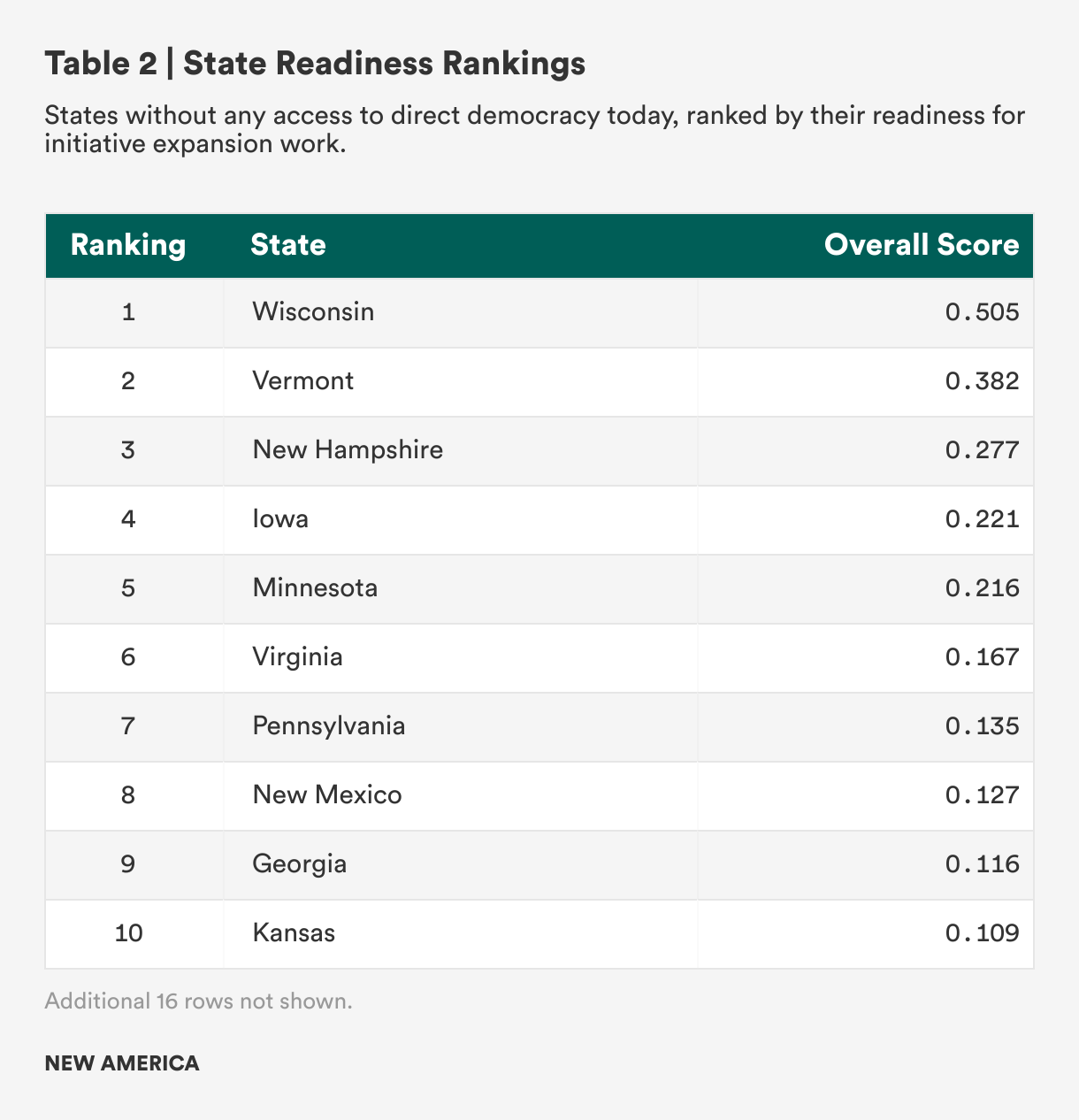
A closer look at the highest- and lowest-ranked states helps illustrate the logic behind the readiness matrix. Wisconsin ranks first overall among states without citizen-initiated ballot measures. Its high ranking is the result of being a swing state, which expresses itself through a close presidential margin of victory and the highest turnout rate in the 2024 presidential election, and consistently ranking among the lowest five states in various key indicators. For instance, Wisconsin has a divided legislature, which is an important predictor of the adoption of statewide direct democracy. This is reflected in the state having the third-lowest score when it comes to the majority party advantage in the state senate, the fourth-lowest score in the majority party advantage in the house, and the fifth-lowest scores in the majority party surplus in both the senate and the house. Wisconsin has the second-lowest level of congruence between mass public opinion and social policies and the fourth-lowest level of congruence between mass public opinion and economic policies. (Because direct democracy expansion is not yet a live issue in most states, we did not include indicators like active gubernatorial support in this round of scoring. However, Wisconsin is the only non-initiative state as of this writing whose governor is actively pro-I&R adoption, a fact that lends some credence to our method).
In the case of Vermont, it ranks second largely because it ranks highest in social capital variables, its population is mostly white (which is associated with a greater likelihood of adopting citizen-initiated measures), and the majority party in its legislature has a low seat surplus and total advantage.
In contrast, Hawaii ranks the lowest among states without citizen-initiated ballot measures. Hawaii is not a swing state, and it had the lowest presidential turnout rate. Democrats have a significant seat advantage and surplus in the state senate and house, with Hawaii having the third-highest majority party surplus of seats in both the senate and house and the third-highest majority party advantage in both chambers. The state legislature is also one of the least polarized among the states considered, and Hawaii ranks fourth in congruence between mass opinion and social and economic policies. These indicators suggest that, while not perfect, many of the state residents’ demands and preferences can be channeled through traditional electoral institutions.
Breaking Down the Readiness Ranking by Feasibility and Impact
The overall ranking presented in this section aggregates all the indicators into one score. The ranking, however, hides important variation in the state’s readiness based on feasibility or impact. For instance, whether a state ranks high on the list could be because it scores high on both the feasibility and impact indicators or because it scores very high in one or the other.
Figure 3 plots each state by its score on each dimension, with the feasibility on the horizontal axis and the impact dimension on the vertical axis. The plot reveals that, once the ranking is disaggregated by dimension, Vermont’s high ranking is mostly attributable to its high score on the feasibility dimension and not on the impact dimension. The plot is also helpful in identifying edge cases. North Carolina, for example, is close to being positive on the feasibility dimension.
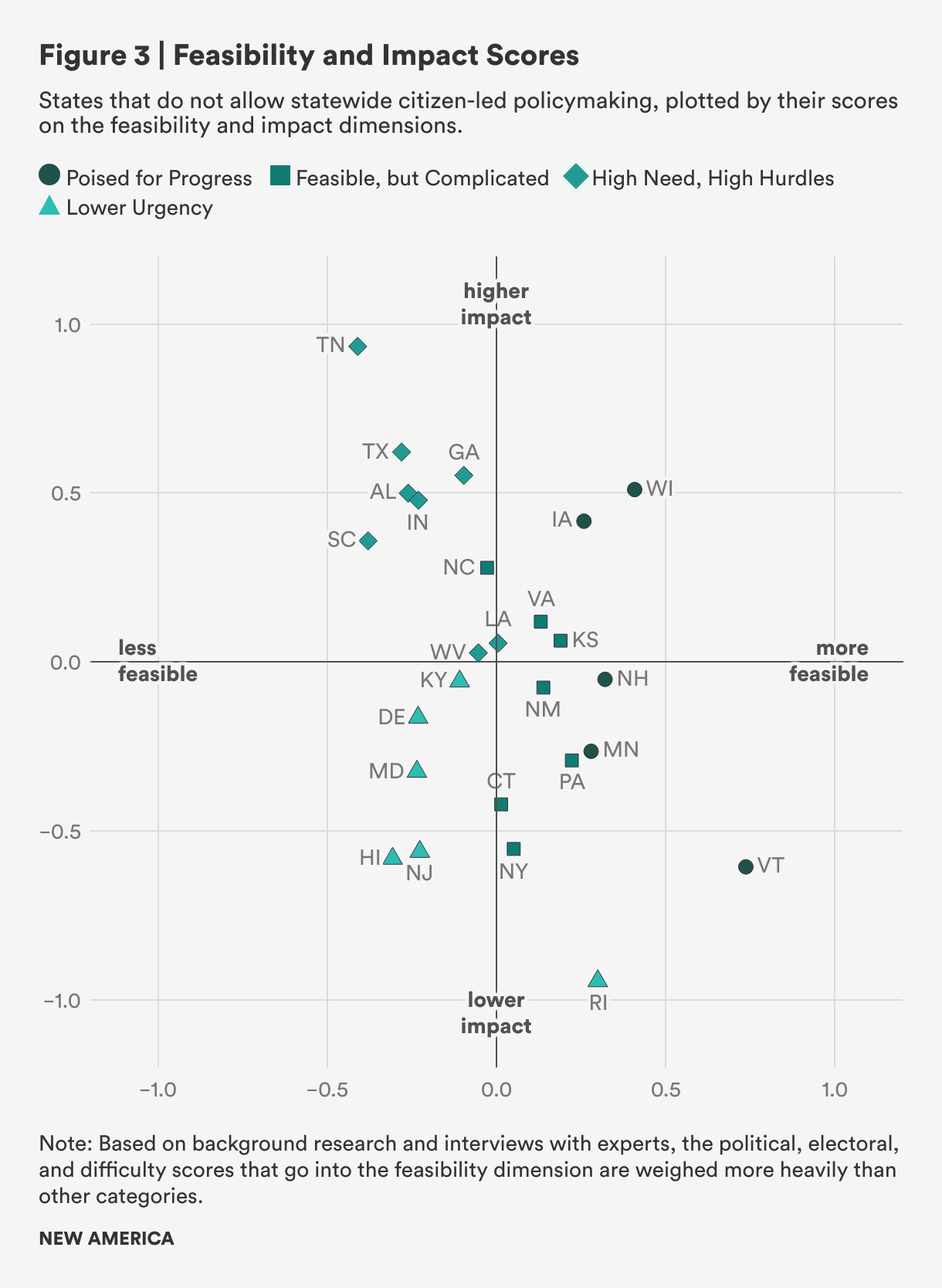
Since overall scores can mask some of this nuance, states were also sorted into four “Strategic Opportunity” groups based in large part on these disaggregated scores. As shown in Table 3 below, states in the “Poised for Progress” group are the top five overall scorers: These states boast the highest feasibility scores, making them strong candidates for near-term efforts despite variable impact scores. “Feasible, but Complicated” states have moderate feasibility and impact scores but face obstacles in one or more major categories, indicating that success is not out of reach but would require more time or investment. “High Need, High Hurdles” states face entrenched systemic challenges to feasibility, yet their high impact potential makes them important targets for longer-term movement-building and investment. Lastly, “Lower Urgency” states exhibit low-to-moderate feasibility but limited impact potential, suggesting that while barriers to legal reform are relatively low, there’s less strategic incentive or sense of urgency to pursue this type of reform.
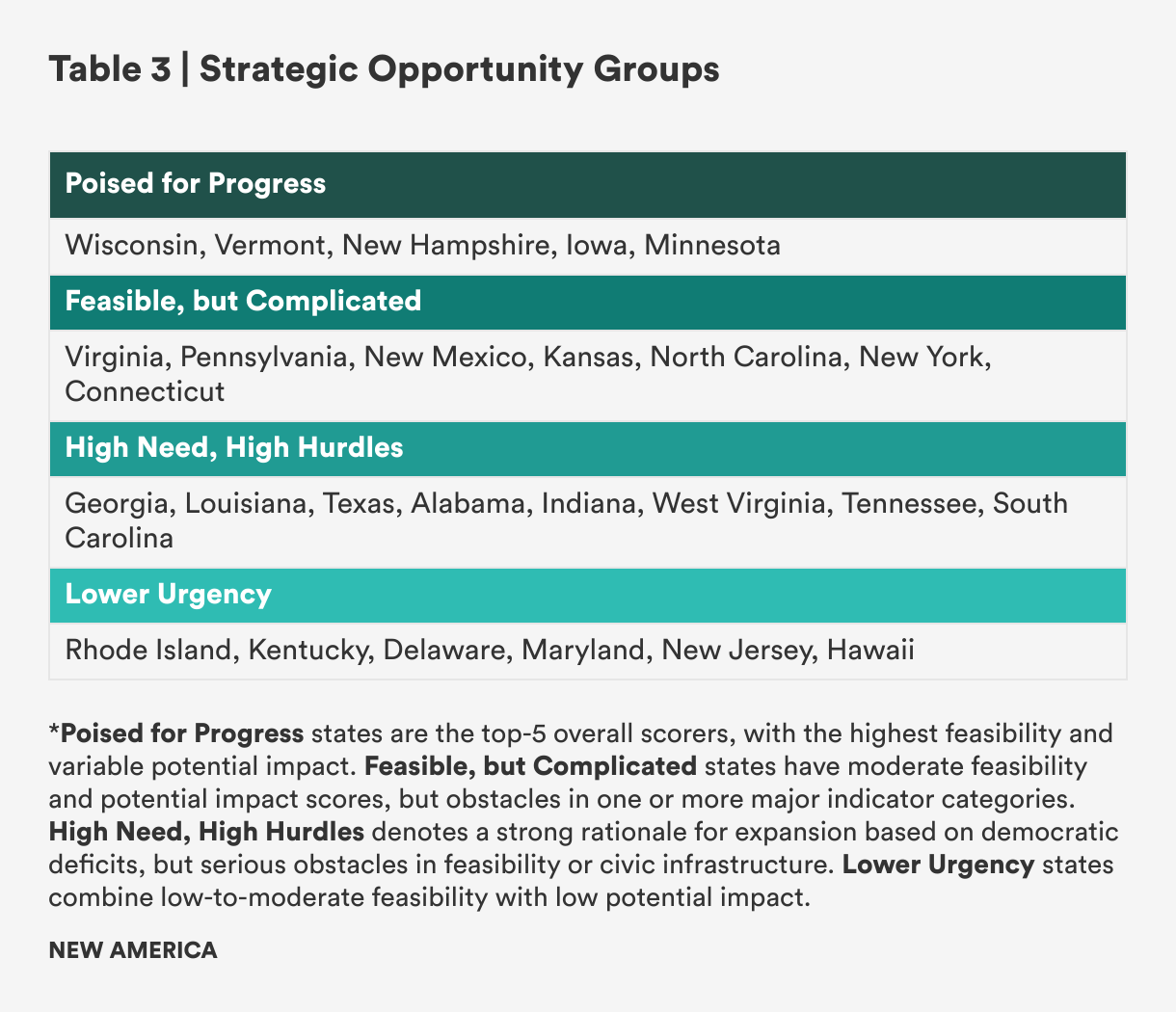
This assessment should not be interpreted to mean that Wisconsin is necessarily the best equipped to execute an initiative adoption campaign or Hawaii the least. With enough public will and investment, every state is capable of running an effective amendment campaign. Given the relative lack of advocacy activity today (inside or outside government) to expand the map of initiative states, this methodology attempts to turn a somewhat blank canvas into a pencil sketch to be filled in as conditions on the ground evolve. Scores reflect baseline, quantifiable conditions, and we fully expect them to shift based on future research on the topic. Most importantly, they will also shift in response to emergent advocacy efforts.
Citations
- For example, see Devin Caughey and Christopher Warshaw, Dynamic Democracy: Public Opinion, Elections, and Policymaking in the American States (University of Chicago Press, 2022).
- Smith and Fridkin, “Delegating Direct Democracy,” source.
- Smith and Fridkin, “Delegating Direct Democracy,” source.
- Caughey and Warshaw, Dynamic Democracy.
Conclusion: The Future of Citizen-Initiated Ballot Measures
At a time of mounting public frustration with government and democratic backsliding, expanding access to ballot initiatives is not merely a promising reform, it is a democratic imperative.
Historically, direct democracy emerged from real-world struggles to overcome corruption, malapportionment, and elite obstruction of broadly popular policies to support the working class. Its expansion was driven by diverse coalitions of reformers—Populists, Progressives, labor organizers, faith leaders, journalists, and others—who believed that ordinary people deserved a direct role in shaping their government. Today’s political challenges, from legislative capture to popular policy obstruction to public cynicism about government, are similar in both substance and urgency.
This project’s next phase will begin to turn analysis into action. It will involve refining the state selection model, conducting deeper policy and legal scans in states, and partnering with on-the-ground advocates to support new or existing coalitions needed to advance reform. Alongside the vital work of defending and strengthening existing initiative systems, this forward-looking strategy seeks to expand democratic rights to the millions of Americans currently denied a direct voice in policymaking.
Appendix
Readiness Score by Category
Table A1 breaks down the overall readiness score of each state by category. These are weighted averages of the individual indicators grouped by category, so the average of these categories is not equivalent to the weighted average of all the pooled indicators used for the rankings.
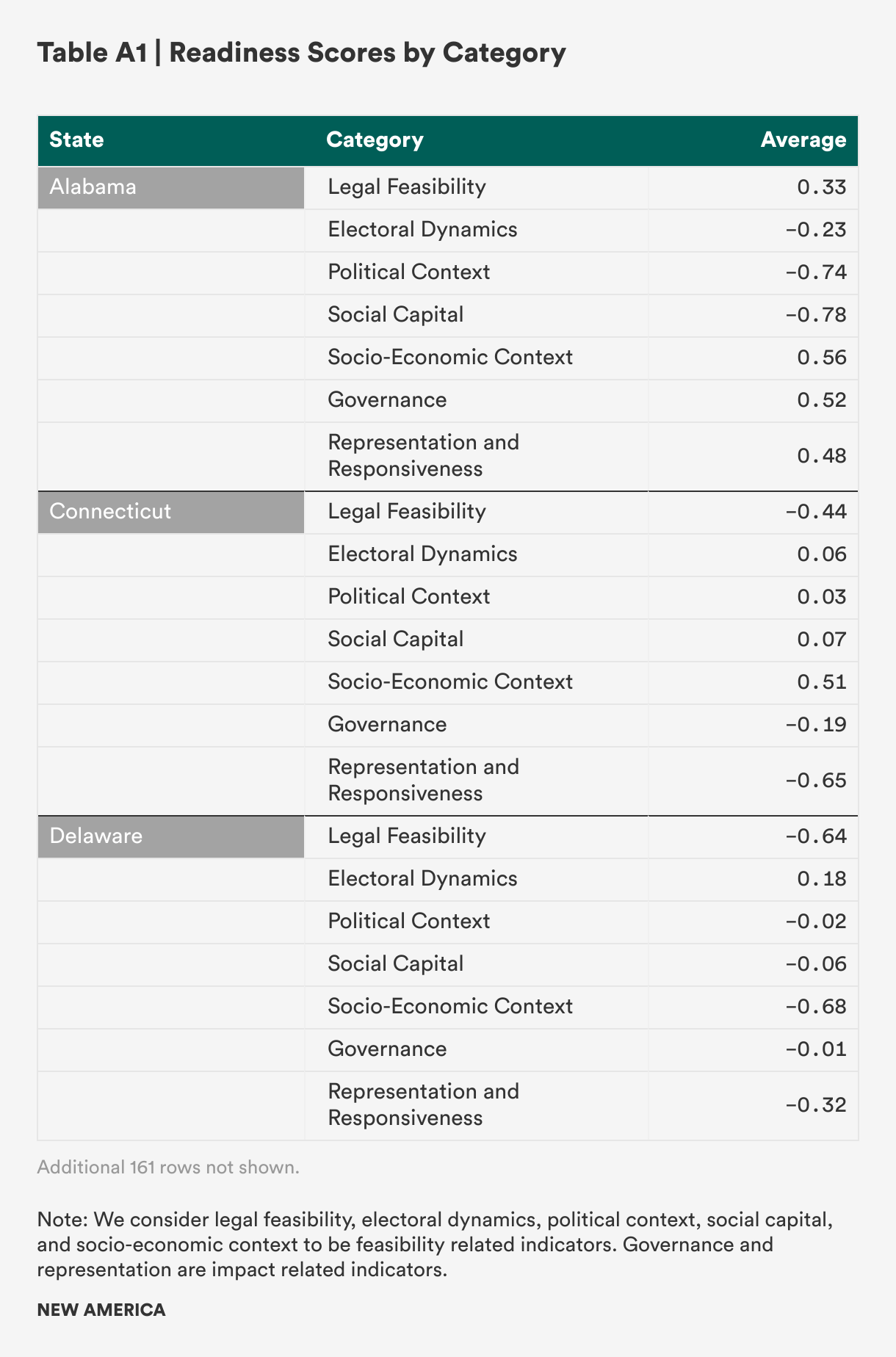
Initiative Type and Adoption History
Table A2 provides state-by-state information on initiative processes and adoption history. States that attempted but failed to adopt initiative processes are also included. For each state, the table indicates which types of initiatives are allowed (if any), the year of and method of adoption or attempted adoption, and, where successful, the relevant constitutional provision that enshrined initiative or referendum into law.
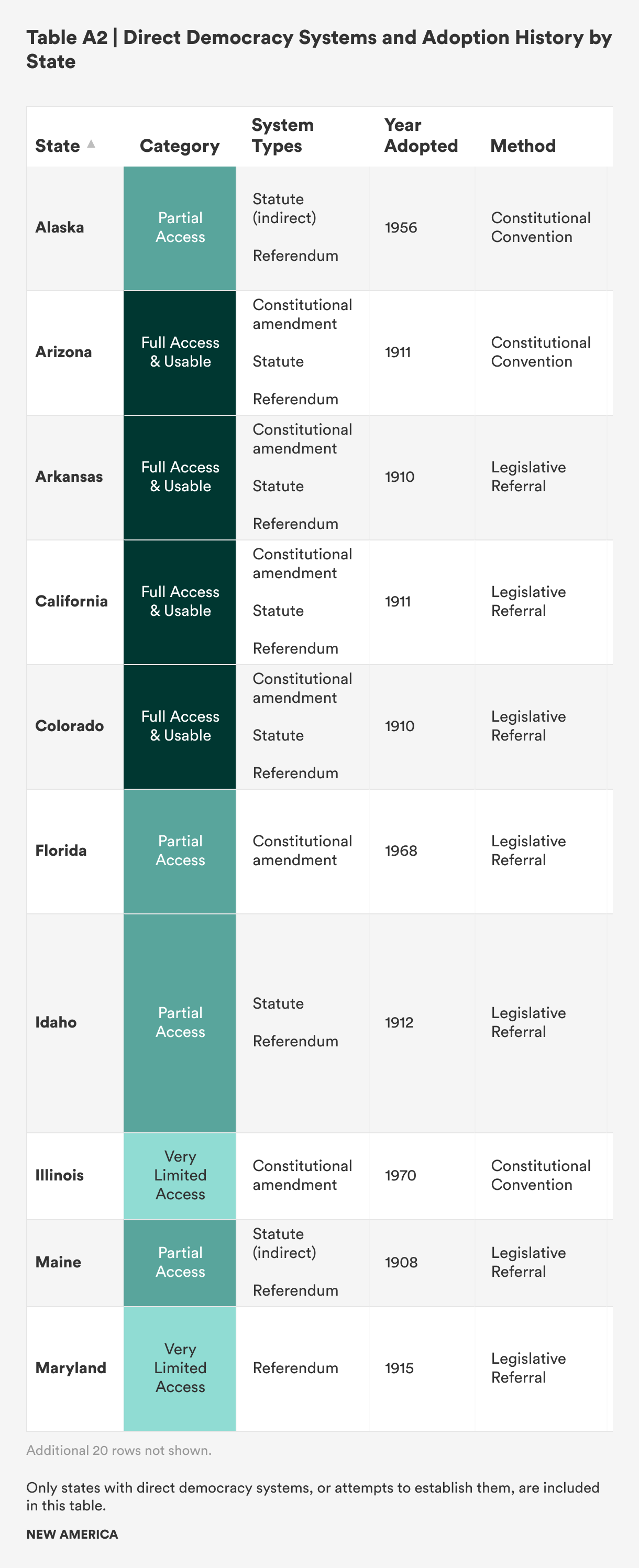
Source and Descriptive Statistics of Variables Used in Readiness Scores
Table A3 lists the source, mean, and range for all the variables used to calculate the readiness scores. Where applicable, the table also lists the year for which the data is relevant. The table shows the mean and range for each variable before standardization.
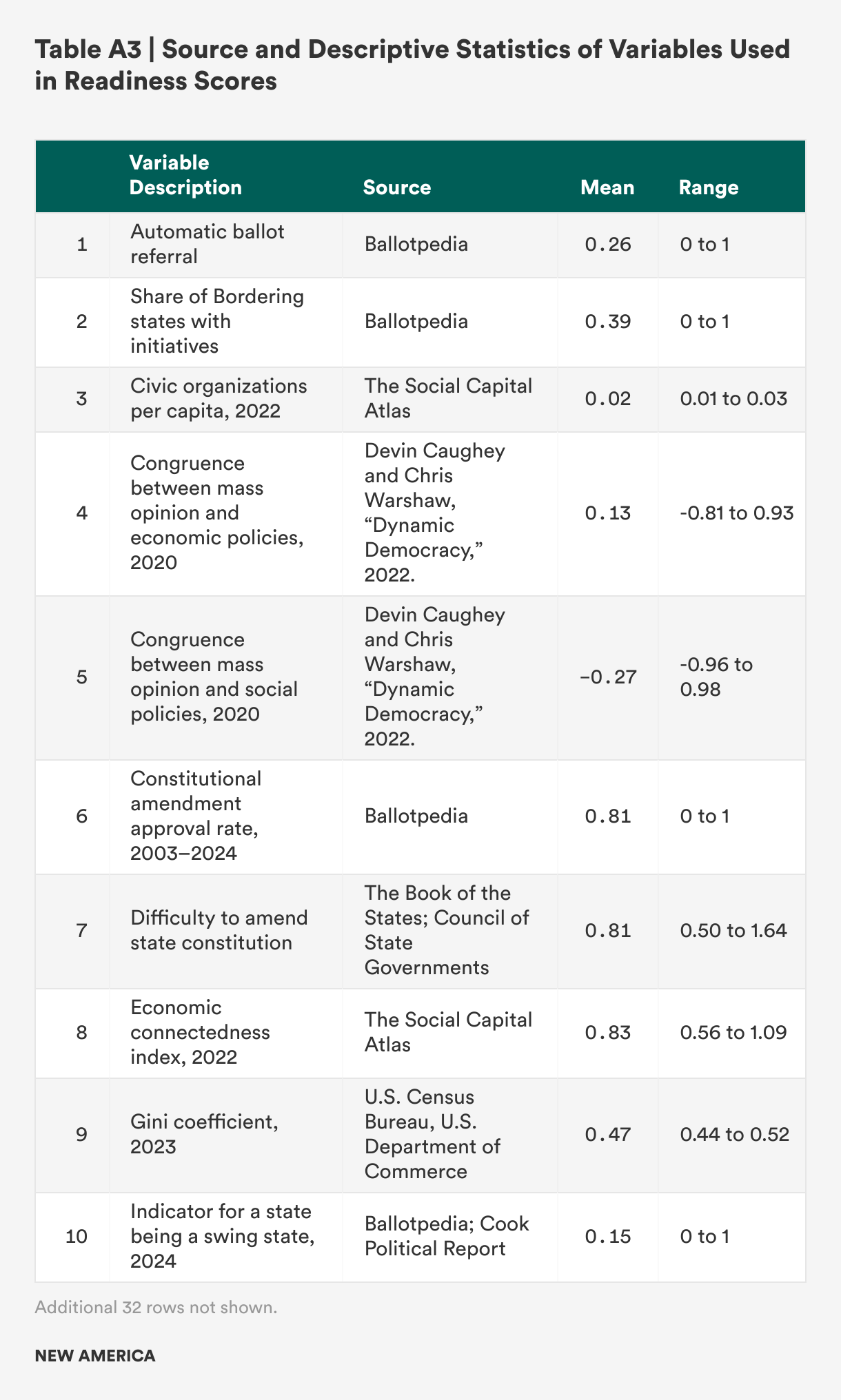
More About the Authors

Mark Schmitt
Senior Director, Political Reform Program

Maresa Strano
Deputy Director, Political Reform Program

Oscar Pocasangre
Senior Data Analyst, Political Reform Program
Issues
Programs/Projects/Initiatives
Related

A Case for (Responsibly) Expanding Citizen-Led Policymaking in the United States