Table of Contents
- Introduction (Lee Drutman and Maresa Strano)
- Support for Ranked-Choice Voting across Race and Partisanship (Joseph Anthony, David C. Kimball, Jack Santucci, and Jamil Scott)
- Ranked-Choice Voting is an Acquired Taste (Joseph Anthony and David C. Kimball)
- Does Ranked-Choice Voting Reduce Racial Polarization? (Yuki Atsusaka and Theodore Landsman)
- Ranked-Choice Voting is No Refuge for Extreme Candidates (Melissa Baker)
- The Future is Proportional: Improving Minority Representation through New Electoral Systems (Gerdus Benadè, Ruth Buck, Moon Duchin, Dara Gold, and Thomas Weighill)
- Choosing to "Vote As Usual" (André Blais, Carolina Plescia, and Semra Sevi)
- Ranked-Choice Voting and Political Expression: Voter Guides Narrow the Gap between Informed and Uninformed Citizens (Cheryl Boudreau, Jonathan Colner, and Scott MacKenzie)
- Ranked-Choice Voting, Runoff, and Democracy: Insights from Maine and Other U.S. States (Joseph Cerrone and Cynthia McClintock)
- RCV is Neither Panacea nor Catastrophe for Minority Representation (Melody Crowder-Meyer, Shana Kushner Gadarian, and Jessica Trounstine)
- Electoral Systems Affect Legitimacy Gaps and Affective Polarization (Sean Fischer, Amber Hye-Yon Lee, and Yphtach Lelkes)
- Multi-seat Districts and Larger Assemblies Produce More Diverse Racial Representation (Michael Latner, Jack Santucci, and Matthew S. Shugart)
- Ranked-Choice Voting Delivers Representation and Consensus in Presidential Primaries (Baodong Liu, Nadia Mahallati, and Charles M. Turner)
- More Expression, Less Error: Alternative Ballots Outperform Status Quo (Jason Maloy)
- Does Ranked-Choice Voting Affect Attitudes Toward Running for Office? (Jamil Scott and Jack Santucci)
- The Missing Link: RCV and Substantive Representation in Local Politics (Arjun Vishwanath)
The Future is Proportional: Improving Minority Representation through New Electoral Systems (Gerdus Benadè, Ruth Buck, Moon Duchin, Dara Gold, and Thomas Weighill)
The Future is Proportional: Improving Minority Representation through New Electoral Systems
By Gerdus Benadè, Ruth Buck, Moon Duchin, Dara Gold, and Thomas Weighill
Citations
Working Paper: Gerdus Benadè, Ruth Buck, Moon Duchin, Dara Gold, and Thomas Weighill, “Ranked Choice Voting and Minority Representation,” February 18, 2021, available at SSRN: https://ssrn.com/abstract=3778021.
Brief: Gerdus Benadè, Ruth Buck, Moon Duchin, Dara Gold, and Thomas Weighill, The Future is Proportional: Improving Minority Representation through New Electoral Systems (Washington, DC: New America, 2021), https://www.newamerica.org/political-reform/reports/the-future-is-proportional/.
Overview
The single transferable vote (STV) is a kind of ranked-choice system that is used to elect multiple representatives from a single zone or district. We have developed a realistic data-driven methodology that voting rights advocates can use to project and compare likely minority representation in local government under both STV and the standard system of plurality voting in single-member districts. We demonstrate this method on four case studies: judicial elections in Terrebonne Parish, Louisiana; the county commission of Jones County, North Carolina; and the city councils of Cincinnati, Ohio and Pasadena, Texas.
Research Questions
- How can we estimate the level of representation a minority group will secure for its preferred candidates under a STV system?
- How do we incorporate local information, such as historical election results, into this estimate? In particular, how can we use single-winner electoral history to generate simulated voter rankings?
- How do STV projections compare with a favorably drawn single-member district (SMD) plurality system?
Key Findings
- STV systems tend to elect candidates of choice for people of color (POC) in proportion tothe POC population.
- Compared to STV, the range of representational outcomes in a SMD plurality system is highly sensitive to the size and residential distribution of the minority group.
- SMD plurality’s ability to generate representation for POC is especially questionable in the case of low voter turnout.
Background and Research Design
When it comes to voting, your preferences matter, but how you express those preferences matters deeply as well. For example, in many city council elections in the United States, voters vote for a number of candidates (up to the number of open seats) and the candidates with the most overall votes are elected. Under these at-large plurality elections, if 51 percent of the population votes for the same full slate of candidates, the other 49 percent of voters are left with nothing. Some localities try to break down this effect by using designated seats, where a candidate must choose to run for Seat 4 or Seat 7, say, but is still voted on by all voters. Even with designated seats, however, as long as the majority slate is distributed over the seats, the effect is the same. For this reason, at-large plurality voting has long been acknowledged as a fundamental reason that racial and ethnic minorities in the United States struggle to gain representation on local governing bodies such as city councils or county commissions.
Across the country, jurisdictions have experimented with several alternative electoral systems. The leading alternative in the United States is single-member district (SMD) plurality elections, where the jurisdiction is carved up into territorial divisions electing one representative each by a first-past-the-post or plurality mechanism. This system has been more successful at generating minority representation than at-large plurality systems by creating districts where a much greater proportion of the population belongs to a specific racial or ethnic group than the level in the state or locality overall. Many courts have even called for the creation of majority-minority districts to remedy a pattern of disenfranchisement for a minority group. However, SMD plurality systems also have well-documented flaws. For example, sometimes the residential pattern of the minority group is too dispersed, so that it is not possible to draw a district that is advantageous to that group. SMDs are also subject to gerrymandering.
Instead, multi-winner ranked-choice voting, also called single transferable vote (STV), is a promising alternative voting system that does not rely on districts. Under STV, each voter ranks the candidates rather than just selecting some of them. If a voter’s first choice is elected or eliminated from contention, voting strength is transferred to their second choice, and so on. An algorithm then tallies the ballots in multiple rounds as votes are transferred, until the elected body is complete. Despite its promising features, only one U.S. city, Cambridge, Massachusetts, uses STV for its city council elections today.1
For this project we wanted to compare these two different remedies—SMD and STV—that could result after voting rights litigation aimed at an at-large plurality system.
This task is extremely challenging because there are many unknowns and very little appropriate historical data. With this in mind, we built on existing election analysis tools used in voting rights law and well-studied statistical models of ranking behavior and supplemented these with alternative models. We combined these elements into a three-step method.
Step 1. Learn from historical elections. Look at multiple past elections to measure the level of racial polarization. Voting is racially polarized when a minority group tends to vote cohesively for a candidate of choice, and the majority group votes as a bloc for other candidates. Because of the secret ballot, obtaining the necessary racial and ethnic voter information requires the use of statistical inference. (Here, we used standard ecological inference techniques from voting rights litigation.)
Step 2. Simulate rankings and project STV outcomes. Feed the polarization parameters from Step 1 into four different models to simulate voter behavior in hypothetical STV elections. Each of our models has additional parameters to account for candidate strength—is there a clear favorite among the minority-preferred candidates, for instance, or do voter preferences distribute evenly? Run each model with a range of parameters to produce outputs over a wide variety of plausible scenarios. This provides a more complete picture of the possible outcomes under STV.
Step 3. Compare favorable districting plans. Search the universe of all districting plans (i.e., ways of breaking up the locality into districts) to find configurations with large numbers of majority-minority districts. This gives an indication of how well SMDs might perform under favorable conditions, such as roughly equal turnout between majority and minority voters.2
Findings and Implications
We ran our methodology on four case studies: (1) the judicial court serving Terrebonne Parish, Louisiana, (2) the city council of Cincinnati, Ohio, (3) the county commission for Jones County, North Carolina, and (4) the city council of Pasadena, Texas.
Terrebonne Parish, Jones County, and Pasadena were each recently challenged under the Voting Rights Act for their system of election. In Jones County and Pasadena, these challenges resulted in a change from an at-large system (or in the case of Pasadena, a hybrid at-large and district system) to an SMD system. The plaintiffs in Terrebonne Parish lost on appeal, and so no change was implemented. Additionally, Cincinnati provides an interesting case because it historically employed STV before switching to at-large plurality voting in the 1950s. We specifically chose our four case studies to be diverse in terms of geographic location, size of the governing body, size of the minority group, and voter turnout. Our case studies are far from an exhaustive picture of possible settings for STV, but together with previous work in Santa Clara, California; Chicago, Illinois; Lowell, Massachusetts; and Yakima County, Washington, we are starting to put together a strong portfolio that is varied in scale, demographics, and region.
The table below summarizes the results of the four case studies. We used the proportion of the citizen voting age population (CVAP) belonging to the community of interest (Latino voters in Pasadena and Black voters in the others) as a benchmark for proportional representation.3 The two rightmost columns show the projected levels of POC representation under STV and SMD plurality. Seat share under STV captures the typical range of seat share won by minority-preferred candidates across simulated STV elections. For representation under a SMD plan, we estimated the number of districts which could reliably offer an opportunity to elect POC candidates of choice.4
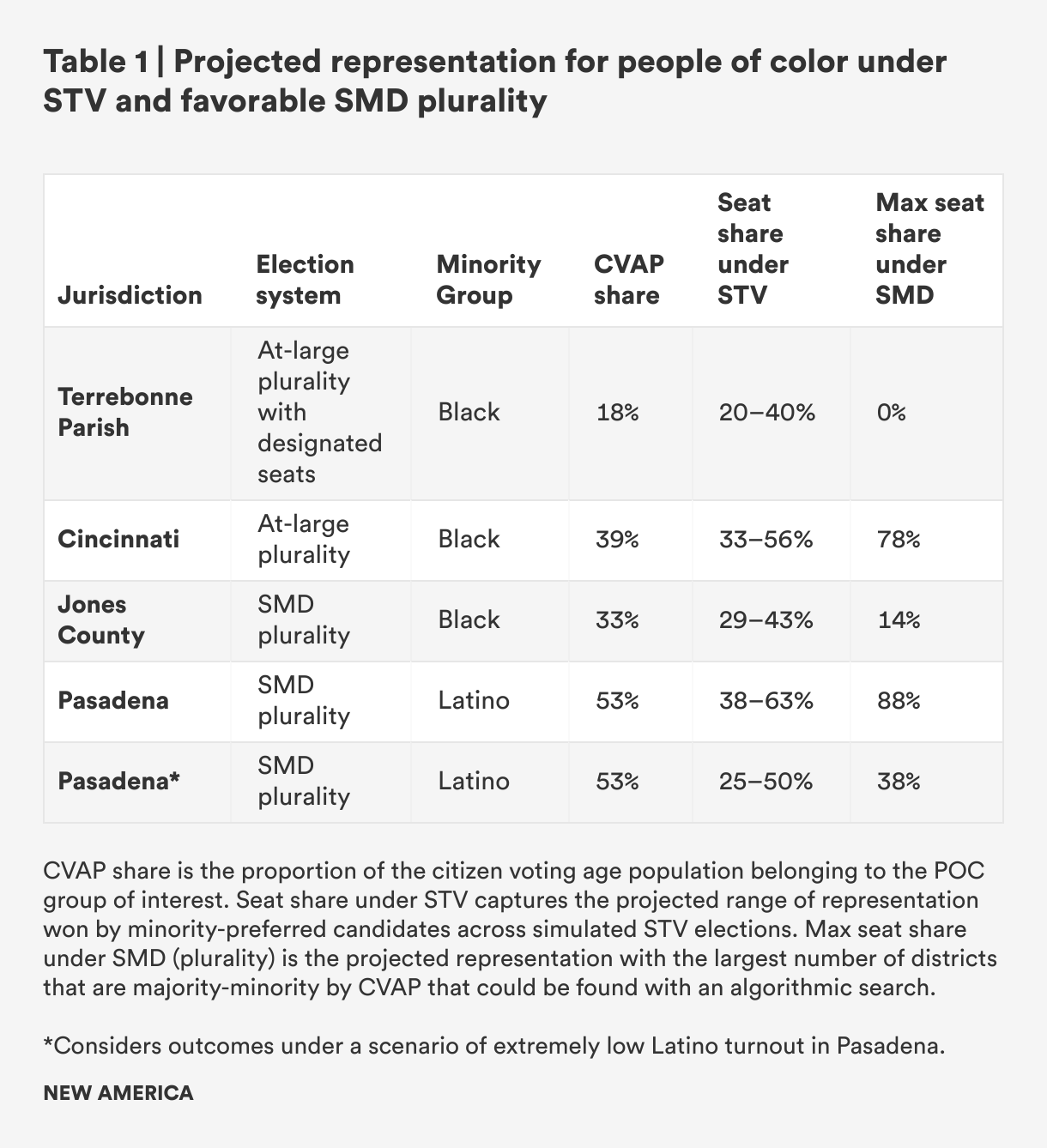
The table illustrates our main finding: across four case studies, multiple statistical models, and a wide range of assumptions, STV indeed projects roughly proportional representation for people of color.
The comparison with the SMD outcomes is stark: our algorithmic search could not find a single plan containing majority-Black districts in Terrebonne Parish, nor any plans that track closely to proportionality in Jones County. This is because the Black population is too small and dispersed in those places for districts to be an effective remedy. On the other hand, the Black population in Cincinnati and the Latino population in Pasadena are large and concentrated, making it possible with careful line-drawing to break through the proportionality ceiling. Such carefully orchestrated districting has major drawbacks, however, because it relies on narrow majorities in each district. The beneficial outcomes are unstable if population shifts over time and are highly vulnerable to the possibility of low minority turnout, as we demonstrate with Pasadena (where low turnout was specifically cited as a major obstacle to Latino representation by the court). In contrast, we find that proportionality under STV holds up under variations like a very low level of Hispanic turnout in Pasadena.
Combining the results of these case studies, a clear picture comes into view. STV will stably and reliably secure representation for people of color in line with their population share, whereas districts can have a wide range of performance. SMD systems sometimes shut out a substantial minority group entirely, no matter how the lines are drawn; in other instances, they can produce representation at rates significantly greater than what is proportional for groups that are large enough and whose residential geography is concentrated just right. But advocates face tricky decisions in district-drawing with respect to turnout and residential shifts if they want to produce plans that will hold up over time. These concerns are simply not present in STV, because proportionality is a structural property.
Conclusion
In this project, we consider the potential for the single transferable vote, a form of multi-winner ranked-choice voting, to better protect voting rights for historically disenfranchised communities, compared to the more standard plurality district approach. Though there is no one-size-fits-all projection for STV outcomes, we have developed a flexible and powerful methodology for exploring the range of outcomes under different models of voter behavior and local electoral conditions which builds on the foundation of established legal practice under the Voting Rights Act of 1965. The early lessons from applying these models in four case studies indicate that while representation under districted plurality systems can vary widely, STV consistently provides proportional (or slightly better) representation for minority groups. The full report presents our method in greater detail and the accompanying web tools (such as this app) allow you to try it for yourself.
Acknowledgments: We are grateful for the suggestions and input from participants of the Electoral Reform Research Group (ERRG) workshop in February 2020. This project was funded by New America through their ERRG initiative, with support from Arnold Ventures. We thank our colleagues in the MGGG Redistricting Lab and at Tisch College for their instrumental support of the project.
Citations
- This is in contrast to single-winner ranked-choice voting, which is used for local elections in about 20 U.S. cities as well as statewide in Maine.
- For this purpose, we use a powerful computational algorithm called ReCom, developed by the MGGG Redistricting Lab. See Daryl DeFord, Moon Duchin and Justin Solomon, “Recombination: A family of Markov chains for redistricting”, arXiv preprint, source.
- In each of these four jurisdictions, the identified minority group was the only one of significant size.
- In legal settings, majority-minority CVAP districts are a standard stipulation in decisions and consent decrees, even though such districts are an admittedly imperfect proxy for electoral opportunity. Counting POC electeds is not an adequate substitute, both because it ignores the important fact that minority candidates of choice can belong to any demographic group and because of the quirks of candidate availability.