Table of Contents
- Introduction (Lee Drutman and Maresa Strano)
- Support for Ranked-Choice Voting across Race and Partisanship (Joseph Anthony, David C. Kimball, Jack Santucci, and Jamil Scott)
- Ranked-Choice Voting is an Acquired Taste (Joseph Anthony and David C. Kimball)
- Does Ranked-Choice Voting Reduce Racial Polarization? (Yuki Atsusaka and Theodore Landsman)
- Ranked-Choice Voting is No Refuge for Extreme Candidates (Melissa Baker)
- The Future is Proportional: Improving Minority Representation through New Electoral Systems (Gerdus Benadè, Ruth Buck, Moon Duchin, Dara Gold, and Thomas Weighill)
- Choosing to "Vote As Usual" (André Blais, Carolina Plescia, and Semra Sevi)
- Ranked-Choice Voting and Political Expression: Voter Guides Narrow the Gap between Informed and Uninformed Citizens (Cheryl Boudreau, Jonathan Colner, and Scott MacKenzie)
- Ranked-Choice Voting, Runoff, and Democracy: Insights from Maine and Other U.S. States (Joseph Cerrone and Cynthia McClintock)
- RCV is Neither Panacea nor Catastrophe for Minority Representation (Melody Crowder-Meyer, Shana Kushner Gadarian, and Jessica Trounstine)
- Electoral Systems Affect Legitimacy Gaps and Affective Polarization (Sean Fischer, Amber Hye-Yon Lee, and Yphtach Lelkes)
- Multi-seat Districts and Larger Assemblies Produce More Diverse Racial Representation (Michael Latner, Jack Santucci, and Matthew S. Shugart)
- Ranked-Choice Voting Delivers Representation and Consensus in Presidential Primaries (Baodong Liu, Nadia Mahallati, and Charles M. Turner)
- More Expression, Less Error: Alternative Ballots Outperform Status Quo (Jason Maloy)
- Does Ranked-Choice Voting Affect Attitudes Toward Running for Office? (Jamil Scott and Jack Santucci)
- The Missing Link: RCV and Substantive Representation in Local Politics (Arjun Vishwanath)
Choosing to "Vote As Usual" (André Blais, Carolina Plescia, and Semra Sevi)
Choosing to "Vote As Usual"
By André Blais, Carolina Plescia, and Semra Sevi
Citations
Working paper: Blais, Carolina Plescia, and Semra Sevi, “Choosing to vote as usual,” February 12, 2021, available at SSRN: https://ssrn.com/abstract=3784822.
Brief: Andre Blais, Carolina Plescia, and Semra Sevi, Choosing to “Vote As Usual” (Washington, DC: New America, 2021), https://www.newamerica.org/political-reform/reports/choosing-to-vote-as-usual/.
Overview
This research brief reports results from two independent yet complementary surveys to examine which voting system citizens prefer. The first survey targeted states that held 2020 Super Tuesday Democratic primaries and used the real candidates, and the second was nationally representative with fictitious candidates. In both surveys, respondents were invited to vote using four different voting rules—single, approval, rank, and point (score)—and then asked how satisfied they were using each system.
Research Questions
- What is the degree of support for single, approval, rank, and point (score) voting systems?
- Which subgroups of the population are most (and least) favorable to each system?
Key Findings
- The single vote remains the most preferred voting method.
- Citizens’ views are strongly correlated with age, with the eldest being much more favorable to the single vote. Surprisingly, these views do not vary across education levels.
- Those who have had personal experience with ranked ballots are more positive toward ranked-choice voting, which suggests the presence of a status quo bias.
Background and Research Design
Electoral reform has resurfaced on the political agenda in the United States. An increasing number of jurisdictions have already switched to ranked-choice voting. Some cities are starting to consider approval voting as well. But, how do citizens assess different ways of voting?
We provide a systematic analysis of citizens’ attitudes towards four different voting systems—single, approval, rank, and point (or score)—based on two separate but complementary surveys conducted in the context of the 2020 Super Tuesday primary elections, one with real Democratic primary candidates and one with hypothetical candidates. The reference point is the single vote, where citizens are asked to vote for one single candidate. The other three options ask voters to cast multiple votes. Under approval voting, voters are invited to vote for as many candidates as they wish, that is, all those that they “approve.” Then there is ranked-choice voting (RCV), where voters are invited to rank the candidates on an ordinal scale, first preference, second, third, and so on. The last option is point voting, also known as score voting. Under such a rule, voters give each candidate points (or scores) and the candidate with the highest number of points (or average score) is elected. The specific system that we used in our study allows voters to give between zero and five points to each candidate.
Among these four voting systems, the one that affords the greatest freedom of expression is the point system (i.e., not only can voters rank the candidates, but they can indicate the intensity of their preferences by giving very low or high scores, and they can also reveal their indifference by giving the same number of points to different candidates), followed by RCV, approval voting, and the single vote. If people value expressiveness in their voting options, they should give the highest rating to point voting and the lowest to single vote. However, people’s ratings may be influenced by “status quo bias”: They may believe that the system that they know the best is the best, regardless of how expressive it is. Among American voters, status quo bias should work in favor of the single vote method, and against the other three options.
To better understand how status quo bias and ballot expressiveness influence Americans’ views on different voting methods, we conducted two studies. Study 1 refers to real candidates from the 2020 Super Tuesday Democratic primary; only citizens eligible to vote in the Democratic primaries were able to participate. The candidates we put on the ballot were the six most prominent candidates at the time: Joseph Biden, Michael Bloomberg, Pete Buttigieg, Amy Klobuchar, Bernie Sanders, and Elizabeth Warren. In Study 2, we used hypothetical candidates, enabling us to measure the views of the entire U.S. population. The names of the candidates are fictional and were chosen to vary in both gender and ethnicity. Respondents were given information on each candidate’s age and top policy priority. Doing the survey with both real candidates in select states and hypothetical candidates nationwide has also allowed us to ascertain the robustness of our findings.
The questionnaire and design were exactly the same for both studies: Participants were asked to vote four times successively, with the same candidates, using each of the four voting systems. The order in which the voting systems appeared was randomized. Evaluations of the four voting systems were tapped in two different ways. First, immediately after casting their vote within a given system, respondents were invited to indicate how satisfied they were with that system on a scale of zero to 10. Second, after they had cast their vote with all four systems, they were asked which one they liked the best.
Findings and Implications
Figure 1 presents the distribution of responses to the questions asked immediately after voters cast their vote for each system. The ratings presented are normalized to take into account the fact that some respondents systematically used higher (or lower) scores. Each score is divided by the total scores given to the four systems and multiplied by 10. For instance, for a person who gives ratings of 8, 8, 4, 0, her normalized scores are 4, 4, 2, 0. In this way, the sum of ratings for the four systems equals 10 for each respondent, and the average rating is 2.5.
The normalized mean rating is 3.36 and 3.08 for the single vote in Study 1 and 2 respectively, compared to 2.22 and 2.31 for the three other options, with little difference between these three within and across the two studies. The results are similar in both studies: The single vote is clearly the most popular way of voting.
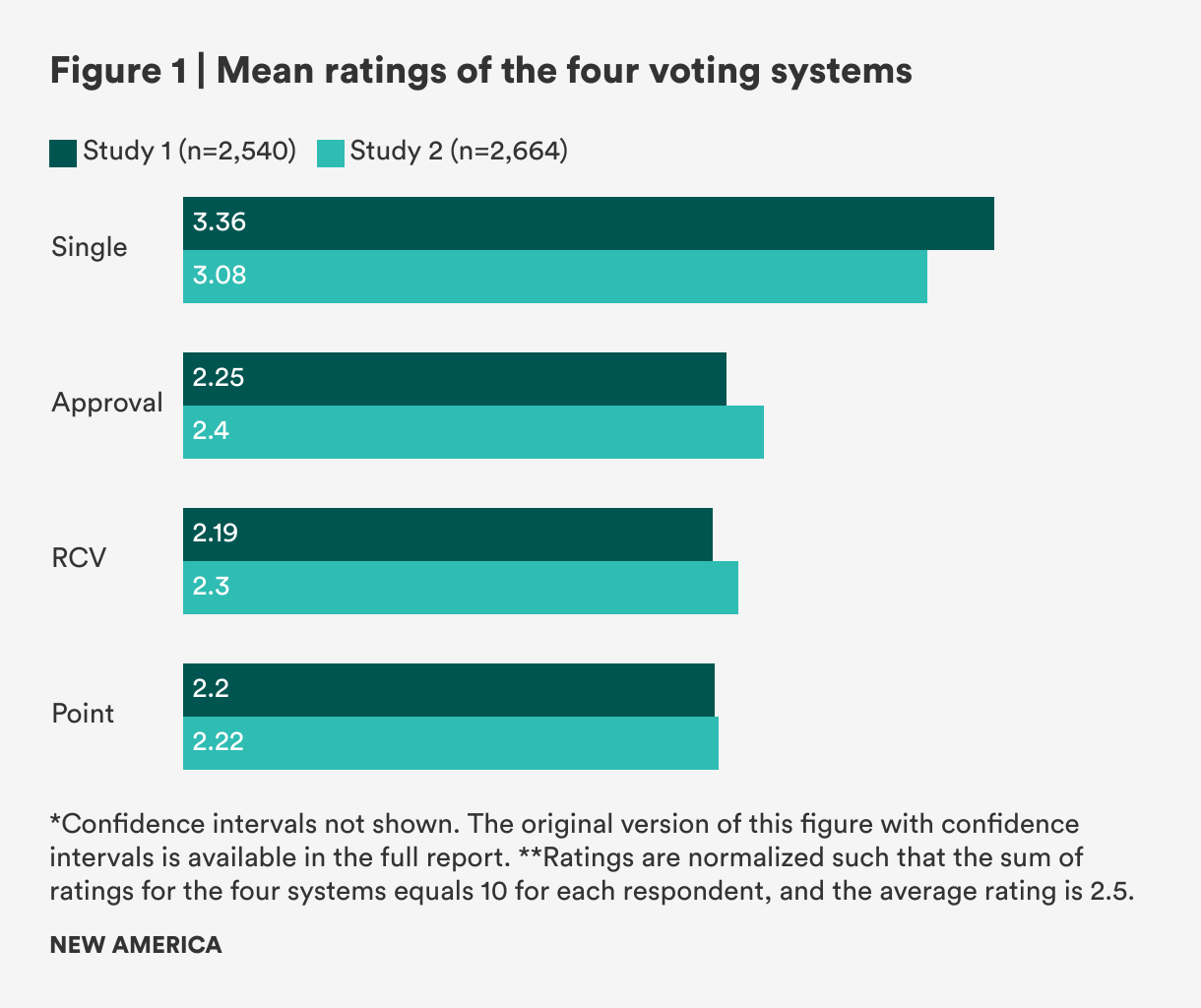
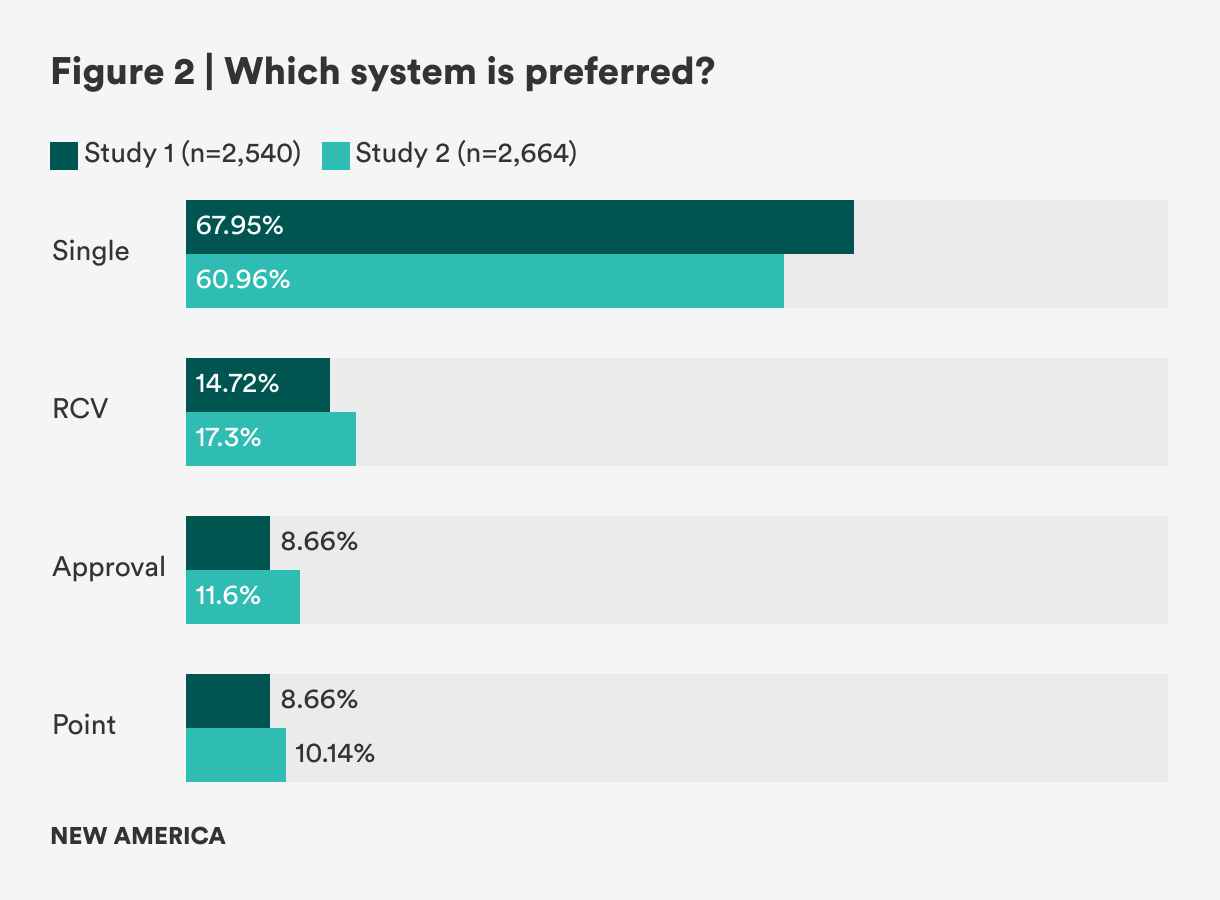
Figure 2 shows the percentage of voters indicating a preference for each voting system at the end of the survey. In both cases, more than 60 percent of the respondents select the single vote and less than 20 percent select each of the three other options. The pattern of preferences is the same as shown in Figure 1 but the contrast between the single vote and the new voting methods is starker. This reflects the fact that many respondents give similar ratings to the various options. Indeed, 46 percent of respondents in Study 1 and 47 percent in Study 2 give their highest ratings to at least two options. Furthermore, these ties usually include the single vote. As expected, most of the time people choose the most familiar option, the single vote.
As shown in our full report, evaluations of the different systems are unrelated to education in both studies. Insofar as education can be regarded as a proxy for cognitive ability, we expected less educated respondents to prefer the single vote method because it is the simplest. In fact, our results indicate they do prefer the single vote—but so do the better educated. This suggests that complexity is not a principal factor in people’s evaluations of various voting methods. Likewise we observe little to no correlation between respondents’ gender, race, and ideology, and their preference for different voting methods.
Age is by far the most powerful cleavage. The older the respondent, the greater the support we see for the single vote versus each of the three other options. Among the elderly, the single vote is clearly the preferred option. Our results also show that those who identify as Republican overwhelmingly prefer the single vote and dislike the other systems, especially RCV. Finally, those who have personal experience with the RCV ballot tend to give higher ratings to that system, and lower ratings to the single vote. In short, it appears that when it comes to different voting systems, familiarity and satisfaction are positively associated.
These findings suggest that the single vote is the most popular system because of status quo bias. The fact that age is a powerful factor while education is not is consistent with that interpretation. So is the fact that the dominant contrast is between the single vote and the three less familiar options. The status quo is preferred by all but the youngest respondents, who are more open to other ways of voting, as well as those who have already used another voting system (RCV).
Conclusion
Our main finding is clear and consistent across the two studies: There is no strong demand among Americans for abandoning the single vote. Yet, resistance to alternative voting systems is not very strong either. More importantly, resistance does not appear to stem from a taste for simplicity, as ratings of the various voting methods are not related to education. Support for the single vote is rather the reflection of a status quo bias, as it is strongly correlated with age.
This research suggests that support for voting reform in the United States is unlikely to be based on frustration with the single vote’s limitations on expression per se. This does not mean that the reform movement has no future. On the one hand, more Americans are likely to become familiar with RCV in the years to come, which is bound to weaken the status quo bias. On the other hand, some of the arguments in favor of reform pertain to its effects on the supply of candidates and their campaign strategies. It remains to be seen how people react to these arguments. Further research is needed to take into account these other considerations.
Acknowledgments: The authors would like to thank Jason Maloy and Lee Drutman. We also received valuable guidance from participants at the Electoral Reform Research Group (ERRG) conference in February 2020 in Washington, DC. Data collection for this project was funded by New America through their ERRG initiative, with support from Arnold Ventures. The data themselves are available on request from the authors.
- The Future is Proportional: Improving Minority Representation through New Electoral Systems (Gerdus Benadè, Ruth Buck, Moon Duchin, Dara Gold, and Thomas Weighill)
- Ranked-Choice Voting and Political Expression: Voter Guides Narrow the Gap between Informed and Uninformed Citizens (Cheryl Boudreau, Jonathan Colner, and Scott MacKenzie)