Table of Contents
- Executive Summary
- Introduction
- Mass Incarceration in the U.S.
- Congress Weighs In: Higher Education in Prison
- Research on Correctional Education
- Current Landscape of Higher Education & Job Training in Prison
- Study
- Results
- Discussion
- Policy Implications/Recommendations
- Conclusion
- Appendix A: Methodology
- Appendix B: Description of PIAAC Proficiency Levels on the Literacy Scale
- Appendix C: Description of PIAAC Proficiency Levels on the Numeracy Scale
Discussion
We attended a college graduation during a prison site visit in June, and the tangible excitement and pride from the graduates, family members, and instructors were contagious. Upon leaving the graduation, one of the family members, with a wide grin and a gleam of hope in her eyes said, “My son graduated today and I am right proud of him! Usually I leave here feeling sad and down. But not today! I am leaving with so much joy and happiness.” Unfortunately, this mother’s sense of pride is rarely experienced by family members with loved ones who are in prison, as this report reveals that fewer than 10 percent of incarcerated adults complete a postsecondary education during their sentence.
But while fewer than 10 percent of incarcerated adults in U.S. federal and state prisons complete a postsecondary credential, nearly 7 in 10 (69 percent) say they want to continue their education post-high school, whether or not they expect to be released soon. As this report finds, although there is a significant gap between incarcerated adults and the general public in both literacy and numeracy skills, participation in and completion of postsecondary education and job training programs mitigate the proficiency gap. Those who participate in and/or complete these correctional programs have comparable literacy and numeracy scores to the general public, closing the gap considerably. Individuals who complete and participate in either college or job training during their time in prison have median scores in the 50th percentile of the general public for literacy and numeracy.
As the overwhelming majority of those in federal and state prisons will rejoin society, it is imperative to prepare individuals to transition with effective rehabilitative programs. The culture of prisons as a place of continuous punishment, with few opportunities to rehabilitate, must be reformed. The very nature of isolation and confinement; limited communication with family, friends, and the outside world; and the challenges of navigating unspoken norms of prison culture leave many individuals ill-equipped to transition back into the fast-paced, technologically advanced 21st century environment. Missing the opportunity to maximize time during incarceration with meaningful rehabilitative programs that will help individuals integrate back into society further disadvantages justice-involved individuals.
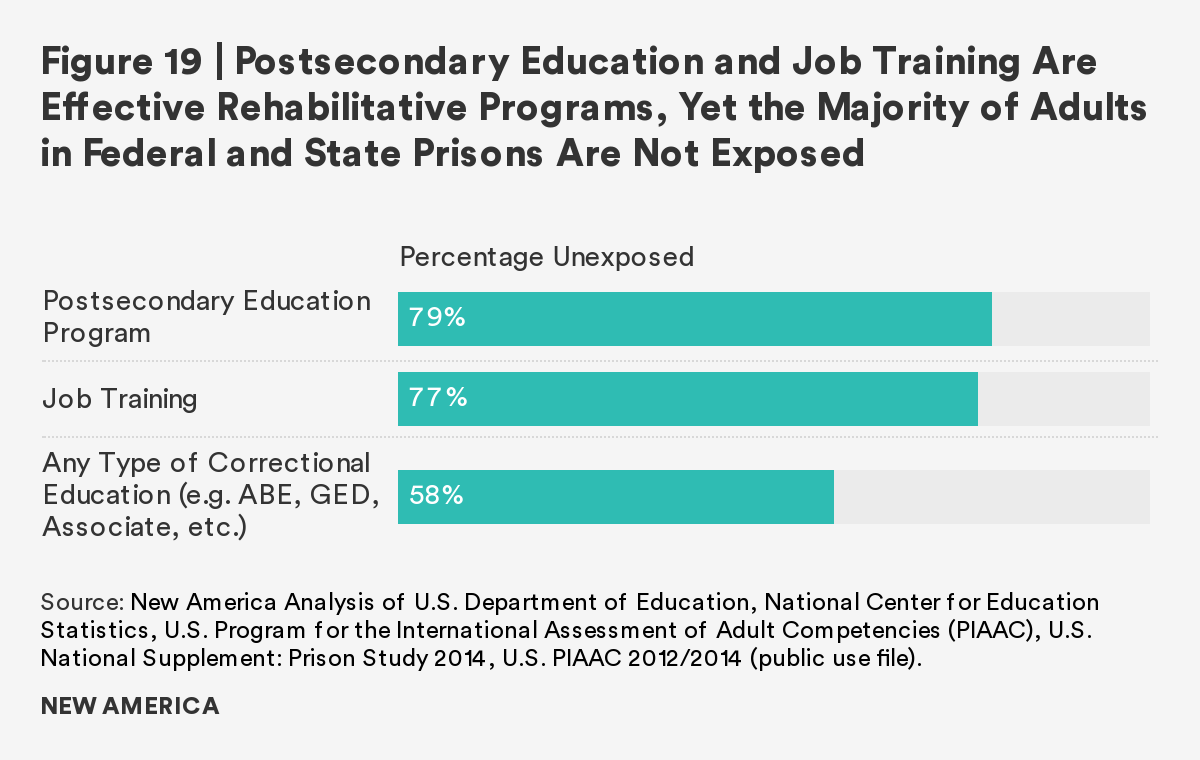
This report shows that postsecondary education and job training programs are effective rehabilitative programs to equip individuals with the critical skills necessary for employment post-release. Yet our findings also reveal that 79 percent of adults in federal and state prisons are released with absolutely no exposure to a postsecondary education, 77 percent leave without participation in a job training program, and 58 percent leave with no exposure to any type of correctional educational programming (e.g. ABE, GED, etc.).
We spoke with students in various prisons and learned that many currently incarcerated adults in federal and state prisons were never employed prior to serving their time. That makes preparing individuals with skills for employment even more critical. If the infrastructure, correctional staff buy-in, political will, and resources are not invested to shift prisons to rehabilitation, individuals will continue to be released from prison unprepared and less likely to succeed in their efforts to reenter society.