English Learners with Disabilities: Shining a Light on Dual-Identified Students
Abstract
The following brief provides an overview of the separate but intersecting federal policies that govern the identification of and services provided to English learners and students with disabilities. This overview will frame key opportunities to serve ELs with disabilities more equitably with the aim of helping policymakers, advocates, and practitioners take more strategic action on behalf of these students.
Acknowledgments
Special thanks to Elizabeth Burr, Gregory Cheatham, and Patricia Snyder for reviewing drafts of the paper. We also appreciate our New America colleagues Amaya Garcia and Sabrina Detlef for their editorial support, as well as Riker Pasterkiewicz, Julie Brosnan, Maria Elkin, and Naomi Morduch Toubman for their graphics and communications support. New America’s PreK–12 team is generously supported by the Bill & Melinda Gates Foundation, the Heising-Simons Foundation, the Hewlett Foundation, the W. K. Kellogg Foundation, the McKnight Foundation, and the W. Clement and Jessie V. Stone Foundation. The views expressed in this report are those of the authors and do not necessarily reflect the views of these foundations.
Downloads
Introduction
Nearly 5 million public school students in the United States are classified as English learners (ELs), a number on the rise in recent decades. From 2000 to 2015, ELs increased from 8.1 to 9.6 percent of the total student population, according to the most recent data from the National Center for Education Statistics.1 Within this group of EL students, nearly 15 percent also qualify for special education services.2 These students are commonly referred to as “dual-identified,” entitled to receive extra supports for both English language acquisition and learning with a disability.
But this subgroup of dual-identified students is not well understood or well served. Across the country, districts, schools, and educators struggle to discern whether students are lagging because of disability, language proficiency, or both, and then further struggle to provide appropriate instruction and related services that meet the comprehensive needs of each individual student.
Designing policies and practices that meet the diversity of language development and disability needs is inherently difficult work. Indeed, delivering appropriate services and supports for students with disabilities from monolingual, English-speaking families is, by itself, a complex challenge for schools. The work of appropriately identifying and serving students becomes all the more complicated when a student is learning across multiple languages. Disentangling issues of language acquisition and disability in the youngest years, when children are learning to speak, read, and write for the first time, is even more difficult.
One of the largest policy concerns is the disproportionate identification of EL students with learning disabilities. This problem cuts in both directions: Studies suggest that ELs are at risk of being both over- and under-identified for special education services. The EL student population also faces challenges beyond language acquisition. ELs are more likely than non-ELs to live in low-income families, to attend schools with high concentrations of other low-income ELs, and to experience limited or interrupted formal schooling, high mobility, low attendance, and medical problems stemming from unreliable access to health care.3 The EL population is enormously diverse, representing different races, ethnicities, nationalities, and languages spoken. It is also not a static population, as students who are classified as ELs will be reclassified as English proficient.4 These realities further complicate the process of developing equitable and effective strategies for dual-identified EL students.
The following brief provides an overview of the separate but intersecting federal policies that govern the identification of and services provided to English learners and students with disabilities. This overview will frame key opportunities to serve ELs with disabilities more equitably with the aim of helping policymakers, advocates, and practitioners take more strategic action on behalf of these students.
Citations
- U.S. Department of Education, National Center for Education Statistics (website), “The Condition of Education: English Language Learners in Public Schools,” updated April 2018, source.
- Ruby Takanishi and Suzanne Le Menestrel, eds., “Dual Language Learners and English Learners with Disabilities,” in Promoting the Educational Success of Children and Youth Learning English: Promising Futures (Washington, DC: The National Academies Press, 2017), source.
- Jarice Butterfield, Meeting the Needs of English Learners with Disabilities Resource Book (Santa Barbara County, CA: SELPA Administrators of California Association, 2014), 16; and Charles T. Clotfelter, Helen Ladd, Jacob Vigdor, and Justin Wheeler, “High Poverty Schools and the Distribution of Teachers and Principals,” North Carolina Law Review (2007): 1345–1379.
- For more on understanding English Learner data, see Janie Tankard Carnock, Seeing Clearly: Five Lenses to Bring English Learner Data into Focus (Washington, DC: New America, 2017), source.
The Federal Policy and Funding Landscape
To understand the current structures impacting dual-identified students, it is critical to understand the intersecting federal education policies that apply. Even as there is huge variation in the details of implementation, federal parameters represent the starting point and minimum standard for what state and localities must do to serve dual-identified students.
Federal policy addresses the education of EL students and those with disabilities in parallel yet distinct ways. Legislation and civil rights rulings separately protect both groups, requiring that schools accurately identify students for each category and provide extra instructional supports and services.1 In both cases, federal policy calls on education leaders to determine how to serve children in ways that meet their targeted or individualized needs but do not segregate and inadvertently restrict their potential.2
Special Education Policy
The backbone of federal special education policy is the Individuals with Disabilities Education Act, or IDEA.3 First enacted in 1975, the law requires schools to provide a free appropriate public education to children with disabilities. The largest part of the law, Part B, covers children ages 3 through 21. IDEA Part C covers infants and toddlers from birth to age 3.4 Schools must provide services in the “least-restrictive environment,” which means that students with disabilities should be integrated with peers who do not receive special education services to the greatest extent possible.5
Under IDEA’s “Child Find” mandate, states must actively identify all children, birth to age 21, who may qualify for services.6 Child Find obligates states to search and account for all children who may need special education services, including children who are homeless, migrant, or in private education settings. Child Find systems rely on referrals from caretakers, primary care physicians, local media campaigns, public notices, and connections with other community partners.7
Within public schools, IDEA specifies that any student with a suspected disability should receive an evaluation at school to determine if he or she qualifies for special education services. Parents have the right to request an evaluation at any time (or withhold their consent for a school to administer one).8 While there is considerable variation in how evaluations are carried out, the law requires an evaluation by a multidisciplinary team, which can include observation and formal or informal assessment.9 After an evaluation, a school will typically hold an eligibility meeting with parents, the child’s general classroom teacher, a special educator, school administrators, and others. At the meeting, the team reviews data from the evaluation and other sources, such as from parents, classroom teachers, student work samples, and other records. Once all the information has been reviewed, the team determines whether a student qualifies for special education services.
To qualify under IDEA, a student’s school performance must be “adversely affected” by a disability in one of the 13 categories, including autism, specific learning disability, speech or language impairment, intellectual disabilities, emotional disturbance, and other health impairment (such as attention and executive functioning disorders).10
During the evaluation process, IDEA also requires that assessment and other materials are provided and administered in the child’s home language, by trained personnel, and “in the form most likely to yield accurate information on what the child knows and can do academically, developmentally, and functionally.”11 This requirement is appended with “unless it is clearly not feasible to so provide or administer,” an important caveat given the increasing diversity of languages spoken within school districts.12 Parent participation is a central tenet of IDEA and by law schools must take steps to ensure that parents are informed and included in team meetings and decisions. For parents with limited English who require language assistance, schools must provide an interpreter and translate any written documents into the family’s home language.13
Once a student qualifies for special education services, the team develops an Individualized Education Plan (IEP), a legal document that details the specialized instruction and services a school will provide.14
English Learner Policy
Federal policy related to English learners primarily involves Titles I and III of the Elementary and Secondary Education Act.15 Congress most recently reauthorized this law in 2015 as the Every Student Succeeds Act (ESSA). Title I of ESSA provides additional funds for low-income schools and includes accountability provisions related to EL achievement and growth in English language proficiency. Title III focuses exclusively on EL services and funding.
Under Title III of ESSA, states must follow a process for identifying K–12 ELs. Similar to IDEA’s process for identifying students with disabilities, Title III allows states considerable variation within this process.16 Typically, however, the process begins with a home language survey that schools send home with all incoming students (kindergarteners and other students enrolling for the first time) to identify the pool of students who speak a language other than English at home. Next, students in this pool participate in a screening assessment of their English language skills. Students who score below a state’s benchmark are formally classified as ELs and are eligible for a language instructional educational program, such as English as a second language (ESL) or bilingual models.17
EL students are tested annually in their English language development. Once they meet the state’s proficiency benchmark, they are reclassified as fluent English proficient, and additional language services are phased out.18 After exiting EL status, these former ELs must be monitored by the district for at least two years to ensure they are progressing comparably to their never-EL peers.
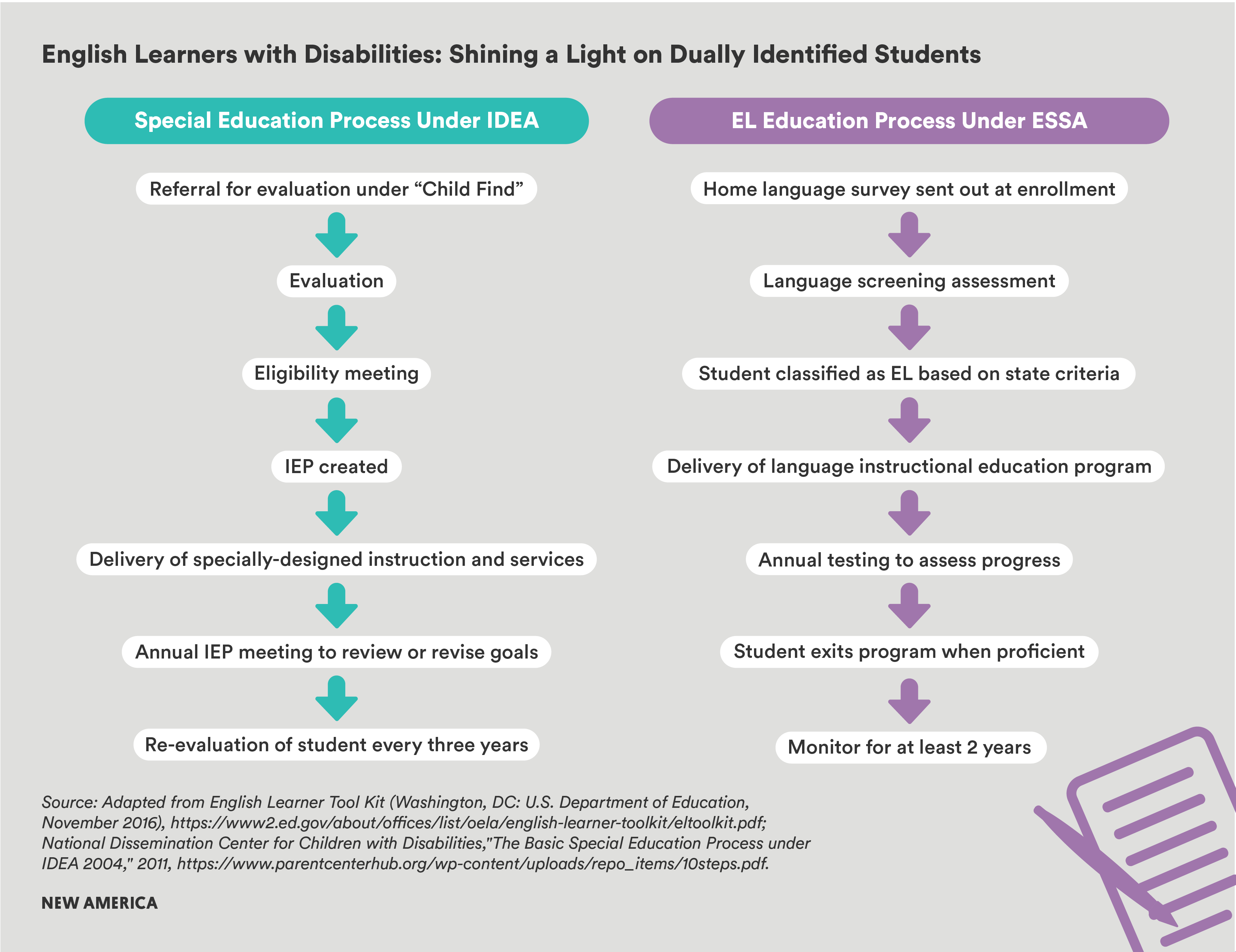
Because the groups of students represented under IDEA and ESSA overlap in the case of dual-identified ELs, lawmakers and administrators have made some effort to coordinate the two separate domains. For example, ESSA guidance explicitly notes that Title III funds may be leveraged for the professional development of special education teachers working with ELs.19 The new Title III requirements also mandate—for the first time—that states report on the academic progress and achievement of dual-identified ELs as a distinct subgroup.20 In comparison, under IDEA, states must report data on the number and percentage of children with disabilities receiving services, disaggregated by subgroups, which includes limited English proficiency status.21
IDEA and Title III: The Intersection of Chronic Underfunding
These two pieces of federal legislation—IDEA and ESSA—provide an important backdrop for dual-identified learners, defining who these students are and shaping what services they are eligible to receive. To execute federal requirements under IDEA and ESSA’s Title III, schools need adequate financial resources. Congress, however, has chronically underfunded both policies, impacting ELs with disabilities in a compounded way.
When Congress first passed IDEA in 1975, it promised to pay for 40 percent of the overall average cost of educating students with disabilities. It has never come remotely close to this amount: in the last eight years, federal funding has hovered around 16 percent, less than half of the original goal.22 This trend exists in the context of escalating special education costs, as the number of children with disabilities rises and the legal standard for special education benefits increases.23
Although federal dollars must supplement and not supplant local spending, Congress’s failure to provide sufficient resources has strained state and district compliance with IDEA. The lack of sufficient federal support can lead state and local leaders to cut special or general education services, limit the hiring of necessary teachers and personnel, and even cap special education identification rates.24 States and districts looking to cut costs may find a vulnerable target in EL students and their families, and disproportionately deny their access to special education when scaling back on services.
Texas offers a case in point. According to a Houston Chronicle investigation, state officials devised a system to keep tens of thousands of children out of special education. Motivated to lower costs, leaders set an arbitrary target in 2004 that no more than 8.5 percent of students should be identified for services—despite a state and national average of around 13 percent.25 English learners seem to have been hit the hardest. While overall EL enrollment rose, EL enrollment in special education dropped by 5 percent. By 2016, just over 7 percent of ELs in Texas (compared to 9 percent of non-ELs) were identified for special education.26
In the case of EL funding, a similar story of rising costs but stagnant (or decreasing) funds exists with Title III allocations. In 2002, Title III received $664 million to serve around four million ELs, working out to about $166 per student. Advocates considered this amount inadequate at the time, and it fell far below the $750 million authorized by Congress.27 For fiscal years 2015 through 2019, Title III appropriations remained flat, at $737 million for closer to five million students, about $147 per student.28 The relative ratios convey a downward trend of investment. Moreover, the flat spending levels continue despite the fact that Congress authorized substantial increases in Title III spending under ESSA, allowing allocations as high as $885 million by 2020.29
Citations
- See Dear Colleague Letter: English Learner Students and Limited English Proficient Parents (Washington, DC: U.S. Department of Justice and U.S. Department Education, January 7, 2015), 25: “The Departments are aware that some school districts have a formal or informal policy of ‘no dual services,’ i.e., a policy of allowing students to receive either EL services or special education services, but not both. Other districts have a policy of delaying disability evaluations of EL students for special education and related services for a specified period of time based on their EL status. These policies are impermissible under the IDEA.”
- Fact Sheet: Ensuring English Learner Students Can Participate Meaningfully and Equally in Educational Programs (Washington, DC: U.S. Department of Justice and U.S. Department Education, January 2015).
- Andrew M. I. Lee, “Individuals With Disabilities Education Act (IDEA): What You Need to Know,” Understood (website), source. In addition to requirements under IDEA, the Americans with Disabilities Act (ADA) and Section 504 of the Rehabilitation Act are also important anti-discrimination laws for students with disabilities. These laws are monitored and enforced by the U.S. Department of Education's Office for Civil Rights (OCR). However, they are not attached to any type of funding stream. Students identified under Section 504 do not typically receive additional special education services but rather accommodations, such as additional time on tests, modified assignments, or preferential seating. For more, see 504 Plans/Individual Accommodation Plans (Lynn, MA: Children’s Law Center of Massachusetts, July 2016), source.
- IDEA statute includes four Parts. The largest, Part B, covers children ages 3–21. Children ages birth to 3 are covered separately under Part C. Some provisions such as “free appropriate public education” (FAPE) do not apply or are different under Part C. For more details on Parts A–D, see source
- Amanda Morin, “Least Restrictive Environment (LRE): What You Need to Know,” Understood (website), source.
- Child Find requirements show up under Part B (school-aged children ages 3 and up) and Part C (infants and toddlers, birth through 2). See General Provisions of IDEA: Part C and Part B (Boulder, CO: Hands and Voices), source.
- Brian Barger, Catherine Rice, Christina Anne Simmons, and Rebecca Wolf, “A Systematic Review of Part C Early Identification Studies,” Topics in Early Childhood Special Education 38, no. 1 (2016): 4–16, www.ncbi.nlm.nih.gov/pmc/articles/PMC5418588/; and Andrew M. I. Lee, “Child Find: What It Is and How It Works,” Understood (website), source.
- For more on parents rights related to evaluation, see Andrew M. I. Lee, “Evaluation Rights: What You Need to Know,” Understood (website), source.
- Amanda Morin, “The Evaluation Process: What To Expect,” Understood (website), source.
- See Part B, Sec 300.8, source. Under Part C (birth to 3), children are eligible based on whether they have a developmental delay or another condition that puts them at risk for developmental delay. For a useful comparison of Part B and Part C eligibility see 2016 chart, “Eligibility and Service Delivery Policies: Differences Between IDEA Part C and IDEA Part B,” source.
- See Sec. 300.304, source.
- While Spanish is still the most common home language among ELs, ELs in U.S. public schools speak over 400 different languages, according to the U.S. Department of Education. See Our Nation's English Learners: What are Their Characteristics? source.
- “Chapter 6: Tools and Resources for Addressing English Learners with Disabilities,” in The English Learner Toolkit (Washington, DC: U.S. Department of Education, 2015), 2. For more on the specific challenges with language interpretation in early intervention, see Gregory A. Cheatham, “Language Interpretation, Parent Participation, and Young Children with Disabilities,” Topics in Early Childhood Special Education 31, no. 2 (2011): 78–88.
- Up until age three, the equivalent of an IEP is an Individualized Family Service Plan (IFSP), which outlines early intervention services. See Annie Stuart, “IFSP: What It Is and How It Works,” Understood (website), source.
- Title VI of the Civil Rights Act of 1964 and the Equal Educational Opportunities Act also provide additional sources of legal protection, with the Office of Civil Rights monitoring violations.
- See Education Commission of the States detailed comparisons of state methods for identifying ELs, “50-State Comparison,” source.
- Language Instruction Educational Programs (LIEPs): A Review of the Foundational Literature, (Washington, DC: U.S. Department of Education, 2012).
- ESSA also requires local education agencies to report on the number and percentage of former ELs meeting state academic standards for four years. For an overview of the process and requirements, see English Learner Tool Kit (Washington, DC: U.S. Department of Education, November 2016), source.
- Non-Regulatory Guidance: English Learners and Title III of the Elementary and Secondary Education Act (ESEA), as Amended by the Every Student Succeeds Act (ESSA) (Washington, DC: U.S. Department of Education, September 23, 2016), 26.
- Non-Regulatory Guidance, 37–40.
- Non-Regulatory Guidance, 41.
- The National Council on Disability (NCD) highlighted the failure of adequate federal funding for all students with disabilities in a 2018 report entitled Broken Promises: The Underfunding of IDEA (Washington, DC: NCD, February 7, 2018), 21.
- After a slight decline between 2006–12, the population of students with disabilities in U.S. public schools rose between 2012–18. See U.S. Department of Education, National Center for Education Statistics, “The Condition of Education: English Language Learners in Public Schools,” April 2018, source. The U.S. Supreme Court ruled on the Endrew F. v. Douglas County School District case on March 22, 2017. For a fuller description of the case and its implications, see Joshua Dunn, “Special Education Standards,” Education Next 17, no. 3 (2017), source.
- Broken Promises: The Underfunding of IDEA, 9; and Bianca Vázquez Toness, “Special Education Costs Force Some Districts To Cut Elsewhere,” 89.7 WGBH (Boston’s Local NPR), June 19, 2018, source.
- Brian Rosenthal, “Denied: How Texas Keeps Tens of Thousands of Children Out of Special Education,” Houston Chronicle, September 10, 2016, source.
- Rosenthal, “Denied”; and Laura Isensee, “English Learners Were Hurt The Most When Texas Limited Special Education,” NPR Ed, May 31, 2017, source.
- Conor Williams, “The Every Student Succeeds Act and Dual Language Learners,” EdCentral (blog), New America, December 2, 2015, source.
- U.S. Department of Education, National Center for Education Statistics, “The Condition of Education: English Language Learners in Public Schools,” April 2018, source; Education Department Budget by Major Program (Washington, DC: U.S. Department of Education, October 26, 2016), source.
- See the Every Student Succeeds Act (ESSA) of 2015, Sec. 3002: Authorization of Appropriations, source. As of March 2019, funding for Title III and special education under Trump's proposed budget for FY 2020 remained flat, at the same level as for FY 2019.
Challenges and Strategies for Accurate Identification
IDEA mandates that states identify all children with disabilities who qualify for additional supports and services, including English learner (EL) students. However, identifying ELs with disabilities accurately and reliably has proven difficult within PreK–12 education systems. Often, educators overlook or discount the presence of a disability, believing that issues stem from a student’s limited English skills. Other times, the opposite occurs: educators falsely conclude that difficulties in language learning indicate a need for special education.
In part, complications result from the fact that several features of language learning mimic those associated with certain disabilities. For example, as highlighted by the U.S. Department of Education’s English Learner Tool Kit, ambiguous learning behaviors for EL students may include: delays or no response to questions and directions from a teacher; the inability to decode English words correctly when reading; spelling words incorrectly and sequencing them out of order within sentences; difficulty completing word problems in math; and appearing inattentive, easily distracted, or unmotivated (in the context of a curriculum delivered only in English).1
The root cause of these and other behaviors may validly reflect language development, disability, some combination of the two, or other factors.2 Therefore, correctly identifying EL students for special education presents an ongoing challenge for school systems needing to make determinations carefully and consistently.
A Two-Pronged Issue: Trends of Under- and Over-Identification
Schools across the nation both over- and under-identify ELs with disabilities, as emphasized in a recent consensus report on ELs by the National Academies of Sciences, Engineering, and Medicine.3 Overall, at the national level, EL students are underrepresented in special education.4 But looking deeper, other trends appear.
First, the data indicate a high degree of state and district variability. For example, in contrast to the national pattern, some states with the largest EL populations—such as Nevada, New Mexico, New York, and California—have historically over-identified ELs students for special education.5 In California, ELs make up around 23 percent of the total student population but represent 31 percent of students with disabilities.6 And yet, researchers have found ELs to be both over- and under-represented by district, grade level, and by EL status when they first enter school.7
Second, trends in identification vary by age or grade level. In the years before third grade, ELs are generally under-identified. By the secondary school years, however, ELs tend to be over-identified in special education.8 For instance, in grades 6 through 12, ELs are more than 3.5 times more likely to qualify for special education than non-EL peers. While this could be the result of ineffective EL instruction in earlier grades, it likely reflects variation in how and when ELs are reclassified as English proficient. 9
Most notably, school systems over- and under-identify students based on the type of disability. For instance, the most common category for all students with IEPs is specific learning disability (SLD), which covers 34 percent of students who qualify for special education services.10 Speech/language impairment is second at 19 percent.
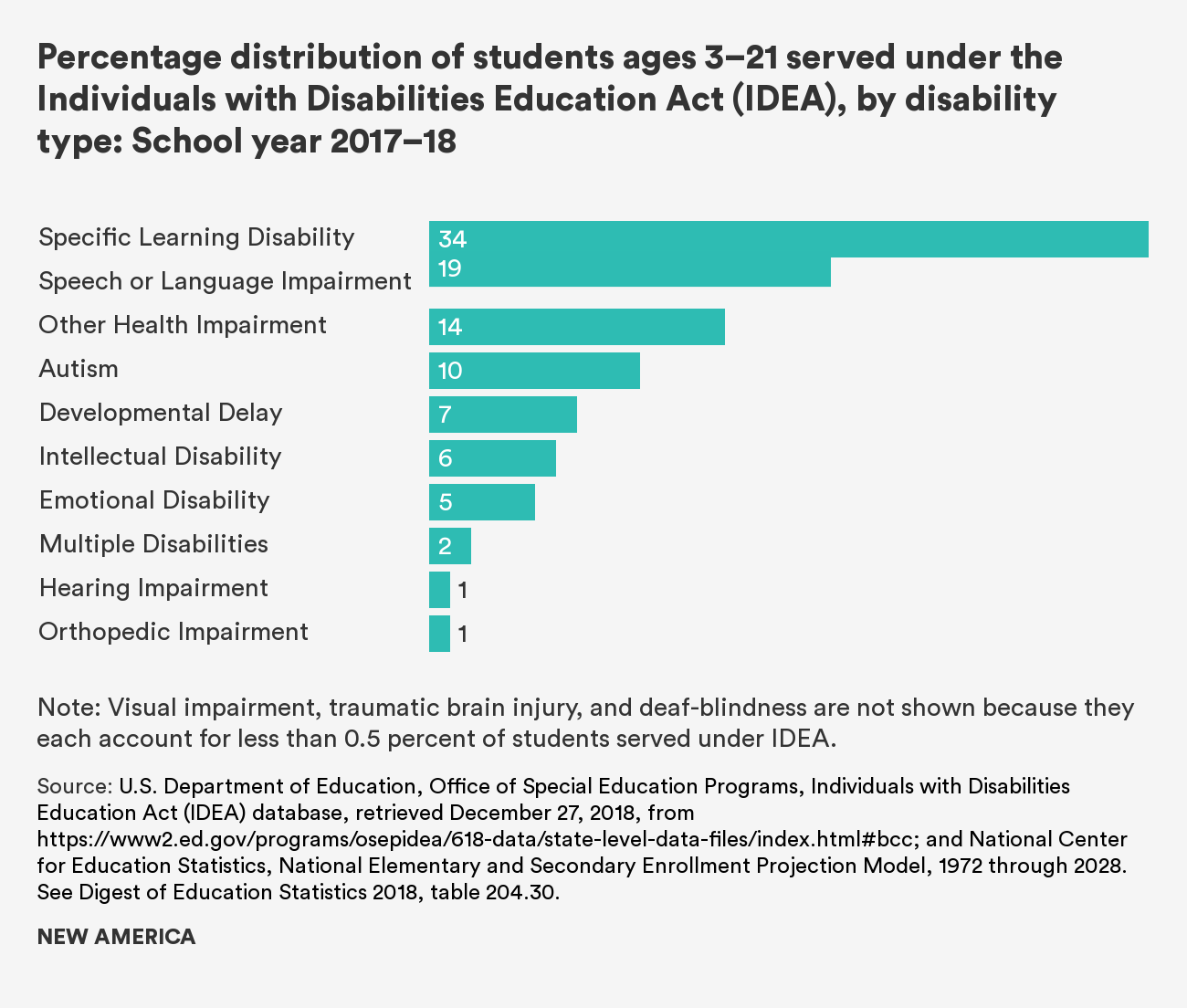
SLD is defined under IDEA as “a disorder in one or more of the basic psychological processes involved in understanding or in using language that is spoken or written, that may manifest itself in the imperfect ability to listen, think, speak, read, write, spell, or to do mathematical calculations.”11 The category includes a range of “perceptual disabilities,” including dyslexia, dyscalculia, and dysgraphia.
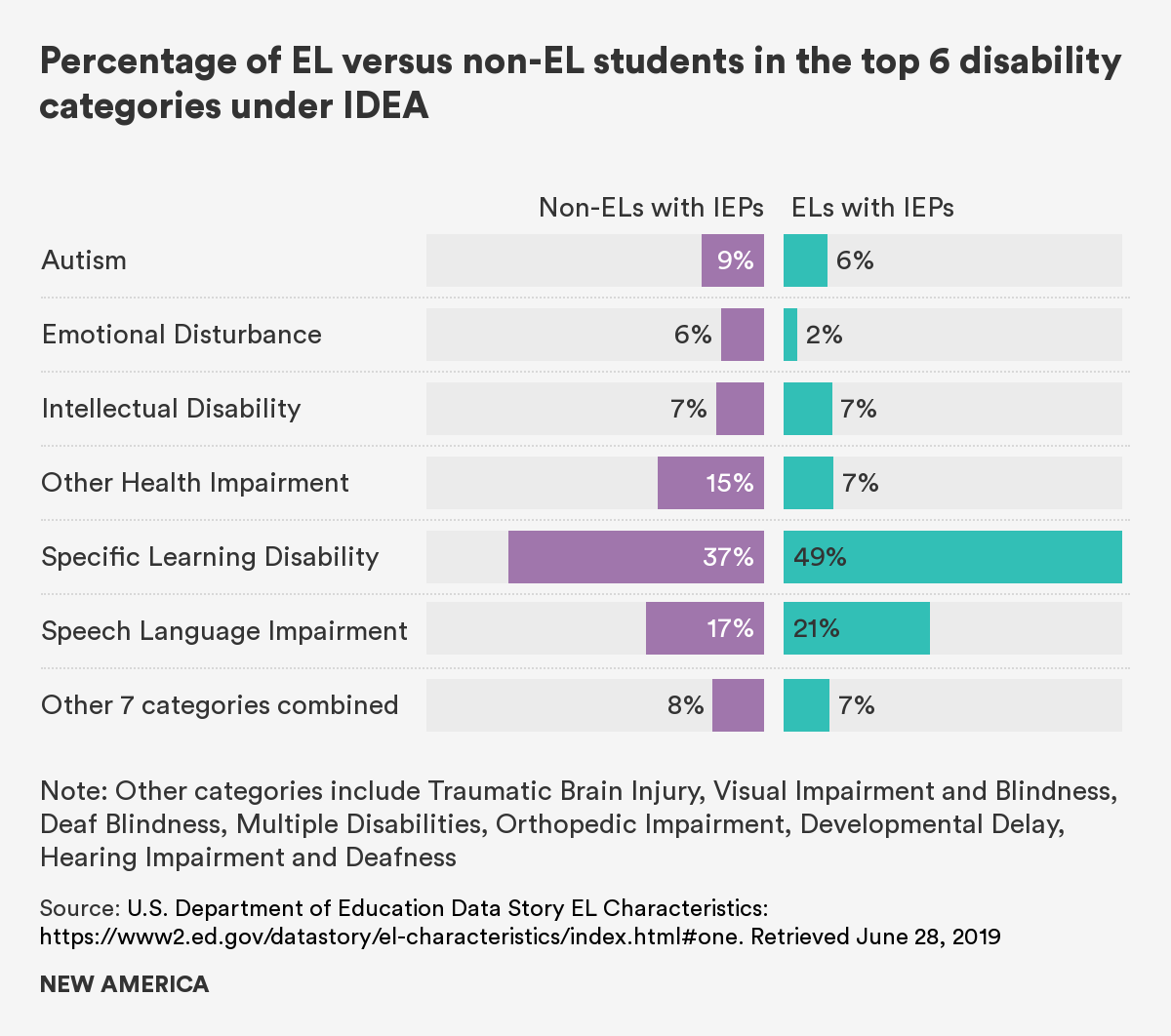
National research indicates that the categories of SLD and hearing impairment have higher proportions of students also identified as ELs, while other disability categories such as autism and emotional disability have lower proportions of students who are also identified as ELs.12 According to the U.S. Department of Education, "Among ELs with disabilities, nearly 50 percent had a specific learning disability, compared to nearly 38 percent of students with disabilities who are not ELs. Similarly, 21 percent of ELs with a disability, compared to 17 percent of non-ELs with a disability, were identified as having a speech or language impairment."13
Certain parameters around eligibility also impact trends of over- and under-identification. For example, IDEA includes a special rule referred to as the “Exclusionary Clause,” which stipulates that children cannot be deemed eligible for special education services if limited English proficiency is “the determinant factor” impacting such a decision.14 IDEA further excludes eligibility from the specific learning disability category if the disability results from “visual, hearing or motor disabilities”; “mental retardation”; “emotional disturbance”; or “environmental, cultural, or economic disadvantage.” These factors must be ruled out as the primary cause of a student’s academic and learning difficulties to determine and maintain eligibility for special education services. The underlying principle is that a child should not be regarded as having a disability if (1) he or she has not been given sufficient and appropriate learning opportunities, or (2) the child’s academic struggles are primarily due to other factors. However, while intended to protect ELs from inappropriate over-identification, these exclusionary clauses can lead to confusion and improper diagnosis.15 There is, for example, no shared definition of what it means for a child to be “environmentally or culturally” disadvantaged.16 The ambiguity of these clauses further contributes to inconsistent identification patterns overall.
This dual nature of misidentification—the risk of over- or under-representing ELs—is important to remember when analyzing data and monitoring representation, which IDEA requires states and the federal government to do. For example, the U.S. Department of Education recently led a multiyear analysis of special education representation, but only flagged measures of overrepresentation (i.e., districts with risk ratios above the national median). 17 By omitting measures of underrepresentation, the analysis obscures the extent of misidentification for ELs.
Citations
- “Chapter 6: Tools and Resources for Addressing English Learners with Disabilities,” in The English Learner Toolkit (Washington, DC: U.S. Department of Education, 2015), 6–10.
- “Chapter 6: Tools and Resources for Addressing English Learners with Disabilities,” 2; and Elizabeth Burr, Eric Haas, and Karen Ferriere, Identifying and Supporting English Learner Students with Learning Disabilities: Key Issues in the Literature and State Practice (Washington, DC: U.S. Department of Education, Institute of Education Sciences, July 2015).
- Takanishi and Menestrel, “Dual Language Learners and English Learners with Disabilities,” in Promoting the Educational Success of Children and Youth, 359.
- Takanishi and Menestrel, 362.
- Takanishi and Menestrel, 371; and Identifying ELLs with Specific Learning Disabilities: Facts, Advice, and Resources for School Teams (Madison: WIDA, Wisconsin Center for Education Research, May 2017).
- English Learners and Students from Low-Income Families (Washington, DC: National Council on Disability, February 7, 2018), 20.
- Ilana M. Umansky, Karen D. Thompson, and Guadalupe Díaz, “Using an Ever-EL Framework to Examine Special Education Disproportionality Among English Learner Students,” Exceptional Children, 84, no.1 (2017): 76–96. Also see Alfredo J. Artiles, Robert Rueda, Jesús José Salazar, and Ignacio Higareda, “Within-Group Diversity in Minority Disproportionate Representation: English Language Learners in Urban School Districts,” Council for Exceptional Children 71, no. 3 (Spring 2005): 283–300.
- Takanishi and Menestrel, “Dual Language Learners and English Learners with Disabilities,” in Promoting the Educational Success of Children and Youth, 362.
- For more about why ELs may be under-represented in early years and over-represented in later years, see Ilana M. Umansky, Karen D. Thompson, and Guadalupe Díaz, “Using an Ever-EL Framework to Examine Special Education Disproportionality among English Learner Students,”Exceptional Children, 84, no.1 (2017): 76–96. source.
- U.S. Department of Education, National Center for Education Statistics, Digest of Education Statistics 2018, Table 204.30, source; The National Council on Learning Disabilities has a host of accessible resources on SLD and other learning and attention issues at its site Understood.org.
- See IDEA Sec 300.8 source
- English Learners and Students from Low-Income Families, 17.
- U.S. Department of Education, "Number and percent of children ages 3 through 5 and students ages 6 through 21 served under IDEA, Part B, by LEP status and state," 2014–15. source.
- See 20 U.S. Code § 1414, Evaluations, eligibility determinations, individualized education programs, and educational placements, source
- Takanishi and Menestrel, “Dual Language Learners and English Learners with Disabilities,” in Promoting the Educational Success of Children and Youth, 364.
- Experts also question whether a disability can be entirely disassociated from these factors. See, for example, James E. Ryan, “Poverty as Disability and the Future of Special Education Law,” Georgetown Law Journal 101 (2013), source
- Takanishi and Menestrel, “Dual Language Learners and English Learners with Disabilities,” in Promoting the Educational Success of Children and Youth, 363.
Policy Considerations
There is clear room for improvement at the policy level to more accurately identify ELs with disabilities and provide appropriate instructional services. Researchers have recognized several system weaknesses, pointing to gaps in educator knowledge of the language acquisition process, child development, and disability; a dearth of bilingual instructional knowledge and practices; weak referral strategies; and inappropriate assessment tools.
Here are seven ways that leaders and policymakers can strengthen education for ELs with disabilities:
- Provide clearer policy guidance. Many states lack clearly defined procedures or expectations for educators when referring EL students for special education. The lack of basic guidance for dual-identified ELs fosters confusion and varying interpretations from teachers about the rules they need to follow.1 A 2019 review by the Institute of Education Sciences found that nine states, seven of which are among the top 20 states with the highest EL populations, have publicly available manuals or handbooks on best practices to navigate the identification process for ELs.2 These in-depth resources offer case examples, checklists, sample intervention programs, and explicit decision criteria for referrals. This basic, common starting point is crucial to foster more consistency in decision-making.3
- Prioritize early identification for young ELs. IDEA (Part C) calls for the identification of infants, toddlers, and preschoolers with special needs starting at birth. In these early years, research shows ELs are less likely than their non-EL peers to be referred to early intervention and early childhood special education services. One study found that four-year-old ELs were 48 percent less likely to be referred for early intervention compared to non-EL peers.4 This trend is unfortunate, given that studies show early intervention can mitigate or even eliminate long-term effects of a disability on a child’s development.5 Leaders should invest more aggressively in early identification methods, such as early developmental screening in a child’s home language. As a positive step forward, Head Start’s new regulations require screening in English and in a student’s home language. However, few state pre-K programs require developmental language screening in English, let alone in other languages.6
- Improve evaluation and assessment practices. As a baseline, assessment tools should be culturally appropriate and yield results that are psychometrically valid and reliable.7 Moreover, it is critical that assessment administrators evaluate ELs in their home language and in English to yield meaningful data, as any delay or disability will be observable across both languages in most cases.8 IDEA requires such bilingual assessment when students have academic skills in their native language and stipulates that it be administered by trained bilingual personnel to the extent possible. However, despite these mandates, the Department of Justice and Department of Education’s Office of Civil Rights have found that ELs are frequently tested in English only.9
- Train and support educators in developing key knowledge and skills. Since creating a more effective identification process relies on implementation by educators, it is vital that they have a solid understanding of how culture, language, and disability intersect. Well-designed pre-service learning and in-service professional development (PD) should address typical and atypical language and literacy trajectories, formal and informal evaluation practices, instructional strategies that correspond to each stage of language development, and early intervention strategies.10 States and districts should also provide ongoing training for teachers to support their implementation of effective practices for instructing ELs with disabilities. As highlighted in 2017 guidance from the Council of Chief State School Officers (CCSSO), PD for dual-identified ELs should focus primarily on how to embed supports and accommodations in instruction and assessment.11 According to CCSSO, states should also use PD to explicitly counter the idea that special education services can replace English learner services; ELs with disabilities have a right to both special education and English language services by federal law.
- Institutionalize collaboration. General educators, special educators, English language specialists, and paraeducators all play an important role in supporting dual-identified ELs. Though a multidisciplinary team must come together to develop a student’s initial IEP, educators often work in silos in their day-to-day work. School administrators should reserve and prioritize time for cooperative planning where educators can meet regularly to align IEP goals with language objectives, discuss strategies, review data, and consider adjustments to services.12 At the district and state level, administrators can build explicit connections between different divisions working with these students. For instance, California’s English Learner Support and Special Education Divisions have held a joint symposium on supporting ELs in recent years. Within the Colorado Department of Education, the special education branch funds a portion of staff salaries in the EL branch, writing collaboration for dual-identified ELs into core job responsibilities.13
- Support home language as an asset. For dual-identified students, one of the biggest questions revolves around whether to integrate home language supports. Similar to debates in EL education, some educators fear that using the home language will confuse students and delay progress. However, in an academic review of over 60 studies spanning 30 years, no research supported this conclusion.14 Rather, compared to English-only approaches, researchers found that interventions that used both home language and English result in similar or even greater rates of growth in English abilities.15 In New York, leaders have acted aggressively in light of this research base, promoting bilingual education for all children—including ELs with disabilities—and launching the nation’s first dual language program for students with autism.16
- Expand bilingual supports, including through the use of technology. The majority of states now report a shortage of bilingual educators, including special educators, school psychologists, speech-language pathologists, and others who play a central role in identifying and supporting dual-identified ELs. Expanding the number of bilingual personnel would allow for inclusive rather than exclusionary services for ELs with disabilities. When bilingual staff members are unavailable, school systems can explore telepractice strategies, such as interactive video conferencing. This strategy has proven particularly useful for speech-language specialists delivering online services for EL children. A promising example of this model is the dual language support program at the Center for Hearing and Speech, located in Houston, which utilizes remote technology to provide bilingual services to a growing population of ELs who are deaf or hearing impaired and live in rural areas across Texas.17 For school systems facing similar limitations, using technology can help expand bilingual services for ELs when in-person options are not practical.18
Citations
- Janette Klingner and Beth Harry, “The Special Education Referral Decision-Making Process for English Language Learners: Child Study Team Meetings and Placement Conferences,” Teachers College Record 108 (2006): 2247–2281.
- See Strategies to Identify and Support English Learners With Learning Disabilities: Review of Research and Protocols in 20 States (Washington, DC: U.S. Department of Education, Institute of Education Sciences, National Center for Education Evaluation and Regional Assistance, Regional Educational Laboratory West, January 2019), source. This review, which includes 13 states and localities that have manuals or are in the process of developing them, is an update to a comprehensive 2015 study of state practices and resources: Elizabeth Burr, Eric Haas, and Karen Ferriere, Identifying and Supporting English Learner Students with Learning Disabilities: Key Issues in the Literature and State Practice (REL 2015–086) (Washington, DC: U.S. Department of Education, Institute of Education Sciences, National Center for Education Evaluation and Regional Assistance, Regional Educational Laboratory West, July 2015), source.
- The Council of Chief State School Officers (CCSSO) released guidance in 2017 to help states create frameworks to help steer district-level processes. See Soyoung Park, Martha Martinez, and Fen Chou, CCSSO English Learners with Disabilities Guide: A Guide for States Creating Policies on the Identification of and Service Provision for English Learners with Disabilities (Washington, DC: CCSSO, November 2017).
- Takanishi and Menestrel, “Dual Language Learners and English Learners with Disabilities,” in Promoting the Educational Success of Children and Youth, 369.
- Rebecca Ullrich, Patricia Cole, Barbara Gebhard, and Stephanie Schmit, Building Strong Foundations: Advancing Comprehensive Policies for Infants, Toddlers, and Families (Washington, DC: Zero to Three and CLASP, October 2017), 1.
- Janie Tankard Carnock, Dual Language Learner Data Gaps: The Need for Better Policies in the Early Years (Washington, DC: New America, June 2018), source.
- Jamal Abedi, “Psychometric Issues in the ELL Assessment and Special Education Eligibility,” Teachers College Record 108, no. 11 (November 2006): 2282–2303.
- The IRIS Center, Peabody College, Vanderbilt University, “Distinguishing Between Disability and Language Difference,” 2015, source.
- Takanishi and Menestrel, “Dual Language Learners and English Learners with Disabilities,” in Promoting the Educational Success of Children and Youth, 364.
- Identifying English Learners with Disabilities, 7.
- Identifying English Learners with Disabilities, 26.
- Butterfield, Meeting the Needs of English Learners with Disabilities, 42–43; and Huong Tran Nguyen, “General Education and Special Education Teachers Collaborate to Support English Language Learners with Learning Disabilities,” Issues in Teacher Education 21 no. 1 (Spring 2012): 127–152.
- Park, Martinez, and Chou, CCSSO English Learners with Disabilities Guide, 7.
- Takanishi and Menestrel, “Dual Language Learners and English Learners with Disabilities,” in Promoting the Educational Success of Children and Youth, 360.
- Takanishi and Menestrel, “Dual Language Learners and English Learners with Disabilities,” in Promoting the Educational Success of Children and Youth, 385.
- Janie Tankard Carnock, From Blueprint To Building: Lifting the Torch for Multilingual Students in New York State (Washington, DC: New America, November 2016); and Michael Vaughn, “Angelica Infante-Green on Creating the Nation’s First Dual Language Program for Children With Autism,” Education Post, January 11, 2017, source.
- Michael Douglas, “The Center for Hearing and Speech: Bilingual Support Services through Videoconferencing Technology,” Volta Review 112, no. 3 (Winter 2012): 345–356.
- See Nirvi Shah, “One-on-One Speech Therapy Goes Digital,” Education Week, October 11, 2011, source.
Conclusion
Designing and implementing more effective identification policies and instructional practices for ELs with disabilities should be a priority for leaders at the school, district, and state levels. Without thoughtful consideration in these areas, ELs who genuinely need extra supports and services will fall through the cracks, and students without disabilities may be placed in environments misaligned with their learning needs.
While there is much more complexity than can be presented here, education leaders seeking to support dual-identified ELs should begin by understanding the basic parameters of federal policy under IDEA and ESSA and the core issues impacting EL students with disabilities. With this as a starting point, school systems can move towards applying particular strategies within their own contexts and constraints.
More fundamentally, policymakers at all levels must recognize that “English learners” are not a monolith. The EL category represents a diversity of students with unique needs and abilities.1 By shining a light on ELs and their various intersections with other student groups, education leaders can create more equitable, responsive, and individualized school experiences that help all students reach their fullest potential.
Citations
- This includes ELs in gifted education programs, where their representation falls significantly behind non-EL peers. See Rachel Mun, Susan Dulong Langley, Sharon Ware, E. Jean Gubbins, Del Siegle, Carolyn Callahan, D. Betsy McCoach, and Rashea Hamilton, Effective Practices for Identifying and Serving English Learners in Gifted Education: A Systematic Review of the Literature (Storrs, CT: National Center for Research on Gifted Education, December 2016).
More About the Authors

Elena Silva
Senior Director, PreK–12 Education

Janie Tankard Carnock