
What are the Biggest Challenges Fathers Face?
The survey asked parents whether, in thinking about the parent they want to be, there are any barriers standing in their way. Almost one-third—32 percent of fathers and 29 percent of mothers—said yes. An open-ended question then asked those who said yes to describe the barriers they faced. The barriers most commonly mentioned by fathers were:
- A lack of resources, including money (22 percent)
- Their paid work (18 percent)
- A lack of time (11 percent)
A Majority of Fathers Feel Work-life Conflict
Other survey findings also pointed to paid work as a barrier to fathers achieving their desired outcomes in their families. When asked a series of questions about how often they feel a conflict between work and family, a majority of parents of both genders saw work as getting in the way of family time. However, fathers were more likely than mothers to say this occurs very often or sometimes.
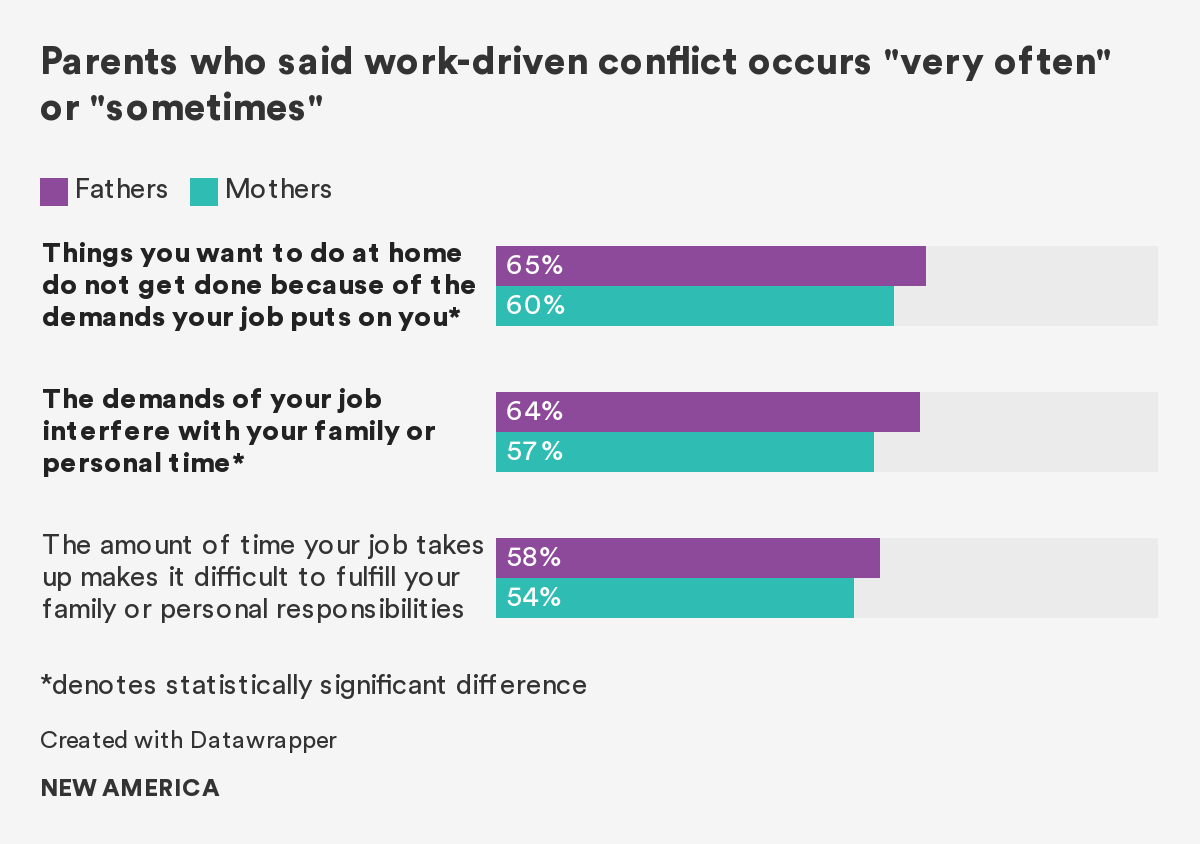
Fathers were significantly more likely than mothers to say things they want to do at home do not get done because of the demands of their job and that the demands of their job interferes with family or personal time.
Both fathers and mothers were more likely to say their job interferes with their family time, rather than the other way around. Two-thirds of fathers (64 percent) and over half of mothers (57 percent) said that the demands of their job interfere with their family or personal time, whereas fewer than half of fathers (41 percent) and a third of mothers (33 percent) the demands of family and personal relationships interfere with their work.
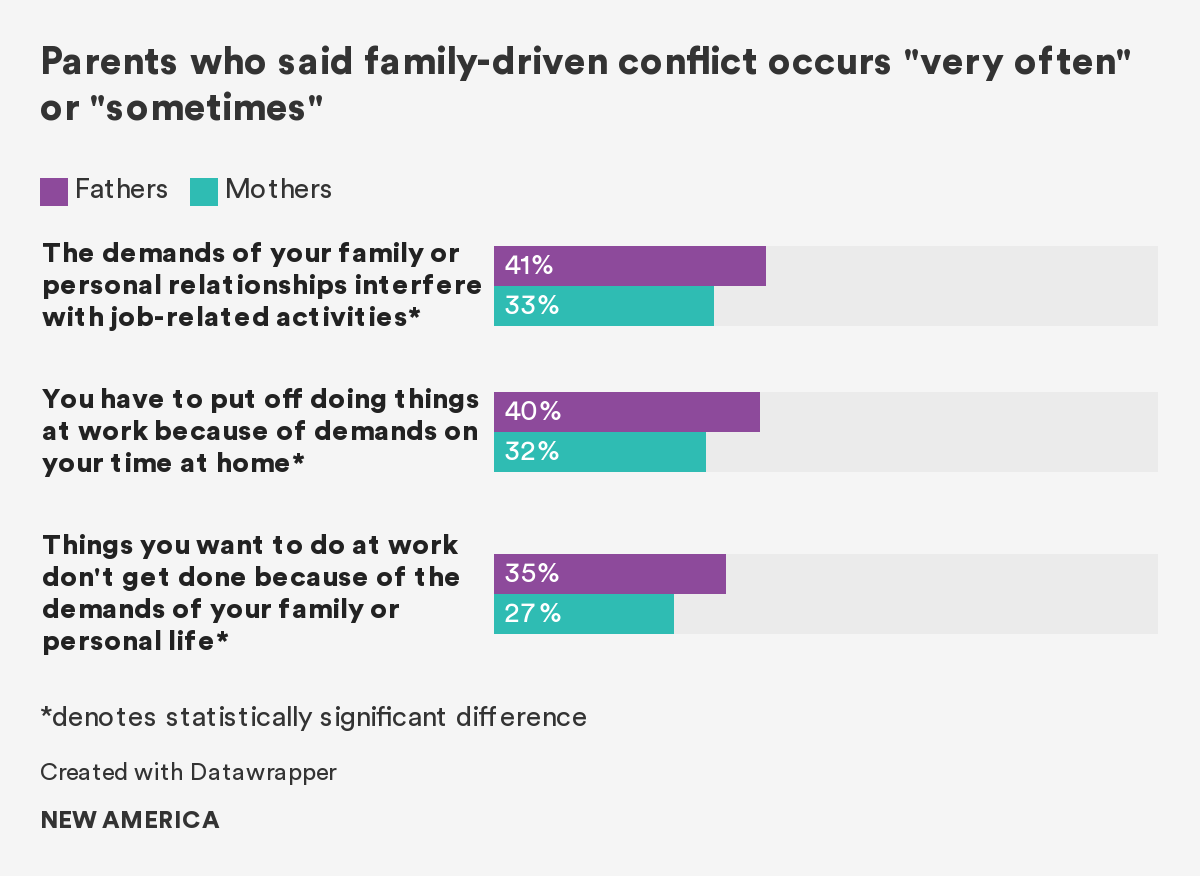
Fathers were more likely than mothers to say that the demands of their family or personal relationships interfered with job-related activities, that things they want to do at work don’t get done because of the demands of family or personal life, and that they have to put off doing things at work because of demands on their time at home.
Focus group respondents explained what this work-life conflict feels like in their daily decision making.
As one respondent said: “The thing I feel most limiting me from being the dad I want to be is time at home with my family. Because I travel so much for work I feel guilty that [my wife] needs to often play single parent when I’m off on a business trip. I try to make up for it by going above and beyond on the weekends when I am home and can be present with family, but I'm also hit with a wall of exhaustion from a long week of travel and often have a large list of chores and to-dos I need to tackle at the same time.”
"It seems like if a mom and dad both work, employers expect the dad to go to work and the mom to call in sick when a kid is home."
Focus group respondents felt that their employers could do more to support them: “I do think that it would be nice to have employers recognize the roles of fathers more. More paternity leave would be a good thing and helping to break down the stigma associated with fathers that need to take a sick day or work from home because there is a sick kid at home would be nice. It seems like if a mom and dad both work, employers expect the dad to go to work and the mom to call in sick when a kid is home.”
Another respondent left his paid work and started his own business precisely because of these difficulties in balancing work and home life. “I can never be a committed full time employee. It is the reason I decided to go into business for myself. There’s nothing wrong with being a full time employee or a committed employee overall, it’s just not the life I want for me. … You are told when to be at work, when you can go eat. You need to have permission to take days off to attend family gatherings, etc.”
About Half of Fathers of Children 0-8 Want More Time with Their Kids
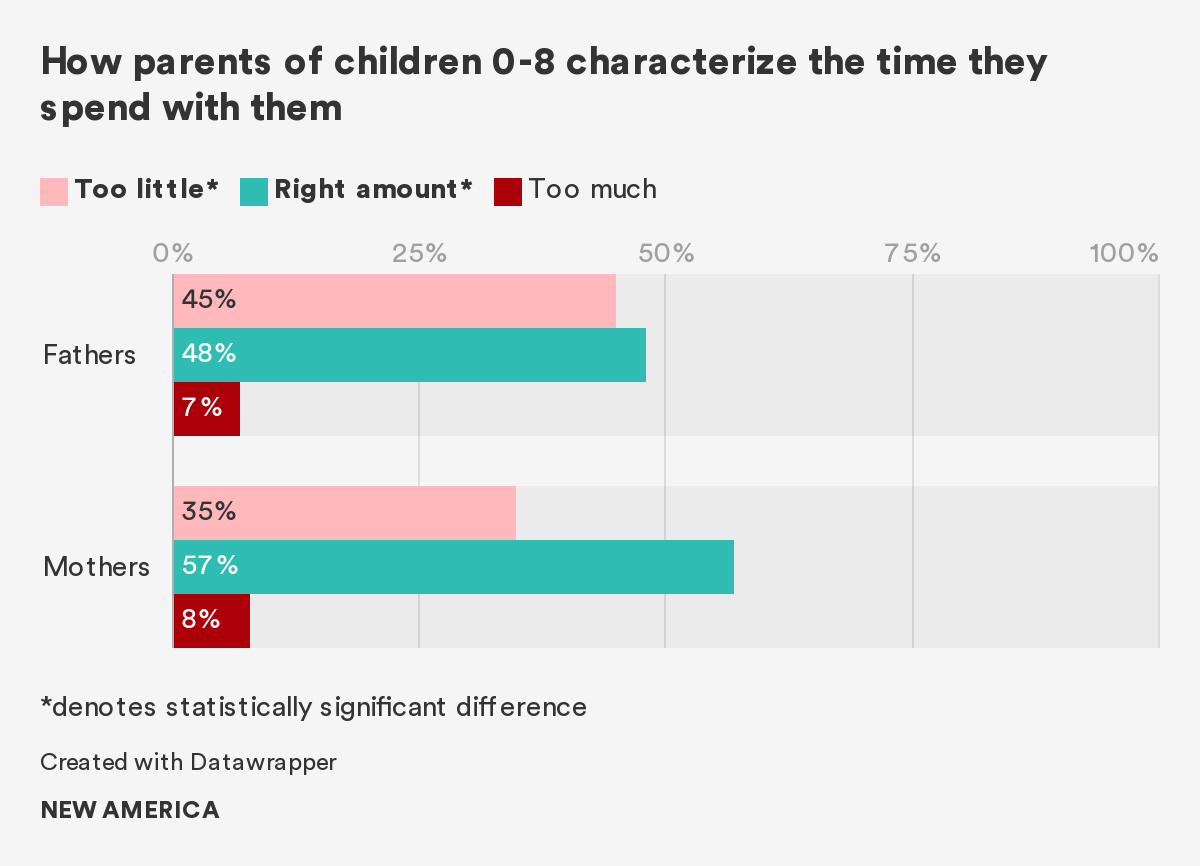
Fathers of children under age eight are significantly more likely than mothers of children under eight to say they spend too little time with their children. When it comes to parents of young children, just 7 percent of dads and 8 percent of moms say they are with their children too much. In contrast, many more parents feel they spend too little time with their children overall. Almost half of fathers (45 percent) say they spend too little time with their children, compared with just over a third of mothers (35 percent). While many fathers point to their jobs as the main reason they don’t have enough time with their children, they also express a general feeling that their families are too busy and juggling too many things to make the time they want. What would they do with that extra time?
Focus group respondents mostly wanted more quality time, an opportunity to spend time with their kids playing and talking. Others wanted to be more involved in their educational and recreational activities—working with them on homework, reading books, or teaching them skills. Others said the desire for time is just a desire to be more present at home.
As one father said: “I’d like to be a calm, teaching, knowledgeable presence to my boys. It’s very difficult since they are only 16 months apart and practically twins at this age. My wife takes care of their mornings and afternoons 99 percent of the time… breakfast, school bus, volunteering at school, afternoons off the bus, and keeping them busy until I get home usually around 5:30 p.m. I do wish that my days were more flexible so I could be home in the mornings more, or work closer to home more often (I do have the opportunity, but it feels like I’m missing the ‘important’ things if I’m not downtown with the rest of the team and department).”
Resources and Community Support
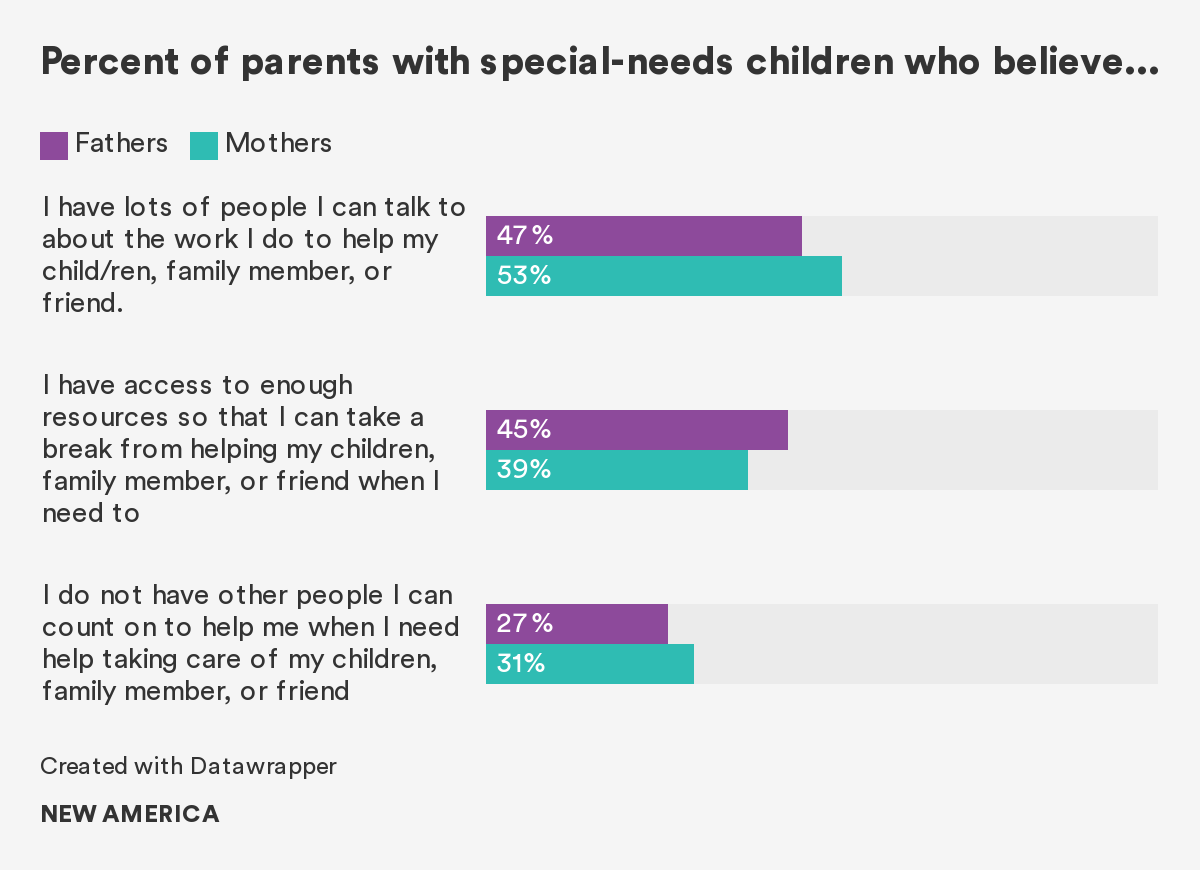
Parents who are also caregivers, that is, who take care of a sick adult or a child with special needs, are in need of additional resources and more support from people they can talk to. Only about half of fathers (47 percent) and mothers (53 percent) said they have “lots of people” to talk to about the caregiving they do. Less than half of fathers (45 percent) and mothers (39 percent) said they had enough resources to “take a break” from caregiving when they needed to.
Focus group participants listed a number of community resources that they believe would help, including more funding for schools and outside activities for kids, paid paternity and maternity leave, affordable child care, more educational and healthcare assistance especially for parents of children with disabilities, and fathers’ groups.
As one respondent said: “I think we could be proactive about how we support fathers. It’s common to see moms groups (MOPS, mother’s day out, etc.) but you don’t see those types of groups or opportunities for fathers. Society needs to understand that fathers have the same struggles that mothers do. We are just expected to deal with them on our own and getting support or community is the exception and not the rule.”
One further barrier to men being able to participate as fully in the lives of their children as they’d like may lie in stigma around and a lack of community support for men as caregivers. Over a quarter of surveyed fathers (26 percent) said they sometimes feel like people don’t trust them to parent because of their gender. Fathers in the focus group also expressed a belief that society did not adequately respect their role and competence as fathers.
Over a quarter of surveyed fathers said they sometimes feel like people don’t trust them to parent because of their gender.
In the focus group discussions, participants were asked what they believe the experience of a man working in a child care and learning center would be like. While most participants said they would have no problem with a man taking care of their children, they also felt that society in general may make it difficult for him. As one respondent said, “I have no problem with a male being a teacher, but I feel like a lot of parents would. Society tells us that young children should be taught by women and if there is a male teacher teaching young kids, he has impure motives.”
Another focus group participant felt that this lack of support for fathers was unfair when compared with the support for women who have entered the paid workforce: “As much as people have worked to accept women as equals in the workplace, I haven’t seen the same for dads who stay at home.”
However, in the absence of these community, policy, and workplace resources, parents did establish support networks for themselves to get by. Fewer than one-third of fathers, similar to the general population as a whole, said they did not have people they could count on for help with caregiving when they needed it.