
Trends in Apprenticeship Programs
Apprenticeship has been a consistent focus of state and federal policymakers’ attention over the past decade. Apprenticeships are jobs first and foremost, requiring commitment and investment from businesses who must pay an apprentice’s wage and ensure he or she has access to structured on-the-job learning and mentorship. Apprenticeship programs strike a balance between employers’ business needs and workers’ needs for both training and income. Responses to the Employer Training Survey help to illuminate motivations and decision-making on the employer side of the apprenticeship contract.
Characteristics of Apprenticeship Providers in the ETS
More than half of all ETS respondents—388 of 682—indicated that they provided apprenticeship programs. The median apprenticeship program size was three employees, and the median program length was 24 months. Apprenticeships were somewhat more common among private sector and public sector respondent organizations than in nonprofit organizations, with 25 percent of private and public sector employers reporting apprenticeships, compared to 14 percent in the nonprofit sector.
About three-quarters of all apprenticeships reported in the survey were described as Registered Apprenticeships.1 Nationally, Registered Apprenticeship programs are heavily concentrated in the construction trades, with a smaller but still sizable proportion in manufacturing occupations.2 Respondents to the ETS were also concentrated in manufacturing and construction, accounting for 29 percent and 18 percent of respondent organizations, respectively. While the survey is not representative of all American organizations that provide apprenticeship training, the prevalence of construction and manufacturing businesses among ETS respondents means the survey likely reflects some general trends in American apprenticeship.
On the other hand, respondents’ apparent focus on younger apprentices diverges from national trends. Over 40 percent of ETS respondents with apprenticeship offerings reported that their programs were targeted at youth aged 24 or under. By contrast, the average age of American apprentices in registered programs is about 30, and only about one-fifth of active apprentices are under age 25.3 This disparity likely reflects the dissemination of the ETS through the Partnership to Advance Youth Apprenticeship Network. Additionally, the ETS respondent pool included a large number of businesses based in Wisconsin, where a unique registered youth apprenticeship system has existed in state law since 1991.
Employer Motivations for Apprenticeship Training
Proponents of apprenticeship commonly emphasize the model’s relevance and customizability to employers’ talent needs. The immediate relevance and productivity of apprenticeship training continues to anchor advocates’ pitches to employers, even though the widespread “skills gap” narrative has been shown to stand on shaky empirical foundations.4 Additionally, apprenticeship advocates commonly promote the model’s potential cost-savings: starting wages for apprentices are relatively low and, the thinking goes, training apprentices is likely to result in greater productivity and employee retention than hiring fully trained workers off the street.5 Advocates also frequently emphasize the potential benefits to organizational diversity obtained by widening the talent aperture through apprenticeship.6
Some of these common justifications for employer participation in apprenticeship were indeed borne out by ETS respondents, according to ETH Zürich’s analysis. Compared to employers using other non-apprenticeship training models, apprenticeship providers in the ETS sample were significantly more likely to indicate that their choice to adopt apprenticeship was motivated by improved employee retention, certainty that trainees would “get the right skills,” and the perception that college graduates were not able to meet their company’s needs.7 Apprentice employers also tended to see their training programs as a way to replace retiring workers, a finding that seems to align with the large proportion of apprenticeship-providing companies who delivered youth-focused programs.
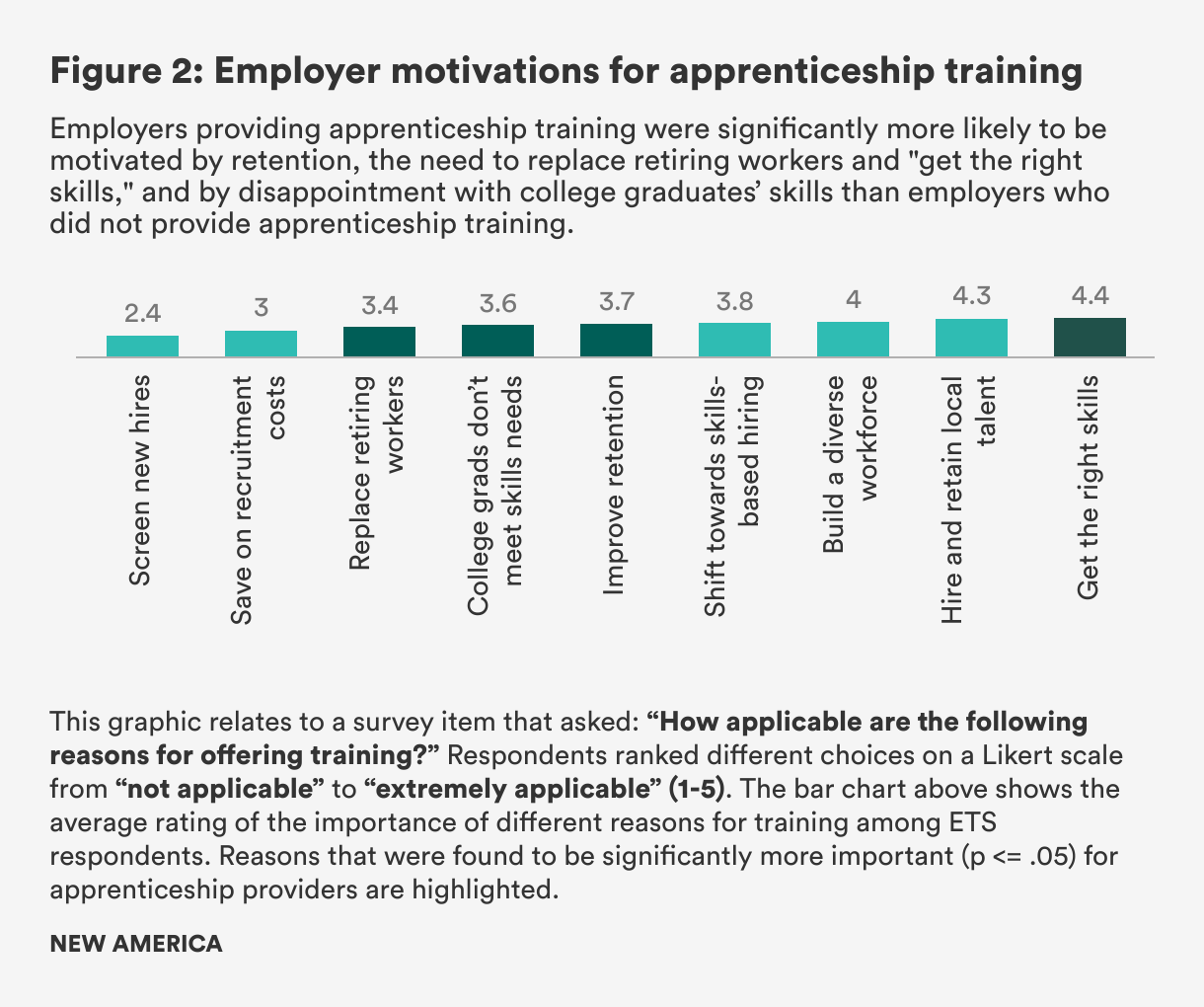
However, other common justifications for apprenticeship provision were not evident in employers’ responses. Apprenticeship providers were not significantly more likely to report being motivated by programs’ potential to better screen applicants, nor by an interest in reducing recruitment costs.
Apprentice employers’ relative indifference to recruitment costs is not especially surprising. Registered Apprenticeships last at least one year, and often as long as four years. And while apprenticeships are effective at training workers, and may produce cost-savings in the long run relative to hiring fully-trained employees, they are not cheap: businesses invest tens or even hundreds of thousands of dollars in education and wages over the course of an apprentice’s training.8 On the other hand, the fact that respondents with apprenticeship programs did not assign significantly higher priority to workforce diversity than other surveyed employers was somewhat surprising, given that apprenticeship is sometimes promoted as a diversity strategy.
Apprenticeship Program Value and Quality
Although the ETS did not seek to quantify the economic benefits of different types of training for trainees, the survey did include items highlighting program characteristics that can provide more rigorous educational experiences. ETH Zürich's researchers evaluated the tendency of different training models to include purpose built-curricula, dedicated trainers, and quality assurance measures, as well as their likelihood of involving paid work and culmination in a credential or college degree.
Unsurprisingly, almost all apprenticeships reported by employers were paid (98 percent), had dedicated trainers or mentors (97 percent), and were built on standard curricula (96 percent)—all required features of the national Registered Apprenticeship system and Wisconsin’s registered youth apprenticeships. A large number of apprenticeship programs, about 83 percent, allowed participants to work towards a degree, and 77 percent had some formal quality oversight, for example from a union, industry association, or internal performance management process.
In these respects, apprenticeship compares favorably to other training options, especially internships, which are also often targeted at younger workers. Although internships were significantly more likely to have quality control measures than on-the-job training programs, a smaller proportion of internships were paid compared to apprenticeships, especially in the private sector,9 and internships were significantly less likely than on-the-job training to feature dedicated curricula. Interns were also less likely to obtain company-specific credentials, external credentials, or licenses through their training than typical on-the-job training participants.
The tendency to register apprenticeship programs appears to increase with firm size. Medium-sized and large businesses in the ETS were more likely to offer Registered Apprenticeships than small ones, and large businesses significantly so. This finding aligns with a recent evaluation of the U.S. Department of Labor’s State Apprenticeship Expansion grants, which identified particular challenges for small businesses interested in Registered Apprenticeship.10 While large companies may have sufficient capital and staff capacity to quickly develop sizable Registered Apprenticeship programs, smaller businesses typically require support from a coordinating intermediary to be successful.
Responses to the ETS suggest that apprenticeship is generally well regarded among businesses and likely to support the educational and economic goals of learners. But despite substantial public investments and impressive expansion in apprenticeship opportunities, overall apprenticeship participation remains low in the United States relative to other rich countries. In particular, the finding that small businesses were less likely to provide Registered Apprenticeships suggests that continued public policymaking may usefully encourage the growth of regional apprenticeship partnerships that pool talent demands and training capacity among smaller firms.
Citations
- Registered Apprenticeship is a legal framework for apprenticeship training, authorized by the National Apprenticeship Act of 1937 (29 U.S.C. §50) and regulated in 29 CFR Parts 29 and 30. For an employer-facing overview of the components of Registered Apprenticeship, see “A Quick-Start Toolkit: Building Registered Apprenticeship Programs,” U.S. Department of Labor, 9–10, source
- Construction and manufacturing occupations account for about 74 percent of Registered Apprenticeships in the 25 states whose apprenticeship programs are overseen by the U.S. Department of Labor’s (USDOL) Office of Apprenticeship. “Data and Statistics: Federal Data: Apprenticeship Statistics by Industry for Fiscal Year 2020,” Employment and Training Administration, U.S. Department of Labor, source
- According to USDOL representatives, the average age of active apprentices in the third quarter of 2021 was 30.1 years old. See also “Data and Statistics: Apprenticeship Data Files,” USDOL, source; and Robert Lerman and Felix Rauner, “Apprenticeship in the United States,” in Antje Barabasch and Felix Rauner, eds., Work and Education in America: The Art of Integration (New York: Springer Press, 2012).
- Suresh Naidu and Aaron Sojourner, Employer Power and Employee Skills: Understanding Workforce Training Programs in the Context of Labor Market Power (New York: Roosevelt Institute, 2020), 35–38, source
- For a visualization of this economic return on investment, see Lynn Gambin, Chris Hasluck, and Terence Hogarth, “Recouping the Costs of Apprenticeship Training: Employer Case Study Evidence from England,” Empirical Research in Vocational Education and Training 2, no. 2 (2010): 133, source
- See, for example, Gretchen Cheney, Growing Equity and Diversity through Apprenticeship: Business Perspectives, (JFF, July 2019), source; and Diversity, Equity, and Inclusion in Cybersecurity, (Aspen Institute, September 2021), 12–14, source
- Throughout this brief, the term significant is used to mean statistically significant. Only results with p-values of p < .05 are described as significant.
- A 2016 report from the U.S. Department of Commerce described one multi-year apprenticeship program that cost the employer $250,000 per apprentice; similarly, a 2021 report from the Urban Institute found that some programs in North Carolina cost between $175,000 and $180,000 per apprentice. It should be noted, however, that these program costs may not necessarily exceed typical costs to companies for recruiting some fully trained workers: one employer in the 2016 Commerce study reported 20 percent recruitment cost savings through apprenticeship. Susan Helper, Ryan Noonan, Jessica R. Nicholson, and David Langdon, The Benefits and Costs of Apprenticeship: A Business Perspective, (Case Western Reserve University and U.S. Department of Commerce, 2016), 22–24, source and Bhavani Arabandi, Zach Boren, and Andrew Campbell, Building Sustainable Apprenticeships: The Case of Apprenticeship 2000 (Washington, DC: Urban Institute, February 2021), 14, source
- The overall proportion of paid internships was nevertheless high, about 90 percent.
- Samina Sattar, Jacqueline Kauff, Daniel Kuehn, Veronica Sotelo Munoz, Amanda Reiter, Kristin Wolff, State Experiences Expanding Registered Apprenticeship: Findings from a Federal Grant Program (Princeton, NJ: Mathematica, September 8, 2020), 27 and 38, source