
Employer Training Survey 2021
Abstract
Last year, the Center on Education & Labor at New America partnered with the Swiss university ETH Zürich to administer the 2021 Employer Training Survey (ETS). The ETS explored the characteristics of American employer-provided training; businesses' reasons for providing training; and the effects of the COVID-19 pandemic on training programs. The resulting dataset included information about the types of program offered by each employer—apprenticeship, on-the-job training, professional development, internship, or other training programs—as well as the size, industry, and sector (public, private, or nonprofit) of the respondent organizations.
In this brief, I summarize findings from ETH Zürich's August 2021 analysis of the ETS dataset as they relate to apprenticeship programs, youth-focused programs, and the effects of the COVID-19 pandemic on employer-provided training. Although the survey is not nationally representative, analyses of the survey data draw out important differences in the credentials, quality control measures, and employer motivations associated with different training models. Analytical findings also highlight varying levels of program disruption resulting from the COVID-19 pandemic across different models, and point to topics in employer-provided training where further research is needed.
Acknowledgments
I and my colleagues at New America would like to thank our generous funders the Annie E. Casey Foundation, the Ballmer Group, Bloomberg Philanthropies, Carnegie Corporation of New York, JP Morgan Chase & Co., the Ralph C. Wilson, Jr. Foundation, the Siemens Foundation, the Smidt Foundation, and the Walton Family Foundation, for their support of this research through the Partnership to Advance Youth Apprenticeship.
The survey and analyses discussed in this brief were conducted by Katherine Caves and Patrick McDonald of ETH Zürich and Lul Tesfai of the Center on Education & Labor at New America (CELNA). I am extremely grateful for their leadership and guidance. I thank Mary Alice McCarthy and Taylor White, also of CELNA, for their feedback and constant support. Finally, I would like to acknowledge the invaluable work of many colleagues on New America's communications and production staff, in particular Julie Brosnan, Sabrina Detlef, Fabio Murgia, Riker Pasterkiewicz, and Joe Wilkes.
Views expressed in this report are mine and do not necessarily represent the views of Bloomberg Philanthropies, its officers, or its employees.
Downloads
Introduction
When Americans prepare to enter the workforce, they tend to look to educational institutions, and not their prospective employers, to provide their training.1 But although high schools and colleges provide students with general skills and job readiness, employer-provided training is often necessary for workers to successfully carry out the requirements of a particular job, obtain promotions, and earn higher wages. According to Paul Osterman, who conducted a 2020 study that found that about half of surveyed workers received some formal or informal employer-provided training in the past 12 months, employer-provided training is “the largest source of skill development” in the United States and is positively associated both with earnings growth and promotion for workers and with strong productivity for firms.2
Despite its importance in the success of individual workers and workplaces, the content, prevalence, and value of employer-provided training in the U.S. context are still not well understood. Last year, the Center on Education & Labor at New America partnered with the Swiss university ETH Zürich to administer the 2021 Employer Training Survey (ETS), investigating the training American businesses provide; their reasons for providing training; differences in training provision related to firm size, training type, and employee demographics; and the effects of the COVID-19 pandemic on training.3
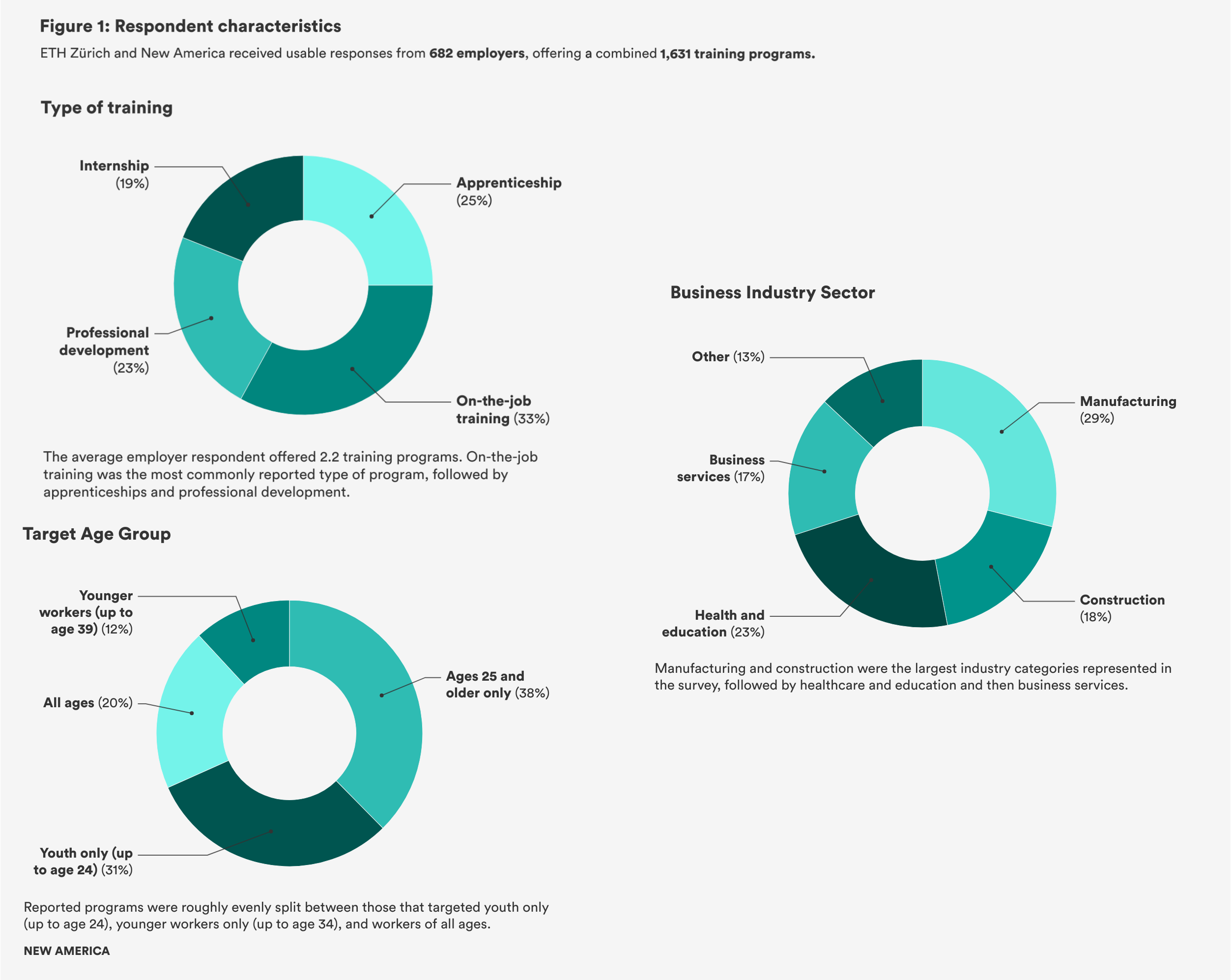
The survey was disseminated by email to U.S.-based business networks developed through the Partnership to Advance Youth Apprenticeship (PAYA) and the Apprenticeship Forward Collaborative, national initiatives led by New America focused on the expansion of youth apprenticeship and apprenticeship opportunities, respectively.4 In total, 682 respondents provided usable responses to the ETS, mostly businesses in the Midwest region.5 The resulting dataset includes information about the types of program offered by each employer—apprenticeship, on-the-job training, professional development, internship, or other training programs—as well as the size, industry, and sector (public, private, or nonprofit) of the respondent organizations.
Respondents indicated whether multiple training programs were available within their organization: the average number of programs per organization was 2.2, across all sectors. Respondents also indicated the target age group or groups of each program: trainees up to age 24 (i.e., youth only), adults between ages 25 and 39, or adults above age 40. Roughly one-third of programs targeted youth trainees up to age 24 only; 12 percent targeted trainees up to age 39; and 20 percent targeted trainees of all ages. Roughly 38 percent of training programs were not available to youth.
The following brief uses descriptive statistics as well as statistical models developed from the ETS to add to workforce development stakeholders’ understanding of employer-provided training in the U.S. The three sections of the brief focus on apprenticeship programs, youth-focused programs, and the impact of the COVID-19 pandemic on employer-provided training. Because the survey was not representative of employer-provided training nationally, summary statistics from the survey do not necessarily reflect the characteristics of employer-provided training programs in the U.S. as a whole. However, findings from ETH Zürich's statistical analyses provide insight into characteristics of businesses that provide training, employers’ decision-making with regards to training, the effects of the COVID-19 pandemic, and the value of different types of employer-provided training for workers.
Citations
- Among respondents to the 2016 Adult Training and Education Survey who indicated that they held a non-degree work credential such as a license or certification, the majority (67 percent) indicated that they prepared for the credential with classes from a college, technical school, or trade school. Only 38 percent indicated that they prepared using classes from their company, union, industry association, or a private instructor; 51 percent indicated they studied on their own (respondents could choose multiple options). Stephanie Cronen, Meghan McQuiggan, Emily Isenberg, and Sarah Grady, Adult Training and Education: Results from the National Household Education Surveys Program of 2016: First Look (Washington, DC: U.S. Department of Education, 2018), 13, “Table 4: Percentage of adults with a work credential who have a credential with each characteristic, by type of most important work credential: 2016,” source
- Paul Osterman, “How American Adults Obtain Work Skills: Results of a New National Survey,” ILR Review (June 2021): 1–30.
- Katherine Caves and Patrick McDonald, "Skills, Employer-Provided Training, and the COVID-19 Pandemic," CES Studies, no. 19, (ETH Zürich, Chair of Education Systems, August 2021), source. For the purposes of this brief, employer-provided training can be run exclusively by a company itself, delivered by a third party selected by the company, or offered in partnership with other employers, educational institutions, community-based organizations, or other workforce training providers. See also “FAQ: 2021 Employer Training Survey,” New America, 1, source
- See “Partnership to Advance Youth Apprenticeship: About PAYA,” New America, source and “Apprenticeship Forward,” source
- The Midwest region (IL, IN, IA, KS, MI, MN, MO, NE, ND, OH, SD, and WI) accounted for 407 ETS responses—approximately 60 percent of total responses. As a result, ETH Zürich conducted tests for standard error clustering at the state level to determine whether sample variation occurred primarily within or across states. These tests only found significant state-level clustering in the category of “reasons for training”; clustering was insignificant in other categories of survey items. As a result, most findings discussed below can be generalized to any state.
Trends in Apprenticeship Programs
Apprenticeship has been a consistent focus of state and federal policymakers’ attention over the past decade. Apprenticeships are jobs first and foremost, requiring commitment and investment from businesses who must pay an apprentice’s wage and ensure he or she has access to structured on-the-job learning and mentorship. Apprenticeship programs strike a balance between employers’ business needs and workers’ needs for both training and income. Responses to the Employer Training Survey help to illuminate motivations and decision-making on the employer side of the apprenticeship contract.
Characteristics of Apprenticeship Providers in the ETS
More than half of all ETS respondents—388 of 682—indicated that they provided apprenticeship programs. The median apprenticeship program size was three employees, and the median program length was 24 months. Apprenticeships were somewhat more common among private sector and public sector respondent organizations than in nonprofit organizations, with 25 percent of private and public sector employers reporting apprenticeships, compared to 14 percent in the nonprofit sector.
About three-quarters of all apprenticeships reported in the survey were described as Registered Apprenticeships.1 Nationally, Registered Apprenticeship programs are heavily concentrated in the construction trades, with a smaller but still sizable proportion in manufacturing occupations.2 Respondents to the ETS were also concentrated in manufacturing and construction, accounting for 29 percent and 18 percent of respondent organizations, respectively. While the survey is not representative of all American organizations that provide apprenticeship training, the prevalence of construction and manufacturing businesses among ETS respondents means the survey likely reflects some general trends in American apprenticeship.
On the other hand, respondents’ apparent focus on younger apprentices diverges from national trends. Over 40 percent of ETS respondents with apprenticeship offerings reported that their programs were targeted at youth aged 24 or under. By contrast, the average age of American apprentices in registered programs is about 30, and only about one-fifth of active apprentices are under age 25.3 This disparity likely reflects the dissemination of the ETS through the Partnership to Advance Youth Apprenticeship Network. Additionally, the ETS respondent pool included a large number of businesses based in Wisconsin, where a unique registered youth apprenticeship system has existed in state law since 1991.
Employer Motivations for Apprenticeship Training
Proponents of apprenticeship commonly emphasize the model’s relevance and customizability to employers’ talent needs. The immediate relevance and productivity of apprenticeship training continues to anchor advocates’ pitches to employers, even though the widespread “skills gap” narrative has been shown to stand on shaky empirical foundations.4 Additionally, apprenticeship advocates commonly promote the model’s potential cost-savings: starting wages for apprentices are relatively low and, the thinking goes, training apprentices is likely to result in greater productivity and employee retention than hiring fully trained workers off the street.5 Advocates also frequently emphasize the potential benefits to organizational diversity obtained by widening the talent aperture through apprenticeship.6
Some of these common justifications for employer participation in apprenticeship were indeed borne out by ETS respondents, according to ETH Zürich’s analysis. Compared to employers using other non-apprenticeship training models, apprenticeship providers in the ETS sample were significantly more likely to indicate that their choice to adopt apprenticeship was motivated by improved employee retention, certainty that trainees would “get the right skills,” and the perception that college graduates were not able to meet their company’s needs.7 Apprentice employers also tended to see their training programs as a way to replace retiring workers, a finding that seems to align with the large proportion of apprenticeship-providing companies who delivered youth-focused programs.
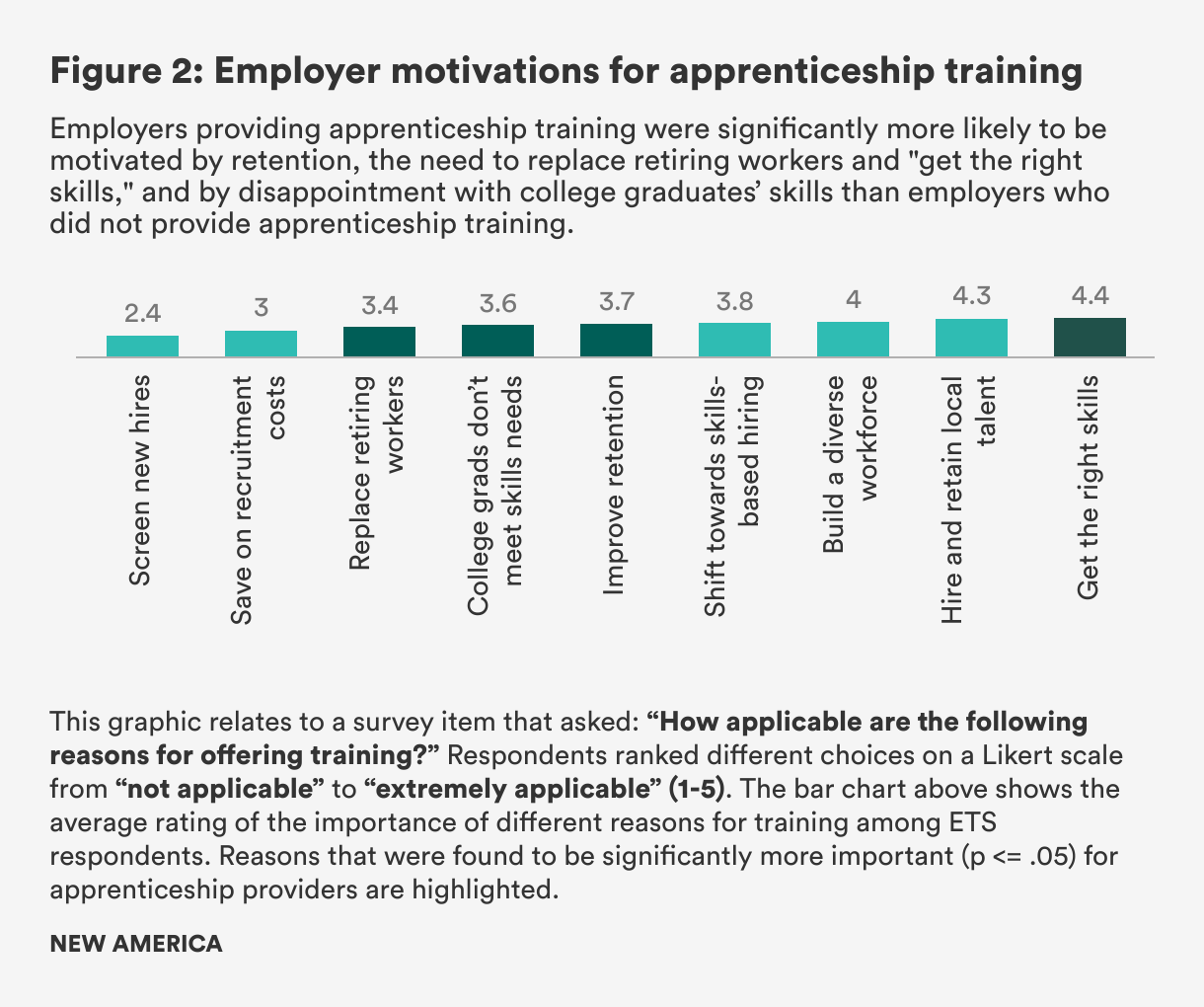
However, other common justifications for apprenticeship provision were not evident in employers’ responses. Apprenticeship providers were not significantly more likely to report being motivated by programs’ potential to better screen applicants, nor by an interest in reducing recruitment costs.
Apprentice employers’ relative indifference to recruitment costs is not especially surprising. Registered Apprenticeships last at least one year, and often as long as four years. And while apprenticeships are effective at training workers, and may produce cost-savings in the long run relative to hiring fully-trained employees, they are not cheap: businesses invest tens or even hundreds of thousands of dollars in education and wages over the course of an apprentice’s training.8 On the other hand, the fact that respondents with apprenticeship programs did not assign significantly higher priority to workforce diversity than other surveyed employers was somewhat surprising, given that apprenticeship is sometimes promoted as a diversity strategy.
Apprenticeship Program Value and Quality
Although the ETS did not seek to quantify the economic benefits of different types of training for trainees, the survey did include items highlighting program characteristics that can provide more rigorous educational experiences. ETH Zürich's researchers evaluated the tendency of different training models to include purpose built-curricula, dedicated trainers, and quality assurance measures, as well as their likelihood of involving paid work and culmination in a credential or college degree.
Unsurprisingly, almost all apprenticeships reported by employers were paid (98 percent), had dedicated trainers or mentors (97 percent), and were built on standard curricula (96 percent)—all required features of the national Registered Apprenticeship system and Wisconsin’s registered youth apprenticeships. A large number of apprenticeship programs, about 83 percent, allowed participants to work towards a degree, and 77 percent had some formal quality oversight, for example from a union, industry association, or internal performance management process.
In these respects, apprenticeship compares favorably to other training options, especially internships, which are also often targeted at younger workers. Although internships were significantly more likely to have quality control measures than on-the-job training programs, a smaller proportion of internships were paid compared to apprenticeships, especially in the private sector,9 and internships were significantly less likely than on-the-job training to feature dedicated curricula. Interns were also less likely to obtain company-specific credentials, external credentials, or licenses through their training than typical on-the-job training participants.
The tendency to register apprenticeship programs appears to increase with firm size. Medium-sized and large businesses in the ETS were more likely to offer Registered Apprenticeships than small ones, and large businesses significantly so. This finding aligns with a recent evaluation of the U.S. Department of Labor’s State Apprenticeship Expansion grants, which identified particular challenges for small businesses interested in Registered Apprenticeship.10 While large companies may have sufficient capital and staff capacity to quickly develop sizable Registered Apprenticeship programs, smaller businesses typically require support from a coordinating intermediary to be successful.
Responses to the ETS suggest that apprenticeship is generally well regarded among businesses and likely to support the educational and economic goals of learners. But despite substantial public investments and impressive expansion in apprenticeship opportunities, overall apprenticeship participation remains low in the United States relative to other rich countries. In particular, the finding that small businesses were less likely to provide Registered Apprenticeships suggests that continued public policymaking may usefully encourage the growth of regional apprenticeship partnerships that pool talent demands and training capacity among smaller firms.
Citations
- Registered Apprenticeship is a legal framework for apprenticeship training, authorized by the National Apprenticeship Act of 1937 (29 U.S.C. §50) and regulated in 29 CFR Parts 29 and 30. For an employer-facing overview of the components of Registered Apprenticeship, see “A Quick-Start Toolkit: Building Registered Apprenticeship Programs,” U.S. Department of Labor, 9–10, source
- Construction and manufacturing occupations account for about 74 percent of Registered Apprenticeships in the 25 states whose apprenticeship programs are overseen by the U.S. Department of Labor’s (USDOL) Office of Apprenticeship. “Data and Statistics: Federal Data: Apprenticeship Statistics by Industry for Fiscal Year 2020,” Employment and Training Administration, U.S. Department of Labor, source
- According to USDOL representatives, the average age of active apprentices in the third quarter of 2021 was 30.1 years old. See also “Data and Statistics: Apprenticeship Data Files,” USDOL, source; and Robert Lerman and Felix Rauner, “Apprenticeship in the United States,” in Antje Barabasch and Felix Rauner, eds., Work and Education in America: The Art of Integration (New York: Springer Press, 2012).
- Suresh Naidu and Aaron Sojourner, Employer Power and Employee Skills: Understanding Workforce Training Programs in the Context of Labor Market Power (New York: Roosevelt Institute, 2020), 35–38, source
- For a visualization of this economic return on investment, see Lynn Gambin, Chris Hasluck, and Terence Hogarth, “Recouping the Costs of Apprenticeship Training: Employer Case Study Evidence from England,” Empirical Research in Vocational Education and Training 2, no. 2 (2010): 133, source
- See, for example, Gretchen Cheney, Growing Equity and Diversity through Apprenticeship: Business Perspectives, (JFF, July 2019), source; and Diversity, Equity, and Inclusion in Cybersecurity, (Aspen Institute, September 2021), 12–14, source
- Throughout this brief, the term significant is used to mean statistically significant. Only results with p-values of p < .05 are described as significant.
- A 2016 report from the U.S. Department of Commerce described one multi-year apprenticeship program that cost the employer $250,000 per apprentice; similarly, a 2021 report from the Urban Institute found that some programs in North Carolina cost between $175,000 and $180,000 per apprentice. It should be noted, however, that these program costs may not necessarily exceed typical costs to companies for recruiting some fully trained workers: one employer in the 2016 Commerce study reported 20 percent recruitment cost savings through apprenticeship. Susan Helper, Ryan Noonan, Jessica R. Nicholson, and David Langdon, The Benefits and Costs of Apprenticeship: A Business Perspective, (Case Western Reserve University and U.S. Department of Commerce, 2016), 22–24, source and Bhavani Arabandi, Zach Boren, and Andrew Campbell, Building Sustainable Apprenticeships: The Case of Apprenticeship 2000 (Washington, DC: Urban Institute, February 2021), 14, source
- The overall proportion of paid internships was nevertheless high, about 90 percent.
- Samina Sattar, Jacqueline Kauff, Daniel Kuehn, Veronica Sotelo Munoz, Amanda Reiter, Kristin Wolff, State Experiences Expanding Registered Apprenticeship: Findings from a Federal Grant Program (Princeton, NJ: Mathematica, September 8, 2020), 27 and 38, source
Trends in Youth-focused Programs
Early work experience and postsecondary education, including employer-provided training, cannot guarantee economic security but remain key predictors of success in adulthood.1 The results of the Employer Training Survey show that employers may implement different types of training programs and quality assurance when they train youth, and suggest that providers of youth-focused training programs are particularly interested in meeting long-term skills needs by recruiting from local communities.
Types of Youth Training Programs in the ETS
ETS respondents provided data about the target age group or age groups of 1,631 training programs: 499 programs exclusively targeted youth up to age 24; 512 programs targeted youth as well as other age groups; and 620 programs did not train youth.2
The two most popular types of youth-focused training were apprenticeship and internship, representing 33 percent and 39 percent of all reported youth-focused programs, respectively. At 23 percent of reported youth-focused programs, on-the-job training was also relatively common among ETS respondents with youth programs. However, professional development was very uncommon, accounting for only 2 percent of youth programs, compared to 41 percent of programs that targeted any age group.
The prevalence of apprenticeships among youth-focused programs reported by ETS respondents results from the survey’s dissemination through the Partnership to Advance Youth Apprenticeship Network and the large number of responses—289 out of 682—received from Wisconsin employers. Although youth apprenticeships remain relatively rare in the U.S., Wisconsin has a formal statewide youth apprenticeship system with nearly 4,000 participating employers and over 5,000 active participants, making it the largest youth apprenticeship system in the country.3
The overrepresentation of youth apprenticeship providers among ETS respondents suggests that the mix of youth programs reflected in the survey does not accurately reflect national trends. Apprenticeship training, with its much longer duration, higher intensity and rigor, and greater external oversight, is still uncommon among American employers interested in training youth.4 However, the dataset does provide valuable insight into the motivations of youth training providers, and the types of credentials and quality control they implement in their training programs.
Employer Motivations for Youth Training
Regardless of whether or not their training programs focused on youth, employers represented in the ETS dataset were concerned by employees’ skills levels. They were only satisfied with new hires’ initial skill levels about 57 percent of the time, and they were most likely to invest in training because they felt it was the “best way to get the right skills.” Employers were particularly unimpressed with new hires’ advanced technical skills and advanced conceptual skills, with only 52 percent reporting that employees met or exceeded skills needs in each category. The average employer reported an average period of 24 weeks required for new hires to reach full productivity, with some reporting a year or more spent on training. Perhaps unsurprisingly, employers rated internal hiring and promotion as their most important talent strategy.
ETS responses showed the extent to which specific concerns about skills factor into employers’ decisions to provide youth training. ETS respondents who provided youth-focused training saw local hiring and employee retention as more important justifications for training than respondents who did not train youth. Building a diverse workforce and reducing recruitment costs may be more important to businesses providing youth-focused training, but evidence from ETH Zürich's analyses was not conclusive on these points. Concerns about retirement, recruit screening, dissatisfaction with college graduates, and a preference for skills-based hiring were not significantly more important to employers with youth-focused programs versus those without. For surveyed employers, then, the decision to include youth in their training programs appears to have more to do with hiring local, loyal workers than with any particular skills needs.
Youth Training Program Value and Quality
Youth-focused programs in the ETS differed from other employer-provided training types in the benefits they confer to participants, and in the quality-assurance features employers use to make sure training programs work as intended.
Across all types of employer-provided training programs reported in ETS responses, 62 percent conferred external credentials and 60 percent conferred company-specific credentials. Occupational licenses were the next most common benefit, seen in 46 percent of programs, while 44 percent of training programs resulted in postsecondary credit. In youth-focused programs, both external credentials and occupational licenses were significantly less common. Postsecondary credentials were not significantly more often conferred in programs that included youth among their target age groups.
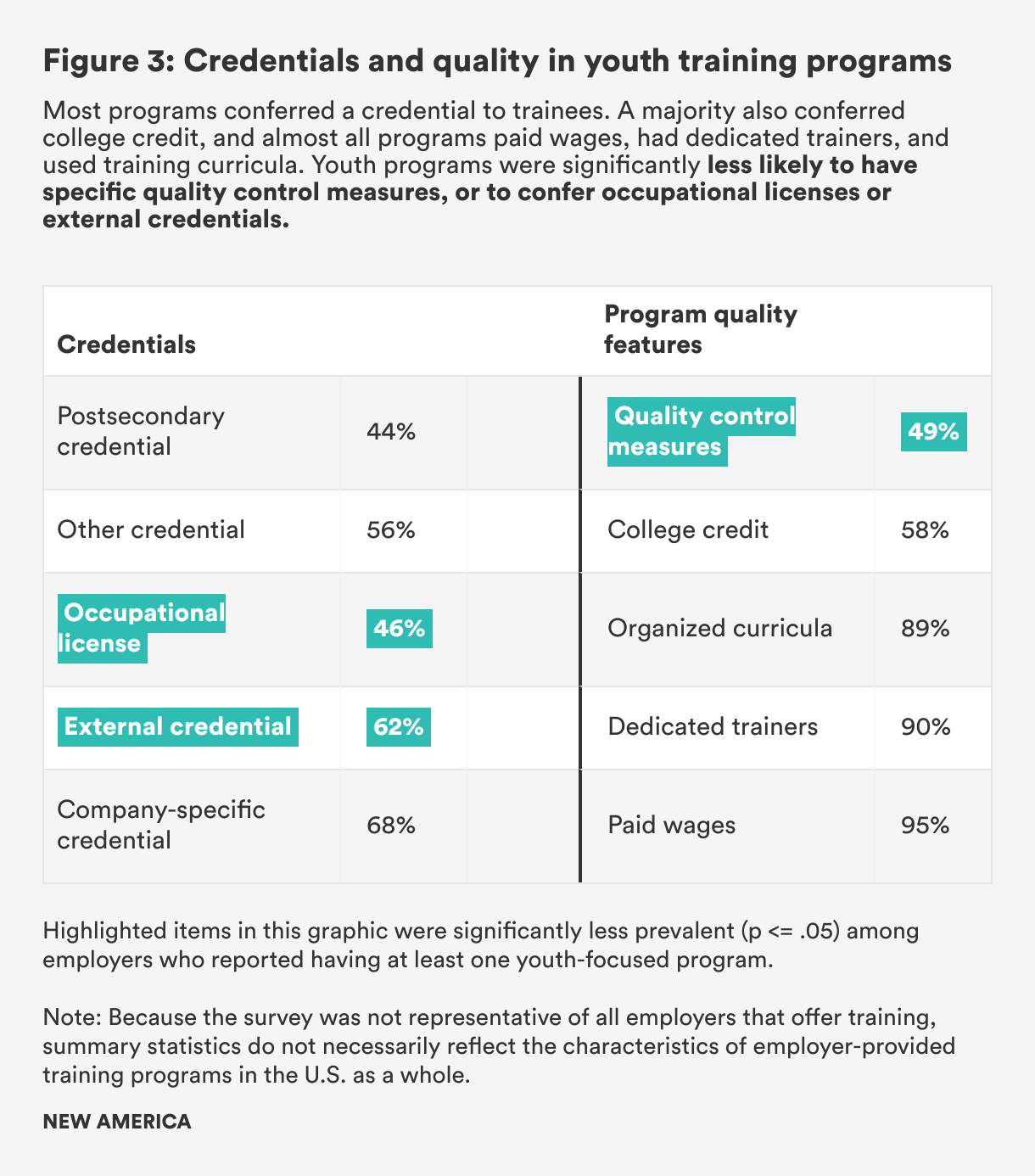
In terms of program quality, most employer-provided training programs seen in the ETS dataset pay wages, have trained mentors, and feature purpose-built curricula, whether internally or externally developed. Youth-focused programs tend to conform to these general characteristics, with the exception of formal quality control systems. Among ETS respondents, quality control measures were found to be significantly less common for youth-focused programs than for all programs. However, this finding may result from respondents’ different interpretations of survey items about quality control. Wisconsin’s youth apprenticeships, in particular, are subject to oversight by state as well as sectoral authorities, but respondents may not have considered these measures to be a form of accreditation, the term used in the survey.
The picture painted of youth-focused employer training by ETS data is heavily influenced by Wisconsin’s youth apprenticeships, which are more widespread than in other states. Even taking this into account, however, the data still reflect positive trends in youth-focused employer-provided training. Most programs are paid, confer portable credentials or credit, and are built on skilled mentorship and dedicated training plans. Although most states do not yet have a youth training infrastructure like Wisconsin’s, the ETS shows that many employers are willing to make investments to provide rigorous, educationally valuable training to youth, and suggests that employers who train youth may be more attentive than others to their organizations’ diversity and the economic success of their communities.
Citations
- Martha Ross, Kristin Anderson Moore, Kelly Murphy, Nicole Bateman, Alex DeMand, and Vanessa Sacks, Pathways to High-Quality Jobs for Young Adults (Washington, DC: Brookings Institution, October 2018), source
- For the purposes of ETH Zürich’s analysis and this brief, “youth-focused training” refers to any training program that listed youth under age 24 as a target age group, whether it was the only target age group or one of several.
- According to Wisconsin’s Department of Workforce Development, the state’s youth apprenticeship system had 5,407 youth participants and 3,970 employer participants in 2020–21. “YA Student Participation Dashboard,” Wisconsin Department of Workforce Development, source. According to USDOL, the state had 11,735 registered apprentices, which does not include apprentices in its youth program. “Data and Statistics: Fiscal Year 2020 State Totals,” USDOL, source. For a further discussion of Wisconsin’s apprenticeship system, see Brent Parton, Youth Apprenticeship in America Today, (Washington, DC: New America, December 2017), 18–19, source
- Though youth apprenticeship is uncommon in the U.S., it is growing. At an October 2021 PAYA event, Acting Assistant Secretary Angela Hanks of USDOL’s Employment & Training said that the number of registered apprentices ages 16–24 had nearly doubled from 2011 to 2020, to a total of over 68,000. New America, “Preparing our Youth, Preparing our Future: Full program,” YouTube video, 15:56, November 4, 2021, source
COVID-19 Impact on Employer-provided Training
The Employer Training Survey was fielded during the unprecedented economic disruption caused by the coronavirus pandemic, during which the national unemployment rate reached nearly 15 percent and labor force participation plummeted. Alongside questions pertaining to employers’ training methods and motivations, some survey items sought to understand how the pandemic affected training programs, employee skill development, training modalities, and employers’ incentives to provide training. The pandemic’s effects on training programs varied for different types of employers and programs, as well as across states with different levels of stringency in their COVID-19 responses.1
Disruption of Training Programs and Skill Development
The ETS asked respondents to characterize the effect of the COVID-19 pandemic on their current and future business situation. About half of respondents reported strong or very strong current effects of COVID-19 on their businesses, and about a third expected further strong or very strong effects in the future. ETH Zürich’s analysis subsequently investigated how perceptions of COVID-19’s business impacts were correlated with training program disruption and employers’ perception of trainees’ skills gains.
Survey data were inconclusive as to whether pandemic conditions caused significant disruption to training programs overall. Reported disruptions to training by large employers were more common than for small businesses, and for programs that were demographically different from the rest of the company, but neither effect was found to be significant in ETH Zürich’s analysis. However, some employers and some types of programs did experience significantly greater training disruption due to the pandemic. Internships were significantly more disrupted by the pandemic than on-the-job training for regular employees, and private sector companies were significantly less affected than public sector organizations.
Analysis of survey data showed that the pandemic did significantly impact employers’ perceptions of practical skills attainment by trainees overall. As with program disruption, neither firm size nor trainee age group significantly affected trainees’ skill development during the pandemic, and skill development for private sector employees was also significantly less affected than for public sector employees. Participants in professional development programs and internships, both less structured training models, suffered significantly more severe effects on skills development than participants in on-the-job training programs.
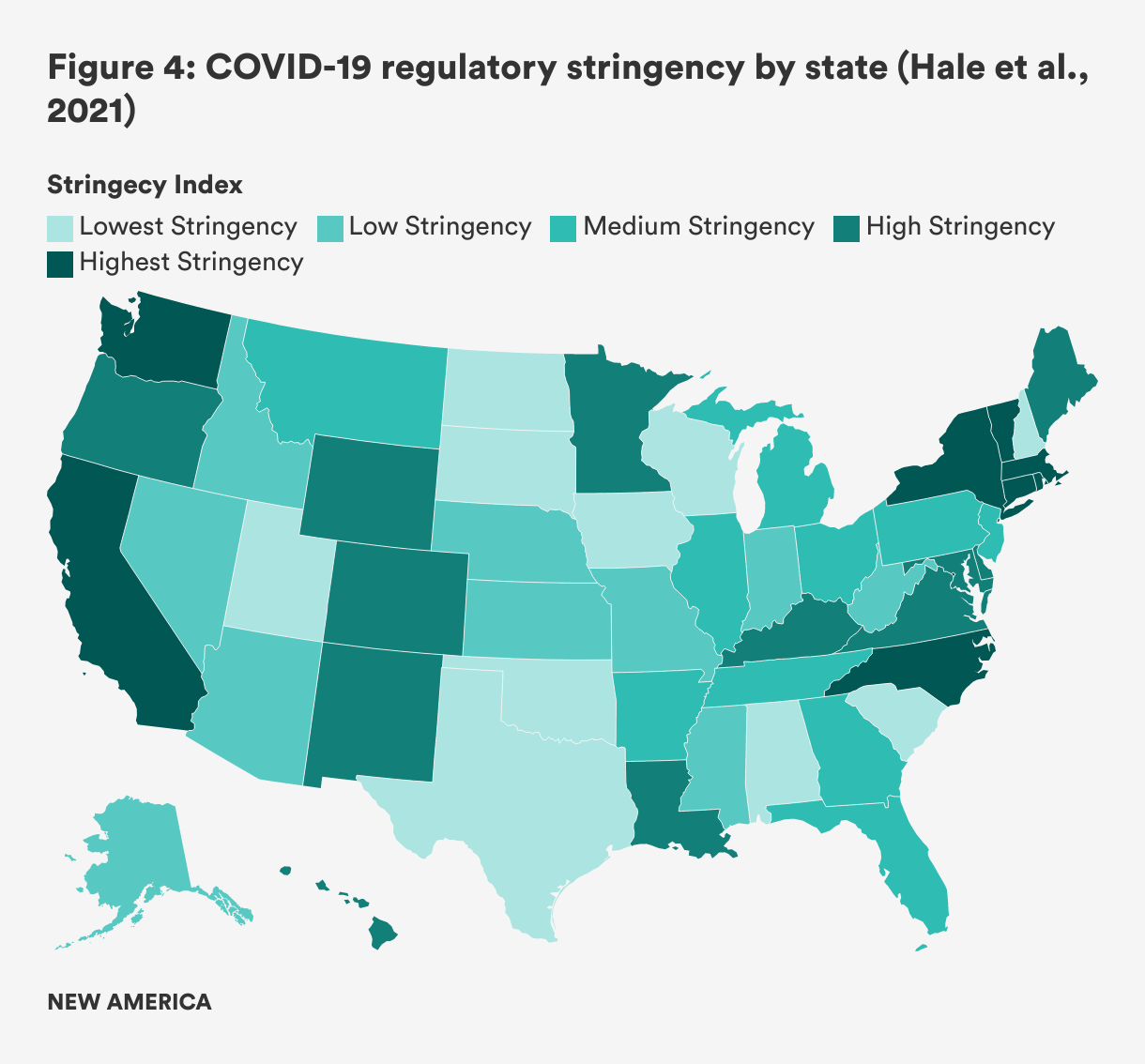
Current pandemic conditions and states’ regulatory stringency did not significantly affect program disruption, but survey data suggest that employers who anticipated future business effects from COVID-19 were significantly more likely to pause, cancel, or delay programs. Conversely, while expected future impacts of COVID-19 were not associated with significantly larger effects on employers’ appraisals of trainees’ skills, employers facing more severe current effects—whether in the form of stringent public health regulations or actual pandemic conditions—were significantly more likely to report negative skills effects. In short, employers worried about long-term pandemic effects appear more likely to adjust plans for training delivery, while those facing more disruptive present conditions were more likely to report immediate skills effects.
Changes in Training Modalities and Motivations for Training
The ETS also sought to understand pandemic-related changes in training delivery and in employers’ motivations for training.
The survey asked respondents about the types of learning and work activities trainees performed since the start of the pandemic, including normal on-site work, limited or “hybrid” on-site work, remote work, training “homework,” or no practical training. Most respondents reported that their trainees continued to perform normal, on-site work; the second most common option was limited on-site work. Fully remote work and training homework were both rare overall, although internships and professional development programs were significantly more likely to have shifted to a fully remote setting than on-the-job training, and significantly less likely to have continued as normal in person. Internship participants were the only type of trainee significantly more likely to have received no practical training during the pandemic. Nonprofits were significantly more likely to move trainees to remote work or training homework arrangements than public sector employers.
Separate survey items asked if the pandemic had affected the availability of skilled workers to meet respondents’ business needs, and whether a lack of qualified employees had affected business growth. Although 43 percent of respondents reported that skills problems had become worse during the pandemic, 50 percent saw no change in the availability of skilled workers. However, respondents in manufacturing and construction sectors, as well as those who employed fewer women as trainees, were significantly more likely to report worsening skills problems due to the pandemic. These findings mirror recent complaints from construction sector employers and industry associations about workforce shortages as building projects resume.2
As the full economic impact of the pandemic emerged, economists, workforce development practitioners, and education researchers feared that workforce education programs would grind to a halt, derailing the career aspirations of millions of Americans. Indeed, total fall enrollment at community colleges has declined nearly 14 percent since 2019.3
ETS data show important pandemic-related effects on employer-provided training, with 40 percent of companies reporting program cancellation or pauses. Providers of certain types of training, such as internships and professional development, were especially likely to adopt new delivery models and contend with some skills losses. Apprenticeships, which are typically longer, more rigorous, and more consistently defined than either internships or professional development, experienced shocks from the COVID-19 pandemic but were not significantly more affected than on-the-job training. With most employers still affirming that skills shortages affect their business prospects, it seems unlikely that the pandemic will lead to sustained disinvestment in employer-provided training.
Citations
- ETH Zürich’s analysis used a stringency index developed by researchers at Oxford University’s Blavatnik School of Government to explore training effects related to the stringency of states’ pandemic responses. Stringency refers to the strictness of lockdowns and other types of government pandemic responses. Laura Hallas, Thomas Hale, Ariq Hatibie, Saptarshi Majumdar, Monika Pyarali, Rachelle Koch, and Andrew Wood, Variation in U.S. States’ Responses to COVID-19 (Oxford, UK: Blavatnik School of Government, May 7, 2021), source. The data used to develop the stringency index can be downloaded from GitHub: source
- See Vanessa Yurkevich, “America desperately needs 1 million more construction workers,” CNN Business, July 11, 2021, source and Patrick Sisson, “One Solution to a Shortage of Skilled Workers? Diversify the Construction Industry,” New York Times DealBook Newsletter, September 25, 2021, source
- Current Term Enrollment Estimates: Spring 2021 (Herndon, VA: National Student Clearinghouse Research Center, January 13, 2022), 4, source
Conclusion
In Switzerland, Germany, and Singapore, many workers obtain career preparation through rigorous employer-provided training programs like apprenticeship. Although a far smaller proportion of Americans train for new jobs through apprenticeship, U.S. employers do invest in training that is vitally important to workers’ job performance and economic mobility. The 2021 Employer Training Survey provided insights into the scale, motivations, and program characteristics of employer-provided training.
ETS respondents almost universally described their training provision as motivated by the need to “get the right skills.” But although employers recoup the productivity benefits of highly customized training, workers may find that these specific skills are not as valued elsewhere in the job market. ETS questions relating to training programs’ credentialing and quality assurance highlight the importance of monitoring program performance and embedding portable credentials and college credit in training. Policymakers and participating businesses should be especially attentive to these characteristics when socioeconomic inequities are at play, as they invariably are.
The tension between employers’ interests and workers’ interests in employer-provided training is also visible in ETS respondents’ appraisals of different training models. Apprenticeship programs were well represented among survey responses, owing to the survey’s dissemination method and high response rates in states like Wisconsin, with large apprenticeship systems. For workers and businesses alike, there is a lot to love about the longer, more rigorous apprenticeship model. ETS results suggest that less formal employer-provided training models, such as internships and professional development, may be more vulnerable to the type of disruptions that occurred at the height of the COVID-19 pandemic. Though longer, more rigorous employer-provided training programs are more complicated to develop, and still vulnerable to pandemic disruptions, they are likely to confer greater educational benefits to learners and to be more robust in the face of future crises.
Businesses will not provide their employees with training unless they are convinced that they will receive a return on investment. At the same time, the experience of the pandemic and ensuing labor shortages have allowed workers to demand more from their employers. As the American labor market continues to recover and realign from the shock of the pandemic, findings from the inaugural ETS can inform state and local policymakers working to better integrate businesses into workforce and economic development projects that serve employers and workers alike.
More About the Authors