Election 2008: Student Aid Hurdles for the Next President

No matter whether Sen. Barack Obama (D-IL) or Sen. John McCain (R-AZ) wins today’s election, the next president is going to face major challenges on the higher education front.
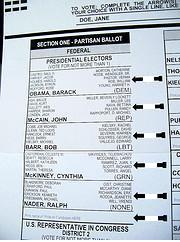 While neither candidate has made education a centerpiece of his campaign, each has offered proposals that may be difficult to carry out given the hurdles that lie ahead. Not the least of which is the federal budget deficit, which is likely to far exceed the $482 billion the Congressional Budget Office projected in July. Obama may be particularly frustrated in his plans, as he has called for significantly increased spending on federal student aid. McCain, on the other hand, has proposed consolidating the government’s aid programs.
Here is a brief description of some of the other student aid challenges awaiting the next president:
- The Continuing Credit Crunch
Over the last year, the federal government has made extraordinary efforts to help the student loan industry cope with the turmoil in the financial markets. As a result of these efforts, and the revitalization of the Direct Student Loan program, students haven’t experienced any difficulty obtaining federal loans.
Still, there’s little evidence that the credit crunch is likely to subside anytime soon. With more and more colleges considering switching to Direct Lending, lenders and their allies at groups like the National Association of Student Financial Aid Administrators will continue to raise panic levels and demand greater federal intervention to prop up the ailing Federal Family Education Loan (FFEL) program further (including a renewed effort to get Congress to rescind the cuts it made to lender subsidies last year). In the face of these entreaties, it will be important for the new president to remember that the point of the federal student loan programs is not to protect the well-being of each and every lender, but to make sure that low-cost loans are available to college students.
The new administration will also have to resist efforts by the loan industry to use the credit crunch to kill key student loan reforms, such as the new pilot PLUS auction program that is scheduled to go into effect next fall. If anything, the credit squeeze provides even further evidence that policymakers need to fundamentally change the way that the government compensates student loan providers.
- Budget Shortfall in the Pell Grant Program
A surge in demand for Pell Grants — caused by the downturn in the economy and a major expansion in student eligibility for the awards by Congress — has left the program in a deep hole. According to the Department of Education’s budget chief, Congress will need to find an additional $4 to $5 billion to keep the maximum Pell Grant award at its current level of $4,731. Given the political stakes, the next president and Congress will likely find the money to keep the program whole. But spending such an exorbitant amount just to maintain the status quo will leave them with few, if any, additional resources to raise the Pell Grant further or to finance other student-aid priorities.
This could be especially problematic for Obama because he would be under substantial pressure from Democratic-leaning interest groups to substantially increase spending on student aid. Ironically, if elected, he could find himself in the same position as former Democratic President Bill Clinton was early in his presidency. During his first several years in office, Clinton and the Democratic Congress grappled with a $2 billion Pell Grant shortfall and were able to provide only a tiny increase in the maximum grant. College leaders and lobbyists complained bitterly. This is “what we are used to seeing from Reagan and Bush. But a kick in the teeth hurts a lot more from a friend,” Julianne Still Thrift, then-president of Salem College and a strong supporter of Clinton, told The Chronicle of Higher Education in 1993.
- Expiring Student Aid Programs and Benefits
The next president is also going to have a very difficult decision to make regarding student loans toward the end of his first term. The interest rate reduction that Congress approved for subsidized federal student loans is due to expire at the end of the 2011-12 academic year. In other words, under current law, loans issued that year will have a fixed interest rate of 3.4 percent for the life of the loan, but loans issued the following year will carry a fixed rate of 6.8 percent. The new president will have to decide whether he supports extending the 3.4 percent interest rate. Doing so could cost as much as $3 billion a year. Of course, allowing student loan interest rates to double could be politically risky, no matter the costs or public policy implications. [At Higher Ed Watch, we believe that policymakers should consider expanding the existing student loan interest rate reduction instead. That proposal would be less costly and better targeted on recent college graduates with burdensome levels of debt.]
Also expiring during the next president’s term will be two relatively new grant programs that provide additional support to Pell Grant eligible students who meet certain academic standards. Both programs were created in 2006 by the Republican-led Congress and funded through 2010. The first, Academic Competitiveness Grants (ACG), are given to low-income freshmen and sophomores who complete a “recognized rigorous secondary school program of study” and maintain a 3.0 grade point average in college. The other, SMART Grants, are available to low-income juniors and seniors majoring in mathematics and science. The new president will have to decide whether to extend these programs, at a cost of $1 billion a year.
For a number of reasons, these programs have not been particularly well received by financial aid administrators and college lobbyists, and they have been underutilized by students. In fact, Congress has had to rescind a significant amount of the money it has provided for these programs, citing low participation rates. Still, these programs do provide generous benefits to financially-needy students. So deciding whether or not to continue financing them will not be an easy call to make.
Despite these hurdles, we remain hopeful that the next president will take higher education policy making in a new direction. Tomorrow, we will highlight some of the changes we would like to see the next administration make. Stay tuned.
Issues
Programs/Projects/Initiatives
Related

State Legislatures Weighing in on Workforce Pell
A Trump Official’s Thin Legal Case Against Accreditors’ DEI Policies