
Education in the President’s Preliminary Budget Request

This morning, President Obama released his preliminary fiscal year 2010 budget request. It provides $46.7 billion in total discretionary funding for the Department of Education. This is lower than the proposed fiscal year 2009 funding level of $66.5 billion in an omnibus bill now under Congressional consideration. The large funding drop, however, can be largely explained by the request’s proposal to move Pell Grant funding from the discretionary side of the budget to the mandatory side, the mechanics of which are explained below. (The omnibus includes $17.3 billion for Pell Grants.)
Because this is a preliminary request, the budget released today only contains specific details on mandatory spending adjustments. More information on discretionary spending, which includes all elementary and secondary education programs, will be released in April.
Below is a list of the mandatory spending items related to education in the President’s initial budget request. Also included is a list of K-12 spending priorities that currently have no appropriations amounts attached to them.
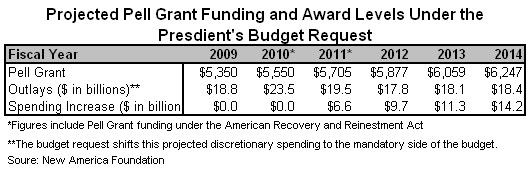
Move Pell Grants to Mandatory Funding
Baseline Cost: $116.1 billion over five years (2010-2014)
Additional Cost: $41.8 billion over five years
Total Cost: $157.9 billion over five years
Rather than distribute Pell Grants through their funding system, which provides support for the award through two different streams, the budget request would shift all Pell Grant money to the mandatory side of the budget. The maximum grant would be raised to $5,550 in the 2010-11 school year, and would then grow at an annual rate of the consumer price index plus 1 percentage point to preserve the grants purchasing power over time. Moving the Pell Grant to the mandatory funding side fixes several existing policy problems with the award. First, it eliminates the current confusing funding structure, in which Pell Grant money comes from two separate streams. Second, it makes future maximum award levels predictable, meaning Congress does not have to estimate enrollment to determine how much funding to provide. Third, it would guarantee funding to eliminate a $5 billion shortfall in fiscal year 2013. If not addressed, this shortfall would result in a substantial reduction of the maximum Pell award.
Elimination of Subsidies for the Federal Family Education Loan Program
Estimated Savings: $24.3 billion over five years (2010-2014)
The administration proposes that starting July 1, 2010, the federal government should no longer provide subsidies to new loans made by lenders participating in the Federal Family Education Loan (FFEL) program. (Click here to learn about the subsidies.) Instead, it says the Department should hire more loan servicers and switch all new federally guaranteed student loans into the Direct Loan program. Lenders would still receive subsidies on existing FFEL loans and could compete for the new servicing rights.
Make the American Opportunity Tax Credit Permanent
Budgeted Additional Cost: $23.3 billion over five years (2010-2014)
The budget request calls for Congress to make the American Opportunity Tax Credit permanent. Introduced in place of the existing Hope Tax Credit in the American Recovery and Reinvestment Act, this new $2,500 credit is available for four years of postsecondary education. Unlike Hope, it is also 40 percent refundable, which allows lower-income students with little to no tax burden to still receive a benefit of up to $1,000. Students will also be able to claim expenses for books and course materials as part of their credit. The current higher education tax credits only cover tuition and fees.
College Access and Completion Fund
Budgeted Additional Cost: $2.1 billion over five years (2010-2014)
President Obama promised Monday night that America would have the highest proportion of college graduates worldwide by 2020. To help fulfill that goal, the budget request proposes to create a new College Access and Completion Fund. This fund would provide federal money to states to help boost their college attainment and completion rates. Improving completion percentages would also necessitate focusing on college preparation, given that nearly one-third of freshmen entering college each fall require remediation and students who need remedial coursework are far less likely to obtain a higher education credential.
Expansion of Perkins Loans
Estimated Savings: Undetermined [1]
Rather than raising federal Stafford loan limits, the President’s budget request proposes recalling and redirecting funding for the Perkins Loan program. Instead, the Department would convert this money to make supplemental direct loans available to an estimated 2.7 million students so they can cover gaps between their postsecondary costs and available financial assistance. The Perkins loan program consists of an $8.6 billion fund, of which $6.6 billion are federal assets, which schools use to make loans to their students. The budget request proposes that when students make payments on these loans to their schools, the institution remits the federal share of the funds back to the Department of Education. The request intends that these proposed funds would be used to make loans fully serviced and disbursed by the Department. The request says these new loan funds would be distributed in such a way to reward schools that control college costs or enroll lots of low- and middle-income students.
Budget Request Elements without Specific Funding Levels
The budget request does not include discretionary spending figures for the vast majority of Education Department programs. It does, however, lay out several of President Obama’s priorities for elementary and secondary education. These include:
- Improved Early Childhood Education Access The budget request proposes to invest more in early childhood education programs. It also provides support to make federal, state, and local early childhood efforts better coordinated and more transparent to parents.
- High Standards and Better Assessments The budget request says the administration will help states improve the rigor of their academic curriculum and create quality assessments. Both measures are indicated as a prelude to reforms that will be proposed during the No Child Left Behind reauthorization.
Teacher and Principal Training and Rewards The administration’s budget promises to strengthen teacher and principal preparation programs and hold them more publicly accountable for the success of their graduates. - Improving Student Achievement The request mentions two specific endeavors to help track and improve student achievement. First, it suggests using the Innovation Fund to reward organizations that have shown an ability to improve student achievement. Second, it proposes funding for Promise Neighborhoods, a program mimicking the Harlem Children’s Zone, which provides support to children for an integrated educational experience from pre-kindergarten through college acceptance.
- Other Priorities The budget request also mentions taking a critical eye to studying existing education programs and scaling up those that are effective at improving student learning and achievement. It also includes a measure to help improve low-performing schools. Finally, it requests more money for charter schools.
Click here to read commentary on two of the administration’s higher education proposals from our sister blog Higher Ed Watch)
[1] The Office of Management and Budget estimates that the Perkins changes will save $3.2 billion over five years (2010-2014). It is unclear, however, the manner by which these savings will occur since it involves recalling money that is already a federal asset and was set to be recalled by law in 2013.
Issues
Related

Interview with Emilio Saenz: Helping Families Find Bilingual Support in Arizona Schools

Why Accreditation Exists: A Q&A with Antoinette Flores