ED Stands Its Ground on IDEA Maintenance of Effort Waivers

The economic recession that began in 2008 hit state and local tax revenues hard and has had a lasting effect. Many states targeted education budgets—often their largest expenditure—to make up for budget shortfalls in the past few years. Although some states cut general K-12 funding, the federal government has a mechanism to prevent states and districts from making disproportionate cuts to special education services. And for the most part, the strategy has worked.
Under the Individuals with Disabilities Education Act (IDEA), the federal government provides annual grants to states to help cover the cost of providing special education services. To receive these funds, states must meet a “maintenance of effort” requirement that Congress included in the law to ensure that states prioritize special education in their budgets and don’t use federal funds to replace their own spending.
Specifically, states must provide funding for special education in a given year that is equal to or greater than what they provided the prior year. School districts must expend the same amount or more of combined local and state funding for special education as they did in the prior year. If a district spends less, the U.S. Department of Education will fine its respective state government for the difference between that year and the prior year’s spending. If a state allocates less than it did the previous year, the federal government will deduct the difference from its federal IDEA allocation the following year. States are held accountable for district cuts because they receive and distribute IDEA grants.
Many states have met the IDEA maintenance of effort provision (MOE) by making steeper cuts elsewhere in their budgets to maintain their special education funding – a sign that the provision is working as Congress intended. But the law grants states a way out of meeting MOE – a state can apply for a waiver from the Department of Education if it cannot maintain its special education funding due to “exceptional or uncontrollable circumstances.”
How does the Department of Education determine if a state has endured “exceptional or uncontrollable circumstances”? A closer look at some of the reasons state requests were approved or denied helps answer this question.
From the 2008-09 school year to the 2010-11 school year, seven states—Alabama, Iowa, Kansas, New Jersey, Oregon, South Carolina, and West Virginia—requested these waivers. In their applications, these states cited huge budget shortfalls as the reason they could not meet the MOE. Each state specifies in its waiver request the amount of special education funding the state plans to cut. In some instances, states do not discover that they have cut funding until after the fiscal year has ended, forcing them to apply for waivers after-the-fact.
The Department of Education has not approved some of the waivers based on whether or not a state prioritized special education in its budget. For example, Alabama requested a waiver for $9.2 million, a 1.5 percent reduction in the state’s share of special education funding for the 2009-10 school year. According to their request, the state experienced a 10.0 percent drop in tax and other sources of revenue, but protected special education from most of the cuts. Because Alabama cut its special education funding less than other programs, the Department of Education approved the waiver.
The case of South Carolina, on the other hand, shows that the Department of Education does not take granting waivers lightly.
Last year, the state submitted waiver applications for the 2008, 2009, and 2010 school years because newly elected State Superintendent of Education Mick Zais realized the state had not met the maintenance of effort requirement for those years. The Department approved the request for 2008 because the state made cuts to special education that were proportionally smaller than those for other agencies, but it denied the waiver requests for the other years.
Specifically, in 2009 South Carolina cut special education spending by 12.0 percent, or $67 million, despite a decline in tax revenue for the year of only 4.7 percent. In response, the Department of Education is reducing South Carolina’s IDEA allocation for 2012 by $36 million – an amount that reflects the state’s special education spending gap. South Carolina is appealing the Department’s decision.
For 2010, South Carolina requested a waiver for a proposed $75 million special education funding cut even though the state’s revenues had increased by 2.6 percent that year. This funding gap was based on the state’s 2008 special education funding levels, the last year it met the MOE. After the Department denied the waiver, the state ultimately restored the $75 million in special education funding. Had it not, the Department of Education would have likely withheld additional IDEA funding from the state in the annual appropriation. In this instance, it appeared that South Carolina applied for a waiver even though it had sufficient funds to meet the MOE.
Kansas is another good example of the Department’s implicit criteria for approving or denying IDEA MOE waivers – the proportion by which states cut spending for special education cannot exceed the proportion by which state revenues have decreased. For the 2009 school year, the state requested a waiver for the $60 million it planned to cut from its special education budget, a 14.0 percent reduction. In that year, however, the state’s revenue fell by a smaller proportion – 12.3 percent. Ultimately, the Department approved an amended waiver for Kansas for $53 million, a 12.3 percent decrease commensurate with the revenue decline the state reported.
The table below shows the requested waivers by year and the Department’s decision for each of the seven states.
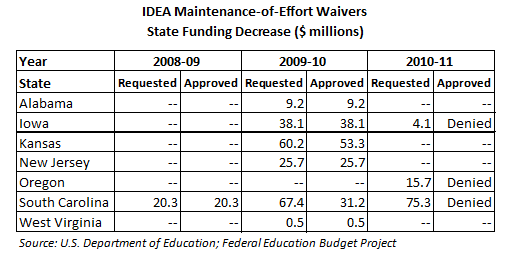
Based on these applications, it appears that the federal government has actually been quite successful in using the IDEA MOE provision to ensure that states maintain or increase their special education funding. No doubt, this has helped maintain the quality of special education services in schools across the country, particularly as spending for other areas of education have dropped. Check back with Ed Money Watch to see if this pattern persists as we continue to track state IDEA MOE waivers.
To see the state waiver applications, click here.
More About the Authors
Issues
Related

Representation Matters for Women of Color in Youth Apprenticeships

Meet the Commissioners

New America & ACCT Invite Community Colleges to Apply for Work-Based Learning Capacity-Building Cohort