Early Education in the FY2009 Omnibus Bill

Yesterday, the House and Senate Appropriations Committees jointly released text of a fiscal year 2009 Omnibus Appropriations bill that would fund federal agencies for the remainder of the fiscal year. Since fiscal year 2009 began in October, federal agencies have been operating under a continuing resolution that maintained funding at 2008 levels. (Yes, we know it’s confusing–you can learn more about the federal budget process here and here).
For the most part, the Omnibus bill maintains funding levels for key early education programs at fiscal year 2008 levels or provides very modest nominal increases.
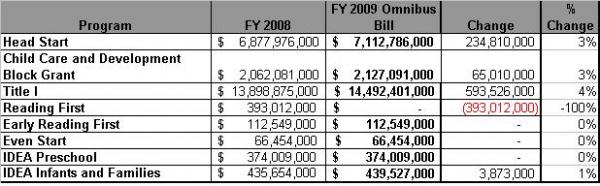
While the relatively stable funding for early education programs may look unimpressive, it’s important to remember that Congress just passed a stimulus bill that provided substantial amounts of funding for many of these programs, so in fact states, local school districts, and Head Start agencies will be receiving a lot more federal dollars for these programs this year than they did in the past.
The big exception here is the federal Reading First program, for which the appropriators eliminated funding altogether. We think that was a lousy call. The “mismanagement, conflicts of interest, and cronyism” that a House Appropriations Committee press release cites as justification for the program’s elimination all occurred under the Bush administration, which is no longer in power. Congress should have given the new administration an opportunity to demonstrate they could run the program better before zeroing out its funding. Abundant evidence suggests that far too many children go through our schools without learning to read proficiently, demonstrating the need for a stronger federal commitment to supporting effective literacy programs in the early grades. Rather than eliminating funding for Reading First with nothing to replace it– and thereby penalizing school districts, teachers, and students who had benefited from the resources the program provided–Congress should have waited until ESEA reauthorization, which would have provided an opportunity to replace Reading First with a new federal literacy program that would support scientifically based reading programs while also emphasizing content and expanding literacy supports for adolescents.
The House and Senate are working to pass identical versions of the bill so that it can be passed on to the president and signed into law quickly. That’s good because the current continuing resolution expires at the end of next week, on March 6th, so the President must sign the 2009 budget into law by then (alternatively, Congress could pass yet another continuing resolution, but they appear to be trying to avoid that). We’ll continue to update you on this issue over the course of the week.
More About the Authors
Issues
Programs/Projects/Initiatives
Related

Confronting Harmful Federal Disability Policy in Health and Human Services

Federal Early Education Update: March 2026

A Bureaucratic Shakeup Threatens Future Child Care Research