
This brief is part of a series by the Electoral Reform Research Group, a collaboration between New America, Stanford University’s Center on Democracy, Development, and the Rule of Law, the American Enterprise Institute, and the Unite America Institute. To find the full report of the study summarized below, click here.
Overview
This research brief discusses three survey experiments—two nationwide and one in Philadelphia—that examine how ranked-choice voting affects attitudes toward running for office. The national experiments oversampled minority respondents to capture diverse perspectives. Across the three experiments, we tested three types of messages about ranked-choice voting (RCV). Some respondents were given a simple explanation of RCV; some were given an explanation of RCV and how it is different from the current 'choose one' system; and some were given an explanation of RCV, how it is different from the current system, and that RCV systems have been shown to benefit women and people of color. Our results suggest that electoral system structure does not necessarily shift interest in running for office.
Research Questions
- How does a ranked-choice-voting (RCV) electoral system affect attitudes about running for office?
- Do effects vary across groups of interest, especially for women and people of color?
Key Findings
- Broadly, we see a null effect in the relationship between electoral system messaging and interest in running for political office. However, there are some exceptions.
- Messaging about whom RCV benefits is positively associated with white voters’ interest in running for office, while messaging about how RCV is distinct from the current system is positively associated with interest in running among Black respondents.
- There is reason to be cautious of messaging about who benefits from RCV. The idea that women and people of color win more in RCV systems either had no effect or, in the case of Latinos, negatively affected respondents’ attitudes about running.
Background and Research Design
Despite the electoral gains for women and people of color across all levels of political office in 2018, these groups remain underrepresented. Many scholars who study candidate emergence (i.e., who runs for office) would agree that the largest barrier is candidate supply.1 However, we know that interest in running for office varies by race and gender.2 Women tend to be less likely to consider themselves as officeholders than their male counterparts, but there is variation in interest when we consider racial identity.
Some observational research suggests that replacing “conventional” systems (like plurality and majority runoff) with alternative rules might mitigate candidate-supply problems. Previous evidence suggests structural changes like multi-seat districts and cumulative or limited voting3 can increase the share of officeholders from underrepresented groups.4 Ranked-ballot systems have similarly been associated with more diverse supplies of candidates—especially in the San Francisco Bay Area.5
At least three questions arise: Is the Bay Area different from other American cities? Did increased candidate supply result from long-term RCV messaging? More broadly, does RCV nudge potential candidates (particularly those underrepresented in politics) into thinking that they could win?
To better understand the impact of RCV on candidate supply, we tested RCV messaging among respondents who were largely unfamiliar with ranked-ballot systems. We used a national convenience sample (Lucid), a city-based sample (by way of Emerson College Polling), and a nationally representative sample (Collaborative Multiracial Post Election Survey, or CMPS). In our national studies, we oversampled people of color in order to capture how race and gender impact the consideration to run under an alternative electoral system. Our Philadelphia study had two roles: again to study a diverse population, but also one that had not seen much RCV advocacy.
Across our three studies, we tested three types of messages: (1) knowledge of RCV; (2) knowledge that, under it, one can win on vote transfers; and (3) knowledge that it has benefited women and people of color.6 We tested all three messages with the Lucid and Emerson sample and only tested the third message (in relation to a no-message control) with the CMPS sample. In CMPS, all respondents were primed with information about RCV and an activity in which they were able to practice the RCV process.
The first message (denoted RCV in the figures below) used a simple explanation of RCV: "Using RCV, voters have the opportunity to rank candidates in order of choice. A voter could rank a candidate second or third, and those rankings might help a candidate get elected."
The second message (denoted RCV+ in the figures below) included an explanation of RCV and how it is different from the current 'choose one' ballot system: "Rather than need the most votes to win like in our current system, voters could rank a candidate second or third, and those rankings might help a candidate get elected."
The third message (denoted RCV++ in the figures below) included an RCV explanation, how it is different from the current system, and information consistent with diversity effects: "Rather than need the most votes to win like in our current system, voters could rank a candidate second or third, and those rankings might help a candidate get elected. Studies have shown that this method leads to more women and people of color in office."
In all three studies, the outcome variable is respondent interest in running for office. The outcome takes the form of a thermometer rating (0 to 100) in the Lucid and Emerson study. In the CMPS, the outcome is “run for political office,” or not.
Findings & Implications
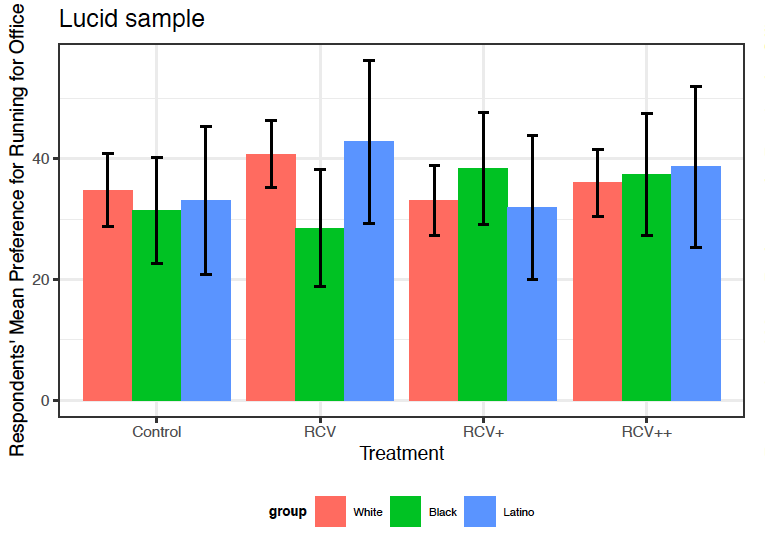
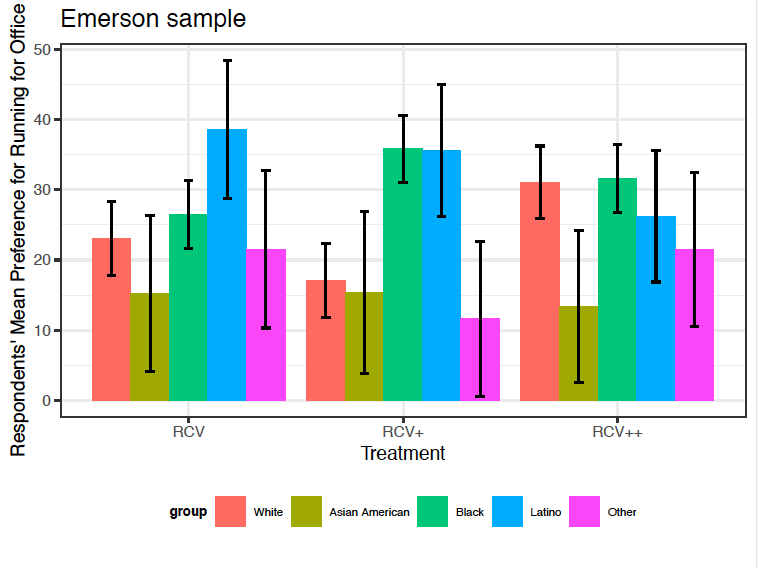
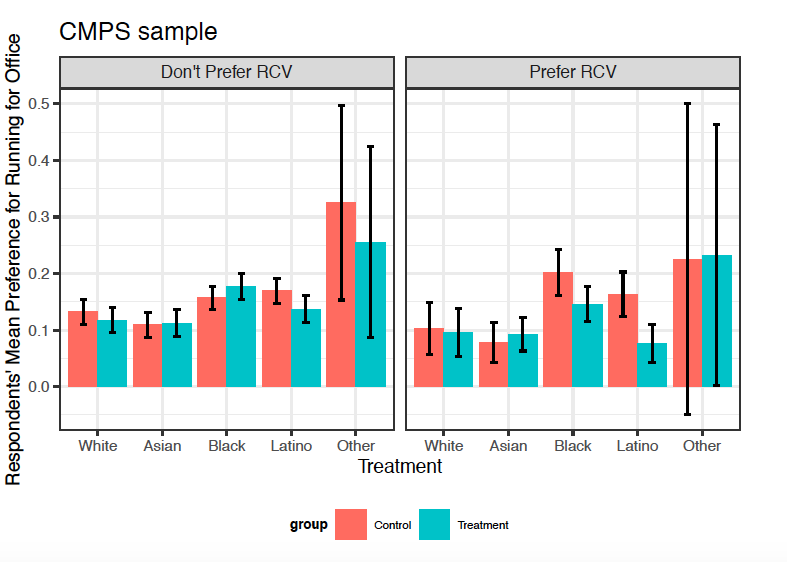
Figures 1–3 presents our results across all three samples. Bar height represents the mean rating of interest in running for office for a given group: white, Black, or Latino, in each of the experimental conditions. The black line at the top of each bar is a 95-percent confidence interval. (Confidence intervals that do not overlap reflect a statistically significant difference.)
Figure 1 shows results for the Lucid sample. Because all confidence intervals overlap, we do not find any effect of message type in that sample.
Figure 1 | No effect for message type in the Lucid (national) sample
Results from the Philadelphia experiment (Figure 2) were similar with one exception: Black respondents receiving the RCV+ message (which contrasts RCV with the plurality rule of “most votes to win”) rated running for office more highly than Black respondents in the control condition. No other within-group effect, including by gender, was significant.7
Our Philadelphia sample shows us how messaging about RCV matters, to some degree, across racial groups. As in the Lucid sample, we see null effects for many of the groups included in our sample. However, Black and white respondents present exceptions. Black respondents who receive the second message (explanation of RCV and how it is different from plurality) are more positively oriented toward running for office than their Black counterparts who receive the first (simple explanation of RCV). It is only among white respondents that the third message (that RCV helps women and people of color) significantly increases interest in running for office. Why we got such results is beyond the scope of the study, but others have found that subjects from different racial groups respond in different ways to the same experimental treatments.8
Figure 2 | Messaging matters for Black respondents in the Philadelphia sample
Finally, we look at data from the CMPS (Figure 3). The oversample of people of color lets us tell a broader story about RCV messaging. Again, when taking racial identity into account, we see mostly null effects, except for some that involve Black and Latino respondents. We focus on respondents who show a preference for RCV after the simulated experience using it (right panel).9 Among Latinos, the third message (RCV elects more women and people of color) leads to decreased interest in running for office. While there is no difference among Black respondents in their interest in running for office, Black respondents in the control condition are more likely to consider running for office than their white and Asian counterparts.
Figure 3 | Emphasizing RCV’s diversity effects is associated with decreased interest in running for office among Latinos
Conclusion
Overall, most of our results are null. This is meaningful in that the desire to run (or at least consider it), particularly among people of color, likely depends on a balance of personal considerations, not so much on system structure. Some of the significant effects we do see suggest that some messages may be less appealing when talking about RCV with respondents of color.
To the extent that these results may be useful, however, several points are worth noting. First, we are not able to test for differences among ranked-ballot systems (e.g., single-winner versus multi-seat proportional).
Nor did we ask about eliminating primaries, where party leadership and other figures have been shown to deter candidate entry and/or steer votes toward preferred nominees. Some contend that this is where RCV has most promise. While the debate about primaries is beyond the scope of our study, our results suggest that RCV on its own may not improve diversity.
More generally, as reformers seek to engage in the conversation about how local electoral systems might incorporate ranked ballots, women and people of color should be included. Political gains for women and people of color start at the local level.10 As local office is a pipeline to higher office, local-level changes certainly might shape the next generation of representatives at the state and national levels.
View and download the full report here.
Acknowledgments
We thank New America's Political Reform Program; the American Enterprise Institute; the Unite America Institute; Stanford University's Center on Democracy, Development, and the Rule of Law; Drexel University; Georgetown University; and Arnold Ventures for the support needed to execute this study. We especially thank Spencer Kimball and Emerson College Polling for heroic work in deploying the Philadelphia study.
Citations
- Eric Gonzalez Juenke, and Paru Shah, "Demand and supply: Racial and ethnic minority candidates in White districts," Journal of Race, Ethnicity, and Politics 1, no. 1 (2016): 60-90.
- Mirya R. Holman, and Monica C. Schneider, "Gender, race, and political ambition: how intersectionality and frames influence interest in political office," Politics, Groups, and Identities 6, no. 2 (2018): 264-280.
- Katie EO Swain, and Pei-te Lien, "Structural and contextual factors regarding the accessibility of elective office for women of color at the local level," Journal of Women, Politics & Policy 38, no. 2 (2017): 128-150.
- Shaun Bowler, Todd Donovan, and David Brockington Electoral reform and minority representation: Local experiments with alternative elections (Ohio State University Press, 2003).
- Sarah John, Haley Smith, and Elizabeth Zack, "The alternative vote: Do changes in single-member voting systems affect descriptive representation of women and minorities?," Electoral Studies 54 (2018): 90-102.
- The Lucid sample received a control message that was unrelated to RCV. We varied our design between the Lucid and Emerson study to ensure that our results were not an effect of overall dislike of running for office or of an overall preference for ‘choose one’ voting.
- See the working paper for results broken out by gender: Jack Santucci and Jamil Scott, “Do Ranked Ballots Stimulate Candidate Entry?,” November 4, 2021, source.
- Migel M. Unzueta, Angélica S. Gutíerrez, and Negin Ghavami, "How believing in affirmative action quotas affects White women's self-image," Journal of Experimental Psychology 46, no. 1 (2010): 120-126.
- In this study, for which we partnered with other researchers, the key survey item read: “if the voting system fit your preference…”
- Paru Shah, "It takes a black candidate: A supply-side theory of minority representation," Political Research Quarterly 67, no. 2 (2014): 266-279.
More About the Authors