
Table of Contents
Housing Loss in the Sun Belt
Updated at 9:00 a.m. on November 9, 2022: This report has been changed to reflect updates in the eviction analysis of Norfolk City, Virginia, including the aggregate eviction findings data. See more details on these updates in the Norfolk City, Virginia section of this report.
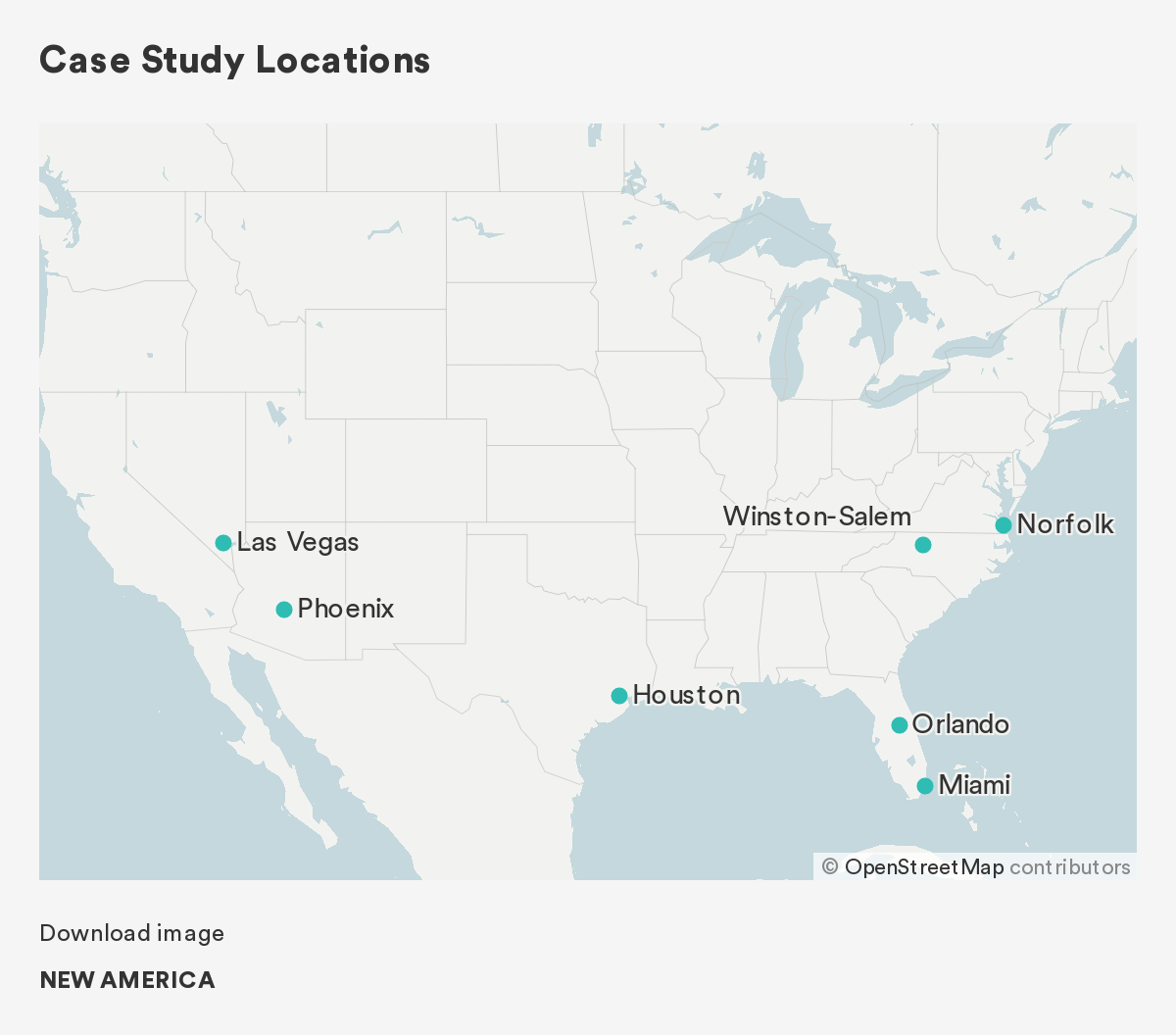
Each Sun Belt county is unique in its history, economy, racial and ethnic composition, and government policies, all of which shape local housing dynamics today. Relative to coastal cities like New York and San Francisco, cities in the Sun Belt have long been viewed as affordable places to live, growing rapidly as a result. However, stagnant wage growth, coupled with both an affordable housing shortage and increasing housing costs, has caused housing insecurity to rise in these counties, especially among low-wage workers.
When and Where are People Losing Their Home?
Overall Housing Loss: Between 2017 and 2019, the average rate of housing loss across our seven Sun Belt counties was 3.4 percent. This means that one in thirty households is losing their home to eviction or foreclosure each year. Roughly half a million people lost their homes each year, out of our 17 million person sample.
Housing loss has stayed steady across the three-year study period. However, it fluctuated greatly between study sites. Norfolk City, Virginia residents experienced housing loss at a rate of 5.4 percent, more than double that of residents in Orange County, Florida.
Evictions: The average eviction rate across all seven Sun Belt counties was 5 percent. Across the study period, we saw the eviction rate increase very slightly, by about 0.2 percent. Eviction rates in our case studies ranged from 2.4 percent in Miami-Dade County, Florida to 7.6 percent in Norfolk City, Virginia, meaning that in Norfolk, one in every 13 renters is being evicted each year.
Seasonal Variations in Evictions Across Seven Sun Belt Counties
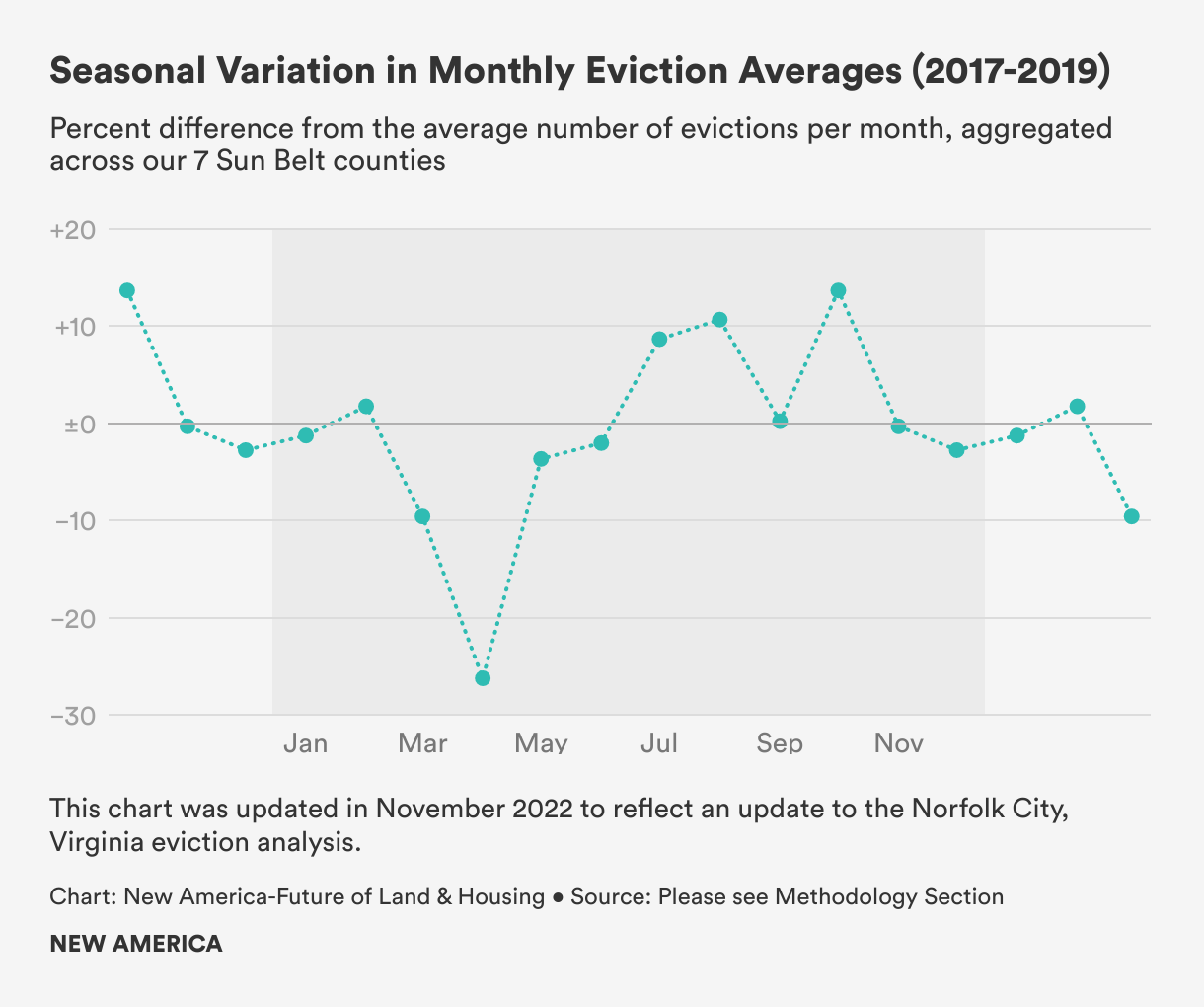
Across the seven Sun Belt counties, evictions fell during winter months and rose steadily until the late summer months. Evictions tend to drop in the month of September and peak in the month of October. On average, eviction rates were nearly 46 percent higher in October than in April.
However, aggregate trends mask important differences between the individual counties. For example, evictions in Clark County, Nevada fell sharply in July, a month when we would expect evictions to be high, and evictions in Forsyth County, North Carolina spiked in winter months instead of falling steadily as in other counties.
Mortgage Foreclosures: Between 2017 and 2019, the average mortgage foreclosure rate across the seven Sun Belt counties was 1.4 percent. Foreclosure rates are low relative to eviction rates, and we saw a 25 percent drop overall across the three-year study period. Of all case study counties, Maricopa County, Arizona had the lowest foreclosure rate, 0.3 percent, whereas Miami-Dade County, Florida had a highest foreclosure rate ten times higher. In every county except Harris County, Texas and Clark County, Nev., we saw a steady decline in foreclosure rates over the three-year time period. In Harris County and Clark County, foreclosure rates increased from 2017 to 2018 and then declined from 2018 to 2019.
Similar to evictions, we tend to see high foreclosure rates in major cities, often the center of economic activity within a county. Cities like Houston (Harris County), Orlando (Orange County), Phoenix (Maricopa County), Las Vegas (Clark County), and Miami (Miami-Dade) had foreclosure rates magnitudes higher than census tracts in other parts of the county.
Who Is Losing Their Home?
“Neighborhood racial composition is the biggest predictor of neighborhood eviction rate” – Researcher, RVA Eviction Lab at VCU1
Demographic Variables Associated with Housing Loss
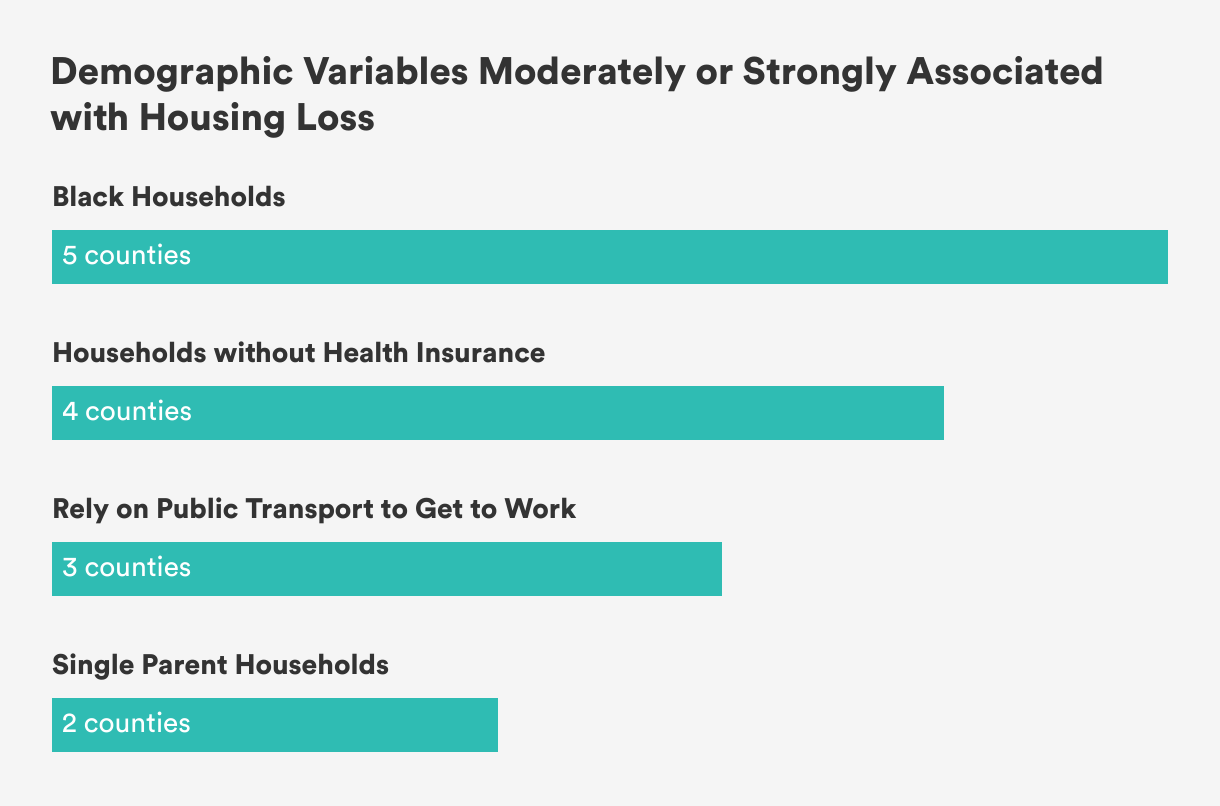
This chart illustrates the demographic variables that showed moderate or strong positive associations (defined as having an r value above 0.4) in the most Sun Belt counties, out of 6. To see which variables are associated with each county, please see the county-specific chapters.
To better understand who is losing their home, we tested the strength of the relationship between housing loss, eviction, and foreclosures and a host of demographic, socio-economic, and housing variables from the U.S. Census Bureau’s American Community Survey. This allows us to understand the degree to which increases in housing loss rates within a given census tract are associated with increases in certain demographic and other factors.
In nearly every Sun Belt county included in this report, we saw a strong relationship between race and housing loss. In particular, census tracts with higher numbers of Black households had substantially higher rates of both evictions and mortgage foreclosures.
We also found that as the percentage of residents without health insurance in a census tract increases, so does the rate of housing loss. Many poor-paying jobs do not provide health insurance, and this finding suggests that low-income households cannot pay for both housing and medical treatment following an unexpected emergency.
Finally, census tracts in which more residents took public transit to work had higher rates of housing loss. Based on our Displaced in America report, dependence on unreliable public transportation systems can lead to repeated tardiness or absence for work, leading to job loss and an inability to pay for housing.
Housing Loss and COVID-19 in the Sun Belt
Due to COVID-19, tens of millions of residents are at risk of eviction and mortgage foreclosure. Pandemic-related restrictions and lockdowns have led to mass job losses, particularly among low-wage Black and Latinx workers. Nationwide 1 in 6 renters is behind on rent and 1 in 3 express low confidence in next month’s ability to pay on time. Local housing experts across the Sun Belt counties emphasized that the communities most at-risk of housing loss prior to the pandemic are facing increased vulnerability as a result of COVID-19. As one researcher said, “the same communities are being impacted doubly by COVID and by eviction at the same time right now.”
2020 saw significant attention and activism around stabilizing renters and homeowners impacted by the COVID-19 pandemic. This work has resulted in a patchwork of national and local eviction and foreclosure moratoriums, as well as the implementation of billions of dollars in rental and mortgage relief programs and homelessness prevention through funding for motel and hotel stays from the first CARES Act passed in March 2020, and other sources of federal and local funding.
However, local housing stakeholders characterized the rollout of pandemic-related housing aid as slow, uneven, and often ineffective. Most counties relied on non-profit organizations embedded in local communities to facilitate the distribution of funds. According to several interviewees, several factors impeded non-profits’ ability to distribute aid efficiently, including differing application processes and eligibility criteria within the same locality, extensive documentation requirements, means-testing, and in one case, the requirement of in-person appointments. Local stakeholders also highlighted the discrepancy in cities’, and even non-profits’, access to resources and pre-existing distribution networks.
We also identified the following notable trends and innovations:
- Undocumented individuals are not eligible to receive federal CARES Act funding, so some counties used local dollars for relief efforts, which allowed them more discretion over who can receive aid.
- Outreach to impacted or at-risk communities about the existence of aid is perhaps more important than the distribution process itself, and this was also uneven across counties.
- Local innovations to safely housing the unhoused population amidst the pandemic could lead to longer-term solutions for this population, such as utilizing vacant spaces to ensure everyone has housing. This highlights that while the aim of relief funding is to mitigate housing loss and economic harm in the short-term, there are opportunities in COVID-19 responses to address inequalities that existed pre-pandemic in Sun Belt counties and beyond.
Local housing challenges preceding the pandemic are also hindering recovery efforts. A shortage of affordable housing not only contributes to housing loss, but exacerbates the consequences of displacement, as fewer and fewer available housing options exist for households who are evicted or foreclosed upon. The reasons underlying affordable housing shortages vary based on local dynamics, but common challenges include the availability and cost of land, labor and construction materials; a lack of adequate local, state, and federal funding for the development of affordable housing (i.e., through tax incentives, housing trusts, and voucher programs); and deteriorating conditions of older “naturally occurring” affordable housing. Further, once eviction moratoria expire, Sun Belt counties with poor tenant protections, widespread misinformation around evictions, or landlord-friendly court processes, may experience an unprecedented level of evictions.
Policy Recommendations
In the short-term, the ability of local and state governments to provide relief to tenants and homeowners is paramount to avoiding a massive wave of home loss, especially as eviction moratoriums and mortgage forbearances come to an end. In the medium- and long-term, it is essential that we tackle the underlying challenges that contribute to housing insecurity. While COVID-19 and the resultant economic fallout is indeed unprecedented, the fact that so many residents across Sun Belt counties, namely Black and Latinx residents, were just an unexpected expense away from housing loss is not just or sustainable. Below we briefly discuss short- and long-term policy recommendations.
Proposed Solutions to Mitigate Pandemic-related Housing Loss:
- Improve the disbursement of pandemic-related aid by simplifying application processes and reducing barriers to access (e.g., reducing onerous documentation requirements and means-testing, and dropping the requirement of in-person visits).
- Disburse aid directly to tenants, instead of to landlords, allowing at-risk communities to budget at their discretion.
- Strengthen tenant protections and slow down the eviction process once moratoriums lift, to provide tenants an opportunity to access funding, resources, and legal representation.
- Increase tenant education around the availability of aid, through robust outreach to vulnerable communities.
Medium- and Long-Term Proposed Solutions:
- Increase affordable housing options through better funding of housing trusts, voucher programs, and tax credits. Increase affordable homeownership, as well, through community land trusts and limited equity cooperatives.
- Invest in research to better understand public and private land ownership, from “mom-and -pop” rentals to large real estate investment trusts (REITs), in order to “demystify” the role that outside investment in local real estate markets and identify areas where affordable housing could be developed.
- Develop a holistic approach to addressing housing insecurity that reallocates money in state and local budgets for public housing, public transportation, education, childcare, healthy food options, and healthcare.
Citations
- From an interview with contributing author Jack Portman.