Disconnected Systems for Disconnected Youth Performance Partnership Pilots
Table of Contents
Abstract
This report explores motives, experiences, and outcomes of the Performance Partnership Pilots for Disconnected Youth (P3)—a federal program to improve services for “opportunity youth” by increasing flexibility for sites focused on systems change—and makes recommendations for federal leaders to improve its appeal and impact.
Building on our initial analysis in 2024, we interviewed federal staff involved in the creation and implementation of P3, as well as leaders from sites in the first three rounds of the program. We found that lasting systems change has been limited in four ways: (1) Sites lacked buy-in and understanding of the full flexibilities P3 provided; (2) P3 did not include planning time before implementation or technical assistance for proposal development; (3) program design elements prioritized programmatic flexibility over systems change; and (4) phased-out grant support reduced its appeal to potential applicants.
To address these limitations, we recommend seven changes implemented administratively (like offering technical assistance), legislatively (like codifying P3), and systemically (like changes to the definition of “opportunity youth”).
Acknowledgments
We would like to thank the Gates Foundation for its generous support of this research. The findings and conclusions contained within are those of the authors and do not necessarily reflect positions or policies of the foundation.
Massive thanks are due to the 17 individuals involved in the development and implementation of P3 who participated in interviews with us and shared their experiences and ideas. We are grateful to them for speaking candidly with us about the benefits and challenges of P3. Their reflections and insights were essential to our analysis.
We are grateful to our many wonderful New America colleagues for their support. Thank you to Taylor White and Braden Goetz for their thought partnership, Mary Alice McCarthy and Iris Palmer for their astute editing and feedback, Sabrina Detlef for her skilled copyediting, Katie Portnoy and Mandy Dean for their communications support, and Natalya Brill for the accompanying graphics.
Downloads
Introduction
In America, nearly five million young people ages 14–24 are not in school or working.1 Policymakers and practitioners call these individuals disconnected youth, out-of-school youth, or opportunity youth. Life for these young people is not easy. Opportunity youth frequently come from underresourced communities and face higher rates of poverty. Many have experienced homelessness, have disabilities, or have been involved with the child welfare or juvenile justice systems. Youth of color are overrepresented in this population, as are rural youth.2
These young people usually exist in the intersection of multiple systems (like child welfare, juvenile justice, education, and training and employment) that do not interact with each other.3 Successfully navigating these siloed systems to get support requires time, energy, savvy, and sometimes plain luck. It is too easy for youth to fall through the cracks between systems. Services often fall short of being fully effective because the systems within which they exist lack coordination.
This disconnect at the local level arises partly because of how federal funding works. Federal resources for opportunity youth are spread across multiple agencies and sub-agencies, distributing the funding to state and local education, workforce, and human services sectors. Programs that aim to serve the same population end up with different accountability, reporting, and eligibility requirements.
For front-line service providers, this makes it hard to effectively and efficiently serve youth and makes collaboration across organizations in different systems close to impossible. For example, a young person experiencing homelessness might be eligible for support through Workforce Innovation and Opportunity Act (WIOA) Title I and Reentry Employment Opportunities (REO) at the U.S. Department of Labor (DOL), Transitional Living Program (TLP) at the U.S. Department of Health and Human Services (HHS), and various resources at the U.S. Department of Education (ED), like Community Schools or Promise Neighborhoods. However, each of these programs has different requirements, and each is administered through a different system. These systems are not designed to interact with each other. Rather than creating a coherent system, federal funding tends to support a fragmented landscape of programs that too often fail opportunity youth.4
The Obama administration appreciated the urgency of improving services to opportunity youth and began looking for ways to address the fragmentation inhibiting a more holistic approach to their challenges. Federal workers believed programs serving disconnected youth could benefit from a performance partnership approach, which the Environmental Protection Agency (EPA) has long used to streamline funding and minimize administrative burdens.5 In 2014, Congress approved a new pilot program called the Performance Partnership Pilots for Disconnected Youth (P3), modeled after the EPA’s successful framework.6
Citations
- “Youth Disconnection in America,” n.d., source.
- William M. Rodgers III, Alice L. Kassens, Nishesh Chalise, and Nicole Summers-Gabr, “Not Working, Out-of-School Young Adults in the U.S. by Race and Geography,” On the Economy (blog), Federal Reserve Bank of St. Louis, August 15, 2024, source.
- Lancy Downs, “Lessons from the Performance Partnership Pilots for Disconnected Youth,” EdCentral (blog), New America, May 15, 2024, source.
- Taylor White, “How Can Federal Funding Support Systems Alignment for Career Pathways?,” EdCentral (blog), New America, May 15, 2024, source.
- United States Government Accountability Office, Performance Partnerships: Agencies Need to Better Identify Resource Contributions to Sustain Disconnected Youth Pilot Programs and Data to Assess Pilot Results (GAO, April 2017), source.
- U.S. Congress, Consolidated Appropriations Act, 2014, Pub. L. No. 113-76, §§ 526–528, 128 Stat. 413–417 (2014), source.
The Basics of P3
Federal policymakers hoped that P3 would remove the barriers state, local, and tribal governments face in serving opportunity youth through federal programs.
P3 is not a federal program in the conventional sense. Rather, it creates permission—or “authority”—for participating federal agencies to “waive statutory, regulatory, or administrative requirements” associated with their discretionary funding programs for youth.1 Under P3, certain federal agencies can grant states or local areas permission to follow different rules for spending federal funds that participating agencies administer. However, agencies do not waive requirements universally. Instead, state, local, or tribal governments have to apply, through a competitive process, to receive P3 authority.
P3’s goal is twofold: (1) to enhance service delivery and improve outcomes for disconnected youth by reducing programmatic and administrative barriers, and (2) to promote broader systems change and alignment across agencies and service providers.2 Systems change refers to changes in how partners collaborate across education, workforce, and human services systems to support disconnected youth.3 It can include implementing shared or collaborative governance structures, streamlined communication practices, and integrated data-sharing.4 These changes impact how youth-serving organizations operate collectively.
Programmatic changes, conversely, are often more youth-facing: They are changes to how services are provided to youth or which youth are eligible to participate. For example, expanding a college preparation program to include first-year college students is a programmatic change. Amending a federal funding stream’s definition of opportunity youth to include foster youth or homeless youth, regardless of whether they are disconnected from school and work, is another example.
There are two main components to the P3 authority: granting waivers to certain program requirements and allowing the blending and braiding of federal funds.5 Waivers and blending arrangements require approval from the relevant federal agencies to ensure they remain consistent with the original statutory intent of each funding stream. Most of the waivers that sites requested through P3 focused on programmatic changes that made serving youth in their communities easier through federal programs. For example, approved waivers ranged from expanding the age range of young people served to allowing service during the school day to negotiating alternative performance measures.
Within a single organization, combining various federal funding streams to support one unified program can be challenging.6 For example, an organization may want to provide access to social workers to help opportunity youth in middle school learn about various careers and the corresponding education and experience required. It could use a variety of federal funds to pay for this, like Gaining Early Awareness and Readiness for Undergraduate Programs (GEAR UP), Perkins, or WIOA, to name a few. Coordinating multiple funding sources while maintaining separate accountability, reporting, and eligibility rules for each is called braiding funding, and it requires meticulous financial tracking to stay compliant.7
Blending, by contrast, allows funds to be merged under a single set of requirements, offering more flexibility. However, blending typically needs legal authorization or approval from the overseeing agency, making it less common.8 While some providers successfully braid or blend funding within their own organizations, doing so across multiple organizations is rare.9 Cross-organizational pooling of funds demands complex invoicing, fund transfers, or the involvement of fiscal sponsors, which are administratively burdensome and costly. As a result, many providers become discouraged from pursuing deeper, cross-system collaboration.
Implementation of P3
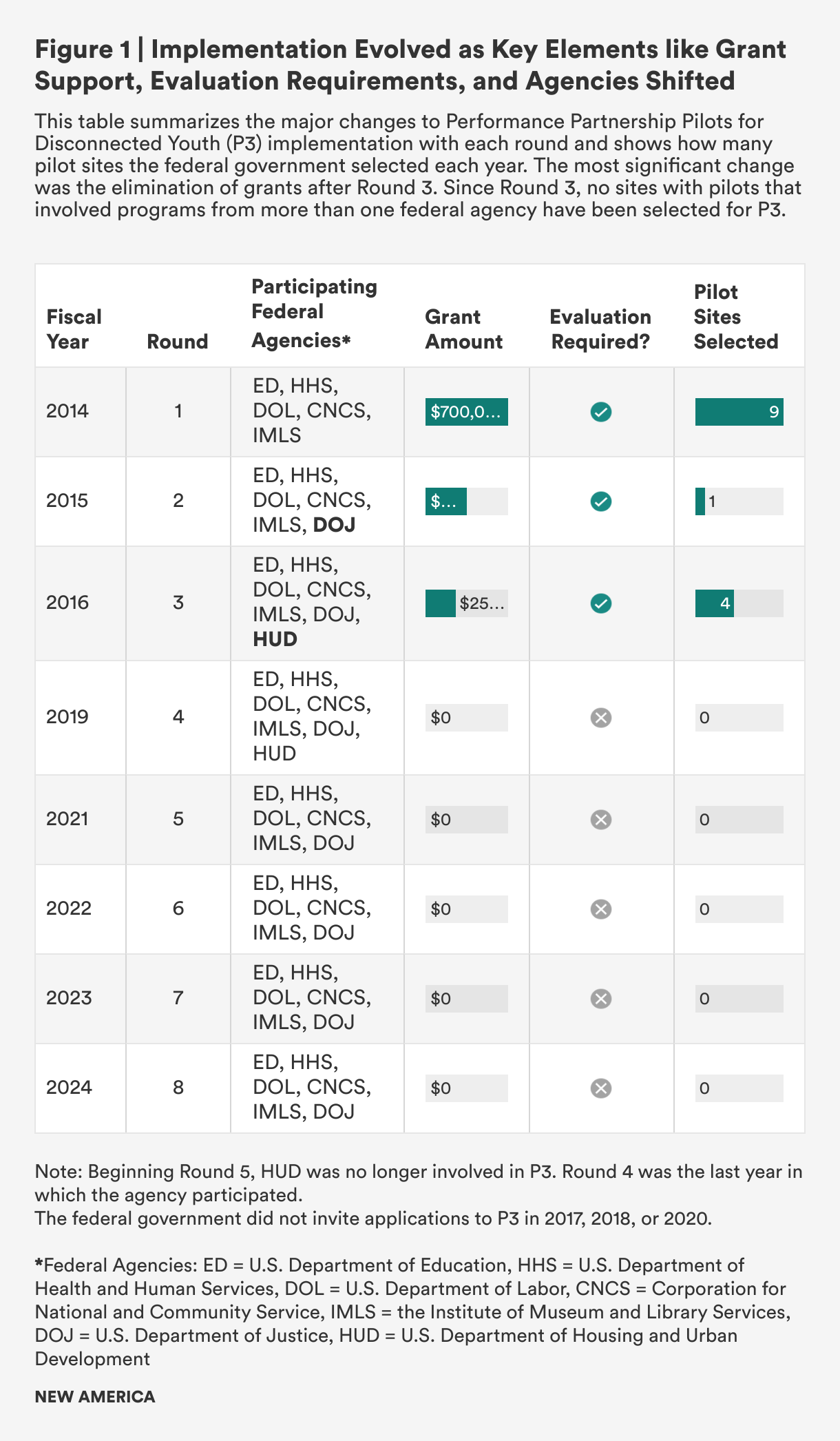
Though the Office of Management and Budget (OMB) led the initial effort to secure P3’s inclusion in the Consolidated Appropriations Act of 2014, implementation was handed off to agencies themselves, with the ED as the lead, with the DOL and HHS playing key roles. At the start, federal staff spent significant energy on figuring out how to collaborate across their own siloes. Below, we outline core elements of P3 implementation. Figure 1 below shows how these elements evolved over time.
Participating Agencies
At first, P3 included programs at five agencies: ED, DOL, HHS, the Corporation for National and Community Service (CNCS), and the Institute of Museum and Library Services (IMLS). It expanded in 2015 when Congress added the Department of Justice (DOJ) and then again in 2016 with the inclusion of the Department of Housing and Urban Development (HUD). HUD left the program after FY2020. There have been no changes since then. (To see the programs within each agency that were most frequently involved in P3, see Figure 3.)
Application Process and Selected Pilots
Between 2014, when the P3 authority was created, and 2024, the federal government issued eight rounds of application notices.10 Sites are selected through a competitive process, with state, local, or tribal governments eligible to serve as lead applicants and organizations and agencies from across the education, workforce, and human services systems listed as partners.
In their applications, sites must submit a proposal for how they would like to use the P3 authority, including any waiver or blended funding requests. For the first three rounds (2014–16), applicants needed to propose—and, if selected, implement—an evaluation design of their P3 project.
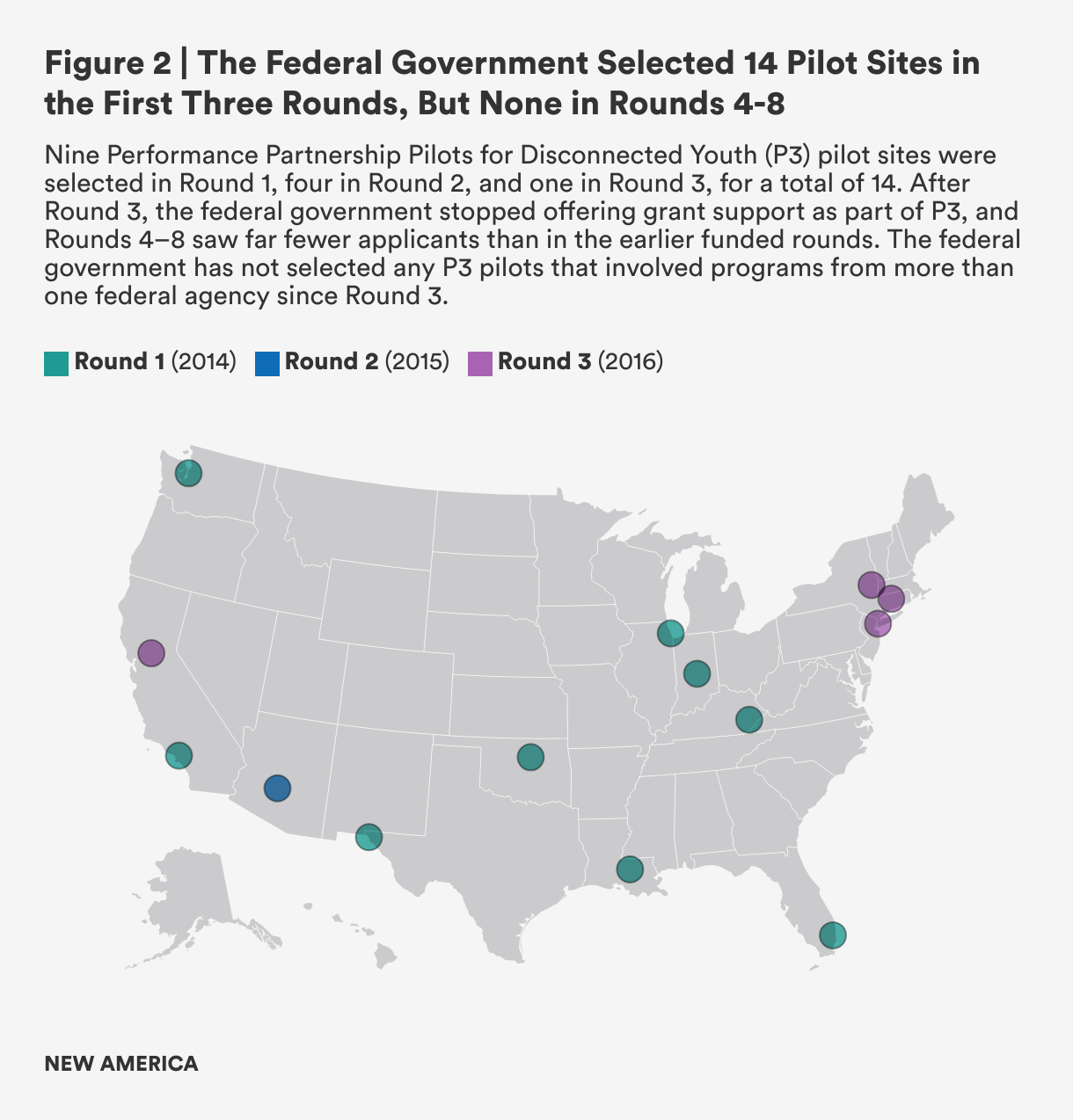
P3 authority was granted to 14 pilot sites in the first three rounds of P3: nine in the first round, one in the second, and four in the third (see Figure 2).11
Implementation Grants
The first three rounds provided grants to fund sites’ P3 intervention and evaluation. Notably, these grants were not funded through congressional appropriations.12 Instead, ED used P3’s blending authority to pool funding from other programs, like DOL’s Reentry Employment Opportunities, Adult Education and Perkins national activities, and the CNCS’ Social Innovation Fund, to create the grants.
Originally, the grants were capped at $700,000, but the agencies reduced the cap to $350,000 in the second round and $250,000 in the third.13 After this, the federal government phased out the grant support entirely and eliminated the requirement for sites to conduct evaluations of their projects. Later rounds have not provided funding for implementation. Not surprisingly, the rounds with implementation funding support had more applicants and selected sites (14) than later rounds that did not include funding.
Waivers
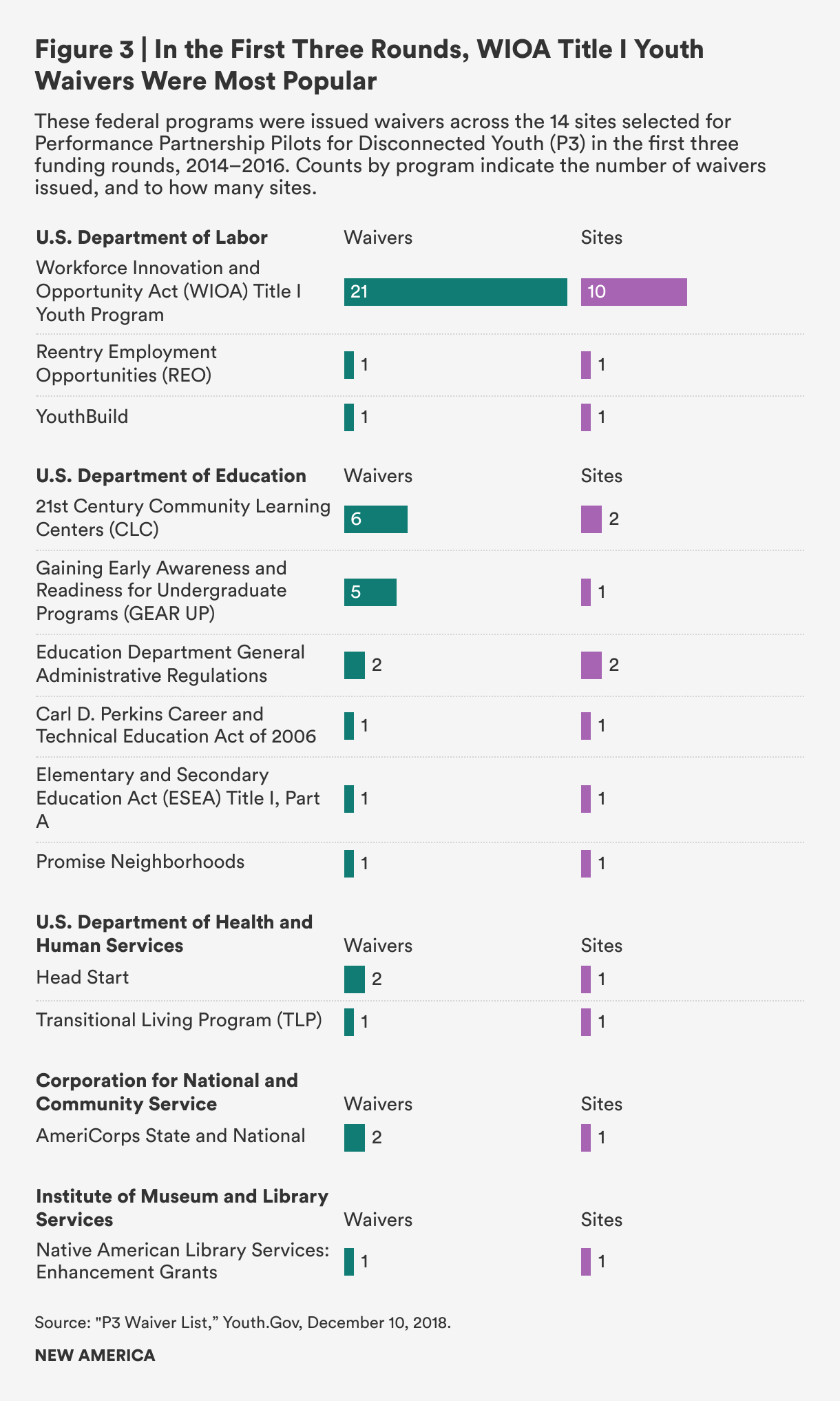
In the first three rounds, WIOA Title I Youth waivers were the most popular by a wide margin.14 Of the 45 waivers issued across the 14 sites in the first three rounds, 21 were for WIOA Title I Youth, with 10 different sites receiving WIOA Youth waivers.15 In several cases, pilot sites received waivers for more than one WIOA Youth requirement. Pilots used WIOA waivers to expand participant eligibility; create more flexibility in where, when, and how they served WIOA-eligible youth; and reduce administrative burden.16 ED’s 21st Century Community Learning Centers was the next most popular, with six waivers issued at two pilot sites.17 See Figure 3 for more information about the other waivers issued in the first three rounds of P3.
Citations
- GAO, Performance Partnerships, 12, source.
- Elizabeth Brown, Performance Partnership Pilots for Disconnected Youth (P3): Sustaining Systems Change Efforts and Coordinated Services for Youth (Mathematica, October 2020), source.
- Brown, Performance Partnership Pilots for Disconnected Youth, source.
- Brown, Performance Partnership Pilots for Disconnected Youth, source.
- Downs, “Lessons from the Performance Partnership Pilots for Disconnected Youth,” source.
- For more on these challenges, see Downs, “Lessons from the Performance Partnership Pilots for Disconnected Youth,” source.
- Taylor White and Lancy Downs, “Combining Multiple Funding Sources” in Unraveling the Finance Models of Work-Based Learning Intermediaries (New America, November 16, 2023), source.
- White and Downs, “Combining Multiple Funding Sources” in Unraveling the Finance Models, source.
- White and Downs, “Combining Multiple Funding Sources” in Unraveling the Finance Models, source.
- See the following links for the full notices: source for FY 2014; source for FY 2015; source for FY 2016; source for FY 2019; source for FY 2021; source for FY 2022; source for FY 2023; and source for FY 2024.
- In round three, an additional pilot site was selected but voluntarily ended its project before the P3 term expired, so we have not included the site in our analysis. Since round three, the federal government has approved some single-agency P3 pilots, either through ED or DOL. We do not focus on them in this analysis because they did not break down federal funding silos. They also functioned differently from the original 14, as they didn’t receive grant support or conduct an evaluation.
- Alexandra Stanczyk, Armando Yañez, and Linda Rosenberg, Performance Partnership Pilots for Disconnected Youth (P3): Implementation Study Findings of the Pilots’ Experiences (Mathematica, December 8, 2020), 3, source.
- Stanczyk, Yañez, and Rosenberg, Performance Partnership Pilots for Disconnected Youth (P3): Implementation Study, 3, source.
- “P3 Waiver List,” Youth.Gov, December 10, 2018, source.
- If an agency granted the same flexibility to more than one site, we counted that as multiple waivers, not one. For example, for six different sites, DOL waived WIOA performance measures and allowed the sites to use proposed alternative measures instead. For the purposes of this paragraph and our accompanying graphic, we counted these as six individual waivers, not one waiver.
- “P3 Waiver List,” source.
- “P3 Waiver List,” source.
Research Methods
From January through April 2025, we interviewed 17 individuals involved in P3’s design and implementation. Interviewees included current and former officials at the ED, DOL, and OMB. We also spoke with site leaders and evaluators from five pilots in the first round of P3, as well as an external technical assistance provider. These 60-minute conversations had either one or, in the case of some discussions with pilot sites, two interviewees. They were conducted by two New America staff members via Zoom.
We also reviewed over a dozen publications on P3, including national and site evaluations, notices inviting P3 applications published in the Federal Register, and technical assistance materials provided to prospective P3 applicants. The materials we relied on for our analysis were Mathematica’s national evaluation of P3,1 GAO’s 2017 evaluation of performance partnership initiatives,2 and notices inviting P3 applications published in the Federal Register. We also drew on New America’s previous research on P33 and federal systems alignment efforts in support of youth career pathways.4
We tracked common themes from interviews and background reading to identify four major findings and to develop recommendations for federal policymakers.
Citations
- “The National Evaluation of the Performance Partnership Pilots for Disconnected Youth (P3),” Mathematica, source.
- GAO, Performance Partnerships, source.
- Downs, “Lessons from the Performance Partnership Pilots for Disconnected Youth,” source.
- Taylor White, Lancy Downs, and Morgan Polk, “Building Better Pathways for Youth: A Blog Series Exploring Examples of Federal Flexibility,” EdCentral (blog), New America, September 4, 2024, source.
Findings
Federal expectations for P3 were high. The program, developed in response to what federal leaders had learned on the ground about the challenges of serving opportunity youth, was a long time coming. Leaders at federal agencies saw the flexibilities P3 offered as a new and exciting way to innovate and hoped it would catalyze systems change at the selected sites. The option to blend federal funds represented a major departure from the usual rules. In theory, it could allow sites to collaborate across organizations in ways that federal funding restrictions and reporting requirements normally limit. The opportunity to waive programmatic requirements like eligibility criteria is more common in some federal programs than others. Packaged together, these flexibilities made for a formidable toolkit, and the federal agencies expected to receive innovative and bold proposals in response.
Ultimately, P3 didn’t live up to these lofty expectations, particularly when it came to the program’s goals around systems change. P3’s results over the past decade demonstrate that while flexibility can help local programs address pain points in service delivery, it is not a lever for sustained systems change. This does not mean, however, that it stymies systems change. Los Angeles’s P3 efforts, for example, resulted in a new hub called the ReLAY Institute,1 which builds partnerships and organizational capacity, shares data and information, and promotes innovative practices with the goal of “transform[ing] service delivery systems” that support disconnected youth.2 Broward County and Hartford both used P3 to build an integrated data system,3 which is often key to breaking down silos between systems. These interventions proved that systems change efforts could leverage flexibility offerings to advance systems-level work. But flexibility on its own is not a forcing mechanism to create systems change.
There are four key reasons why P3 was unable to fully capitalize on the goals federal leaders set out to achieve, especially regarding systems change.
1. Sites Lacked Buy-In and Understanding of P3’s Flexibilities
Federal agencies were largely disappointed with the proposals they received from prospective P3 sites in the early rounds. Many of the applications requested waivers for adjustments that sites could already make without P3. Most did not touch the blending flexibility, which was theoretically the most novel aspect of P3. Agency staff were perplexed. Why were applicants requesting unnecessary waivers? Why did they forego some of the flexibilities entirely?
Our research found that this usually occurred because site staff and federal agency staff had different understandings of what was already allowed under the funding streams included in P3. This accounted for the unnecessary waiver requests in P3 applications. Sites thought they needed special permission from the federal government to use the money in a particular way; the agency’s interpretation of the law said that sites could already do so without a waiver.
These misconceptions often had murky origins. Sometimes, sites inadvertently imposed nonexistent restrictions around federal funds. In these instances, sites had organizational norms or rules that constrained the use of federal dollars to ensure total compliance with the law. Staff assumed the federal government imposed these rules. They did not realize the limitations were of their own making until they submitted a P3 application and heard from federal agencies that the issue they wanted a P3 waiver to resolve was already allowable.
At the same time, sites didn’t have much practice with the kind of creative thinking the federal agencies expected. Pilot sites were used to operating in a compliance-first environment when it came to federal dollars. In many cases, sites struggled to believe that some P3 flexibilities were allowable and would not result in a penalty. According to Mathematica, four of the nine first-round sites said “they were unable to secure enough trust and buy-in from their state and local partners to implement their planned approaches.”4
The blending flexibility, in particular, was a nonstarter for most sites. Mathematica researchers found that staff at many pilot sites were not familiar with blending and did not know how to use that flexibility to support their work.5 A person at one site told us that if blending had been a requirement, the site’s project would have failed because blending was simply too difficult. Another said that their organization had no accounting mechanism to blend and that trying to create one would take more time and effort than it was worth. Some also saw blending as a threat to their work: Staff from one P3 site described blending as “dangerous” because it could cause confusion during an audit, which could, in turn, impact their ability to secure future grants.
These concerns meant that site staff generally took advantage of the “safer” flexibilities, like braiding funding and waivers, rather than the more innovative aspects of blending, which they found too risky to pursue.
But when sites did cultivate buy-in for P3, it proved impactful in their communities. In Los Angeles, for example, city leaders actively advocated for P3 to build support among their core partners and a broad coalition of public, nonprofit, and philanthropic organizations.6 Securing this buy-in early paid dividends as the P3 work unfolded. The city was able to convene over 50 partner agencies around a goal of creating a stronger, more cohesive youth services system city-wide, crafting a strategic plan to guide their efforts.7 Staff participated in work groups aimed at advancing key plan objectives, held regional collaborative meetings to support information-sharing, and developed a revised intake process for youth centers that more easily connected youth with education, job training, and mental health services, among other services.8
These efforts reshaped how partners from different systems worked together, and Los Angeles became one of only two sites in the first round that saw sustained systems change. In other words, the Los Angeles site did not simply make changes to how one particular organization serves youth, but rather to how the entire network of youth service providers functions and how partners within it communicate. Today, Los Angeles is the only site from the original three rounds with an active P3 authority.
The discrepancy between federal expectations and site realities highlights a tension at the heart of P3: Simply providing the flexibility was not enough for sites to take advantage of it—or to drive systems change, P3’s stated goal. Minor adjustments often eased barriers to effective service delivery, even if they did not lead to actual system changes.
2. P3 Did Not Include Planning Time Before Implementation or Technical Assistance for Proposal Development
Successful systems change requires partners across different systems to spend time developing a shared vision before implementation of their effort begins. But P3’s structure did not build in planning time for sites in advance of their P3 intervention, which meant sites not already engaged in systems change work struggled to use P3 as a way to foster lasting systems change, though some were able to take initial steps.
Mathematica found that only two sites in the first round—Los Angeles, California, and Broward County, Florida—were able to foster sustained systems change through P3.9 Los Angeles focused on building a new youth service delivery system that was coordinated across all partners, while Broward County used P3 to relaunch efforts to build an integrated data system.10 In both places, partners had engaged in cross-system planning efforts before P3, and once they received the P3 authority, they used it as an opportunity to set explicit systems change goals.11 The other sites, where cross-system partnerships were not as developed, generally approached P3 from a programmatic perspective and didn’t use it as a tool to support systems change.12
Sites also could not meaningfully workshop and refine their P3 proposals, including their requested waivers, with federal agency staff. Sites submitted applications, which were then peer-reviewed by federal staff. For the applications selected to move ahead, the requested waivers and flexibilities went through an extensive approvals process that included sign-off from the relevant agency secretaries. Once applications were submitted, the sites had little opportunity to get feedback from the agencies and adjust their proposal based on that input. Sites unsure how to use P3 as a vehicle for systems change submitted more programmatic proposals and could not revise their plans to focus more on systems change elements.
The lack of a planning period and limited proposal development technical assistance also exacerbated the problems discussed in the finding above. Without time to cultivate buy-in and support to craft more ambitious, creative proposals, sites struggled to submit applications that met the federal government’s high expectations.
3. Program Design Elements Prioritized Programmatic Flexibility Over Systems Change
In the initial notice inviting applications to P3 in the Federal Register, the government offered several examples of potential pilot projects.13 All were related to collaboration, alignment, or partnerships across systems that serve disconnected youth. But of the 14 sites in the first three rounds of P3, only Los Angeles and Broward County set goals relating to system change.14
Outside of these two places, most sites’ P3 interventions focused on improving program delivery for youth populations. The New York City pilot, for instance, extended the time period for which parenting youth could receive WIOA services and provided them with a case manager who could connect them to free or subsidized child care.15 Active at two sites in Brooklyn, this intervention was aimed at improving the services that parenting youth received rather than transforming how youth services operate citywide.16
Despite ambitious goals around breaking down silos and promoting systems alignment, P3’s design placed more emphasis on providing programmatic flexibility than on creating systems change. For example, sites had to track youth education and workforce outcomes, but not progress on data-sharing, collaboration, or how agencies and institutions work together.17 Mathematica researchers hypothesized that this sent a message to the sites about which goals the government cared most about, incentivizing a focus on service delivery over systems-oriented efforts.
Another barrier to systems change resulted from P3’s time-limited authority, which didn’t incentivize the long-term, structural changes needed to foster systems alignment. Pilot sites were granted P3 flexibilities for roughly two years, though Congress later created an option for a five-year extension if a site demonstrated strong performance.18 But once the P3 term was up, the flexibilities would expire. This made it hard for sites to commit to long-term systems change efforts that depended on the P3 flexibilities. There was little motivation for sites to engage in a major systems alignment project that might be rendered unusable as soon as their P3 term was over.
Indeed, most of the site staff we spoke with said that the changes they implemented during P3 did not last once their P3 authority expired. We found some exceptions, like Los Angeles, but the city’s cross-system coordination and planning was happening before it became a P3 pilot and was not reliant on P3 flexibilities like waivers to continue.
While most staff we interviewed reported that the P3 changes did not last at their site, many did say that P3 either created or strengthened relationships between local partners across different systems. Improved connections have continued after P3 and have enhanced local collaboration.
4. P3 Phased Out Grant Support, Reducing Appeal to Potential Applicants
P3 is a relative rarity in this era of political polarization: It enjoys bipartisan support from federal policymakers. P3 owes its popularity and longevity, in part, to its low price tag: zero dollars.
Because Congress has never appropriated any funds to support P3’s implementation,19 federal agencies involved in P3 have had to find money for it elsewhere in their budgets. Federal staff assigned to develop the notice inviting applications, evaluate applications, provide technical assistance, and implement the evaluations had to find time for this work in their normal course of duties. Without dedicated staff, coordinating across agencies became a challenge. “It was a tax on the agencies,” one former federal employee told us.
The agencies also had to find the money for the $700,000 grants provided to pilot sites to support implementation and evaluation. Because there were no appropriations for the grants, ED created the grants by pooling funding from programs across the involved agencies. Taking money from already sparsely funded programs proved difficult to sustain. The agencies reduced the grant size in the second and third rounds of P3, before phasing it out entirely in the fourth round, along with the evaluation requirement. Without evaluations, the federal government lost the ability to learn the extent to which P3 was working.
The elimination of the site grants delivered a blow to interest in the program. Since the third round—the last with grants—no sites with pilots that involved programs from more than one federal agency have been selected,20 and the federal government has received very few applications despite regular solicitation.
All of the site staff we spoke with said that the grant was vital, and that without it, they would not have applied or been able to implement their proposed P3 intervention. One site leader said that the grant did not cover all staff capacity needed for the project, and colleagues had to work long hours to fill the gaps. Another told us their site had started brainstorming proposals for future rounds of P3 but abandoned their plans once they found out it would not come with a grant to fund the staff capacity needed to implement the proposal.
These strong feelings were, in part, due to the evaluation element of P3. For the first three rounds of P3, sites had to propose an evaluation of their P3 intervention in their application, and then, if selected, fund it using their grant dollars. In our interviews, site staff reported that the evaluation requirements were onerous. Applications got more points for proposing rigorous experimental evaluations—high-quality studies—but these are expensive and hard to execute. Not all sites had the same level of in-house evaluation expertise; some proposed evaluations beyond what they could perform. Without the P3 grant funding (and considerable evaluation technical assistance from Mathematica), site staff said, they would not have been able to implement the evaluation requirements.
Citations
- ReLAY Institute (website), source.
- Brown, Performance Partnership Pilots for Disconnected Youth, 9, source.
- Stanczyk, Yañez, and Rosenberg, Performance Partnership Pilots for Disconnected Youth (P3): Implementation Study, 11–12, source.
- Brown, Performance Partnership Pilots for Disconnected Youth, 28, source.
- Stanczyk, Yañez, and Rosenberg, Performance Partnership Pilots for Disconnected Youth (P3): Implementation Study, 27, source.
- Brown, Performance Partnership Pilots for Disconnected Youth, 6–11, source.
- Brown, Performance Partnership Pilots for Disconnected Youth, 6–11, source.
- Brown, Performance Partnership Pilots for Disconnected Youth, 6–11, source.
- Brown, Performance Partnership Pilots for Disconnected Youth, source.
- Brown, Performance Partnership Pilots for Disconnected Youth, 4, source.
- Brown, Performance Partnership Pilots for Disconnected Youth, 4, source.
- Brown, Performance Partnership Pilots for Disconnected Youth, source.
- “Applications for New Awards; Performance Partnership Pilots,” 79 Federal Register 70034, November 24, 2014, source.
- Brown, Performance Partnership Pilots for Disconnected Youth, 4, source.
- Theresa Anderson, Alex Carther, and Alan Dodkowitz, Supporting Young Parents: Impacts of the New York City Performance Partnership Pilot (P3) on Young Parents’ Outcomes (Urban Institute, March 2022), source.
- Anderson, Carther, and Dodkowitz, “Supporting Young Parents: Impacts of the New York City Performance Partnership Pilot (P3) on Young Parents’ Outcomes,” source.
- Stanczyk, Yañez, and Rosenberg, Performance Partnership Pilots for Disconnected Youth (P3): Implementation Study, 40, source.
- Because P3 was tied to the use of a particular year’s appropriation, the flexibility was effective only for the time during which the appropriation could be spent. This period varied by program but was no longer than 27 months. The agencies developed some workarounds for that limitation, and Congress later gave them the authority to extend pilots for up to five years if they demonstrated strong performance, but the period in which pilots were expected to be implemented was still relatively brief.
- Stanczyk, Yañez, and Rosenberg, Performance Partnership Pilots for Disconnected Youth (P3): Implementation Study, 3, source.
- As noted in our “Implementation of P3” section, the federal government approved some single-agency P3 pilots, either through ED and DOL, after round three. We do not focus on them in this analysis because they had less emphasis on breaking down federal funding silos.
Policy Recommendations
The seven recommendations below, on three tiers, aim to balance flexibility with the targeting necessary to support opportunity youth. They should not be seen as an endorsement of block grants, as block-granting this funding would enable flexibility that might direct resources away from disconnected youth. Block grants do not appropriately balance flexibility with ensuring funding gets where it needs to go. The flexibility P3 seeks to allow is meant to make it easier to serve opportunity youth, not harder to get the necessary resources for them. Block-granting a program tends to lead to fewer resources overall. For example, a 2017 proposal to convert the Supplemental Nutrition Assistance Program into a block grant would have also cut 30 percent of its funding.1 Furthermore, block grants do not allow funding to respond to economic indicators. If the need increases in a region, the resources do not match it.
Tier 1: Administrative Changes
Clarify allowable uses of federal dollars.
Our conversations with staff at P3 sites revealed confusion about how federal funding streams can and cannot be spent. Fear of noncompliance even led some site staff to impose restrictions not required by the federal government. If practitioners had a clearer understanding of flexibilities and waivers available under regular practice outside of P3, it could eliminate some of the barriers they face in serving opportunity youth and improve the delivery of those programs.
Myth-busting from federal agencies could help provide this clarity. We focus on P3 in this brief but believe this would benefit all career pathways programs. We suggest regularly releasing requests for information to solicit examples of challenges and questions from practitioners. Agencies can then issue guidance that speaks to common misconceptions and provides specific, and, if possible, real-world examples of how other sites use their federal dollars. Guidance should specifically address the flexibilities that require a waiver and those that programs can simply enact on their own. Programs also need clarity about which requirements come from the federal government and which are imposed by their state departments. Joint guidance issued by agencies is especially valuable to practitioners who receive funding from more than one federal department. Supplemental webinars through technical assistance platforms like DOL’s WorkforceGPS could reinforce messaging provided in guidance.
Maximizing federal investments requires a steady stream of support and guidance from the administering agencies, not just one-off efforts. Without continuous technical assistance, federal dollars are underutilized, but agencies do not always have the capacity to provide such hands-on support. Increased funding from Congress to boost federal technical assistance capacity could ensure funding is used more efficiently and effectively to serve youth.
Update the application solicitations.
Include real-world examples of how sites have used P3 flexibilities and examples of how P3 can support systems change. One reason sites struggle to submit strong applications for P3 is a lack of clarity about the available options. Specific examples of how other sites have used P3 can help spark ideas.
The government has already taken productive steps in this direction. The Federal Register notices soliciting applications include hypothetical examples of how P3 can be used, which has been a helpful practice for prospective applicants. For example, in 2021, one of the examples discussed waivers to include undocumented college students in TRIO programs, which prompted California colleges and universities to submit an application for that flexibility. Oregon postsecondary institutions followed suit the next year. (Both received P3 authority as single-agency pilots through ED.2 In March 2025, the Trump administration revoked the pilots’ TRIO waivers.3) And since 2019, the notices have included a link to previously approved waivers, though the list has not been updated since 2018.
The government should build on this effort and provide real examples of how sites have (successfully) used the P3 authority. It should also update the list of previously approved waivers as new ones are approved and continue to include this list in application solicitations.
Clarify the goals.
Though one of the core goals of P3 was to promote systems change, most of the P3 interventions in the first three rounds aimed to improve service delivery for youth populations. The systems change goal is not clear in the P3 application solicitation, since the hypothetical examples of P3 used are focused on combining multiple federal funding streams to run programs for opportunity youth. They do not speak directly to how P3 can support collaboration, alignment, or partnerships across systems through strategies like shared data systems or collaborative governance.
If the government would like to encourage more systems change efforts through P3, it needs to highlight examples, hypothetical or not, of how to do so, and add metrics that would measure the success of such efforts. The interest from California and Oregon in response to the TRIO example shows that practitioners will take cues from the options provided in the application solicitation. P3 may have lost some of its appeal without implementation grants, but there is still an appetite for innovative ideas. Proposing realistic, inexpensive ways P3 can support systems change, and concrete ways this change could be measured, could entice prospective applicants to submit proposals to do just that and provide the evidence needed to scale up successful innovation.
Tier 2: Legislative Changes
The results from Los Angeles and Broward County suggest that, with the right enabling conditions in place, P3 can support both programmatic flexibility and systems change. For P3 to provide this dual support to all sites—not just those that have already begun systems change work—several key aspects of P3’s design and implementation need to be adjusted.
Codify P3 as a competitive grant program.
Include funding for planning, implementation, evaluation, and federal agency support. P3 authority is provided each year through the appropriations bill, which places it in a precarious position for several reasons. First, there is no way to predict if Congress will simply choose to exclude P3 from this bill in any given year, in which case the P3 authority would cease. And because the P3 authority is tied to the use of a particular year’s appropriation, the flexibilities for approved pilot sites are effective only for the period during which the appropriation could be spent, which limits the time in which sites can implement their P3 proposals. The appropriations process also worsens this time crunch: Appropriations bills are often pushed off further in the year as Congress increasingly relies on continuing resolutions to fund the government and avoid a shutdown. This forces agencies to run behind in implementing P3, starting the application process under one year’s appropriation and designating pilots under the next year’s appropriation.
Creating a permanent P3 authority would lend the program stability and provide sites with longer implementation periods. Funding for P3 could be generated by setting aside a small percentage of the money appropriated for the WIOA Youth Program, the Carl D. Perkins Career and Technical Education Act, and/or a youth-serving program administered by HHS, such as the Runaway and Homeless Youth Program. This funding structure would give each agency a stake in P3’s success and help boost buy-in at federal agencies. If Congress sets a clear expectation that it wants agencies to collaborate, it would have a license to grant waivers that some have hesitated to approve.
A codified P3 program should include three elements:
1. Implementation and evaluation grants. The slowdown in P3 applications, which coincided with the elimination of grant funding for P3 sites, reflects the fact that sites need money to do this work. Coordinating across organizations and systems is challenging and time-consuming. Funding not only encourages sites to apply but also allows them to actually implement P3.
Reinstating the grants to support both implementation and evaluation would attract more applicants and revive the government's ability to learn how well P3 works. We recommend adjusting the evaluation measures to include outcomes focused on systems change and alignment to encourage sites to build that work into their P3 proposals.
2. Planning grants. These should focus on supporting systems change and technical assistance to make the most of the time to plan. Mathematica found that sites that planned before P3 were the most successful at incorporating systems change efforts into their P3 work. We recommend funding planning grants and requiring that all P3 sites engage in a planning period before implementation.
Planning grants and individualized technical assistance from federal agencies would provide three key benefits. First, partners from across different systems could align around a common vision and goal for the P3 work before implementing it. This would provide all sites with the preplanning opportunity critical to P3’s success in Los Angeles and Broward County. Second, affording time and space to ask questions and get comfortable with P3’s flexibility would improve buy-in among site partners, increasing the likelihood of the intervention’s effective implementation. Third, sites would have the opportunity to receive feedback on and refine their P3 plans. Individualized support for sites around waiver selection and the systems-changes aspect of P3 would foster strong, innovative, and systems-change-oriented P3 plans.
3. Technical assistance. Though there were 14 pilot sites during the first three rounds of P3, the technical assistance was mainly for evaluation support. There was no formal, consistent TA program for the pilot sites as a cohort and few opportunities for them to learn from one another.
We recommend a more structured, cohort-based technical assistance model, including peer learning, site visits, and in-person convenings with federal staff. Peer-learning opportunities would allow site staff to learn how counterparts have taken advantage of P3 flexibilities, how those approaches could be applied to their own contexts, and how to tackle common barriers. Site visits to successful current or former P3 sites or localities that have done strong systems alignment work would offer a similar benefit. Pilot site staff told us that one of the most valuable aspects of their P3 experience was meeting with and asking questions of federal staff from multiple agencies at a convening in Washington, DC. Bringing back these opportunities for firsthand observation could boost buy-in from sites.
Tier 3: Systemic Changes
Broaden the opportunity youth definition.
Because the majority of waivers requested and approved were surrounding WIOA Youth, we recommend a broader definition of opportunity youth, like that proposed in the Stronger Workforce for America Act.4 This WIOA reauthorization legislation would replace “out-of-school youth” with “opportunity youth,” including youth experiencing homelessness and youth in foster care, regardless of school enrollment status.
Create state-level systems-change grants.
The challenge of aligning workforce, education, and human services systems could be more efficiently addressed at the state level rather than city by city. With resources and support, states could, for example, work to create or improve longitudinal data systems that providers across the state could access to support career pathways. This would make it easier for local organizations to work together, whether or not they have P3 authority.
Coordinate timelines and performance indicators.
For education and workforce systems at the state and local levels to coordinate most effectively, the legislation that governs these at the federal level should be more aligned. Ensuring that planning timelines line up and performance metrics work together will allow the WIOA and Perkins systems (and actors within them) a better chance at coordinating work streams and improving service delivery.
Citations
- “The Stealth Attack on Women’s Health: The Harmful Effects Block Granting Safety Net Programs Would Have on Women,” National Women’s Law Center, May 22, 2017, source.
- As noted in our “Implementation of P3” section, this analysis focuses on pilots that involved more than one federal agency, rather than on the single-agency pilots, which had less emphasis on breaking down funding silos.
- U.S. Department of Education, “U.S. Department of Education Revokes Waivers to California and Oregon Universities Using Federal Funding to Provide Services to Illegal Immigrants,” press release, March 27, 2025, source.
- A Stronger Workforce for America Act, H.R. 6655, 118th Cong. (2023), source.
More About the Authors

Lancy Downs
Senior Policy Analyst, Center on Education & Labor

Morgan Polk
Senior Policy Analyst, Center on Education & Labor
Issues
Programs/Projects/Initiatives
Related


Does Combined Planning Help States Align Workforce Initiatives? Survey Shows Mixed Results.