
Table of Contents
- Overview
- Introduction
- A Closer Look at the Lower Mekong Region
- Factors Affecting the Development, Deployment, and Acceptance of Digital Solutions
- A Brief Landscape of the Regional Digital Ecosystem
- Broad Recommendations for People-Centered Digital Transformation
- Conclusion
- Appendix 1: Country Briefs
- Appendix 2: Catalog of Digital Solutions in the Lower Mekong Region
- Additional Readings
A Brief Landscape of the Regional Digital Ecosystem
Implementing and ensuring safeguards for human rights, privacy, and fundamental freedoms while the region’s digital ecosystem is still nascent is critical. Current authoritarian approaches to technological governance in the Lower Mekong Region present a significant barrier toward people-centered digital transformation. The failure to course-correct only further jeopardizes current or ongoing digital solution initiatives and their ability to create whole-of-society change. With this in mind, this section details some of the larger components of digital ecosystems that represent areas of potential socioeconomic growth and regional cooperation, including foundational elements such as capacity, digital literacy, and innovation culture; advancements in social media and messenger apps; fintech and e-commerce; and the emergence of digital public infrastructure and e-government activities.
To take a closer look at each country’s digital development and key areas to watch in their digital transformation process, please see the Country Briefs.
Capacity, Digital Literacy, and Innovation Culture
The Lower Mekong countries are at various stages in developing their technology innovation ecosystem to support large-scale digital transformation. In most of the region, digital literacy represents a barrier to digital solutions deployment.
Capacity
The region is made up of relatively nascent digital ecosystems that are often limited by underdeveloped infrastructure and regulation, as discussed. While some countries are more advanced in this area than others, each could benefit from greater coordination among governments, investors and corporate venture capital, educational institutions, development actors, and civil society, in order to support large-scale digital transformation. Capacity for digital transformation relies on these stakeholders working together to create an ecosystem for developing, deploying, vetting, and adopting new technologies. Entrepreneurs, talent, investment, and regulatory support are all necessary components to fostering ecosystems conducive to rights-respecting technological innovation.
Each country in the region other than Myanmar participates in the United Nations Development Programme (UNDP) Accelerator Labs network. The Accelerator Labs are designed to close the gap between the current practices of international development and the accelerated pace of change in the digital era. While the labs are closely aligned with achieving the UN’s Sustainable Development Goals (SDGs) by 2030 and are embedded in the UNDP’s global policy teams and country offices, every Accelerator Lab has its own initiatives and broader priorities. Overall, the Accelerator Labs in the Lower Mekong Region focus on using data to inform scalable and innovative solutions for priority areas such as circular economies, waste management, pollution monitoring, and sustainability.
- Cambodia: Cambodia’s lab works on issue areas such as mobile air-quality monitoring sensors, poverty mapping, and supporting local start-ups with incubation programs.
- Laos: Laos’s lab has focused on innovative experimentation and conducted studies on waste management solutions using satellite imagery and data, and separately is working on skills training that can help address youth unemployment.
- Thailand: Thailand’s lab is working to bridge the digital divide and support the Thai government’s digital transformation initiative to make public service delivery more efficient and accessible.
- Vietnam: Vietnam’s lab was chosen as a participant in the Japan SDGs Innovation Challenge to work with Japanese companies to co-develop, design, and test potential solutions for SDG target areas.
Digital Literacy
UNESCO (the United Nations Educational, Scientific, and Cultural Organization) defines digital literacy as “the ability to use information and communication technologies to find, understand, evaluate, create, and communicate digital information, an ability that requires both cognitive and technical skills.” However, digital literacy levels are difficult to assess as there is no standard measure. Even where estimates are provided, there is little information on how rates are determined. For example, the Cambodian government has determined that 30 percent of its population is digitally literate but does not explain its methodology.1 Generally, low rates of digital literacy are widely recognized as a barrier to technology use, development, and deployment throughout the region, particularly for women and girls. This creates further marginalization, as already socially excluded groups have less access to tech. With large segments of the population online, low literacy rates can make users vulnerable to scams and predatory behavior.
Innovation Culture
Start-up culture growth is fueled by a few factors, including government support, digital entrepreneurship, favorable tax and visa regulations, and an emerging sector with increasing competition and potential. Cambodia, Thailand, and Vietnam all boast promising tech start-up cultures. Conversely, Laos’s and Myanmar’s ecosystems are hampered by missing key features including investment, infrastructure, developed markets and modern financial services, supportive regulation, and access to tech talent. In Laos, barriers to tech sector growth include a relatively small population and therefore small market potential, as well as low digital literacy concerns and complex business registration. In Myanmar, promising accelerator and incubator initiatives have been felled by instability in the country.
- Cambodia: The number of technology start-ups in Cambodia has grown significantly. Most focus on fintech, followed by media and advertising, e-commerce, development services, and digital marketplaces. The Cambodian government has taken action to strengthen tech innovation in line with recent national strategy plans by promoting start-ups and fostering entrepreneurship and innovation through e-learning programs, licenses for tech-related businesses, and technology industry zones.
- Laos: Smaller companies just starting out may prefer to remain unregistered and under the radar to avoid dealing with taxes, licensing, and other government regulations. They also have to contend with a lack of access to funding and local programming capacity. But there has been a leader on the start-up front in Laos: LOCA. LOCA was created to fill the gap left by a lack of reliable transportation services and absence of international rideshare services. But LOCA has emerged as more than a ride-hailing service, also providing tours, information about tourist sites, and a directory of local restaurants.
- Thailand: Start-ups have seen explosive growth over recent years in Thailand, particularly those in the fintech sector. One source cited tenfold growth from 2018 to 2022. Thailand’s first tech “unicorn,” Flash Express, was another milestone in the country’s mission to position itself as an “innovation nation.” The National Innovation Agency even set a national goal of having 100 deep-tech start-ups—which develop their own tech solutions—in the country by 2025, with 65 focused on bio-circular and green economy.2
- Vietnam: Attempting to launch its own Silicon Valley in Ho Chi Minh City, Vietnam is using three eastern city districts to create a technology development zone to attract tech entrepreneurs from across the country and the world.3 This initiative supports Vietnam’s National Digital Transformation Programme by 2025, which aims to develop more digital institutions, digital skills and capacity, and digital resources to support whole-of-society digital transformation. In one released draft strategy for developing Vietnam’s digital technology companies, Vietnam announced the goal of training more than 1.5 million digital workers and fostering 100,000 digital companies by 2030.
Social Media and Messenger Apps
Regardless of location, gender, and age divides, internet users in the region use social media and messenger apps to connect socially, economically, and civically. Social media’s role in the region extends beyond traditional social communication into informal online commerce, social activism, and access to the greater internet. Using data from social media platforms, the number of accounts in Cambodia, Thailand, and Vietnam are equal to about 75 to 80 percent of the population. This same model shows accounts in Laos at about 50 percent and in Myanmar at about 40 percent (see Table 9). Actual percentages of populations online may be smaller than reported when factoring in the use of multiple accounts from the same user or users who have inactive accounts.
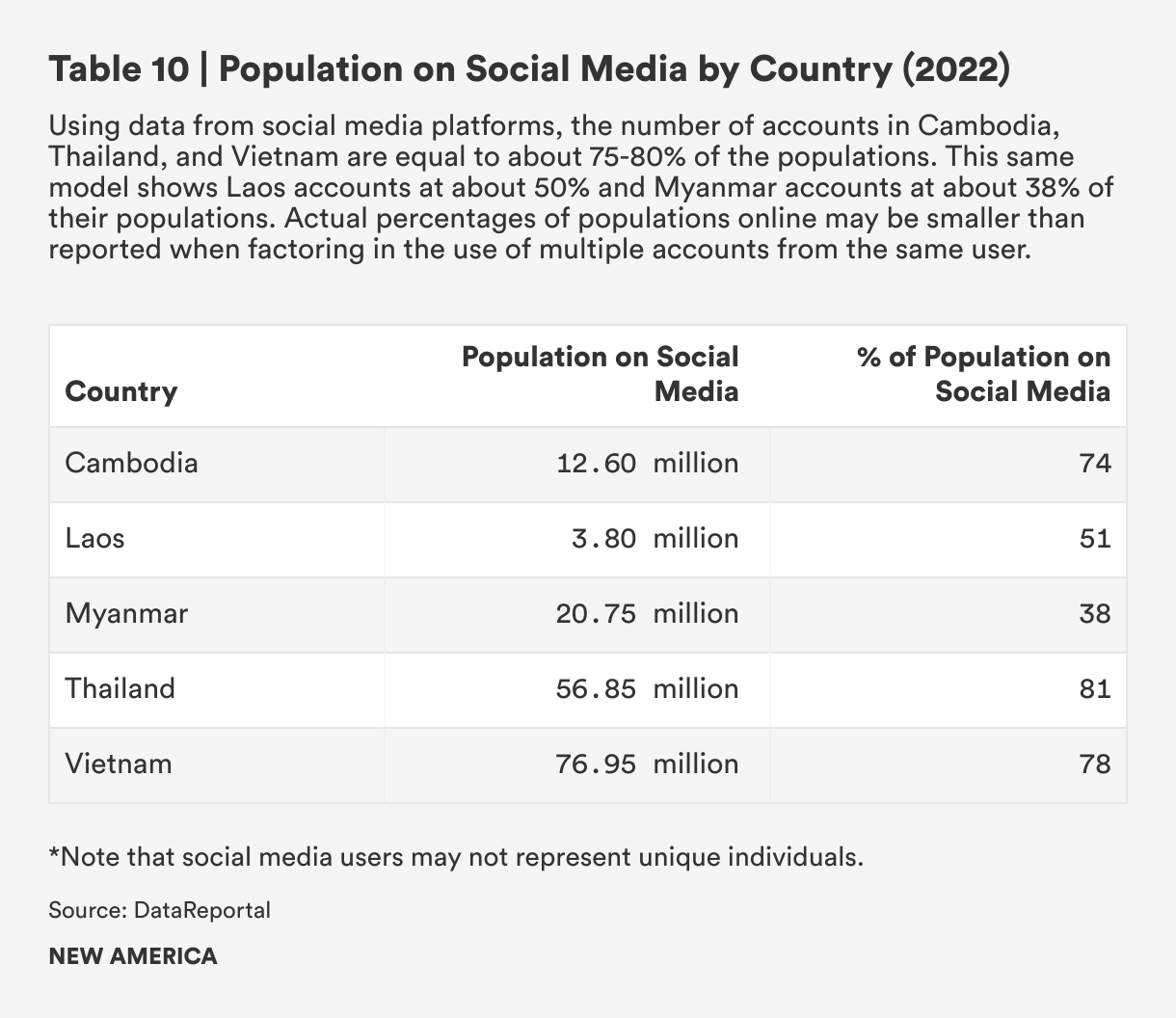
Each country uses various social media and messaging platforms at different rates. Meta’s Facebook is the most prevalent, but other systems like WeChat, Zalo, LINE, KakaoTalk, and Telegram are also used. Facebook has a disproportionate share of the market and plays an outsized role across the region. Both Thailand and Vietnam rank in the global top 10 of countries with the highest numbers of Facebook users. Facebook gained popularity when it launched the Free Basics program—a service that gave users free-of-charge access to a limited number of websites and services.4 Although the initiative ended in 2017, it made Facebook the go-to platform in many LMICs, including those in the Lower Mekong Region. Facebook, among other platforms, also provided a no- or low-cost space for users to build and promote their small businesses. Interviewees from Cambodia and Vietnam discussed how small businesses, particularly women-owned ones, are embracing social media for informal online commercial purposes. These income streams work in a bottom-up fashion, with women taking advantage of lower barriers to entry and the ability to work from home.5
At the same time, increased social media use has also enabled governments to harness platforms as tools for surveillance, censorship, and digital repression.
- Myanmar: Facebook has been used to amplify violence against Rohingya people in Myanmar.6 In 2018, Facebook publicly acknowledged that it was too slow in removing harmful posts. Post-coup, Facebook banned individual military leaders from the platform, while the military blocked access to Facebook in Myanmar. Access to Facebook is still blocked by some ISPs in Myanmar, however people can access the platform through VPNs—although that route has restrictions as well.7 (Read more about Meta/Facebook’s impact in Myanmar in the Country Briefs.)
- Thailand: An interview with a civil society organization indicated that the Thai government has targeted protestors who use social media to express anti-monarchy views and has ordered Facebook to block pro-democracy and anti-monarchy content. This is consistent with international coverage.
- Vietnam: The Vietnamese government can require social media platforms to remove anti-government content within 24 hours of receiving notice from a government official.8 As a result, Facebook drastically increased the number of posts it removed in Vietnam, from 834 in early 2020 to more than 2,200 in late 2020.
Advancing Economic and Financial Inclusion with FinTech
One of the most prominent and promising areas of digital solutions growth in the region is in economic and financial inclusion technologies—or “fintech”—such as online banking, digital payments, and mobile e-wallets. Mobile fintech solutions offer the region a way to leapfrog to greater financial and economic inclusion, bypassing analog and in-person banking infrastructure and moving straight to digital alternatives, although some significant limitations exist. In 2021, the World Bank’s Global Findex Database stated that there is a high percentage of unbanked adults in the region, with Cambodia at 67 percent, Lao at 63 percent, Myanmar at 52 percent, and Vietnam at 69 percent. Thailand stands out with only 4 percent of the country’s adult population unbanked, dropping from 18 percent in 2017.
A brief look at the countries in the region shows a push toward easy, efficient, and interoperable cashless payments using mobile or e-wallets, digital payment platforms, and QR codes, which have gained traction since the onset of the pandemic. (See the Catalog of Digital Solutions.)
- Cambodia: Launched by the National Bank in October 2020, the Cambodian Bakong digital currency is a blockchain-enabled, QR code–based, peer-to-peer and peer-to-business digital payment system. The Bakong platform speeds up and simplifies banking and blockchain-secured payments, enabling anyone in the nation to access their account and initiate transactions through a smartphone.
- Laos: The Bank of the Lao PDR (BOL), the national bank, launched the Lao QR Code standard for digital, domestic payments in January 2020 to boost cashless payments, facilitate increased digital transactions, and improve integration between banks. BOL authorized the establishment of the National Payment Network to help connect banks further, connecting seven commercial Lao banks and China’s UnionPay.9
- Myanmar: At least 10 fintech companies were offering online banking or e-payment services in Myanmar. One of the leading mobile wallet platforms in the country, WavePay, boasted over 2 million active monthly users in January 2021. However, this number fell by half after the coup.10
- Thailand: The digital payments ecosystem in Thailand is also well developed, with PromptPay operating through the Bangkok Bank and mPay. PromptPay enables users to use a mobile phone number or citizen ID to receive and transfer funds through online banking, mobile banking, or ATMs, helping to bypass the traditional inclusion concerns with un- and underbanked populations. As part of Thailand’s Payment Systems Roadmap, the country is also at the center of a number of regional QR code–based, cross-border payments that facilitate regional interconnection with Vietnam, Cambodia, Laos, Malaysia, Indonesia, Singapore, and Japan.11
- Vietnam: As of 2021, over 80 banks in Vietnam offer online banking services, while 44 banks offer specifically mobile banking services. Intermediary payment services are offered by 45 fintech firms in the country, with more than 90,000 stores accepting QR code payments.12
Generally, the rise of fintech solutions in the region have increased financial and economic inclusion, particularly for un- or underbanked communities such as women, minorities, rural communities, disabled populations, and small and medium-sized enterprises (SMEs). However, there are limitations to the benefits of fintech. One major concern regarding digital payments, expressed by interviewees working in development in Vietnam, is the degree to which the systems are integrated with existing infrastructure. Cambodia and Thailand have well-integrated digital payment and banking systems that are interoperable across banks and with e-commerce platforms. However, in Laos and Vietnam, digital payments and banking tend to be more fragmented and therefore do not always deliver on the full potential of the technology. In addition, these technologies are not easily accessible and deployable for all sectors and populations. Fintech is often concentrated in the service industry. Informal sectors such as agriculture, which a large portion of the population in this region relies on, tend to not be as connected to digital platforms and thus miss out on the associated benefits. On the individual level, those who are banked and have higher incomes, digital literacy skills, and more consistent access to the internet benefit most from fintech solutions. These are typically urban, middle-class consumers. Other interviewees mentioned that limited trust in banking systems and digitization processes can keep rural populations from accessing fintech and other digital solutions, only furthering the divide of who benefits from fintech solutions.
Growth of Digital Public Infrastructure
Countries in the Lower Mekong Region are exploring ways to further socioeconomic growth and facilitate e-government activities through digital public infrastructure (DPI). DPI refers to the solutions and systems that enable the effective provision of essential society-wide functions and services in the public and private sectors. However, existing DPI in the region is limited, as analog systems are still the critical method of accessing public services.
DPI includes, but is not limited to, proprietary or open source digital solutions for digital forms of ID and verification, payment, data exchange, information systems, and civil registration and e-government.13 The potential of improving the reach of public programs and social assistance with DPI was proven during the pandemic. For example, the World Bank issued a report indicating that the digitization of COVID-19 response programs led to a global increase in financial account ownership, including in Thailand and Vietnam. Although many of the digital account-based payments made were only for temporary COVID-19 response programs, the countries that utilized digital payments systems can now leverage that investment to facilitate a meaningful shift to more modern and efficient social assistance payments across various social assistance programs and government services.
Despite the promise of these digital solutions, not every country is able to prioritize digital public infrastructure pursuits. In particular, Laos and Myanmar lag behind other Lower Mekong countries and rely more heavily on nondigitized data and in-person operations. While the countries in the region may try to use digital technologies to either strengthen or leapfrog social and economic advancements, it is important to note that digital solutions are not a panacea to all development challenges. As one interviewee, who is an international cyber policy expert based in the region, noted, implementing digital solutions without the necessary supporting architecture (governance, processes, access, and infrastructure) results in only a facade of digitization, which persists throughout the region. While it may seem like many in the region have a smartphone that gives them access to sleek, digitized e-commerce and e-government platforms, this interviewee noted that behind the scenes, commerce and the government are still very analog, and will continue to be so until digital public infrastructure and interoperability are prioritized.
While digital transformation has changed how people interact with their government, it has also opened new civic spaces online—supporting mass mobilization of offline social movements that fuel activism efforts—and has supported greater access to public benefits and services. However, just as often, digital transformation efforts have created new risks and challenges for individuals interacting with their government. It is important to recognize that in this region, greater digitized relationships between government and people can put populations at greater risk to government censorship, surveillance, and monitoring. In addition, the risks to individual data security or privacy that arise from the governance of public digital identity, digital payments, online banking, and finance depend on the design and oversight choices of the institution and country that deploys them—and in this region, increasing authoritarian governance and practices puts potential DPI users at risk.
E-Government
Throughout the region, countries have outlined various plans and initiatives to facilitate and advance digital solutions for social and economic development. The 2022 UN E-Government Development Index (EGDI), which ranks 193 UN member states based on the quality and scope of their online services, status of telecommunications infrastructure, and human capital. Cambodia has a “High EGDI” score for e-government, ranked at 127; Laos has a “Middle EGDI” score at 159; Myanmar has a “Middle EGDI” score, ranked at 134; Thailand has a “Very High EGDI” score, ranked at 55; and Vietnam has a “High EGDI” score, ranked at 86.
- Cambodia: In Cambodia, the Digital Economy and Society Policy Framework 2021–2035 sets out to build a digital government backed by population trust as the first step toward a “vibrant digital economy and society.” The policy framework outlines 10 strategies for improving digital infrastructure and digitizing government services, while also setting goals for building integrated digital infrastructure and management platforms, creating technical standards, recruiting digital technology officers, and tasking each agency with a digital transformation unit.
- Laos: In 2021, the Lao government, in coordination with UNDP, launched a Digital Maturity Assessment, released in August 20222, that will help shape priorities for digital transformation in Laos, contribute to the development of a Digital Government Master Plan and a Standards Framework of Digital Government, and inform digitized pilot programs for government services and agencies.
- Myanmar: Before the coup in Myanmar, the Ministry of Transport and Communications put forth a new Universal Service Strategy for 2018–2022 to extend telecoms services and internet access in the country, as well as an e-Governance Master Plan 2021–2025 that included plans for e-payments, protection against cybercrime, and the movement of public services online. With the military coup and subsequent internet shutdowns, the long-lasting effects of these initiatives, especially on human rights, are still to be determined.
- Thailand: In addition to the Thailand 4.0 initiative (read more in Country Briefs), the Digital Government Act aims to improve government efficiency and service delivery. This includes creating a government data exchange platform that can facilitate standards for data sharing and allow the Thailand Anti-Corruption Association to monitor the use of data in government projects. The Digital Government Agency, which is spearheading the nation’s e-government push, is looking to incorporate artificial intelligence (AI) auditing tools and chat boxes, digital ID, and open data to enhance government service delivery.14 In addition, one interviewee discussed UNDP’s efforts in Thailand to improve civic engagement by testing an app called Consul—a citizen participation software that establishes a clear platform for citizens to debate, create proposals, and collaborate on legislation.
- Vietnam: In 2021, Vietnam issued its first e-government strategy, the Digital Transformation Programme by 2025, which aims to support whole-of-society digital transformation through quality services and policies. In addition, Vietnam is working with e-GovernanceAcademy to develop a plan to advance the e-cabinet and e-consultation processes and eventually move toward the e-service system that will fit into a future data exchange platform.
Digital Identity and Verification
Digital identity and verification solutions are rapidly gaining traction in the Lower Mekong countries. While government-sponsored digital IDs can unlock access to government benefits and services and lift users out of poverty, they can also pose great human rights risks and increase opportunities for governments to marginalize or deny citizenship to ethnic minorities and others. Identity verification tools can also provide greater access to public and commercial services when built interoperably with other digital solutions. However, if not created thoughtfully and securely, these tools can also put user data and privacy at risk. An international law–focused interviewee from Cambodia expressed concern that any country in the region—especially Cambodia, Myanmar, and Vietnam—could abuse these systems to surveil and track people. In addition, these governments have few security systems in place to protect whatever PII data they may collect from potential fraud or crime. Citing India’s Aadhaar system as a cautionary tale to learn from, the interviewee warned that, “the ability of malicious actors to hack into these data centers—the potential to create harm is enormous.”
- Cambodia: According to the General Department of Identification in the Ministry of Interior, Cambodia is currently working on introducing digital ID cards, birth certificates, and passports under its 10-year national strategic plan.15 Current plans also indicate that biometric data will be collected as part of the digital ID card registration.
- Laos: In 2018, the Lao Ministry of Science and Technology and private-sector company Lina Network signed a memorandum of understanding to develop and deploy a blockchain digital identity to improve government service delivery.16
- Myanmar: Myanmar listed piloting a digital ID system as one of the priorities in its national economic policy. Given the current political turmoil, though, it is unclear whether such a system is being developed. However, in 2019, Myanmar’s Post and Telecommunications Department issued a SIM biometrics database tender to private organizations. The government’s choice to maintain a database that would store and manage biometric mobile subscriber information caused an international uproar, with critics accusing the government of wanting to use these technologies for the purpose of ethnic cleansing.17 Despite the public outcry, Myanmar has since moved to impose additional data localization regulation in the name of cybersecurity and data protection that would give the regime greater access to data. The Rohingya Project is working on a pilot to create blockchain-backed digital identities, called R-ID, for stateless and diaspora Rohingya populations that had to flee Myanmar, where they are denied citizenship and face genocide.
- Thailand: Thailand’s National Digital Identity (NDID) is a platform for identity verification, online self-service for financial transactions, and data sharing. NDID uses blockchain and facial recognition for secure data exchanges. Users allow an authorized agency, such as a bank or national credit bureau, to be their data trustee, but must authorize the release of data outside the appointed trustee institution.18 In 2021, more than 9 million identity requests were made through NDID, which has over 30 million users in total. Mastercard agreed to a partnership with NDID to advance international connectivity.19
- Vietnam: In 2021, Vietnam began a new initiative to modernize ID cards for citizens 14 years and older by using facial and fingerprint data to register more than 50 million people for digital IDs.20 Vietnam’s electronic ID cards are used to access government and bank services and digitally sign documents, with Vietnam aiming for these to be used to authorize private-sector transactions at a later time.21 The ID cards have raised privacy concerns given the country’s lack of a personal data protection framework.
Digital Payments
As covered in previous sections of this report, governments play a significant role in the digital payments and fintech sector. A secure and reliable digital payments system helps introduce financial solutions to the unbanked and provides opportunities to expand safety net services. There are many foundational initiatives being explored to expand financial inclusion efforts.
- Cambodia: Bakong, a digital currency housed in the National Bank of Cambodia, is used to strengthen the Khmer riel and reduce dependence on the U.S. dollar.
- Laos: The Bank of Laos introduced the Laos QR Code standard to make sending and receiving cashless domestic payments more convenient and accessible, and to improve integration between banks.22
- Thailand: Bangkok Bank’s PromptPay is a digital payment service that uses the user’s government-sponsored national ID number or mobile phone number. In addition, Thailand has cross-border QR payment agreements with Cambodia, Laos, and Vietnam.
Regional Cooperation
Region-wide digital technology deployment is also starting to take off, led by development actors and multinational organizations. The three examples below demonstrate how collaborative digital solutions can address regional problems that would otherwise require consistent, concerted effort by individual governments in the region.
- ASEAN Single Window Cross-Border Customs and Trade Portal: In order to promote trade and ease the customs process for producers, importers, and exporters in member nations, ASEAN created the ASEAN Single Window, a unique platform that takes information from various country-specific digital trade and customs databases and online portals and integrates them for interoperability. As a result, any trade authority in a member nation can find documentation in a standardized format, streamlining the customs process and shortening the time required for cross-border transit of goods and services.
- Mekong Dam Monitor: With the Mekong River affecting the livelihoods and safety of tens of millions, the U.S. government and the Stimson Center, a U.S.-based think tank, partnered on a project called the Mekong Dam Monitor that uses satellite imagery, remote sensing, and geographic information system software to report river flow and dam operations. This open source project informs users of river flow changes and effects from upstream dam operations, and serves as an early warning system for communities subjected to the effects of river flow changes.
- Mekong River Commission’s water quality monitoring system: The water quality monitoring system monitors and provides digital information on water flow and quality from dams and other infrastructure projects along the river. Employment of the technology at a major project on the Cambodia-Laos border allowed developers to modify water flow to better enable movement for fish populations. Continuous monitoring provides easily accessible, near-real-time information on water levels, quality, and fish populations to the tens of millions dependent upon these resources.
For more demonstrations of regional and multicountry collaboration, please see the Catalog of Digital Solutions in the Lower Mekong Region.
Citations
- Ry Sochan, “Ministry plots path to ‘Digital Cambodia,’” Phnom Penh Post, February 28, 2022, source.
- Komsan Tortermvasana, “NIA in push for new deep tech, BCG startups,” Bangkok Post, March 11, 2022, source.
- Ralph Jennings, “Why Vietnam’s 'Silicon Valley' Won’t Be Like California’s,” Voice of America, May 27, 2020, source; Joe Devanesan, “Vietnam planning its own ‘Silicon Valley’ in Ho Chi Minh City,” Tech Wire Asia, June 2, 2020, source.
- “Facebook was the internet in Myanmar. What happens now that it’s banned?,” KrAsia, February 24, 2021, source.
- Joep Roest and Yasmin Bin-Humam, “Forging Her Own Path: Women and Informal Online Commerce,” Consultative Group to Assist the Poor, September 7, 2021, source.
- “Algorithm of harm: Facebook amplified Myanmar military propaganda following coup,” Global Witness, June 23, 2021, source; Paul Mozur, “A Genocide Incited on Facebook, With Posts From Myanmar’s Military,” New York Times, October 15, 2018, source; Steve Stecklow, “Why Facebook is losing the war on hate speech in Myanmar,” Reuters, August 15, 2018, source.
- Billy Perrigo, “Facebook’s Ban of Myanmar’s Military Will Be a Test of the True Power of Social Media Platforms,” Time, March 1, 2021, source.
- Phuong Nguyen and Fanny Potkin, “EXCLUSIVE Vietnam plans 24-hour take-down law for ‘illegal’ social media content -sources,” Reuters, April 21, 2022, source.
- Asia News Network, “Bank of the Lao PDR drafts plan to boost cashless payments in Laos,” Phnom Penh Post, May 21, 2019, source.
- “Wave Money has lost half of its app users since Myanmar’s coup in February,” KrAsia, August 16, 2021, source.
- “Thailand and Vietnam launch QR code to facilitate cross-border transactions,” International Finance, April 5, 2021, source; Ed Davies, “Thailand, Malaysia c.banks launch cross-border QR payment linkage,” Reuters, June 18, 2021, source; “Indonesia and Thailand roll out their pilot cross-border QR payment linkage,” International Finance, August 18, 2021, source.
- Oanh Nguyen, “Vietnam witnessing speedy growth in digital payments,” Vietnam Investment Review, June 6, 2022, source.
- For more information about digital public infrastructure and digital public goods, visit source. The Digital Public Goods Alliance (DPGA) is a multi-stakeholder initiative with a mission to accelerate the attainment of the sustainable development goals in low- and middle-income countries by facilitating the discovery, development, use of, and investment in digital public goods. Digital public goods are open source software, open data, open artificial intelligence models, open standards and open content that adhere to privacy and other applicable laws and best practices, do no harm by design, and help attain the SDGs. The DPGA relies on engagement and leadership from private sector technology experts, think tanks, governments, philanthropic donors, international implementing organizations, and the UN.
- Shirley Tay, “Thailand’s strategy for digital transformation,” GovInsider, October 6, 2020, source.
- Soth Koemsoeun, “Cambodia soon to transit into digital identification milestone,” Khmer Times, February 11, 2022, source.
- “Laos moves towards application of e-governance,” Viet Nam News, June 20, 2018, source.
- “Myanmar: Dangerous plans for a National Digital ID and Biometric SIM Card Registration must be scrapped,” Privacy International, December 9, 2019, source.
- Tian Jiao Lim, “Exclusive: Thailand’s vision for trusted digital ID,” GovInsider, August 20, 2020, source.
- Frank Hersey, “Thailand’s NDID partners with Mastercard to connect digital IDs internationally,” Biometric Update, March 10, 2022, source.
- Ami Yamada, “Vietnam adopts NEC's biometric ID system, registering 50m,” Nikkei Asia, April 28, 2022, source.
- Ayang Macdonald, “Vietnam releases draft digital identity and authentication guidelines,” Biometric Update, July 22, 2021, source.
- Taejun Kang, “Laos Launches QR Code Payment Standard,” Laotian Times, February 3, 2020, source.