
Digital Transformation Opportunities and Challenges in the Lower Mekong Region
Table of Contents
- Overview
- Introduction
- A Closer Look at the Lower Mekong Region
- Factors Affecting the Development, Deployment, and Acceptance of Digital Solutions
- A Brief Landscape of the Regional Digital Ecosystem
- Broad Recommendations for People-Centered Digital Transformation
- Conclusion
- Appendix 1: Country Briefs
- Appendix 2: Catalog of Digital Solutions in the Lower Mekong Region
- Additional Readings
Abstract
This report landscapes the opportunities and challenges of the Lower Mekong Region’s (Cambodia, Laos, Myanmar, Thailand, and Vietnam) pursuit of society-wide digital transformation. It covers factors affecting the region’s path towards people-centered digital development—such as geopolitical influences, the impact of the COVID-19 pandemic, digital connectivity and accessibility, and legal and regulatory governance—and explores different aspects of the region’s digital environment, from foundational digital elements to social media and messenger apps, financial technologies, digital public infrastructure, and regional cooperation. Despite the region’s potential, the greatest barrier remains significant concerns surrounding human rights, including both fundamental and internet freedoms. The report concludes with recommendations for digital development and governance best practices that cross-sector stakeholders working toward a more equitable, inclusive, and open digital transformation process can carry out.
The report is accompanied by Country Briefs that provide a digital overview, identify challenges to digital transformation, and outline key areas to watch specific areas for each of the five countries; a Catalog of Digital Solutions in the Lower Mekong Region curated to fill an information gap on the use of digital solutions to address social, economic, and sustainability challenges in the region; and an Additional Readings list of resources on technology and digital public infrastructure in the Lower Mekong countries.
Acknowledgments
This publication has been funded by the Australian Government through the Department of Foreign Affairs and Trade. The views expressed in this publication are the authors’ alone and are not necessarily the views of the Australian Government. The team is especially grateful for the grant support, guidance, and partnership of Michelle Hughes, Lucy Wells, and Stuart McAdams. In addition, the authors appreciate the passion and perspectives of the following individuals who served as part of the research and writing team and who we hope will continue making contributions to the emerging field of digital public infrastructure: Marcia Kramer, Julia Meltzer, John Remensperger, Avery Reyna, Dona Stewart, Jordan Sandman, and Lucy Warren. We are grateful to colleagues from other New America programs for sharing their time and ideas, including Alberto Rodríguez with the Public Interest Tech program and Michelle Siegel with the Open Technology Institute. We would also like to thank all of those who contributed to this work through interviews and the review process.
Downloads
Overview
Framework and Methodology
Every community is attempting to balance the potential of innovation with the risks of digital technologies. Regardless of economic status or political leaning, our undeniably interconnected digital future lacks consensus around a global people-centric vision and the guardrails necessary to ensure equitable and sustainable innovation. Accelerating digital development and internet connectivity have improved financial, environmental, health, and education systems. However, digital transformation efforts must also contend with political and social fracturing, growing economic inequalities, increased state-sponsored surveillance, and extractive or exploitative data-use practices.
The Digital Impact and Governance Initiative (DIGI) at New America set out to explore the Lower Mekong Region’s digital transformation for a more prosperous, sustainable, and open digital future—one that ideally places people first and uses tech responsibly. Keeping in mind the complexities surrounding regional technology development and deployment, as well as the limitations in research, this report has three objectives:
- Conduct a landscape analysis of the opportunities and challenges of technology use in the Lower Mekong Region, the influence of outside nations and tech companies, infrastructure and internet access levels, how stakeholders are using technology for social and financial development, and how technology is furthering regional cooperation;
- Explore the digital technology governance models, including existing legal and regulatory frameworks (or lack thereof) on cybersecurity, privacy, and content; and
- Spotlight key opportunities surrounding digital transformation by identifying deployable and replicable digital solutions and developing recommendations directed toward stakeholders in this region, including public interest technologists and development advisers.
This report makes use of existing qualitative and quantitative research from a broad array of public sources, including organizations focused on development, economics, human rights, and technology policy. In addition to secondary research, this report was informed by interviews with local and remote public interest technologists, researchers, and development actors to augment areas of focus. Interview responses were aggregated, organized, and coded to reveal insights. All interview responses are attributed to anonymous sources due to regional political sensitivities. The interviews regarding Myanmar produced the least extensive information of the five countries, given limited access to the region during a period of intense turmoil.
The most significant challenge to navigating this research process was the lack of reputable, up-to-date, and complete data. Thailand and Vietnam have more readily available information than Cambodia and Laos. Myanmar has the most limited information available. This created a patchwork effect on sources and citations. The research team addressed this hurdle by collecting information and statistics from multiple sources to develop the most accurate picture of the region possible. In some cases, English-based regional news sources for government announcements were used, knowing that these sources may be biased. All five countries have abysmal independent and open press rankings from Reporters Without Borders—most are in the bottom quartile of the World Press Freedom Index—which made fact-checking diligence even more complicated.
Data and development indicators from the United Nations (UN) and Organization for Economic Cooperation and Development (OECD) were helpful in identifying regional progress and challenges. This report makes comparisons to common standards among OECD countries. However, these comparisons are limited by the fact that the deployment of digital solutions often depends upon a country’s level of economic development, wealth, and infrastructure—categories in which the identified countries of the Lower Mekong Region predominantly lag behind OECD countries.
Given the scope of the subject addressed, the myriad of serious complications in the region, and the limitations mentioned above, this report should serve as a jumping-off point for further research into areas of opportunities and challenges to digital transformation and technology deployment in the Lower Mekong Region.
Executive Summary
A complex set of interrelated issues impacts digital transformation in the Lower Mekong Region of Southeast Asia, which includes Cambodia, Laos, Myanmar, Thailand, and Vietnam. Envisioning a prosperous, sustainable, and more open digital future for the more than 245 million people living there will require a greater focus on human rights, inclusion, accessibility, digital infrastructure, and governance. While there is substantial room for improvement in people-centered outcomes both on- and offline, the region has nurtured significant social, economic, and technological growth in recent years to develop and advance their innovative digital ecosystems and support large-scale digital transformation.
Fueled by expanded access to mobile phones, social media platforms, and 5G networks, the governments of the region are in the process of developing their regulatory approaches. Choices to foster or hinder a more people-centered and innovative future are significant and have major human rights implications. Thailand and Vietnam, with nearly 70 percent of the regional population, are leading the Lower Mekong Region’s digital development efforts, followed by Cambodia and Laos. Myanmar is more difficult to assess and is, in many ways, a regional outlier due to years of turmoil, ethnic violence, the 2021 military coup, and the resulting isolation.
Digital transformation in the region presents an opportunity to design for a more resilient future—for an internet that is open, trusted, and provides safe means for communication, commerce, and education. However, there are economic and political implications and consequences, as well as a confluence of competing factors, incentives, and external influences that makes the digital future of the region uncertain. Digital transformation efforts could lead to greater transparency and accountability in systems and institutions, while improving access to education, health, and economic opportunities for individuals and communities. At the same time, without necessary safeguards, digital tools could make it easier for governments to exert additional control and repression. Actions taken now and the values and priorities instilled within digital solutions at the onset of development and deployment will determine the path the region takes.
This report intends to serve as a resource for public interest technologists, development advisers, researchers, and government officials looking to better understand and address the myriad of issues complicating the regional digital landscape.
Ten Key Digital Transformation Considerations in the Lower Mekong Region
- An increase in internet connectivity has enabled millions of people to gain access to online services; created science, technology, engineering, and math (STEM) education and job opportunities; offered new ways to participate in the economy; and opened digital civic spaces. These benefits of connectivity need to be cautiously assessed alongside increasingly heavy-handed governments harnessing digital platforms and tools to control and repress information and people.
- Geopolitical influences play a complicated and outsized role in regional decision-making. Governments in this region are accustomed to balancing various external pressures and influences —which are often conflicting—against internal development priorities. The United States, China, the European Union (EU), and regional countries like Australia, Indonesia, South Korea, Japan, and Singapore frequently leverage investment and aid to help guide development while also establishing major economic and digital ties associated with trade opportunities, market share, high-tech manufacturing and parts, and tech talent.
- The COVID-19 pandemic accelerated regional digital transformation, amplifying reliance on public and private digital infrastructure. With the pandemic limiting in-person activities and everyday interactions, the number of online users and their digital literacy increased significantly, as many communities quickly created and deployed digital solutions to meet urgent needs.
- Digital divides in the region are reinforced by limited digital access, literacy, and skills—disproportionately affecting women, low-income individuals, and those living in rural communities. Together, these challenges, along with limited trust in technology and government use of it, present significant barriers to the accessibility and effectiveness of digital solutions, furthering digital divides.
- Regulatory regimes are underdeveloped and vary country to country, but they generally show an increasingly authoritarian approach to digital governance. Governments in the region have enacted laws contributing to pervasive internet freedom and human rights concerns, curtailing fundamental freedoms.
- Social media and messaging platforms have an outsized impact on the region—particularly Meta’s Facebook, which has historically controlled a disproportionate share of the market, amplifying both its positive and negative effects. Users in the region are reliant on the free services provided by social media platforms and messaging apps to access social spaces and informal online commercial spaces. However, social media is also used as a tool, in some cases by governments, to surveil or improperly access user data, censor speech, and amplify violence.
- Innovative digital environments and a favorable tech start-up culture are powered by digital entrepreneurship, government support (such as favorable tax and visa regulations), and an emerging sector with lots of potential. However, lack of coordination, investment, digital literacy, and capacity still limit digital ecosystem growth.
- One of the most prominent and promising areas of digital solutions in the region is in economic and financial technologies (fintech) such as online banking, digital payments, mobile e-wallets, and QR codes. There is a pronounced regional push from private companies and governments to enable easy, efficient, and interoperable cashless payments, helping to advance financial and economic inclusion.
- Digital public infrastructure (DPI) and e-government solutions can help enable the effective provision of essential society-wide functions and services in the public and private sectors. However, governance structures, human rights concerns, abuse as a result of access to digital data, and low country capacity can limit the safety, efficiency, and accessibility of DPI solutions deployed in the region.
- Multi-stakeholder collaboration and engagement is essential in region-wide deployment of digital technology designed to address common economic and social challenges, especially in the fields of public health, economic mobility, agricultural technology (agritech), environmental management, and disaster readiness. An existing culture of regional partnerships and investments through organizations like the Association of Southeast Asian Nations (ASEAN), the United Nations, and the World Bank—particularly around environmental monitoring and Mekong River management—may help strengthen systems reliant on shared data, open code, and trust.
This report utilized openly available materials and interviews with civil society and development leaders active in the region to compile the following recommendations on how to prioritize actions for a more people-centered, whole-of-society digital transformation. Many of the recommendations encompass best practices that can apply more generally to all nations balancing the potential of innovation with the risk of misuse or alternative uses of digital technologies.
Broad Recommendations for People-Centered Digital Development in the Lower Mekong Region
- Elevate human rights, security, and privacy through safeguards, education, and incentives to increase trust and transparency.
- Address insufficient infrastructure and access inequality by prioritizing the installation of fixed and mobile broadband and other hard infrastructure, particularly for women, older populations, and rural residents.
- Encourage user-centered design, agile development practices, and open source code to improve digital solution accessibility, functionality, and replicability.
- Amplify the positive elements of thoughtful digitization by boosting digital skills and literacy through educational and professional opportunities to safely prepare all communities and industries for greater economic and digital transformation.
- Commit to a whole-of-society approach to enable and strengthen innovative digital ecosystems, such as online marketplaces, innovation labs, and government-sponsored technology-focused institutions, fostered by cross-sector and multi-stakeholder collaboration when possible.
- Prioritize good governance, regulation, and frameworks for technology. The Lower Mekong governments have not historically prioritized open data and interoperability, or successfully protected the safety and privacy of users, and they appear to be continuing down a repressive path.
- Design and deploy digital solutions, emerging technologies, and digital public infrastructure to unlock social and economic development; better coordinate environmental and sustainability efforts; and increase equality, privacy, and security across the population, especially vulnerable communities.
The scope of this report is significant. Readers are encouraged to navigate the table of contents for links to specific sections. The report is accompanied by a collection of complementary materials, including:
- Country Briefs that provide a digital overview, identify challenges to digital transformation, and outline key areas to watch in specific areas for each of the five countries.
- A region-specific Catalog of Digital Solutions in the Lower Mekong Region curated to fill an information gap on the use of digital solutions to address social, economic, and sustainability challenges. The searchable list includes a number of solutions, many of them open source and replicable.
- An Additional Readings list of resources on technology and digital public infrastructure in the region.
Introduction
The Lower Mekong Region—Cambodia, Laos, Myanmar, Thailand, and Vietnam—has seen significant social, economic, and technological growth in recent years. An increase in internet connectivity and access has brought millions of people online, accelerating connections and making services more accessible through digital solutions. While tech innovation and transformation are still nascent in the region, social internet platforms are widespread, economic- and financial-inclusion technologies are proliferating, e-government solutions are underway, and digital public infrastructure is seeing investment from governments and organizations operating in the region.
However, the greatest barriers to the deployment and governance of modern digital infrastructure in the region continue to be concerns surrounding human rights, trust in government, inclusion, access to information, and economic mobility. Limited digital literacy, skill levels, and access hinder the growth of the region’s digital ecosystem. Regulatory regimes are underdeveloped and vary between countries, but they generally show increasingly authoritarian approaches to digital governance. The region’s potential for responsible digital solutions, international cooperation, and investment is limited and complicated by various geopolitical interests vying for influence.
This report was written as a resource for stakeholders supporting digital solutions development and deployment to maximize social and economic advancement. It covers major topics, including factors affecting the development, deployment, and use of digital solutions—such as the COVID-19 pandemic’s impact, digital connectivity and access, and legal and regulatory governance. In addition, it provides a brief landscape of the region’s digital environment by providing overviews of foundational digital elements like human capacity, digital literacy, innovation culture, social media and messenger app usage, financial technologies, digital public infrastructure, and regional cooperation on digital technology. The report concludes with actionable recommendations for a more people-centered digital transformation in the Lower Mekong Region.
A Closer Look at the Lower Mekong Region

Population dynamics, economic indicators, government models, pursuits of cooperation and competition, and the complexities of outside involvement are foundational elements to consider when gauging the region’s potential for digital transformation.
More than 245 million people live in the Lower Mekong Region. Cambodia, Laos, Myanmar, Thailand, and Vietnam are connected by the Mekong River, which drives the region’s extraordinary agricultural and fishery productivity and provides the economic livelihood for tens of millions of people. Even as the region modernizes away from the dominance of river-powered economies, the countries remain deeply connected. Altogether, there is a reliance on foreign direct investment and assistance, export-focused production and manufacturing, travel and tourism revenue, trade, agritech, education, and sustainability measures.
While there is a wide variety of development and digital transformation across the five countries, Thailand and Vietnam tend to follow similar paths of development and capacity with significant urban populations and advanced commercial and innovation pursuits. Cambodia and Laos follow behind with larger percentages of rural populations and a stronger reliance on foreign investment and aid. Myanmar’s development has regressed since the military coup in February 2021.
Population
Demographic trends in the Lower Mekong Region are marked by increased urbanization, with the region’s populations generally skewing younger and slightly more female. The region’s population growth is characterized by substantial urbanization driven by economic development, which has led to greater access to modern healthcare and longer life expectancies. Most growth is centered in urban areas where there is greater access to education and jobs. The age breakdown across the region skews younger than other regions, as approximately a fifth of the population is under the age of 14. The population over the age of 65 is lower in the Lower Mekong Region than the average across Asia. Recent data shows that in Cambodia, Myanmar, Thailand, and Vietnam, women tend to slightly outnumber men.
Economic Development
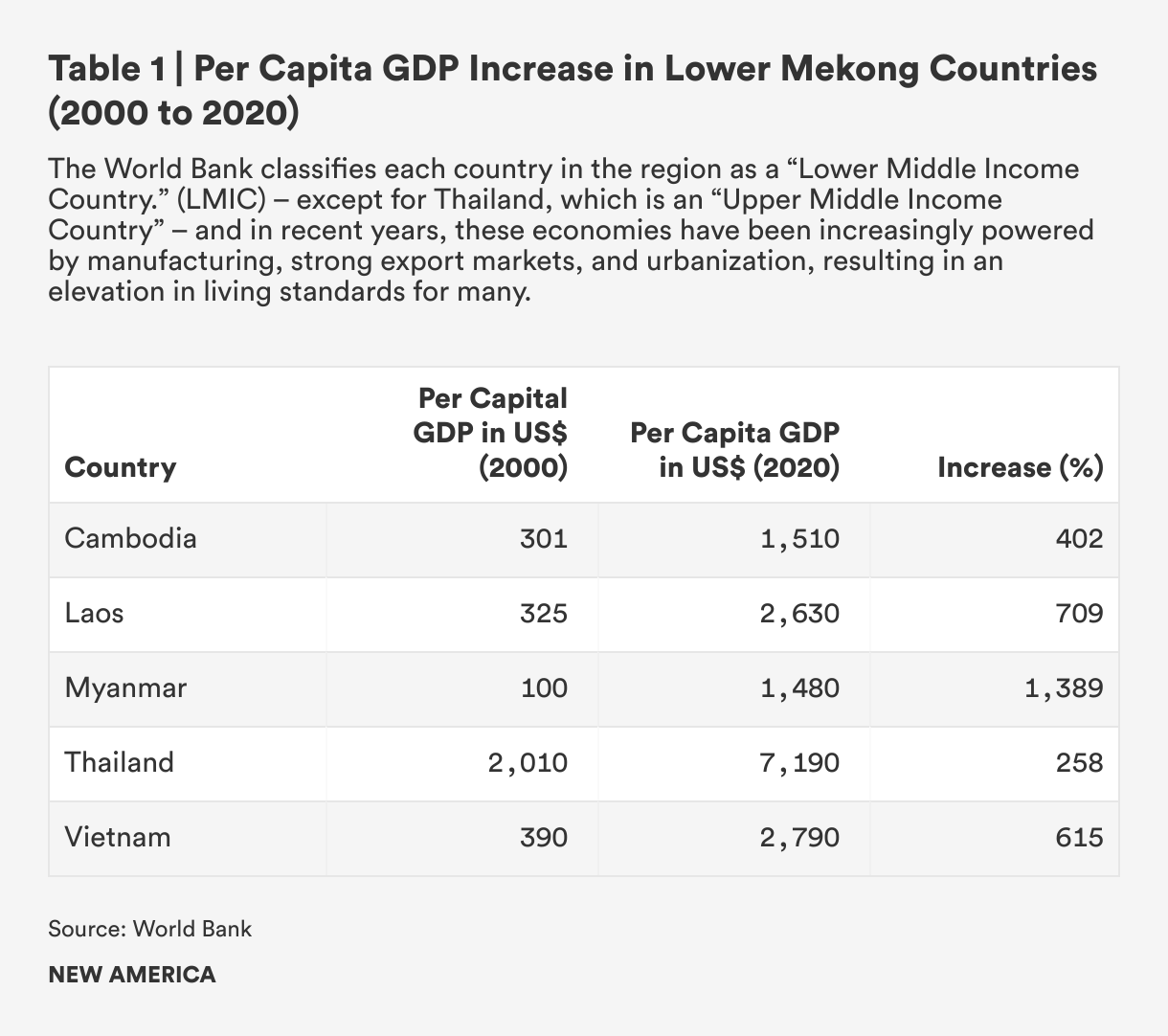
The World Bank classifies each country in the region as a “Lower Middle Income Country” (LMIC)—except for Thailand, which is an “Upper Middle Income Country.” In recent years, these economies have been increasingly powered by manufacturing, strong export markets, and urbanization, resulting in an elevation in living standards for many. Thailand and Vietnam have seen greater poverty alleviation than Cambodia, Laos, and Myanmar, in part because the two countries are industrializing at a rapid pace, as demonstrated in Table 1. Both nations have focused on high-tech manufacturing in hopes of avoiding the “middle income trap.” This happens when a nation’s development stalls because its major industries revolve around producing basic goods that face extensive global competition instead of higher-technology goods that require greater skills and technical expertise. Over the past twenty years, both Thailand and Vietnam have doubled the concentration of high-technology production as a share of manufacturing. In comparison, both Cambodia and Laos have lost some share over the last twenty years.
Government Models
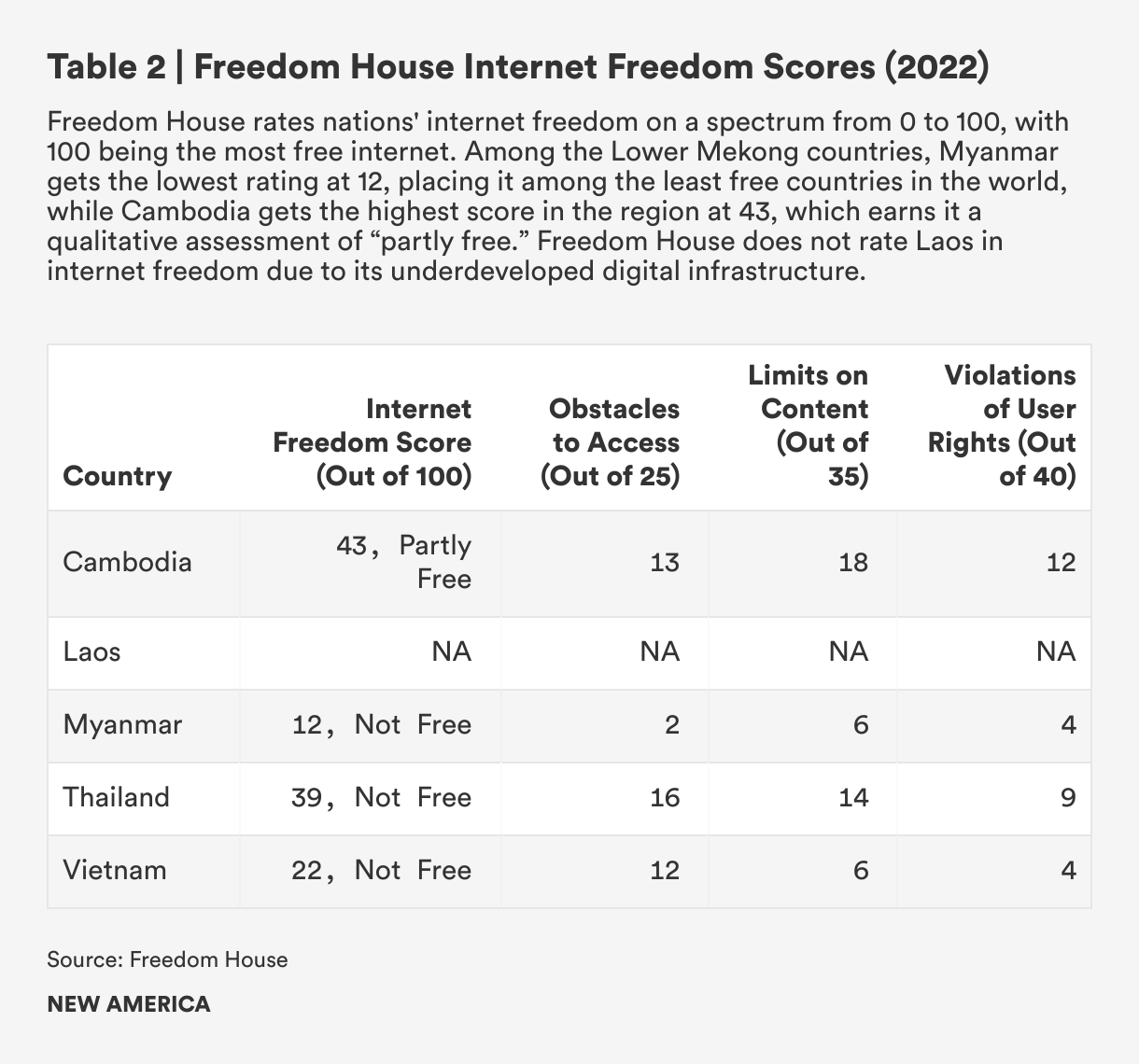
Forms of public administration vary across the region, but all populations are navigating increasingly authoritarian governments. Laos and Vietnam are communist states with single-party rule. Thailand is a constitutional monarchy. Cambodia is more complicated, with a self-defined multiparty democracy under a constitutional monarchy. Myanmar has been under a series of dictatorships since 1962, with a brief semi-parliamentary democracy period from 2010 to 2020, and has been under military rule since a 2021 coup. While there are different forms of government in the region, none of the countries are considered to be open and free societies with strong legal protections of individual liberties and political rights per human rights watchdog organization Freedom House. See Table 2 for each country’s Internet Freedom Scores from Freedom House.
Competing Global Influences
Geopolitical influences play an outsized role in how this region cooperates internally and with other global players. Countries in this region are often pushed and pulled in different geopolitical directions, making them accustomed to balancing external pressures and influence against internal development priorities. Sources of foreign direct investment often help shape and drive government priority areas for development and action in the region, which are further complicated when navigating competing outside influences surrounding technological advancements. As one international cyber policy expert noted when interviewed, some of the Lower Mekong governments are hesitant to partner with China despite the attractiveness of Chinese foreign investment due to suspicions of strings-attached deals and incidents of hacking and surveillance. Conversely, the same governments are also wary of partnering with Western nations, given the democracy-related obligations and expectations that come with development money.
United States
Beyond the longstanding cultural, historical, and political ties, there are deep innovation and commercial links between the United States and the Lower Mekong Region. The United States is the top trading partner for Thailand and Vietnam. Enhancing U.S. ties with this region is a priority of President Joe Biden’s administration. U.S. foreign assistance to the subregion totaled more than $4.3 billion over the past 12 years. There are over 1,000 U.S. companies active in the region, with many U.S. companies looking to decrease their manufacturing costs and dependencies, strategically navigate tariffs on goods, diversify their supply chains, and identify new customers.1 The U.S.-based Big Tech giants—Amazon, Apple, Google, Meta, and Microsoft—are active in the region, offering popular platforms, e-commerce, gaming, products, cloud services, and jobs at regional office hubs and manufacturing sites. Facebook (Meta) is often the only internet known in some regional communities. Apple has diversified production lines to be less dependent on China, many AirPods Pro are now stamped with: “Designed by Apple in California. Assembled in Vietnam.” In addition, one of the largest high-tech investments in Vietnam is from a U.S. company, Intel, which has invested nearly $1.5 billion to build a state-of-the-art chip assembly and test manufacturing facility in Saigon Hi-Tech Park, creating thousands of jobs.2
China
Despite periodic strained political relations, China and the five countries share natural resources, trade ties, and investment for major traditional and digital infrastructure systems. While China is highly influential across the Lower Mekong, international conflicts—such as the South China Sea dispute—and other political and economic divides drive tensions in the region. In fact, the administration of the Mekong River is a particular concern, complicated by allegations that upriver dams in China are negatively affecting the health of the Mekong downriver. China continues to participate in the Greater Mekong Subregion Economic Cooperation Program, created in 1992 with support from the Asian Development Bank. In addition, China remains the biggest trading partner of Myanmar, the second-largest trading in Thailand and Vietnam, and the biggest foreign investor in Cambodia and Laos.3 China's Digital Belt and Road Initiative seeks to place Chinese technology—of which the United States has raised concerns about high-risk vendors such as Huawei and ZTE—at the center of rapidly developing digital infrastructure worldwide. In addition, the Belt and Road Initiative brings the promise of jobs and updated infrastructure that are sorely needed in the region.
China’s Huawei is the world’s largest supplier of 5G infrastructure technology. While Lower Mekong governments seek 5G investment, they have generally not agreed to exclusive arrangements with Chinese companies. Thailand was one of the first Asia-Pacific countries to launch its own 5G network. Thailand moved quickly to reallocate spectrum for 5G and begin auctions for service providers. Similar to other Southeast Asian countries, such as Malaysia, Thailand also chose to base its 5G network on the open radio access network (ORAN) standard and courted all of the major global suppliers. Vietnam is working on a phased deployment of their 5G network while seeking to strengthen its own technology firms in hopes they will become global exporters. Vietnam's largest telecom group, the military-run mobile network operator Viettel, is already active in 11 countries serving 110 million customers.4
Bilateral Relationships
Geopolitical influences in the region are not limited to the United States and China. Tech heavyweights such as South Korea’s Samsung, Japan’s SoftBank, and Singapore’s Shopee have major economic and digital development ties to the region. Companies from other Southeast Asian nations such as Taiwan, Malaysia, Indonesia, and the Philippines are also looking for trade opportunities, market share, manufacturing and parts, and tech talent. Furthermore, there are significant diplomatic agreements, technical and digital development support, and cooperation frameworks between Lower Mekong countries, EU countries, and regional neighbors such as Australia, South Korea, Japan, and India. Although the strategies, agreements, or partnerships may have different amounts of aid and investment attached, each shares a similar intent to further regional development, cooperation, connectivity, and socioeconomic growth.
Regional Cooperation
Beyond bilateral relationships, regional cooperation is facilitated by development projects and multilateral organizations. With oversight and support from the local Mekong River Commission, the governments collaborate on river maintenance projects such as flood and drought management, hydropower, and climate change. The region also works together to further collaborations and cooperation frameworks with global partners. All countries are members of the United Nations (UN), the Association of Southeast Asian Nations (ASEAN), and the Asian Development Bank (ADB). They are also signatories to the Regional Comprehensive Economic Partnership and members of China’s Belt and Road Initiative (BRI). ASEAN helped facilitate the ASEAN-Mekong Basin Development Cooperation (AMBDC) platform, which includes the five Lower Mekong countries and China, with the mission to “enhance the economically sound and sustainable development of the Mekong Basin.” The ADB provides loans, technical assistance, grants, and equity investments to promote social and economic development. In addition, it facilitates the Greater Mekong Subregion Economic Cooperation Program. In March 2021, the ADB issued regional priorities including upgrading and strengthening cities’ connectivity.
Citations
- Raymond Zhong, “Your Next iPhone Might Be Made in Vietnam. Thank the Trade War,” New York Times, July 30, 2019, source.
- “Intel Invests Additional $475 Million in Vietnam,” Intel, January 26, 2021, source.
- “Thailand’s foreign trade up 23.1 pct in 2021,” Xinhuanet, January 21, 2022, source; Phayboune Thanabouasy, “China Remains the Largest Foreign Investor in Laos,” Laotian Times, August 17, 2021, source.
- Richard Javad Heydarian, “SE Asia fragments on pro and anti-Huawei lines,” Asia Times, July 9, 2021, source; Matthew Strong, “Southeast Asia expands 5G to replace China as world’s factory,” Taiwan News, August 20, 2021, source.
Factors Affecting the Development, Deployment, and Acceptance of Digital Solutions
There are several factors affecting the development, deployment, and acceptance of digital solutions in the Lower Mekong Region. This section covers critical factors such as the impact of the COVID-19 pandemic, connectivity and digital access, and digital and cyber governance concerns. This includes concerns about internet freedom, censorship, internet shutdowns, and data security—all of which understandably take a toll on trust in governments in the region. To take a closer look at each country’s digital development, please see the Country Briefs in this report’s appendix.
The COVID-19 Pandemic’s Impact on the Digital Landscape
The COVID-19 pandemic contributed to significant loss of life, disturbances in public health screenings and treatment, food security challenges, and education gaps. It also had a mixed effect on the trajectory of digital transformation in the region. With the pandemic limiting in-person activities and everyday interactions, the number of online users skyrocketed, digital literacy accelerated by necessity, and governments invested in tech infrastructure for their populations to combat the impacts of COVID-19.1 The outbreak also exacerbated development challenges and existing concerns surrounding human rights, privacy, security violations, and content moderation.
An increase in reliance on digital infrastructure necessitated increased government investment. For example, Freedom House’s Freedom on the Net reported that the COVID-19 pandemic actually spurred technology infrastructure investment and innovation in Thailand. At the start of the pandemic, Thailand saw a 30-percent increase in internet usage. In response, the National Broadcasting Telecommunications Commission (NBTC) provided 10 gigabytes to all mobile users and, in January 2021, ordered all mobile and broadband operators to increase their speed and capacity to support increased internet usage. Later, low-cost mobile packages were introduced to offer faster speeds and unlimited data. Similarly, Vietnam saw a movement to increase access to public services in the wake of the pandemic. After a wave of new services were provided on Vietnam’s National Public Service Portal, the portal saw a steep uptick in views.2 Although demand for digital products and opportunities increased, so did privacy and security concerns, especially around digital exposure trackers and quarantine enforcement.
Many governments quickly created, often replicated, and deployed new digital technologies to meet urgent societal needs. For example, Vietnam achieved a fast system rollout using NCOVI, an existing disease monitoring and data sharing platform, to track and analyze COVID-19 data and provide suspected and confirmed case information to the public in real time. Similarly, Laos harnessed District Health Information Software 2 (DHIS2)—a widely available global open source software platform for health data collection, access, and use at the local level—to quickly respond to pandemic-related concerns. As one of the first countries to employ the platform for COVID-19, Laos enhanced it by using locally produced apps to add specific features facilitating vaccine delivery, web-based vaccine appointment scheduling, and vaccine status tracking.
Digital Connectivity and Access
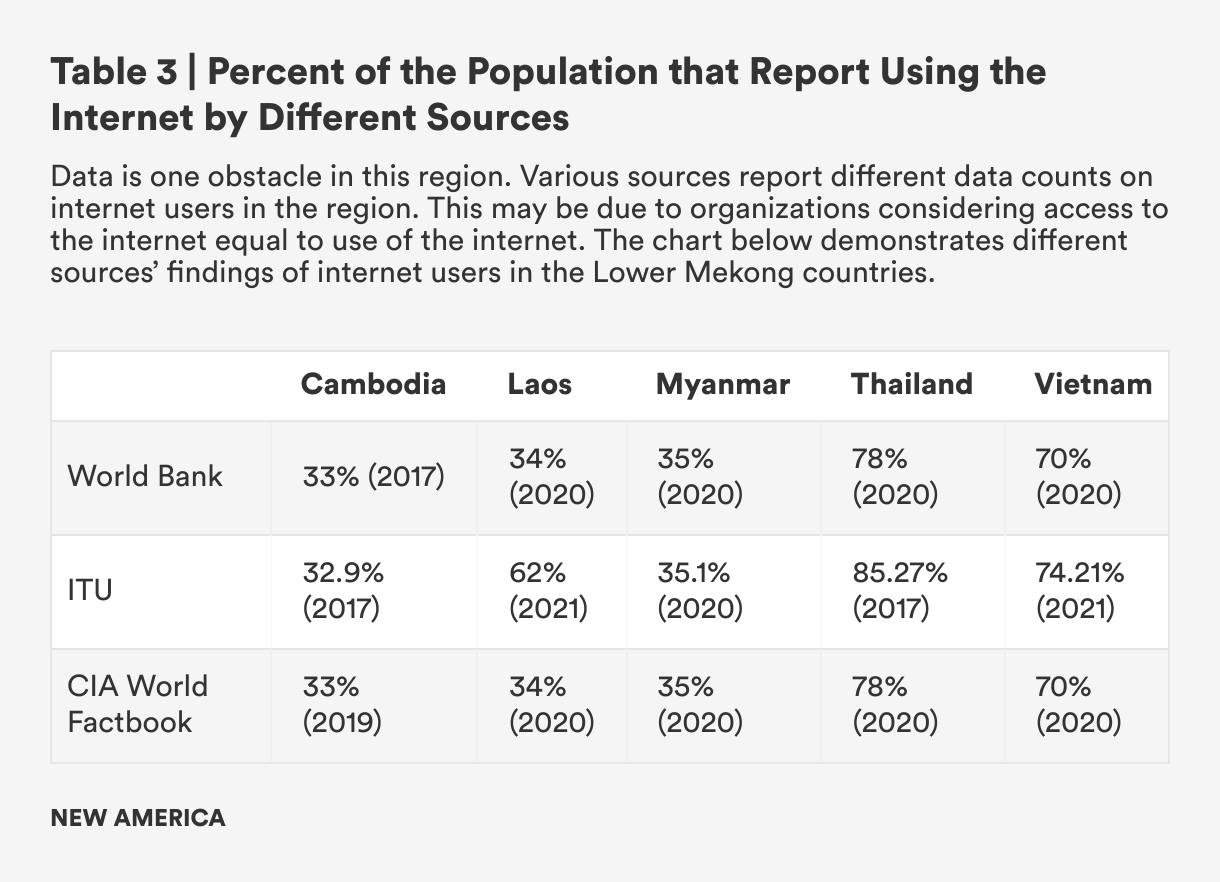
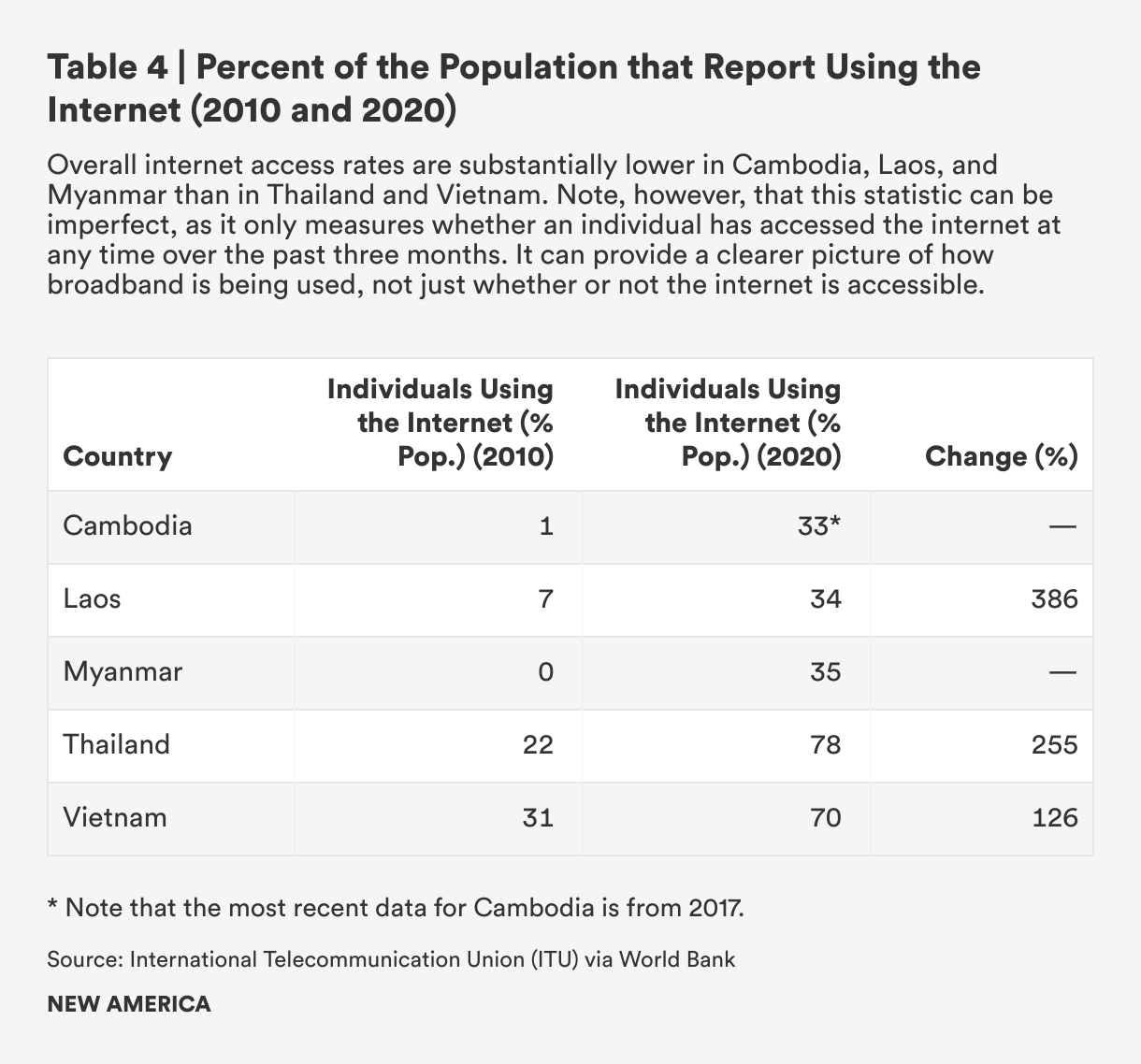
Internet usage varies significantly by country, but general trends span the region—urban users, men, and younger people are the most online (see Table 3). Thailand and Vietnam have larger percentages of their population online than Cambodia, Laos, and Myanmar (see Table 4). The number of online users is a difficult statistic to calculate and different sources provide different estimates.
These numbers may not account for the widespread use of virtual private networks (VPNs), which allow users to access blocked or restricted content and browse anonymously by encrypting and rerouting their internet service provider (ISP) location. VPNs are also often used to circumvent government control and monitoring, contributing to the fact that it is difficult to accurately measure VPN usage. According to the Global Web Index, in 2018, the greater Asia-Pacific region accounted for 30 percent of global VPN usage. Thailand was ranked within the top 10 global VPN markets, with 38 percent of users surveyed reporting VPN use. VPNs are legal in the region with the exception of Myanmar, where the ruling military junta has publicly proposed blocking and criminalizing the technology. It is unclear where the decision currently stands. In addition, the Thai government has blocked access to some websites that sell VPNs as a way to restrict access to the tool.
According to the Roland Berger Digital Inclusion Index (based on accessibility, affordability, ability, and attitude), the Lower Mekong Region is generally on par with global averages but lags behind more developed nations. Thailand and Vietnam score the highest in digital inclusion; Cambodia, Myanmar, and Laos follow, respectively. Across the region, data seems to point toward three development indicators that follow general internet use trends around the world, rather than being specifically unique to the Lower Mekong Region:
- Urban users outpace rural users. While there is not accessible information on urban-rural user discrepancies in all Lower Mekong countries, the International Telecommunications Union (ITU) reports that, in 2020, urban internet users in the Asia-Pacific region outpaced rural users 75 percent to 39 percent. In addition, while rural populations may have growing online coverage (such as in Vietnam, where 91 percent of the rural population had access to the internet in 2020), costs, low digital literacy, and limited access to devices often keep rural populations from actually accessing the internet.
- Gender gaps persist with more men online than women (see Table 4). In Thailand, gender gaps online are quite small, with 79 percent of men and 76.8 percent of women accessing the internet in 2020. Meanwhile, data from Myanmar shows a 30 percent gender gap for mobile internet users in 2020, with men outpacing women as internet users in every age group. Overall, the ITU reports that, in 2020, 54 percent of women and 59 percent of men in the Asia-Pacific region were internet users.
- Younger generations are more likely to be online. As of 2021, nearly 99 percent of those surveyed aged 15 to 34 reported using the internet in Thailand, while only 64 percent of those aged 50 and older reported doing so. Similarly in Myanmar, data from 2019 showed a huge drop-off in internet use after the age of 34. While there is no easily accessible data on age breakdown of internet use in Laos, Cambodia, or Vietnam, it is likely that their populations follow similar trends, given similarities in other categories.
In addition to digital literacy and skills, affordability, and relevance of services or activities to individual users, security and privacy concerns across the region may also be an inhibiting factor for device ownership and usage.3 For example, users in Vietnam and Thailand report higher distrust of tech companies and platforms.4 Other countries report distrust of government usage of technology. For example, 68 percent of Cambodian users reported feeling cautious when interacting with an e-government service. Meanwhile, in Myanmar, users increasingly fear a “digital dictatorship” and cyber hacks, particularly since the 2021 military coup and the resulting internet blackout, surveillance, and criminalization of speech online.5
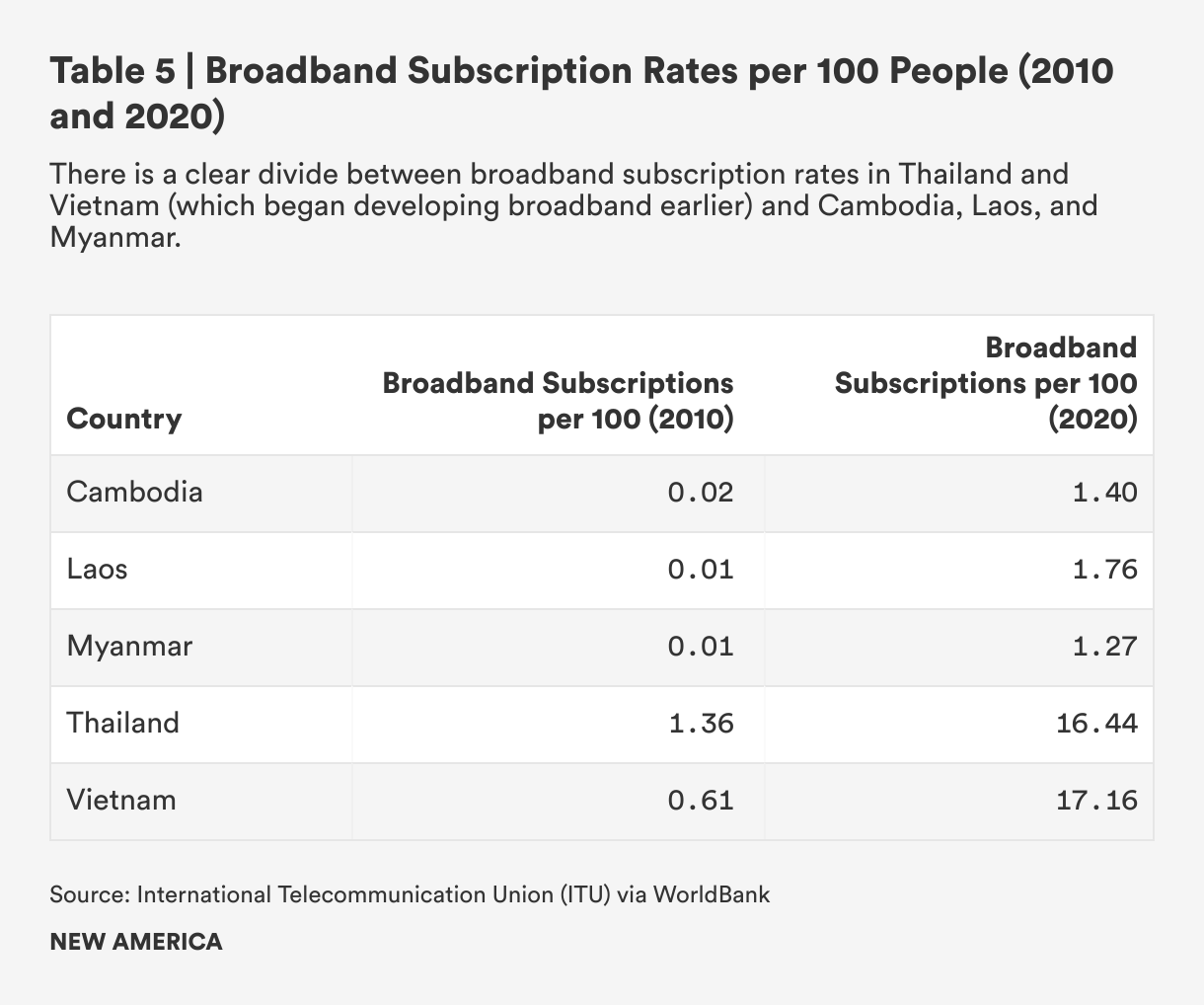
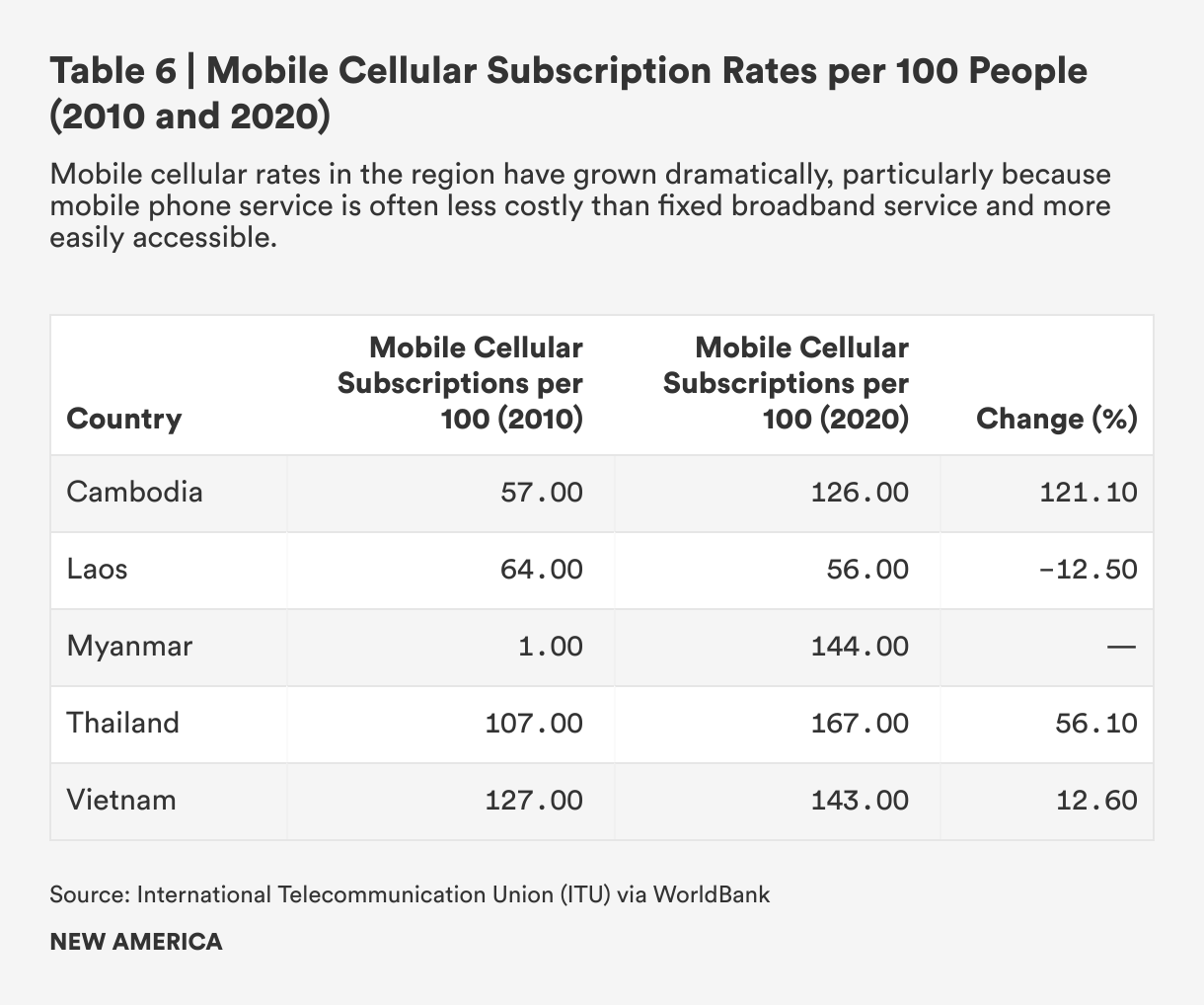
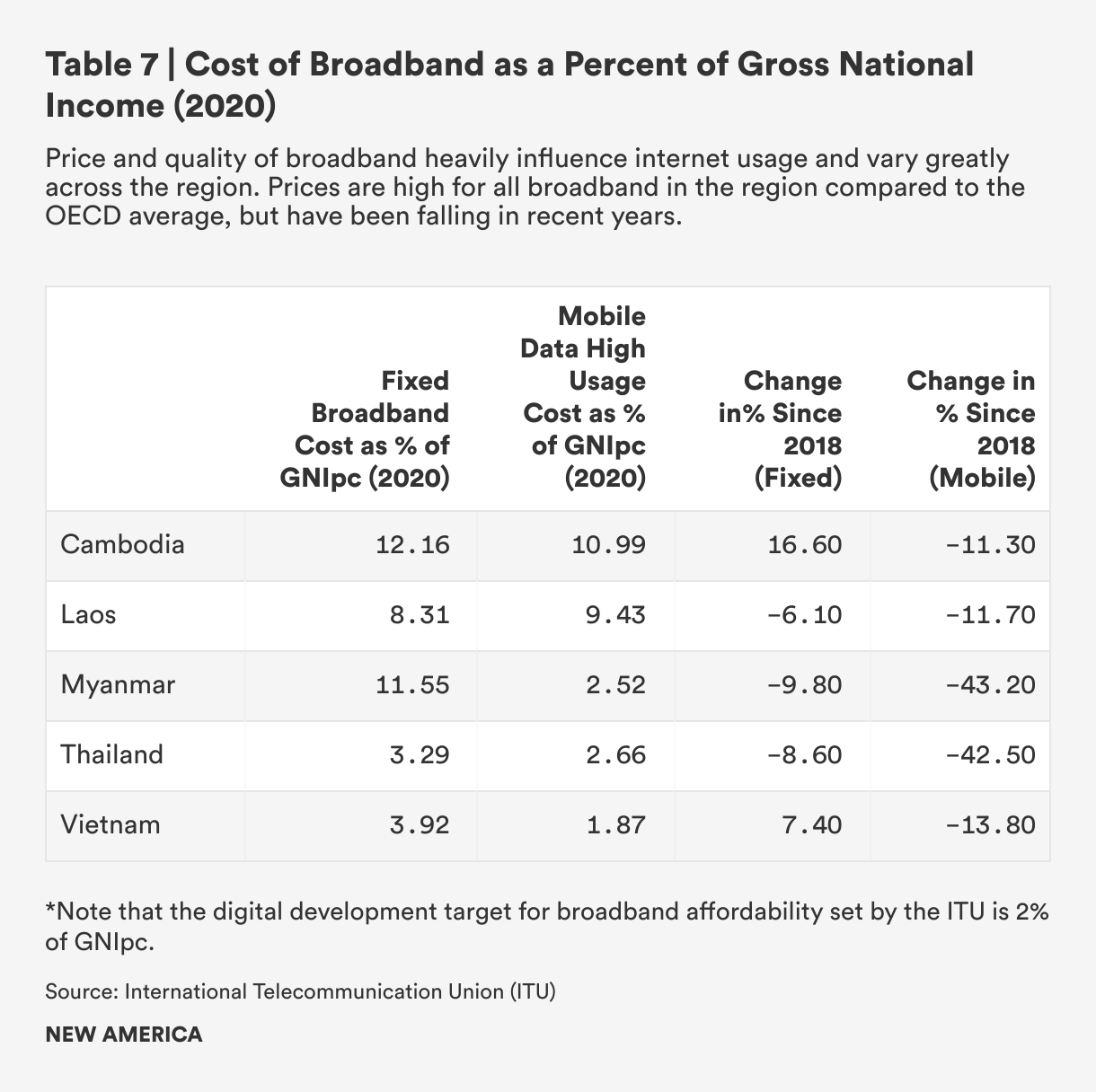
Across the region, while both broadband internet and mobile cellular phone connections have grown substantially, internet access and usage rates are not equal across or within these countries. With respect to fixed and mobile broadband coverage, the region has some infrastructure in place. Thailand and Vietnam often place comparably to international and OECD standards, while Cambodia, Laos, and Myanmar trail behind. Thailand and Vietnam also have higher broadband subscription rates, as they developed broadband access in 2018 before their neighbors (see Table 5). Many developing regions around the world prefer mobile broadband, as it is often less costly for users than fixed broadband service. The Lower Mekong Region is no different, as mobile cellular subscription rates per 100 people greatly outnumber fixed broadband subscription rates across all five countries (see Table 6). The price and quality of broadband heavily influence internet usage and vary greatly across the region. Altogether, regional fixed and mobile broadband prices are high compared to the OECD average (using gross national income per capita, or GNIpc, data) but have been falling in recent years (see Table 7). This drop in relative cost is expected, as incomes are rising faster than the price of broadband—especially for mobile broadband, where there is significant market competition.6 However, since the coup, the military in Myanmar has imposed price hikes and introduced new taxes that have greatly reduced affordable access to mobile phones and data.
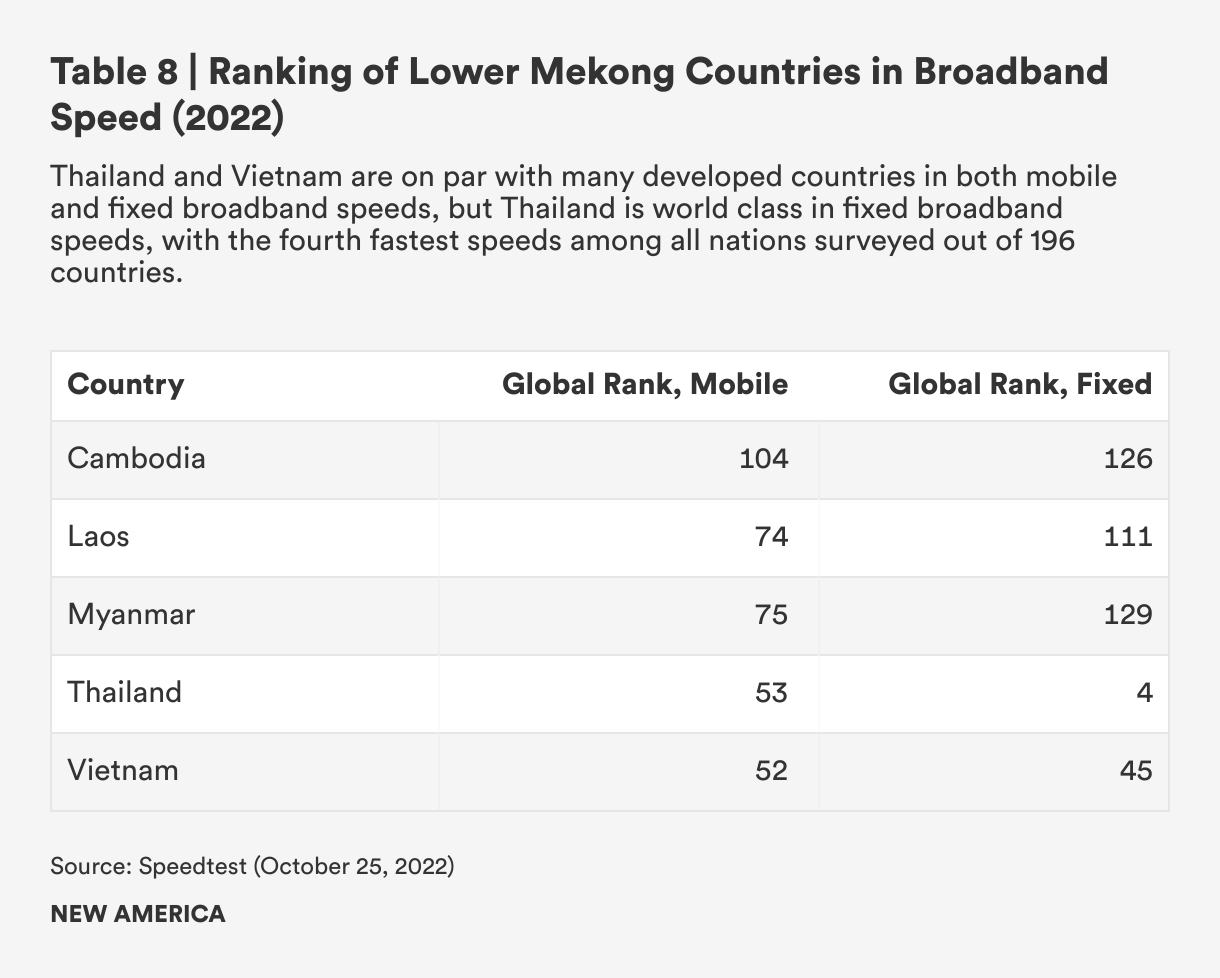
Thailand is doing better and is world-class in fixed broadband speeds, with the fourth-fastest speeds among all nations surveyed. Thailand and Vietnam perform even better on median speed metrics than broadband subscription rates. The other three nations lag significantly on both mobile and fixed broadband speed, placing 50 to 100 spots behind Thailand and Vietnam (see Table 8). As economic development continues across the region, it is likely that the growing number of competitive regional and international internet service providers will help drive the deployment of high-speed 4G/5G bandwidth in urban areas, with smaller cities and rural villages trailing behind.
Digital Governance: Implications for User Data, Privacy, and Internet Freedom
Where they exist, the regulatory regimes of the Lower Mekong countries vary but generally show an increasingly authoritarian approach to digital governance. Digital governance issues, cyber and telecommunications regulations, and internet freedom affect how useful digital services and tools can be for personal and business use. Each government in the region has several institutional bodies that regulate telecommunications services and various issues such as privacy, cybersecurity, digital government resources, and data governance. However, governments in the region frequently use vague, broad laws and regulations to assert authority, limit dissent, and enforce national agendas through a complicated patchwork of cyber and telecommunication bills that often perpetrate, justify, and obfuscate human rights violations and privacy abuses.
Cyber and Telecommunications Regulations and User Data and Privacy
The Lower Mekong countries have enacted several cybersecurity, cybercrime, and data protection and privacy laws, many of which intentionally or unintentionally cause internet freedom and human rights concerns. In most cases, cyber laws nominally protect individuals from bad actors and often carry severe penalties for transgressions. However, most of these laws also give government authorities unbridled access to data and the right to ban or censor information. For example:
- Cambodia: Cambodia’s 2015 Law on Telecommunications increased government control over the telecommunications sector, allowing government officials to temporarily suspend company services and staff, criminalizing any use of telecommunications that leads to “national insecurity,” and allowing for state surveillance of individuals online.
- Laos: In 2015, the Law on Prevention and Combating Cyber Crime was implemented with the stated purpose of strengthening cybersecurity measures and preventing cybercrime. However, some human rights groups have raised concerns that the vague law criminalizes criticism of the government and circulation of “fake news.” While Laos does not have comprehensive data regulations, in 2017, the government enacted the Electronic Data Protection Act to help strengthen user data protections.
- Myanmar: The data localization provision in Myanmar’s 2022 cybersecurity bill requires all data to be physically stored on local servers and allows the government—now the military—access to and oversight of all personally identifiable information (PII), putting users at greater risk.
- Thailand: In Thailand, the 2007 Computer Crime Act (amended in 2017) provides the government with “unlimited powers to restrict online speech, undertake surveillance and warrantless searches of personal information and data, undermine the right to use encryption and anonymity, and force service providers to facilitate government surveillance and censorship.” However, there is also a more recent measure of note. Thailand’s Personal Data Protection Act (PDPA), a policy to protect user data, went into effect in June 2022. The PDPA is similar to the EU’s General Data Protection Regulation, which governs how personal data of individuals in the EU may be processed and transferred. It is still too early to determine if the act will have a net positive or negative impact on the Thai digital ecosystem.
- Vietnam: Vietnam’s Law on Information Security requires technology companies to provide user data and decryption keys upon state request. In addition, Vietnam’s 2018 Law on Cybersecurity created data localization requirements for domestic and foreign companies. The 2022 Decree 53 requires personal data of Vietnamese users be stored on local servers. While the Vietnamese government states that the requirements are intended to protect national security and improve safety, they have also led to increased online censorship and content moderation, putting user data at risk.
Read more about these developments in the Country Briefs.
Concerns about Internet Freedom
Given regional tendencies toward authoritarian cyber and telecommunications regulations, laws, and practices, internet freedom in the region is severely limited. These approaches can be seen in Freedom House’s internet freedom score for each country (see Table 2). These scores note how the internet is governed, how the government censors, how individual rights are affected, how privacy is protected, and how the government collects data for purposes of repression. Based on this assessment, Cambodia has the most-free internet in the Lower Mekong Region with a score of 43 out of 100, although it is still considered limited by democratic standards and may be moving in a more digital authoritarian direction if the country implements its National Internet Gateway legislation (for more, see the Country Briefs). Thailand and Vietnam follow behind with scores of 39 and 22, respectively. Myanmar’s internet freedom score is the second lowest in the world at 12, ahead of only China at 10. Freedom House does not rate Laos in internet freedom due to its underdeveloped digital infrastructure. However, based on political freedom and civil liberties, Laos receives an overall “not free” score of 13, ahead of only Myanmar in the region. It is worth noting that none of the five countries analyzed in this report signed on to the 2022 Declaration for the Future of the Internet, particularly when regional neighboring countries South Korea, Japan, Taiwan, Australia, and New Zealand did join in support of an open internet for all.
Internet Shutdowns and Disruptions
Internet shutdowns—a tool of digital authoritarians—are intentional disruptions of internet services and can be used to exert control over the flow of information. Most internet shutdowns last a few hours; some can last days or weeks, while others persist for months or even years. In Myanmar, the junta periodically shuts down multiple communication channels, including the internet, effectively controlling the spread of news and information and providing cover for the arrests of key members of the political opposition and civil society. In 2021, Myanmar imposed the second-highest number of internet disruptions, second globally only to India. From June 2019 to February 2021, the Rakhine State in Myanmar experienced an internet shutdown for 593 days, during which mobile internet, independent and ethnic news media, and over 2,000 other websites were blocked, some under the guise of them being “fake news.” Other governments in the region have also used similar disruption strategies, though not to the same scale. Thailand has blocked specific website URLs, while Vietnam has blocked specific online platforms. Given the risks of government-related internet disruptions and surveillance, VPN use is popular across the region and helps users access blocked platforms or sites and anonymize online activity.
Censorship and Content Moderation
Since internet shutdowns and disruptions garner greater international attention and can have a negative impact on development dollars flowing into the region, many governments in the Lower Mekong Region use other censorship and content moderation methods to manipulate and limit online freedoms. Authorities also impose economic costs to deter online access, such as social media taxes, data usage fees, or SIM card registration requirements. Additionally, governments may intimidate users, pressure companies to take down content, and institute legal restrictions to access. As a result, individuals and groups who use online or digital platforms for dissent and protest do so with serious risk of repression, prosecution, and imprisonment. Governments in the Lower Mekong Region have taken the following actions:
- Cambodia: Under the cover of pandemic concerns, Cambodia implemented the Law on Measures to Prevent the Spread of COVID-19, which has effectively increased the number of people fined and arrested for online activity throughout the pandemic by criminalizing criticism of COVID-19 management. The proposed National Internet Gateway, which would route all internet traffic through a government-run portal and give more power to the government to censor and moderate content, has been postponed due to technical issues and the COVID-19 pandemic.
- Laos: In 2021, Lao government authorities announced a task force to monitor social media use, focusing especially on fake news and postings that criticize the government.
- Myanmar: According to Freedom House’s Freedom on the Net report, given the widespread internet shutdowns, “whitelisting” of select websites and applications, restricted internet access, and increased online censorship under the military regime, most internet users in Myanmar can access only 1,200 government-approved websites. As a result, VPNs are a popular tool to access the internet. However, a proposed cyber law would make all VPN usage illegal in the country, although it is unclear whether the law has been implemented.
- Thailand: Following pro-democracy protests that began in July 2020, Thailand has seen a sharp increase in government crackdowns on free online expression. Thailand’s military cyberwarfare unit, technology crime suppression division, and Ministry of Digital Economy and Society’s “anti-fake news center” monitor and report activity deemed harmful to the government.7 Thailand has also worked with Facebook, YouTube, TikTok, Twitter, and other social media platforms to remove content critical of government activity.8 Under Thailand’s Computer Crime Act, companies are subject to penalties for failing to comply with content removal requests.
- Vietnam: A 2018 cybersecurity law in Vietnam allowed the Vietnamese government to require social media platforms to remove anti-government content within 24 hours of receiving notice from a government official. Under this law, platforms such as Facebook, Google, and TikTok have been required to take down content, much of which is related to government criticism.
To read more about digital governance concerns in each of the Lower Mekong countries, please refer to the Country Briefs.
Citations
- Charmaine Jacobs, “Southeast Asia has added 70 million online shoppers since the beginning of the pandemic, report finds,” CNBC, September 15, 2021, source.
- “Services on National Public Service Portal now number 2,700,” Vietnam Plus, December 30, 2020, source.
- GSM Association, “Connected Women: The Mobile Gender Gap Report 2020,” GSM Association, May 2020, source; Ha Vy, “Vietnamese consumes more trusting in online activities,” Vietnam Investment Review, October 17, 2017, source.
- “Study Reveals That as APAC Embraces Digital, Consumer Trust Is in Short Supply,” Yahoo, November 12, 2017, source 32% of Vietnamese consumers trust personal data security,” Vietnam Plus, June 19, 2019, source.
- Rina Chandran, “Fears of 'digital dictatorship' as Myanmar deploys AI,” Reuters, March 18, 2021, source.
- Note that we use 2020 broadband service prices as a benchmark, despite the fact that 2021 data is available from the ITU. For purposes of assessing relative affordability, it is imperative to use price and income data from the same year, and 2020 is the most recent year for which income data was available. Recent inflation has increased prices for services in 2021, but we do not know whether that effect is driven mostly by higher rates or lagging wage and income growth.
- Patpicha Tanakasempipat, “Thailand unveils 'anti-fake news' center to police the internet,” Reuters, November 1, 2019, source; Gerard McDermott, “Thailand’s Creeping Digital Authoritarianism,” Diplomat, February 17, 2021, source.
- “Thailand gives Facebook until Tuesday to remove 'illegal' content,” Reuters, May 12, 2017, source.
A Brief Landscape of the Regional Digital Ecosystem
Implementing and ensuring safeguards for human rights, privacy, and fundamental freedoms while the region’s digital ecosystem is still nascent is critical. Current authoritarian approaches to technological governance in the Lower Mekong Region present a significant barrier toward people-centered digital transformation. The failure to course-correct only further jeopardizes current or ongoing digital solution initiatives and their ability to create whole-of-society change. With this in mind, this section details some of the larger components of digital ecosystems that represent areas of potential socioeconomic growth and regional cooperation, including foundational elements such as capacity, digital literacy, and innovation culture; advancements in social media and messenger apps; fintech and e-commerce; and the emergence of digital public infrastructure and e-government activities.
To take a closer look at each country’s digital development and key areas to watch in their digital transformation process, please see the Country Briefs.
Capacity, Digital Literacy, and Innovation Culture
The Lower Mekong countries are at various stages in developing their technology innovation ecosystem to support large-scale digital transformation. In most of the region, digital literacy represents a barrier to digital solutions deployment.
Capacity
The region is made up of relatively nascent digital ecosystems that are often limited by underdeveloped infrastructure and regulation, as discussed. While some countries are more advanced in this area than others, each could benefit from greater coordination among governments, investors and corporate venture capital, educational institutions, development actors, and civil society, in order to support large-scale digital transformation. Capacity for digital transformation relies on these stakeholders working together to create an ecosystem for developing, deploying, vetting, and adopting new technologies. Entrepreneurs, talent, investment, and regulatory support are all necessary components to fostering ecosystems conducive to rights-respecting technological innovation.
Each country in the region other than Myanmar participates in the United Nations Development Programme (UNDP) Accelerator Labs network. The Accelerator Labs are designed to close the gap between the current practices of international development and the accelerated pace of change in the digital era. While the labs are closely aligned with achieving the UN’s Sustainable Development Goals (SDGs) by 2030 and are embedded in the UNDP’s global policy teams and country offices, every Accelerator Lab has its own initiatives and broader priorities. Overall, the Accelerator Labs in the Lower Mekong Region focus on using data to inform scalable and innovative solutions for priority areas such as circular economies, waste management, pollution monitoring, and sustainability.
- Cambodia: Cambodia’s lab works on issue areas such as mobile air-quality monitoring sensors, poverty mapping, and supporting local start-ups with incubation programs.
- Laos: Laos’s lab has focused on innovative experimentation and conducted studies on waste management solutions using satellite imagery and data, and separately is working on skills training that can help address youth unemployment.
- Thailand: Thailand’s lab is working to bridge the digital divide and support the Thai government’s digital transformation initiative to make public service delivery more efficient and accessible.
- Vietnam: Vietnam’s lab was chosen as a participant in the Japan SDGs Innovation Challenge to work with Japanese companies to co-develop, design, and test potential solutions for SDG target areas.
Digital Literacy
UNESCO (the United Nations Educational, Scientific, and Cultural Organization) defines digital literacy as “the ability to use information and communication technologies to find, understand, evaluate, create, and communicate digital information, an ability that requires both cognitive and technical skills.” However, digital literacy levels are difficult to assess as there is no standard measure. Even where estimates are provided, there is little information on how rates are determined. For example, the Cambodian government has determined that 30 percent of its population is digitally literate but does not explain its methodology.1 Generally, low rates of digital literacy are widely recognized as a barrier to technology use, development, and deployment throughout the region, particularly for women and girls. This creates further marginalization, as already socially excluded groups have less access to tech. With large segments of the population online, low literacy rates can make users vulnerable to scams and predatory behavior.
Innovation Culture
Start-up culture growth is fueled by a few factors, including government support, digital entrepreneurship, favorable tax and visa regulations, and an emerging sector with increasing competition and potential. Cambodia, Thailand, and Vietnam all boast promising tech start-up cultures. Conversely, Laos’s and Myanmar’s ecosystems are hampered by missing key features including investment, infrastructure, developed markets and modern financial services, supportive regulation, and access to tech talent. In Laos, barriers to tech sector growth include a relatively small population and therefore small market potential, as well as low digital literacy concerns and complex business registration. In Myanmar, promising accelerator and incubator initiatives have been felled by instability in the country.
- Cambodia: The number of technology start-ups in Cambodia has grown significantly. Most focus on fintech, followed by media and advertising, e-commerce, development services, and digital marketplaces. The Cambodian government has taken action to strengthen tech innovation in line with recent national strategy plans by promoting start-ups and fostering entrepreneurship and innovation through e-learning programs, licenses for tech-related businesses, and technology industry zones.
- Laos: Smaller companies just starting out may prefer to remain unregistered and under the radar to avoid dealing with taxes, licensing, and other government regulations. They also have to contend with a lack of access to funding and local programming capacity. But there has been a leader on the start-up front in Laos: LOCA. LOCA was created to fill the gap left by a lack of reliable transportation services and absence of international rideshare services. But LOCA has emerged as more than a ride-hailing service, also providing tours, information about tourist sites, and a directory of local restaurants.
- Thailand: Start-ups have seen explosive growth over recent years in Thailand, particularly those in the fintech sector. One source cited tenfold growth from 2018 to 2022. Thailand’s first tech “unicorn,” Flash Express, was another milestone in the country’s mission to position itself as an “innovation nation.” The National Innovation Agency even set a national goal of having 100 deep-tech start-ups—which develop their own tech solutions—in the country by 2025, with 65 focused on bio-circular and green economy.2
- Vietnam: Attempting to launch its own Silicon Valley in Ho Chi Minh City, Vietnam is using three eastern city districts to create a technology development zone to attract tech entrepreneurs from across the country and the world.3 This initiative supports Vietnam’s National Digital Transformation Programme by 2025, which aims to develop more digital institutions, digital skills and capacity, and digital resources to support whole-of-society digital transformation. In one released draft strategy for developing Vietnam’s digital technology companies, Vietnam announced the goal of training more than 1.5 million digital workers and fostering 100,000 digital companies by 2030.
Social Media and Messenger Apps
Regardless of location, gender, and age divides, internet users in the region use social media and messenger apps to connect socially, economically, and civically. Social media’s role in the region extends beyond traditional social communication into informal online commerce, social activism, and access to the greater internet. Using data from social media platforms, the number of accounts in Cambodia, Thailand, and Vietnam are equal to about 75 to 80 percent of the population. This same model shows accounts in Laos at about 50 percent and in Myanmar at about 40 percent (see Table 9). Actual percentages of populations online may be smaller than reported when factoring in the use of multiple accounts from the same user or users who have inactive accounts.
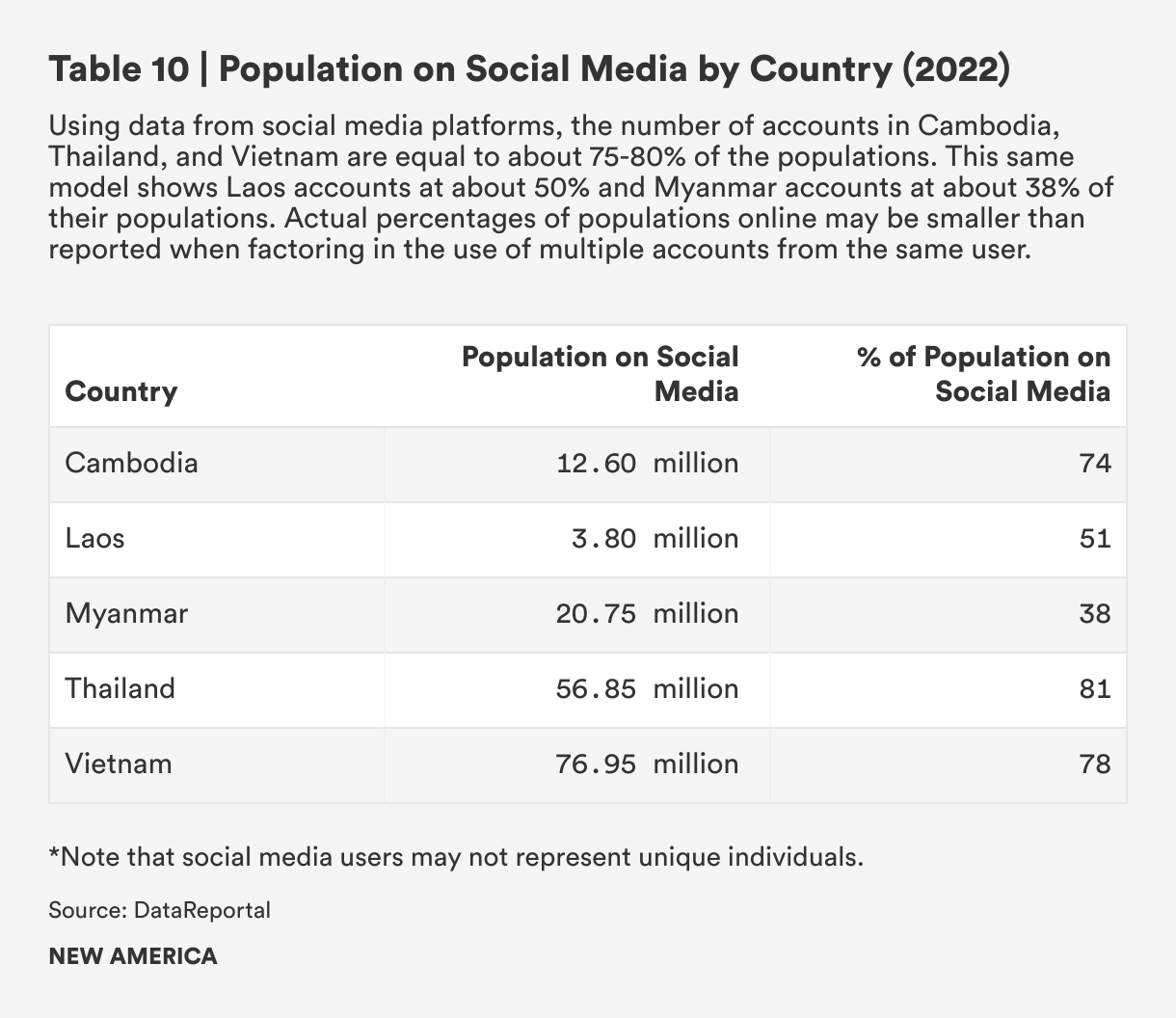
Each country uses various social media and messaging platforms at different rates. Meta’s Facebook is the most prevalent, but other systems like WeChat, Zalo, LINE, KakaoTalk, and Telegram are also used. Facebook has a disproportionate share of the market and plays an outsized role across the region. Both Thailand and Vietnam rank in the global top 10 of countries with the highest numbers of Facebook users. Facebook gained popularity when it launched the Free Basics program—a service that gave users free-of-charge access to a limited number of websites and services.4 Although the initiative ended in 2017, it made Facebook the go-to platform in many LMICs, including those in the Lower Mekong Region. Facebook, among other platforms, also provided a no- or low-cost space for users to build and promote their small businesses. Interviewees from Cambodia and Vietnam discussed how small businesses, particularly women-owned ones, are embracing social media for informal online commercial purposes. These income streams work in a bottom-up fashion, with women taking advantage of lower barriers to entry and the ability to work from home.5
At the same time, increased social media use has also enabled governments to harness platforms as tools for surveillance, censorship, and digital repression.
- Myanmar: Facebook has been used to amplify violence against Rohingya people in Myanmar.6 In 2018, Facebook publicly acknowledged that it was too slow in removing harmful posts. Post-coup, Facebook banned individual military leaders from the platform, while the military blocked access to Facebook in Myanmar. Access to Facebook is still blocked by some ISPs in Myanmar, however people can access the platform through VPNs—although that route has restrictions as well.7 (Read more about Meta/Facebook’s impact in Myanmar in the Country Briefs.)
- Thailand: An interview with a civil society organization indicated that the Thai government has targeted protestors who use social media to express anti-monarchy views and has ordered Facebook to block pro-democracy and anti-monarchy content. This is consistent with international coverage.
- Vietnam: The Vietnamese government can require social media platforms to remove anti-government content within 24 hours of receiving notice from a government official.8 As a result, Facebook drastically increased the number of posts it removed in Vietnam, from 834 in early 2020 to more than 2,200 in late 2020.
Advancing Economic and Financial Inclusion with FinTech
One of the most prominent and promising areas of digital solutions growth in the region is in economic and financial inclusion technologies—or “fintech”—such as online banking, digital payments, and mobile e-wallets. Mobile fintech solutions offer the region a way to leapfrog to greater financial and economic inclusion, bypassing analog and in-person banking infrastructure and moving straight to digital alternatives, although some significant limitations exist. In 2021, the World Bank’s Global Findex Database stated that there is a high percentage of unbanked adults in the region, with Cambodia at 67 percent, Lao at 63 percent, Myanmar at 52 percent, and Vietnam at 69 percent. Thailand stands out with only 4 percent of the country’s adult population unbanked, dropping from 18 percent in 2017.
A brief look at the countries in the region shows a push toward easy, efficient, and interoperable cashless payments using mobile or e-wallets, digital payment platforms, and QR codes, which have gained traction since the onset of the pandemic. (See the Catalog of Digital Solutions.)
- Cambodia: Launched by the National Bank in October 2020, the Cambodian Bakong digital currency is a blockchain-enabled, QR code–based, peer-to-peer and peer-to-business digital payment system. The Bakong platform speeds up and simplifies banking and blockchain-secured payments, enabling anyone in the nation to access their account and initiate transactions through a smartphone.
- Laos: The Bank of the Lao PDR (BOL), the national bank, launched the Lao QR Code standard for digital, domestic payments in January 2020 to boost cashless payments, facilitate increased digital transactions, and improve integration between banks. BOL authorized the establishment of the National Payment Network to help connect banks further, connecting seven commercial Lao banks and China’s UnionPay.9
- Myanmar: At least 10 fintech companies were offering online banking or e-payment services in Myanmar. One of the leading mobile wallet platforms in the country, WavePay, boasted over 2 million active monthly users in January 2021. However, this number fell by half after the coup.10
- Thailand: The digital payments ecosystem in Thailand is also well developed, with PromptPay operating through the Bangkok Bank and mPay. PromptPay enables users to use a mobile phone number or citizen ID to receive and transfer funds through online banking, mobile banking, or ATMs, helping to bypass the traditional inclusion concerns with un- and underbanked populations. As part of Thailand’s Payment Systems Roadmap, the country is also at the center of a number of regional QR code–based, cross-border payments that facilitate regional interconnection with Vietnam, Cambodia, Laos, Malaysia, Indonesia, Singapore, and Japan.11
- Vietnam: As of 2021, over 80 banks in Vietnam offer online banking services, while 44 banks offer specifically mobile banking services. Intermediary payment services are offered by 45 fintech firms in the country, with more than 90,000 stores accepting QR code payments.12
Generally, the rise of fintech solutions in the region have increased financial and economic inclusion, particularly for un- or underbanked communities such as women, minorities, rural communities, disabled populations, and small and medium-sized enterprises (SMEs). However, there are limitations to the benefits of fintech. One major concern regarding digital payments, expressed by interviewees working in development in Vietnam, is the degree to which the systems are integrated with existing infrastructure. Cambodia and Thailand have well-integrated digital payment and banking systems that are interoperable across banks and with e-commerce platforms. However, in Laos and Vietnam, digital payments and banking tend to be more fragmented and therefore do not always deliver on the full potential of the technology. In addition, these technologies are not easily accessible and deployable for all sectors and populations. Fintech is often concentrated in the service industry. Informal sectors such as agriculture, which a large portion of the population in this region relies on, tend to not be as connected to digital platforms and thus miss out on the associated benefits. On the individual level, those who are banked and have higher incomes, digital literacy skills, and more consistent access to the internet benefit most from fintech solutions. These are typically urban, middle-class consumers. Other interviewees mentioned that limited trust in banking systems and digitization processes can keep rural populations from accessing fintech and other digital solutions, only furthering the divide of who benefits from fintech solutions.
Growth of Digital Public Infrastructure
Countries in the Lower Mekong Region are exploring ways to further socioeconomic growth and facilitate e-government activities through digital public infrastructure (DPI). DPI refers to the solutions and systems that enable the effective provision of essential society-wide functions and services in the public and private sectors. However, existing DPI in the region is limited, as analog systems are still the critical method of accessing public services.
DPI includes, but is not limited to, proprietary or open source digital solutions for digital forms of ID and verification, payment, data exchange, information systems, and civil registration and e-government.13 The potential of improving the reach of public programs and social assistance with DPI was proven during the pandemic. For example, the World Bank issued a report indicating that the digitization of COVID-19 response programs led to a global increase in financial account ownership, including in Thailand and Vietnam. Although many of the digital account-based payments made were only for temporary COVID-19 response programs, the countries that utilized digital payments systems can now leverage that investment to facilitate a meaningful shift to more modern and efficient social assistance payments across various social assistance programs and government services.
Despite the promise of these digital solutions, not every country is able to prioritize digital public infrastructure pursuits. In particular, Laos and Myanmar lag behind other Lower Mekong countries and rely more heavily on nondigitized data and in-person operations. While the countries in the region may try to use digital technologies to either strengthen or leapfrog social and economic advancements, it is important to note that digital solutions are not a panacea to all development challenges. As one interviewee, who is an international cyber policy expert based in the region, noted, implementing digital solutions without the necessary supporting architecture (governance, processes, access, and infrastructure) results in only a facade of digitization, which persists throughout the region. While it may seem like many in the region have a smartphone that gives them access to sleek, digitized e-commerce and e-government platforms, this interviewee noted that behind the scenes, commerce and the government are still very analog, and will continue to be so until digital public infrastructure and interoperability are prioritized.
While digital transformation has changed how people interact with their government, it has also opened new civic spaces online—supporting mass mobilization of offline social movements that fuel activism efforts—and has supported greater access to public benefits and services. However, just as often, digital transformation efforts have created new risks and challenges for individuals interacting with their government. It is important to recognize that in this region, greater digitized relationships between government and people can put populations at greater risk to government censorship, surveillance, and monitoring. In addition, the risks to individual data security or privacy that arise from the governance of public digital identity, digital payments, online banking, and finance depend on the design and oversight choices of the institution and country that deploys them—and in this region, increasing authoritarian governance and practices puts potential DPI users at risk.
E-Government
Throughout the region, countries have outlined various plans and initiatives to facilitate and advance digital solutions for social and economic development. The 2022 UN E-Government Development Index (EGDI), which ranks 193 UN member states based on the quality and scope of their online services, status of telecommunications infrastructure, and human capital. Cambodia has a “High EGDI” score for e-government, ranked at 127; Laos has a “Middle EGDI” score at 159; Myanmar has a “Middle EGDI” score, ranked at 134; Thailand has a “Very High EGDI” score, ranked at 55; and Vietnam has a “High EGDI” score, ranked at 86.
- Cambodia: In Cambodia, the Digital Economy and Society Policy Framework 2021–2035 sets out to build a digital government backed by population trust as the first step toward a “vibrant digital economy and society.” The policy framework outlines 10 strategies for improving digital infrastructure and digitizing government services, while also setting goals for building integrated digital infrastructure and management platforms, creating technical standards, recruiting digital technology officers, and tasking each agency with a digital transformation unit.
- Laos: In 2021, the Lao government, in coordination with UNDP, launched a Digital Maturity Assessment, released in August 20222, that will help shape priorities for digital transformation in Laos, contribute to the development of a Digital Government Master Plan and a Standards Framework of Digital Government, and inform digitized pilot programs for government services and agencies.
- Myanmar: Before the coup in Myanmar, the Ministry of Transport and Communications put forth a new Universal Service Strategy for 2018–2022 to extend telecoms services and internet access in the country, as well as an e-Governance Master Plan 2021–2025 that included plans for e-payments, protection against cybercrime, and the movement of public services online. With the military coup and subsequent internet shutdowns, the long-lasting effects of these initiatives, especially on human rights, are still to be determined.
- Thailand: In addition to the Thailand 4.0 initiative (read more in Country Briefs), the Digital Government Act aims to improve government efficiency and service delivery. This includes creating a government data exchange platform that can facilitate standards for data sharing and allow the Thailand Anti-Corruption Association to monitor the use of data in government projects. The Digital Government Agency, which is spearheading the nation’s e-government push, is looking to incorporate artificial intelligence (AI) auditing tools and chat boxes, digital ID, and open data to enhance government service delivery.14 In addition, one interviewee discussed UNDP’s efforts in Thailand to improve civic engagement by testing an app called Consul—a citizen participation software that establishes a clear platform for citizens to debate, create proposals, and collaborate on legislation.
- Vietnam: In 2021, Vietnam issued its first e-government strategy, the Digital Transformation Programme by 2025, which aims to support whole-of-society digital transformation through quality services and policies. In addition, Vietnam is working with e-GovernanceAcademy to develop a plan to advance the e-cabinet and e-consultation processes and eventually move toward the e-service system that will fit into a future data exchange platform.
Digital Identity and Verification
Digital identity and verification solutions are rapidly gaining traction in the Lower Mekong countries. While government-sponsored digital IDs can unlock access to government benefits and services and lift users out of poverty, they can also pose great human rights risks and increase opportunities for governments to marginalize or deny citizenship to ethnic minorities and others. Identity verification tools can also provide greater access to public and commercial services when built interoperably with other digital solutions. However, if not created thoughtfully and securely, these tools can also put user data and privacy at risk. An international law–focused interviewee from Cambodia expressed concern that any country in the region—especially Cambodia, Myanmar, and Vietnam—could abuse these systems to surveil and track people. In addition, these governments have few security systems in place to protect whatever PII data they may collect from potential fraud or crime. Citing India’s Aadhaar system as a cautionary tale to learn from, the interviewee warned that, “the ability of malicious actors to hack into these data centers—the potential to create harm is enormous.”
- Cambodia: According to the General Department of Identification in the Ministry of Interior, Cambodia is currently working on introducing digital ID cards, birth certificates, and passports under its 10-year national strategic plan.15 Current plans also indicate that biometric data will be collected as part of the digital ID card registration.
- Laos: In 2018, the Lao Ministry of Science and Technology and private-sector company Lina Network signed a memorandum of understanding to develop and deploy a blockchain digital identity to improve government service delivery.16
- Myanmar: Myanmar listed piloting a digital ID system as one of the priorities in its national economic policy. Given the current political turmoil, though, it is unclear whether such a system is being developed. However, in 2019, Myanmar’s Post and Telecommunications Department issued a SIM biometrics database tender to private organizations. The government’s choice to maintain a database that would store and manage biometric mobile subscriber information caused an international uproar, with critics accusing the government of wanting to use these technologies for the purpose of ethnic cleansing.17 Despite the public outcry, Myanmar has since moved to impose additional data localization regulation in the name of cybersecurity and data protection that would give the regime greater access to data. The Rohingya Project is working on a pilot to create blockchain-backed digital identities, called R-ID, for stateless and diaspora Rohingya populations that had to flee Myanmar, where they are denied citizenship and face genocide.
- Thailand: Thailand’s National Digital Identity (NDID) is a platform for identity verification, online self-service for financial transactions, and data sharing. NDID uses blockchain and facial recognition for secure data exchanges. Users allow an authorized agency, such as a bank or national credit bureau, to be their data trustee, but must authorize the release of data outside the appointed trustee institution.18 In 2021, more than 9 million identity requests were made through NDID, which has over 30 million users in total. Mastercard agreed to a partnership with NDID to advance international connectivity.19
- Vietnam: In 2021, Vietnam began a new initiative to modernize ID cards for citizens 14 years and older by using facial and fingerprint data to register more than 50 million people for digital IDs.20 Vietnam’s electronic ID cards are used to access government and bank services and digitally sign documents, with Vietnam aiming for these to be used to authorize private-sector transactions at a later time.21 The ID cards have raised privacy concerns given the country’s lack of a personal data protection framework.
Digital Payments
As covered in previous sections of this report, governments play a significant role in the digital payments and fintech sector. A secure and reliable digital payments system helps introduce financial solutions to the unbanked and provides opportunities to expand safety net services. There are many foundational initiatives being explored to expand financial inclusion efforts.
- Cambodia: Bakong, a digital currency housed in the National Bank of Cambodia, is used to strengthen the Khmer riel and reduce dependence on the U.S. dollar.
- Laos: The Bank of Laos introduced the Laos QR Code standard to make sending and receiving cashless domestic payments more convenient and accessible, and to improve integration between banks.22
- Thailand: Bangkok Bank’s PromptPay is a digital payment service that uses the user’s government-sponsored national ID number or mobile phone number. In addition, Thailand has cross-border QR payment agreements with Cambodia, Laos, and Vietnam.
Regional Cooperation
Region-wide digital technology deployment is also starting to take off, led by development actors and multinational organizations. The three examples below demonstrate how collaborative digital solutions can address regional problems that would otherwise require consistent, concerted effort by individual governments in the region.
- ASEAN Single Window Cross-Border Customs and Trade Portal: In order to promote trade and ease the customs process for producers, importers, and exporters in member nations, ASEAN created the ASEAN Single Window, a unique platform that takes information from various country-specific digital trade and customs databases and online portals and integrates them for interoperability. As a result, any trade authority in a member nation can find documentation in a standardized format, streamlining the customs process and shortening the time required for cross-border transit of goods and services.
- Mekong Dam Monitor: With the Mekong River affecting the livelihoods and safety of tens of millions, the U.S. government and the Stimson Center, a U.S.-based think tank, partnered on a project called the Mekong Dam Monitor that uses satellite imagery, remote sensing, and geographic information system software to report river flow and dam operations. This open source project informs users of river flow changes and effects from upstream dam operations, and serves as an early warning system for communities subjected to the effects of river flow changes.
- Mekong River Commission’s water quality monitoring system: The water quality monitoring system monitors and provides digital information on water flow and quality from dams and other infrastructure projects along the river. Employment of the technology at a major project on the Cambodia-Laos border allowed developers to modify water flow to better enable movement for fish populations. Continuous monitoring provides easily accessible, near-real-time information on water levels, quality, and fish populations to the tens of millions dependent upon these resources.
For more demonstrations of regional and multicountry collaboration, please see the Catalog of Digital Solutions in the Lower Mekong Region.
Citations
- Ry Sochan, “Ministry plots path to ‘Digital Cambodia,’” Phnom Penh Post, February 28, 2022, source.
- Komsan Tortermvasana, “NIA in push for new deep tech, BCG startups,” Bangkok Post, March 11, 2022, source.
- Ralph Jennings, “Why Vietnam’s 'Silicon Valley' Won’t Be Like California’s,” Voice of America, May 27, 2020, source; Joe Devanesan, “Vietnam planning its own ‘Silicon Valley’ in Ho Chi Minh City,” Tech Wire Asia, June 2, 2020, source.
- “Facebook was the internet in Myanmar. What happens now that it’s banned?,” KrAsia, February 24, 2021, source.
- Joep Roest and Yasmin Bin-Humam, “Forging Her Own Path: Women and Informal Online Commerce,” Consultative Group to Assist the Poor, September 7, 2021, source.
- “Algorithm of harm: Facebook amplified Myanmar military propaganda following coup,” Global Witness, June 23, 2021, source; Paul Mozur, “A Genocide Incited on Facebook, With Posts From Myanmar’s Military,” New York Times, October 15, 2018, source; Steve Stecklow, “Why Facebook is losing the war on hate speech in Myanmar,” Reuters, August 15, 2018, source.
- Billy Perrigo, “Facebook’s Ban of Myanmar’s Military Will Be a Test of the True Power of Social Media Platforms,” Time, March 1, 2021, source.
- Phuong Nguyen and Fanny Potkin, “EXCLUSIVE Vietnam plans 24-hour take-down law for ‘illegal’ social media content -sources,” Reuters, April 21, 2022, source.
- Asia News Network, “Bank of the Lao PDR drafts plan to boost cashless payments in Laos,” Phnom Penh Post, May 21, 2019, source.
- “Wave Money has lost half of its app users since Myanmar’s coup in February,” KrAsia, August 16, 2021, source.
- “Thailand and Vietnam launch QR code to facilitate cross-border transactions,” International Finance, April 5, 2021, source; Ed Davies, “Thailand, Malaysia c.banks launch cross-border QR payment linkage,” Reuters, June 18, 2021, source; “Indonesia and Thailand roll out their pilot cross-border QR payment linkage,” International Finance, August 18, 2021, source.
- Oanh Nguyen, “Vietnam witnessing speedy growth in digital payments,” Vietnam Investment Review, June 6, 2022, source.
- For more information about digital public infrastructure and digital public goods, visit source. The Digital Public Goods Alliance (DPGA) is a multi-stakeholder initiative with a mission to accelerate the attainment of the sustainable development goals in low- and middle-income countries by facilitating the discovery, development, use of, and investment in digital public goods. Digital public goods are open source software, open data, open artificial intelligence models, open standards and open content that adhere to privacy and other applicable laws and best practices, do no harm by design, and help attain the SDGs. The DPGA relies on engagement and leadership from private sector technology experts, think tanks, governments, philanthropic donors, international implementing organizations, and the UN.
- Shirley Tay, “Thailand’s strategy for digital transformation,” GovInsider, October 6, 2020, source.
- Soth Koemsoeun, “Cambodia soon to transit into digital identification milestone,” Khmer Times, February 11, 2022, source.
- “Laos moves towards application of e-governance,” Viet Nam News, June 20, 2018, source.
- “Myanmar: Dangerous plans for a National Digital ID and Biometric SIM Card Registration must be scrapped,” Privacy International, December 9, 2019, source.
- Tian Jiao Lim, “Exclusive: Thailand’s vision for trusted digital ID,” GovInsider, August 20, 2020, source.
- Frank Hersey, “Thailand’s NDID partners with Mastercard to connect digital IDs internationally,” Biometric Update, March 10, 2022, source.
- Ami Yamada, “Vietnam adopts NEC's biometric ID system, registering 50m,” Nikkei Asia, April 28, 2022, source.
- Ayang Macdonald, “Vietnam releases draft digital identity and authentication guidelines,” Biometric Update, July 22, 2021, source.
- Taejun Kang, “Laos Launches QR Code Payment Standard,” Laotian Times, February 3, 2020, source.
Broad Recommendations for People-Centered Digital Transformation
While the Lower Mekong countries have experienced socioeconomic growth that is propelling them toward greater digitization, this process is still relatively nascent. There are opportunities for the emerging regional digital ecosystem to pursue digital development best practices. Choices made now to further align with digital authoritarianism or shift toward a more open and rights-respecting digital ecosystem will determine the digital future of this region.
The following section includes cross-sector recommendations that encompass digital best practices rooted in transparency and accountability. Some are specific to this region, but most can be applied to LMICs in general. While many of these recommendations and best practices would ideally be implemented or led by governments, there may be insufficient incentive to change existing processes. The region has a history of low government prioritization of human rights, privacy, and online freedoms, and a growing digital ecosystem alone will not solve that. As such, the recommendations that follow, while most suitable for governments, are generally geared toward other implementers: civil society, academia, regional partners, funders, development actors, public interest technologists, policy professionals, and the private sector. Each recommendation is annotated with suggestions for implementer communities.
1. Elevate Human Rights, Security, and Privacy
Technology can be harnessed to support open and secure access to the internet. However, concerns over human rights, security, and privacy sit at the center of every digital development issue. Particularly in the Lower Mekong Region, these challenges represent the greatest barrier to people-centered digital development and deployment, and thus need to be addressed first.
Recommendations to strengthen human rights:
- Encourage online speech to be free, less restricted, and free from censorship across the internet and on social media, while protecting individuals and the press from direct harassment. (Multi-sector)
- Consult with domestic and international civil society groups to ensure that digital solutions and digital transformation plans take into consideration human rights concerns from the beginning of the process. A lack of public buy-in early has the potential to create more problems later on, so multi-stakeholder engagement is in every party’s best interest. (Multi-sector)
- Identify priority areas of action for multi-sector mobilization efforts and improve coordination in resources, capacity, coalition building, and information sharing across borders to promote rights-respecting digital transformation. (Multi-sector)
- Create opportunities and channels for civil society groups and users to assess how communications platforms function, and encourage the private sector to clearly and openly share how they operate to safeguard users. (Civil society, private sector)
Recommendations to address cybersecurity challenges:
- Conduct routine independent risk assessments with engagement from the local community and civil society organizations before developing and deploying projects. (Multi-sector)
- Create and reinforce safeguards and reliable information for users, particularly children, by anticipating, detecting, and eliminating online harms like harassment, mis- and disinformation, and trafficking. (Multi-sector)
- Create opportunities for international knowledge exchange on best practices in cybersecurity initiatives. If possible, create accessible case studies or tabletop exercises, such as the National Democratic Institute’s CyberSim, to explore safeguards and system readiness. (Multi-sector)
- Design worker registration processes using ethical digital identity systems, especially to integrate informal laborers safely into the formal economy. (Multi-sector)
- Educate and raise awareness of human trafficking and online scam operations that recruit vulnerable individuals with the promise of high-paying jobs. Greater investment in innovative, user-friendly tools that can be understood across various ethnic dialects is needed to help inform and raise awareness of online human trafficking schemes, particularly for more vulnerable communities. (Multi-sector)
- Enact policies to prevent domestic or foreign actors from disrupting critical infrastructure, including telecommunications and banking systems. (Government)
- Improve security measures and standards for government databases and systems that collect necessary population data, such as information needed to distribute government benefits and services, both while data is in transit and being stored. This should include end-to-end encryption and monitoring of the types of equipment in existing networks, especially as they upgrade to 5G. (Government)
- Make intentional decisions regarding source countries and companies when buying foreign-made infrastructure and digital tools to avoid high risk vendors that may pose a threat to network security. (Government)
Recommendations to improve privacy practices:
- Minimize collecting data, particularly biometric data. Employing privacy standards for digital solution development at the outset could help decrease the collection of personally identifiable information. Parties should also be mindful of what data is collected or is accessible when working with high-risk vendors or already marginalized communities. (Multi-sector)
- Improve privacy regulations by implementing established guidelines such as the UN Principles on Personal Data Protection and Privacy and Data Privacy, Ethics and Protection Guidance Note on Big Data to inform governance standards, frameworks, and practices. Where possible, promote the creation of regulatory frameworks for data-driven technologies such as AI, facial recognition, and other biometrics. (Government)
- Collaborate with and support investigations similar to the Pegasus Project, which serve as transparency (and hopefully prevention) measures against surveillance abuse by governments around the world. (Civil society)
2. Address Insufficient Infrastructure and Access Inequality
Much of the Lower Mekong Region—particularly Cambodia, Laos, and Myanmar—still lacks access to the broadband infrastructure needed to support greater internet coverage and access. Women, low-income individuals, the elderly, and rural residents—often marginalized communities—are the most impacted by weak infrastructure and therefore are the least online. Uneven infrastructure levels between countries diminish the ability to collaborate on regional partnerships. At the same time, governments are also struggling with internal technical capacity issues that limit interagency collaboration and public services. While digital solutions can help ensure further collaboration and greater access to services, it is important to manage expectations of what gaps technology can and will fill, as opposed to considering it a panacea to solve all development challenges. Given the current state of digital development in the region, proven traditional and analog solutions may be more practical, safe, and feasible than digital ones. Until the digital divide is dramatically reduced, online-only resources will inevitably leave some of the most vulnerable behind.
Recommendations for improving infrastructure and access:
- Prioritize mobile broadband infrastructure and affordability. Mobile options are less expensive and people in the region tend to use more mobile broadband than traditional fixed broadband. (Multi-sector)
- Invest in safe 4G/5G infrastructure needed to keep up with international digital innovation and competition. (Multi-sector)
- Develop solutions accessible for all communities—for both high and low connectivity users—placing low-income, rural, women, and older users at the center of considerations with respect to 1) internet connectivity rates, 2) digital literacy, and 3) cost of and access to technology. (Multi-sector)
- Continue to build both online and mobile services as viable options, retaining in-person, paper-based methods for those without digital access. (Multi-sector)
3. Design Matters: Accessibility and Functionality
User-centered design is crucial in closing the digital divide. E-Government initiatives, in particular, must be designed in a way that does not create additional marginalization of those seeking services. Other vulnerable groups, such as youth, need thoughtfully designed initiatives as well, as they are often at risk and need safe online environments. Appropriate, people-centered design approaches will help determine and create the services that people actually want and need, proactively countering potential harms.
Recommendations for improving user-centered design:
- Place people at the center of every step in the innovation process by focusing on human progress and opportunity instead of technological solutions, because technology is only a tool. This ethos includes analyzing how language, accessibility, trust, and digital skill levels affect the user experience. A simpler design is often better, more navigable, and easier to replicate in the future. (See the National Democratic Institute’s step-by-step guide Co/Act: Human Centered Design for Activists.) (Multi-sector)
- Use open standards, iterate open source solutions, and make data open where possible to increase interoperability, transparency, and accountability of systems and minimize duplicative efforts. (Multi-sector)
- Introduce policies that address human rights, security, and privacy concerns at the design level, taking inspiration from projects such as Australia’s Safety by Design or Canada’s Privacy by Design principles. (Multi-sector)
- Develop clear guidelines and manuals on how to build gender inclusivity into digital solutions. Inclusivity research can be included as a requirement in the design and development process. (Multi-sector)
- Discern the difference between digital IDs and digital identity verification technologies and determine how verifying a digital identity can be done without further marginalizing the lives of stateless and undocumented people. (Government, private sector)
- Pilot digital solutions and solicit feedback from users to ensure design and function meet users’ diverse needs and skill level. Involve subject matter experts from the outset to ensure solutions account for ethnic diversity as well as security and governance situations. (Multi-sector)
- Start small before scaling to bigger solutions to better ensure systems work for the end-user. Expect to have an iterative improvement process based on feedback from users and data from the system. (Multi-sector)
- Make funding for specific tech and development projects contingent on meeting people-centered outcomes based on clear and realistic monitoring and evaluation frameworks. Ensure that measurements are aligned with the needs of people and communities and the goals of the initiative. (Multi-sector)
Recommendations for encouraging collaboration:
- Create opportunities for trusted and independent knowledge exchange, as well as professional development for civil servants, by working toward cross-border data and information interoperability and pulling inspiration from the ASEAN Single Window initiative. Companies should prioritize information sharing across country and regional offices to streamline operations, ensure interoperability, and share best practices. (Multi-sector)
- Connect civil society representatives with service providers on the ground to identify areas of opportunity, concern, and measures to increase tech accessibility. (Civil society, private sector)
- Civil society should be able to safely serve as an independent watchdog for both the private and nonprofit service providers and government. (Multi-sector)
4. Amplify Digitization: Human Capacity and Digital Literacy
Digital literacy and education levels are driving factors in the impact of digital solutions. Those affected by inequalities in access, education, and professional development are often already vulnerable communities. Low-income, female, rural, and older populations tend to receive less digital literacy training. Although women tend to have digital literacy rates on par with men, they start falling behind in higher level STEM education and workforce development. Without corresponding growth in digital literacy, the current growth in digital access can be harmful and create populations more susceptible to mis- and disinformation, crime, and exploitation.
Recommendations on increasing human capacity:
- Support more digital educational opportunities for women and children. Grassroots and community efforts are key. Inspiration can be taken from initiatives similar to Khang Panya Lao, a digital learning platform enabled for offline access, that teaches digital skills to Lao communities in rural areas. These communities face challenges because digital connections are scarce, and the population has less access to resources and devices. (Multi-sector)
- Foster human capacity by providing greater curriculum offerings at all levels for STEM-related careers. This includes additional courses in business, entrepreneurship, and ethics in order to build a workforce that is well equipped to design and deploy thoughtful and competitive tech. (Academia/universities, private sector)
- Create more opportunities for public interest technologists to problem-solve with governance and accountability practitioners, networks, and communities of practice. Accelerator labs, innovation hubs, hackathons, tech showcases, and fellowship programs offer opportunities for greater collaboration. (Academia/universities, private sector)
- Develop international worker certificates on specific digital skill topics to help facilitate job growth and potential. Advance the field of public interest technology locally. This would better integrate regional workers into the larger global economy and workforce—and vice versa. (Academia/universities, private sector)
- Share best practices for government tech procurement at the local level. For example, look for opportunities to train civil servants on the significance of hiring local, community-based companies rather than larger international vendors. (Multi-sector)
- Foster opportunities that curtail a brain-drain of technical talent, knowing that skilled technologists leave the region for better job markets or are reluctant to return after higher education pursuits abroad. (Government, private sector)
- Consider immigration and visa policies for international tech talent to conduct research and development at domestic institutions. A good example of this is Thailand’s sector-targeted SMART Visa program. (Government)
Recommendations on addressing digital literacy challenges:
- Collaborate on government- and civil society–sponsored digital literacy initiatives for all ages, especially the basics related to PII—what is collected, where it goes, and best practices for password selection and management. (Civil society, government)
- Reinforce the connection between digital skills and income-generating job opportunities, incentivizing digital literacy training. This can be done through hosting job fairs, recruiting digital businesses to have offices in country, and improving incentives, such as financial benefits and special economic zones, for foreign tech businesses to create opportunities within the country. (Multi-sector)
- Maximize opportunities to integrate digital literacy into popular platforms and games, and partner with strategic influencers. Meet users where they are, and assess what works or is popular to maximize reach in creative ways that reflect the users’ habits. This route may be more effective with youth, but it can be adapted for other communities. (Multi-sector)
- Further research is needed to establish a standard for digital literacy indicators in order to assess population rates and target specific challenges—especially in LMIC countries—to know what interventions are working to bridge divide issues and to build a metric of measuring progress or decline. (Multi-sector)
Recommendations to prioritize online safety education:
- Deploy public education campaigns about online risks such as scams, misinformation, hate speech, cyberbullying, and security breaches. One replicable example of work designed to help youth make smart and responsible choices online was the ASEAN Online Safety Academy developed by Google and the ASEAN Foundation. (Multi-sector)
- Promote greater transparency and education around sexual exploitation and abuse, especially for children, which goes significantly underreported. At least 9 percent of internet-using children in Thailand aged 12 to 17 (approximately 400,000 children) were victims of grave instances of online sexual exploitation and abuse. This includes blackmailing or coercing children to engage in sexual activities or sharing their images without permission. (Multi-sector)
5. Commit to a Whole-of-Society Approach to Support Innovative Digital Ecosystems
Creating a vibrant digital innovation ecosystem in the Lower Mekong Region will require cooperation and collaboration among the private sector, funders, governments, development actors, and education systems to overcome existing challenges. Political turmoil in countries severely slows down the domestic market and innovation initiatives. Adding on to the already difficult local competition environment, international tech companies tend to dominate the local markets and benefit from favorable taxation systems, making it more difficult for local SMEs. Although some foreign platforms and technologies are considered safer, with stronger data protection policies for users, putting too much power in foreign countries that do not uphold human rights can affect local priorities and policies. Altogether, left unaddressed, lower standards of living, backsliding on human rights, and governance concerns throughout the region will deter talent, business, and investment, particularly in the nascent digital ecosystem.
Recommendations for a whole-of-society approach to enabling innovative digital ecosystems:
- Strengthen online marketplaces, which make it easier for women to participate in the economy. Women who were previously excluded from owning and operating storefronts are now using online systems such as Facebook Marketplace and digital payment systems to achieve economic and financial freedom. (Government, private sector)
- Sponsor and partner with locally based innovation labs, sandboxes, and start-up hubs to identify and train locals who want to create technologies that will enhance the region with sustainable businesses and creative thinking skills. (Multi-sector)
- Adopt a centralized, fully integrated digital authority to enable large-scale digital transformation. Consider Taiwan’s Ministry of Digital Affairs and its work on curbing mis- and disinformation around COVID-19 as inspiration, while accounting for the fact that Taiwan’s development and economic stage is different from those of the Lower Mekong countries. (Government)
- Support whole-of-society digital transformation plans that outline priority areas and funding for cross-sector collaboration and advancement, such as Thailand’s 4.0 initiative. (Multi-sector)
- Create opportunities and funding for longer-term, sustainable tech programs and products, recognizing that governments create financial incentives for start-ups in order to generate quicker returns. (Funders)
- Sustain the digital advancements and momentum that were possible due to the innovations during the onset of the COVID-19 pandemic, in part through government and funder investment in technology and private companies. (Multi-sector)
6. Prioritize Good Governance, Regulation, and Frameworks for Technology
Recommendations for prioritizing good governance, regulation, and frameworks for technology:
- Develop a clear and comprehensive technology governance framework and guidelines in collaboration with, and drawing from, international standards-setting bodies and civil society to help guide and govern digital innovation. Examples include the Universal Declaration of Human Rights and Freedom House’s recommendations for protecting privacy and security. (Civil society, government)
- Look to existing legislation, such as the EU’s General Data Protection Regulation (GDPR), for guidance on country or regional data privacy and human privacy protections. Thailand has already begun to do this with its Personal Data Protection Act, which was implemented in June 2022. Legislation needs to be grounded in local realities rather than creating overly burdensome requirements that would stifle nascent SMEs or serving as a Trojan horse for increasing surveillance or censorship, such as through data localization requirements. (Government)
- Emphasize user security, privacy, and technology resilience in the development and deployment of emerging and disruptive technologies (EDTs). For example, the Prague Proposals—signed by Australia, South Korea, and Japan—outline security measures for 5G network rollouts to be taken throughout the technology and infrastructure design and construction phase, and the policy and regulation development phase. (Government)
- Embrace open source government platforms. Making code and platforms open source increases transparency, enabling individuals and civil society groups to assess the ethics of the platforms and demand more government accountability. Open source tech also increases data portability, while decreasing costs and vendor lock-in. (Government, multi-sector)
- Use tech as a method to promote positive interactions with the government. This should include not only online government resources, forms, and filing opportunities, but also increased civic engagement opportunities for people to provide feedback and interact with government officials. (Multi-sector)
- Monitor open source and e-government solutions available in the region for ethics, data security, and privacy concerns and create trusted transparency portals. (Civil society, government)
- Facilitate civil society and private sector participation in internet and digital technology–related policymaking through policy activism and cross-sector dialogue. (Multi-sector)
7. Navigate the Future of Tech: Emerging Technologies and Digital Public Infrastructure
Emerging technology—especially when being used for digital public infrastructure and smart city transformations—can unlock social and economic development and increase equality across the population. At the same time, when abused, it can create new ways for governments to exercise undue influence over local markets and competition or track its residents and infringe on fundamental freedoms. In the Lower Mekong Region, emerging tech has largely been concentrated in the fintech sector, with companies aiming to create “super apps,” or apps that serve as a one-stop portal for several services.1 While novel digital payments systems can augment digital transformation, collaborations between national banks and local private banks can create monopolies where smaller banks cannot compete. Innovative digital identity systems aimed at deploying state benefits and services can be abused by governments to track, monitor, and punish political dissenters and minorities.
Recommendations to improve access to digital public infrastructure:
- Focus on digital public infrastructure to strengthen and improve areas where government administration aims are agreed upon or less controversial. Examples such as monitoring systems for air quality, water issues, floods, tsunamis, or other disasters already exist but need additional research, financing, and support to scale. (Government)
- Assess the landscape of risks and conflicting priorities before pursuing digital solutions. The current social and political environment in the Lower Mekong Region makes it difficult to envision public acceptance or outside stakeholder partnership in digital ID systems, due to security and privacy concerns. India’s Aadhaar system serves as a warning that this region may want to prioritize human rights advancements first. (Multi-sector)
- Cooperate on the development of digital public infrastructure and improve discoverability of responsible solutions. Organizations such as the UN and the Digital Public Goods Alliance are helping collect and vet promising solutions that can be replicated or iterated, saving time and money. (Multi-sector)
- Leverage existing mechanisms such as the UN Sustainable Development Goals as defined and targeted outcomes that have wide societal buy-in. Find appropriate opportunities for digital transformation to accelerate achievement of these shared objectives. (Multi-sector)
- Embed environmental sustainability measures into technology-related decision-making. Digital solutions can provide better means to monitor environmental issues, share open datasets, and ensure global multi-stakeholder participation. (Multi-sector)
- Implement legal frameworks and financial and tax incentives for innovative and emerging technology development and use by private and public sectors. (Government)
- Developing successful digital public infrastructure requires defining outcome-based metrics for success and a phased implementation approach that strengthens civic engagement. Examples include a commitment to accessible services for all, full collaboration between departments and ministries, a one-stop portal for resident services, the ability to accept digital transactions from the public, preparation to move away from paper-based documentation and operations, and reduction of corruption in public processes. (Multi-sector)
- Improve competition, infrastructure, and governance to enable full interoperability of online payments within and across borders to optimize trade and economic growth potential in the region. Support small and regional banks in their pursuit to develop digital banking services. (Government, private sector)
- Focus on advancing safe and effective fintech solutions that increase the ability of rural and vulnerable communities to leapfrog into new financial services. Place a special focus on solutions that offer digital wallet access for the unbanked, increase e-commerce opportunities, strengthen entrepreneurship for women, and reduce cash dependencies. (Multi-sector)
- Explore innovative uses for emerging technology—particularly digital public infrastructure, smart cities technology, blockchain, and AI—to further social and economic development without creating additional social or economic divides, while seeking the collaboration of civil society organizations and international standards-setting bodies. (Multi-sector)
Citations
- Goh Chiew Tong, “Here are the 3 top trends for Asia’s start-up scene in 2022, according to Microsoft,” CNBC, April 5, 2022, source.
Conclusion
The Lower Mekong Region has seen significant economic and technological growth in recent years. While digital transformation efforts are still nascent in the region, the COVID-19 pandemic accelerated tech innovation and the reliance on digital solutions across sectors. Exponential increases in internet connectivity have enabled millions to gain access to online services, created education and job opportunities, and provided new ways to participate in the economy.
Despite progress made, the Lower Mekong Region is still struggling to reach the necessary digital access, basic literacy, and skill levels for effective and sustainable large-scale digital transformation. Human rights, fundamental freedoms, inclusion, and access to information challenges in the digital realm must be addressed. While underdeveloped, regulatory regimes generally show an increasingly authoritarian approach to digital governance, as the region continues to bear the often-conflicting pressures of rival powers and opposing visions for digital transformation—putting a more open and people-centered digital future for the region at further risk.
Many of these challenges are not unique to the Lower Mekong Region but are representative of the challenging terrain LMICs face on their path to digital transformation. It remains to be seen how the disruptions of the COVID-19 pandemic, international supply chain issues, worldwide economic instability, geopolitical influences, and the growing divide between digital democracy and digital authoritarianism will affect the region and its digital development.
Despite this myriad of complex factors, now is the moment to reach across sectors, collaborate on digital development challenges, and elevate opportunities for people-centric, rights-respecting digital transformation, particularly in the following areas:
- Strengthening human rights, with an emphasis on security and privacy;
- Improving infrastructure and technology access;
- Placing people at the center of project and tech design;
- Fostering supportive and innovative digital ecosystems; and
- Deploying a more positive vision for the future of tech, including emerging technology and digital public infrastructure.
Appendix 1: Country Briefs
To highlight the unique opportunities and challenges of each Lower Mekong country, the following Country Briefs provide a digital overview, identify challenges to digital transformation, and outline key areas to watch in each country. In addition, this section includes a cross-country comparison chart (below) outlining the foundational elements to regional digital transformation including political and governance models; socio-economic statistics; online freedoms; and internet usage, cost, and quality.
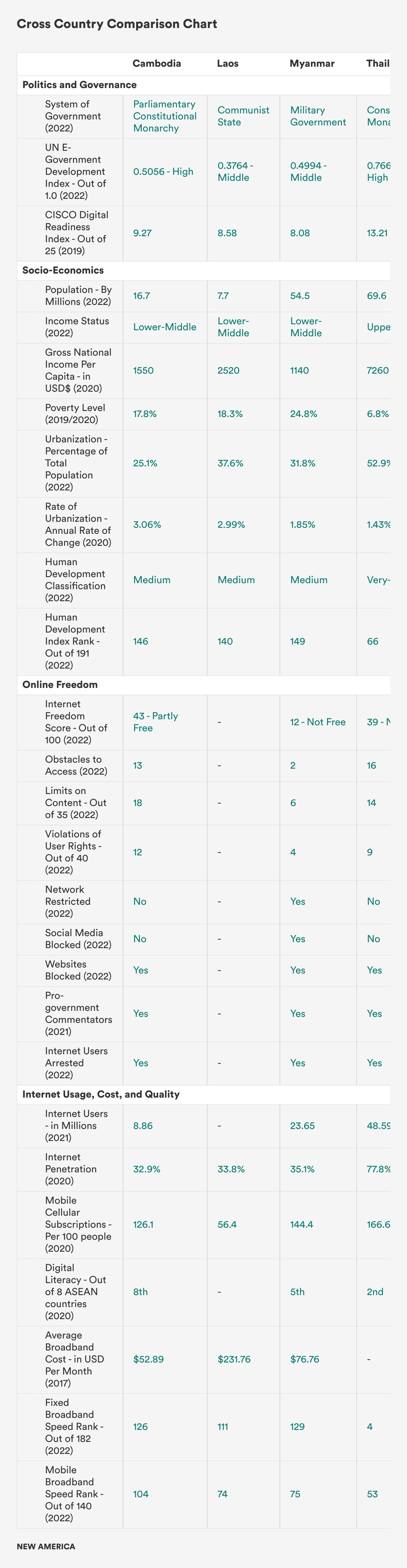
Cambodia | Kingdom of Cambodia
After years of strategic economic and social development, Cambodia is poised to leapfrog to modern digital solutions, particularly in the field of financial technologies. Given the current state of digital development and deployment and the geopolitical interest in the region, priority areas to watch include (1) digital governance measures; (2) sustaining a healthy environment for digital commerce and economy; (3) digital solutions for environmental management and monitoring; and (4) engagement from multistakeholder organizations. However, Cambodia continues to face several barriers to sustainable digital transformation, such as human rights and civil liberties violations that reinforce systemic challenges around trust and security, as well as lagging hard infrastructure development and low digital literacy.
The Cambodian government began tightening its control over the country’s digital transformation with the 2015 Law on Telecommunications that allowed the government plenary authority over information and communications technologies and put the licensure of any entities seeking to conduct telecommunications activities in the country at the discretion of the government. Recent developments have further strengthened government control over the internet. Implementation of the National Internet Gateway (NIG) was postponed due to technical issues and the COVID-19 pandemic the day before it was scheduled to go live in February 2022. The NIG would route all internet traffic—including from abroad—through a government-run portal, as is done in China, with the stated goal of cracking down on internet service providers (ISPs) that facilitate illegal online gambling and underpay government fees. Instituting the NIG would give state regulators the means to “prevent and disconnect all network connections that affect national income, security, social order, morality, culture, traditions, and customs.” However, the system has been met with widespread concerns by human right organizations and internet freedom advocates who state that it would lead to increased censorship, restriction of online freedoms, and crackdowns on activists. There is some cautious optimism about the delay, as civil society believes that the Cambodian government is not ready for the potential ramifications of going that far toward a digital authoritarian approach to systems.
Digital transformation government priorities are landscaped in Cambodia’s Digital Economy and Society Policy Framework 2021–2035. The framework outlines 10 strategies to support whole-of-society digital transformation, including improving digital connectivity and digital payments infrastructure, strengthening digital security infrastructure, developing digital human capital, and promoting collaborations with digital technology companies and startups.
Challenges for Digital Transformation:
- Digital governance in Cambodia remains fragmented and presents serious concerns for human rights, civil liberties, and online freedoms. Two out of three Cambodian users report feeling that the internet is not a safe method of interacting with the government, and three out of four users report that they do not trust e-government services.
- Lagging hard infrastructure development, such as fixed and mobile broadband coverage, limits Cambodia’s ability to develop and deploy digital solutions.
- Low rates of digital literacy in the country limit the impact of digital solutions. According to the Ministry of Post and Telecommunications, only 30 percent of Cambodians have both access to the internet and the basic digital literacy needed to use it, spurring the need for such programs as UNESCO’s National Media, Information, and Digital Literacy Competency Framework.
Four Key Areas to Watch:
- Digital Governance: Cambodia is rapidly adopting technology and looking to further boost innovation, but the current fragmented approach to digital governance has two major impacts: (1) human rights violations, restricted civil liberties and free speech, and other limited online freedoms; and (2) ineffective regulatory frameworks and policies that have left gaps in user security and privacy. Cambodia has a history of strict monitoring of users’ internet activity, leaving users wary of digital and e-government services. Cambodia also lacks comprehensive and effective cybersecurity policies, disincentivizing telecom investments. With greater reliance on e-payment methods, the lack of cybersecurity threatens consumer confidence and greater adoption of digital platform services. However, while digital governance is lacking, Cambodian officials are promoting implementation of electronic Know Your Customer services, particularly in digital finance and other important sectors.
- Digital Commerce and Economy: While rapid growth in the fintech sector has been led by government efforts, large-scale digital transformation is required to foster greater collaboration among the private sector, investors, governments, development actors, civil society, and educational institutions. Cambodia is also seeing great promise in its technology innovation ecosystem. An extensive report by the Asian Development Bank on technology startups in the country demonstrates how the ecosystem has grown from fewer than 50 tech startups in 2013 to around 300 by 2018 and six local venture capital firms, with most in fintech. While not representative of all startups in the country, as of August 2022, StartUp Cambodia, a national entrepreneurship program led by the Ministry of Economy and Finance is working with 105 active startups, and a number of investors, academic institutions, development partners, incubators and accelerators, corporate partners, co-working spaces, and government institutions supporting tech startups. As the digital environment in Cambodia matures, the private sector is expected to continue to grow. Cambodia’s leading commercial banks, ACLEDA and ABA, have reportedly connected more than 1.5 million users to mobile banking options. The growth of financial digital solutions is supported by state-led efforts, such as the National Bank of Cambodia’s Bakong digital currency, a blockchain-enabled, QR-code based, peer-to-peer and peer-to-business digital payment system that enables anyone in the nation to access their account through a smartphone.
- Environmental Management and Monitoring: Given persistent environmental issues and vulnerability to natural disasters, Cambodia has significant opportunity to leverage data-powered digital solutions for environmental management and monitoring. Somleng partnered with the government and an NGO called People in Need to create an interactive voice response-based early warning system that provides lifesaving information to more than 50,000 people in disaster-prone areas during inclement weather, overcoming existing literacy and internet access barriers. In 2020, the U.S. Embassy in Cambodia announced the Mekong Dam Monitor, created in collaboration with the Stimson Center and Eyes on Earth. This system uses open source remote sensing, satellite imagery, and geographic information systems to provide real-time reporting of climate conditions, estimated river flows, and reservoir conditions in an effort to promote better water management.
- Multistakeholder Engagement: Multistakeholder organization engagement can help drive the direction of development toward more open and people-centered solutions. In January 2022, the Cambodia Academy of Digital Technology, in collaboration with UNESCO, launched an Assessment of Internet Development in Cambodia using UNESCO’s Internet Universality Indicators to provide a holistic diagnosis of Cambodia’s internet policies and digital environment. The aim is to promote universal access to information and freedom of expression. The effort includes a Multistakeholder Advisory Board composed of local Cambodian cross-sector experts and representatives from the Ministry of Post and Telecommunications, the Ministry of Information, civil society organizations, media, private sector, regulators, and U.N. agencies. Multistakeholder engagement is essential for people-centric digital transformation.
Laos | Lao People's Democratic Republic
Laos faces several barriers to economic and social development, including significant poverty and high debt, growing inequalities between social groups in the multiethnic region, and limited development and infrastructure. These challenges complicate and stifle digital development and deployment initiatives. Given the current development challenges and limited information available, priority areas to watch include (1) nascent digital innovation ecosystems, (2) “leapfrog” digital development; (3) e-learning and capacity building; and (4) foreign investment and special economic zones.
In recent years, Lao public officials have prioritized a more structured approach to development and infrastructure buildout, with a 2015 revised constitution and a 2017 national strategy. In 2022, along with Cambodia, Thailand, and Vietnam, Laos joined the Regional Comprehensive Economic Partnership, which aims to build the region’s capacity in order to establish and grow its digital ecosystem in line with the Master Plan on ASEAN Connectivity 2025. In 2020, Laos revealed its $6 billion (USD) Vientiane-Boten Expressway project linking Laos and China, and two years later, Lao Telecom, the leading telecom service in Laos, launched its first 5G service as part of the smart motorway network. As Laos seeks to strengthen its physical and digital infrastructure development, simultaneous updates are being made to domestic regulations on the country’s burgeoning digital sectors, such as the 2021 Regulation on e-Commerce. In addition, there is growing focus on data security and privacy concerns as more people gain access to online spaces. Currently, Laos is the only country in the region that does not have policies that enable the government to block and moderate content. How Lao officials decide to approach these concerns will have larger impacts on human rights, civil liberties, and online freedoms.
Challenges for Digital Transformation:
- Laos is considered by the UN to be a least-developed country. While development advancements in Laos have reduced poverty rates in the past 25 years, the country’s reliance on agriculture, the informality of the Lao labor market, lack of access to education, and the impact of the COVID-19 pandemic complicate social and economic development.
- Development efforts are reliant on foreign investment and aid, which bring geopolitical pressures and complicate the country’s ability to power sustainable development and governance initiatives. Improved management of natural resources and enhanced agricultural productivity have been identified as top development priorities, both areas could benefit from innovative approaches.
- Modest economic growth has been accompanied by rising inequality in the country, as poverty remains high among ethnic minority groups and households with less education.
- Limited infrastructure coverage and quality have long been a barrier for development. These challenges also affect internet access and digital solutions deployment.
- Lagging access to online spaces and low digital literacy affect the country’s capacity for digital transformation. Accessibility, quality, and affordability remain large barriers to internet access in the country.
Four Key Areas to Watch:
- Nascent Digital Innovation Ecosystems: UNDP labeled Laos as digitally nascent,1 but it is moving towards digitally emerging. Compared with its neighbors, the country's digital innovation ecosystem is very nascent and is missing key players and components, such as investment, developed markets, and supportive regulation, initiatives, and administration. This limits the ability of startups to innovate, grow, and contribute to improved national outcomes. In addition, Laos lacks the homegrown investment needed to grow its sector, yet at the same time, seeking foreign investment presents challenges. The small population and market potential, as well as low rates of digital and English literacy, are barriers to receiving foreign investment and growing the technology sector. As Laos seeks to expand its digital innovation ecosystem, overcoming these barriers will advance progress on the country’s path to a people-centered digital transformation. Movement toward improved government regulations, requirements, and services should be monitored and assessed for accessibility, inclusion, security, privacy, and human rights impact.
- “Leapfrog” Digital Development: In 2022, Lao Telecom launched its first 5G service as part of the Vientiane-Boten (Laos-China) Expressway, a smart motorway network that strengthens connectivity with China. The steady increase in projects such as the railway marks a turning point for the country’s hard infrastructure development as Lao technology corporations prioritize information and communications technology development in rural areas, including 3G internet connectivity. In addition, international (particularly Chinese and Thai) technology, such as inexpensive computing devices and solar tech, is being brought into the country. Close attention should be paid to the potential of tech leapfrogging in Laos and the flows of foreign funding, such as the World Bank’s Poverty Reduction Fund, that might steer more innovative approaches to reducing inequality in the region. Now that 5G infrastructure has been launched by the state telecommunications service, consideration should be given not just to service costs, but also to how the government uses it to track data and users.
- E-Learning and Capacity Building: The COVID-19 pandemic accelerated the reliance on digital connectivity, amplifying the need for digital education and literacy in Laos. As schools closed in-person instruction, Laos began to lean on its limited digital infrastructure, which was needed but not readily available in rural and remote areas where poor, rural students lacked the digital technology to learn from home. In the 2020 UN Lao PDR Socio-Economic Response Framework to COVID-19, the Laos Ministry of Education put forth commitments to the education ecosystem, such as “the continuity of learning through the implementation of diverse/key learning activities/opportunities aimed at quality learning and the wellbeing of learners, teachers, caregivers/parents, and school committees.” Out of this public commitment, several technologies were launched, such as Khang Panya Lao, a teaching and learning platform for adults and children modeled after UNICEF’s Learning Passport education tool. By May 2022 the platform had approximately 90,000 users. Other e-learning platforms such as the SMART UP e-learning platform were launched to help small and medium-sized enterprises enhance their digital skills. Through these initiatives and others like them, Laos can strengthen access to education for rural and poor communities, basic and digital literacy levels for all ethnic groups, and e-learning opportunities for all age groups.
- Foreign Investment and Special Economic Zones: As Laos continues to develop, it is struggling to overcome its heavy reliance on foreign investment and aid, which drives national priorities and leads to tension in this geopolitically sensitive region. The Boten Special Economic Zone and the Mohan-Boten Economic Cooperation Zone are particular areas of interest for the region. Costing over $11 billion (USD), the Boten Special Economic Zone is the most expensive infrastructure development project in Laos. It has been funded and developed by China since 2003. In coordination with this project, the Boten region is being transformed into an urban and tourism hub, called the “Boten Beautiful Land” Specific Economic Zone. As the relationship between Laos and China deepens, key areas to watch are the types of next-generation technologies Chinese developers will import or develop in its neighboring country, how the developments will influence the future of work for multiethnic populations, and what key governance challenges may arise from such approaches to foreign partnerships and investments.
Myanmar
Myanmar faces the most challenging and uncertain path to progress in the region. With widespread human rights abuses, recent genocide of the Rohingya people, extreme isolation, an increase in misinformation and disinformation online, Myanmar has experienced accelerating political, economic, and social turmoil in recent years. Since the 2021 military coup, there have been internet blackouts and a massive withdrawal of foreign governments, companies, and development projects. Prior to the coup, Myanmar’s digital landscape was very briefly led by the private sector, but is now inextricably tied to military rule. A foundational site for understanding this entanglement is through Myanmar’s 2004 Electronic Transactions Law (amended in 2021). The first iteration of the law was used to “regulate and control phone and internet users with harsh criminal punishments.” Shortly after the military seized control, an amendment was made to the law suspending Section 5 (protection against search, seizure, and arrest without civilian observation), Section 7 (protection against indefinite detention), and Section 8 (provision of a wide-ranging individual privacy rights). Under such circumstances, technological development and regulation have regressed and any development in the sector under military rule poses a threat to human rights, privacy, and security. Keeping this in mind, the four areas to watch are (1) Meta/Facebook’s disproportionate impact on the country; (2) internet shutdowns, government censorship, and the response; (3) regressing digital development; and (4) withdrawal of development agencies and outside support in protest of the coup.
Challenges for Digital Transformation:
- Current regime actions are categorized by human rights violations and abuses, including widespread genocide of the Rohingya people, torture and sexual violence of military detainees, blocked humanitarian aid, censorship and crackdown on dissent, and attacks on civilians.
- Lagging infrastructure and poor quality of electricity, roads, railways, and other basic infrastructure limits Myanmar’s development and economic growth.
- Widespread internet shutdowns, particularly on mobile internet access, as well as restricted internet access, censorship, and online surveillance, have led UN human rights experts to call Myanmar a “digital dictatorship.”
- Foreign governments, development actors, and the private sector halted operations and imposed sanctions on the country after the February 2021 coup. The resulting hostile environment not only isolates Myanmar from the international community but also makes the outlook for social and economic development incredibly bleak.
Four Key Areas to Watch:
- Meta/Facebook’s Disproportionate Impact on the Country: Meta’s Facebook has played an outsized role in the country and is often referred to as “the internet,” due to its popularity (roughly 76 percent of internet users in Myanmar are on Facebook in 2022). A large part of this user base grew out of Facebook’s Free Basics initiative, a program that offered free-of-charge access to other select websites and services, turning Facebook into a landing page in a larger internet hub. However, Meta’s popularity had an outsized impact on the country. In 2017, Facebook was used to promote discrimination and genocide of the Myanmar Rohingya community. Coordinated campaigns by the military on Facebook flamed ethnic violence toward the Rohingya community and led to nearly 7,000 deaths and 700,000 Rohingya fleeing the country. After an independent internal review, Facebook publicly admitted in 2018 that it did not do enough to prevent the platform from being used to incite violence in Myanmar. As a result, a $150 billion (USD) class-action complaint was filed in California by parties in the United States and the United Kingdom on behalf of the Rohingya in December 2021.2 This case remains pending but is being closely watched by human rights and open internet advocates. Facebook’s internal Human Rights Impact Assessment suggested publishing data in order to evaluate the scale of human rights violations in Myanmar. However, when pressed to share data with a trial at the International Court of Justice, Facebook refused. The military blocked Meta’s Facebook and Whatsapp when activists began using it to organize. Post-coup, Facebook banned individual military leaders from the platform, while the military blocked access to Facebook in Myanmar. Access to Facebook is still blocked by some internet service providers in Myanmar, however users can access the platform through virtual private networks (VPNs).3 The role of social media platforms in society has a large impact on many societies, not just Myanmar. There are serious global considerations about the governance of social media platforms, the preservation of digital evidence, and the responsibility of the private sector to take action to prevent atrocities. These considerations do not just apply to Facebook, but to all platforms, especially as alternative platforms gain traction in the country.
- Internet Shutdowns, Government Censorship, and the Response: The military conducts widespread internet shutdowns, restricts internet access, and relies on censorship and online surveillance. While fiber-optic and fixed wireless connectivity has been intermittently restored, much of the restrictions targeting mobile internet remain, so the vast majority of the population still lacks reliable access to the internet. Users have attempted to bypass these restrictions with virtual private networks (VPNs), which have become increasingly popular in the country. However, a newly proposed cyber law would make all VPN usage illegal with the punishment of a steep fine and jail sentence of up to three years. Blocking VPNs removes essential cybersecurity protections and prevents international companies from accessing necessary business information on servers outside of Myanmar. Furthermore, with Facebook effectively blocked, individuals, businesses, and civil rights groups that rely on VPN use to access online platforms have deeply criticized the potential regulation. In March 2022, Norwegian company Telenor completed the sale of 80 percent of Telenor Myanmar to a local, military-linked group. Telenor is one of the world’s largest telecom companies, and the deal received significant pushback from civil society, with expectations that it will further threaten human rights and the relationship between private sector and state-sponsored control and censorship. The military control of the country is also being met with online protests in the form of doxing family members of officers in the military.4
- Regressing Digital Development: Starting in 2014, a slew of investments spurred incredible growth in telecommunications infrastructure deployment and adoption in Myanmar. However, the lack of a strong telecommunications policy framework and increased digital authoritarianism are causing growth in the sector to reverse. Promising accelerator and incubator initiatives such as the Phandeeyar Tech Seed Accelerator, Ooredoo’s Ideabox Myanmar, and One to Watch have been slowed. Wave Money was expected to be Myanmar’s first tech unicorn, with Ant Financial buying a stake in the company for $70 million (USD). After the 2021 military coup, however, the company lost over half of its monthly active users. Not surprisingly, Myanmar ranks lowest among all ASEAN countries in the development of information and communications technology, e-government development, network readiness, and cybersecurity. Prior to the coup, Myanmar’s Ministry of Transport and Communications put forth a new Universal Service Strategy for 2018 to 2022 to extend telecom services and internet access in the country, as well as an e-Governance Master Plan (2021 to 2025) that included plans for census data management, e-payments, cyber crime, income tax management, and the movement of public services online. However, the status of these initiatives is unknown—and there is a high chance they have been shelved.
- Withdrawal of Development Agencies and Outside Support in Protest of the Coup: The government has arrested over 14,000 people and killed over 2,000 since the coup began in 2021. This sparked a wave of development actors pulling investments and canceling projects in the country. Myanmar has an abundance of natural energy resources, particularly natural gas; the country is among the region’s top five exports, generating nearly 7 percent of the country’s GDP in 2019. Natural resource extraction historically attracted foreign investment and created revenue for the military. However, in an effort to influence military action, international companies, including ones that work in natural resources, have faced pressure to halt projects in the country. Voltalia, a renewable power producer, exited the country in March 2021. TotalEnergies ceased production at Yadana gas field in May 2021, and Chevron withdrew from its gas venture in January 2022. Several other companies ended military-owned leases, sold stocks in Myanmar-based companies, and rejected production opportunities. In addition, sanctions and potential sanctions from other countries prevent or inhibit the flow of investment and resources into the country.
Thailand | Kingdom of Thailand
Thailand consistently leads the region in infrastructure accessibility, digital literacy, and digital transformation efforts. As the only upper middle-income-country in the Lower Mekong Region, much of Thailand’s success comes from its private sector and high rates of tech innovation. A nationwide movement toward Industry 4.0 is on the verge of turning the country into an economic force, or a self-described “Asian digital behemoth.” The digital industry is growing quickly, with an estimated value of $1.08 billion (USD), driven by gaming, big data, and animation industries. With the size of this market, Thailand is ready for 5G, e-payments systems, and the rest that Industry 4.0 has to offer. As part of the Thailand 4.0 plan, the government intends to revitalize the easternmost region of Thailand and turn it into the Eastern Economic Corridor, dedicated to increased and improved infrastructure; business, industrial clusters, and innovation hubs; tourism; and the creation of new cities through smart urban planning.
However, Thailand’s tech promise is hindered by legislation and regulation that consistently censors free speech, increases government control and surveillance over the internet, and lacks commitment to strengthening human rights. For example, the 2007 Computer Crime Act (amended in 2017) provides the government with “unlimited powers to restrict online speech, undertake surveillance and warrantless searches of personal information and data, undermine the right to use encryption and anonymity, and force service providers to facilitate government surveillance and censorship.” As Thailand continues to develop its tech sector and usher in a period of digital transformation, areas to watch include (1) digital governance; (2) whole-of-society digital transformation; (3) development of agritech and smart farming; and (4) the country’s innovative environment.
Challenges for Digital Transformation:
- Tensions between efforts in driving economic progress and retaining tight regulator control and censorship can make it difficult for outside countries and businesses to decide if and how to interact with the country.
- Human trafficking is a significant concern in Thailand and other countries in the region. Thailand recently moved from a tier 3 to a tier 2 in the U.S. State Department’s Trafficking in Persons ranking, indicating a slight improvement in the country’s efforts to curb trafficking and forced labor. Tier 3 status prompts the State Department to assess whether economic sanctions are warranted. Sanctions, or even the risk of sanctions, limit Thailand’s ability to attract the foreign direct investment needed to advance its digital sector.
- Thailand’s widespread government surveillance represents major concerns for human rights and freedom of speech. Civil society reports have identified Pegasus surveillance software on Thai civil dissidents’ phones, and in June 2022, the Thai Minister of Digital Economy and Society admitted to the Parliament that the government used spyware to track individuals related to national security cases. He later walked the statement back, but the initial admission raised concerns for civil society and international partners.
- Navigating geopolitical tensions as a rising regional leader is a complicated endeavor with economic consequences. Thailand is simultaneously working to improve their relationship with the United States post-pandemic with the United States-Thailand Communiqué on Strategic Alliance and Partnership, signed in July 2022, which details cooperation on everything from cybersecurity to innovation and education. Thailand is also working on economic, technological, and defense infrastructure deals with China—ranging from buying Huawei 5G technology to negotiating a complex deal for submarines. Thailand is hedging these complications and seeking more partnerships with other middle powers to find a more stable balance in security and economic interests.
Four Key Areas to Watch:
- Digital Governance: In 2022, Thailand received a low Freedom on the Net score by international watchdog Freedom House because of the continued rise in digital authoritarianism in the country. After the military coup in 2014, several reforms sparked increased regulation of online activity. As a result, Thailand’s military cyberwarfare unit, technology crime suppression division, and Ministry of Digital Economy and Society’s “anti-fake news center” monitors and reports activity deemed harmful to the government. Thailand has also worked with Facebook, YouTube, and other social media platforms to remove content critical of government activity. In 2020, over 8,000 closed-circuit TV cameras supposedly equipped with artificial intelligence technology were activated across the country, leading the UN to criticize the government for using biometric data captured by the cameras at checkpoints. This criticism has not slowed efforts. In fact, the government has since installed over 60,000 new closed-circuit TV cameras in Bangkok alone.
On a brighter note, the Thai Personal Data Protection Act, a policy to protect user data, went into effect in June 2022. The PDPA is similar to the European Union’s General Data Protection Regulation, which governs how personal data of individuals in the EU may be processed and transferred. Thailand’s measure was enacted in 2019 but implementation was stalled due to COVID-19 and lack of business readiness. The PDPA outlines several rights for users, including “the right to be informed, access, rectify and update data; restrict and object to processing; and the right to data erasure and portability.” In addition, users must give consent to data-tracking and businesses must ensure adequate cybersecurity to prevent data breaches, otherwise businesses are at risk of fines and jail time for violations. It is still too early to tell if the act will have a net positive or negative impact on the Thai digital ecosystem.
- Whole-of-Society Digital Transformation: In 2018, Thailand released the Thailand 4.0 national strategy, an innovative economic development plan to uplift the country’s economy to avoid falling into the so-called middle-income trap through prioritization of digital transformation, characterized by a move into the Fourth Industrial Revolution—one centered around smart technology, connectivity, and automation. This suite of government-led economic development initiatives is dedicated to enhancing the country’s overall tech competitiveness by funding research and development, directing the private sector toward high-technology, high-value-added industries, and training to support the labor force that will be needed.
The Thailand 4.0 digital transformation is supported in part by the new 5G Ecosystem Innovation Center, an incubator and innovation hub backed by the Thai government’s Digital Economy Promotion Agency and the Chinese tech giant Huawei. Huawei is also a leading member of the Thailand 5G Ecosystem Partnership Alliance, composed of public agencies, private companies, and industry associations that strive to support 5G integration and tech-driven economic growth across the country. In a promising development in smart governance, Thailand is working to harness X-Road, open source software that promises unified and secure data exchange between organizations. X-Road is an open source public good verified by the Digital Public Goods Alliance being used by a handful of early-mover countries to help attain the UN SDGs.5
- Development of Agritech and Smart Farming: There is a great regional need for higher-production agricultural services. As a major agricultural force in Asia, Thailand is strategically positioned to lead in this movement. Even though 30 percent of Thailand’s land is arable and 30 percent of its workforce is in the industry, agriculture provides only 8.63 percent value added to Thailand’s GDP, and COVID-19 posed a significant challenge for most of Thailand’s small farms. The Thai government has recognized these opportunities and is aiming to create the FoodTech Silicon Valley. Transformative goals capitalizing on agritech and smart farming have been incorporated into the Thailand 4.0 model and the Bio-Circular-Green economic model. Thailand’s Board of Investment, a government agency dedicated to promoting foreign investment, has created an incentive system to support innovation throughout the food supply chain. It is offering corporate income tax exemptions for companies taking action in a variety of future-forward ways, through cloud technology; farm management services; smart farming techniques using sensors, drones, and greenhouses; and biotechnology.
- Innovative Environment: Thailand intends to create “a digitized integrated business and social system” by increasing internet access, providing educational opportunities, and assisting digital entrepreneurs. To recruit digital talent, Thailand began offering the SMART Visa in 2018 to investors and entrepreneurs working in such industries as next-generation automotives, digital technologies, smart electronics, automation and robotics, and human resource development in science and technology. By 2021, Thailand has issued over 700 SMART Visas. In addition, Thailand has reformed several other government processes to ease business activity including simplifying paying corporate income taxes by strengthening its online platform and reducing the time-cost of border compliance by developing an online matching system. Thailand’s efforts have increased its ease of doing business score, which measures business-friendly policies and strengthening the potential of its innovative ecosystem. Social entrepreneurship, a rapidly expanding field in Thailand, is on the rise with the help of government backing. In February 2019, Thailand adopted the Social Enterprise Promotion Act, which offers tax breaks and other incentives to ventures seeking to reconcile profit with purpose.
Vietnam | Socialist Republic of Vietnam
Similar to Thailand, Vietnam is technologically advanced for the region, with investments in both soft and hard infrastructure and a government that prioritizes tech development and long-term digital strategy. Vietnam is trying to foster a more welcoming climate for foreign investment by simplifying and streamlining its legal and bureaucratic processes through opening, deregulating, and privatizing its economy to drive growth. A clear indicator on this front is the March 2022 launch of the Vietnam Ministry of Finance’s e-portal for foreign suppliers to comply with the rules for taxation of e-commerce. The e-portal is available in both English and Vietnamese, and allows for the handling of tax registration, declaration, and payment under the e-commerce rules. Vietnam continues to prioritize supply-chain diversification and manufacturing opportunities, positioning the country as a safer alternative to China. Apple, Canon, Samsung, LG, Microsoft, Sony, Nokia, Panasonic, Intel, and other major global corporations have a substantial manufacturing presence in the country. In addition, Vietnam is working to address a number of tech-related development challenges, including workforce capacity issues, insufficient digital literacy, low access to capital, and cybersecurity concerns. Key areas to watch are developments in (1) the governance and security landscape; (2) 5G rollout; (3) advancing digital skills and capacity; and (4) digital financial services.
Vietnam’s government demonstrated their commitment to digital transformation with the 2021 passage of the National Digital Transformation Programme by 2025, the country’s first e-government strategy. The program outlines five target areas to support whole-of-society digital transformation by providing high-quality services, broadening public engagement, improving state agency operations, addressing socio-economic growth, and improving the country’s UN E-Government ranking. These five areas touch a broad array of sectors, with particular focus on government and finance. Changes to government processes include benchmarks such as all national databases being online and connected, with shared data available on a government reporting information system and 80 percent of online public services being accessible through mobile devices. Goals in the finance sector include ensuring that half of consumer banking operations are fully online and that 70 percent of customer transactions can be done through digital channels. The Asian Development Bank commends the strategy for moving in the right direction but notes that it needs an implementing force to ensure that movement will take place. In addition, the World Bank funded Vietnam’s work with e-Governance Academy to develop a plan to advance the e-cabinet and e-consultation processes and eventually move toward the e-service system. This plan entailed how e-cabinet, e-consultation and e-services will fit into a future data exchange platform in Vietnam, similar to X-Road. Furthermore, Vietnam is planning to launch its own version of Silicon Valley in Ho Chi Minh City, setting aside three eastern city districts to create a technology development zone that can attract tech entrepreneurs from across the country and the world. This initiative supports national plans to develop more digital institutions, digital human resources, and digital resources to support whole-of-society digital transformation.
Challenges for Digital Transformation:
- Repression and censorship, particularly on social media, pose threats to free speech and civic spaces as the government continues to hinder online activity. Vietnam is the only Southeast Asian state to publicly acknowledge having a military cyber unit: Force 47, a 10,000-person military unit, that is working to repress online dissent in the country.
- User distrust must be addressed at the foundational levels. Internet users in Vietnam are concerned about scams, government surveillance, and a general lack of protections to ensure a healthy digital ecosystem.
- Vietnam lacks sufficient plans to address critical workforce capacity and digital literacy issues. The high-tech developed in the factories necessitates a highly trained workforce to manage it. A digital transformation in Vietnam should include plans to address potential marginalization or digital divide issues, especially for women and rural communities. Although companies like CoderSchool, a Vietnam-based code training and mentoring platform, help fill the gap, the payment model remains out of reach for many workers who could benefit from upskilling.
- After a years-long delay, Vietnam’s data localization law came into effect in October 2022, mandating that telecommunications, internet or value-added service providers that collect personally identifiable information will need to host the data locally, opening companies up to potential data auditing by the government. The U.S. Chamber of Commerce, the American Chamber of Commerce Hanoi, and the Asia Internet Coalition published a letter to the Vietnamese Prime Minister, stating that the law creates uncertainty and could have a “considerable impact” on investment.
Four Key Areas to Watch:
- Governance and Security Landscape: Vietnam’s Law on Cybersecurity, enacted in 2018, was designed to protect national security and improve safety in cyberspace. Despite these goals, the law came under heavy criticism from Western businesses, which said new data localization requirements and restraints on free speech would hinder Fourth Industrial Revolution ambitions to achieve GDP and job growth in Vietnam, discourage foreign investment, and hurt opportunities for local businesses and small and medium-sized enterprises to flourish. These claims proved true. Meta’s Facebook in particular felt the realities of the cybersecurity law and has come under heightened scrutiny for complying with government censorship requests in Vietnam. The country is one of Facebook’s top 10 markets globally with an estimated 60 million to 70 million active users on the platform. After the cybersecurity law was adopted, the Vietnamese government required Facebook to remove anti-government content within 24 hours of receiving notice from a government official. As a result, the company drastically increased the number of posts it removed in Vietnam, from 834 in early 2020 to more than 2,200 in late 2020. Facebook has chosen to comply with the legislation and regulation stating that “not complying with the government’s demands would be even worse for free speech in Vietnam.” With Facebook’s market in Vietnam being worth about $1 billion (USD), civil society has countered that the company’s compliance is more than just a dedication to free speech.
- 5G Rollout: Upgraded digital systems are key to social digital transformation and unlocking the leapfrog capabilities of technology. Vietnam has shown particular promise in its organizing of a nationwide 5G rollout. The Ministry of Information and Communications has issued permits for telecom businesses to pilot 5G technology in 40 provinces and cities nationwide. In a strategic financing move, Vietnam’s major telecom operators (all state owned)—Viettel, Vinaphone, and Mobifone—have agreed to share 5G infrastructure in an effort to streamline capital investment. The approach will be phased, with 5G coexisting with other networks and connectivity solutions until it becomes the predominant system. Additionally, 5G has the potential to provide quality and reliable internet access to geographical areas that are underserved by the more traditional telecommunications network. This could bring significant social impact through advancements in healthtech and edtech in addition to the economic potential of increasing the country’s capacity for high-tech manufacturing.
- Advancing Digital Skills and Capacity: As Vietnam outlines plans for whole-of-society digital transformation and focuses on growing its entrepreneurial environment to include hosting at least five tech unicorns by 2025 and 10 by 2030, investing in human capacity is key. Projects aimed at both the general population and specific talent development are gaining traction across the country. Training in digital skills must be inclusive and sustainable. Vietnam lags behind global standards when it comes to national policies that address female digital inclusion, specifically internet access; female-focused digital skills training; and education in the STEM fields of science, technology, engineering, and mathematics. Outside organizations are trying to address this gap. Global Digital Library (GDL), for example, is a remote e-learning platform created through a collaboration between UNESCO, Creative Commons, the Norwegian Agency for Development Cooperation (Norad), and Global Book Alliance. GDL has special focus on increasing literacy for girls, especially those who do not have easily accessible schooling, and provides reading resources in multiple languages, especially underserved languages, to improve its reach. In 2021, Google launched “Be Internet Awesome” in Vietnam, an educational project promoting safe and confident use of digital technology for children by teaching the fundamentals of online engagement. The program also trains primary school teachers to be able to teach safety skills to students directly. Another example of a program used to transform the skills of entire communities in Vietnam is the Ignite project (which also runs in Pakistan and Peru) supported by the humanitarian organization CARE and the Mastercard Center for Inclusive Growth. Ignite provides access to financial services and technology, with training on how to build networks and entrepreneurship capacity and skills. The program aims to accelerate the growth of 50,000 businesses and reach nearly 1 million Vietnamese entrepreneurs, of whom at least 70 percent will be women, after three years.
- Digital Financial Services: Vietnam has a promising fintech market, and connecting users with online and mobile banking services is an area of opportunity for the country. The hope is that the competition around services will help with financial inclusion measures. Fintech app MoMo, with a valuation of $2 billion (USD) in December 2021, became Vietnam’s 4th tech unicorn and most widely used e-wallet. MoMo developed a super app that includes payment and financial transaction processing in one self-contained online commerce platform and has attracted over 30 million users in Vietnam. The demand for digital payment solutions, such as mobile payment and QR code payment has pushed e-wallet players like MoMo, VNPay, Moca (on Grab), ViettelPay, and ZaloPay to widen their presence with merchants, both online and offline, to increase user convenience. The government has recognized the potential for fintech services and included the goal of ensuring that 80 percent of its population has access to an e-payment account by 2025 in its National Strategy for Digital Economy and Society Development. A state-owned solution, for example, allows users to pay for their Viettel phone bills and other telecom packages using Viettel Money. Advancement of fintech services may help integrate those who are unbanked or underbanked into the economy.
Citations
- The Laos UNDP Digital Maturity Assessment was published in August 2022, and therefore its findings are not fully incorporated into this report. However, readers are encouraged to explore the UNDP report for a more in-depth view of Laos’s digital development.
- Dan Milmo, “Rohingya sue Facebook for £150bn over Myanmar genocide,” Guardian, December 6, 2021, source.
- Billy Perrigo, “Facebook’s Ban of Myanmar’s Military Will Be a Test of the True Power of Social Media Platforms,” Time Magazine, March 1, 2021, source.
- Clara McMichael, “Myanmar’s Social Punishment,” Slate, April 23, 2021, source.
- Like many open solutions, the available documentation is often not the easiest to discover or written in the language of the government or organization looking for proven or innovative ideas. In a promising sign, “E-Estonia. E-Governance in Practice” was translated into Thai language in 2021 (It’s fourth after English, Russian, and Japanese). The handbook was published with support from Khon Kaen University.
Appendix 2: Catalog of Digital Solutions in the Lower Mekong Region
The Catalog of Digital Solutions in the Lower Mekong Region is a curated list of existing digital solutions to demonstrate how these technologies are deployed to address social, economic, political, and sustainability challenges in Cambodia, Laos, Myanmar, Thailand, and Vietnam. This tool was designed to complement the landscape research in this report.
The discoverability of good tech solutions remains a challenge—particularly solutions and products operating in low- and middle-income countries—even as interest in social entrepreneurship and digital public goods continues to grow. While not an exhaustive list of digital solutions in the region, this catalog should serve as a tool to help public interest technology practitioners identify, replicate, or iterate existing digital solutions to address systemic challenges. Technology included was identified through research, reports, interviews, and the registry of solutions verified by the Digital Public Goods Alliance.
Digital Solutions Measures
Digital solutions included in the catalog were evaluated to determine (where possible):
- Whether or not the digital solution is active
- Which country/region the digital solution operates or previously operated in
- Who operates the digital solution
- Whether the digital solution is open source
- Which of the following sectors the digital solution addresses:
- Agriculture, Civic participation, Communications, Customs information management, E-commerce, Economic and financial inclusion, Education, Environmental monitoring and management, Healthcare, Infrastructure monitoring, Labor, Research
- Function or technology/type the digital solution utilizes:
- App, Artificial Intelligence, Blockchain, Data exchange, Data platform, Digital identity, Digital payments, Web platform
View the Catalog of Digital Solutions in the Lower Mekong Region here.
To provide feedback on the Catalog of Digital Solutions in the Lower Mekong Region, please email DIGI@newamerica.org.
Disclaimer: This catalog is neither an exhaustive list of digital solutions active in the region nor an endorsement of any particular solution by New America’s Digital Impact and Governance Initiative. The featured technologies were chosen to provide insight into the types of active digital solutions in the region and help demonstrate larger regional trends of digital technology development. They were assessed using publicly available information, as thoroughly as possible given the complications of regional and language barriers. This resource was published in November 2022 and is not regularly updated. While some supplemental readings are linked in the catalog, readers of this resource are encouraged to pursue additional due diligence measures.
Additional Readings
For those interested in exploring this topic further, below is a curated list of additional readings below, separated by geographic or thematic focus.
Regional
- Accelerating AgTech: Australia’s Opportunity in Vietnam, Asialink Business and Beanstalk, 2021
- ASEAN Digital Masterplan 2025, Association of Southeast Asian Nations, 2021
- ASEAN Guidelines on Public Service Delivery, Association of Southeast Asian Nations, 2020
- Charting ASEAN's Digital Future: Emerging Policy Challenges, Singapore Institute of International Affairs, June 2022
- Data Connectivity in the Greater Mekong Subregion, Lurong Chen, 2020
- Digital Literacy Levels in ASEAN (Comparative Study on ASEAN Countries), Astrida Fitri Nuryani and Ayu Kusumastuti, October 2019
- Enabling Cross-Border Data Flow: ASEAN and Beyond, United Nations Development Programme, February 2021
- The Future of Work in the Mekong Subregion, Romina Bandura, Daniel F. Runde, and Janina Staguhn | Center for Strategic & International Studies, February 2021
- The Greater Mekong Subregion 2030 and Beyond: Integration, Upgrading, Cities, and Connectivity, Asian Development Bank, March 2021
- The Greater Mekong Subregion Economic Cooperation Program Strategic Framework 2030, Asian Development Bank, September 2021
- Meeting Asia’s Infrastructure Needs, Asian Development Bank, February 2017
- The Potential of Digital Infrastructure Financing: Fintech and Blockchain, Organisation for Economic Co-operation and Development, August 2020
- Remittances as a Driver of Women's Financial Inclusion in the Mekong Region, United Nations Capital Development Fund, June 2017
- South-East Asia: A Hotspot in Great Power Rivalry, Linda Maduz and Simon Stocker | Center for Security Studies ETH Zurich, February 2021
- Southeast Asia Rising From the Pandemic, Asian Development Bank, March 2022
- Study on Connectivity Issues for Enhancing Coordination Among the Mekong-Lancang Countries, Mekong Institute, November 2020
Cambodia
- Benefitting from the Digital Economy: Cambodia Policy Note, World Bank, July 2018
- Cambodia Digital Economy and Society Policy Framework 2021-2035, Royal Government of Cambodia, May 2021
- Cambodia Digital Government Policy 2022-2035, Royal Government of Cambodia, 2022
- Cambodia’s Ecosystem for Technology Startups, Sopheara Ek and Paul Vandenberg | Asian Development Bank, June 2022
- Fostering an Inclusive Digital Transformation in Cambodia, Supporting Economic Transformation, July 2020
- Internet Impact Brief: Cambodia National Internet Gateway, Charles Mok and Adrian Won | Internet Society, February 2022
- On Government Intervention in the Digital Economy of Least-Developed Countries: The Cambodian Experience, Daravuth Rath Sithy | KAS Singapore & Digital Asia Hub, June 2021
- Pathways to Inclusive Digital Transformation, Clare Curran | United Nations Cambodia, March 2021
Laos
- Digital Connectivity in Lao PDR: Lagging Behind Peers, World Bank, February 2019
- Digitalizing Laos: Improving Government Transparency, the Business Environment, and Human Capital, Romina Bandura and Daniel F. Runde | Center for Strategic & International Studies, February 2022
- Lao PDR: Digital Maturity Assessment, UNDP, August 2022
- Lao PDR: Digital Opportunities for a More Competitive Future, World Bank, November 2019
Myanmar
- Myanmar Digital Economy Roadmap, Digital Economy Development Committee, 2019
- Myanmar: Investment Analysis and Implementation Options for Proposed Digital Government Project, World Bank, June 2018
- Myanmar's New Digital Strategy Improves ICT Development and Network Readiness, Oxford Business Group, 2020
Thailand
- Annual Report: Thailand Digital Outlook, Office of the National Digital Economy and Society Commission | Government of Thailand, December 2021
- Thailand Digital Transformation Survey Report 2021: The Impact of COVID-19, Deloitte, June 2021
Vietnam
- The Development of the Digital Economy in Vietnam, Nguyen Thi Vu Ha, December 2020
- Vietnam’s Future Digital Economy: Towards 2030 and 2045, Commonwealth Scientific and Industrial Research Organisation | Australian Government, May 2019
- Viewpoints and Goals of National Digital Transformation Program, Ministry of Information and Communications | Socialist Republic of Vietnam, December 2020
Geopolitics
- Building Blocks for a New U.S. Posture on Digital Development—from Bilateral Response to Multilateral Coordination, Kay McGowan and Priya Vora | Heinrich-Böll-Stiftung, January 2022
- China’s Belt and Road Initiative: Five Years Later, Jonathan Hillman | Center for Strategic & International Studies, January 2018
- China Is Accused of Exporting Authoritarian Technology. But the West Has Done So, too, More Covertly, Ausma Bernot | The Conversation, October 2021
- China’s Digital Silk Road and the Global Digital Order, Richard Ghiasy and Rajeshwari Krishnamurthy | The Diplomat, April 2021
- How China Turned Off the Tap on the Mekong River, Brian Eyler | Stimson Center, April 2020
- Tech Companies Slowly Shift Production Away From China, Tripp Mickle and Daisuke Wakabayashi | New York Times, September 2022
Technology
- 2021 Digital Public Goods Alliance Report, Digital Public Goods Alliance, December 2021
- Beyond Scale: How to make your digital development program sustainable, Digital Impact Alliance, December 2017
- Bridging the Digital Divide, Sulina Kaur, John Low, Damien Dujacquier | Roland Berger, February 2021
- Can Digital Public Goods Deliver More Equitable Futures? | Reimagining Development in Asia and the Pacific Foresight Brief, UNDP Regional Bureau for Asia and the Pacific | United Nations Development Programme, August 2022
- The Case for Digital Public Infrastructure, Ethan Zuckerman | Knight First Amendment Institute, January 2020
- Co-developing Digital Public Infrastructure for an Equitable Recovery, Liv Marte Nordhaug and Kevin O'Neil | Rockefeller Foundation, July 2021
- Fast-Tracking Development: A Building Blocks Approach for Digital Public Goods, Anit Mukherjee and Shankar Maruwada | Center for Global Development, September 2021
- Foundational Digital Infrastructures for Inclusive Digital Economies, Monetary Authority of Singapore, 2021
- Freedom on the Net 2022: Countering an Authoritarian Overhaul of the Internet, Adrian Shahbaz, Allie Funk, and Kian Vesteinsson | Freedom House, October 2022
- Open Source in Government: Creating the Conditions for Success, Emma Gawen, Emily Middleton, Angie Kenny, Anna Hirschfeld, James Stewart | Public Digital, June 2021
More About the Authors

Allison Price

Sarah Forland
Policy Analyst, Open Technology Institute, New America

Summer Boucher-Robinson

Silvana Rodriguez
Research Fellow, Digital Impact and Governance Initiative

Sabrina Abu-Hamdeh

Jermaine Anthony Richards
Research Fellow, Digital Impact and Governance Initiative
Issues
Programs/Projects/Initiatives
Related