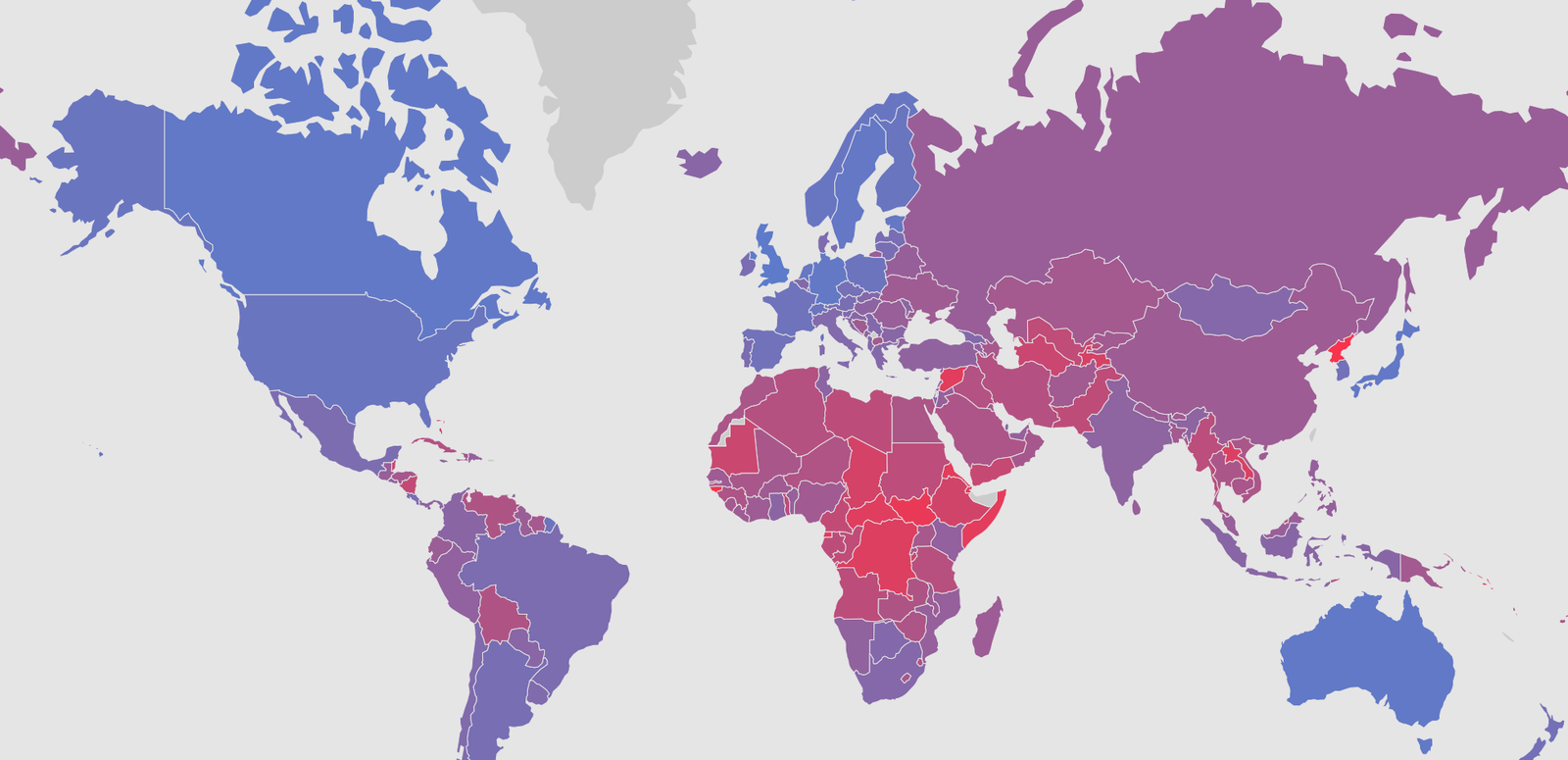
Understanding the Clusters Through Data
This tool is intended to provide policymakers and researchers with a means to analyze the profiles of states around the world in an effort to better understand how and why they may be attracted to either the Sovereign and Controlled or Open and Global poles.
This data tool is meant as a means for diplomats to analyze these Digital Deciders in the pursuit of a better international strategy for cyberspace. The different rankings and data sets in this paper can shed light on things like which countries to prioritize for engagement and how to engage them.
A high overall score indicates that a country is both influential and more likely to favor a Global and Open approach to the internet. This does not mean that countries that score poorly are not worthy of engagement, particularly countries that score poorly on the two values scores and the reliance score. In some ways it does not matter where countries stand on the list, but where the Digital Deciders sit on the scatterplot in relation to the major clusters. Sometimes it is those on the far fringe most worth engaging.
Our overall scoring system is based on five factors:
- Internet Values Score: A score that rates states on the values that drive their internet. A score approaching 1 embodies more liberal and democratic tendencies, like freedom and openness. A score demonstrates 0 embodies more authoritarian tendencies. Those who score highly will have values for governing the internet and information most similar to the Global and Open cluster.
- Political Values Score: A score that rates states on their overarching political values. A score approaching 1 embodies more liberal and democratic tendencies, like freedom and openness. A score demonstrates 0 embodies more authoritarian tendencies. Those who score highly will have political values most similar to the Global and Open cluster.
- International Internet Policy Participation Score: A score that rates states on their involvement in international internet policy processes and debates, to date. A score approaching 1 signals a high level of participation. A score approaching 0 signals a low level of participation.
- International Influence Score: A score that rates states based on how influential they are internationally and regionally on all political and policy issues. A score approaching 1 signals a high degree of influence. A score approaching 0 signals a low level of influence.
- Internet Reliance Score: A score that rates states based on how reliant they are on the internet for commerce, governance, and broader societal interaction. A score approaching 1 indicates a high degree of reliance. A score approaching 0 indicates a low level of reliance.
The default setting for the map and ranking places equal weight on each of these five factors and presents just the Digital Deciders. However, the tool is designed to allow users to both isolate different groupings and place greater or lesser importance on the different factors. Increasing the slider for a factor to 10 does not mean the values in that particular factor are higher, rather that the factor is given greater weight in calculating the ranking.
For a detailed description of the metrics collected, their methodologies, and our methodology for our scoring system, see Appendix I: Methodology and Description of Indicators.