Internet Governance and Today’s Context
Internet governance is the simplest, most direct, and inclusive label for the ongoing set of disputes and deliberations over how the Internet is coordinated, managed, and shaped to reflect policies.1
– Milton Mueller
In April 2014, New America conducted a study on swing states in internet governance.2 Using the informal vote at the World Conference on International Telecommunications as a barometer, we identified two camps—one in favor of a multistakeholder governance model and the other favoring state control over the internet and the baggage that comes with it. In between these two camps was a group of potential swing states. Using a series of qualitative and quantitative metrics, we identified what we believed to be the top 30 most influential swing states in internet governance.
At the time of that publication, the world was still trying to make sense of new internet realities. But a lot has changed since early 2014.
Specifically, three trends have come to the forefront, each of which have impacted the state of internet governance around the globe:
- Shifts in the broader political context and an uptick in the emphasis on sovereignty, on the internet and other aspects of international politics;
- An increase in awareness of online disinformation, the awareness being something of a novelty in Western Europe and the Americas;
- The IANA transition, which transferred administrative oversight of core internet functions out of the U.S. government.
These trends are driven in large part by a series of watershed events between 2014 and 2017. The 2013 leaks of classified material by Edward Snowden resulted in political leaders around the globe gradually comprehending and pushing back against the perception of pervasive surveillance. In 2014, this manifested in calls from many traditionally pro-global internet countries for greater sovereign control over their local internets and the way their data is stored and transmitted.3 In March of the following year, the United States Federal Communications Commission issued the Open Internet Order, a bastion of hope for proponents of maintaining an open, global internet.4 To many in liberal democratic societies, an open and free internet would be instrumental in promoting democratic interests around the world, but the very concept appeared to be under assault domestically.
In mid-2016, yet another watershed moment occurred. The seemingly around-the-clock work of Russian intelligence officers and “patriotic hackers” to distort reality in American politics opened the eyes of policymakers worldwide to the potential harms a fully open and free internet could pose to democracy itself.5 The parallel rise of populism in the United States and elsewhere, coupled with concerns about the collapse of liberal international order, saw many of the traditional open internet sword-bearers retreat into their shells. The U.S. and others began considering methods for blocking disinformation, mirroring the techniques of more closed states for stopping the free flow of information, and populism pushed back against free trade causing agreements that would bolster the free flow of information and data to suffer.6 States like Australia, the United Kingdom, and others have attempted to step in to fill the resultant political leadership vacuum, but only with mixed success.
An open and free internet would be instrumental in promoting democratic interests around the world, but the very concept appeared to be under assault domestically.
Then, in September 2016, as Russian trolls used the internet to sway an American election, the U.S. Department of Commerce completed its nearly two-decade long process of transitioning oversight over the Internet Assigned Names and Numbers Authority (IANA) to the Internet Corporation for Assigned Names and Numbers (ICANN).7 The transition, which was lauded as a victory for multistakeholder internet governance, did transition oversight to a more multistakeholder body than the U.S. government, but it also weakened the U.S. government’s ability to reliably advocate for a multistakeholder model at ICANN.
In the wake of these experiences, even the staunchest proponents of a free, open, interoperable, secure, and resilient internet began to construct domestic governance that emphasizes two concepts—security and resilience—at times to the detriment of freedom, openness, and interoperability. The U.K., for example, is in the process of building their own version of a national firewall capable of sifting out malicious traffic at national borders.8 Rumors persist about others following suit. This is not necessarily a bad thing, but it does carry immense international implications with it.
Domestic and international governance efforts have always run in parallel, regardless of the politics at play. Authoritarians have long sought to use the international system and its institutions as means to legitimize or provide cover for domestic actions. Internet politics are no different from any other politics in this regard. In our 2014 Swing States report, we wrote about two primary “visions for Internet governance”—one a bottom-up, multi-stakeholder model, and the other a top-down model driven primarily by governments. At the time, the battle lines were relatively stark and certainly international. The burning question then revolved around the form “global internet governance” would take. In retrospect, it is the national or domestic governance that truly matters.
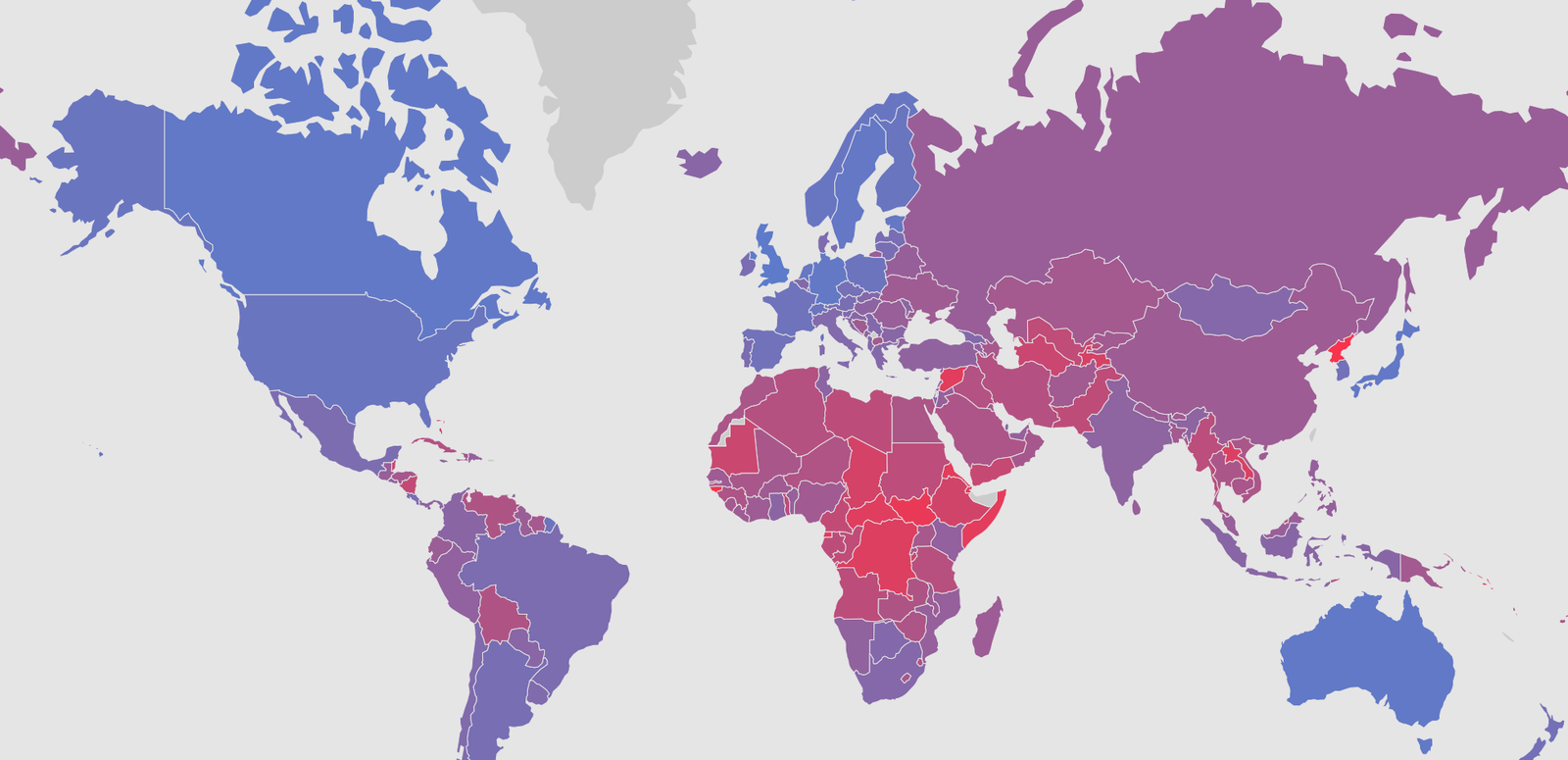
The two visions we described in 2014 still represent the prevailing ideologies for internet governance. What is perhaps different from 2014 is the unit of analysis. Where the focal point of the debate in 2014 was around the “right” way to model and govern the internet globally, the battle today is over how states should model their internets domestically. Rather than resolving, this debate has mutated. Today, some states have built governance structures and internets that increasingly gravitate towards one of two poles—Global and Open, or Sovereign and Controlled—often in alignment with other political interests.9 However, a far larger group of countries—the Digital Deciders—have yet to gravitate towards either end of the spectrum, some undecided and others seeking a third path.
Although corporate and civil society actors influence the trajectory of the global internet, the focus of this report is states. Despite early technoutopianism and technolibertarianism, the sovereignty of states remains reality. Companies and individual developers are not sovereign. States are increasingly setting the context within which these private actors operate. The opportunity for the clusters described in the next section lies in how they use that reality.
The Digital Deciders have yet to gravitate towards either end of the spectrum, some undecided and others seeking a third path.
Citations
- Milton Mueller, Networks and States: The Global Politics of Internet Governance (Cambridge, MA: MIT Press, 2010), 9.
- Tim Maurer and Robert Morgus, Tipping the Scale: An Analysis of Global Swing States in the Internet Governance Debate (Waterloo, Canada: The Centre for International Governance Innovation and the Royal Institute for International Affairs, 2014), source.
- Tim Maurer, Robert Morgus, Isabel Skierka, and Mirko Hohmann, Technological Sovereignty: Missing the Point? (Berlin, Germany: Transatlantic Digital Debates on Security and Freedom in the Digital Age), source.
- Robert McMillan, “The FCC’s Vote To Protect Net Neutrality Is A Huge Win For The Internet,” WIRED, January 26, 2015, source. And The US Federal Communications Commission, Open Internet Order, Adopted: February 26, 2015, source.
- Robert Morgus, “Russia Gains an Upper Hand in the Cyber Norms Debate,” NetPolitics, December 5, 2016, source.
- Credit for these points goes to Adam Segal of the Council on Foreign Relations.
- David G. Post and Danielle Kehl, Controlling Internet Infrastructure: The “IANA Transition” and Why It Matters for the Future of the Internet, Part I, (Washington, DC: New America), source. And National Telecommunications and Information Administration, “Fact Sheet: The IANA Stewardship Transition Explained.” September 14, 2016, source.
- David Bond, “‘Great British firewall’ helps block 54m cyber attacks,” Financial Times, February 4, 2018, source.
- Specifically, we assert that 37 countries have governance structures that favor a free and open internet and 27 have governance structures that emphasize sovereign control and political stability.