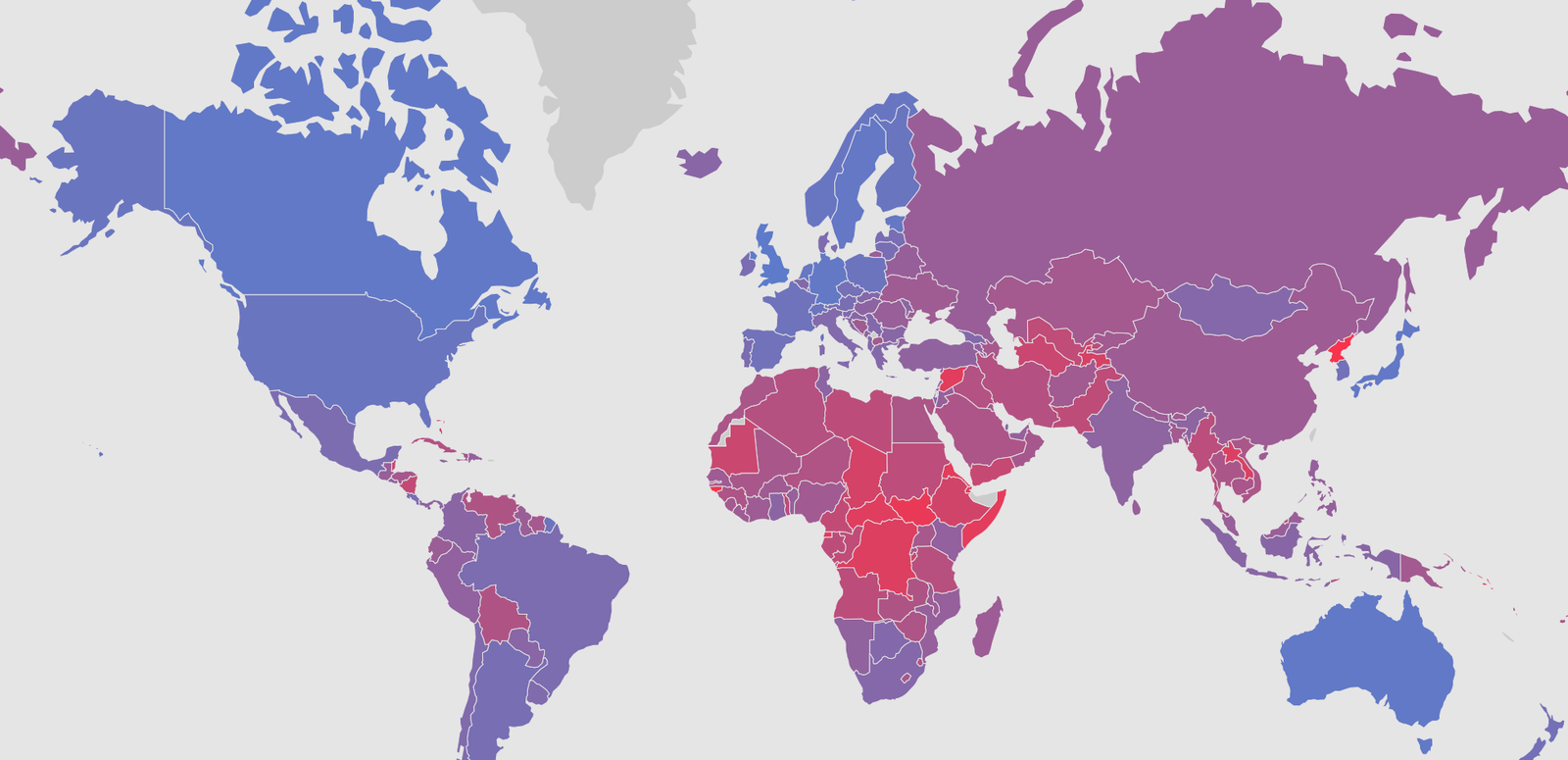
Analyzing the Clusters
Figure 2: How Different Camps Score on Average (out of 1)
| Number of Countries | Liberal Internet Values Average | Liberal Political Values Average | International Internet Policy Participation Average | International Influence Average | Internet Reliance Average | |
|---|---|---|---|---|---|---|
| Global | 193 | .53 | .45 | .60 | .44 | .52 |
| Global minus LDCs and small countries | 114 | .67 | .54 | .74 | .51 | .61 |
| Sovereign and Controlled | 27 | .34 | .26 | .56 | .45 | .52 |
| Global and Open Average | 37 | .88 | .78 | .80 | .69 | .80 |
| The Digital Deciders | 50 | .69 | .51 | .69 | .53 | .51 |
Sovereign and Controlled
Our Sovereign and Controlled camp consists of countries that scored as “Not Free” on the Freedom House Freedom in the World Index and “Authoritarian” in the Economist Intelligence Unit’s Democracy in the World Index. Their internets largely mirror their political systems. For example, every member of the coalition to submit the proposal for a regressive Code of Conduct for Information Security to the United Nations General Assembly sits in the Sovereign and Controlled group.1
In terms of values, both the internet values and the political values largely fall below global averages and the average of the Global and Open group. This does not, however, prevent this group of states from wielding influence on internet issues and more broadly in international settings. Particularly influential actors falling into the Sovereign and Controlled camp include the logical candidates, China and Russia, but also countries like Turkey, Belarus, and Egypt.2
Their model for the internet differs in subtle and not-so-subtle ways from the version idealized by liberal democrats, and this difference appears to have yielded different results regarding the extent to which these countries, on average, are reliant on the internet. Our data suggests that some countries in this group, like the United Arab Emirates, Qatar, Bahrain, Russia, and a few others, are as reliant on the internet for the functioning of their governments, economies, and social systems as the rest of the world. However, on average it appears that the Sovereign and Controlled group has built less reliance on the internet. This could be construed as a positive—lower dependence means less of a shock should the internet become less reliable—but to many the benefits of the internet likely outweigh this prospective risk. Indeed, in purely economic terms, business usage of the internet—which can unlock new efficiencies and markets—is staggeringly low in comparison to the Global and Open cluster.
Figure 3: Sovereign and Controlled
| Country | Aggregate Score |
|---|---|
| Qatar | 0.654 |
| Turkey | 0.614 |
| United Arab Emirates | 0.581 |
| Belarus | 0.574 |
| Russia | 0.563 |
| China | 0.536 |
| Kazakhstan | 0.502 |
| Oman | 0.491 |
| Bahrain | 0.490 |
| Azerbaijan | 0.488 |
| Vietnam | 0.466 |
| Saudi Arabia | 0.455 |
| Egypt | 0.451 |
| Zimbabwe | 0.447 |
| Venezuela | 0.440 |
| Swaziland | 0.434 |
| Cuba | 0.419 |
| Iran | 0.411 |
| Algeria | 0.404 |
| Libya | 0.362 |
| Angola | 0.362 |
| Uzbekistan | 0.343 |
| Cameroon | 0.328 |
| Turkmenistan | 0.291 |
| Tajikistan | 0.222 |
| Syrian Arab Republic | 0.151 |
| Democratic People's Republic of Korea | 0.028 |
Global and Open
Our Global and Open camp consists of countries that largely embody the principles of freedom and openness online. This is perhaps explained by the importance of the internet for the functioning of these countries’ economies, political, and social systems. Nearly every country in this group scores highly on our Internet Reliance score. Nineteen of the top 20 scorers on Internet Reliance come from the Global and Open cluster (see Figure 4). Only 15 of the Digital Deciders or Sovereign and Controlled states scoring higher than Romania, the lowest from the Global and Open group (see Figure 5).
Figure 4: Top 20 Internet Reliant
| Country | Internet Reliance | Digital Decider | Global and Open |
|---|---|---|---|
| Sweden | 0.92 | x | |
| Norway | 0.91 | x | |
| Finland | 0.91 | x | |
| United States | 0.91 | x | |
| Netherlands | 0.90 | x | |
| Denmark | 0.90 | x | |
| Singapore | 0.89 | x | |
| Switzerland | 0.89 | x | |
| Japan | 0.88 | x | |
| United Kingdom | 0.88 | x | |
| Republic of Korea (South Korea) | 0.87 | x | |
| Germany | 0.87 | x | |
| New Zealand | 0.87 | x | |
| Luxembourg | 0.86 | x | |
| Australia | 0.86 | x | |
| Canada | 0.86 | x | |
| Belgium | 0.85 | x | |
| Estonia | 0.84 | x | |
| Austria | 0.84 | x | |
| France | 0.84 | x |
Figure 5: Romania and Internet Reliance
| Country | Internet Reliance | Digital Decider | Sovereign & Controlled |
|---|---|---|---|
| Singapore | 0.89 | x | |
| United Arab Emirates | 0.84 | x | |
| Qatar | 0.81 | x | |
| Bahrain | 0.80 | x | |
| Saudi Arabia | 0.70 | x | |
| Kuwait | 0.70 | x | |
| Russia | 0.70 | x | |
| South Africa | 0.70 | x | |
| Belarus | 0.69 | x | |
| Oman | 0.67 | x | |
| Uruguay | 0.67 | x | |
| Serbia | 0.67 | x | |
| Turkey | 0.66 | x | |
| Azerbaijan | 0.65 | x | |
| Republic of Moldova | 0.65 | x | |
| Romania | 0.64 |
Most states gravitating to the Global and Open of the spectrum appear to share a set of liberal values for the internet. Indeed, 20 of the 30 members of the Freedom Online Coalition, a group of states “committed to work together to support Internet freedom and protect fundamental human rights—free expression, association, assembly, and privacy online—worldwide,” fall in the Global and Open camp.3 Of the remaining 10, nine are in the Digital Deciders and one was disqualified from our analysis due to its small population. Analysis of the majority of these countries’ publicly available international internet strategy documents reinforces the notion of shared internet ideals. In addition, all but two are signatories of the Council of Europe’s Budapest Convention on Cybercrime, further suggesting a shared set of principles for defining and enforcing cybercrime. These internet values are likely derived from a shared set of liberal political values, as each Global and Open country scored higher on our liberal political score than every Sovereign and Controlled state.
Interestingly, while the average score between the Global and Open and Sovereign and Controlled camps is extremely close on two cybersecurity indicators4 intended to depict how well a country is doing on cybersecurity broadly, the Global and Open camp actually scores slightly lower on aggregate. This data point could be interpreted in one of three ways: (1) The Sovereign and Controlled approach does produce better cybersecurity as measured by these metrics, (2) cybersecurity concerns should not be viewed as a legitimate reason for closing one’s internet, as the two camps appear to have very similar cybersecurity scores and the discrepancy could be explained away by confounding variables, or (3) it is not empirical cybersecurity outcomes that drive the desire for more internet closedness, but ill-defined perceptions of cyber insecurity. Each of these interpretations merit greater exploration to elucidate the relationship between different governance and architectural models and national cybersecurity performance.
Figure 6: Global and Open Cluster
| Country | Aggregate Score |
|---|---|
| United Kingdom | 0.97 |
| Canada | 0.94 |
| Australia | 0.94 |
| Germany | 0.93 |
| Japan | 0.93 |
| Sweden | 0.92 |
| Netherlands | 0.90 |
| United States | 0.90 |
| Norway | 0.88 |
| France | 0.87 |
| Finland | 0.87 |
| Switzerland | 0.86 |
| Estonia | 0.86 |
| Spain | 0.83 |
| Poland | 0.82 |
| New Zealand | 0.81 |
| Republic of Korea (South Korea) | 0.79 |
| Austria | 0.77 |
| Ireland | 0.77 |
| Czech Republic | 0.77 |
| Portugal | 0.76 |
| Denmark | 0.75 |
| Italy | 0.75 |
| Latvia | 0.75 |
| Lithuania | 0.75 |
| Luxembourg | 0.75 |
| Belgium | 0.72 |
| Slovenia | 0.72 |
| Greece | 0.71 |
| Chile | 0.71 |
| Cyprus | 0.68 |
| Slovak Republic | 0.68 |
| Israel | 0.66 |
| Croatia | 0.66 |
| Bulgaria | 0.66 |
| Hungary | 0.63 |
| Romania | 0.57 |
The Digital Deciders
The ultimate trajectory of the future internet will depend just as much, if not more, on domestic developments in the Digital Deciders as international negotiations and developments. If we want to bolster our version of the internet—one where the internet is free, open, and global and sovereign internets are an anomaly—we will need to do a better job of building a broad coalition.
In our 2014 report, we sought to identify a top 30 set of swing states, ranked in order of importance. Today, such a ranking—even one backed by empirics—would be highly subjective. Instead, we decided to focus on identifying the Digital Deciders and evaluate these states based on: (1) how well a country’s values align with a given camp, (2) how much influence a country has globally, regionally, and within global cyber policy circles, and (3) the importance of the internet to the country for things like governance, the economy, and society more broadly. Our data tool has default settings, which give equal weight to five different factors and produce a ranking based on that setting, but the tool is designed to allow users to alter these weights. The subjective importance of different members of the Digital Deciders will vary depending on how much weight one puts on each of these categories. Readers can use our tool to assign their own weights to value, influence, and importance categories.
The full list of Digital Deciders is below, along with their evenly weighted aggregate score. The higher the score, the more our data suggests a state is influential and more closely aligned with the Global and Open approach.
Figure 7: 50 Digital Deciders (alphabetical order)
| Country | Aggregate Score |
|---|---|
| Albania | 0.69 |
| Argentina | 0.75 |
| Armenia | 0.60 |
| Bolivia | 0.43 |
| Bosnia and Herzegovina | 0.52 |
| Botswana | 0.69 |
| Brazil | 0.73 |
| Colombia | 0.65 |
| Congo (Republic of) | 0.34 |
| Costa Rica | 0.74 |
| Cote d'Ivoire | 0.54 |
| Dominican Republic | 0.59 |
| Ecuador | 0.55 |
| El Salvador | 0.61 |
| Georgia | 0.69 |
| Ghana | 0.64 |
| Guatemala | 0.57 |
| Honduras | 0.49 |
| India | 0.63 |
| Indonesia | 0.66 |
| Iraq | 0.41 |
| Jamaica | 0.62 |
| Jordan | 0.59 |
| Kenya | 0.60 |
| Kuwait | 0.51 |
| Kyrgyz Republic | 0.52 |
| Lebanon | 0.60 |
| Macedonia | 0.51 |
| Malaysia | 0.57 |
| Mexico | 0.73 |
| Mongolia | 0.68 |
| Morocco | 0.46 |
| Namibia | 0.62 |
| Nicaragua | 0.33 |
| Nigeria | 0.52 |
| Pakistan | 0.35 |
| Panama | 0.64 |
| Papua New Guinea | 0.51 |
| Paraguay | 0.65 |
| Peru | 0.61 |
| Philippines | 0.59 |
| Republic of Moldova | 0.65 |
| Serbia | 0.69 |
| Singapore | 0.74 |
| South Africa | 0.68 |
| Sri Lanka | 0.57 |
| Thailand | 0.46 |
| Tunisia | 0.64 |
| Ukraine | 0.53 |
| Uruguay | 0.71 |
Influence
Figure 8: The Top 20 Digital Deciders Ranked by Influence
| Country | Aggregate Influence Score |
|---|---|
| Brazil | 0.91 |
| Indonesia | 0.90 |
| Mexico | 0.89 |
| India | 0.86 |
| Singapore | 0.84 |
| Botswana | 0.81 |
| Albania | 0.78 |
| Paraguay | 0.77 |
| Serbia | 0.77 |
| Jordan | 0.76 |
| Argentina | 0.75 |
| Colombia | 0.75 |
| Armenia | 0.69 |
| Lebanon | 0.69 |
| Uruguay | 0.67 |
| South Africa | 0.66 |
| Costa Rica | 0.65 |
| Mongolia | 0.63 |
| El Salvador | 0.62 |
| Malaysia | 0.62 |
The Influence Score combines the international internet policy participation score and the international political influence score and is meant to provide insight into which countries may have an outsized impact or influence over international internet policy. As a reference point, .52 is the global average Influence Score and .61 is the average Influence Score for the Digital Deciders. To that end, our data points to several expected regional leaders as potentially crucial—Brazil, India, Indonesia, Mexico, and Singapore. Notably, Botswana and South Africa both score well in Africa, while Serbia and Albania score highly in Europe, each of their scores driven up by their consistent participation in global internet policy processes. The scores of these countries suggest that engaging them on internet governance issues has potential to scale as geographical and cultural neighbors are likely to look to these influential countries for leadership.
Notably, of the Digital Deciders, Nicaragua and Bolivia are the only two countries to score 0 on Internet Policy Participation, having not participated in the WCIT vote or any of the UNGGEs and lacking ICANN GAC membership. This reality sees them score at the bottom with regard to influence in this debate.
Whereas the Influence Score provides insight into which countries may be particularly important to engage, the other scores, Value Scores and Internet Reliance Score, provide insight into how to engage Digital Deciders countries.
Value Alignment
Figure 9: The Top 20 Digital Deciders Ranked by Value Alignment
| Country | Aggregate Values Score |
|---|---|
| Costa Rica | 0.89 |
| Georgia | 0.82 |
| Ghana | 0.82 |
| Argentina | 0.81 |
| Mongolia | 0.78 |
| Uruguay | 0.77 |
| Tunisia | 0.75 |
| Republic of Moldova | 0.73 |
| Botswana | 0.72 |
| Kenya | 0.71 |
| Jamaica | 0.70 |
| Namibia | 0.70 |
| South Africa | 0.70 |
| Mexico | 0.68 |
| Panama | 0.68 |
| Peru | 0.66 |
| Philippines | 0.65 |
| Albania | 0.64 |
| El Salvador | 0.63 |
| Serbia | 0.63 |
The Value Score captures the extent to which a country rates highly on both liberal internet values and liberal political values. The global average Value Score is .49, while the Digital Deciders average Value Score is .60, the Global and Open average is .83, and the Sovereign and Closed average is .30. Of the Digital Deciders, 41 score above the global average on our Value Score, but only one (Costa Rica) scores above the average of the Global and Open group.
What this means is that a values-based approach to engagement with this set of countries on the issue of internet governance and control is likely to bear fruit. In particular, the nine Digital Deciders members of the Freedom Online Coalition (see Figure 7) are highly likely to be receptive to an approach that emphasizes the benefits of a free and open internet, with two possible exceptions of Tunisia and Mexico, both of whom score worse than the rest on current measurements of internet openness and freedom. Of the Digital Deciders that rank highly on the Value Score, Costa Rica, Ghana, and Tunisia have particularly strong civil society presence, which may represent a similar opportunity to work with stakeholders outside of the government.
Figure 10: The Nine Freedom Online Coalition Members of the Digital Deciders
| Country | Aggregate Values Score |
|---|---|
| Costa Rica | 0.89 |
| Georgia | 0.82 |
| Ghana | 0.82 |
| Argentina | 0.81 |
| Mongolia | 0.78 |
| Tunisia | 0.75 |
| Republic of Moldova | 0.73 |
| Kenya | 0.71 |
| Mexico | 0.68 |
Internet Reliance
Figure 11: The Top 20 Digital Deciders Ranked by Internet Reliance
| Country | Internet Reliance Score |
|---|---|
| Singapore | 0.89 |
| Kuwait | 0.70 |
| South Africa | 0.70 |
| Uruguay | 0.67 |
| Serbia | 0.67 |
| Republic of Moldova | 0.65 |
| Argentina | 0.64 |
| Brazil | 0.63 |
| Costa Rica | 0.63 |
| Georgia | 0.63 |
| Malaysia | 0.63 |
| Panama | 0.62 |
| Thailand | 0.61 |
| Mongolia | 0.59 |
| Albania | 0.58 |
| Ukraine | 0.57 |
| Armenia | 0.57 |
| Colombia | 0.57 |
| Bosnia and Herzegovina | 0.57 |
| Lebanon | 0.56 |
The Internet Reliance Score provides an indication of the extent to which a country relies on the internet to function. To measure this, we aggregate six different sub indicators that measure internet penetration,5 social media use,6 the robustness of local internet infrastructure and content,7 the extent to which local businesses use and rely on the internet,8 the use of the internet for the delivery of public services,9 and the country’s international internet bandwidth.10 Like the Value Score, the Internet Reliance Score can indicate not only who to engage in evangelizing the benefits of a more open and equitable internet, but how to engage certain countries.
The starkest point that emerges from an exploration of our data is that Singapore is far ahead of all other Digital Deciders in terms of internet reliance. Indeed, Singapore scores the highest in the Digital Deciders on each of our sub indicators and nearly 20 points higher on the aggregated score than the second highest scoring country, Kuwait.
Of the Digital Deciders, Singapore, Malaysia, Indonesia, and South Africa are the only countries to score higher than the global average on business usage, suggesting that an appeal to industry and the current benefits of the global internet may be inefficient with the majority of the Digital Deciders. However, an appeal to untapped potential as they look around the world and see far more connected businesses among peers and competitors may prove productive. A study empirically drawing the correlation between increased business usage of the internet and economic growth would aid such an endeavor.
While the Digital Deciders appear to lag behind the rest of the world with regard to business usage of the internet, their populations’ reliance on social media and virtual social networks appears to be roughly on par with the rest of the world.
Citations
- United Nations General Assembly, Letter Dated 9 January 2015 from the Permanent Representatives of China, Kazakhstan, Kyrgyzstan, the Russian Federation, Tajikistan and Uzbekistan to the United Nations addressed to the Secretary-General, 69th Session, Agenda item 91, January 13, 2015, Available at: source
- It’s worth noting that Qatar also scores well in the influence categories, but this is likely no longer the case today due to tensions in the Persian Gulf.
- Freedom Online Coalition, ”About Us,” Freedom Online Coalition, source.
- The ITU’s Global Cyber Index and Cyber Green’s Risk Exposure Score. See:The International Telecommunications Union, Global Cybersecurity Index (GCI) 2017, (Geneva, CH: The International Telecommunications Union, 2017) source. And CyberGreen, “DDOS,” CyberGreen, source.
- internet live stats, “Internet Users by Country (2016),” internet live stats, July 2, 2016, source.
- World Economic Forum, “Indicator 6.07: Use of Virtual Social Networks,” Networked Readiness Index 2016 (2016), source.
- World Economic Forum, “3rd Pillar – Infrastructure and Digital Content,” Networked Readiness Index 2016 (2016), source.
- World Economic Forum, “7th Pillar – Business Usage,” Networked Readiness Index 2016 (2016), source.
- United Nations, “E-Government Development Index,” United Nations Department of Economic and Social Affairs, source.
- World Bank, “Int’l Internet bandwidth, kb/s per user,” World Bank, source.