
Privacy
The disinformation problem is powered by the ubiquitous collection and use of sensitive personal data online. Data feeds the machine learning algorithms that create sophisticated behavioral profiles on the individual, predict consumer and political preferences, and segment the body politic into like-minded audiences. These analytics are then accessed by or sold to advertisers that target tailored political messaging at those audience segments—also known as filter bubbles—in ways used to trigger an emotional response and which drive polarization, social division, and a separation from facts and reason. Under current U.S. rules and regulations, anything goes in this arena. The starting point to contain this problem is to pop the filter bubbles. This can be done by increasing user privacy and individual control over data in ways that blunt the precision of audience segmentation and targeted communications. Current privacy law is insufficient to the task. To build a new regime, we can start by taking lessons from Obama-era legislative proposals, recent progress in the California legislature, and Europe’s current regulatory framework for data protection.
The connection between privacy and the problem of disinformation in our digital information system sits at the core of the business of the digital platforms. The platforms are designed to extract as much personal information as possible from users in order to optimize the curation of organic content and the targeting of ads. The less privacy a user has from the platform, the more precisely the algorithms can target content. If that content is malignant, manipulative or merely optimized to confirm pre-existing biases, the effect (however unintended) is one that distances consumers from facts and fragments audiences into political echo chambers by feeding them more and more of the content that the algorithm predicts they prefer based on the data.
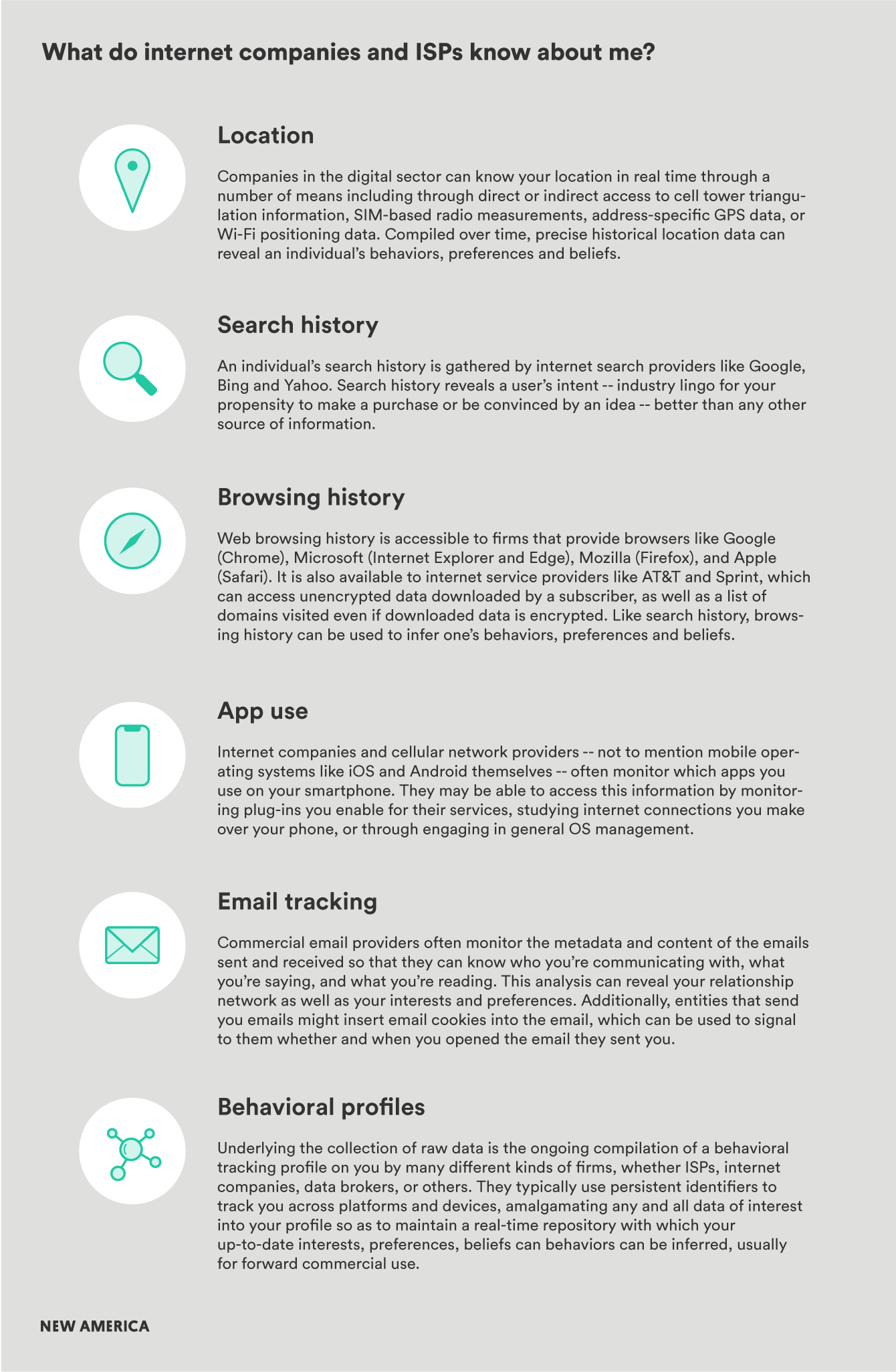
How does this work? The tracking-and-targeting data economy is based on two interrelated commodities—individual data and aggregated human attention. Companies offer popular, well-engineered products at a monetary price of zero. They log user-generated data, track user behavior on the site, mine the relationships and interactions among users, gather data on what their users do across the internet and physical world, and finally, combine it all to generate and maintain individual behavioral profiles. Each user is typically assigned a persistent identifier that allows all data collected across multiple channels, devices, and time periods to be recorded into an ever more sophisticated dossier.
Companies use these data profiles as training data for algorithms that do two things: curate content for that user that is customized to hold their attention on the platform, and sell access to profiling analytics that enable advertisers to target specific messages tailored precisely for segmented user audiences that are likeliest to engage. These curation and targeting algorithms feed on one another to grow ever smarter over time—particularly with the forward integration of advanced algorithmic technologies, including AI. The most successful of the platform companies are natural monopolies in this space; the more data they collect, the more effective their services, the more money they make, the more customers they acquire, and the more difficult it is for competitors to emerge.
The starting point to contain this problem is to pop the filter bubbles.
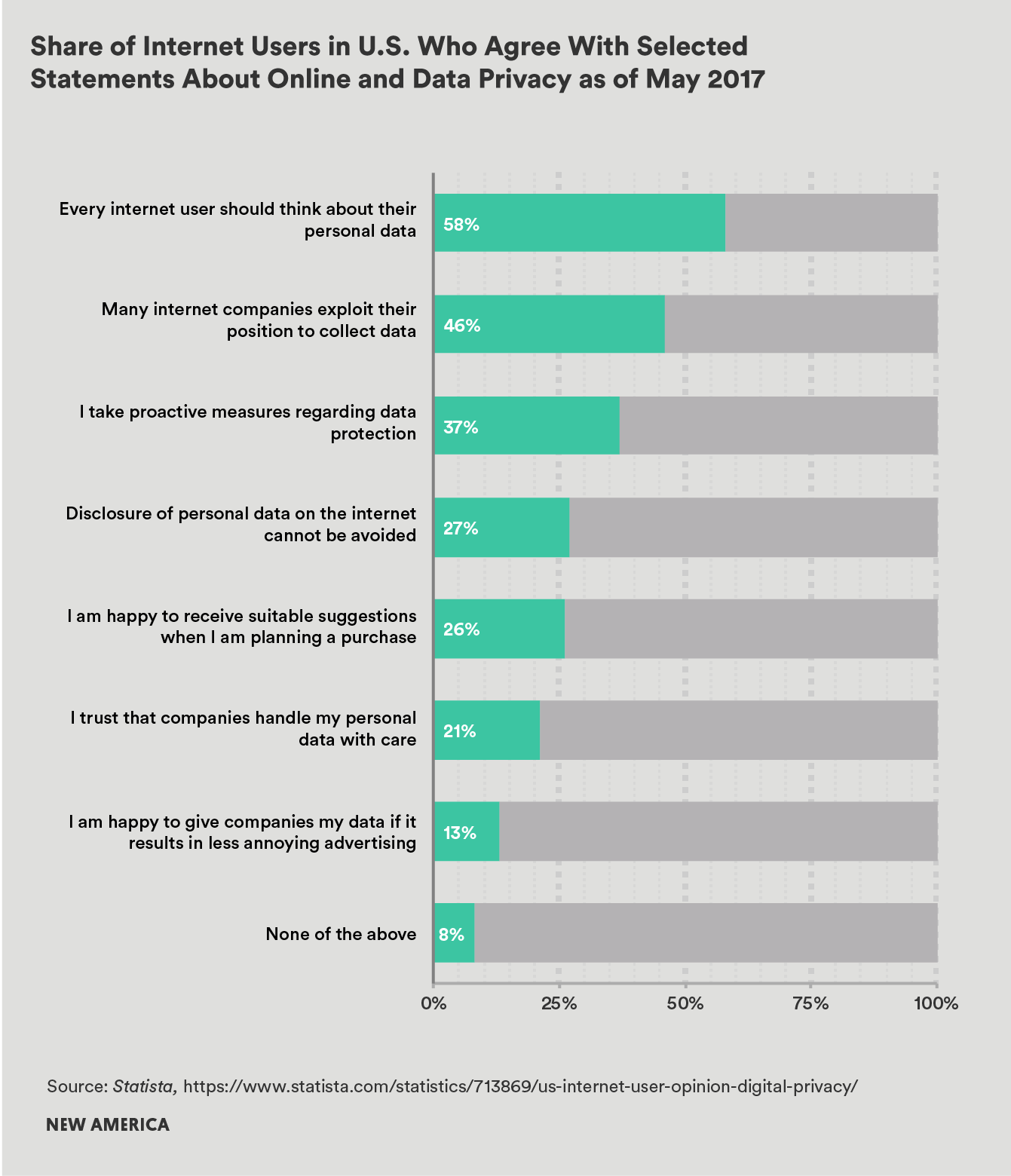
Meanwhile, most users have very little visibility into or understanding of the nature of the data-for-service transactional quality of the consumer internet, or for the breathtaking scope of the tracking-and-targeting economy. A 2015 Pew survey reported that 47 percent of Americans polled said they were not confident they understood how their data might be used, and that “many of these people felt confused, discouraged or impatient when trying to make decisions about sharing their personal information with companies.”1 And even if they do become aware of the asymmetry of information between buyers and sellers, once the market power plateau is reached with an essential service (such as internet search or social networking), there is little in the way of meaningful consumer choice to provide any competitive pressure.
Perhaps this lack of awareness is responsible for the persistent lack of public demand for meaningful privacy regulation in the United States. Anecdotal accounts suggest that many consumers seem not to care about protecting their privacy. At the same time, though, we know from the fallout of the Cambridge Analytica incident and prior academic studies that consumers do in fact place some value on the privacy of their information.2 Perhaps the lesson to draw from this is that people typically don’t care about their privacy until and unless they have experienced a harm from the unauthorized access or use of their personal information. Or, more simply, they care, but they are resigned to the fact that they have no real control over how their data is used if they want to continue to have essential services. This explains the fact that, even in the aftermath of the Cambridge Analytica incident, the #DeleteFacebook movement has apparently proved inconsequential.3
It is not only Facebook, Google, Twitter, and other internet companies that engage or plan to engage in tracking and targeting practices. So do the owners of physical networks—known as broadband internet access service (BIAS) providers. BIAS providers, situated as the consumer’s route to the internet as they are, necessarily gain access to a universe of sensitive personal data including any internet domains and unencrypted URLs the consumer may have visited—which can readily be used to infer the consumer’s interests and preferences.4 These firms, the wireline leaders among them in United States being AT&T, Comcast, and Verizon, enjoy tremendous market power in the regions in which they operate. Meanwhile, they are increasingly investing in the digital advertising ecosystem because they see synergies between their data collection practices and the core resources needed to succeed in digital advertising.
People typically don’t care about their privacy until and unless they have experienced a harm from the unauthorized access or use of their personal information.
Comcast, for example, owns subsidiaries Freewheel, an industry-standard video ad management platform, and Comcast Spotlight, which enables advertising clients to place targeted digital advertisements. Meanwhile, Verizon owns Oath, which may possess the most sophisticated full-service digital advertising technology stack outside of Google and Facebook. Each also owns significant consumer media properties—for instance, NBC, Telemundo, and Universal Pictures; and AOL, Yahoo!, and HuffPost respectively. And of course, both Verizon and Comcast serve as BIAS providers as well, possessing regional market power in providing internet service throughout the United States.
This is a dangerous vertical integration; it allows these corporations to provide consumers internet service, maintain large stores of consumer data in-house, generate behavioral profiles on consumers using that data, provide them with digital content over their television networks and internet media properties, and target ads at them over those digital platforms. And because these firms are not compelled to reveal their management practices concerning consumer data, it is difficult for the public to know if and how they use broadband subscribers’ web browsing and activity data in the advertising ecosystem. But under current FCC regulations, there alarmingly are few restrictions if any against its use. To resolve this glaring problem, the Obama FCC promulgated rules that would have established data privacy regulations on BIAS providers for the first time—recognizing the potential harms of a network operator leveraging total access to internet communications in and out of a household in order to collect and monetize data. Unfortunately, Congress nullified these rules soon after Trump took office, leaving consumers with no protection against potential abuses.5
The tracking-and-targeting regime pursued by these industries results in a persistent commercial tension that pits the profits of an oligopoly of network owners and internet companies against the privacy interests of the individual. Without the oversight of regulators, the consumer has no chance in this contest. The appropriate policy response to contain and redress the negative externalities of the data tracking-and-targeting business must begin with an earnest treatment of privacy policy. But the U.S. government currently possesses no clear way of placing checks on the business practices relating to personal data. While narrow, sectoral laws exist for particular practices—among them, the Children’s Online Privacy Protection Act (COPPA), the Electronic Communications Privacy Act (ECPA), the Gramm-Leach-Bliley Act (GLBA), and the Health Information Portability and Accountability Act (HIPAA)—none of these independently or collectively address the harms (including political disinformation) wrought by the internet’s core tracking-and-targeting economy.
Without the oversight of regulators, the consumer has no chance.
Internet companies and broadband network operators exist under a regulatory regime that is largely overseen at the national level by the Federal Trade Commission (FTC). Industry commitments to consumers are enforced principally through Section 5 of the Federal Trade Commission Act of 1914, which prohibits “unfair or deceptive acts or practices.”6 This regime allows the FTC to hold companies accountable to voluntary policy commitments—including privacy policies, terms of service and public statements—that they make to their users. So if a firm chooses to be silent about certain practices, or proactively says in fine text that it reserves the right to sell all of the subject’s data to the highest bidder, then it has, in effect, made it extraordinarily difficult for the FTC to bring an enforcement action against it for those practices since it could be argued that the firm has not deceived the consumer.7
The additional fact that the FTC largely lacks the ability to promulgate new regulations from fundamental principles—known as “rulemaking authority”—suggests that consumers face a losing battle against industry practices.
The FTC is only empowered to punish firms for past abuses under Section 5, including failures to comply with voluntary commitments—producing a light-touch regime that cannot proactively protect consumers. The outcome is that the industries that fall under its jurisdiction—including internet firms and the broader digital advertising ecosystem—are for the most part responsible for policing themselves.
The resulting self-regulatory mode of regulation established by the internet and digital advertising industries companies in consultation with other stakeholders is relatively favorable to the industry—providing it the leverage to negotiate policies on its own terms. Industry experts can essentially define the terms of frameworks like the Network Advertising Initiative’s Self-Regulatory Code of Conduct, and while stakeholders including government and consumer advocates can attempt to influence the terms of such codes, there is nothing compelling the industry to listen.8 This is in part why we now have a digital ecosystem in which personal data is largely out of the person’s control and rather in the corporation’s. This is not to say that the FTC staff and commissioners do not act earnestly, but rather that the agency as a whole requires far greater resources and authority to effectively protect consumers of the firms for which the FTC is the principal regulator, including internet-based services.
Industries that fall under the FTC's jurisdiction are for the most part responsible for policing themselves.
It is worth noting that on occasion, an FTC with political will can find ways to corner companies that have made major missteps that deviate from the privacy guarantees made to consumers in the terms of service. The FTC intervenes to discipline companies by compelling them to agree to broad public-interest settlements called consent orders. Facebook, Snapchat, and Google have all entered such arrangements with the agency. These consent orders typically require that the firm follow certain stipulated practices to the letter, and keep agency staff informed of their compliance with those requirements.
Notably, though, the FTC lacks the resources to hold the companies that are under consent orders accountable, or to develop consent orders with all bad actors. For instance, in the case of Facebook, which was compelled by a 2011 FTC consent order to have its privacy practices externally audited by PricewaterhouseCoopers, the auditors missed for years the fact that those with access to Facebook’s developer platform could siphon social graph data from an entire friend network just by persuading a single user to agree to the terms of the application.9 PricewaterhouseCoopers found nothing wrong, even in its 2017 report, despite the December 2015 reports about the connections between Cambridge Analytica and Sen. Ted Cruz.
The current system is broken. What we need now is a completely new legal framework that establishes a baseline privacy law.
The Legacy of the Obama Administration’s Efforts
As we consider how to structure an American baseline privacy law to treat problems like filter-bubble-driven political disinformation, policymakers need not start from zero. There have been several attempts to legislate baseline commercial privacy in the past, the most comprehensive of which was the “Consumer Privacy Bill of Rights” discussion draft published by the Obama administration in early 2015.10
Throughout President Barack Obama’s first term, the technology industry made exciting predictions about the potential of applying sophisticated algorithms to the processing of big data to generate new economic growth. Vast sums of investment capital poured into the markets to develop new tools and create new firms. Very little industry attention was paid to the privacy implications of this data gold rush. The Obama administration accordingly predicted that the industry’s trend toward more expansive data collection meant that a baseline privacy law—legislation that could apply across industries and to most kinds of personal data collected by companies—was necessary to protect consumer privacy in the future.
What we need now is a completely new legal framework that establishes a baseline privacy law.
In 2015, the Obama White House and U.S. Department of Commerce jointly developed and released a legislative proposal that put forth a comprehensive approach to regulating privacy called the Consumer Privacy Bill of Rights Act of 2015. It was informed by more than two years of market research and policy analysis, and amplified by the public outcry over data privacy that accompanied the Snowden revelations in 2013. The wide-ranging proposal attempted to encapsulate the key lessons—including from a corresponding 2012 report titled the Consumer Privacy Bill of Rights, as well as policy efforts that came before like the Clinton administration’s Electronic Privacy Bill of Rights and various European approaches—into a legislative draft that the U.S. Congress could take forward.11
The hope was that Congress could work atop the legislative language shared by the White House and send revised language back to the President’s desk. But the draft got very little traction. With the proposal opposed by industry as too regulatory and by privacy advocates as too permissive, Congress never attempted to legislate.
Looking back now, it appears the Consumer Privacy Bill of Rights Act of 2015 was ahead of its time. We begin our analysis by revisiting these ideas in light of today’s market context and newfound political will.
Control
The clear and persistent public harms resulting from the tracking and targeting data economy make quite clear that consumers have lost meaningful control over how their data is collected, shared, sold, and used. Therefore, the starting point for new digital privacy regulations must be the ability for consumers to control how data collected by service providers is used, shared and sold. The ideas expressed in the proposed Consumer Privacy Bill of Rights Act represent a good starting point for deliberation in the way forward.
First and foremost is the proposed bill’s definition of personal data. It sets the boundaries for what kinds of information pertaining to the individual is protected under the bill. The discussion draft takes a broad approach and includes the individual’s name, contact information, and unique persistent identifiers, but also “any data that are collected, created, processed, used, disclosed, stored, or otherwise maintained and linked, or as a practical matter linkable by the covered entity, to any of the foregoing.”
Atop this framework, the draft proposes commanding and expansive rights for the consumer. Data collectors “shall provide individuals with reasonable means to control the processing of personal data about them in proportion to the privacy risk to the individual and consistent with context.” Additionally, consumers would be afforded the capacity for easy access to control their data in ways that the data collector would have to to clearly explain. Consumers would also have the right to withdraw consent at any time. These elements should be part of future legislative and regulatory frameworks.
With these elements in place—a broad definition of personal data, and an affordance of consumer control over what data is collected and how it is used to a degree adjusted for various commercial contexts—the effectiveness of online disinformation operations could be substantially reduced. This is because these new protections would immediately blunt the precision of targeting algorithms as service providers would be permitted to store and apply only the information that the individual elects can be used. It would also begin to put limits on the now ubiquitous data gathering practices in the industry that too often result in non-purpose specific collection and data leakage to ill-intended actors.
Trust and transparency in data use
The tracking-and-targeting data economy has gone off the rails in large part because it operates out of sight of the consumer. No Facebook user would have knowingly consented to have their data shipped to Cambridge Analytica or to sell access to their profile to target ads sent by foreign agents to disrupt elections. Because the problem of distortion in our political culture is exacerbated by the scale of data collection that shape filter bubbles in digital media, the damage can be limited by instituting the requirement that data be used only for transparent and agreed-upon purposes as specified with the individual. There is no reason to deny the individual consumer full knowledge of why and how data is collected, particularly when it can so readily be used to abet the goals of nefarious actors. But the problem remains that they are simply unaware of how their data is used, and there is little they can do about that.
The Consumer Privacy Bill of Rights attempted to solve for exactly this predicament by requiring that companies be transparent with users about what kinds of data they collect and how they use it. This was accomplished in the legislative draft through clever implementation of two core concepts that have long been central to protective privacy policymaking: purpose specification and use limitation.
Purpose specification—the general concept that before an individual’s data is collected, the data-collecting entity (say, a BIAS provider)—should inform the individual (in this case, a subscriber to broadband services) of what data is collected and why it is collected. For instance, a BIAS provider needs to maintain data on the subscriber’s identity and internet protocol (IP) address; the provider also needs to receive and transmit the subscriber’s input signals as well as the information routed back to the subscriber after server calls—in other words, the subscriber’s broadband activity data. This information is needed by the BIAS provider so that it can serve the subscriber with broadband internet services. A BIAS provider that properly engages in purpose specification will note to the subscriber the data streams it will collect to provide broadband services; commit to the subscriber not to use the data for any other purpose; and enforce that policy with rigor, or risk facing regulatory enforcement should it fail to do so.
There is no reason to deny the individual consumer full knowledge of why and how data is collected.
Use limitation, meanwhile, is the idea that data collected on the individual will not be utilized by the data-collecting entity outside the realm of reasonability. Extrapolating the example of the BIAS provider, it is more than reasonable to expect that they will need to take the user’s input data (say, the subscriber’s navigation to the URL “www.reddit.com”) in order to feed the subscriber that data over the broadband connection. But perhaps less reasonable, at least considering the average subscriber’s expectations, would be the forward use of that sensitive broadband activity data—including URLs visited and time spent exploring different domains—to infer the subscriber’s behavioral patterns and consumer preferences to inform digital ad-targeting. This is the sentiment captured in the principle of use limitation: that the data-collecting entity will refrain from using the subject’s data for any reason outside of providing that subject with a technically functional service offered to the degree and level of service expected by the user. Stated differently, a policy regime that upholds use limitation as a priority should use the minimum amount of personal data required to uphold the technical functionality of its service.
These two principles—purpose specification and use limitation—are regularly overlooked by the leading internet firms. This negligence has eroded the public’s trust over time. Restoring them to the core of a new set of consumer privacy rights will limit many of the harms we see today at the intersection of data privacy and disinformation. For example, applied effectively, these rights would restrict the practices of invisible audience segmentation and content-routing that are exploited by disinformation operators. These rules would apply not only to the internet companies; but also to the data broker industry, which exists primarily to hoover up data from such sources as credit agencies, carmakers and brick-and-mortar retailers in order to apply that data for purposes unrelated to those for which it was given.
Drawing Lessons from the European Approach
The European Union, over the past several years, has developed its General Data Protection Regulation (GDPR), a broad set of new laws that applies restrictions to the general collection and use of personal data in commercial contexts. The much-anticipated regulatory framework went into effect on May 25, 2018. The regulation, which is technically enforced by the data protection authorities in each of the 28 member states of the European Union, includes novel and stringent limitations that will likely force significant changes to the operations of the major internet firms that serve European consumers. Many of its provisions mark important building blocks for any future American privacy law. Indeed, many were transposed into the newly passed data privacy law in California, which will go into effect in 2020.12 Further, the principles of purpose specification and use limitation encapsulated in the Consumer Privacy Bill of Rights come to life vividly in the GDPR.
While the present industry landscape has encouraged an information asymmetry, the GDPR will offer consumers more power in the face of powerful internet companies. Among the GDPR’s constraints are the following.
- Consent and control: The GDPR requires that consent to data collection and use must be “freely given, specific, informed and unambiguous.” Further, the subject’s consent must be collected for each type of processing of the subject’s data, and consent can be withdrawn at any time in a manner easily available to and understandable by the subject. The GDPR explicitly requires meaningful consent by regulating against the opposite, as well; it bans opt-out data-collection consent frameworks in forbidding the use of silent or passive regimes that have so often been used by internet companies to collect consent in the past, particularly for web cookies.
- Individual rights: The GDPR stipulates that data collectors offer a number of unassailable rights to data subjects. One is the general requirement that data collectors communicate their practices and the individual’s options “in a concise, transparent, intelligible and easily accessible form, using clear and plain language.” Moving forward, such requirements will be vital in providing consumers with the in-context information needed to make thoughtful decisions about their personal data. Equally important is the right to erasure of personal data held by a data controller and to the portability of personal data, shareable with the individual in machine-readable format. This latter provision, which we will touch on further in the following section on competition policy, is critical in the balance of power between individuals and corporates. In addition, data subjects are afforded the rights to access their data, rectify erroneous information about them, restrict the processing of their data, and object to the collection and processing of their data.
- Protections from automated processing: Perhaps the GDPR’s most novel set of restrictions are those it institutes in regard to the automated processing and profiling of individuals. The core problem that the GDPR attempts to address is that companies—especially internet companies—analyze personal data to draw out certain inferences about us without our knowledge. It is not raw data that allows internet companies to most effectively curate ads and content; it is the inferences that these companies are able to make about us—about our personalities, interests, behaviors, character traits, and beliefs. But we know very little about this kind of secret processing. The GDPR, for the first time, institutes hard checks against this sort of practice, first by giving the individual the right to object to “profiling to the extent it is related to direct marketing.” Alongside this, the GDPR gives individuals the ability to request that firms cease the processing of their data and avoid making non-transparent decisions about them that have been powered by profiling. Finally, the regulation also establishes an important protection from algorithmic bias by disallowing firms from making discriminatory decisions “against natural persons on the basis of racial or ethnic origin, political opinion, religion or beliefs, trade union membership, genetic or health status, or sexual orientation.” This set of new protections in the face of the industry’s use of opaque algorithms is a critical step in the right direction.
- Explicit regulations on sensitive personal data: Regulations instituted by the GDPR include requirements that firms obtain explicit consent for the collection of especially sensitive data, including data that reveals “racial or ethnic origin, political opinions, religious or philosophical beliefs,” as well as the stipulation that enforcement operators can block the collection of certain forms of personal data even if the individual consents to its collection. This provision is a critical bulwark for consumer privacy to guard against disinformation because this is the kind of data that enables the sort of audience segmentation that catalyzes filter bubbles and the distortion of the public sphere. The GDPR’s restrictions over sensitive data could afford individuals substantially more protection from malicious uses of their data.
- Strong enforcement: A stunning feature of the GDPR is its establishment of harsh penalties for firms that violate the regulations. Enforcement authorities can levy fines of up to either 20 million Euros or 4 percent of global turnover. These are penalties that will force the industry into productive negotiations with both Brussels and the 28-nation enforcement authorities.
This menu of regulatory powers afforded to the European regulatory community is the start to establishing a strong privacy regime that will offer European citizens far greater power in the face of the industry than they historically have had. But how effective the regime instituted by GDPR will be determined in large part by the nature of enforcement. An important consideration for national policymakers in the United States will be whether we can accept a bifurcated regime of data regulation that affords certain classes of individuals—Europeans among them—one set of rights in the face of the industry, while Americans continue to have lesser rights.
Another critical point for review in the U.S. policymaking community is the usability challenge of GDPR. There is no doubt that the European regulations have given EU citizens tremendous new rights against commercial practices, but these rights have also come at an explicit cost to the individual consumer: The internet-based services that have complied with GDPR have instituted a bevy of compliance measures that add to the clutter of already-confusing privacy disclosures made by firms. Some of the apparent impacts include expanded fine print in privacy policies, waves of email notifications, and increased just-in-time consent mechanisms (e.g., to accept cookies). In addition, some services have found the new regulations so challenging to comply with that they have indefinitely ceased serving the EU—among them the Pinterest-owned service called Instapaper,13 the email unsubscribing service Unroll.me,14 and the digital versions of the Los Angeles Times and Chicago Tribune.15 This clear trade-off with usability imposed by GDPR is something that regulatory policymakers and the industry should address together.
A Way Forward for an American Baseline on Privacy
The disinformation problem is directly catalyzed by the phenomenon of the filter bubble and the consequential polarization of the American electorate. These echo chambers are begotten by the industry’s expansive data collection, consumer profiling, and content targeting that altogether exploit personal information to segment audiences. Meaningful privacy regulation has the potential to blunt the capacity for nefarious audience segmenting and algorithmic targeting, which can thereby reverse the atomization of the polity and restore social dialogue and engagement among communities with differing views.
A baseline privacy law for the United States must begin by empowering the consumer. We propose that the United States renew its efforts to pass a comprehensive consumer privacy law that provides the following rights to the individual, drawing on precedents from legislative analysis in the Obama White House as well as legal frameworks in the EU and now in California.
- Control: Consumers require control of their data. This means that they should have to give direct and meaningful consent to the collection of their data by companies. It additionally means that they should have the ability to withdraw the company’s access to it or delete it outright at any time, and to object to the processing of their data, including in digital advertising contexts, if they so choose. These controls should all be easy to find and communicated plainly to consumers. And finally, the data over which consumers have control should be the comprehensive set. As such, legislators should define personal information broadly to include any and all information pertaining to the individual, including the inferences that the corporate makes about the individual. This is critical. It is upon those inferences, whether drawn from first-party or third-party data, that internet companies and other corporates truly premise their commercial decisions.
- Transparency: As important, a baseline privacy law should enforce a strong commitment to maintaining transparency with the user. Most users are likely completely unaware of the extent of the data collected about them by internet companies and other firms in the digital ecosystem. Even if they understand that companies like Facebook collect information about them through their use of the company’s leading platforms, the layperson is likely unaware of the use of such off-platform tracking technologies as web cookies, email cookies, location beacons, and more. And the fact is that companies like Facebook and Google are far from being alone in using these technologies to maintain behavioral profiles. The entire industry must be more transparent, and this can only be enforced through federal legislation that appropriately codifies the privacy concepts of purpose specification and use limitation.
- Enforcement: A critical failing of federal privacy and security policy enforcement is that the enforcement is shockingly lax. Much of the problem lies in the fact that the independent regulatory agencies—the government entities that are meant to protect the public from corporate abuse—are terribly resourced. Agencies that are charged to police the digital sector including the FCC and FTC lack the funding and staff necessary to give the industry the scrutiny it deserves. More staff and funding can alleviate a number of tensions, among them the need to begin new investigations, understand modern and evolving technology, maintain closer ongoing dialogues with industry and civil society, and reduce the harm wrought by regulatory capture. Legislators should assure more resource goes to these two agencies in particular. Should Congress be unable to adequately resolve these consistent issues plaguing the regulatory agencies, legislators should afford consumers a private right of action so that they can sue firms in the industry directly.
Recent developments in California—particularly with the passage of Assembly Bill 375 as the new California Consumer Privacy Act of 2018—deserve recognition as the starting point for a path forward at the national level. This law is now the most protective privacy standard anywhere in the United States. We saw even greater promise in the ballot initiative that was originally proposed, and which prompted the serious consideration of A.B. 375; it was more robust and would have afforded individuals many novel protections in the face of digital disinformation. However, the California Consumer Privacy Act—which was watered down after interest lobbying—still represents progress from which the rest of the nation should build.16
A baseline privacy law for the United States must begin by empowering the consumer.
The new law affords California residents important new data rights vis-a-vis businesses that collect their personal data. But among the new law’s less redeeming qualities are its lack of a private action for the individual for any violations of the law besides those encapsulated in its data breach regime, and a general reliance on attorney general enforcement in its stead; its lax definition of personally identifiable information, which is borrowed from California’s existing data breach statute, which fails to include most kinds of modern data collected by internet companies among others; the fact that the rights to data-related requests about oneself are premised on that restrictive definition of personal information; and the fact that the right to be forgotten only applies to data that is directly provided by the user.
Our hope is that California’s new law can trigger a much-needed discussion amongst policymakers at the national level—and renewed calls for the sort of meaningful federal legislation that we discuss above.
Citations
- Lee Rainie, “The state of privacy in post-Snowden America”, Pew Research Center, September 26, 2016.
- Federico Morando, Raimondo Iemma, and Emilio Raiteri, Privacy evaluation: what empirical research on users’ valuation of personal data tells us, Internet Policy Review, Vol. 3, Iss. 2, 20 May 2014.
- Jessica Guynn, Delete Facebook? It's a lot more complicated than that, USA Today, March 28, 2018.
- An interesting note on this matter is that BIAS providers have, in the recent past, made the argument that they should to be able to use the consumer’s browsing history—known as broadband activity data—to develop behavioral profiles so that they can compete with internet companies in the market digital advertising. This is an unfortunate and misleading argument. BIAS providers—like retail banks or insurance companies—collect data on the consumer to provide a critical service to the consumer for which the consumer is forced to pay additional fees. This is namely access to the internet. That BIAS providers argue that they should be able to use their privileged place in the market to take data collected for one purpose (provision of internet services) and use it for another is misplaced; we would hold a similar position with the banking and insurance industries as well. And while BIAS providers may choose to further argue that they are different from these other types of firms since internet service providers are part of the digital ecosystem along with internet firms like Facebook and Google, this too is a misleading argument since this is an arbitrarily chosen market boundary. The only conclusion, independent of any current politics, is that broadband activity data should have special protection from commercial use for tertiary purposes.
- Brian Fung, “Trump has signed repeal of the FCC privacy rules. Here’s what happens next.”, Washington Post, April 4, 2017.
- A Brief Overview of the Federal Trade Commission's Investigative and Law Enforcement Authority, Federal Trade Commission, July 2008.
- Comment of Terrell McSweeny, Commissioner, Federal Trade Commission, In the Matter of Restoring Internet Freedom, WC Docket No. 17-108, July 17, 2017.
- “The NAI Code of Conduct”, Network Advertising Initiative.
- Nitasha Tiku, “Facebook’s Privacy Audit Didn’t Catch Cambridge Analytica”, WIRED, April 19, 2018.
- Administration Discussion Draft: Consumer Privacy Bill of Rights Act of 2015, The White House, February 2015.; Note that privacy legislation, like the Electronic Privacy Bill of Rights championed by Vice President Al Gore in 1998, has been advocated by past administrations. But none were as comprehensive as the Obama Administration’s effort.
- Office of the Press Secretary, “We Can’t Wait: Obama Administration Unveils Blueprint for a “Privacy Bill of Rights” to Protect Consumers Online,” The White House, February 23, 2012.
- Ed Chau, “AB-375 Privacy: personal information: businesses.”, California State Legislature, June 28, 2018.
- Nick Statt, Instapaper is temporarily shutting off access for European users due to GDPR, The Verge, May 23, 2018.
- Natasha Lomas, Unroll.me to close to EU users saying it can’t comply with GDPR, TechCrunch, May 5, 2018.
- Alanna Petroff, LA Times takes down website in Europe as privacy rules bite, CNN, May 25, 2018.
- We also wish to note that we see quality in a number of legislative proposals that, while not as broad or comprehensive as the approach taken in the Consumer Privacy Bill of Rights or the California Consumer Privacy Act, would represent real progress in narrower aspects for consumers. Some of these legislative proposals that have been introduced at the federal level include, among others, the SAFE KIDS Act introduced by U.S. Senators Richard Blumenthal and Steve Daines, the CONSENT Act introduced by U.S. Senators Edward Markey and Richard Blumenthal, and the Data Broker Accountability and Transparency Act introduced by U.S. Senators Richard Blumenthal, Edward Markey,Sheldon Whitehouse, and Al Franken.