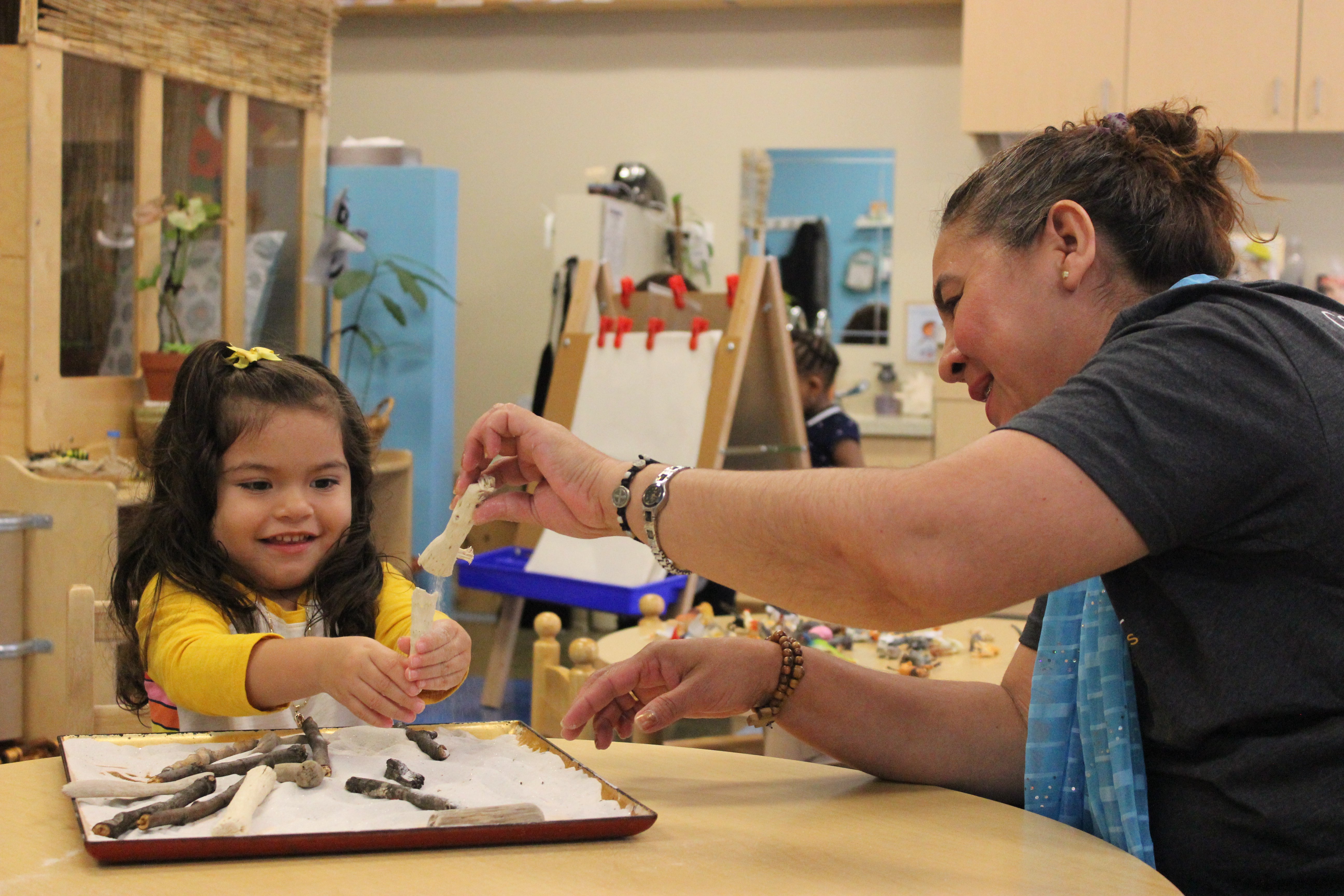
Designing a Bilingual Degree Program
The University of the District of Columbia is the city’s only public institution of higher education. In 2009, the university was split into a four-year institution and a community college. According to a 2009 report by JBL Associates, the rationale for this change was to strengthen and improve the university. The report said, “UDC has struggled since it was founded to provide associate degrees, certificates, and workforce preparation programs alongside its four-year and graduate programs. Combining the two missions proved unmanageable because the educational missions of community colleges and universities require different resources and staff expertise.”1 UDC-CC has an open admissions process and low tuition to promote greater access to its career and technical training certification and associate degree programs—making it a strong fit for meeting the educational needs of the city’s early childhood workforce.
Leveraging Existing Structures
Cecelia Alvarado, former education program coordinator at UDC-CC, was determined to design a program that would meet the needs of the Spanish-speaking providers in the city. Even before the regulations were passed, early childhood teachers in the community were asking for classes in Spanish. “I already had the idea of offering the whole degree in Spanish and sent notices to eight to nine programs to get their input on what it might look like,” she told us.2
An advisory group was convened to help think through a vision for the program, the resources that could be brought to bear, and the needs of providers. At one of the first advisory meetings in July 2017, Spanish-speaking providers and representatives from Spanish early childhood programs shared their wishes for the program. All agreed that a degree program in infant and toddler education was most needed, given growing demand for infant and toddler care. The group also devised a list of program “must-haves” including community locations for classes, a cohort structure, scholarships, and strong collaboration and communication with the admissions and financial aid offices.3 The input of the early childhood educator community was essential, given that the program would serve educators who work in center-based care and those who work in and lead family child care (see Special Considerations for Helping FCC Providers Attain Degrees).
Special Considerations for Helping FCC Providers Attain Degrees
Family child care (FCC) providers are an important part of the early childhood ecosystem—their homes are where a disproportionate number of children from families with low incomes are cared for. These small businesses are often run by community members whose linguistic capacity and cultural knowledge reflect the families they serve. But FCC providers face unique challenges operating within a system built largely around center-based child care. FCC providers often have less access to professional development and face challenges increasing their academic credentials.4 To best support FCC providers, degree programs should include the following:
- Cohort Model: FCC providers often work in isolation, without an instructional coach or peer support. Utilizing a cohort model enables providers to build networks of support, share resources, and learn from each other.5 The relationships they build will enhance their experience in the program6 and persist after graduation.
- Business Training: Not only are FCC providers teachers, they are also small business owners. It is important for coursework to build their knowledge of early childhood development as well as small business ownership.7 FCC providers would benefit from courses that will strengthen their knowledge of business administration, finance, accounting, and regulatory compliance.
- Awareness of Mixed-Age Settings: FCC providers teach in mixed-age settings where infants and toddlers learn alongside older children. Degree programs should acknowledge this aspect of FCC settings and include differentiated coursework and instruction on child development and learning across the age continuum as well as how to support peer-to-peer interaction between younger and older children.8
- Specialized Supports: Teachers from a center-based setting may receive employer supports including stipends to help with the costs of education, release time to attend classes, or help navigating the higher education system. Because FCC providers are self-employed, they must rely on external entities to provide these supports. Institutions of higher education, state entities administering early childhood scholarships, provider associations, staffed family child care networks,9 and child care provider unions could work together to offer this network of supports and create a pool of qualified substitutes so FCC providers do not have to close their businesses to attend class.
Members of the advisory group also volunteered to help people through the enrollment process. Lisa Luceno, who was a member of the advisory group and is senior director of early childhood at Briya Public Charter School, described a sense of partnership in planning the program, saying, “we were involved with [thinking through] what Briya could provide. Many people had tried to get in [to UDC] and were just met with obstacles at the university level. So we had conversations about how Briya could fill this critical role, being an educational institution in the community that is more accessible.”10
Briya was a natural partner because, since 1989, it has served the immigrant community in D.C., beginning as an Even Start Multicultural Family Literacy Program that served Central American and Vietnamese refugee families who were immigrating in large numbers to the city.11 The school network has four campuses across D.C., the majority of which are co-located with Mary’s Center, a community hub that offers health and social services. Together, Mary’s Center and Briya have earned a reputation throughout the region as leaders in the early learning community. For decades, Mary’s Center provided technical assistance and business coaching to hundreds of center-based and FCC providers each year.
Briya uses a two-generation model that provides adult education and early childhood education to the immigrant community. Briya’s adult education programs are designed to meet the needs of immigrant families; they offer English for Speakers of Other Languages (ESOL) courses and workforce development programs to help students earn a high school diploma or obtain a child development associate credential (CDA) or registered medical assistant credential (RMA). Since 2002, Briya has offered a CDA program in Spanish. Given its wide reach, Briya offered to hold classes at one of its campuses to increase accessibility for its own teachers and others in the community.
With the support of key community stakeholders in place, Alvarado turned to Marilyn Hamilton, dean of academic affairs at UDC-CC, to help make the program a reality. They started by finding ways to push obstacles out of students’ way. “We want to do things that will help them succeed and not provide any barriers that will [make them] fail,” said Hamilton.12 They worked together to identify how the program could be adopted into the current structure of the university, address challenges that arose, and establish the systems of support needed to help candidates enroll and persist in the program.
The program was built on the existing infant and toddler degree program, which meant that it did not need to go through a formal approval process. “Seriously, sometimes you just have to do it! Once the university understood why this was needed and what was needed, they understood the need to support [the program],” said Hamilton.13
The part-time bilingual degree program covers the same content and curriculum as the program offered in English. The only differences between the two programs are the language used for instruction, the course sequence, and amount of time to earn the degree.14 “We flipped how people take the classes, so we have them take the [infant and toddler] courses first and the general education courses last,” said Alvarado.15 That means the first nine courses in the degree program are offered in Spanish, the next four are offered bilingually, and the remaining eight general education courses are in English. By front-loading the content courses, the program offers participants the chance to start off in an area of strength and build off their existing knowledge gained through years of working with young children. In addition, Hamilton says that she believes “that if someone writes and speaks the content in their own language, they understand and embrace it better.”16 Indeed, research on adult English as a Second Language (ESL) students affirms that use of a native language supports the acquisition of content, and ultimately supports language learning.17
Addressing Challenges
The bilingual design of the degree program is not without its challenges, as program participants still need to have strong enough English language skills to be successful in their general education coursework. UDC-CC requires applicants to take the Accuplacer test, which is used to determine course placements and the need for remediation. In addition, students in the bilingual associate degree program must take the ESL Accuplacer test to measure their English language skills. It may be that the program will need to integrate some English language development within the current courses. “When we get to that point, we’re going to be teaching those courses in English, but they’ll have someone who speaks their language as a supplemental instructor” who can help explain the content more meaningfully, noted Hamilton.18
To be sure, offering a bilingual degree program comes with challenges beyond navigating program design and university bureaucracy: Spanish-speaking faculty with expertise teaching infants and toddlers and Spanish textbooks and materials are also essential.
Both Alvarado and Hamilton described the challenge of finding course instructors. “The job announcement called for Spanish-speaking instructors with an infant and toddler background. We received 13–14 applications. Nine did not have Spanish and the others did not have infant-toddler experience,” said Alvarado.19 The need for some background in infant-toddler was a priority as they wanted to ensure an understanding of this developmental period, of family engagement, and of how to incorporate best practices into infant and toddler settings. Ultimately, the instructors who were hired did have some expertise but were offered additional training in the Program for Infant Toddler Care (PITC) to ensure their understanding of the specific materials and philosophy undergirding UDC-CC’s program. The majority of courses in the degree program use PITC training manuals, available in Spanish, as the textbook.
The majority of university systems have processes in place that are “entrenched in English” noted Alvarado, which meant that resources had to be placed towards translating materials into Spanish. These materials include information sheets and guides on the financial aid process, about the program and required courses, about the application process, and more. In addition, finding supplemental textbooks in Spanish also proved difficult—some textbooks have Spanish editions, but the majority of texts that were found were published in different countries. Course instructors had to go beyond traditional resources and pull together a variety of materials to support student learning. In the class we observed, the instructor used a combination of written materials and videos from YouTube.
Key Takeaways
Program Design
- Reduce bureaucratic barriers by using existing program structures to build out degree programs in other languages
- Consider the unique needs of family child care providers in supports offered and course content/curriculum
- Engage the early education community in program planning through advisory boards, community meetings, and other strategies
- Designate resources and time to translating and finding program materials
- Provide faculty with professional learning to grow their skills and knowledge
- Identify strategies and best practices for integrating English language development into college coursework
Citations
- Building a Strong, Independent DC Community College (Washington, DC: JBL Associates, 2009), source
- Interview, November 29, 2018.
- Program need rationale statement, shared by Cecelia Alvarado.
- National Center on Early Childhood Quality Assurance, Addressing the Decreasing Number of Family Child Care Providers in the United States (Fairfax, VA: U.S. Department of Health and Human Services, Administration for Children and Families), source
- Juliet Bromer and Toni Porter, Staffed Family Child Care Networks: A Research-Informed Strategy for Supporting High-Quality Family Child Care (Washington, DC: National Center on Early Childhood Quality Assurance, Office of Child Care, Administration for Children and Families, U.S Department of Health and Human Services, 2017), source
- The authors observed this during the class discussion of UDC-CC class “Orientation to Infant/Toddler Professional Practice” on March 2, 2019 in Washington, DC at Briya.
- Michael B. Abel, Teri N. Talan, and Marina Magid, Closing the Leadership Gap: 2018 Status Report on Early Childhood Program Leadership in the United States (Wheeling, IL: McCormick Center for Early Childhood Leadership at National Louis University, 2018).
- Phone interview with Jill McFarren Aviles (UDC-CC adjunct professor), April 28, 2020.
- Natalie Vieira and Shannon Hill, Creating the Conditions for Family Child Care to Thrive (New Haven, CT: All Our Kin, 2019), source
- Phone interview, March 29, 2019.
- Briya Public Charter School (website), “History,” source
- Phone interview, February 13, 2020.
- Phone interview, Feb. 13, 2020.
- The traditional AA degree program is designed to be completed in two years. The bilingual degree program is designed to be completed in three years to allow students to continue working full time and take a lower course load per semester.
- Interview, November 29, 2018.
- Phone interview, February 13, 2020.
- Ana Huerta-Macias and Kerrie Kephart, “Reflections on Native Language Use in Adult ESL Classrooms,” Adult Basic Education and Literacy Journal 3, no. 2 (2009): 87–96.
- Phone interview, February 13, 2020.
- Interview, November 29, 2018.