
Introduction
In 2022 and 2023, New America Chicago hosted its first series of community design sessions as part of a new community engagement initiative called CivicSpace. Targeted at areas around Chicago with high predatory lending rates,1 these sessions asked borrowers to respond to alternatives to predatory loans and to consider what would help improve uptake of more affordable financial products. In 2019, individuals in 40 Chicago-area majority minority zip codes took out over $65 million in small dollar loans (not including interest and fees),2 so responsible lenders would do well to pay attention to the needs of these borrowers.
Partnering with 32 residents living around Chicago who had recent experience accessing small dollar loans, the attendees worked together to answer two questions: (1) Where do you go for information you can trust about small dollar loans; and (2) what features make those loans safe and useful? Answers to these questions are important now, when the cost of living has jumped, making it more difficult for many Americans to feed and house their families.
These Chicago residents generated an abundance of policy and practice ideas for designing small dollar loans to help people solve cash flow challenges. Participants also described their ideal ways to learn about loans and gain the financial literacy skills to leverage those loans. They were interested in simple loan processes, flexible options, ways to build credit, and wealth-building opportunities, in addition to short-term emergency assistance.
Understanding the perspectives and preferences in lower-income Black and Latino communities is important, as Black and Latino households in Cook County are far more likely to be financially vulnerable than their counterparts nationwide (39 percent versus 20 percent). Around half of Black and Latino Cook County residents (51 percent and 46 percent, respectively) say their household debt is not manageable.3
Participants who had some experience with high-interest personal loans were recruited, particularly those living in areas around Chicago that were hardest hit by exorbitant predatory loans prior to the passage of Illinois’s 36 percent cap on loan annual percentage rate (APR) via the Predatory Lending Prevention Act (PLPA). The first community design session was held at The Chicago Community Trust in September 2022, with 10 participants of different races and ethnicities. The second session was held in June 2023, in collaboration with local nonprofit Palenque LSNA, with 11 Latina participants recruited from Belmont Cragin, Logan Square, and the surrounding area. The final session was held in August, at the Woodson Regional Library, with 11 participants, most of them Black, recruited from the southern suburbs and area around Washington Heights.
“Many times people don’t want to talk about money, but they don’t ask until it is too late. Everyone needs to help each other, especially disenfranchised and minorities. It tends to be Black and Brown communities. We all need to help each other. Doesn’t matter if you’re Black or Brown. You should help each other to live because at the end of the day, poverty affects everyone.” —Gaby, 34, Irving Park
This report outlines the ideas that residents expressed the most agreement with and offers a summary of the pain points they experience with short-term, small dollar borrowing. For details about the demographics of the participants, please see Appendix A. For details on the methodology and research process for our sessions, please see Appendix B or read our Chicago Residents Design Better Small Dollar Loans brief for more about this approach.
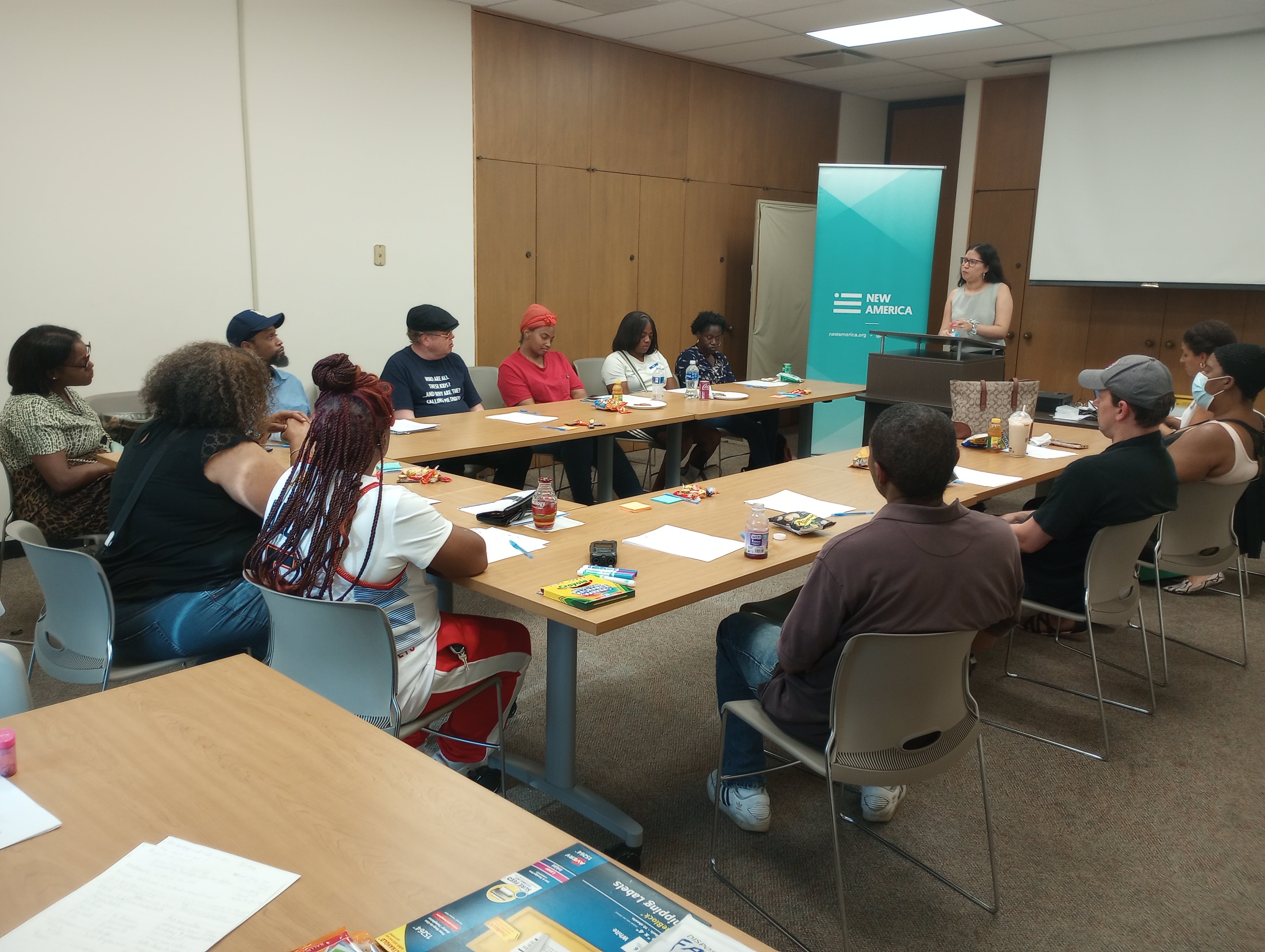
Meegan Dugan Adell/New America
Citations
- Meegan Dugan Adell, Kathie Kane-Willis, Spencer Cowan, Hala Kourtu, and Vanessa Rangel, Ill-gotten Gains: Predatory Lending and the Racial Wealth Gap in Chicago (Chicago: New America, 2022), source.
- Adell et al., Ill-gotten Gains, source.
- Necati Celik, Meghan Greene, Wanjira Chege, and Angela Fontes, Financial Health Pulse 2022 Chicago Report (Chicago: Financial Health Network, January 2023), source.