
Table of Contents
III. Receiving: Delivery and Access

For those already engaged with public programs, existing touchpoints—like recertification or caseworker interactions—offer trusted opportunities to share information about tax credits and help families access what they’re eligible for.
Tax Credits Feel Disconnected from Other Government Support
Many low-income households are already connected to government programs, but credits through the tax system often feel separate from other supports they rely on.
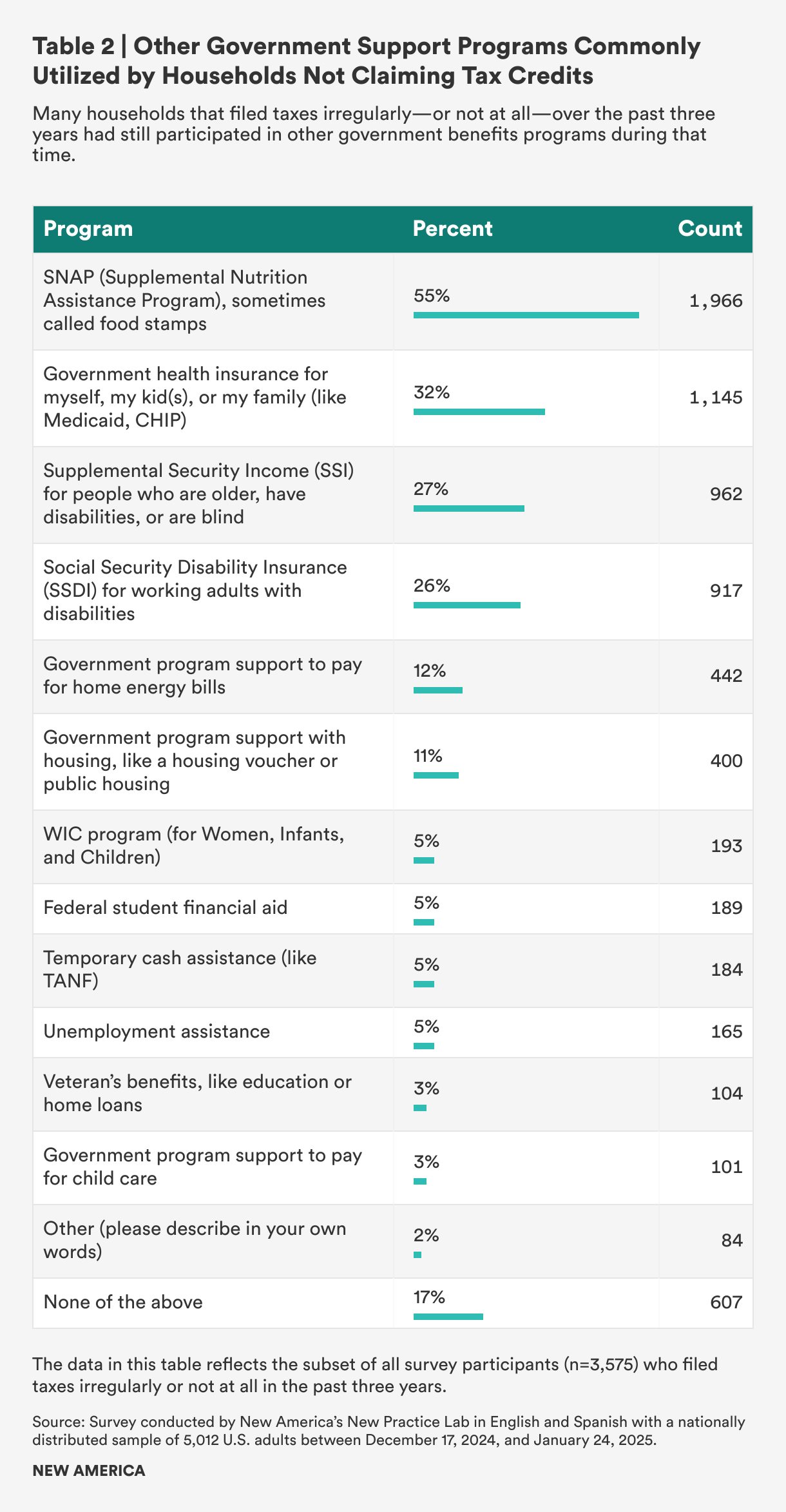
Of households who had not filed taxes at all or irregularly in the past three years, 84 percent had participated in at least one other government support program during that time period. On average, respondents (or someone in their household) had participated in 1.7 government support programs over the past two years, with participation highest among those who had not filed taxes at all (two programs on average).
“The information’s already in the system because of SSDI and SNAP. Why can’t they just file for me?”
Commonly used government support programs among households that did not file or filed taxes irregularly included:
- Supplemental Nutrition Assistance Program, or SNAP (55 percent)
- Government health insurance (32 percent)
- Supplemental Security Income, or SSI (27 percent)
- Social Security Disability Insurance, or SSDI (26 percent)
- Home energy bills (12 percent)
- Housing support (11 percent)
In both survey responses and interviews, many households expressed interest in getting help with filing to alleviate stress or simplify the process. One idea that we presented in our interviews in Illinois and re-tested in the survey was a process that could prefill parts of a tax return using information already provided to other state agencies, with the filer reviewing and approving it before submission.
Overall, 70 percent of all respondents said they were either very (36 percent) or slightly (34 percent) interested in this kind of support. Interest rose significantly among those already interacting with multiple government support programs:
- 62 percent interest among those with no other program participation
- 71 percent interest among those participating in one to two programs
- 81 percent interest among those participating in five or more programs
Respondents wanted agencies to use the data they already have to reduce administrative burden and simplify access. While the rising interest with higher participation may suggest greater comfort, trust, or familiarity with agencies connecting them to benefits, it could also reflect fatigue from repeatedly providing the same information across multiple systems to “the government” as a single perceived entity.
Respondents told us it would save time, reduce anxiety, and build confidence:
“ANYTHING filled in for me would be amazing during such a stressful time.”
“I have bad anxiety about forms, this would relieve stress.”
“The government already has the info. Why not use it?”
For some, the idea was appealing only when introduced by agencies people already trust—like their SNAP office or a known caseworker:
“If my taxes were to be prefilled by the county building where I received my SNAP and CalWORKS benefits I wouldn’t mind it at all. They already know what I make so it only makes sense that could help with the pre-fill tax form.”
“That’ll be wonderful because it would be confidential with someone you’re talking to at a program you already know…And like I said, with the cost of living right now, anything helps.”
At the same time, not everyone was on board. About 17 percent of respondents said they wouldn’t be interested, and another 12 percent were unsure. Concerns ranged from distrust of government systems to fears about mistakes and scams:
“I don’t trust the government to get my info right.”
“One more place things could get messed up.”
“Could be a scam, I wouldn’t be sure.”
While fully pre-filled tax returns may not be widely feasible in the near term, the strong interest we heard points to a broader need: People want simpler, more supported filing experiences, especially when introduced by trusted sources like SNAP caseworkers or local community organizations.
Small, actionable steps can still make a big difference: Using known data to pre-populate income or household size in reminder notices, or sending personalized prompts like “You may qualify for $X in tax credits,” can lower the barrier to filing.
The goal isn’t to do everything at once—it is to offer help that feels familiar, reliable, and easy to act on. Trust, familiarity, and control are essential ingredients for effectively reaching people.
Recommendations for Implementation
Integrate Tax Credits into Support Families Already Receive
Most low-income households are already connected to public programs like SNAP, Medicaid, or housing assistance. These agencies have regular, high-touch interactions with families and are seen as trusted sources of support, making them a powerful starting point for accessing tax credits.
States can take a “crawl–walk–run” approach to help households see tax credits as part of the broader benefits system and streamline access, starting with simple, actionable steps that are already within reach:
- Introduce the Department of Revenue (DOR) through trusted partners. Equip trusted benefits agencies to give families a simple heads-up: “You might hear from the DOR about tax credits you may be eligible for.” Even this small touchpoint can reduce skepticism and increase familiarity.
- Use existing benefits data to trigger targeted outreach. Agencies can use existing (if incomplete) data to verify tentative eligibility and send personalized messages like “You may be eligible for $X,XXX in tax credits” based on known income and household data.
- Build secure data-sharing agreements. Trusted agencies can play a critical role in helping households connect data they’ve already provided with the DOR, even if the original agency a family is connected to isn’t managing credit delivery itself.
This coordination doesn’t require perfect eligibility matching or full integration across systems. In fact, what we’ve heard in past state engagements is that non-DOR agencies are often hesitant and don’t have the capacity to manage tax credit delivery directly. However, they can still be powerful bridges, helping DOR become a more trusted and familiar face and a member of the broader support system.
Ultimately, coordinated outreach is just one piece of the puzzle. To create truly connected and accessible support, infrastructure and policy must evolve in tandem:
- Align eligibility criteria across programs. Programs often use different rules for determining eligibility (like income cutoffs or household composition). Aligning these criteria across benefits (such as syncing SNAP and state Child Tax Credit income thresholds) can make cross-agency coordination easier and more accurate.
- Establish clear, limited data-sharing agreements between agencies. Limit the type and amount of personal data shared across agencies to only what’s necessary to verify eligibility (e.g., income range or number of dependents). Include clear language on how data will be used, stored, and protected, and ensure that individuals are informed when their information is being shared, including for their benefit.
- Give people control. Transparency builds trust. Allow individuals to opt in to receive help with tax credits using their existing benefits data. Make clear what data is being used and for what purpose.
Even modest steps toward this—supported by aligned eligibility, inter-agency trust, and privacy safeguards—can open new pathways for delivering tax credits in ways that feel safer, simpler, and more connected to the public programs families already rely on. Done well, this can also reinforce the idea that tax credits are part of the broader system of support for families.