What Does It Tell Us?
A presidential campaign is a contest not just about personalities, but also about ideas. As candidates set out their policy priorities and develop their proposals, we learn more about what they care about, but we also see in their reflection what voters and party activists care about and want to hear. The proposals candidates embrace, and the priority they give them, define the agenda for the years that follow. Even candidates who don’t win their party’s nomination, like Ronald Reagan in 1976 and Bernie Sanders in 2016, and some who drop out even before the first primaries, often bring forward ideas or ideological visions that take hold later.
From our deep dive into the 2020 candidates’ positions on issues of democracy, we see strong evidence that Lee Drutman was correct in observing recently that “from the long arc of American political history, I see the bright flashing arrows of a new age of reform and renewal ahead.” Not since 1976, in the aftermath of Watergate and an earlier impeachment, has the notion of reforming democracy itself been as central to a presidential contest as it is in 2020.
While reform of money in politics has been on the agenda in previous campaigns—it was a hallmark of 2008 Republican nominee John McCain’s career, and particularly his 2000 campaign for his party’s nomination, and Barack Obama emphasized restrictions on lobbying—the range of different democracy-reform issues on the agenda in this cycle is unprecedented. Issues of democracy used to be considered as something of an elite preoccupation, less immediately meaningful than economic or social policy issues, or those of war and peace. But in the decade since the Citizens United and Shelby County decisions, core issues of voting rights, corruption, and the relationship between economic and political power have mobilized citizens at a level unseen since the post-Watergate period.
That passion and concern for democracy is reflected in the priority that all Democratic candidates, and one Republican, have given to issues of political reform, and in the range and creativity of their ideas.
To begin on the Republican side, William Weld, the former Massachusetts governor who was the Libertarian Party’s vice presidential nominee in 2016, embraced a broader political reform agenda than might be expected. Weld, who dropped out in late March, challenged the winner-take-all allocation of electoral votes and embraced ranked-choice voting. He also supported independent redistricting commissions, restoring the Voting Rights Act, and experiments in voting by mobile phone. He even gone further than some of the Democratic contenders on the issue of restoring voting rights to felons, indicating he is open to allowing some currently incarcerated felons to vote. It remains to be seen whether this reflects an emerging Republican agenda or the particular priorities of a candidate who has also run on a third-party ticket.
Of the other announced candidates for the Republican nomination, former Rep. Joe Walsh (who dropped out of the race after a dismal showing in Iowa) had little to say about political reform. As the incumbent, Donald Trump has embraced some limits on the “revolving door” between lobbying and government, but in practice, the Associated Press found that he has appointed more lobbyists to key positions in three years than his two predecessors had done in eight. Otherwise, Trump has not endorsed any elements of a political reform agenda, and he has endorsed efforts at the state level to limit voting and remove voters from the rolls.
Unsurprisingly, it’s in the opposition party where the debate on political reform is robust and where there are signs of innovation. As our analysis shows, there are some issues on which there is broad consensus, such as the need for impartial congressional redistricting and stricter campaign finance regulations. We can expect that any Democrat who becomes president will pursue these consensus ideas. Others are newer or more controversial, embraced only by some candidates, but may reflect a consensus that will develop in the future.
Candidates’ positions on democracy can be grouped, roughly, in three categories. One involves expanding voting rights, reinstating the provisions of the Voting Rights Act that were overturned in the Shelby County ruling, eliminating voter ID and felon disenfranchisement laws, and otherwise extending the promise of democracy more broadly. A second strand focuses on corruption, limiting the influence of lobbyists and campaign donors. And finally, there are reforms intended to make it easier for a majority to achieve lasting policy changes and overcome the barriers to majoritarian government, from the Electoral College to the Senate filibuster (perhaps even the Senate itself!), to the Supreme Court as currently constituted.
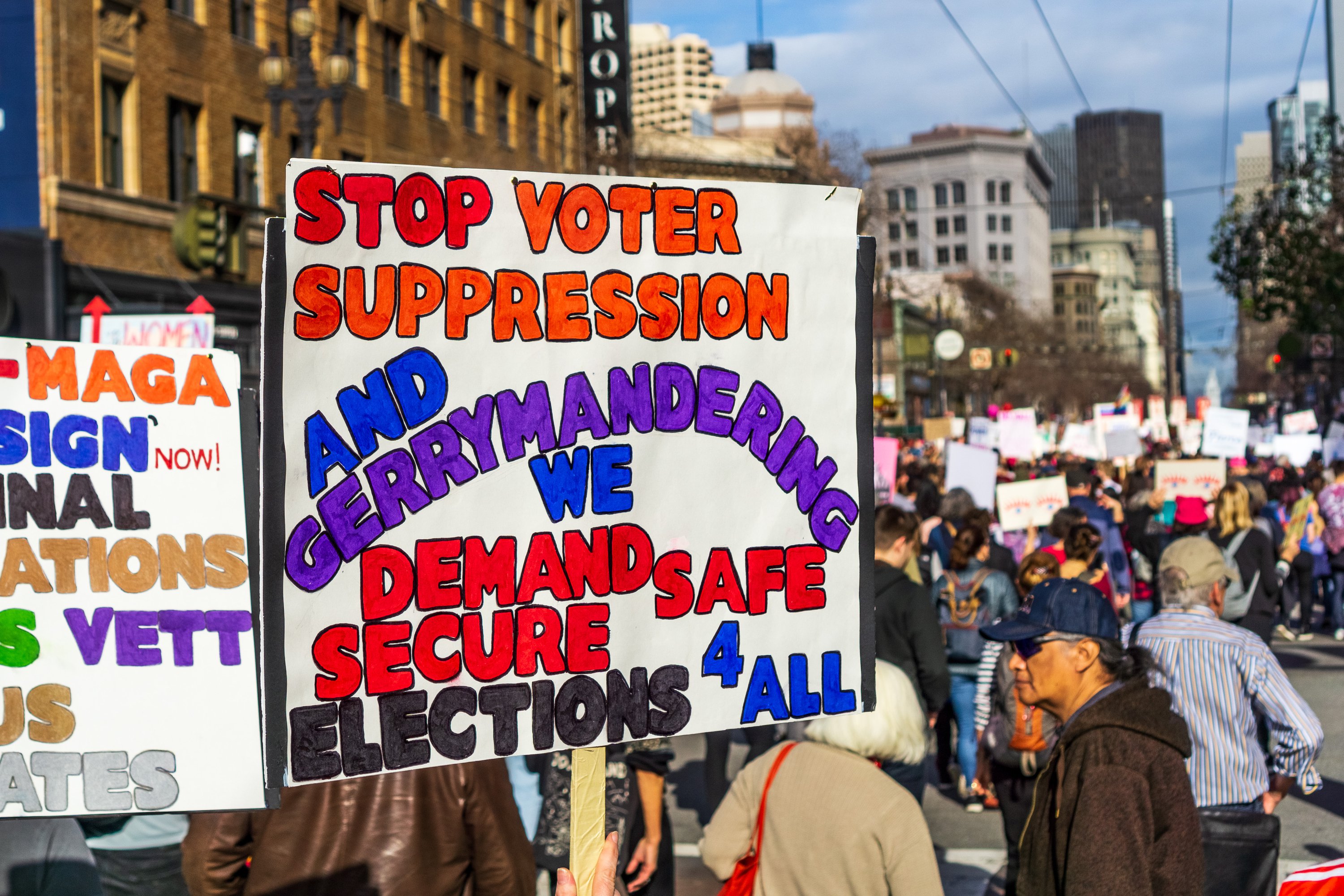
In the first category, a candidate who ended his campaign before the first vote, Cory Booker, was the pacesetter on voting rights, advocating a “New Voting Rights Act,” automatic voter registration, voting by mail, and making Election Day a holiday. Pete Buttigieg similarly proposed a “21st Century Voting Rights Act,” which would “use every resource of the federal government to end voter suppression.” While these are among the most sweeping proposals, almost all the other Democratic contenders have embraced much of this agenda, particularly automatic voter registration and reversing the Shelby County decision.
A related stream of reform in this category concerns the perceived failures of our plurality, winner-takes-all system of voting. Currently, the most prominent alternative to this system is ranked-choice voting. Ranked-choice voting (otherwise known as instant runoff voting, preferential voting, and alternative voting) has been tested in several cities over the past decade, and in the state of Maine in 2018. Most recently, New York City voters approved ranked-choice voting for municipal primary and special elections beginning in 2021. Several candidates have already said they’re “open” to such reforms, and a few, including Bernie Sanders and former candidates Michael Bennet and Andrew Yang, have been more explicit in endorsing ranked-choice voting. Over the next year, we expect ranked-choice voting will become an even bigger public conversation: Several states—including Alaska, Nevada, Hawaii, Kansas, and Wyoming—are using ranked-choice voting in their presidential primaries and caucuses in 2020, so candidates and voters alike are sure to become more familiar with the idea.
Two candidates have framed their approach to political reform almost entirely around the second category of reform, which addresses the idea of corruption and ending a system that’s “rigged” for the wealthy: Elizabeth Warren (who dropped out after Super Tuesday) and Bernie Sanders. The currency of Warren’s campaign was detailed policy proposals, so unsurprisingly she has the most specific plans to end corruption, with a particular focus on lobbying. Her proposal to ban campaign contributions by lobbyists and institute lifetime bans on elected officials from lobbying is the most sweeping, and, while it may raise constitutional questions or deter people from public service, it directly targets the intersection of money and influence, which is lobbying.
Support for an amendment to the Constitution that would overturn both Citizens United and the 1974 decision, Buckley v. Valeo, in order to permit broader regulation of political spending, is one of those ideas with broad consensus support among Democrats. In fact, all the candidates who were in the U.S. Senate in 2014 voted for such an amendment. Most also support a system of public financing based on matching small contributions, though some are vague about it and some quite specific. Michael Bloomberg (who, like Warren, dropped out of the race after Super Tuesday) takes credit for expanding New York City’s small-donor matching program, although he himself did not use the program in his three campaigns for mayor in the 2000s.
The third category of political reform proposals is where the newest and most controversial ideas are found. Particularly during the Obama era, when the Senate was able to block most of his initiatives after the first year, Democrats became acutely aware of the “veto points” in the American political system that have made progress difficult, even when a solid majority favors change. The Senate filibuster was the most immediate obstacle, and candidates who have not served in the Senate, including former candidates Tom Steyer and Yang, along with Warren, have supported ending the filibuster. Joe Biden, who served 36 years in the Senate, has opposed this change, and other candidates have been more ambivalent about it. The Supreme Court, having gutted much of the Affordable Care Act, along with its decisions in Shelby County and Citizens United, is seen as another veto point in the system, leading a few candidates, notably Buttigieg, John Delaney, Steyer, and Yang (all of whom dropped out before Super Tuesday), to embrace reforms such as expanding the Court or imposing fixed terms. After two recent presidential elections in which the Electoral College determined the winner, superseding the popular vote, there is new interest in eliminating or reforming that institution as well. Of the 12 Democratic candidates tracked here, eight have expressed support for proposals that would either amend the Constitution or employ an interstate agreement to effectively give the presidency to the winner of the popular vote. Of them, three remain in the race.
These proposals suggest a dramatic expansion of the scope of political reform, well beyond the narrow focus on limiting money in politics and lobbying from just a few years earlier. But while previous efforts, such as McCain’s, had broad support across both major parties, the energy and enthusiasm for reform are now mostly concentrated among Democratic candidates and Democratic voters. This partisan split was likewise illustrated in 2019 when the newly elected Democratic majority in the House introduced as its first piece of official legislation a bold pro-democracy reform package. The For the People Act (H.R. 1, 2019) passed in the House by a strict party-line vote, but the Republican-controlled Senate, led by Majority Leader Mitch McConnell, has so far refused to put it to a vote.
However concerning this divide may be, the crisis of democracy and the hunger for real change identified by Drutman makes it plausible that the ideas on the agenda in 2020 will capture the imagination of voters and politicians across the political spectrum in the decade ahead.