Introduction and Snapshot
The Iowa caucuses took place February 3, marking the official beginning of the 2020 presidential election season. For many of the candidates, this came after more than a year of hard campaigning.
Most of the campaigns have focused on policy areas key to Americans’ everyday problems—issues like healthcare, income inequality, and the burden of student debt. However, candidates have also been taking positions on structural and procedural questions of democracy and political reform. Though these issues may not receive much time on debate stages, our political institutions also demand attention and innovation.
Over the last decade, American democracy has been rocked by a series of setbacks, from rulings like Citizens United v. FEC, Shelby County v. Holder, and Janus v. AFSCME to the rise of voter-ID laws and partisan gerrymandering. In 2016, the Economist Intelligence Unit downgraded the United States from a “full democracy” to a “flawed democracy,” a change that reflected “a sharp fall in popular confidence in the functioning of public institutions,” and that both preceded and paved the way for Donald Trump’s presidency. Under these circumstances, democracy reform issues have taken on a new urgency and salience.
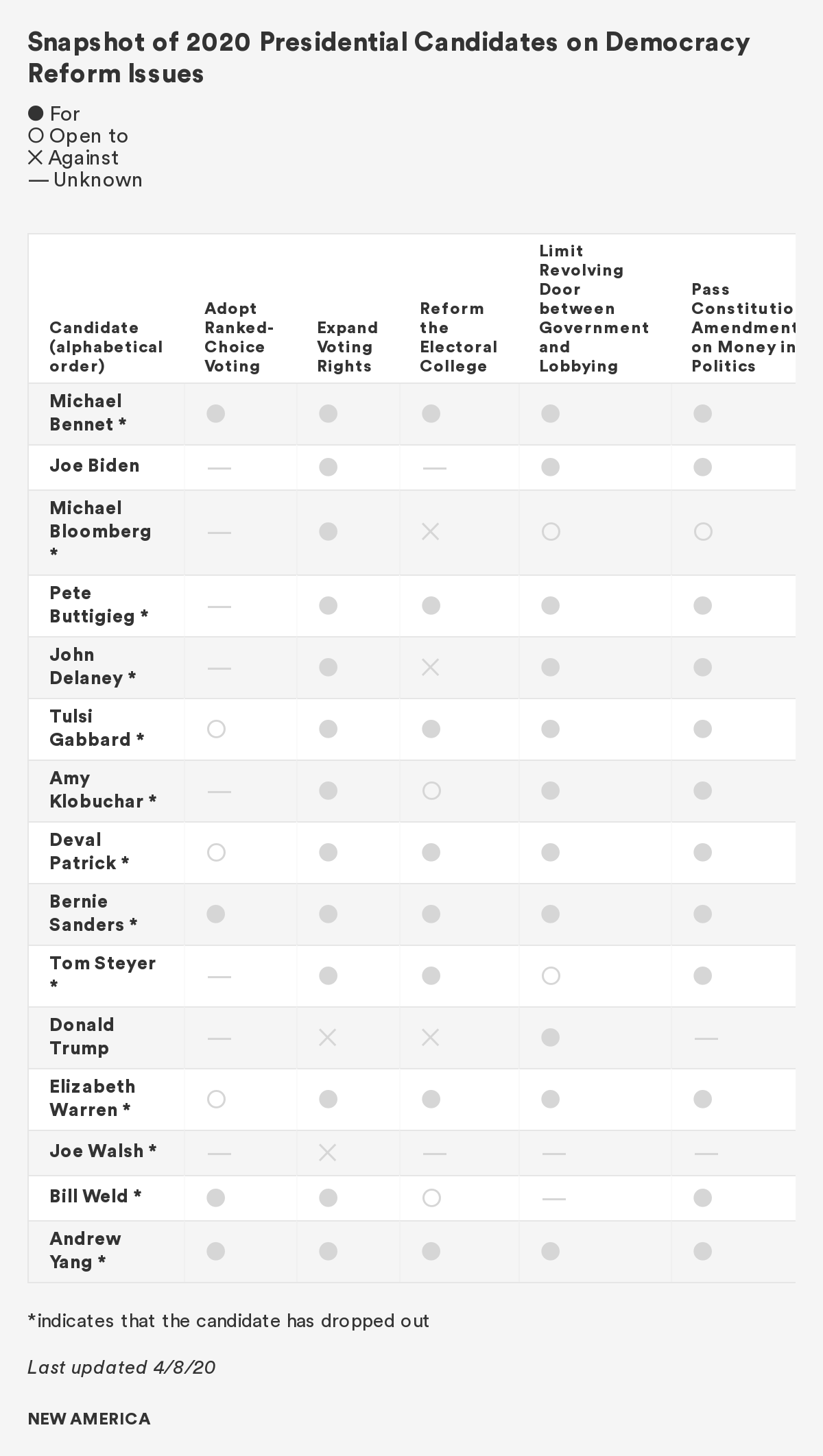
To help journalists, advocates, and the public assess where the candidates stand, the Political Reform program at New America is tracking presidential candidates’ 2020 positions on major democracy reform issues. Specifically, we are focusing on eight potential reforms: adopt ranked-choice voting, expand voting rights, reform the Electoral College, limit the revolving door between government and lobbying, pass a constitutional amendment to allow stricter campaign finance regulation, expand small-donor public financing, eliminate the Senate filibuster, and reform the Supreme Court.
As the 2020 campaign has unfolded, all of the Democratic candidates and two of the Republican candidates have embraced at least one of the eight reforms we are tracking. Many candidates have issued novel, bold policy proposals that go beyond the current progressive consensus or currently proposed federal legislation, while other candidates have not addressed these with specificity or urgency. Some have failed to articulate any position at all.
The candidates featured here—12 Democratic and three Republican—are those who were still running as of January 14, the day of the last pre-Iowa televised debate. A snapshot of each candidate's platform, speeches, and record on the issue in question is presented below, with each dot hyperlinked to a source. Below the snapshot you can find a narrative analysis and issue breakdowns of the data. These breakdowns include public statements and campaign website excerpts indicating the candidates’ positions, where they exist, on each issue. For current or former officeholders, co-sponsorship of federal legislation and support of state or local decisions may also be cited.
Our analysis does not suggest endorsement, support of, or opposition to any candidate; it is simply a record of whether each candidate has expressed a position on particular reforms, and if so, whether the candidate supports (●), opposes (✕), or is “open to” those reforms (○).