Methodology
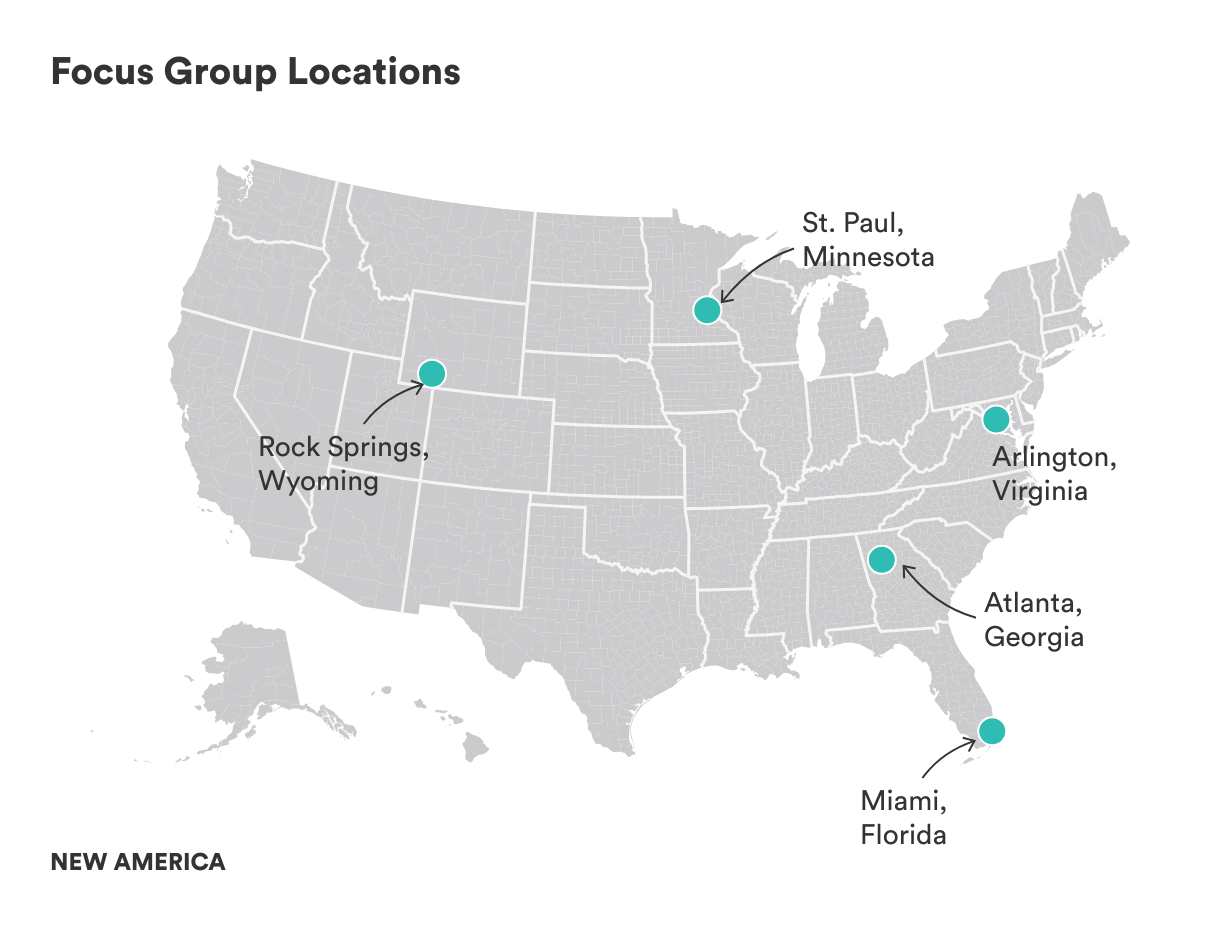
Between October 2023 and February 2024, Democracy Rising conducted five in-person focus groups with immigrant communities around the country: a Mexican community in Rock Springs, Wyoming; a Haitian community in Miami, Florida; an Eritrean community in Arlington, Virginia; a Hmong community in St. Paul, Minnesota; and a Nigerian community in Atlanta, Georgia. Locations were selected in purple to red-leaning states and in localities where Democracy Rising had existing relationships with trusted local leaders. These leaders were engaged as consultants to recruit focus group participants, coordinate logistics, and facilitate the discussion. In total, there were 45 focus group participants across the five locations. (See the appendix for a more detailed breakdown of participant demographics.)
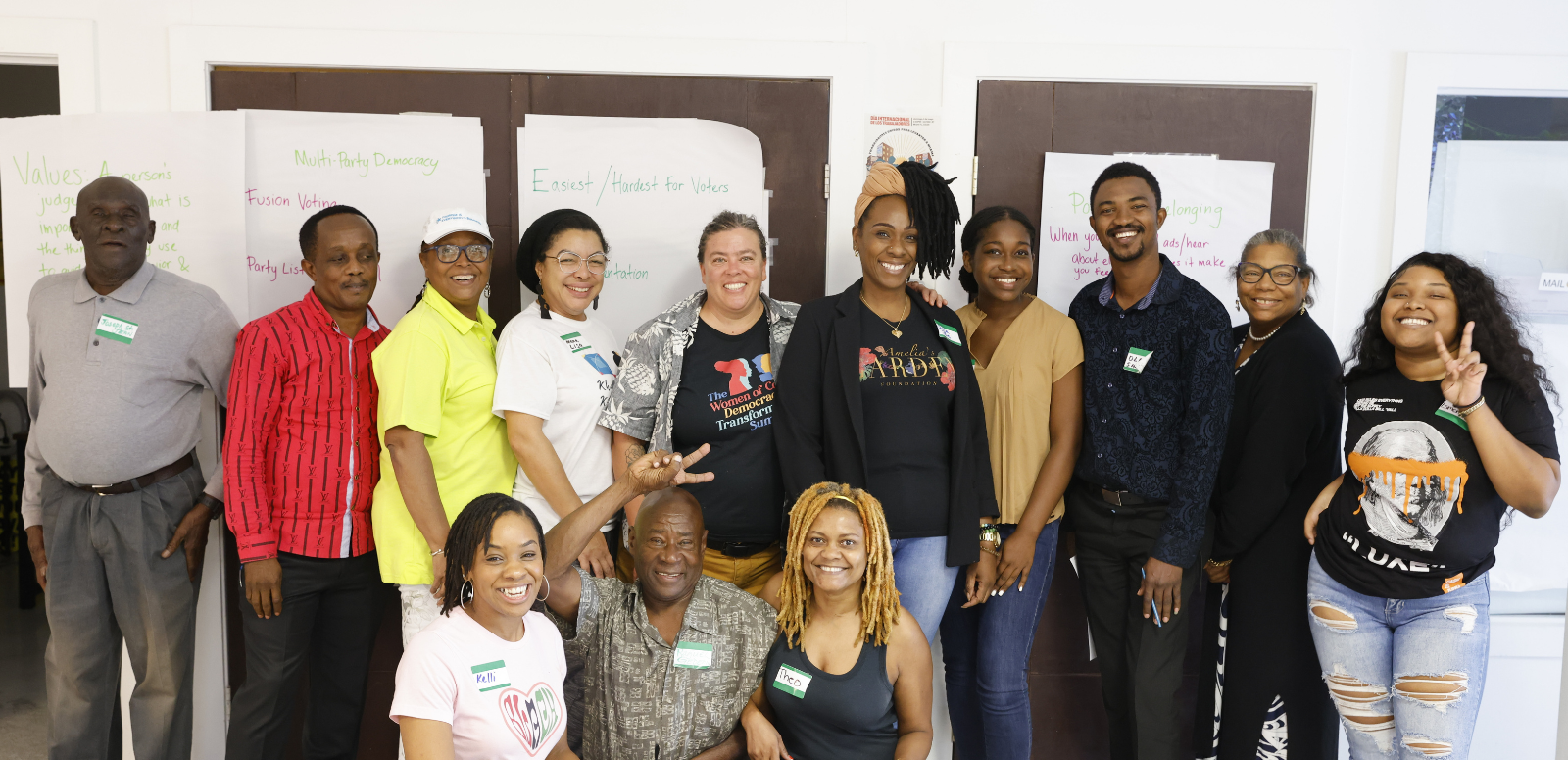
In advance of these conversations, Democracy Rising convened a working group of partners—the vast majority of whom are immigrants or first-generation Americans themselves—to co-develop the program and facilitation guide. Once completed, each facilitator went through a two-hour training to prepare for the sessions and to ensure that facilitation would be as consistent as possible across locations. A member of the Democracy Rising team attended each of the five sessions and served as a note-taker. Participants were paid a minimum of $30 an hour for their time, and each session was served a meal. Sessions were conducted in English, and interpretation was not provided. However, facilitators and participants frequently gave comments or context in their first language to ensure understanding.
Rather than a standard one- or two-hour focus group, sessions for this project lasted five hours because they were conducted using pedagogical principles of popular education. Popular education (often described as “education for critical consciousness”) is a teaching methodology developed by the Brazilian educator and writer Paulo Freire.1 Popular education is a process that aims to empower people who feel marginalized socially and politically to take control of their learning and effect social change. In popular education, the learning process starts with identifying and describing one’s personal experience through various activities. After the activity, a debriefing process allows participants to analyze their situation together, linking their experiences and historical and global perspectives to see the “big picture.” Through the generation of this new knowledge, the group is able to reflect more profoundly about themselves and how they fit into the world. Essentially, all participants have something to teach and something to learn.
For the purposes of this project, it was important to understand the lived experience of participants and how that impacts the way they engage with American democracy—as it is now and how it could be in the future. Additionally, in contrast with traditional focus group methodology, the sessions provided the participants a primer on the systems and structures within American democracy that have resulted in our two-party system and some proposals for alternative systems. The facilitation guide was divided into three sections, detailed below. Participants received the following materials: a participant survey to gather demographic and basic beliefs and attitudes information, the New York Times multiparty democracy quiz designed by Lee Drutman,2 a brief presentation on American democracy and the two-party system, and a series of basic educational resources about alternative voting systems, including mixed-member proportional representation, ranked-choice voting, and fusion voting.
Facilitation Guide
Section 1: What Is Community?
This section was grounded entirely in the lived experience of participants. The discussion revolved around the groups that give people a sense of belonging—those we choose and those we do not—and how those groups engage with the larger community and politics. Additionally, this section contained an exercise where all participants defined core values for themselves and shared values for the group.
Section 2: Power and Belonging
This section gained an understanding of how participants grapple with the idea of a political home. How do they (or do not) engage with politics and parties in the present, and what would a political home look like to them if they could create it?
Section 3: Multiparty Democracy
This section provided participants with a primer on how U.S. democracy has led to a two-party system and several reform proposals. Participants gave their feedback on the theory of the systems, as well as their perceptions of how they would work in practice. The session concluded with participants’ reflections on the conversation as a whole.
After completing all five sessions, transcripts were created for each, and the analysis phase began. Analysis was conducted by a working group consisting of Democracy Rising’s two co-directors, the facilitators for all five sessions, and an additional two research partners who have previously worked on Democracy Rising projects. The transcripts from the sessions were divided into the facilitation guide’s three sections. The working group held meetings to review the process and assign each member their segments to analyze individually. Each working group member was assigned at least two sections of the facilitation guide for all five locations and two locations total to ensure that each section and location was analyzed by multiple people. Working group members conducted a qualitative analysis of their assigned sections and locations over the course of three weeks. When their analysis had been submitted, the group reconvened for another meeting to discuss the overall themes of the data. Following this discussion, the group met two additional times to collectively review each section’s themes and subthemes that emerged from the analysis. The final meeting of the working group addressed lingering questions that had been identified through the process and the additional research questions and needs that this project could grow towards.
When the working group’s analysis was concluded, the notes and data were uploaded to the online platform Dedoose using the coded themes and subthemes identified by the working group. The themes and subthemes were then reviewed by an independent researcher (external to the working group) to determine which themes were most salient to report. Each interview transcript was thoroughly examined to identify the codes and themes that appeared most frequently. The themes that were reported most frequently were determined to achieve the saturation point, at which no additional qualitative analysis was needed.3 The most frequently reported themes were then used to write the findings section below.
Citations
- Paolo Freire, Pedagogy of the Oppressed (London, England: Penguin Classics, 2017).
- Lee Drutman, “Quiz: If America Had Six Parties, Which Would You Belong To?,” New York Times, September 8, 2021, source.
- Benjamin Saunders, Julius Sim, Tom Kingstone, Shula Baker, Jackie Waterfield, Bernadette Bartlam, Heather Burroughs, Clare Jinks, “Saturation in Qualitative Research: Exploring its Conceptualization and Operationalization,” Quality & Quantity 52, no. 4 (2018): 1893–1907, source.