
Appendix One: Evaluating the Attack in Pensacola
Is There Evidence of a Continued, Sustained AQAP External Attack Capability?
The attack in Pensacola, Fla. in December 2019 provides the strongest indicator that al-Qaeda via its Yemeni affiliate Al-Qaeda in the Arabian Peninsula (AQAP) may maintain a sustained capability to attack the U.S. homeland.1 There is no question that AQAP was connected to and coordinating the plot as it came together.
Yet, it is not clear if AQAP provided any form of material assistance to the perpetrator or actually contributed to the plot beyond branding it as an AQAP attack by communicating with the plotter and providing evidence of that communication. In addition, the plot was not particularly sophisticated despite the involvement of a foreign terrorist organization. The attack only involved a single individual who infiltrated the United States, and that individual killed three people in an attack not dissimilar from the attacks that Americans inspired by jihadist ideology—or other ideologies—with no actual ties to foreign terrorist organizations have conducted.2 In the absence of other confirming evidence, analysts should be wary of assuming the attack suggests a reconstituted AQAP sustained external attack capability.
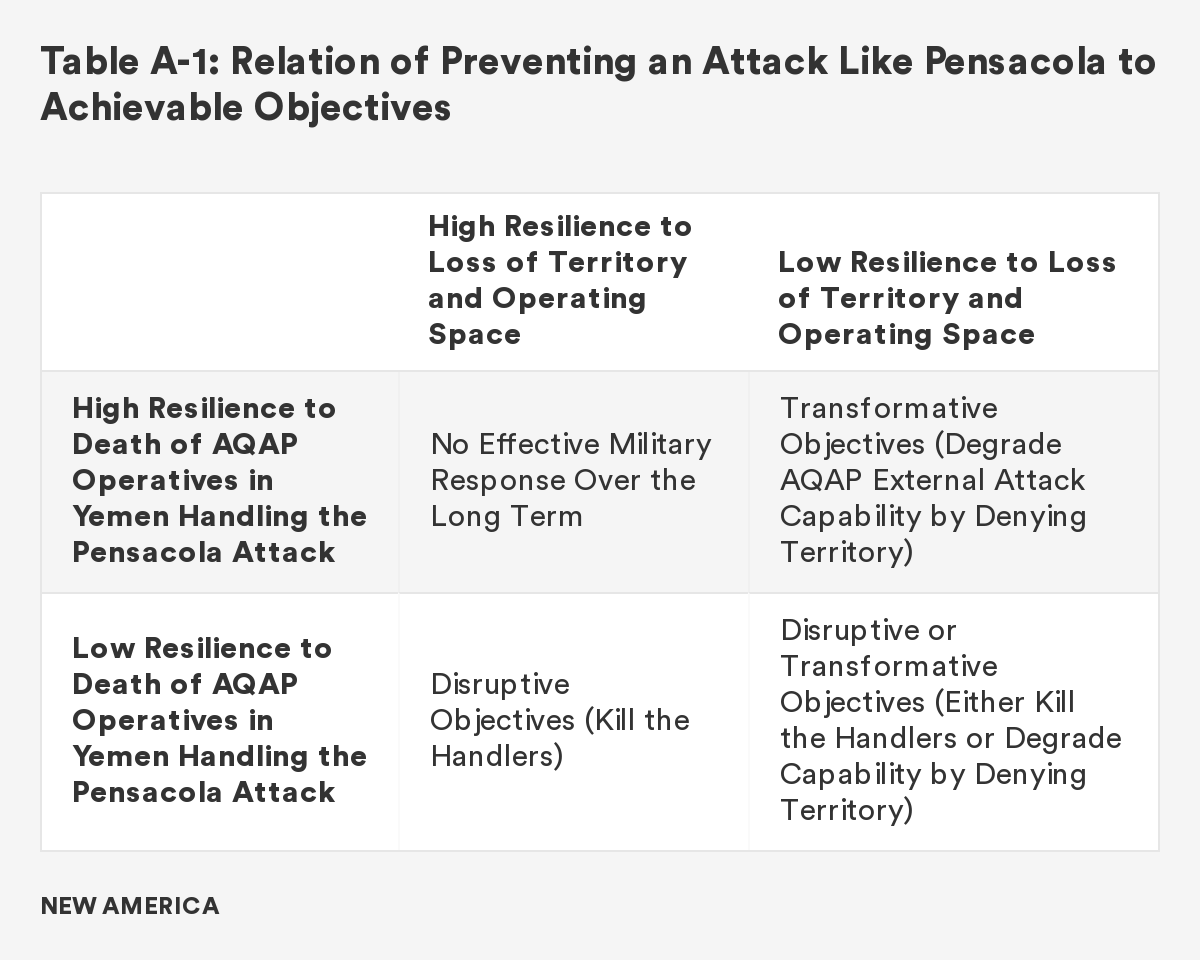
If the Pensacola attack does not represent evidence of a sustained AQAP external attack capability, and did not require a substantial material contribution from AQAP, citing the prevention of such an attack as a military objective is a recipe for endless war. There is little reason to believe such an attack would not be resilient to AQAP’s loss of territory—indeed it appears to have taken shape while AQAP was struggling to hold its own in Yemen’s complex civil war.3 Nor is it clear why the plot would not be resilient to the killing of specific operational figures in AQAP. As can be seen in Table A-1, this would mean that in the absence of the total and complete defeat of AQAP and the jihadist movement from which it emerges (an objective this author finds implausible), preventing attacks like the one in Pensacola over the long term is not an achievable objective. If the plot is shown to not be resilient to these factors, achievable limited objectives might be available.
Citations
- For an argument that emphasizes the attack in Pensacola as a major indicator of threat see Thomas Joscelyn’s discussion of the attack. However, even Joscelyn notes that AQAP’s capabilities are more constrained than they were previously. Thomas Joscelyn, “The Naval Air Station Pensacola Shooter Shows That Al-Qaeda Is Still a Significant Threat,” Dispatch, May 20, 2020, source.
- This lack of sophistication reflects the larger failure of virtually coached plotters to demonstrate a greater threat than those merely inspired by propaganda but without a direct connection to a foreign terrorist organization. Mueller, “The Cybercoaching of Terrorists: Cause for Alarm?”
- “Letter Dated 15 January 2019 from the Chair of the Security Council Committee Pursuant to Resolutions 1267 (1999), 1989 (2011) and 2253 (2015) Concerning Islamic State in Iraq and the Levant (Da’esh), Al-Qaida and Associated Individuals, Groups, Undertakings and Entities Addressed to the President of the Security Council” (United Nations Security Council, January 15, 2019), source.