
Table of Contents
- Executive Summary & Key Findings
- Introduction
- Defining Terms & Probing the Edges of Russia’s Proxy Strategies
- Russian Military Reorganization, Modernization & The Market for Private Force
- Tracing Wagner’s Roots
- Forward Operations: From Deir Ezzor to Donbas and Back Again
- Solving the Puzzle of Russian Proxy War Strategy
- The Risks of Russia’s Proxy Warfare Strategy
- Appendix: Glossary of Terms
Tracing Wagner’s Roots
The story of the Wagner Group has largely been told as the story of one critical Russian oligarch, Yvgeney Prigozhin, and his role in connecting private, financially motivated PMSCs to Putin’s agenda through their personal friendship. Online references to Prigozhin and his links to the Wagner Group run into the tens of thousands, and the Wagner-Prigozhin mythos has garnered its own Wikipedia page.1 Wagner’s alleged links to Prigozhin prompted the U.S. Treasury in 2017 to sanction Wagner and its titular commander Dmitry Utkin for lending material support to Russian separatists in Ukraine.2
This narrative of Prigozhin as the trusted Kremlin insider behind the Wagner Group may add up in some respects, but it also tends to obscure the deeper web of relationships and networks that extends far beyond Prighozin. The preceding history suggests that the there are several puzzle pieces that don’t fit. The story of a former hot dog vendor turned restaurant mogul surreptitiously orchestrating the movement of thousands of armed men into first Ukraine and then Syria begs several questions. In Putin’s Russia, what does it take contractually to organize the recruitment, training, deployment, and payment scheme for hundreds or possibly thousands of presumably seasoned military veterans across thousands of miles of land and ocean territory?
Since Russian law technically prohibits its citizens from fighting for financial gain outside the country’s borders, what are the legal, bureaucratic, and organizational frameworks that permit PMSCs like the Wagner Group to operate—apparently unimpeded—in Ukraine, Syria, Libya, and elsewhere in the world? Who are the primary clients of the Wagner Group and other Russian PMSCs? To what degree does the PMSC client base overlap with other Kremlin insiders beyond Prigozhin? What exactly is the Russian government seeking to plausibly deny by letting questions about mass PMSC casualties in places like Syria go unanswered?
Prighozin plays a role in the story of the Wagner Group and Russian PMSCs more broadly, but he is not the only powerbroker profiting from Russian PMSC operations. Instead he is ensconced within the larger set of networks that define and gave rise to the PMSCs as well as the Russian national interests they often pursue via proxy warfare. This section examines this dynamic and the above questions by providing a genealogy of the rise and activity of the Wagner Group.
Genealogy of a Privateering Network
The genealogy of the Wagner Group and affiliated PMSC contingents can be traced directly through the networks of strategic state-enterprises and siloviki3 security agency connected powerbrokers that have grown in influence under Putin. The Anti-Terror Orel group was among Wagner’s progenitors. It was in essence, a confederation of small cadres of military intelligence veterans and retired and reserve spetsnaz special operators. Antiterror-Orel’s central link was to five men listed in Russian company registries as stakeholders in the Orel Airborne Forces and All Union Special Forces Association of Paratroopers: founders Igor Iliyin, Oleg Maslov, Alexander Filipinkov, Pavel Ovsyannikov, and Director Sergey Epishkin.4 As appears to be typical for many Russian PMSCs in the 1990s, the veterans organization linked to Antiterror Orel served as a nexus for several siloviki private security enterprises, several of which were, at one time or another, registered under Epishkin’s name and appear to reference a connection to FSB Alpha and other spetsnaz units, according to Russian company registry information.5
An archived version of the group’s website indicates that about half of the individuals affiliated with Antiterror Orel confederation of PMSCs at one time served in the Airborne Troops (VDV), special operations forces of the 7th Squad of Special Forces (“ROSICH”) and the 1st Special Purpose Unit of the Internal Forces or MVD (“Vityaz”).6 Another smaller slice of the group consisted of GRU veterans, Vympel, Alpha and Russian navy marines. The now defunct website also indicates that the Antiterror Orel constellation of affiliated detachments included the Patriot Group and R.O.S.A., some members of which may have shifted to join Rusich,7 a group of Russian neo-Nazi spetsnaz veterans that would later play a significant role in the battles at Debaltseve and Ilovaisk in Donbas, according to human rights experts and military veterans groups based in Ukraine.8
Headed by Sergey Isakov and Epishkin, a Vympel veteran who once led a sapper team in the Balkans, the Antiterror Orel team got its start in the 1990s with mine clearing operations and energy infrastructure protection in Iraq.9 Russian company registries list Epishkin as the director for five companies that explicitly reference spetnaz branches.10 He is also listed as a shareholder in a dozen other security companies, including one called Vityaz-Patriot and another called Soldier of Fortune, that was initially registered in December 2001 and apparently liquidated in November 2016.11
According to company lore shared by Isakov with the Russian version of Forbes magazine in 2010, Antiterror Orel started with a chance encounter with Russian nationalist Vladimir Zhironovsky in 1997. At the time, Zhironovsky, a virulent populist, was leading a delegation of Russian diplomats on a trip to Iraq, but Zhironovsky was having difficulty getting permission for the delegation to flyover Iran en route because of U.N. sanctions that were then pending against Saddam Hussein’s regime.12 Isakov, who had already traveled to Iraq a few times for work, said he could help solve Zhironovsky’s problem and not long after, Isakov ferried Zhirinovsky and his gaggle of parliamentarians and journalists on board Vnukovo Airlines, a now defunct airline run by Isakov’s one-time business partner Suleiman Karimov.13
Iraq was also where two other Antiterror Orel Group affiliated detachments—Antiterror-Redut and TigrTop Rent—serviced Russian state-run energy enterprises. Both groups drew from a pool of spetsnaz paratroopers affiliated with a training club called the Redoubt Center for Operational-Tactical Tasks, an organization registered as a Moscow-based regional public organization known as the Association of Veterans of Peacekeeping and Local Conflict Missions.14
The association’s registered director and president, Viktorovich Makhotkin, served in Russia’s Pacific fleet and later volunteered to fight in Chechnya with the 106th Guards Airborne Division and fought as a volunteer in Abkhazia.15 According to an online journal dedicated to memorializing TigrTop Rent’s operations, members of Antiterror-Redut and TigrTop also did stints in Afghanistan during the 2004–2006 timeframe and served later in Ukraine and Syria under the banner of Slavonic Corps and the Wagner Group.16
Figure 1. TigrTop Rent Detachment Afghanistan 2006
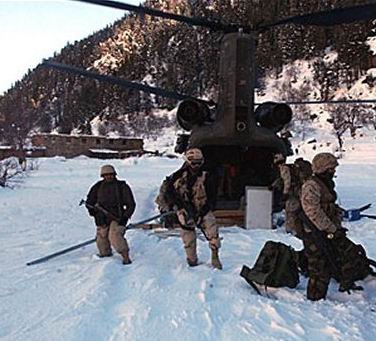
Perhaps the most notable in this group was Vadim Gusev who was later arrested in Russia on charges of violating laws prohibiting mercenary activity after a disastrous encounter near Palmyra, Syria in the fall of 2013 that exposed his links to the Wagner Group.17 Pictured in desert camouflage and sporting a tan t-shirt with a RusCorp logo on the sleeve, photos of Gusev on a detail in Iraq dated around 2005 provide the first hint of the elaborate corporate architecture that would eventually form the backbone of one of the world’s largest state-sanctioned paramilitary cartels.
Figure 2. Vadim Gusev on Duty for TigrTop-RusCorp Baghdad 2005 18

In 2008, Isakov’s Antiterror Orel Group was leading a team of former Vympel sappers charged with a massive cleanup of unexploded ordnance in preparation for the construction of the South Stream pipeline, a joint oil streaming venture between Gazprom and Italian energy major Eni that was halted after the annexation of Crimea.19 It was this deal that cemented the Antiterror Orel Group’s prominent place in the pantheon of Russian PMSCs and was likely partly responsible for the re-incorporation of the group under the aegis of RusCorp, a company registered in Moscow in 2007, that repeatedly surfaces in the digital paper trail of Russian PMSCs.20
Originally slated to run from the Black Sea across southeastern Europe, the South Stream pipeline would ultimately be managed by a conglomerate of Russian-European energy companies that established a joint corporation in Zug, Switzerland.21 Perhaps not coincidentally, Putin signed a joint pipeline agreement with then Italian Prime Minister Silvio Berlusconi in the Black Sea town of Sochi in 2009, only a few months after a Kremlin-connected firm called Emercom Demining won a major contract to demine a substantial portion of the South Stream pipeline pathway in eastern Europe.22
As part of a humanitarian assistance package with Russia, Serbia’s Mine Action Center awarded Emercom Demining company the contract.23 This contract supported a joint Russian-Serbian team of sappers, which Isakov noted,24 in successfully clearing the Nis airport nearly a decade after NATO dropped tons of cluster munitions on the site. The connections the Antiterror Orel Group made in Serbia proved enduring, later emerging as node in a Balkans-based network of recruitment and training centers that deployed dozens of Serbians who joined pro-Russian separatist units in eastern Ukraine.25 Many who joined battalion tactical groups (BTGs) in this network, such as Batman, 1st Slavyansk, Prizrak and the International Brigade, would later engage in some of the most intense fighting in Donbas.
As reported by Novaya Gazeta reporter Roman Anin for the Organized Crime and Corruption Reporting Project (OCCRP), Emercom Demining, the Russian state-owned company that oversaw the team of Russian sappers affiliated with the Antiterror Orel Group, had already had several lucky breaks in winning major Russian government contracts by then.26 With operations spanning from Sri Lanka to Iraq, the confederation of former Vympel, Alpha, Vityaz, and VDV special operators attached to Emercom Demining became one of the biggest beneficiaries of Russian state largess. Emercom won bids on major mine clearing and infrastructure protection campaigns that appeared to track closely with Gazprom and Transneft’s efforts to branch into new markets for offshore extraction and pipeline construction ventures.
Antiterror Orel Group’s early success was due in large part to Emercom Demining’s chief, Oleg Belaventsev. A former KGB officer and Russian navy vice-admiral who went to school in the Crimean town of Sevastopol, Balaventsev served several tours on a nuclear submarine in 11th fleet and tours with the Black Sea 5th Fleet before a stint at the Soviet embassy in the United Kingdom that ended ignominiously when he was expelled—along with two dozen other alleged spies—after the KGB’s chief of station in London defected in 1985.27
Interestingly, after his expulsion from the UK, Belaventsev went on to work for a time in East Germany— around the same time Vladimir Putin was stationed there with the KGB—and later went on to serve from 1995 to 1999 as deputy director of Rosvooruzhenie, an arms export division that was later absorbed into Rostec.28 It was not long after that, according to the OCCRP, Belaventsev hitched his star to Sergei Shoigu, a civil engineer who, with Belaventsev at his side, led an early iteration of Russia’s emergency response corps and later became the first to head the Ministry of Extraordinary Situations, also known as the Ministry of Emergency Situations or EMERCOM for short.29 In addition to disaster response, EMERCOM would play a key role early on in peacekeeping missions in the disputed Georgian regions of Abkhazia and South Ossetia and the Balkans as well as supporting counterterrorism response in Chechnya and Dagestan.
After Shoigu became a leader in Putin’s pro-government Unity party, Belaventsev was appointed as head of the Emercom Demining company in 2001—remaining in the role until 2012—a semi-private firm that won millions of dollars in contracts that Belaventsev snagged for the firm using his contacts at the EMERCOM agency. A few years after departing for another Russian government post in the Moscow District, Belaventsev was appointed by Putin as special envoy to Crimea shortly after Russia annexed the embattled territory in 2014. It was around that same time when Belaventsev was appointed that several companies affiliated with him and his family began cropping up in Crimea, according to the OCCRP.30
Much like their Western counterparts at Executive Outcomes and Blackwater, Antiterror Orel Group leaders appear to have emulated the practice of rebranding and registering as different entities whenever controversies would arise over their business model or whenever fresh market opportunities were presented. The approach sprouted several other PMSC offshoots, including Redut Antiterror and Tigr-Top Rent, which interestingly traced its lineage back to Alpha and Vympel subunits that famously led the Storm-333 special operations assault on the Taj-Bek Palace in Kabul that resulted in the assassination of Hafizullah Amin in Afghanistan, later forming the core intelligence and counterintelligence units active in the Soviet-Afghan war.31
It was during this period that Antiterror Orel Group likely reconsolidated under the auspices of RusCorp, an ostensibly private Russian firm registered initially in Moscow in 2007,32 which like Antiterror Orel, serviced state-run enterprises, such as Gazprom.33 In fact, according to an archived version of RusCorp’s defunct website, the PMSC firm was effectively set up as a holding company for the small confederation of PMSC contingents affiliated with the Antiterror Orel Training Center.34
Figure 3. Archived Snapshot of RusCorp Website35
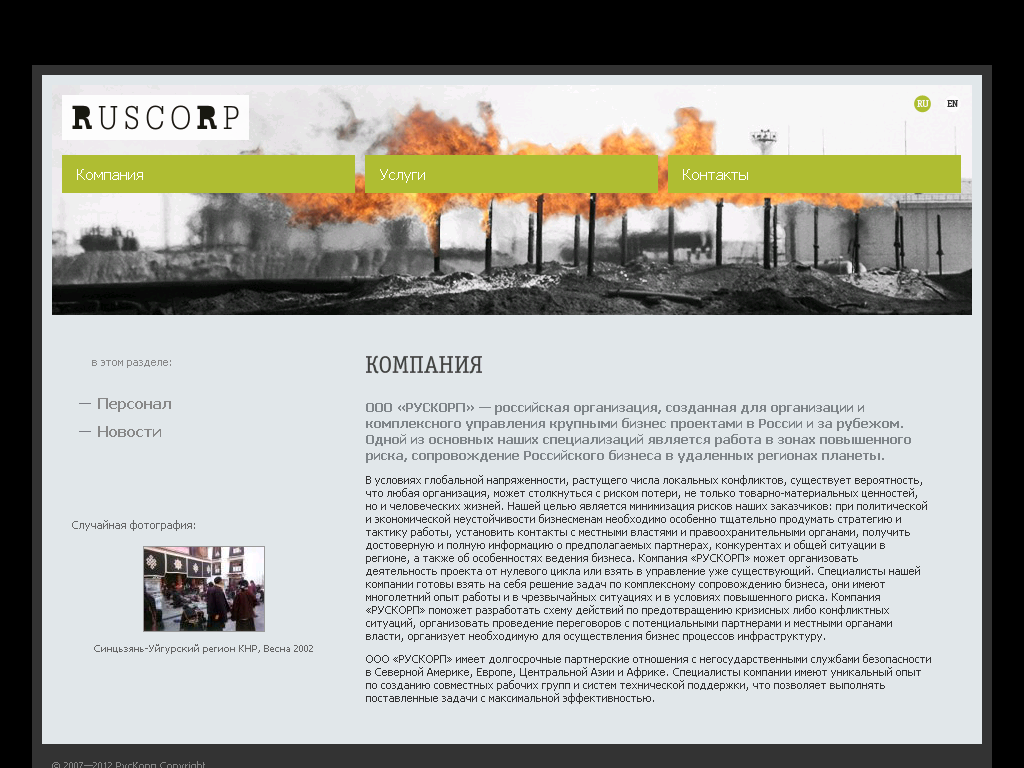
According to archived versions of RusCorp’s website and a Facebook account listed for RusCorp, the company specializes in business intelligence, risk analysis and VIP and general protection services. RusCorp’s leadership at one point included Alexey Eduardovich Danilyants.36 A one-time Moscow resident, Danilyants for a time, at least, was the most visible face of RusCorp’s operations.37 According to interviews Daniliyants gave to several Russian media outlets at the time, Danilyants38 served as RusCorp’s vice-chairman. Public records indicate RusCorp affiliates also appear in corporate registries in Cyprus, Singapore, and the United Kingdom. According to U.K. and Cyprus registries, Danilyants was also registered as a director with companies with names similar to RusCorp.39
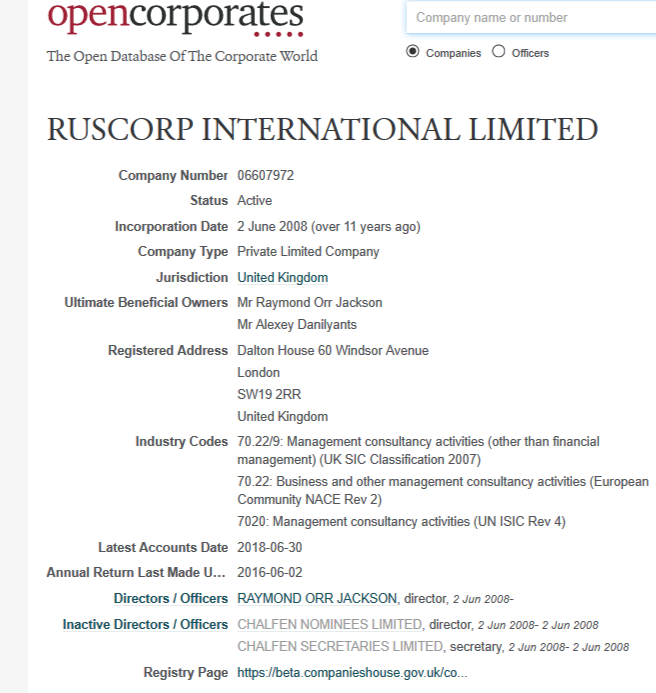
The U.K. corporate registries listed Danilyants in forms filed in 2008 as a principal for a UK registered company called RusCorp International Ltd.40 Beyond the coincidental listing of Danilyants as a director for the RusCorp International Ltd., it is not entirely clear how the U.K.-based firm relates to the Russian registered firm, but the British firm registered originally under Danilyants’s name not only appears to have shared a similar ownership structure, but the same U.K. address as that listed for RusCorp’s British offices on an older version of RusCorp’s website.41
In fact, an online search turns up a number of companies around the world bearing the RusCorps International name. One based in Brazil and registered to the same owners in Florida appears to have links to a Rostec subsidiary that provide engineering services and products and services for extractive and energy industry projects.42 According to OpenCorporates listings, Antonio Carlos Rosset Filho registered as an agent of RusCorp International LLC in December 2015. OpenCorporates lists the status of the Orlando, Florida based company as inactive. According to Russia’s Integrated Economic Information Portal (IEIP), a company listed as RusCorp Russian International based in Brazil is also linked to Rosset. A website listed in the IEIP for that same company indicates that Rosset serves as a member of the Russia-Brazil Chamber of Commerce.43 A slideshow presentation posted on the website of VSMPO-AVISMA, a Rostec subsidiary, depicts Rosset posing with Vladimir Putin and indicates that RusCorp International at one time was the primary purveyor of goods produced by other Rostec linked subsidiaries.44 One slide in the presentation for instance lists Yotaphone, NPO Saturn Turbines, and Minsk Tractors as products distributed by Rosset’s RusCorp International.45
Figure 4. Photo of Carlos Rosset and Vladimir Putin from RusCorp International Slideshow46
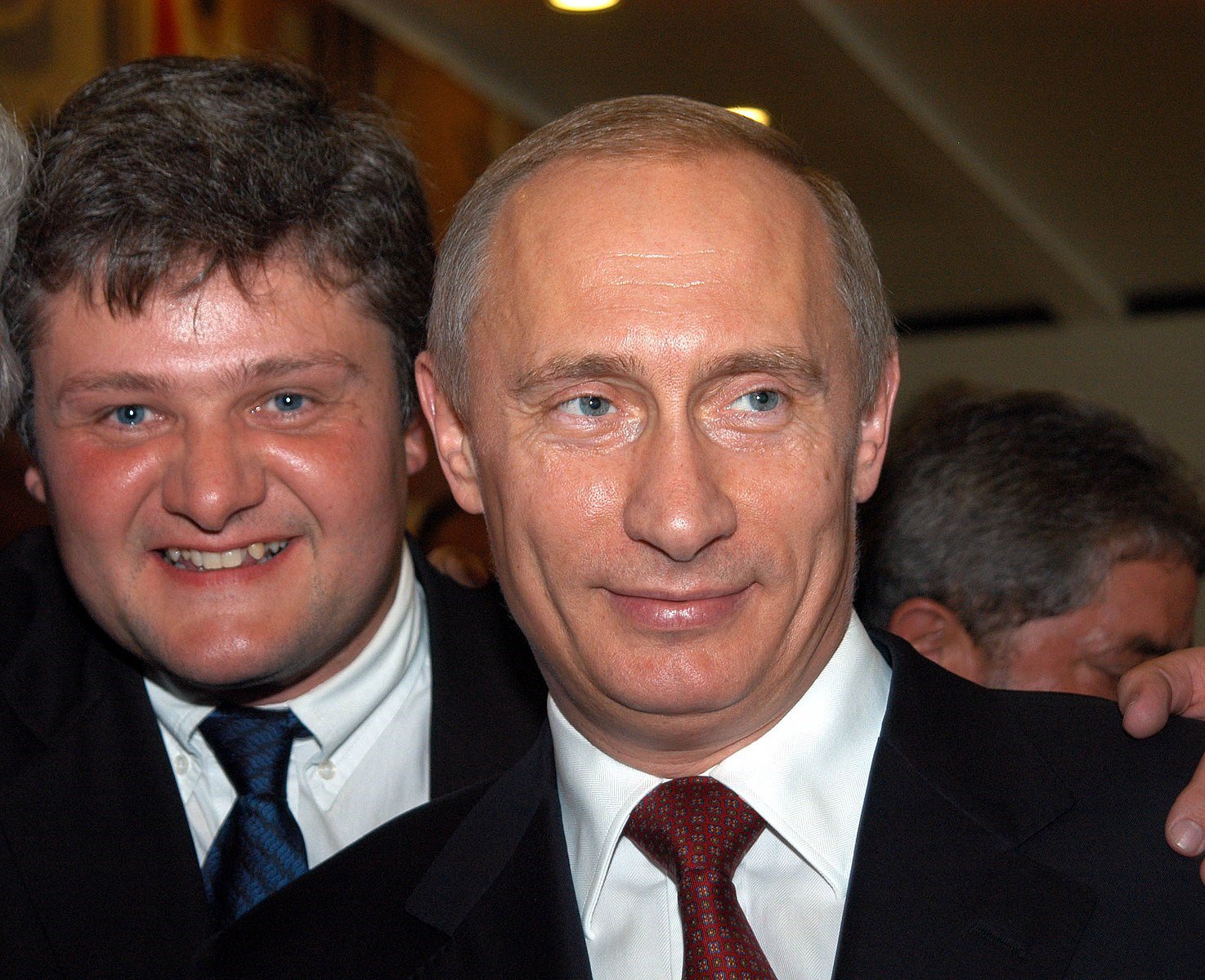
Figure 5. RusCorp International UK Registry Record-Open Corporates47
Archived versions of RusCorp’s website and a Facebook account under the RusCorp name indicate that, in addition to security services, the firm also provided security risk intelligence services under the rubric of its related Independent Research Task Force (IRTF).48 Another site advertising RusCorp’s services along with several other PMSCs indicates that along with its U.K. offices RusCorp at some point also had offices in the United States.49 Interestingly, IRTF-RusCorp at one point also adopted the name “Special Projects Task Force,” a common spetsnaz moniker.50 Many of the photos posted on RusCorp-IRTF’s Facebook page track closely with several of the locations where companies servicing Emercom Demining and/or Antiterror Orel or all both also worked, including locations in Sri Lanka, Afghanistan, Syria, and Iraq.
Figure 6. RusCorp Facebook Account Photo Stadium in Colombo, Sri Lanka, posted 2012
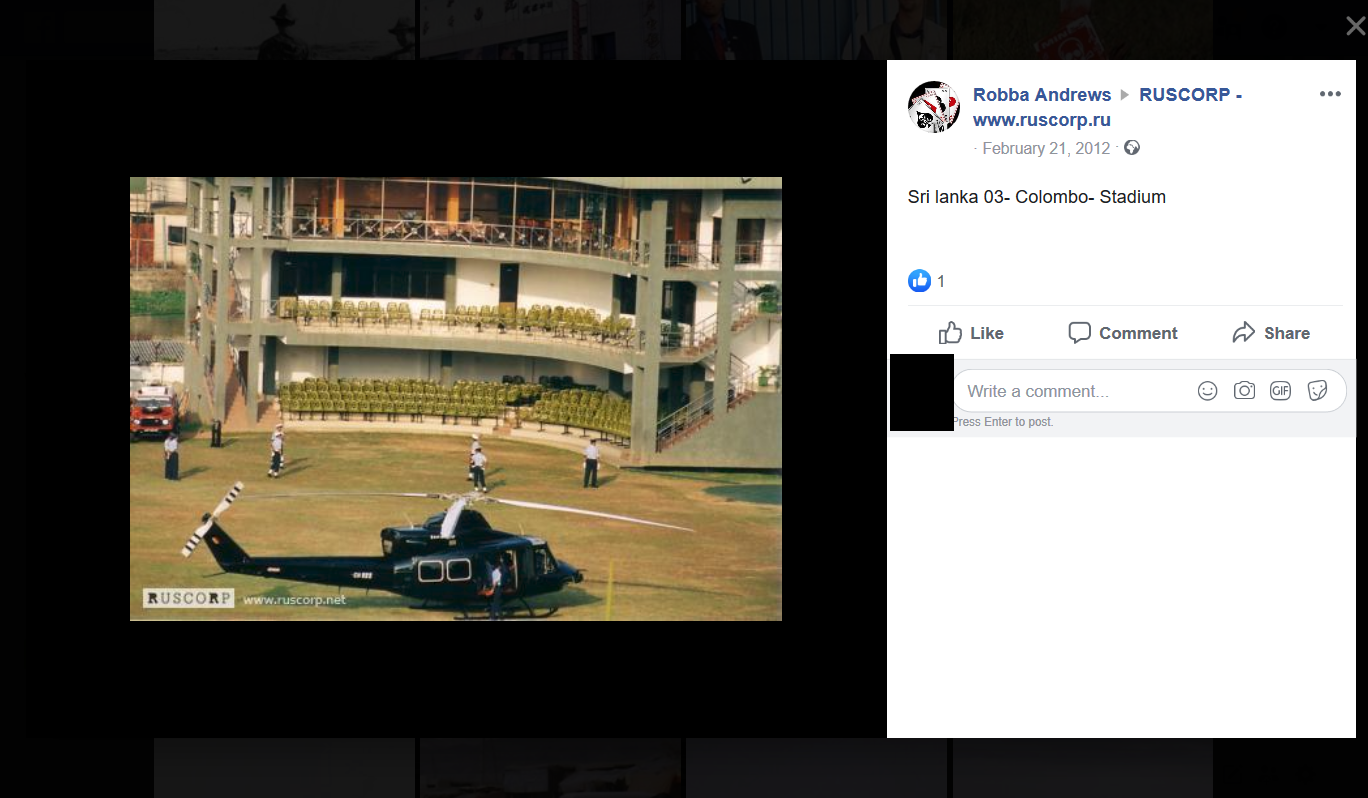
According to a July 2009 Reuters report,51 it was on Danilyants’s watch as vice-chairman, in fact, that RusCorp-IRTF would win one of its first big contracts for the provision of pipeline security in Nigeria on a multi-million dollar Gazprom joint enterprise with the Nigerian National Petroleum Corporation. It is also in Nigeria where outlines of the overlapping networks of Russian contractors variously affiliated with RusCorp, the Antiterror Orel Group, and the consortium of Russian veterans’ associations appear to intersect most clearly with another important player in Russia’s PMSC industry: the Moran Security Group.
Exploring the Moran Security Group-Wagner Connection
Headed by Vyacheslav Kalashnikov, a former KGB officer who served as an assistant to Kremlin insider Alexander Torshin,52 Moran was one of the first PMSCs to jump into the counter-piracy market in the 1990s and quickly locked in millions in annual revenue guarding ships for Sovcomflot, FEMCO, Murmansk Shipping, and United Marine, Russia’s largest shipping concerns.53 Although Boris Chikin, one of Moran’s founders dates the founding of the group to 2010, Moran’s website indicates that it was officially registered in Belize in 2011.54 A timeline on Moran’s website, however, attributes its origins to the late 1990s when concerns peaked within the Russian government about the risk posed by increased piracy along major maritime routes from the Gulf of Aden to the Indian Ocean.55 Moran specifically cites the PMSCs’ involvement in the rescue of an oil tanker nabbed by Sudanese pirates in 1999 and in company presentations refer to its close cooperation with the Russian Navy on numerous anti-piracy missions for energy transports.
Since few if any Russian PMSC companies in 1999 operated outside Russian territory that were not affiliated with the security divisions of major state enterprises, Moran’s organizational origins likely draw on the same legal architecture as many of the privatized militaries attached to state-run companies that began to crop up in the late 1990s. Indeed, Chikin and Alexey Badikov, another leading Moran manager, have said as much publicly.56 Both indicated that PMSCs operate under contract to state-run enterprises under of the auspices of joint military operational teams overseen by Russia’s Ministry of Defense.57 In many cases, it is much more accurate then to characterize the PMSC contingents that work with organizations like Moran as auxiliary privateer detachments that serve a network of militarized state-owned Russian corporations.
Officially registered as a corporate entity in Moscow in 2011, the Moran Security Group bills itself as a group of companies specializing in maritime security, risk assessment, VIP security, and infrastructure protection.58 Old versions of the company’s website dating back to January 2010 indicate Moran operated in Iraq near the Syrian border, Somalia, and Afghanistan and also advertise details about its land-based operations, which include mine clearance, reconnaissance and surveillance, and pipeline protection.59 Registered at various times as the Moran Security Group and/or the Moran Maritime Group, the PMSC appears in offshore company registries around the world.60 Moran is partially owned by Neova Holdings Ltd., an offshore holding company registered at one time in Belize, according to the OpenCorporates registry.61
According to research conducted by Vladimir Neelov, a St. Petersburg-based expert on Russian military affairs, Neova Holdings Ltd. counts as one of its affiliates the public joint stock company Novaem Group, a Russian energy industry, pipe-making, and machine-building conglomerate formed from a merger of Sibenergomash, TM Engineering, Trubmash, and other Russian companies in 2009.62 Public records and company websites for several Novaem subsidiaries indicate the holding company conglomerate has links to multiple Russian-owned companies, including Technopromexport, a joint-stock engineering firm partially owned by Russia’s top arms purveyor, Rostec.63 Older versions of the Moran Security Group company website also list offices in Bedford, New York and Bremen, Germany64 at addresses that match those for the South Asia and Africa Regional Port Stability Cooperative, a maritime safety and anti-piracy organization, also known as SAARPSCO, with offices also listed in Seychelles and KEAMSCO, a Kenyan based affiliate.65
Sovcomflot and its affiliate the SCF Group constitute Moran’s biggest clients. Headed by former Russian Transportation Minister Sergei Frank, Sovcomflot operates one of the world’s largest merchant fleets, specializes in the transport of oil and gas and related production equipment and supplies the energy giant Gazprom.66 In addition to Sovcomflot, Moran counts among its partners and clients Sogaz, which until recently was majority owned by Gazprom and more recently majority owner of Transneft insurance. New York based Marsh, part of the Marsh & McLennan Companies insurance conglomerate, is also listed as a key partner on Moran’s website and like Sogaz is primarily engaged in the financially lucrative reinsurance sector.67
Moran’s business dealings with Sovcomflot in Nigeria resulted in the first major public scandal involving the PMSC in the fall of 2012. According to press reports and UK court documents filed by a Nigerian businessman in connection with the case, Nigerian navy officers raided the Myre Seadiver and arrested 15 members of the Moran Security Group on charges of weapons smuggling. A search of the ship reportedly uncovered a cache of weapons that included more than a dozen AK-47 assault rifles, 20-plus Benelli MR1 rifles, and 8,000 rounds of ammunition.68 The weapons cache was enough to outfit a platoon, or maybe even two, but not quite enough to constitute a charge of smuggling. Nigerian officials nonetheless charged the ship’s crew with arms smuggling when the ship arrived in the Gulf of Guinea after sailing from Baltyisk, a busy port in the heavily secured northern Russian region of Kaliningrad.
The arrests of the Myre Seadiver crew prompted vigorous protests both from Moran’s Managing Director Alexey Badikov and deputy director Vadim Gusev, the very same veteran of the Antiterror Orel Group who had apparently also served with RusCorp in Iraq.69 The ship’s crew remained in custody for several months before Sovcomflot’s Senior Executive Vice President Evgeny Abramasov pressed Sovcomflot’s partner Glencore International to reach out to local contacts in Nigeria in April 2013 to intercede on their behalf. The New York- and Germany-based head of SAARPSCO, Hans Niebergall, also rejected the charges of weapons smuggling and said he too pressed for the Moran crew’s release.70 Nigerian authorities ultimately dropped the charges against the Moran crew in October 2013, almost a year to the day after their arrest.
However, Moran’s run-in with Nigerian authorities would later surface as a key point of contention in a 2015 lawsuit filed against Glencore in U.K. courts in which the head of Glencore’s local Nigerian partner alleged that Glencore had failed to pay him millions owed for work he did to secure the Moran crew’s release.71 Sir Og Amazu, the head of Amazoil, a Nigerian oil company that facilitated Glencore’s local liaisons, claimed in the suit, press accounts, and a subsequent interview in the spring of 2018 that Glencore said it would pay him $5 million for his help in the Moran crew case in Lagos through an offshore company called Glimer Ltd.
Although the suit was later dismissed, Amazu in an interview said he believed Glimer Ltd was registered in Cyprus.72 Amazu further contended in that interview that the remainder of the payment he was due never came through despite multiple calls with Glencore’s Moscow representatives.73 Amazu claimed he was unable to find out more about Glimer Ltd., and there is very little listed about the company online, beyond references to companies with the exact same name that appear to have links to energy firms in Russia and Slovakia.74 Glencore officials, in interviews given to the press shortly after Amazu filed suit in 2015, denied any wrongdoing and called the claims “baseless.”75 By then, however, years had passed, the peaceful protests of the Arab Spring had turned violent and the events in Syria had already overcome the 2012-2013 drama over Moran Security Group affair in Nigeria.
Citations
- “Wagner Group,” Wikipedia, accessed 9/30/2019, source.
- U.S. Treasury, Press Release, “Treasury Designates Individuals and Entities Involved in the Ongoing Conflict in Ukraine,” June 20, 2017, source
- The term siloviki is typically translated "strongmen" (from Russian сила, "force") and originated with the phrase "institutions of force" (Russian: силовые структуры). The colloquialism typically refers to political and business powerbrokers who once served in or have strong ties to successor organs of the KGB and other security services.
- The registry for the veterans group can be found at: source ; An archived version is available at: source
- Registries for further companies registered under Epishkin’s name can be found at: source ; An archived version is available at: source
- See archived version of the Anti-Terror Orel website here: source ; See also: Sergey Sukhanin, “From ‘Volunteers’ to Quasi-PMCs: Retracing the Footprint of Russian Irregulars in the Yugoslav Wars and Post-Soviet Conflicts,” Jamestown Foundation, June 25, 2019. source
- For more background on Rusich see: Belsat, “Russian neo-Nazi who killed Ukrainians, trained Belarus teens now fighting in Syria,” Oct.20, 2017. source
- Author interviews, Kyiv, Ukraine, February-March 2019.
- Igor Popov, “Soldat Na Prokat” (“Soldiers for Rent”), Forbes.ru, Sept. 3, 2010, source .
- Several business linked to Epishkin explicity make reference to “Alpha” units and “Soldiers of Fortune”; see registry for full listing of each: source
- The registry for “Soldier of Fortune” can be seen at: source ; An archived version is available at: source
- Popov, op.cit., 2010.
- Bloomberg Billionaires Index-2019, “#409-Suleiman Karimov,” source
- An archived version of the registry for the Association of Veterans of Peacekeeping and Local Conflict Missions can be found at: source
- Makhotkin’s bio can be seen at: source; source
- An archived version of the journal can be found at: source
- Fontanka, “Poslednii Boii Slavyanskovo Kora,” (“Последний бой «Славянского корпуса»,” “Slavonic Corp’s Last Battle,” Nov. 13, 2014, source
- An archived version of the site hosting the photo of Vadim Gusev on duty in Baghdad can be found at: source
- Enerpub, “Eni and Gazprom sign gas pipeline accord for EU,” June 23, 2007. source
- According to Russian corporate registry records, a woman named Tatyana A. Belayeva is listed as the company director for a company called “RusCorp Group Limited,” which was registered in Moscow in 2006. Those same records indicate Vyacheslav S. Yurichnik and Alexander N. Muravyev, two men who also once owned their own PSCs, as additional stakeholders in RusCorp: source.
- Jacob Gronholt-Pedersen and Alessandro Torello, “Companies Sign South Stream Deal,” The Wall Street Journal, Sept. 16, 2011, source.
- Politinka, “Ruski Demineri Ciste Trasu Juznog-toka,” (“Russian Deminers Clean the South Stream”), April 24, 2009, source
- Nick Cumming-Bruce, Katherine Harrison, et. al., “Clearing Cluster Munition Remants,” Mine Action Monitor, Norwegian People’s Aid, 92, source
- Popov, op.cit., 2010.
- Interview with senior Western diplomat, Kyiv, Ukraine, November 2018. See also: Maya Zinavovic, “Donbass Brothers: How Serbian Fighters Were Deployed in Ukraine,” Balkan Insight, Dec. 13, 2018. source
- Author interview with senior Western diplomat, Kyiv, Ukraine, Nov. 2018. For more background on Serbian contingents linked to Wagner and other pro-Russian Donbas separatists, see also: Roman Anin, Oleysa Shmagun, Jelena Vasic, Organized Crime and Corruption Reporting Project (OCCRP), “Ex-Spy Turned Humanitarian Helps Himself,” Nov. 4, 2015. source
- Michael Dennigan, “Three More Soviet Diplomats Expelled,” UPI, April 23, 1985, source ; See also: source
- According to an official biography Belaventsev posted on St. Petersburg Maritime Assembly website, Belaventsev also worked for a time for Promexport, another military-industrial firm that was consolidated under Rosboronexport and later, Rostec. source; source
- Roman Anin, Oleysa Shmagun, Jelena Vasic, Organized Crime and Corruption Reporting Project (OCCRP), “Ex-Spy Turned Humanitarian Helps Himself,” Nov. 4, 2015. source
- Roman Anin, Oleysa Shmagun, Jelena Vasic, Organized Crime and Corruption Reporting Project (OCCRP), “Ex-Spy Turned Humanitarian Helps Himself,” November 4, 2015. source
- The Zenit and Grom subunits are widely credited for leading the 1979 raid on the seat of Afghan political power in Kabul. Soon after Storm-333 the Soviets also introduced the Kaskad and Omega intelligence task forces in 1980. These specific units are considered part of the Vympel lineage. For a detailed historical account of the Storm-333 operation see: Aleksandr Antonovich Lyakhovskiy, Inside the Soviet Invasion of Afghanistan and the Seizure of Kabul, December 1979, Cold War International History Project, Working Paper No.51, Woodrow Wilson Center for International Scholars, January 2007. source ; and Mark Galeotti, Spetsnaz: Russia’s Special Forces, Oxford: Osprey Publishing, 2015, 27.
- Information on RusCorp can be found at: source; UK Companies House Registry Number 0066079272, Annual Filing 363a, June 30, 2009
- Fedor Butsko, “Rossiya sozdayet bizness-armyu,” (“Россия создает бизнес-армию,”, “Russia Creates a Business Army”) Vzglyad, March 21, 2008, source
- The June 4, 2008 archived version of the RusCorp site can be found here: source
- An archived version of the RusCorp website can be seen at: source
- Felix Onuah, “Nigeria signs oil pipes deal with Russia's Ruscorp,” Reuters, July 30, 2009, source
- Fedor Butsko, “Rossiya sozdayet bizness-armyu,” (“Россия создает бизнес-армию,”, “Russia Creates a Business Army”) Vzglyad, March 21, 2008, source
- Spelled “данилянц” in Cyrillic, public records indicate “Daniliants” as an alternate translation of the name. English language press accounts transliterate the name as Danilyants; that spelling is therefore used throughout.
- For details on RusCorp corporate registry information see for instance: source
- The registry for RusCorp International Limited can be seen at: source
- An archived version of the RusCorp website can be found here: source and references to British offices can be found here: source and elsewhere on other archived versions of the site.A full corporate filings history of RusCorp International Ltd. can be found on the UK Companies House registry site here: source
- According to Open Corporates listings, Antonio Carlos Rosset Filho registered as an agent of RusCorp International LLC in December 2015. OpenCorporates lists the status of the Orlando, Florida based company as in active. See: source
- See Russia-Brazil Chamber of Commerce website: source ; source
- The slides can be found at: source
- Ibid.
- Additional photos of Carlos Rosset were located on this Flickr site: source
- A full accounting of RusCorp’s UK Companies House registry filings can be found here: source
- RusCorp’s Facebook page can be found at: source ; A version is archived at: source
- The site advertising RusCorp services and showing offices in the United States can be found at source ; A version is archived at source
- A logo bearing the name can be found at: source
- Felix Onuah, “Nigeria Signs Oil Pipes Deal with Russia’s RusCorp,” Reuters, July 30, 2009, source
- Kalashnikov’s bio including his link to Alexander Torshin can be found on the Moran Group’s website archived here: source
- Igor Popov, “What Were the Russian Sailors Accused of Smuggling Arms Up to and How Much Did They Earn?” Forbes. Ru, April 2, 2013, source
- Igor Popov, “What Were the Russian Sailors Accused of Smuggling Arms Up to and How Much Did They Earn?” Forbes. Ru, April 2, 2013; source ; source
- An archived version of the website is available at: source ; also archived at source
- Boris Chikin, “Bizness-Razvedka,” (“Business Warrior,”) Mir Bezopastnosti, Feb. 2015, source; Alexey M. Badikov, “O Perspektivakh Pravova Regulirovaniya Deyaltnosti Chasnikh Voennikh (Okrhanikh) Kompaniy v Rossiski Federatsiy: Vglad iz Industrii” Expert Opinion: Perspectives on the Regulatory Regime
- Alexey M. Badikov, “O Perspektivakh Pravova Regulirovaniya Deyaltnosti Chasnikh Voennikh (Okrhanikh) Kompaniy v Rossiski Federatsiy: Vglad iz Industrii” “Expert Opinion: On the Prospects of Legal Regulation of the Activities of Private Military (Security) Companies in the Russian Federation, A View from the Industry,” Voennoe Pravo Rossii, Oct. 24, 2017. source
- Kimberly Marten in her March 26, 2019 article for Post-Soviet Affairs references two separate filings for Moran in Russian corporate registries. Records under links in rusprofile.ru that Marten included as references appear to have been expunged since. Kimberly Marten, “Russia’s Use of Semi-State Security Forces: The Case of the Wagner Group.”
- An archived version of the Moran website can be found at: source ; also at source
- Information about Moran’s registration can be found here. source; source
- The registry for Novaem Group can be found at: source
- Vladimir Neelov, Chastnoe Voenoye Kompanie v Rossi: Opit i Perspektivie Ispolzovaniya (“Private Military Companies in Russia: Practices and Perspectives on Their Use,” 2013, 26. source For details on Novaem see company page: source ; the Novaem site is archived at source Additional information about Novaem and its holdings can be found through a search of Russian company registries: source Russian company registries list Vitaly L. Chernomor as the director of Novaem. Chernomor in a February 16, 2012 guest contributor column in Forbes.ru, details the history of the formation of the Novaem holding company and its links to various machine building and boilermaking plants. See: Vitaly Chernomor, “Has the Era of Factory Acquisitions Ended?” (“Vremya skupat zavodi ne zakonchilos,” “Время скупать заводы не кончилось?”), Forbes.ru, February 16, 2012. source For further details about Novaem’s various holdings and company affiliations see: source
- According to Tekhnopromexport’s website, Rostec owns a 35 percent share of the company, source
- A version of the Moran website showing those listings can be seen at: source
- Websites for SAARPSCO and KEAMSCO list Hans J. Niebergall as President and CEO. On a company website for another company Niebergall has links to, Niebergall International lists KEAMSCO as an affiliated company and lists the same phone number and address in Bremen, Germany and Beford, New York as for those listed for SAARPSCO, KEAMSCO and that indicated for Moran Security Group on older versions of its website. The Moran Security Group site has also consistently listed SAARPSCO on its webpage. In a January 2013 Niebergall was quoted in an online blog calling for the release of Moran Security Group crew members on board the Myre Seadiver. See: The Nation, “International group calls for release of Russian sailors, ship,” January 13, 2013. dohaforum.org See also. Niebergall International Website: source See archived version of Moran Security site: source; See also SAARPSCO website contact information: source; source
- James Lewis, Rob Evans, and David Leigh, “Russia Seeks Extradition of Shipping Magnate in UK,” The Guardian, Feb. 1, 2008, source
- The Moran website is archived at: source
- BBC “Nigerian navy detains Russian crew over arms,” Oct. 23, 2012, source.
- Maritime Security Review, “Russian Crew Arrested in Nigeria,” Oct. 24, 2012, source.
- The Maritime Executive, “SAARPSCO Responds to Suspicions Surrounding Member Vessel, MYRE SEADIVER,” Oct. 24, 2012, source. In the article cited above Hans Niebergall is listed as a SAARPSCO representative and Niebergall is also listed as president of KEAMSCO on the organization’s website: source
- Marcus Leroux, Richard Fletcher, “Nigerian Trader Sues Glencore for $10 million,” Reuters, June 23, 2015, source.
- Information about Glimer Ltd. is limited but a search of open records published online unearthed references to Glimer Ltd. in a company audit performed by Deloitte & Touche for Neftisa, a Russian oil firm that is part of the Safmar Group of energy companies. The Neftisa audit does not indicate specifics about the relationship between Glimer Ltd. The audit document only lists debits and credits on Neftisa’s balance sheets and there is no explanation about Neftisa’ $2.4 million loan to Glimer in 2012. Emailed requests for information about Nefitsa’s business dealings with Glimer had not received a response by the time this report was ready for publication.
- Interview with Sir Og Amazu, Facebook Messenger, February 4, 2019.
- In addition to the references to Glimer Ltd. found in the 2012 Deloitte & Touche audit for Neftisa, a search of public records unearthed another company named Glimer Ltd. registered in Bratislava, Slovakia as “Glimer s.r.o.” According to online corporate registry records, the Glimer firm listed in Bratislava was initially first registered by a person named Michal Borgula on April 17, 2012. The Bratislava firm named Glimer appeared in the registry again on May 18, 2012 and also listed Slovunit, a Slovakia-based energy company headed by Borgula as an associated business entity. On Dec. 31, 2014, Glimer’s name changed to “PL Plant Sagu,” and it later appears as PV Plant Sagu in the same registry. Michal Borgula is listed as a stakeholder in several companies besides it is unclear what, if any, link there is between the Glimer once registered in Bratislava, the Glimer Ltd. listed in the Deloitte & Touche audit for Neftisa or whether there is any connection with between those firms and the Glimer Ltd. Amazu names in his 2015 UK lawsuit against Glencore. It is notable, however, that like several other firms based in Slovakia in which Borgula is listed as a stakeholder, Glimer shows a precipitous decline in revenues over its short time in existence. Registry information for Glimer Ltd. Can be seen at: source
- Javier Blass and Jesse Riseborough, “Nigerian Trader Sues Glencore Over Failed Payments for Sailors’ Release,” Bloomberg, June 24, 2001, source
