
Table of Contents
- Executive Summary & Key Findings
- Introduction
- Defining Terms & Probing the Edges of Russia’s Proxy Strategies
- Russian Military Reorganization, Modernization & The Market for Private Force
- Tracing Wagner’s Roots
- Forward Operations: From Deir Ezzor to Donbas and Back Again
- Solving the Puzzle of Russian Proxy War Strategy
- The Risks of Russia’s Proxy Warfare Strategy
- Appendix: Glossary of Terms
Solving the Puzzle of Russian Proxy War Strategy
Viewing the activities of Russian PMSCs across the Greater Middle East and its periphery reveals much about their conduct. However, understanding the role of Russian PMSCs requires a framework of analysis. The best framework is one that understands Russian PMSCs as agents of a Russian proxy warfare strategy pursuing ends that, as we have seen, share substantial continuities with prior Russian and Soviet strategic ends. However, this is not a framework of proxy warfare as powerful states moving their agents like chess pieces or a framework of Russian PMSCs as simply being disguised state actors.
Instead, as is visible in the contours of other twenty-first century proxy conflicts across the Greater Middle East, proxy warfare must increasingly be understood in terms of relationships embedded within complex networks of influence and power.1 These relationships and networks are essential to understanding both Russian PMSCs and the very Russian state that is using them as proxies. This is a framework that resists both the chessmaster vision prominent among many treatments of this subject in terms of “hybrid war” or the Gerasimov Doctrine, as well as the Russian disinformation of mere financially motivated PMSCs. A thorough understanding of Russian PMSCs and the proxy warfare strategy they are part of requires an understanding of today’s legal framework for privatized forces and an examination of Russia’s history.
Tangled Webs and Complex Networks
Much like RusCorp and Antiterror Orel, many in Moran and Wagner’s reported web of partners, brokers, and employees appear to be connected. For example, Westberg’s registered owner at one time, Oleg Smolian, like several other major players in Moran’s business networks, has cycled through maritime shipping companies that specialize in servicing Russia’s arms exports and Russian partners in the offshore energy production industry. This seems to be typical of many who appear to be part of the same network or, at minimum, appear to have affiliations with Moran, Wagner, or another entity linked to their networks.
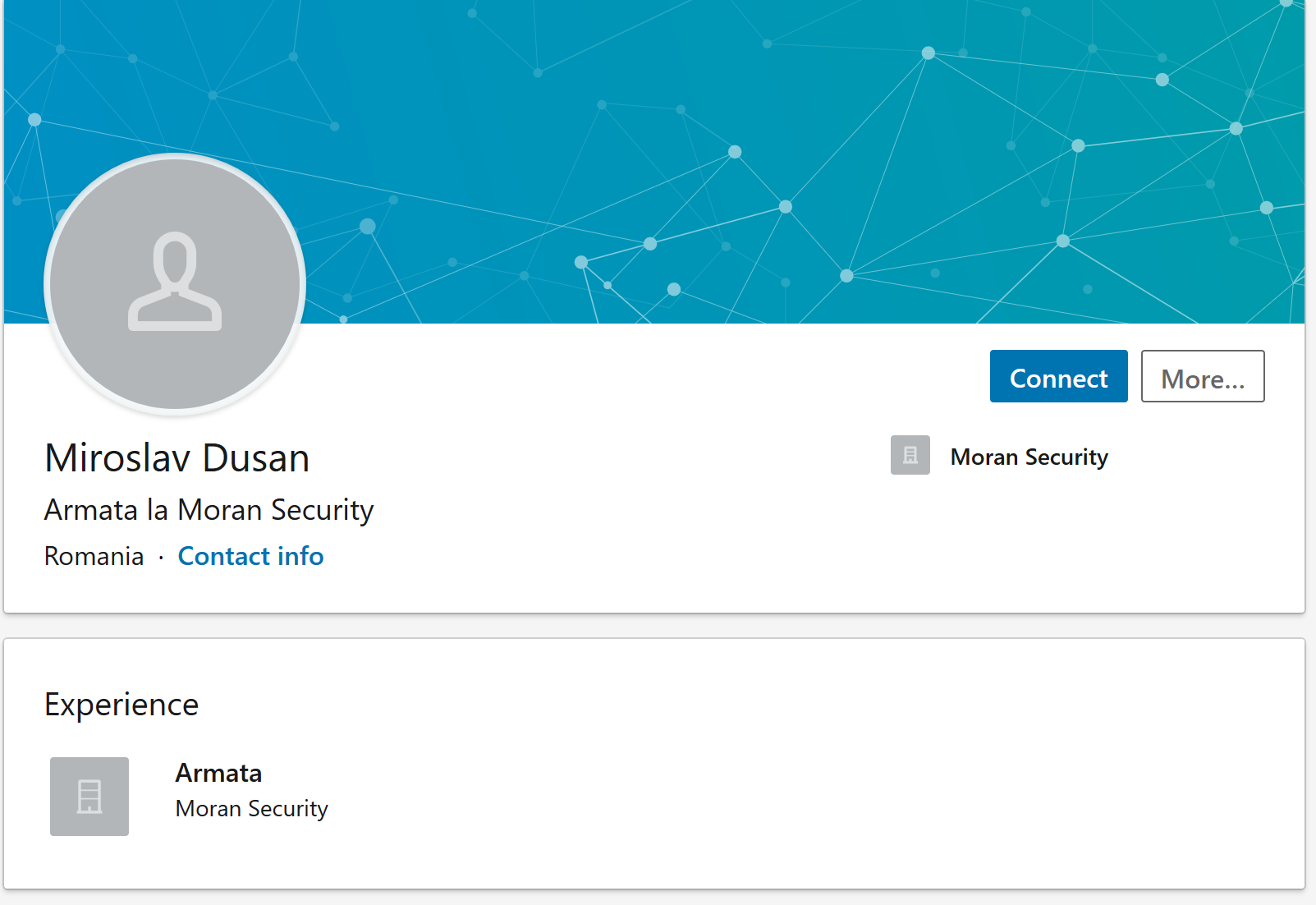
Data collected for this report suggest that besides Smolian, Gusev, Sidorov, and Wagner’s titular head, Utkin, there seems to be considerable crossover between the two ostensibly distinct PMSC detachments. A review of Facebook accounts for more than a dozen Moran employees, for instance, indicate the PMSC has operatives spanning from Turkey, Nigeria, Sri Lanka, Romania, to Serbia and beyond, some of whom openly list their affiliation with Wagner. For instance, a search for Moran Security Group employees on Facebook turned up an account for Miroslav Dusan Petrovic, the lead LinkedIn recruitment contact for the Moran Security website. A 2018 public version of Dusan’s Facebook account shows that he worked for Wagner—in addition to his stated role with Moran.
Figure 8. Facebook Account Page-Dusan Petrovic, Moran-Wagner Employee

Petrovic indicated in a Facebook post while he was in Moscow, dated September 2017, that he recently joined the Wagner Group as an employee. His account has since been made private but a video posted on his page at one time showed him rapping in front of a Russian flag with a small group of other men brandishing weapons typically used by spetsnaz operatives. A related search turned up Dusan’s personal LinkedIn page around the same time in 2018 showed Petrovic listed Moran and Wagner as his employers. As seen from a more recent screenshot of a LinkedIn profile for Miroslav Dusan, he later listed his work affiliation as Armata la Moran Security (The Moran Security Armata).
Figure 8. "Miroslav Dusan" LinkedIn Profile
Spetsnaz veterans from Russia and Ukraine also appear, at least on paper and in social media accounts, to have set up their own PMSC detachments, including several whose social media accounts indicate links to the Wagner-Moran network. The involvement of these specific individuals in the PMSC industry are not an indication of nefariousness or wrongdoing. Nor does the data indicate that the clients they may work for are involved in illicit activities. As stated earlier, many PMSC firms operate well within internationally accepted legal bounds. Beyond public records indicating the affiliation of these particular individuals with different corporate entities with links to the PMSC industry, it is difficult to ascertain their employment status or what contractual functions the PMSCs they have been affiliated with fulfill.2 It is also not entirely clear which contracting parties these particular individuals have worked with or whether the PMSCs they work for hold contracts with Russian state entities.
Digital data again, however, provides a few clues as to the business dealings of some of the Russian PMSC contingents in question, including Vega, another detachment believed to have links to Moran and Wagner. Vega has reportedly been active in Syria since 2013, protecting energy and extractive industry projects and training local forces.3 In January 2019, former pro-Kremlin ANNA News reporter Oleg Blokhin started posting photos of military instructors wearing St. George ribbons (a pro-Kremlin nationalist symbol) and Russian flag patches. Later, Blokhin posted photos and videos of the same instructors with patches of a private military company, Vegacy Strategic Services Ltd., engaged in training al-Quds fighters.4
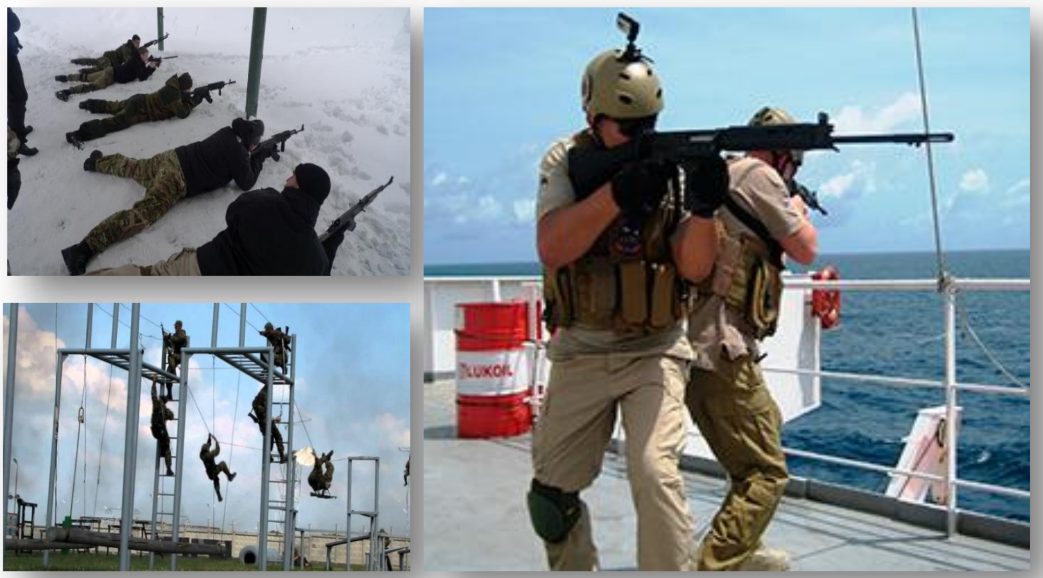
It wasn’t until March 2019 that photos and videos of Vega training pro-regime Liwa al-Quds forces near Aleppo were reported on by the Conflict Intelligence Team, but clues as to Vega’s client base are readily evident. One photo in the photo gallery of Vega’s website clearly shows a Lukoil barrel in the background.5
Figure 10. Vegacy Strategies Website Gallery Photo
Vega’s maritime exploits are not all that surprising. Registries for offshore companies, online merchant marine recruitment services, and other publicly available records also indicate a nexus with a key node in a related network of shippers, brokers, and offshore registry companies that appear to overlap with business entities reportedly linked to Yevgeny Prigozhin. According to postings on several online shipping recruitment services, several one-time Westberg employees who crewed on Moran Security Group ships worked for a Seychelles registered company called Beratex Ltd.6 Numerous media accounts suggest Prigozhin’s Raytheon Hawker private jet was registered in 2012 to a company called Beratex Group Limited.7 Priogzhin, according to media coverage, made multiple trips to Syria, Sudan, Chad, Kenya, and other locations in Africa on the plane.8 Prigozhin denied in a statement released in response to press queries that he owned or used the plane.9
Still, questions abound about Prigozhin’s involvement and how it connects to larger Russian aims. What do the labyrinthine legal and corporate twists and turns add up to when it comes to the Wagner Group and Russian PMSCs? The very complexity of the system undergirding PMSC operations hints at their larger purpose in the scheme of proxy warfare.
Joining the Dotted Lines in Russia’s PMSC Legal Regime
The majority state ownership of many of the Russian firms that do business with PMSC contingents like the Moran Security Group, Slavonic Corps, Wagner, Vega and others means the Russian state is the chief contracting party, and, therefore, responsible for their conduct. The Kremlin-backed effort to bail out the crew of Moran’s Myre Seadiver crew in Nigeria in 2013 and the decision to shut down the Slavonic Corps only a few weeks later after their offensive operations were exposed are both cases in point.
In form, Moran, Slavonic Corps, Vega, and others appear to hew closely to the normative and legally accepted definition of private-military security contractors. The public face that many Russian PMSCs present is intimately tied to the maritime shipping industry and anti-piracy operations. This is not a coincidence; the Kremlin appears to have created a quasi-legal letters of marque regime that permits PMSCs contracted to secure safe passage for major state firms such as STG and Rosboronexport to give PMSC operators wide latitude to apply the principle of collective self-defense.
On paper, this would appear to allow organizations like Moran and Wagner to interpret rules of engagement more loosely than if they were a strictly land-based force operating in a combat zone where the Russian military serves under a bilateral status of force agreement or military-technical agreement. Under international maritime law, letters of marque permit sovereign states to contract with private parties to protect sovereign property on the high seas from piracy. As noted by legal scholar Todd Emerson Hutchins, the 1982 United Nations Convention on the Law of the Sea (UNCLOS), gives “universal jurisdiction so that ‘every State may seize a pirate ship’ on ‘the high seas, or in any other place outside the jurisdiction of any State,’ but also includes complicit functions, like inciting and facilitating piratical activities, within the definition of piracy.”10
Russian PMSCs are cut considerable slack under the letters of marque regime Russia originally set up in the late 1990s to counter piracy threats. Cooperative international arrangements for collective defense of merchant vessels on the high seas also partially explain the close nexus with offshore business havens, such as Seychelles, Cyprus, Belize, and the British Virgin Islands, where regulatory frameworks for maritime trade are much looser.
Contractual arrangements with Russian state enterprises and legal provisions for joint operations in situations of national emergency provide a path for Russian PMSCs to operate as privateers. Domestic legal prohibitions against mercenary activity, therefore, are a mere technicality that in practice are only enforced when individual players in this elaborate system fall afoul of the publicly unspoken Kremlin dictum of maintaining a code of silence around sensitive covert operations.
The uniqueness of the special arrangement between state-run enterprises and Russian PMSCs like Moran and Wagner suggests the informal networks that constitute power in Russia exert considerable sway over PMSCs. Moreover, the intersecting links between individuals affiliated with various contingents of Russian PMSCs and separatist militias, Russian military associations, veterans’ organizations, and self-proclaimed mercenary communities offline and online reinforce the notion that the Kremlin covertly enables, endorses, and encourages their activities. It may very well be that many or even all Russian PMSCs operating in Syria and Ukraine meet the legal standard for a force for which Russia has overall control. Still, a not insubstantial amount of evidence would need to be compiled from primary sources and witnesses to make the case that the Kremlin maintains effective control over these PMSCs in the classic top down sense. That, however, is the point of the strategy.
Making Sense of Where Tactics Meet Strategy
The Rube Goldberg machine complexity of the legal and financial schemes propping up Russia’s PMSC industry may explain why the Kremlin seems inured to the Wagner Group ghost army mythos. The “Prigozhin as Puppet Master” narrative promotes the notion that he is a rogue profiteer, acting singularly and primarily in his own personal interest, a part of which entails keeping the Kremlin happy. However, the overlap in PMSC networks and deep historical continuities makes it unlikely that any person acting in their private capacity exerts singular control over PMSC contingents linked to the Wagner Group. The nexus between the Russian state and PMSCs like Wagner, Moran, Vega, and others is substantial. While contracting arrangements with state enterprises are generally kept under seal it is clear that at least some Russian PMSCs closely coordinate with the Russian military and cooperate with entities known to be involved in illicit sanctions-busting behaviors. This seems especially clear in the case of the Middle East region where so many of Russia’s strategic state-run enterprises operating there appear to rely on Russian military muscle to protect their interests and those of client regimes, such as Assad’s. These facts belie Putin’s assertion that Moscow exerts no control over PMSCs and so long as they don’t break domestic laws they are free to operate as they wish outside of Russian territory.11
What may be more consequential than any indirect association with Prigozhin, from a Kremlin perspective, is unwelcome scrutiny on how PMSC operations are financially supported. As it stands, Russia’s economy is already laboring under the burden of an international sanction regime due to its activities in Ukraine and Syria. With criminal and civil legal claims also pending against alleged Russian PMSC fighters involved in the downing of MH-17, the Kremlin can ill-afford more political or legal exposure.12 From a Kremlin perspective, the less that is known about the mechanics of Russian PMSC operations and their deep ties to Russia’s domestic economy, the better.
The strategy may also have domestic political benefits. As Russia scholar Stephen Blank rightly suggests, the revival of the Primakov Doctrine is intrinsically linked to Putin’s desire to deflect demands for greater democracy at home.13 Russian public support for the annexation of Crimea has generally been positive, bolstering Putin’s popularity.14 Though poll results indicate some initial nervousness in the general public about the Syria campaign, that has not translated into discontent with the military.15 One reason may be that Russian casualties are not widely publicized and when they are, they are almost always accompanied by a counternarrative that recapitulates the notion of the Wagner Group as a ghost army of mercenaries not directly tied to the state and its responsibilities to the Russian people.
Gerasimov’s Ghosts: Deconstructing “Ambiguous Warfare” and Decoding the Wagner Group
In many contemporary Western formulations, covert Russian PMSC operations are part of an intentional chaos strategy that has the twin objectives of enhancing Russia’s ability to project power and consolidating Kremlin power at home. As Oxford University scholar Andrew Monaghan, adroitly points out, in this commonly held scenario Putin is cast as a calculating grandmaster who single-handedly influences strategic outcomes and a skillful conductor, who harmonizes all the elements of government around a singular pursuit of orchestrated strategic excellence.16 Others, like Lawrence Freedman, suggest Putin has a strategy but Russia’s military engagement in Ukraine and Syria undermine Putin’s arguably higher goal of being readmitted to the great powers club.17
Beyond these differences, there is consensus, nonetheless, that restoration of Russia’s great power status in a multipolar world order has been a driving factor in Putin’s three-pronged strategy. Driving a wedge into the Euro-Atlantic alliance, reviving relations with former Soviet Union (FSU) client states, and projecting power beyond Russian borders are likely to remain central objectives for some time to come.18 Assuming those ends hold, it is an examination of the ways and means that hold the most promise for best understanding how PMSC operations fit into contemporary Russian military doctrine.
In recent years, the so-called Gerasimov Doctrine has emerged as a leitmotif in many Western attempts to explain Russia’s proxy war strategies. Although at the time it was barely noticed beyond a group of specialists, the now famous "Value of Science is in Foresight" speech given by Russia’s Chief of the General Army Staff Gen. Valery Gerasimov in February 2013 has become a touchstone of the chaos strategy camp of hybrid warfare analysts. In his remarks, which were later reprinted in Russia’s Military Affairs Courier, Gerasimov pointed to the emerging primacy of irregular forces and use of non-military means—most notably information warfare—for the achievement of strategic ends.19 Given on the eve of Russia’s military takeover of Crimea during the so-called Russian Spring of early 2014 and two years before Moscow agreed to back the Assad regime, Gerasimov’s commentary appeared in retrospect to presage a new Russian emphasis on warfare by other means.
Yet, it is telling that Mark Galeotti, the Russia expert who first coined the Gerasimov Doctrine phrase, has since cautioned that the overweening emphasis on Gerasimov Doctrine has misinterpreted the meaning of the speech.20 Rather than a clarion call for a new hybrid form of war by other means, Galeotti rightly avers Gerasimov’s take on the state of world affairs in 2013 was a warning about the destabilizing effects of Western instigation of the Color Revolutions and Arab Spring uprisings for Moscow-friendly regimes.21 Nonetheless, a kind of mythos has sprung up around the Wagner Group and Prigozhin, who is colloquially known as “Putin’s Chef.”22 Gerasimov’s doctrine, ghost warriors, and masked bands of “polite people” or vezhliviye ludi have likewise emerged as a kind of zeitgeist in much of the coverage on the topic of Russian PMSCs—so much so that the policy community risks missing the forest for the trees.
A more important takeaway from Gerasimov’s speech is how much it reflects a widely held view among the generation of Russian Cold Warriors Gerasimov came of age with about the inadequacies that continue to haunt Russia’s military preparedness. A former tank specialist and one-time battalion commander of a motor rifle brigade, Gerasimov is part of a wave of senior Russian military leaders who climbed the ranks as the Soviet army crumbled in the wake of the Soviet war in Afghanistan. That experience, successive bloody incursions into the Soviet sphere, as well as the swift U.S. military victory in Iraq in 1991 and the parallel rise of network-centric warfare in U.S. military doctrine in the early 1990s has influenced present day Russian strategic thinking and military doctrine—much more than any singular Russian general’s speech.
The United States and its EU allies appear to have missed important signals about how the ghosts of Russia’s past would end up haunting so much of its military establishment. Gerasimov and many in his cadre have openly acknowledged the many hard lessons learned from the First and Second Chechen Wars and the 2008 incursion in Georgia about “small wars.” For much of the latter half of Putin’s leadership, Russia’s power ministries have been caught up in an internal bureaucratic skirmish over how best to adjust force structures so that the military was better equipped to conduct the kind of low intensity conflicts waged by the United States in Iraq and Afghanistan.23 PMSCs fill big gaps in Russia’s ability to sustain expeditionary campaigns in the Middle East. It is Primakov’s strategic legacy and Gerasimov’s ghosts that are likely far more indicative of the present and future trajectory of Russian PMSCs than any elaborate conception of a Russian grandmaster using new hybrid war techniques to outfox American defenses. Russia’s proxy warfare strategy emerges out of specific historical developments in Soviet and post-Soviet military and economic affairs that haunt and shape its advocates.
To Cut Through the Fog Remember History
Another interpretation of the “Wagner Group as ghost army,” narrative is that it permits Russia to reinforce in the minds of its adversaries that it can almost magically mobilize thousands of forces and deploy them in secret. This fits with the reflexive control theory of using concealment and camouflage, or in Russian terms maskirovka, to nudge adversaries into self-induced deception that the Kremlin can reach far behind enemy lines without detection. This theory is not mutually exclusive to the first, and in fact only reinforces the idea that the Kremlin is far more concerned with breaches in secrecy than breaches in military conduct and legal norms.
Given how central deception has been to Russian military doctrine historically it is important to consider how the idea of Wagner fits into the bigger picture of a strategy of coercion. On the one hand the idea of the Wagner Group increases ambiguity around the nature of the relationship with the group’s sponsors. On the other, narratives about Wagner and Prigozhin may offer only one attractive but ultimately inaccurate alternative theory about how Russian PMSCs operate and fit into proxy strategies. The ambiguity created by the tension between these two theories of the Wagner case is at the heart of Russia’s concept of using disinformation and deception to assert reflexive control over its adversaries by creating confusion around desired goals.24
Since a primary objective of proxy warfare is to enhance the ability to project power by expanding influence while lowering the risk of retaliation, the strategy depends on the tactic of increasing ambiguity around the nature of the sponsor-proxy relationship. Heightened ambiguity can grant proxy sponsors significant, if sometimes short-lived, advantages, permitting “salami slicing” tactics to go unchecked by rivals.25
By “hiding the real,” and “showing the false,”26 in the case of Wagner, the Kremlin gains three distinct but interrelated tactical advantages. First, as seen in the case of Ukraine, misdirection around the patterns of deployment of thousands of Russian operatives manifested force-multiplying surprise. Second, the surprise mobilization of PMSCs in Crimea bought time for covert deployments to Donbas and Syria, speeding territorial control and enhancing Russia’s military advantages. Third, at least initially, surprise and speed in both Ukraine and Syria stoked the narrative that Russia was prepared to change facts on the ground, giving it considerably more room to maneuver at the diplomatic level in the early stages of both conflicts.
Citations
- Candace Rondeaux and David Sterman, “21st Century Proxy Warfare: Confronting Strategic Innovation in a Multipolar World,” New America, Feb. 20, 2019, source
- Several attempts were made to contract several of the individuals directly via their social media accounts and other publicly available contact information, but at the time of publication none of our inquiries received a response.
- Video of the Liwa al-Quds fighters being training by the Russian Vega/Vegacy PMC in Syria. It is their 30th day of training. The video was tweeted out of March 2, 2019 and can be seen at source
- A video show Liwa al-Quds operating in the area of al-Mallah, just north of Aleppo. The video did not show Vegacy contractors but showed buildings and military equipment that matched those in the photos on the pictures published below. ANN News, Feb. 4, 2019. source
- The Vegacy Strategies website can be found at: source
- A company called Beratex Group Limited appears in the UK Companies House registry along with several other companies bearing similar names such as Beratex SA, Beratex Limited and Beratex Inter Limited. According to the UK registry listings, Beratex Limited and Beratex Inter Limited were linked to employees of an offshore company registry service in the Seychelles. According to those records, Beratex Limited was incorporated by Stella Port-Louis, a resident of Seychelles.
- Agnes Jouaneau, another Seychelles resident, is also listed as the original sole employee Beratex Inter Limited. Interestingly, Stella Port St. Louis and Agnes Jouaneau were linked by an inquiry into a web of shell companies operated by New Zealand citizen Geoffrey Taylor and his family members that spans from the Seychelles to Belize. In 2012, the non-profit watchdog group Global Witness published the results of a special investigation into Taylor’s web of shell companies that revealed that the so-called “Taylor Network” had serviced several Russian entities and businessmen connected to the Russian mafia and Russia’s largest tax fraud scandal on record, a case linked to the death of Sergei Magnitsky, the Hermitage Capital tax advisor believed to have been killed while in Russian police custody in 2009.
- Irina Dolnina, and Alesa Morovskaya, “Spets’i i Spetsii,” (“Spies and Spices”) Novaya Gazeta, Feb. 4, 2019, source
- Dolnina and Morovskaya, op.cit., Novaya Gazeta, February 2019.
- Todd Emerson Hutchins, “Structuring a Sustainable Letters of Marque Regime: How Commissioning Privateers Can Defeat the Somali Pirates,” California Law Review 99, no. 3 (June 2011): 838.
- Office of the President of the Russian Federation, “Following Direct Line with Vladimir Putin, the President answered a number of questions from media representatives,” July 20, 2019, source
- Michelle Nichols, “Family of American killed in downed MH17 jet sues Russia banks, money-transfer firms,” Reuters, April 4, 2019, source ; BBC, “MH-17: Four Charged with Shooting Down Plane over Ukraine,” June 19, 2019, source
- Blank, op.cit., p. 3.
- The Moscow Times, “Majority of Russians Support Donbass Breaking Away From Ukraine, Survey Says,” June 11, 2019, source
- Ibid; “Syria,” Levada Center, Sept. 26, 2017. source ; Dina Smeltz and Lily Woljtowicz, “Russians Say Their Country Is A Rising Military Power; And a Growing Percentage of Americans View Russia as a Threat,” Chicago Council on Global Affairs, March 21, 2019. source
- Andrew Monaghan, “The ‘War’ in Russia’s ‘Hybrid Warfare,’” Parameters 45, no. 4 (Winter 2015-16): 65–74.
- Lawrence Freedman, Ukraine and the Art of Strategy (Oxford: Oxford University Press, 2019), 164-185.
- Andrew Monaghan, “Putin's Russia: shaping a 'grand strategy'? International Affairs (Royal Institute of International Affairs) 89, no. 5 (Sept. 2013):1221-1236.
- Valery Gerasimov, “Tsennost nauki v Predvidenii.” Voennoii Promishlenost Kuriyer 8, no. 476 (Feb. 27-March 5, 2013): 2, source
- Mark Galeotti, “I’m Sorry for Creating the ‘Gerasimov Doctrine,’ Foreign Policy, March 5, 2018, source
- Ibid.
- Neil MacFarquhar, “Yevgeny Prigozhin, Russian Oligarch Indicted by U.S., is Known as ‘Putin’s Cook,’” The New York Times, Feb.16, 2018; Luke Harding, “Yevgeny Prigozhin: Who Is the Man Leading Russia's Push into Africa?” The Guardian, June 11, 2019, source
- See: Julian Cooper, “The Military Dimension of a More Militant Russia,” Russian Journal of Economics 2, no. 2 (June 2016): 129-145; Andrew Monaghan, “The ‘War’ in Russia’s ‘Hybrid Warfare,’” Strategic Studies Institute, 2016.
- Kimberly Marten, “Russia’s Use of Semi-State Security Forces: The Case of the Wagner Group,” Journal of Post-Soviet Affairs, March 26, 2019, 7.
- Thomas C. Schelling, Arms and Influence (New Haven: Yale University Press, 1966), 66-68.
- Barton Whaley, Stratagem: Deception and Surprise in War, originally published in 1969 by the Center for International Studies at MIT, Artech House: Boston MA, 2007, 188-190.