
Table of Contents
- Executive Summary & Key Findings
- Introduction
- Defining Terms & Probing the Edges of Russia’s Proxy Strategies
- Russian Military Reorganization, Modernization & The Market for Private Force
- Tracing Wagner’s Roots
- Forward Operations: From Deir Ezzor to Donbas and Back Again
- Solving the Puzzle of Russian Proxy War Strategy
- The Risks of Russia’s Proxy Warfare Strategy
- Appendix: Glossary of Terms
Forward Operations: From Deir Ezzor to Donbas and Back Again
Incident in Palmyra: Slavonic Corps and the Birth of the Wagner Group Narrative
Within days of the October 2013 Nigerian judgment in the Myre Seadiver smuggling case, Moran Security Group surfaced in international news headlines again when one-time RusCorps employee Vadim Gusev found himself in hot water again. This time, it was after dozens of fighters affiliated with another Moran Security Group contingent called the Slavonic Corps got into a firefight near the city of Homs while serving in an area of operations that spanned to Syria’s Deir Ezzor province.1 Ostensibly owned by Gusev and managed by Chikin and the firm’s director Sergei Kramskoi, Slavonic Corps was reportedly registered in Hong Kong.2 In spring 2013, recruitment ads for Slavonic Corps began appearing on Moscow-based online bulletin boards and Gusev, Kramskoi, and Chikin successfully recruited 267 men to secure oil facilities near Palmyra on behalf of Syria’s ministry of energy.3
The group’s exploits in Syria went virtually unnoticed until ISIS claimed in October 2013 that it had killed more than 100 people in a battle near Homs—among them Russian contractors, including a Moran employee. When the Slavonic Corps contingent returned home to Russia the FSB interrogated the men and ultimately charged Gusev and Yevgeny Sidorov (another Moran veteran and partner in the Slavonic Corps venture) with violating prohibitions in Russia’s criminal code against mercenary activity.4
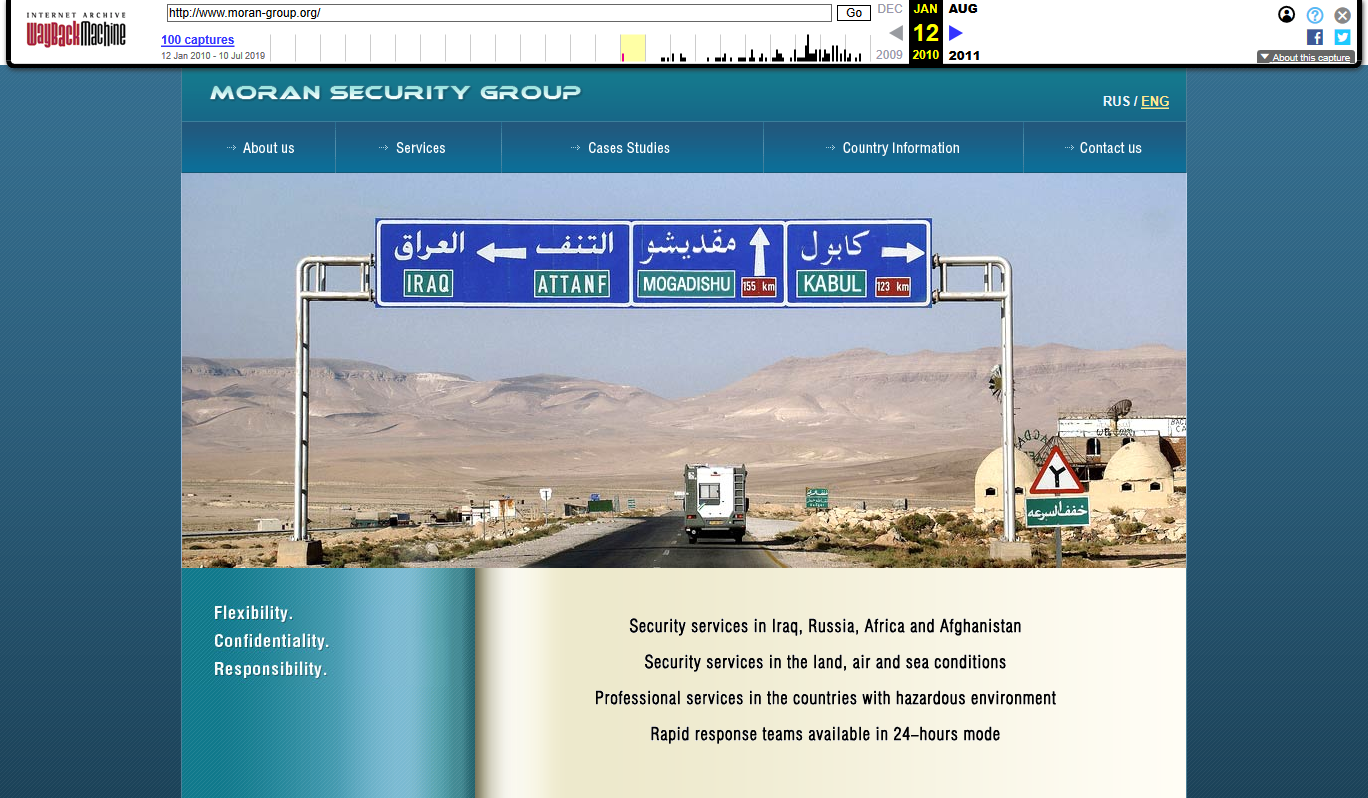
The 2013 Palmyra incident involving Moran triggered a wave of press coverage and appeared to be the first known instance in which Russian PMSC operators were reportedly engaged in offensive operations in Syria. Yet, as more details surfaced about Slavonic Corps and Moran after the October 2013 dust up, it soon became clear that Russian PMSC operators linked to Moran had been operating in Syria for at least a year by then. A 2010 version of Moran’s website indicates the PMSC had been operating near the At-Tanf border station in Syria near the Iraq border at least three years before the St. Petersburg based Fontanka news site unearthed the ties between Moran employees Vadim Gusev, Chikin, Sidorov, and the Wagner Group’s titular head, Dmitry Utkin.5
Several of the Russian state-run enterprises that form less well-advertised parts of Moran’s client base had joined the Russia-Syria Business Council years before the start of the Arab Spring. A key conduit for many of the contracts that support Russian PMSC operations, the 100-plus member business council includes high-level Kremlin insiders, including Sergey Chemezov, head of Rostec, Russia’s chief arms purveyor. Representatives from Rostec subsidiary Technopromexport, StroyTransGaz (STG), and Tatneft, three of the most important Russian state-backed entities, are also on the council.6 All three Russian corporations backed major energy and infrastructure projects in Syria before the civil war and, as a rule, generally insisted on housing their own privatized military contingents separately in the country.7
Figure 7. Moran Security Group Home Page-Archived 2010
At the start of the Syrian war in late 2011, early 2012 leading Syrian partners on the council began to leverage preexisting relations with Russian energy majors to increase their share of Syria’s burgeoning war economy. Among the most notable of these was George Hawswani, head of HESCO Co., a Syrian engineering firm that has partnered closely with STG on projects in Syria and counts the African energy companies Petrodar and Sonartarch as clients in Algeria and Sudan respectively.8 Hawswani’s business relationship with STG’s head Gennady Timchenko, a close associate of Putin, dates back well before the war.9 With HESCO Co.’s help, STG has built oil and gas infrastructure in dozens of places across Syria over the years, which have reportedly brought in millions for Timchenko, Hawswani, and their Syrian and Russian business associates on the Russia-Syria Business Council.10
At the same time, the STG-HESCO partnership has also raised red flags.11 In 2015, the U.S. Treasury sanctioned HESCO Co. and Hawswani12 for his alleged role as a middleman in oil deals made with ISIS on behalf of the Assad regime.13 HESCO Co. subsidiary International Pipeline Company also fell afoul of sanctions for allegedly facilitating payment transfers to ISIS from its offices in the United Arab Emirates.14 Hawswani’s business dealings with STG and Timchenko, sanctioned for his alleged role in connection with Russia’s intervention in Ukraine, was also another factor cited by Treasury officials for scrutiny of his business. One of the most significant pre-war deals cut while Timchenko still was a majority stakeholder of STG was a 2007 agreement for the completion of the Kirkuk-Baniyas pipeline across northeastern Iraq and Syria and the Tuweinan gas facility, just 60 miles south of Raqqa.15 In addition to reactivating contracts for projects that were halted shortly after the 2011 uprising erupted, STG more recently also inked a 49-year $500 million deal with the Syrian government for reconstruction, expansion, and maintenance of the Tartus port.16
The surge of unrest in Syria clearly was good for business for Rostec subsidiaries, STG, HESCO Co., and others on the Russia-Syrian Business Council who dealt in commodities that could easily be sold on the black market for hard currency, such as oil and phosphates. Yet, insecurity and the heavy international sanctions against the Assad regime set up a logistical challenge of gargantuan proportions for anyone looking to still do business in Syria. The political upheaval in the Middle East gave a fresh jolt to Russia’s private security industry. Once again, Moran Security was among the first to capitalize on the situation, becoming one of the first to hop on board an illicit, sanctions-busting high seas pipeline run by a consortium of Russian state enterprises known as the Syrian Express.17
The Syrian Express and the Mobilization on the Black Sea Routes
The toppling during the Arab Spring of key Arab leaders the Kremlin had spent years cultivating threatened to reverse progress Russia had made in expanding its share of the Middle East energy and arms market during Putin’s first few years in office.18 Violent unrest in Libya in early 2011 fueled deep fears in the Kremlin about the risk posed to major players like STG, Tatneft, and Rostec, which had billions invested in the country and the wider region. Those fears became more real when Russia was forced to suddenly evacuate more than 300 Tatneft employees amid violent attacks across Libya in early 2011.19
Russian PMSCs surged into the region to secure Russian assets, provide personal protection to VIPs and ensure the secure transfer of weapons. Instability in the region also presented an opportunity for Russian state firms, especially Rosboronexport, the export arm of Rostec that services the lion’s share of Russia’s foreign military-technical agreements. The United States moved to freeze Syria and Libya out of global markets and temporarily turned off the tap on military aid to Egypt, creating space for Russia to increase its influence. Pressure to quell instability in all three countries drove up demand for weapons and nudged them closer to the Kremlin’s sphere of influence.
Rostec CEO and Putin’s former KGB colleague, Sergey Chemezov, once again played a central role. After consolidating the bulk of Russia’s military-industrial complex under Rostec in 2007, Chemezov, who served alongside Putin during his KGB stint in the German town of Dresden, openly pursued a strategy of nurturing new markets for Russian arms in U.S. sanctioned states. This revitalized the 700 nearly moribund state-enterprises that were folded into the conglomerate by executive decree and built up a network of trusted brokers who could ensure secure shipments of arms and weapons platforms. In the decade since Chemezov launched Rostec’s transformation, the total volume of exports through Rosboronexport more than doubled from $6 billion in 2007 to $13.4 billion in 2017.20
Dollar for dollar, the volume of Rostec arms exports to Syria ranks it amongst the biggest recipients in the Middle East region; a majority of Syria’s arms, in fact, can be sourced to Rosboronexport.21 For Rostec, establishing covert supply chains from 2012 forward ensured safe and most importantly, discrete delivery to one of its most valuable markets. At the outset of the uprisings in Syria in March 2011, established Black Sea transit lines proved crucial in this regard, serving initially as the primary route for weapons delivery and a key source of contract work for Russian PMSCs. Later, as sanctions against the Assad regime brought more public scrutiny to bear on Russian arms transfers to Syrian Baltic sea routes also became essential, precipitating substantial shifts in the way Russian PMSCs operated.
As first documented by C4ADS, most arms exported out of Russia have for decades been shipped out of the southeastern Ukrainian ports of Oktyabrsk and Nikolaev and almost exclusively managed by a network of interlinked firms with offices in Kyiv and Odessa, just a short distance from the Crimean Peninsula.22 A few supply chain managers for Rosboronexport also operate out of the Baltic seaports of St. Petersburg, Russia and Riga, and Latvia; including several Russian state-backed shipping and chartering companies, brokerage houses, and reinsurance firms that handle war risk management and logistics for Moran Security Group clients and partners.23
The most significant among these are FEMCO, Balchart, Northwest-Shipping Company, and Westberg Ltd., the same maritime charterer implicated in the 2012 Myre Seadiver incident involving Moran crewmembers in Nigeria.24 Interestingly, a separate search of the ICIJ database indicates that an organization whose name appeared in the Panama Papers leak called Finaswiss SA and Finaswiss Foundation are listed as an intermediary for Westberg.25 At various points after the Arab Spring, Balchart, FEMCO, Northwest-Shipping, and Westberg were implicated in sanctions busting shipments of Russian arms to the Assad regime on the so-called Syrian Express.26 One of the first such shipments to come to light occurred in January 2012 after the Westberg-chartered MV Chariot stopped in Cyprus as it traveled en route from St. Petersburg to Tartous with dangerous cargo.27 Not long after the MV Chariot reached its destination, press reports documented at least three other Westberg chartered ships were caught carrying weapons to Syria, including the MV Alaed.28 When British authorities caught the MV Alaed carrying refurbished assault helicopters off the coast of Scotland in June 2012, the vessel’s British insurer, the Standard Club, canceled the shipment’s insurance, citing concerns that the arms shipment from St. Petersburg, Russia to Syria violated EU sanctions.29 The incident marked one of several instances in which U.K. or EU authorities interdicted Russian cargo ships carrying weapons to Syria early in the civil war. The loss of a key insurer for such shipments mid-2012 presented a serious challenge for Russian companies looking to do business under the radar with Syria, but also opened up new possibilities for those looking to capitalize on the growth of black market trade of embargoed commodities, including Wagner.
On the Ground in Syria and Ukraine
When ISIS began to take control of large swaths of territory in Syria in late 2012, Russian PMSC contingents evolved their mission to provide the logistical link for Russian special operators in Syria on the ground and train up local militias. The shift from more traditional protection to offensive operations mirrored developments in Russia’s efforts to mitigate risks posed by Assad regime reversals on the ground.
Local sources in Syria and data culled from Russian and Syrian traditional and social media indicate that Moran, Slavonic Corps, and Wagner were the first to take on a more offensive role. Later, two other related PMSC contingents known as Patriot and Vega stepped in to provide infrastructure protection and oversight of at least six major projects backed by Russian and Syrian members of the joint business council, including pipeline and infrastructure construction projects managed by HESCO Co. for STG in Deir Ezzor, Homs and Tartus, and power generation projects managed by Technopromexport.30
Security details for all the projects are additionally manned by local pro-Assad militias trained almost exclusively by Russian PMSCs. Most of the local Syrian forces attached to the deals have at various stages fought as contingents in the Fourth Corps and Fifth Corps. In fact, many of the more well-known sub-units in these local contingents, including the so-called ISIS Hunters and Liwa al-Quds, progressively came online as many of energy project deals were cut with HESCO Co. at the beginning of the Arab Spring. Most of the major Russian PMSC contingents working with Russian-backed businesses in Syria, which either STG or Rostec subsidiaries have trained, equipped, and fought alongside contingents of local Syrian government forces, such as Liwa al-Quds.
Following a series of running battles near Palmyra that started in 2013, STG, with a strong assist from Russian PMSCs and affiliated local pro-Syrian militias, such as the al-Nimr or “Tiger” Forces, also acquired a substantial stake in Syria’s phosphate industry.31 Led by Russian-backed favorite, Brig. Gen. Suhail al-Hassan, and culled from a pro-Assad faction of the Air Force Intelligence Directorate, the Tiger Forces trained with and fought side-by-side with Russian PMSC fighters—most of which claim STG as a key client for security services in Syria according to local sources.32 Yet, Syrian forces loyal to Assad still struggled to reverse rebel and ISIS advances.
It was around this time, not long after the Slavonic Corps debacle, that the Wagner Group reportedly appeared on the scene in Syria and plans were made by Russian advisors and the top tier of Assad’s military to launch the Fourth Assault Corps, or 4th Legion. Near the end of 2014 after the Syrian military experienced several battlefield reversals most notably in Palmyra, Russian advisors began to lobby Syrian military leaders to organize an assortment of pro-Assad militias into a singular division. In October 2015, General Ali Ayoub, Syria’s chief of army staff, announced the formation of the 4th Assault Corps.33 It was at about this same time that Dmitry Utkin’s Wagner Group reportedly replaced Slavonic Corps and took over the train and equip mission of local Syrian militias.
Headquartered in Latakia, the 4th Assault Corps area of operations spanned parts of Hama, including for a time a base at Mesyaf and Aleppo. Initially, the 4th Corps included several military units in the Syrian government army, including the 87th Brigade tank regiment.34 Under the joint command of Russia and Iran, it also included al-Nimr (Tiger) Forces, National Defense Force (NDF) militias, and regiments of special forces.35 These 4th Corps units would figure heavily in battles for control of the cities of Aleppo and Hama after Russia’s military officially began operating in the country in September 2015.36
Despite reported support from the Wagner Group and other Russian contingents, the 4th Corps struggled. Major General Hassan Merhej replaced former Corps commander Major General Shawki Yusuf after 4th Corps units marked significant battlefield losses against opposition forces. Turmoil at the top and infighting at the lower levels between competing militias backed by Iran and Russia apparently blunted the 4th Corps effectiveness even further, prompting Russian advisors to Assad only a few months later to propose a fresh alternative: the formation of a new division composed of a combination of Syrian regulars and pro-Assad militias wholly subsidized, trained, and advised by Russian regulars and PMSCs.37
Repeated failed attempts to seize strategic territory, particularly in the oil, gas, and mineral-rich areas of Palmyra, led Russian commanders on the ground to pursue new avenues for training and equipping local forces independent of Iran. In late 2016, the Syrian army announced the formation of the 5th Assault Corps or "Storming Corps." 38 Composed of local volunteers, the 5th Assault Corps, was almost exclusively trained and equipped by a mix of Russian PMSC contingents. Claims about Wagner’s direct involvement in the 5th Corps train and equip mission are difficult to verify, but a scan of Russian soldier of fortune social media blogs and online bulletin boards, as well as the accounts of dozens of individuals who were killed in action and reportedly affiliated with Wagner, indicate that at least some Russian PMSCs were involved in delivering and training local militias in the 5th Assault Corps area of operations on heavy weapons, such as T72 tanks and SU-300 air defense batteries.39
The Donbas Follies
It is not entirely clear how much Russia’s experience in the early years of the Syrian civil war from 2011 to 2014 informed the use of PMSCs in Ukraine, but there appears to be a feedback loop of lessons learned from Deir Ezzor to the Donbas. In the fall of 2013, as pro-European protests percolated and calls for the ouster of the Russian-backed regime of Ukraine’s President Viktor Yanukovych began to heat up, contingents of Russian-speaking tourists reportedly began cropping up in southern Ukraine.40
When Yanukovych tried but failed to suppress protests on Kiev’s main Independence Square even after more than 100 Ukrainian citizens were killed, the imminent collapse of Yanukovych appeared to trigger a panic in Moscow. Days before Yanukovych fled from his stately mansion in an outer suburb of Kiev in late February 2014, the Kremlin decided to seize control of Crimea. With an estimated 22,000 troops and personnel with Russia’s Black Sea Fleet located on the peninsula Moscow could ill-afford to cede control to a government it did not back and that it saw as ramshackle at best. On February 27, 2014, thousands of Russian military men stripped of their insignia and began to stream across Crimea after they had been covertly deployed to Black Sea bases Anapa and Novorossisk.41
The action in Crimea was soon followed by pro-Russian separatist uprisings in nearby Donbas where sleeper cells of Russian “tourists” began seizing control in towns and villages. Across Ukraine’s embattled southeast, the GRU was the decisive force that made the difference. They activated their proxy networks—the Knightwolves, the Cossacks, and battalions of sympathetic Serbians, Romanians, Belorussians, and other foreign fighters. Igor Girkin, the same Russian fighter who had tweeted about Wagner casualties in Deir Ezzor in the winter of 2018, was among the first to join their ranks. A self-avowed spetsnaz intelligence veteran who fought in Transnistria and the Balkans, Girkin was known by the call sign Strelkov and his small company of men seized government buildings in the town of Slovyansk in the Donetsk district of Donbas early in the conflict.42 With Wagner and other quasi-paramilitaries, the GRU tried to sew a common thread between the motley array of militias, veterans groups, and criminal gangs that seized on the moment.43
Reports have variously estimated Wagner’s strength at somewhere between 2,500 to 5,000, but no full or accurate accounting has been made. What is known is that surreptitious movements of Russian regulars, irregulars, and equipment began moving across the border sometime in May or June 2014.44 Scores of Wagner Group fighters and an unknown number affiliated with Moran and a few other well-known Russian PMSC contingents were highly concentrated in Russian separatist battalions active in the contested areas of what is now known as the Donetsk People’s Republic and Luhansk People’s Republic. Interviews with Ukrainian veterans who claimed they were detained by Wagner operatives in Debaltseve and Ilovaisk in 2014 and 2015 reinforce reporting by local and international human rights organizations.45 Local human rights workers and Ukrainian officials also insist that Moran veterans also fought in Donbas.46 Many of the fighters would come to play key roles in other critical events, including the downing of MH17.47
The above details about Russian PMSC operations in Syria and Ukraine fill in many blanks in the puzzle of Russia’s proxy war strategy. But, there still are a few pieces missing from the Wagner narrative. How do the historical origins, tactics, and broader strategic interests combine into a state proxy warfare strategy and what are the strengths and weaknesses of that strategy?
Citations
- War is Boring, “There Are Russian Mercenaries Fighting in Syria,” Nov. 18, 2013. source
- Denis Korotkov, “Posledni’I boi Slavyanskovo Korpusa” (“Slavonic Corp’s Last Battle”, Последний бой «Славянского корпуса»), Fontanka, Nov. 14, 2013, source
- Denis Korotkov, “Kukhnya Chastnoi Armii,” (Private Army Kitchen Intrigues) Fontanka.ru, June 9, 2016.
- Weiss, “The Case of the Keystone Cossacks,” Foreign Policy, Nov. 21, 2013, source
- An archived version of the Moran Group’s 2010 website can be found at: source
- The Syrian-Russian Business Council website can be seen at: “مجلس الأعمال السوري الروسي” Accessed Oct. 22, 2019, source
- Interviews with Syrian infrastructure engineers, via Skype, May-June 2019.
- Archived versions of the HESCO website can be found at: source ; source
- Ceren Kenar and Ragip Soylu, “Why Are Russian Engineers Working at an Islamic State-Controlled Gas Plant in Syria?” Foreign Policy, February 9, 2016. source
- Sputnik News, “Hawswani to Sputnik: Turkey Wants to Exonerate Itself for Its Support of ISIS,” Dec. 6, 2015. source
- U.S. Treasury, Press Release, “Treasury Sanctions Networks Providing Support to the Government of Syria,” July 21, 2016, source
- U.S. Treasury, Press Release, “Treasury Sanctions Networks Providing Support to the Government of Syria, Including For Facilitating Syrian Government Oil Purchases from ISIL,” Nov. 15, 2015.
- Sameer Aboud, The Economics of War and Peace in Syria, The Century Foundation, Jan. 31, 2017, source; See also: source
- Claude Assaf, “Sanctions US : le spectre d’un « nouveau Gaza » se profile au Liban,” Le Orient Le Jour, Sept.17, 2019, source ; See also: U.S. Department of Treasury, Press Release, “U.S. Treasury Imposes Sanctions on Assad Regime’s Key ISIS Intermediary and a Petroleum Procurement Network,” September 6, 2018. source
- Ceren Kenar and Ragip Soylu, “Why Are Russian Engineers Working at an Islamic State-Controlled Gas Plant in Syria?” Foreign Policy, Feb. 9, 2016, source
- PortS-Europe, “Syria signs 49-year contract for operation, overhaul of Tartus port with Russia’s Stroytransgaz,” April 25, 2019, source
- Jonathan Saul and Maria Tsetkova, “Russia Supplies Syria Mission with Old Cargo Ships Bought from Turkey,” Reuters, Dec. 15, 2015, source
- Connolly and Senstad, op.cit., 2017, 11-12.
- Viktor Feshchenko, “Vivozii Zdelani,” (“Pickups Complete,”), Rossikaya Gazeta, Feb. 28, 2011, source
- Rostec, Annual Report, 2017, 4, source
- See: Anthony, Russia and the Arms Trade, and Denitsiev, Russia in the Global Arms Market: Stagnation in a Changing World.
- Tom Wallace and Farley Mesko, The Odessa Network: Mapping Facilitators of Russian and Ukrainian Arms Transfers, C4ADS, Sept. 2013, 4, source
- Ibid.
- According to international maritime registry records, Myre Seadiver operated under a Cook Island flag of convenience and the Westberg managed vessel was previously named “Ratibor.” source FEMCO is one of several companies listed on Moran’s website as a client along with Sovcomflot. For details about Moran’s listed clients, see: source For a detailed analysis on the links between Balchart, Northwest-Shipping Company, and Westberg see: C4ADS, The Odessa Network, Sept. 2013; and Sergio Fernandi and Peter Danssaert, Fatal Freight: Ships, Guns and Human Rights Abuses, International Peace Information Service, 2017, source
- The ICIJ listing can be found at: source
- For more details on Russia’s involvement in illicit transfer of weapons to Syria see: C4ADS, The Odessa Network, Sept. 2013; and Sergio Fernandi and Peter Danssaert, Fatal Freight: Ships, Guns and Human Rights Abuses, International Peace Information Service, 2017, source
- Thomas Grove, “Russian Operated ‘Arms’ Ship Reaches Syria,” Reuters, Jan.13, 2012, source
- C4ADS, Odessa Network, 2013; Thomas Grove, Erika Solomon, “Russia Boosts Arms Sales to Syria Despite World Pressure,” Reuters, Feb. 21, 2012, source
- BBC, “Ship 'carrying attack helicopters to Syria' halted off Scotland heads for Russia,” June 19, 2012, source
- From May 2019 to June 2019, Syrian researchers affiliated with New America conducted multiple Skype interviews with three local Syrian contractors engaged in construction and energy infrastructure work in the country who provided eye-witness accounts of Russian PMSC presence at ongoing projects backed by Russian state-run enterprises.
- The Syrian Observer, “Russian Ambitions for Syrian Phosphates,” Nov. 7, 2017, source
- Interviews with local Syrian contractors, via Skype, May 2019-June 2019; An email from the author sent on Oct. 23 requesting information about StroyTransGaz projects in Syria was sent to the press contact for STG did not receive a response in time for the publication of this report.
- Murad al-Qwatly, “NDF militia is under threat due to Russian plans to replace it with the Fourth Corps,” al-Souria Net, Jan. 12, 2015, source
- Omran Center for Strategic Studies, The Syrian Military Establishment in 2019: Sectarianism, Militias, and Foreign Investment, May 2019, 92-95.
- Abdullah al-Jabbassini, From Insurgents to Soldiers: The Fifth Assault Corps in Daraa, Southern Syria, European University Institute, May 14, 2019, source
- Omran Center for Strategic Studies, The Syrian Military Establishment in 2019: Sectarianism, Militias, and Foreign Investment, May 2019, 50-52. See also: Gregory Waters, The Lion and The Eagle: The Syrian Arab Army’s Destruction and Rebirth, Middle East Institute, July 18, 2019, source
- Omran Center for Strategic Studies, The Syrian Military Establishment in 2019: Sectarianism, Militias, and Foreign Investment, May 2019, 92-95.
- Gregory Waters, “Rebuilding,” in The Lion and The Eagle: The Syrian Arab Army’s Destruction and Rebirth, Middle East Institute, July 18, 2019, source.
- Tom O’Connor, “Syria’s ISIS Hunters Offer $1 Million for Russian Hostages,” Newsweek, Oct. 5, 2017, source
- Interviews with Ukrainian municipal officials, Dnipro, Ukraine, March 2018.
- Mark Galeotti, Armies of Russia’s War in Ukraine (Oxford: Osprey Publishing, 2019), 7-8.
- Anna Matveeva, Through Times of Trouble: Conflict in Southeastern Ukraine from Within (Lanham, Maryland: Lexington Books, 2018), 95-98. (Location 2794, Electronic Version)
- Interview with former senior U.S. intelligence advisor, February 2019.
- Interview with senior Western diplomats, Kyiv, October 2018; February 2019.
- Interviews with senior Western diplomats, Kyiv, Ukraine October 2018; Interviews with Ukrainian human rights experts, Kyiv, February-March 2019.
- Interview with senior officials in Ministry for the Temporarily Occupied Territory, Kiev, March 2019; Interview with Ukrainian human rights activists, Kiev, March 2019.
- Bellingcat Investigation Team, “MH17 – Russian GRU Commander ‘Orion’ Identified as Oleg Ivannikov,” May 25, 2018. source