Decision-Making in the Counter-ISIS War
Abstract
The counter-ISIS war accomplished much good. It destroyed ISIS's territorial caliphate that, at one point, ruled over almost 8 million people and encompassed an area about the size of Britain. Nestled in the heart of the Middle East, it was the launchpad from which ISIS carried out attacks in Europe and elsewhere.
Yet the war poses significant questions for American counterterrorism strategy. What rationales were used to justify the use of American military power? Did preventive war logic play a role in the decision? Did ISIS directly threaten the United States? Has the counter-ISIS war made the United States safer?
Horror at ISIS's atrocities and terror has helped sideline these questions. This report examines the counter-ISIS war as a historical case study to resurface them. It also seeks to draw out their lessons for use in efforts to end America’s endless wars and to develop sustainable counterterrorism strategies.
Acknowledgments
Thanks to New America interns Sumaita Mulk and Ryan Madsen, who helped review presidential statements for those of relevance to the counter-ISIS war and helped fact-check this report. The author is deeply indebted to former New America Fellow and Professor of International Relations at West Point Scott Silverstone and New America’s Heather Hurlburt and Peter Bergen, whose reviews of earlier versions of the paper have made it far better than it otherwise would have been. Emily Schneider provided a thorough copyedit, and Naomi Morduch Toubman designed the informative graphics herein. Thanks are also due to the several experts and former government officials who took the time to discuss these issues with me. Finally, thanks to Reid Smith, Hugo Kirk, and the Charles Koch Institute for their support of this research.
Downloads
Executive Summary
In 2011, the United States withdrew its last combat troops from Iraq. Yet fewer than three years later, the Obama administration, which viewed the withdrawal as a correction of one of the greatest foreign policy failures of the modern era, initiated a counterterrorism war against ISIS in Iraq. The administration then extended the war to Syria. In doing so, it presented a number of justifications for war, among them preventive war logic, which is the view that war now is preferable to other options as a way of preventing a future conflict in which a rival would pose a greater threat due to a growth in its capabilities.
The counter-ISIS war accomplished much good. It destroyed ISIS's territorial caliphate that, at one point, ruled over almost 8 million people and encompassed an area about the size of Britain. Nestled in the heart of the Middle East, it was the launchpad from which ISIS carried out attacks in Europe and elsewhere.
Yet the war poses significant questions for American counterterrorism strategy. What rationales were used to justify the use of American military power? Did preventive war logic play a role in the decision? Did ISIS directly threaten the United States? Has the counter-ISIS war made the United States safer?
Horror at ISIS's atrocities and terror has helped sideline these questions. This report examines the counter-ISIS war as a historical case study to resurface them. It also seeks to draw out their lessons for use in efforts to end America’s endless wars and to develop sustainable counterterrorism strategies. Its findings include:
- The Obama administration publicly invoked preventive war logic as part of its justification for the counter-ISIS war, and in particular, its extension into Syria. The administration expressed fear that if left unchecked, ISIS would grow to pose a threat to the American homeland and cited that fear as the basis for airstrikes.
- While preventive war logic played an important role, regional security, protection of Americans abroad, and humanitarian concerns and genocide prevention rationales drove the decision to initiate the war. These rationales were given more importance earlier in the decision-making process’s public justifications than preventive war logic. They also played a more direct role in the decision to view ISIS as posing a threat requiring action in June 2014 and in the decision to initiate limited airstrikes in August 2014.
- As the United States confronted ISIS's brutal methods and its threat outside the homeland, decision makers increasingly perceived ISIS as fundamentally incompatible with American values. The emergent discourse of “common threat” rooted in these other rationales and an inferred eventual threat to the United States helped push forward preventive war logic. In turn, the uncertainty that comes with projecting future threats central to preventive war logic encouraged a shift to such values-matching reasoning, creating a feedback loop.
- The importance of different rationales shifted over time, often in reaction to events, warning against viewing promises to end endless war or exercise restraint as the expression of stable preferences. Even the most restraint-oriented decision makers will be tempted to escalate wars under certain conditions.
- ISIS did not pose a direct threat to the United States that would support a case that the war was preemptive. The administration repeatedly stated that there was no credible evidence of specific and imminent ISIS-directed plots against the homeland. A review of jihadist terrorism-related criminal charges in the United States as well as other indicators suggests that this assessment was correct.
- While ISIS has shown no capability to direct an attack inside the United States, ISIS's virtual coaching of attackers and its threat to aviation standout as deserving of deeper analysis and public debate. These threats, in particular the online “enabled” plotting, could conceivably ground an argument that U.S. action was preemptive. However, they were not at the center of the decision to initiate the war and viewing them as sufficient grounds for preemption raises its own risks.
- ISIS did pose a direct threat to Europe, many Middle Eastern states, and the people of Iraq and Syria. ISIS directed major attacks in Europe, conquered Iraqi and Syrian cities, instituted a system of slavery, kidnapped and murdered Americans, and committed genocide. The group also repeatedly demonstrated its intent and ability to spread and direct violence across the Greater Middle East through support for affiliates.
- The ISIS threat to Europe was preceded by substantial warnings of ISIS's capability to conduct such attacks. This stands in stark contrast to the lack of evidence of ISIS's capability to strike the United States.
- The public adoption of preventive war logic fueled America’s endless wars and poses substantial risks for escalation. This effect is rooted in predictable results of the logic itself and is visible in the counter-ISIS campaign’s aftermath.
- Justifications shifted from arguments framed by cost-benefit analysis to justifications based in matching American values. Policymakers justified war citing ISIS's incompatibility with world order and its evil nature. The extent of this shift, however, is contested.
- ISIS's annihilation has proven impossible. Policymakers have over-focused on the group’s capabilities while ignoring the broader political conditions underlying the conflict. This is typical of preventive war strategies, and poses substantial risks of escalating and prolonging war.
- Preventive war logic loosens the required level of threat for military action and risks overtaxing American power while also creating conditions for future wars.
- Calls for withdrawals from America’s wars are insufficient on their own to end endless war. As long as the United States maintains interests in regions facing resilient jihadist insurgencies, it will be prone to re-escalation. The Obama administration did not intend to return to waging war in Iraq. That it did so, and initially justified its return on limited aims, suggests that a politics of embracing withdrawal is insufficient.
- Trump’s withdrawal from northeastern Syria is not an end to endless war and risks setting the stage for a snapback of American military power.
- U.S. forces will remain in the al-Tanf area of Syria with a counter-ISIS mission, but they will also be in effect aiding American competition with Iran and Russia.
- U.S. forces will also likely remain in eastern Syria, purportedly to protect access to oil, potentially resulting in no net decrease in troop presence.
- The Defense Department is seeking ways to continue airstrikes and surveillance.
- Trump has committed the United States to monitoring the conflict so as to be able to re-intervene if ISIS gains power to prevent another situation like 2014, reinscribing the preventive war logic that began the counter-ISIS war.
- Calls for withdrawal or an end to endless war must be combined with substantial efforts to change America’s vision of its role in the world, efforts to improve conditions on the ground, and development of non-military policy options to avoid a snapback of war. In the absence of such efforts, advocates of restraint will find themselves putting unwarranted faith in the statements of politicians rather than a full policy program to end America’s wars.
Introduction
In December 2011, the last U.S. troops left Iraq, completing the United States’ withdrawal from the Iraq war.1 The Obama administration viewed the withdrawal as the culmination of one of its top campaign promises. Within three years the war in Iraq would snap back. The very Obama administration that heralded the withdrawal would commit American military power to fight ISIS2 in Iraq, and then extend the war into Syria.
The counter-ISIS war accomplished much good. It destroyed ISIS's territorial caliphate that, at one point, ruled over almost 8 million people and encompassed an area about the size of Britain. Nestled in the heart of the Middle East, it was the launchpad from which ISIS carried out attacks in Europe and elsewhere.3
However, the war’s escalation raises serious questions regarding the sustainability and effectiveness of American counterterrorism strategy. On what basis did the United States justify the war? Did the United States return to preventive war logic while fighting the counter-ISIS campaign? Did ISIS directly threaten the United States? And has the war made the United States safer? Horror at ISIS's brutality has sidelined these questions.
This report examines the decision-making and impact of the counter-ISIS war as a historical case study seeking to answer these questions. It also draws lessons from the war for how the United States should develop a sustainable counterterrorism strategy that does not fuel endless war.
This report finds that the Obama administration invoked multiple rationales to justify the war. These rationales included preventive war logic; that is the view that war now is preferable to other options in order to prevent a future conflict in which a rival would pose a greater threat due to a growth in its capabilities. This was the very logic that led the United States into Iraq in 2003. However, the Obama administration’s public justification also included references to regional security, extraterritorial protection of Americans, and humanitarian rationales.
As the United States faced ISIS's brutality and interpreted it as posing a great threat to the United States’ regional security, humanitarian, and extraterritorial protection of Americans goals, decision makers increasingly perceived ISIS's existence—in any form—as fundamentally at odds with both international order and American values. This gave rise to an increased emphasis on American homeland security as it was tied to threats outside the homeland and encapsulated in a discourse of “common threat.” As a result it also fueled the rise of preventive war logic.
The preventive war logic adopted during the campaign has helped fuel America’s endless wars. The United States has failed to annihilate ISIS's resilient threat in Iraq and Syria, and the threat to the United States does not look substantially lower than it did before the war. There are renewed calls for a long-term U.S. military presence, not just in Iraq but in Syria as well. Meanwhile, the continued U.S. presence poses a substantial risk of fueling new conflicts. The Trump administration’s withdrawal from northeastern Syria has not ended the war’s endless character or its risks, having maintained a military presence in both Syria and Iraq.
This pessimistic vision is a predictable consequence of the adoption of preventive war logic, which often results in a shift to value-based analysis rather than cost-benefit analysis; an over-focus on reducing an enemy’s capabilities while underestimating the limits of military power to achieve a political solution; and the overstretch of American power.
The counter-ISIS war's escalation raises serious questions regarding the sustainability and effectiveness of American counterterrorism strategy.
Some strategic theorists have accepted the need for repeated wars as a way of suppressing terrorist threats. This strategy is known in Israel—where it is particularly prominent—as “mowing the grass” and holds little promise in the long run as a sustainable approach. While the counter-ISIS war achieved important ends at relatively low costs compared to previous wars, the potential for the lingering issues left unchecked to radically alter the assessment of the campaign’s success is significant. Nor is repetition of counter-ISIS wars likely to be sustainable as a strategy.
At the same time, the administration’s initiation of a counter-ISIS war reveals a challenge facing advocates of foreign policy restraint. The counter-ISIS war provides an example of a snapback problem where threats to regional security interests and to Americans abroad result in re-escalation, opening the door for the reemergence of preventive war logic.
Today, many politicians promise an end to these endless wars. Yet it is easy to overestimate the resilience of such promises due to an overemphasis on decision makers as unitary, rational actors with stable preferences. Instead, when confronted with terrorist threats, there are numerous pressures that encourage even restraint-oriented decision makers—as Obama was in many ways—to pursue re-escalation.
While there is evidence that the American public is reticent to engage in more wars, polling suggests the public remains fearful of terrorism and is willing to use airstrikes to wage war on terrorists.4 Indeed, in September 2014, Gallup showed 60 percent of Americans supporting strikes on ISIS in Iraq and Syria.5 Further, public support in the case of snapback is not restricted to support for airstrikes. An October 2014 CNN poll found that more than 70 percent of Americans would support the use of ground troops were ISIS to attack the U.S. embassy or other facilities in Baghdad.6
The danger of snapback can coexist alongside public or policymaker statements of desire for restraint. A September 2014 joint CBS and New York Times poll, for example, found that even as the United States expanded the counter-ISIS campaign, 46 percent of Americans believed that the United States was right to withdraw without leaving any troops in Iraq in 2011, but two-thirds favored sending military advisors to support Iraq in the counter-ISIS campaign.7
Policymakers do not respond to threats or public fears in a vacuum. Their public statements exist within a domestic political environment where opponents often aim to stoke fear and calls for greater action. For example, the Republican party and multiple Republican congressional candidates ran fearmongering ads and warned of fanciful ISIS threats to the homeland involving infiltration across the southern border and the use of Ebola.8 The 2014 midterm results suggest that simply ignoring such political hype as absurd resulted in the loss of public support for those who dismissed fear mongering without addressing fears.9
The danger of snapback can coexist alongside public or policymaker statements of desire for restraint.
In addition, shocking displays of terrorist violence can generate public and policymaker support for a return to war. In one September 2014 poll, 55 percent of those polled said ISIS's beheading of Americans held hostage made them personally angry.10 Because terrorism’s targeting of civilians violates entrenched values and norms of war, it often generates disgust and a related resolve on the part of states to not make concessions because the targeted population infers maximal ends from the extreme violence, as terrorism scholar Max Abrahms has argued.11 The war on ISIS provides an example of this phenomenon where ISIS's extreme violence, including its murder of American hostages, led the Obama administration to see ISIS's objectives as not containable and requiring a broad military response.12 ISIS's genocidal violence against Iraqi Yazidis likely had a similar effect. The administration was not wrong to view ISIS's objectives as tending towards the maximal, but even among radical terrorist groups, intent exists along a spectrum and the terrorist nature of any particular group does not eliminate the dangers of preventive war.
America is still fighting counterterrorism wars it began almost two decades ago. American military involvement in Iraq—going back to the Gulf War—has an even longer history. Ending these endless wars must be an American priority, but it will take more than calls for withdrawal to escape the snapback challenge.
The rest of this report is divided into five sections. This first section lays out the data used in this report and its limitations while also defining preventive war logic and the other rationales for war at work in the counter-ISIS campaign. The second section examines the justifications the Obama administration gave for the war, arguing that the Obama administration did embrace preventive war logic. However, it also argues that the preventive war logic grew out of other rationales for war that were more important in the decision to initiate the war. The third section examines what is known publicly about the threat ISIS posed to the American homeland, demonstrating that the justification for war regarding homeland security was preventive and not a direct self-defense or preemptive rationale. The fourth section recounts the negative consequences of the adoption of preventive war logic during the counter-ISIS campaign for American counterterrorism broadly and U.S. interests in Syria specifically. The fifth and concluding section draws lessons from the use of preventive war logic in the counter-ISIS campaign with regards to the challenging task of developing a sustainable counterterrorism strategy that does not fuel endless war.
Citations
- Joseph Logan, “Last U.S. Troops Leave Iraq, Ending War,” Reuters, December 17, 2011, source
- The Islamic State of Iraq and Syria is referred to by several names in the literature, including ISIL, Daesh, IS, ISI or the Islamic State. Throughout this paper we use ISIS except when a quoted passage utilizes a different term.
- U.S. Central Command, “Coalition, Partner Forces Liberate Last Territory Held by Daesh,” press release no. 20190323-01, March 23, 2019, source
- John E. Mueller and Mark G. Stewart, Chasing Ghosts: The Policing of Terrorism (Oxford; New York: Oxford University Press, 2016), 53–80.
- RJ Reinhart, “Snapshot: Half of Americans Approve of Strikes on Syria,” Gallup, April 24, 2018, source
- Eric Bradner, “Poll: Americans Losing Confidence Air Strikes Alone Will Defeat ISIS,” CNN, October 29, 2014, source
- “The New York Times/CBS News Poll,” New York Times, September 17, 2014, source
- Zeke J. Miller and Alex Rogers, “GOP Ad Claims ISIS Plot to Attack U.S. Via ‘Arizona’s Backyard,’” TIME, October 7, 2014, source; Jamelle Bouie, “ISIS South of the Border,” Slate, October 9, 2014, source; William McCants, “2014 Midterms: ISIS and the Campaign Trail,” Brookings Institution, October 30, 2014, source
- Heather Hurlburt, “Anxiety Itself,” The American Prospect, April 13, 2015, source
- “CNN/ORC Poll. Sept. 5-7, 2014. N=1,014 Adults Nationwide. Margin of Error ± 3.,” Polling Report.com, accessed August 12, 2019, source
- Author’s Interview with Max Abrahms, July 23, 2019; Max Abrahms, Rules for Rebels: The Science of Victory in Militant History, New product edition (New York, NY: Oxford University Press, 2018); Max Abrahms, “The Political Effectiveness of Terrorism Revisited,” Comparative Political Studies 45, no. 3 (March 2012): 366–93, source; Max Abrahms, “Why Terrorism Does Not Work,” International Security 31, no. 2 (Fall 2006), source.
- Author’s Interview with Max Abrahms, July 23, 2019
Data and Definitions
This section provides a brief summary of the method and data sources used in this paper and their limitations as well as definitions of key terms used throughout the paper, including preventive war logic.
The Data and its Limitations
The primary set of sources for evaluating decision making in the counter-ISIS war are 28 speeches, statements, remarks, and War Powers Resolution letters made or written by President Obama that addressed ISIS and the counter-ISIS war archived on the White House website (see Appendix). These sources were drawn from a review of all statements available on the archived Obama White House website from January 2014 through the end of September 2014.
This report distinguishes between these 28 statements (hereinafter referred to as official presidential statements) and remarks the president made in media interviews but not recorded on the White House website. The 28 statements were supplemented with other speeches, statements, news reports, memoirs, congressional testimony, and a small number of interviews.
Relying primarily upon Obama’s official public statements has limitations. The speeches represent the final, public justification presented by the administration and may not reflect the actual timing of a decision or more private justifications. The supplemental sources used in this paper provide a limited corrective.
The decision to limit the time period examined in detail to January 2014 through the end of September 2014 raises the possibility that the justifications for the war changed substantially after September 2014. Future research should expand the period under examination, however this report focuses on when the war was initiated as a particularly important starting point for analysis.
In assessing the threat posed by ISIS to the United States, this report relies on thousands of pages of court documents, New America’s Terrorism in America database, databases maintained by New America and others on foreign fighters, and government threat assessments. These sources were supplemented by interviews with experts and policymakers with insight into the threat ISIS posed.
Any historical threat assessment is at risk of hindsight bias. This challenge is compounded by the difficulty of counterfactual analysis involving preventive war. As former New America/ASU Future of War Fellow Scott Silverstone writes in his book on preventive war, preventive action “wipes away knowledge of what the future might have held, thus wiping away our ability to judge whether it was actually necessary to avoid an even worse course of events than what preventive attack itself produces.”13 This report makes special effort to clarify what threat dynamics were known to policymakers at the time and to note the potential for alternative outcomes.
Defining Preventive War Logic
Throughout this report, reference is made to preventive war logic. This report defines preventive war logic as a reasoning, justification, or motivation for war based on the belief that war now is preferable to other options as a way of preventing a future conflict in which a rival actor would pose a greater threat due to a growth in its capabilities.
The fear of growing capabilities is central to preventive war logic. There may be other rationales that fall under the category of “better now than later” logic, but only those that seek intervention now to forestall facing a rival with greater capability later are preventive.14
Preventive logic has too often been confused with preemptive logic.15 Preventive logic is distinguished from preemptive logic based on the immediacy of the perceived threat as well as the character of the reasoning. Preemption is generally understood to involve a response to an imminent threat that will manifest regardless of whether the threatened party acts first but in which acting first might provide an edge in the coming conflict. In contrast, preventive war is generally understood as the use of war to shape circumstances to avoid a future threat that is not yet imminent and thus may not happen in the absence of the use of force.16 This is not merely a distinction of timeliness. Preemption is not aimed at preventing a growth in capability, but instead at avoiding the consequences of military attack or achieving tactical benefits like surprise by striking first.17
Preventive war is generally understood as the use of war to shape circumstances to avoid a future threat that is not yet imminent and thus may not happen in the absence of the use of force.
In referring to “preventive war logic” rather than “preventive war” this report foregrounds the decision-making process and the role of preventive justifications for military action rather than the categorization of the war’s primary purpose. As the scholar Jack S. Levy argues, “most wars have multiple causes, and to identify a war as ‘a preventive war’ privileges one cause over others … Preventive logic can also influence the timing of a war sought for other reasons, and it would be misleading to characterize the war as ‘a preventive war.’”18
Defining Other Rationales for War
Preventive war logic is only one of many rationales for war that were cited with regards to the counter-ISIS campaign. This subsection describes four other motivating rationales of relevance to this report. It is important to note that these other rationales can also be framed in preventive terms. Where this report refers to preventive war logic, unless otherwise noted, it refers to preventive war logic in the context of the security of the American homeland.
Extraterritorial Protection of Americans
This report defines the rationale of extraterritorial protection of Americans as justifications or motivations for the use of military force aimed at protecting specific Americans abroad from direct threats to their lives. Such a justification for war has a long history with regards to the American use of military force.19 This rationale is distinguished from regional security rationales (described below) by its focus on threats to specific Americans rather than on threats to regional structures that may be beneficial for American interests.
Humanitarian War
Humanitarian war rationales are defined in this report as justifications or motivations for the use of military force to protect non-American civilians from unlawful killing, war crimes, and atrocities. This rationale is distinguished from extraterritorial protection of U.S. persons by its focus on non-U.S. persons. It is distinguished from regional security rationales by the reference point of what is being protected—civilians from illegal threats as opposed to societies as a whole or particular U.S. interests. As with the logic of extraterritorial protection of Americans, the United States has a history of intervention citing humanitarian war rationales.20 Of particular relevance, the use of the military to prevent genocide is a widely supported rationale for the use of American military power in much of the American foreign policy community, although such support has declined in the wake of the 2003 Iraq invasion and remains controversial internationally.21
Regional Security
Regional security rationales are defined in this report as motivations or justifications for the use of military force to protect the security of populations writ large, trade, or preferred societal arrangements and conditions in territories that are not part of the U.S. homeland.22 It is important to note that regional security rationales can still address threats to Americans. Many Americans travel—or even have familial ties—to Europe and parts of the Middle East that ISIS threatened. For example, Americans died in ISIS's 2015 attacks in Paris and Brussels, and ISIS murdered Americans taken hostage in Syria.23
Homeland Self-Defense
This report defines homeland self-defense rationales as motivations or justifications for military force in order to diminish or eliminate an existing direct threat to people within the territorial United States or to the territorial integrity of the United States.
Protected by two oceans and the strongest military in the world, the United States has been extremely fortunate in largely avoiding direct threats to the homeland in modern times. One has to go back to World War II to find an American war arguably premised on responding to a direct threat to the territorial integrity of the United States.24 However, the United States has at times waged wars against terrorist groups with known, demonstrated capabilities to directly attack the United States.25
Citations
- Joseph Logan, “Last U.S. Troops Leave Iraq, Ending War,” Reuters, December 17, 2011, source">source
- The Islamic State of Iraq and Syria is referred to by several names in the literature, including ISIL, Daesh, IS, ISI or the Islamic State. Throughout this paper we use ISIS except when a quoted passage utilizes a different term.
- U.S. Central Command, “Coalition, Partner Forces Liberate Last Territory Held by Daesh,” press release no. 20190323-01, March 23, 2019, source">source
- John E. Mueller and Mark G. Stewart, Chasing Ghosts: The Policing of Terrorism (Oxford; New York: Oxford University Press, 2016), 53–80.
- RJ Reinhart, “Snapshot: Half of Americans Approve of Strikes on Syria,” Gallup, April 24, 2018, source">source
- Eric Bradner, “Poll: Americans Losing Confidence Air Strikes Alone Will Defeat ISIS,” CNN, October 29, 2014, source">source
- “The New York Times/CBS News Poll,” New York Times, September 17, 2014, source">source
- Zeke J. Miller and Alex Rogers, “GOP Ad Claims ISIS Plot to Attack U.S. Via ‘Arizona’s Backyard,’” TIME, October 7, 2014, source">source; Jamelle Bouie, “ISIS South of the Border,” Slate, October 9, 2014, source">source; William McCants, “2014 Midterms: ISIS and the Campaign Trail,” Brookings Institution, October 30, 2014, source">source
- Heather Hurlburt, “Anxiety Itself,” The American Prospect, April 13, 2015, source">source
- “CNN/ORC Poll. Sept. 5-7, 2014. N=1,014 Adults Nationwide. Margin of Error ± 3.,” Polling Report.com, accessed August 12, 2019, source">source
- Author’s Interview with Max Abrahms, July 23, 2019; Max Abrahms, Rules for Rebels: The Science of Victory in Militant History, New product edition (New York, NY: Oxford University Press, 2018); Max Abrahms, “The Political Effectiveness of Terrorism Revisited,” Comparative Political Studies 45, no. 3 (March 2012): 366–93, source">source; Max Abrahms, “Why Terrorism Does Not Work,” International Security 31, no. 2 (Fall 2006), source">source.
- Author’s Interview with Max Abrahms, July 23, 2019
- Scott A. Silverstone, From Hitler’s Germany to Saddam’s Iraq: The Enduring False Promise of Preventive War (Lanham, MD: Rowman & Littlefield, 2019), 269.
- Jack S. Levy, “Preventive War and Democratic Politics: Presidential Address to the International Studies Association March 1, 2007, Chicago,” International Studies Quarterly 52, no. 1 (March 2008): 1–24, source
- As has been widely noted by a range of journalists and scholars, this is largely due to the Bush administration’s labeling of a doctrine of preventive war as a doctrine of preemptive war in order to support its case for the 2003 invasion of Iraq.
- Levy "Preventive War and Democratic Politics"; Colin Gray, “The Implications of Preemptive and Preventative War Doctrines: A Reconsideration” (Strategic Studies Institute, July 2007), source; Silverstone, From Hitler’s Germany to Saddam’s Iraq, 5.
- Gray, “The Implications of Preemptive and Preventative War Doctrines: A Reconsideration.”
- Levy, “Preventive War and Democratic Politics.”
- A 2018 Congressional Research Service report notes that “the majority of the instances listed prior to World War II were brief Marine Corps or Navy actions to protect U.S. citizens or promote U.S. interests. A number were engagements against pirates or bandits.” Barbara Salazar Torreon and Sofia Plagakis, “Instances of Use of United States Armed Forces Abroad, 1798-2019,” July 17, 2019, source
- For examples see: Torreon and Plagakis.
- Matthew C. Waxman, “Intervention to Stop Genocide and Mass Atrocities” (Council on Foreign Relations, October 2009), source
- Regional security rationales can be further subdivided by the geographic regions that a threat implicates. With regards to the counter-ISIS campaign analyzed here, there are three major regions that often serve as the reference point of regional security rationales. The first region consists of Iraq and Syria, the two nations most directly under threat from ISIS and where ISIS at its peak managed to wrest control of a territory the size of Britain at its peak. A second regional reference point is the broader Middle East and North Africa. A third regional reference is Europe. This report will distinguish these regional threats where relevant.
- “Paris Victims, Remembered,” New York Times, November 20, 2015, source; “Four Americans Confirmed Killed in Brussels Attacks, Death Toll at 35,” Fox, March 28, 2016, source
- Even in the case of World War II, there is debate over the extent to which the United States saw its homeland as threatened. On this point see: Daniel Immerwahr, How to Hide an Empire: A History of the Greater United States, First edition (New York: Farrar, Straus and Giroux, 2019); Stephen Wertheim, “Tomorrow, the World: The Birth of U.S. Global Supremacy in World War II” (Doctoral Dissertation Columbia University, September 5, 2015).
- For a discussion of homeland self-defense rationale versus preventive war logic with regards to drone strikes and the war in Afghanistan, which arguably moved from self-defense to being a preventive war over time, see: Rosa Brooks, “Drones and the International Rule of Law,” Ethics & International Affairs 28, no. 1 (2014): 83–103, source
What Drove the War's Snapback in Iraq and Syria?
Despite its support for the withdrawal from Iraq, the Obama administration returned American military forces to Iraq to wage war on ISIS and then extended the war into Syria. Initially the administration did not want to intervene. At the beginning of the counter-ISIS war, the administration relied more strongly on regional security, extraterritorial protection of Americans, and humanitarian war rationales than preventive war logic. When the administration escalated the war into Syria, it cited preventive war logic more extensively than it did before.
Understanding the Decision Timeline
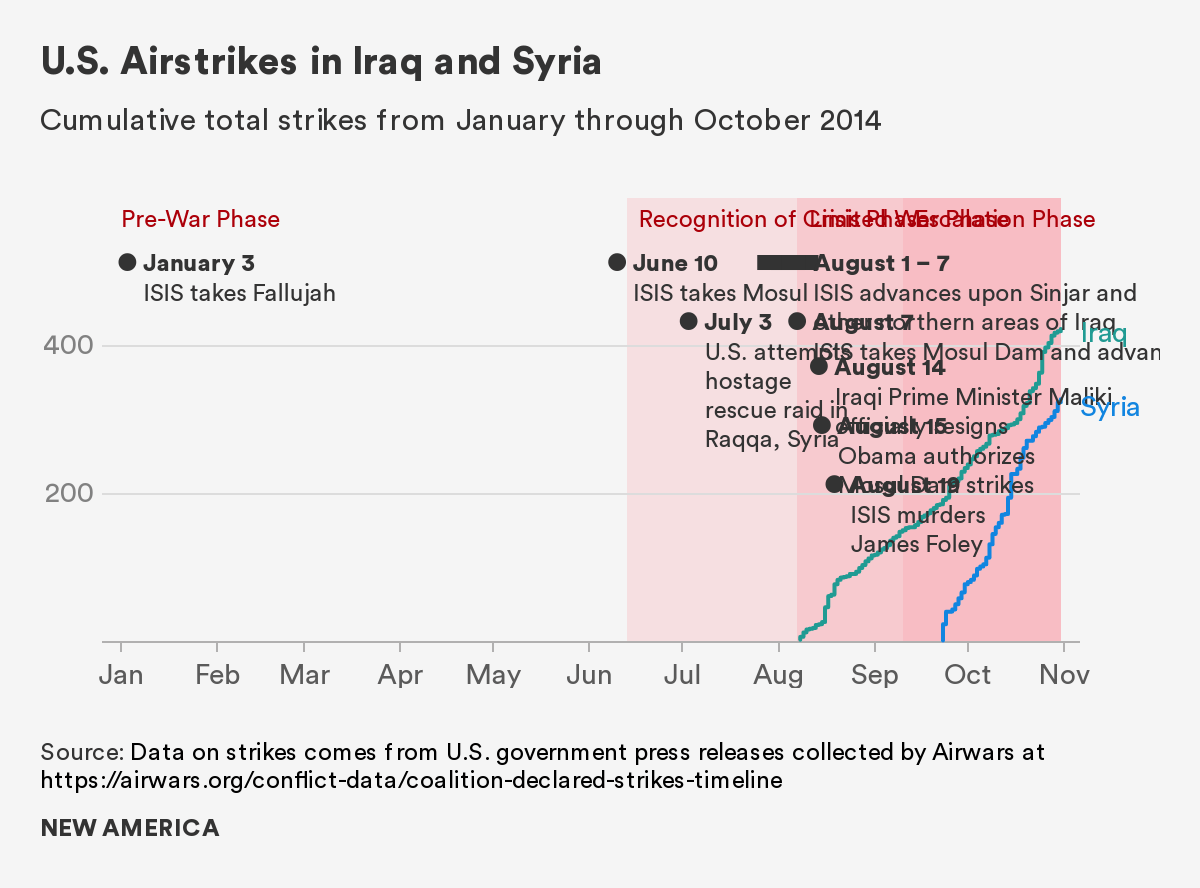
This report divides the war’s decision-making process into four phases divided by moments when Obama made major announcements regarding changes in the administration’s approach based on a review of the 28 official statements on the issue that Obama made from January 2014 through the end of September 2014.
Those phases are:
1) Pre-War (January 2014 – June 12, 2014): The Pre-War phase marks the period before the Obama administration began to consider military intervention against ISIS. During this phase, there are no official presidential statements directly addressing the threat from ISIS or raising the prospect of military action against the group. When Obama gave his counterterrorism policy address at West Point on May 28, 2014, he made no mention of ISIS and referenced the withdrawal of American troops from Iraq as a triumph of his presidency.26 In addition, during this phase, the United States had not started conducting military action as part of a war against ISIS.27
2) Recognition of Crisis (June 13, 2014 – August 6, 2014): Obama gave his first major remarks directly addressing ISIS and raising the prospect of potential U.S. military action on June 13, 2014.28 This speech ended the Pre-War phase and inaugurated the Recognition of Crisis phase during which the administration began to actively consider war. The Recognition of Crisis phase was in large part sparked by ISIS taking of Mosul, Iraq’s second largest city, on June 10, 2014.29 Deputy National Security Advisor Ben Rhodes described the period after Mosul’s fall as a time when “it was becoming apparent, that we would have to intervene again in Iraq.”30 Then Assistant Secretary of Defense for International Security Affairs Derek Chollet writes, “The sense of urgency changed after Mosul […] Obama decided it was time for the U.S. to get more involved directly.”31 On June 19, Obama gave a second statement in which he announced an increase in surveillance assets and a willingness to send 300 additional advisors to Iraq to support Iraqi forces.32 Throughout July, the United States would continue to consider and prepare for potential military options without initiating military action.33 The one known exception is that on July 3, the United States attempted a rescue of Americans held hostage by ISIS in Raqqa, Syria.34
3) Limited War (August 7, 2014 – September 9, 2014): On August 7, the Recognition of Crisis phase with its lack35 of military action gave way to a new phase: Limited War. Obama announced that he had authorized two military operations in Iraq; strikes to protect American personnel and strikes to break ISIS's siege of and genocidal threat to civilians trapped on Mt. Sinjar.36 The decision to initiate the operations was reportedly still being debated that day.37 Ben Rhodes describes August 7 as a “tipping point.”38 The first American strikes in Iraq began on August 8 near Erbil, the main site where American personnel were under threat.39
The authorized operations were limited in scope and duration.40 According to Chris Woods, the director of Airwars and a longtime monitor of American airstrikes, “The government was very precise in its press statements on strikes in the early stages of the conflict, being careful to say that it was conducting strikes to protect Americans.”41 Indeed, for much of the Limited War phase, American strikes occurred only in the areas around Erbil and Mt. Sinjar.42
However, the United States was also preparing to broaden the war. Then Secretary of State John Kerry notes in his memoir that the administration understood a larger campaign to repel ISIS was needed on August 7, but that the administration did not want to do so without a “comprehensive strategy” or while Nouri al-Maliki remained Iraq’s prime minister.43 According to Kerry, he presented a memo containing such a strategy including military aspects three days after the authorization and “the President embraced the strategy in full. The memo became the foundation of our approach from that point forward. I felt unleashed, fully empowered to pull together a decisive coalition that could rescue our friends from the clutches of extremist horror.”44
By the end of the Limited War phase, the broader strategy had taken form—even though its full authorization had not been announced. In early September, a week prior to his announcement of a shift in the authorization, Obama stated: “Our objective is clear, and that is: degrade and destroy [ISIS].”45 Some of the airstrikes during the later portion of the Limited War phase can be seen as having been early attempts at implementing a broader effort to degrade ISIS.46
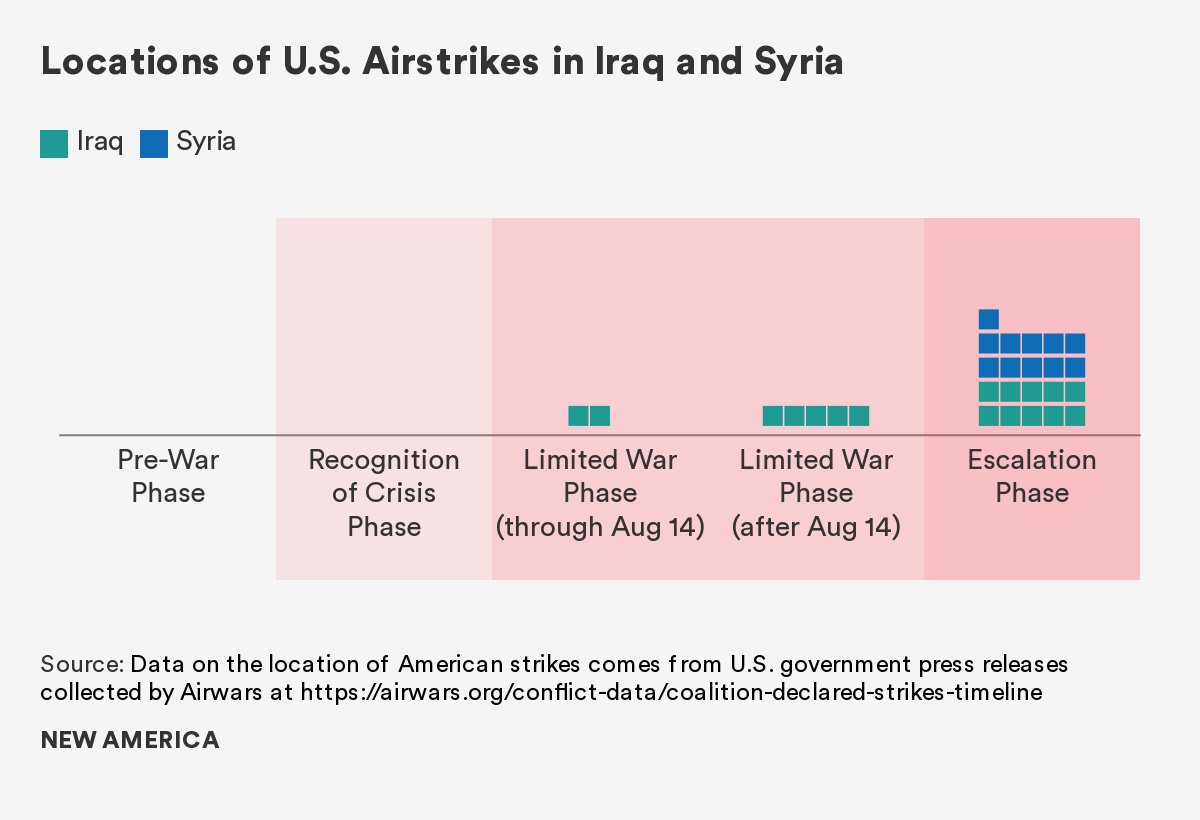
4) Escalation (September 10, 2014+): The final phase of decision-making began on September 10, 2014 when President Obama announced a broader campaign to degrade and destroy ISIS and declared his intent to extend the war into Syria.47 The first strikes in Syria occurred on September 23, 2014.48 On September 23, Obama described these strikes as an implementation of the strategy authorized and announced on September 10, stating: “Earlier this month, I outlined for the American people our strategy to confront the threat posed by the terrorist group known as ISIL. I made clear that as part of this campaign the United States would take action against targets in both Iraq and Syria […] And that's exactly what we've done.”49 The number of locations targeted by airstrikes more than quadrupled from five in the post-August 14 part (following Nouri al-Maliki’s resignation) of the Limited War phase to 21 during the Escalation phase.
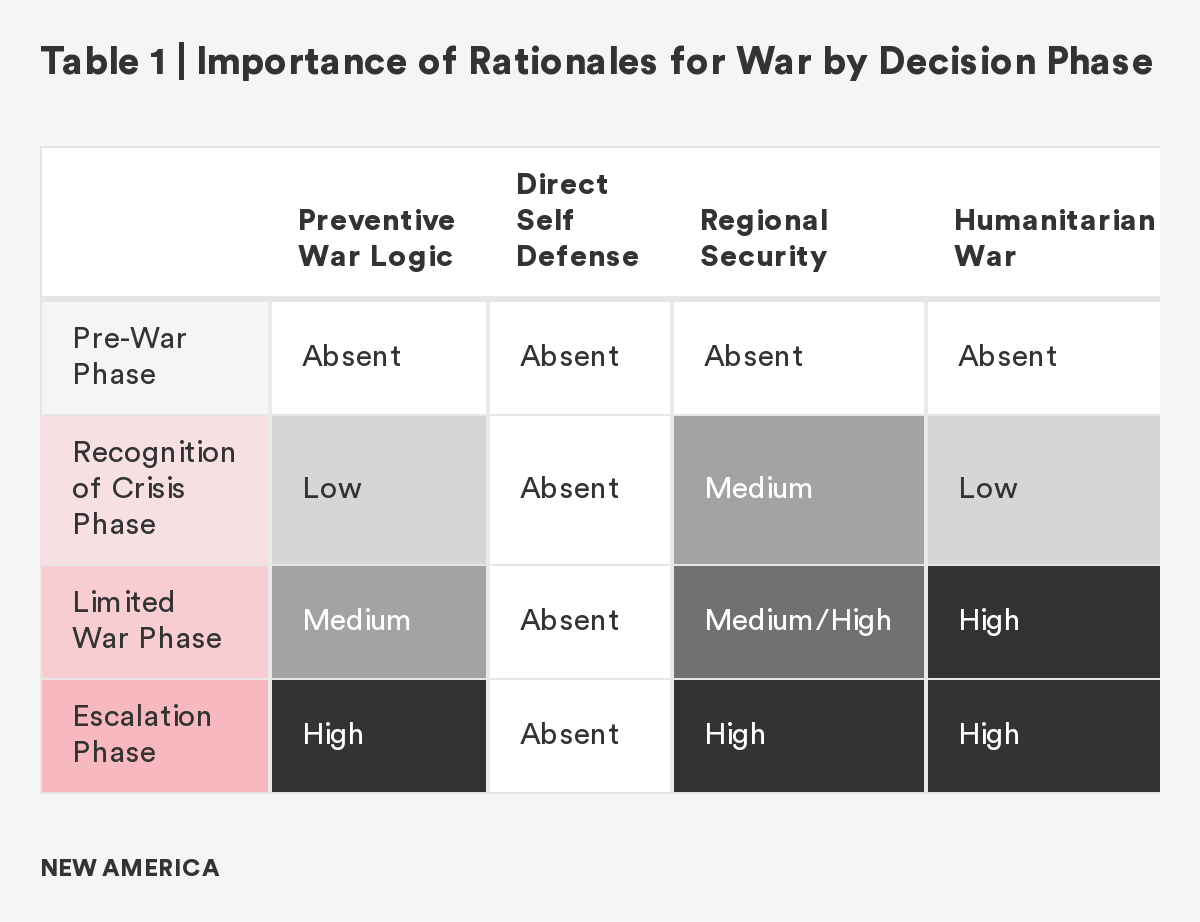
During each of these phases, the five rationales of war addressed in this paper are assessed to have either been absent or referenced at a low, medium, or high level of importance, defined as follows:
Absent: There are no official presidential and few, if any, administration references to the rationale with regards to the question of waging war in Iraq or Syria, and there are no imminent military actions or preparations justified on its basis.
Low: The president and other administration officials make some reference to the rationale, but the references tend to be limited, mostly unofficial, and are not connected to an imminent or already-occurred decision to engage in military activity.
Medium: Administration officials make references to the rationale, and have either begun preparations for an option of military action on its basis in the near future or have taken one-off military actions on the logic’s basis but have not authorized a sustained campaign.
High: Administration officials cite the rationale, and are currently waging war beyond one-off actions based on it.
As can be seen in Table 1, the importance of each war rationale increased as the Obama administration moved through the decision phases. By the Escalation phase, the administration was citing every rationale at a high-level with the exception of direct self-defense, which was absent throughout.
Preventive war logic slowly grew in strength, taking on a high importance around the decision to escalate the war into Syria. However, the first rationales to be triggered at higher levels of importance were the regional security and the extraterritorial protection of American rationales. Humanitarian war justifications gained high importance more suddenly, but also did so before preventive war logic did.
The Slow and Steady Rise of Preventive War Logic
Preventive war logic played an important role in the Obama administration’s public justification for the counter-ISIS war. The logic took the form of an argument that, while ISIS did not currently pose a direct threat to the United States, military action was required to prevent it from developing that capability.
President Obama made this argument explicitly on September 10, 2014, using it as one of the primary justifications for authorizing an expansion of the war beyond limited military operations and into Syria. Obama stated:
If left unchecked, these terrorists could pose a growing threat beyond that region, including to the United States. While we have not yet detected specific plotting against our homeland, ISIL leaders have threatened America and our allies.50
During the Escalation phase, preventive war logic had a high importance and was present not just in the September 10 announcement but in a variety of other statements.51 Obama connected the logic directly to the implementation of a “systematic campaign of airstrikes.”52 He stated: “This is a core principle of my presidency: If you threaten America, you will find no safe haven.”53
Commentators recognized and publicly named the preventive war logic at the time. In Vox, Zack Beauchamp wrote: “Obama is applying a version of that preventive war logic to ISIS.”54 The Cato Institute’s Gene Healy called the September 10 speech a “case for preventive war.”55 Looking back from 2016, RAND terrorism scholar Brian Michael Jenkins wrote that “the administration's campaign against the Islamic State is an example of preventive war. […] America's objective is to prevent the Islamic State from becoming a launching pad for terrorist strikes on the United States.”56
Preventive war logic played an important role in the Obama administration’s public justification for the counter-ISIS war.
There is an open question regarding the extent to which Obama’s comments shaped governmental action versus simply being a public justification for action. The mission statement for Operation Inherent Resolve does not mention homeland security, instead describing success as a situation in which the war “defeats ISIS in designated areas of Iraq and Syria and sets conditions for follow-on operations to increase regional stability.”57
On the other hand, the Operation Inherent Resolve website uses language that echoes the preventive rhetoric: “Strikes are conducted as part of Operation Inherent Resolve, the operation to eliminate the ISIL terrorist group and the threat they pose to Iraq, Syria, and the wider international community. The destruction of ISIL targets in Syria and Iraq further limits the group's ability to project terror and conduct operations.”58
This report cannot rule out the possibility that the preventive war logic was mostly a public relations response to domestic political fear, including the hyped ISIS attack scenarios peddled by some Republican candidates. Commentators at the time understood the September 10 speech in part as an attempt to avoid hyping the domestic threat while still responding to political pressure.59 However, the rise of a publicly stated preventive war logic deserves analysis for its risks, even if other rationales dominated the actual policy implementation.
Preventive war logic was not always of high importance in the justification of the counter-ISIS military campaign. Compared to other rationales for war, preventive war logic had a slower ramp up in importance, as can be seen in Table 1. The slow ramp up suggests that the Obama administration was not eager to return to waging war in Iraq.
Pre-War Phase
During the Pre-War phase, preventive war logic was absent. There are no official presidential statements addressing the threat from ISIS during the Pre-War phase. Other sources show a general rejection of preventive war logic. On January 7, 2014, Obama told David Remnick, “I think there is a distinction between the capacity and reach of a bin Laden and a network that is actively planning major terrorist plots against the homeland versus jihadists who are engaged in various local power struggles and disputes, often sectarian.” 60 In the process, he infamously referred to ISIS as the “JV team” when asked about ISIS's territorial gains in Iraq.61
Obama’s differentiation was not absurd. Al Qaeda’s affiliate in Yemen and its core, as well as other groups in Pakistan, had attempted (not just plotted) attacks inside the United States in the years prior to the initiation of the counter-ISIS campaign.62 The United States conducted drone strikes in Pakistan and Yemen relying in part on the threat to the United States to justify the strikes. In contrast, the Obama administration refused to conduct airstrikes in Iraq in 2013 despite Iraqi requests to do so.63 While the refusal was in part a result of the overall reticence to re-engage in war in Iraq as well as a result of the lack of a formal64 Iraqi government request, at least some outside experts attributed the refusal to a belief that the group did not pose a “direct threat” to the homeland and thus did not justify strikes.65
Obama had made his support for ending the war in Iraq a central component of his presidential campaign. Ben Rhodes, Obama’s foreign policy speechwriter, for example, suggests in his memoir that “Obama would never have become president without the mistake America had made in Iraq.”66 John Kerry also noted the reticence among decision makers, even on August 7, to initiate strikes: “Unspoken but palpable in the room was the reality that a president who had been elected in 2008 promising to get the United States out of a war in Iraq had no choice but to order air strikes in that country again.”67
Obama aides interviewed by the New York Times noted that Obama viewed the previous administration as “too quick to pull the military lever whenever it confronted a foreign crisis.”68 The administration had also stripped the Bush administration’s rhetoric of preemptive war from its 2010 National Security Strategy.69 Multiple members of the Obama administration had criticized the Bush administration’s preemption doctrine.70
There are no official presidential statements addressing the ISIS threat during the Pre-War phase.
This is not to say the Obama administration fully abandoned preventive war logic prior to the counter-ISIS war. The 2010 strategy maintained continuities with previous strategies that could allow preventive war.71 Nor did Obama rule out preventive war on a range of issues, including as a tool to prevent Iranian acquisition of nuclear weapons.72 The historian and military scholar Andrew Bacevich rightly warned that the Obama administration, in large part, merely saw Iraq as the wrong theater of conflict without renouncing a preventive global war on terrorism.73 Yet Obama’s 2002 anti-Iraq war speech, which includes the rhetoric of only opposing “dumb wars” also included an emphasis on the “rash” character of the Iraq war, specifically emphasizing that “Saddam poses no imminent and direct threat to the United States.”74 This early emphasis on imminence and directness and their repetition during the lead up to the counter-ISIS war suggests Obama held some concern regarding preventive war logic.
Recognition of Crisis Phase
Preventive war logic increased to a low level of importance during the Recognition of Crisis phase. Obama made three official comments on ISIS during this phase, consisting of a June 13 statement, a June 19 statement, and a June 26 War Powers Resolution. Obama did not cite preventive war logic in the text of any of these statements.75 Instead, the statements referred to threats to the broader concept of “American interests.” In the June 13 statement, even the threat to American interests was framed preventively, with Obama noting the threat posed by ISIS to “Iraq and its people” and saying that “given the nature of these terrorists, it could pose a threat eventually to American interests as well.”76
However, when answering questions during the June 13 and June 19 statements, Obama did reference preventive war logic. On June 13, he replied to a question by saying: “What we’re going to have to do is combine selective actions by our military to make sure that we’re going after terrorists who could harm our personnel overseas or eventually hit the homeland.”77 On June 19, he made a similar comment when asked to detail the national interests involved:
We also have an interest in making sure that we don’t have a safe haven that continues to grow for ISIL and other extremist jihadist groups who could use that as a base of operations for planning and targeting ourselves, our personnel overseas, and eventually the homeland. And if they accumulate more money, they accumulate more ammunition, more military capability, larger numbers, that poses great dangers not just to allies of ours like Jordan, which is very close by, but it also poses a great danger potentially to Europe and ultimately the United States.78
In both of these cases, preventive war logic is placed relatively late in terms of threats listed and in regards to when the threat might manifest.
On July 24, 2014, Brett McGurk, then assistant secretary of state for Iraq and Iran, concluded his opening testimony to Congress on the issue by stating that while the immediate threat had been “blunted,” that “ISIL represents a growing threat to U.S. interests in the region, local populations, and the homeland.”79 The day after McGurk’s testimony, Chairman of the Joint Chiefs of Staff General Martin E. Dempsey, made a similar comment at the Aspen Security Forum, saying that “the United States military does consider ISIL a threat to—initially to the region and our close allies, longer term to the United States of America, and therefore we are preparing a strategy that has a series of options to present to our elected leaders on how we can initially contain, eventually disrupt and finally defeat ISIL over time.”80 The reference to multiple options suggests the preventive logic was not yet necessarily tied to war as the resolution. General Dempsey further stated, “If ISIL becomes a threat to this country, clearly we would have … the capability to deal with it. … But we haven’t actually come to that point. We’re still very much in the development of those options.”81
Limited War Phase
By the Limited War phase, preventive war logic had gained a medium level of importance. The Obama administration began to explicitly and publicly reference it – and not just in question and answer sessions.
The first explicit reference to preventive war logic in the actual text of an official presidential statement occurred on August 9, when Obama, during his weekly address, stated, “We’ll help prevent these terrorists from having a permanent safe haven from which to attack America.”82 This was not a lone explicit reference.83
In addition, the administration continued to make references to preventive war logic outside of the text of official statements. In an August 9 statement, Obama spoke generally of the danger of an ISIS “safe haven,” but during the question and answer session expanded on the point: “My team has been vigilant, even before ISIL went into Mosul, about foreign fighters and jihadists gathering in Syria, and now in Iraq, who might potentially launch attacks outside the region against Western targets and U.S. targets. So there’s going to be a counterterrorism element that we are already preparing for and have been working diligently on for a long time now.”84
During the Limited War phase, the strikes the United States was conducting were not publicly justified on the basis of preventive logic, but instead on carefully maintaining (at least rhetorically) the limited missions of protecting Americans threatened by ISIS and providing humanitarian support to persecuted minorities.
Preventive war logic played a highly important role in the Escalation phase, but the road to its citation was a slow ramp-up of references in large part due to Obama’s reticence to embrace preventive war. The American war against ISIS was first triggered not by a decision to wage a preventive war to protect the homeland but rather by rationales of regional security, extraterritorial protection of Americans, and humanitarian war that in turn helped to push along the development of a preventive war logic.
During the Limited War phase, the strikes the United States was conducting were not publicly justified on the basis of preventive logic, but on carefully maintaining the limited missions of protecting Americans threatened by ISIS.
The Role of Other War Rationales
Rationales of regional security, extraterritorial protection of Americans, and humanitarian war played the primary role in the initiation of the American counter-ISIS war in Iraq. As shown in Table 1, these rationales reached high levels of importance before preventive war logic did. In addition, these rationales played the primary role in the move from the Pre-War phase to the Recognition of Crisis phase and the Recognition of Crisis phase to the Limited War phase. During the Escalation phase, the concerns underlying these logics played an important role in generating a strongly-stated preventive war logic.
Pre-War Phase
During the Pre-War phase, regional security, extraterritorial protection of Americans, and humanitarian rationales were absent. The president made no official statements on ISIS. The administration was extremely reticent to get involved in Iraq again for any of these reasons. On January 3, ISIS captured Fallujah.85 At the same time, ISIS began to substantially contest Iraqi control of Ramadi.86 In the wake of these substantial ISIS advances, Obama dismissed them as “local power struggles” in his interview with David Remnick. Pressed by Remnick, Obama rejected calls for war against ISIS based on a regional security rationale, arguing that the threat was not specific enough or resolvable with military force:
Fallujah is a profoundly conservative Sunni city in a country that, independent of anything we do, is deeply divided along sectarian lines. And how we think about terrorism has to be defined and specific enough that it doesn’t lead us to think that any horrible actions that take place around the world that are motivated in part by an extremist Islamic ideology is a direct threat to us or something that we have to wade into.87
Obama was similarly resistant to humanitarian war rationales. In his May 2014 speech on counterterrorism at the U.S. Military Academy at West Point, Obama stated, regarding the Afghan surge, “[…]I am haunted by those deaths. I am haunted by those wounds. And I would betray my duty to you and to the country we love if I ever sent you into harm’s way simply because I saw a problem somewhere in the world that needed to be fixed.”88 This was not mere rhetoric. In 2013, Obama backed away from using military force in the aftermath of a Syrian chemical weapons attack and clashed with more interventionist aides over the wisdom of supporting the Syrian rebels for humanitarian reasons.89 While his refusal to intervene was shaped by Congress’s inaction, it was also informed by concern regarding the duration and toll of America’s wars and a view that the intervention in Libya had not been successful.90
The Obama administration was not resistant to extraterritorial protection of Americans rationales during the Pre-War phase. The West Point speech made clear Obama’s willingness to use force to protect Americans, as did the administration’s justifications for drone strikes and use of force to rescue hostages.91 However, the administration made no link between its willingness to use force for such ends and a prospective military campaign in Iraq or Syria.
Recognition of Crisis Phase
An increased perception of ISIS's threat to regional security interests and the group’s threat to Americans abroad drove the Obama administration’s Recognition of Crisis with regards to ISIS. During this phase, the regional security and extraterritorial protection of Americans rationales rose to a medium level of importance.
The opening paragraph of Obama’s June 13 statement reads:
Over the last several days, we’ve seen significant gains made by ISIL, a terrorist organization that operates in both Iraq and in Syria. In the face of a terrorist offensive, Iraqi security forces have proven unable to defend a number of cities, which has allowed the terrorists to overrun a part of Iraq’s territory. And this poses a danger to Iraq and its people.92
Obama went on to say that “nobody has an interest in seeing terrorists gain a foothold inside of Iraq, and nobody is going to benefit from seeing Iraq descend into chaos.”93 Obama concluded by emphasizing diplomacy as the key to “stability in Iraq or the broader region.”94 Obama’s June 19 statement also began by describing the threat “to the Iraqi people, to the region, and to U.S. interests” and warned of the threat to Iraq’s neighbors—specifically citing Jordan as well as referencing threats to Europe.95 Obama said, “We will be prepared to take targeted and precise military action, if and when we determine that the situation on the ground requires it.”96
Comments by administration officials emphasize the role of a perceived increase in the regional threat in generating the Recognition of Crisis. In a 2016 interview Obama stated, “The ability of ISIL to not just mass inside of Syria, but then to initiate major land offensives that took Mosul, for example, that was not on my intelligence radar screen.”97 Chuck Hagel, the secretary of defense at the time, in an interview after his resignation, called the June 2014 ISIS advances a “jolt” to the administration.98 In his memoir, Ben Rhodes, Obama’s deputy national security adviser, recalls that the shock and uncertainty surrounding ISIS's seizure of Mosul and the collapse of Iraqi forces shaped later decisions.99 Joshua Geltzer, a former senior director for counterterrorism at the National Security Council, similarly recalls: “It wasn't just that ISIS's surge surprised some in the U.S government—though there were also some who'd provided warnings about exactly that. It was also that the weakness of Iraqi forces came as something of a shock.”100
The fall of Mosul and ISIS's advances were seen as posing a regional threat beyond Mosul. According to Chris Woods, who has long tracked the United States' air wars in Iraq: “Mosul was an important symbol, but the collapse of the Iraqi army that accompanied it was potentially more troubling. ISIS took out an entire Iraq Army division along with its materiel, and funneled that into its broader war effort, including in Syria. The terrorist group was now also an occupying power, with a well-equipped ‘army.’”101 This fear existed within the administration. Geltzer, for example, notes that “for ISIS to take Mosul was a huge step, and a deeply concerning one. Not only did it show the group's ability to take control over a major urban area, but it also put at the group's disposal a huge population, major financial assets, and significant other resources that it could conceivably put toward its continued expansion of territorial control and other violence.”102
The extraterritorial protection of Americans rationale also increased during the Recognition of Crisis phase, reaching a medium level of importance with military preparations linked closely to protections of Americans commencing. In his June 13 statement, Obama emphasized, “Our top priority will remain being vigilant against any threats to our personnel serving overseas.”103 In his June 19 statement, Obama reiterated this rationale: “First, we are working to secure our embassy and personnel operating inside of Iraq. As President, I have no greater priority than the safety of our men and women serving overseas. So I’ve taken some steps to relocate some of our embassy personnel, and we’ve sent reinforcements to better secure our facilities.”104
The United States placed a low priority on humanitarian war rationales during the Recognition of Crisis phase.
Geltzer confirms that the protection of American personnel was a primary concern at the time, noting that “as ISIS pushed into Iraq from Syria, among the most immediate concerns for the U.S. government was protecting our own presence in Iraq, including in Baghdad.”105 At a Brookings Institution event, Brett McGurk recounted that the United States lacked the intelligence coverage to be able to determine the veracity of threats in Baghdad in June 2014, and that concern played a role in the deployment of advisors.106 This concern was registered by outside observers. According to Chris Woods, the perception at the time was that an ISIS advance on both Erbil and Baghdad looked distinctly possible.107
In addition, in the early hours of July 3, planes began to bomb an ISIS camp in Raqqa while U.S. Special Forces landed in a raid aimed at rescuing hostages, including American journalists James Foley and Stephen Sotloff, held by ISIS.108 This is the only clear instance of American use of military force in Iraq or Syria against ISIS prior to the August 7 authorization, which began the Limited War phase.109 A senior Department of Defense official described the raid to the Washington Post as “a risky operation, deep into Syria, where we hadn’t been before.”110 The raid was not viewed within the government as the beginning of a larger military campaign against ISIS; it was specifically about attempting to rescue the hostages.111
In contrast, the United States placed a low priority on humanitarian war rationales during this phase. Obama’s June 13 statement makes no reference to humanitarian interests.112 In a reply to a question during his June 19 remarks, Obama stated, “It is in our national security interests not to see an all-out civil war inside of Iraq, not just for humanitarian reasons, but because that ultimately can be destabilizing throughout the region.”113 The “not just” phrase suggests that humanitarian reasons were being considered but had little importance as the citation is contraposed to the more important issue of regional security. Even so, Brett McGurk’s congressional testimony makes clear that humanitarian rationales were not absent.114
Limited War Phase
During the Limited War phase, the humanitarian war and extraterritorial protection of Americans rationales reached high levels of importance with sustained military operations initiated on their basis. The regional security rationale reached a medium- to high-level of importance. It was not part of the explicit justification for the authorized operations, but it was part of the preparations for a broader escalation, which was already in development and not entirely separable from the military actions during this phase.
On August 7, Obama announced that he “authorized two operations in Iraq—targeted airstrikes to protect our American personnel, and a humanitarian effort to help save thousands of Iraqi civilians who are trapped on a mountain without food and water and facing almost certain death.”115
Obama’s statement also made clear that the decision differed from earlier remarks regarding the importance of protecting Americans due to a more immediate sense of threat:
First, I said in June—as the terrorist group ISIL began an advance across Iraq—that the United States would be prepared to take targeted military action in Iraq if and when we determined that the situation required it. In recent days, these terrorists have continued to move across Iraq, and have neared the city of Erbil, where American diplomats and civilians serve at our consulate and American military personnel advise Iraqi forces. To stop the advance on Erbil, I’ve directed our military to take targeted strikes against ISIL terrorist convoys should they move toward the city. […] We’re also providing urgent assistance to Iraqi government and Kurdish forces so they can more effectively wage the fight against ISIL.116
The first strikes on ISIS after the authorization included a strike on a mobile ISIS artillery piece that was shelling Erbil.117 The Pentagon tweeted: “US military aircraft conduct strike on ISIL artillery. Artillery was used against Kurdish forces defending Erbil, near US personnel.”118
Post-facto comments from those involved in the decision confirms the increased sense of danger to Americans constituted a tipping point for action. Ben Rhodes writes, “For a couple of days, a sense of crisis enveloped the White House.”119 He notes the role the threat to Erbil played, recalling: “Obama was angry that he didn’t have good information. ‘We didn’t get a warning that the Iraqis were going to melt away’ in Mosul, he complained to a group of us. ‘And now we can’t even get a read on how many Peshmerga’ – the Kurdish security forces – ‘are in Erbil. I’m not happy with the information I’m getting.’”120 The sense of surprise and concern was shared by military analysts and commentators outside of government as well.121
The role of humanitarian war rationales also jumped to a high level of importance during the Limited War phase. In the week leading up to Obama’s August 7 authorization of strikes, ISIS made rapid advances into Iraq’s Sinjar district.122 As ISIS advanced, hundreds of thousands of Iraqis belonging to Iraq’s various minority groups including Yazidis and Turkmen fled, but tens of thousands ended up stranded on Mt. Sinjar.123 As it advanced, ISIS systematically targeted these populations for murder and enslavement.124
ISIS's advance and the campaign of atrocities and genocide it waged against Yazidis and other minorities shaped the administration’s decision to use military force. Obama stated that he had “authorized targeted airstrikes, if necessary, to help forces in Iraq as they fight to break the siege of Mount Sinjar and protect the civilians trapped there.”125 In contrast to references to a humanitarian rationale in earlier phases’ statements, Obama left no doubt that humanitarian objectives had their own driving force rather than counterpoising them to national interests. Rather than making generic, non-descriptive references to ISIS's brutality as in earlier statements, Obama described ISIS atrocities at length, framing it in terms of prevention of genocide:
As ISIL has marched across Iraq, it has waged a ruthless campaign against innocent Iraqis. And these terrorists have been especially barbaric towards religious minorities, including Christian and Yezidis, a small and ancient religious sect. Countless Iraqis have been displaced. And chilling reports describe ISIL militants rounding up families, conducting mass executions, and enslaving Yezidi women. In recent days, Yezidi women, men and children from the area of Sinjar have fled for their lives. And thousands—perhaps tens of thousands—are now hiding high up on the mountain, with little but the clothes on their backs. They’re without food, they’re without water. People are starving. And children are dying of thirst. Meanwhile, ISIL forces below have called for the systematic destruction of the entire Yezidi people, which would constitute genocide. So these innocent families are faced with a horrible choice: descend the mountain and be slaughtered, or stay and slowly die of thirst and hunger126
The ISIS advance on Erbil was not the only example of extraterritorial protection rationale gaining importance. On August 19, the administration learned that ISIS had murdered American journalist James Foley, whom ISIS had taken hostage earlier, when the group placed video of his beheading on YouTube.127 Then Secretary of State John Kerry recalled in his memoir: “My profound feeling of injustice and sadness turned to anger. Something was horribly unimaginably sick and wrong in the world. I closed my eyes. I wanted this brave young journalist to be home with his family, safe, and alive. I wanted Daesh extinguished from the face of the earth. But now I could help accomplish only one of those things.”128 In the wake of the murder, the State Department placed a greater emphasis on its counter-ISIS work, giving the issue more senior-level attention.129
On August 20, Obama gave a statement on the murder, saying, “Jim was taken from us in an act of violence that shocks the conscience of the entire world.”130 He also framed the murder within ISIS's broader set of atrocities, including its “ambition to commit genocide against an ancient people.”131 Obama then reiterated his commitment to using military force to protect Americans, but unlike the more specific, limited effort in Erbil, he framed it as a broader matter of justice not contained to a particular location: “The United States of America will continue to do what we must do to protect our people. We will be vigilant and we will be relentless. When people harm Americans, anywhere, we do what’s necessary to see that justice is done. And we act against ISIL, standing alongside others.”132
ISIS's advance and the campaign of atrocities and genocide it waged against Yazidis and other minorities shaped the administration’s decision to use military force.
The importance of the regional security rationale in the Limited War phase changed over the course of the phase. On August 7, 2014, regional security rationale began moving from a medium level of importance towards a high level of importance.
On August 7, Obama only authorized two limited operations, but he made clear that he viewed the effort through a prism of broader regional security questions. He stated, “We can and should support moderate forces who can bring stability to Iraq. So even as we carry out these two missions, we will continue to pursue a broader strategy that empowers Iraqis to confront this crisis.”133
Kerry’s memoir shows that the humanitarian war and extraterritorial protection of Americans rationales were not separate from a broader regional security rationale. He writes, “In real time there was urgent evidence that Daesh’s threat was existential for the region. Not far from the Turkish border, the extremists terrorized a religious minority, the Yazidi families … Daesh was closing in on Erbil, the Kurdish city where we have a major consulate.” 134 General John Allen, former special presidential envoy to the Global Coalition to Defeat ISIS, has similarly portrayed the threat to Erbil as having broader regional security resonance, stating that ISIS's turn towards Kurdistan “was a major strategic mistake for them because that mobilized a lot of international support for the Kurds that we might not have otherwise seen if they had just gone south for Baghdad […] the potential for Kurdistan to go down to the Islamic State […] helped to mobilize international support so this was a real, dire moment.”135
The lack of immediate operations publicly linked to that broader strategy—rather than justified on the basis of the authorized limited operations—was less a result of an absence of regional security rationale as worries regarding initiating military action while Nouri al-Maliki, who the administration saw as partially responsible for stoking ISIS's rise through sectarianism, remained Iraq’s prime minister. Obama stated, “Once Iraq has a new government, the United States will work with it and other countries in the region to provide increased support to deal with this humanitarian crisis and counterterrorism challenge. None of Iraq’s neighbors have an interest in this terrible suffering or instability.”136
In his memoir, then Secretary of State John Kerry states that the administration did not want to take broader military action without a “comprehensive strategy” or while Maliki still led the country.137 On August 11, Obama gave a statement recognizing the naming of Haider al-Abadi as the new prime minister designate.138
On August 14, 2014, with Maliki having officially resigned, American strikes began to expand both in number and in the number of locations targeted.139 The Obama administration authorized U.S. strikes as part of the effort to retake Mosul Dam.140 In his War Powers Resolution letter conveying the authorization, Obama framed the authorized strikes as “limited in their scope and duration as necessary to support the Iraqi forces in their efforts to retake and establish control of this critical infrastructure site.”141 Legal commentators at the time noted the weakening of the limitations and broadening of the campaign.142
By early September, the Obama administration began to publicly reference a broader objective tied to regional security concerns—degrading and ultimately defeating ISIS.143 On September 5, Obama made reference to Secretary Kerry’s work in preparing the strategy and reiterated both in his statement and in responses to questions a regional security rationale.
By the end of the Limited War phase, regional security, humanitarian war, and extraterritorial protection of Americans logic rationales all reached a high level of importance. Yet the administration continued to provide only a medium level of importance to preventive war logic.
The Escalation Phase – How Non-Preventive Rationales Contributed to the Rise of Preventive War Logic
On September 10, Obama authorized a broader campaign. All of the rationales which had reached a high level of importance in the Limited War phase continued to be cited by the administration.144 The administration’s confrontation with ISIS's brutality and the threats addressed by the non-preventive war rationales described above, led the administration to increasingly view ISIS as a threat incompatible with American values. As a result, the administration adopted a public discourse of common threat and the need to defeat or extinguish ISIS, fueling the rise of preventive war logic by conceptually diminishing the perceived importance of the barriers that separated ISIS's threat abroad from the threat it posed to the United States homeland.
Horror at ISIS's actions helped generate a view that ISIS was not containable and had the intent to commit violence far afield from Iraq and Syria, setting the stage for a decision that war now to destroy those developing capabilities would be better than war later. This process accords with the findings of Max Abrahms that people infer terrorist intent from their actions and tend to see brutality and violence against civilians as a sign that terrorists have maximal goals and do not intend to curtail their violence in exchange for concessions.145 In the case of ISIS, the group did indeed hold maximal goals, though—as will be discussed later—even with groups like ISIS, intent to pursue such maximal goals varies along a spectrum (as does capability).
In turn, this tendency may have created a feedback loop in which the rise of preventive war logic increased uncertainty with regards to specific war aims, encouraging a further shift to a focus on maximizing the identity-based heuristic of eliminating ISIS's challenge to American values.146
Horror at ISIS's actions helped generate a view that ISIS was not containable and had the intent to commit violence far afield from Iraq and Syria.
Obama’s September 10 statement is explicit that ISIS's atrocities, murder of American hostages, and general regional threat played a key role in his decision. The statement used these threats to explain that ISIS had maximal goals fundamentally at odds with America’s safety in the long term. At first, Obama seemed to demur from such a conclusion, stating, “We can’t erase every trace of evil from the world, and small groups of killers have the capacity to do great harm. That was the case before 9/11, and that remains true today.”147 However, he then proceeded to explain why ISIS was different:
ISIL is a terrorist organization, pure and simple. And it has no vision other than the slaughter of all who stand in its way. In a region that has known so much bloodshed, these terrorists are unique in their brutality. They execute captured prisoners. They kill children. They enslave, rape, and force women into marriage. They threatened a religious minority with genocide. And in acts of barbarism, they took the lives of two American journalists—Jim Foley and Steven Sotloff. So ISIL poses a threat to the people of Iraq and Syria, and the broader Middle East—including American citizens, personnel and facilities […].148
These above-quoted lines directly lead into the statement of preventive war logic: “If left unchecked, these terrorists could pose a growing threat beyond that region, including to the United States.”149 This suggests a close connection between the reaction to ISIS's brutality and the more prominent public reference to preventive war logic.
Obama would later in the speech tie the ISIS regional threat to American identity—further suggesting that a shift had occurred from the analysis of costs, benefits, and limitations of American military might expressed during earlier phases of the decision process to a form of values matching reasoning. He stated, “This is American leadership at its best: We stand with people who fight for their own freedom, and we rally other nations on behalf of our common security and common humanity.”150
The roots of this thinking are visible during the Limited War phase in Kerry’s reaction to the murder of James Foley, which in his memoir he described as a turn from sadness to anger and the desire to “extinguish” ISIS.151 It can also be seen in Obama’s August 7 statement, where he states:
America has made the world a more secure and prosperous place. And our leadership is necessary to underwrite the global security and prosperity that our children and our grandchildren will depend upon We do so by adhering to a set of core principles. We do whatever is necessary to protect our people. We support our allies when they’re in danger. We lead coalitions of countries to uphold international norms. And we strive to stay true to the fundamental values—the desire to live with basic freedom and dignity—that is common to human beings wherever they are. That’s why people all over the world look to the United States of America to lead. And that’s why we do it.152
On September 13, Obama reiterated the concept of “common threat” adding that “because we’re Americans. We don’t give in to fear. We carry on.”153 It is a statement that neatly combines the shift to a focus on American identity and values, the interlinking of threats to interests abroad to those at home without evidence supporting an imminent link between the threats, and the refusal to make concessions that is often the reaction to perceived terrorist maximal goals.
The extent of any such shift away from cost-benefit analysis should not be overstated. According to Joshua Geltzer, “The question of how best to degrade and ultimately defeat ISIS was not something to be answered only a single time—instead, it was revisited repeatedly, throughout the course of the campaign. There were meetings at various levels of seniority, often multiple a week.”154 In 2017 the Obama administration held dozens of senior-level meetings over seven months to plan for and weigh the costs and benefits of different approaches in the effort to take Raqqa, eventually deciding that it should hold off as it was a major decision that the Trump administration deserved to have a say in.155 General John Allen similarly recalls such “significant debate.”156 According to Andrew Exum, who was deputy assistant secretary of defense for Middle East policy from 2015 through 2016, “Toward the end of the administration, […] we literally had cabinet secretaries debating the movement of three helicopters from Iraq to Syria.”157
Deliberations on tactical questions and their relation to strategy do not necessarily demonstrate the absence of a shift to values matching with regards to strategic ends and public framing. It is also worth noting that there appears to be a precedent for the Obama administration abandoning cost benefit analysis in the wake of a particularly brutal, violent act. In her memoir, former Ambassador to the United Nations Samantha Power recalls that in the wake of the August 2013 Syrian chemical weapons attack, Obama was “enraged,” and “rather than debating next steps with us, as he generally did, he made clear that he had decided to punish Assad.”158 She also notes that “administration officials who had previously argued against using military force in Syria were now in full agreement with the Commander in Chief. Chairman of the Joint Chiefs of Staff Martin Dempsey, the President’s top military adviser, told Obama in a National Security Council meeting two days after the attack, ‘normally I would want you to know what comes next. But this is not one of those times.’”159 However, this report did not find similarly explicit statements regarding the counter-ISIS war decision.
It is beyond the ability of this report to conclusively show that the regional security, extraterritorial protection of Americans, and humanitarian war rationales gave rise to the preventive war logic rather than it rising independently.160 However, the above statements suggest they played a role by increasing the salience of fear of ISIS's maximal goals and therefore the inferred potential threat to the United States. That conclusion holds a warning for those who would view the accomplishment of more limited military goals as separable from the risks of preventive war logic once a war is begun.
Citations
- Joseph Logan, “Last U.S. Troops Leave Iraq, Ending War,” Reuters, December 17, 2011, <a href="source">source">source
- The Islamic State of Iraq and Syria is referred to by several names in the literature, including ISIL, Daesh, IS, ISI or the Islamic State. Throughout this paper we use ISIS except when a quoted passage utilizes a different term.
- U.S. Central Command, “Coalition, Partner Forces Liberate Last Territory Held by Daesh,” press release no. 20190323-01, March 23, 2019, <a href="source">source">source
- John E. Mueller and Mark G. Stewart, Chasing Ghosts: The Policing of Terrorism (Oxford; New York: Oxford University Press, 2016), 53–80.
- RJ Reinhart, “Snapshot: Half of Americans Approve of Strikes on Syria,” Gallup, April 24, 2018, <a href="source">source">source
- Eric Bradner, “Poll: Americans Losing Confidence Air Strikes Alone Will Defeat ISIS,” CNN, October 29, 2014, <a href="source">source">source
- “The New York Times/CBS News Poll,” New York Times, September 17, 2014, <a href="source">source">source
- Zeke J. Miller and Alex Rogers, “GOP Ad Claims ISIS Plot to Attack U.S. Via ‘Arizona’s Backyard,’” TIME, October 7, 2014, <a href="source">source">source; Jamelle Bouie, “ISIS South of the Border,” Slate, October 9, 2014, <a href="source">source">source; William McCants, “2014 Midterms: ISIS and the Campaign Trail,” Brookings Institution, October 30, 2014, <a href="source">source">source
- Heather Hurlburt, “Anxiety Itself,” The American Prospect, April 13, 2015, <a href="source">source">source
- “CNN/ORC Poll. Sept. 5-7, 2014. N=1,014 Adults Nationwide. Margin of Error ± 3.,” Polling Report.com, accessed August 12, 2019, <a href="source">source">source
- Author’s Interview with Max Abrahms, July 23, 2019; Max Abrahms, Rules for Rebels: The Science of Victory in Militant History, New product edition (New York, NY: Oxford University Press, 2018); Max Abrahms, “The Political Effectiveness of Terrorism Revisited,” Comparative Political Studies 45, no. 3 (March 2012): 366–93, <a href="source">source">source; Max Abrahms, “Why Terrorism Does Not Work,” International Security 31, no. 2 (Fall 2006), <a href="source">source">source.
- Author’s Interview with Max Abrahms, July 23, 2019
- Scott A. Silverstone, From Hitler’s Germany to Saddam’s Iraq: The Enduring False Promise of Preventive War (Lanham, MD: Rowman & Littlefield, 2019), 269.
- Jack S. Levy, “Preventive War and Democratic Politics: Presidential Address to the International Studies Association March 1, 2007, Chicago,” International Studies Quarterly 52, no. 1 (March 2008): 1–24, source">source
- As has been widely noted by a range of journalists and scholars, this is largely due to the Bush administration’s labeling of a doctrine of preventive war as a doctrine of preemptive war in order to support its case for the 2003 invasion of Iraq.
- Levy "Preventive War and Democratic Politics"; Colin Gray, “The Implications of Preemptive and Preventative War Doctrines: A Reconsideration” (Strategic Studies Institute, July 2007), source">source; Silverstone, From Hitler’s Germany to Saddam’s Iraq, 5.
- Gray, “The Implications of Preemptive and Preventative War Doctrines: A Reconsideration.”
- Levy, “Preventive War and Democratic Politics.”
- A 2018 Congressional Research Service report notes that “the majority of the instances listed prior to World War II were brief Marine Corps or Navy actions to protect U.S. citizens or promote U.S. interests. A number were engagements against pirates or bandits.” Barbara Salazar Torreon and Sofia Plagakis, “Instances of Use of United States Armed Forces Abroad, 1798-2019,” July 17, 2019, source">source
- For examples see: Torreon and Plagakis.
- Matthew C. Waxman, “Intervention to Stop Genocide and Mass Atrocities” (Council on Foreign Relations, October 2009), source">source
- Regional security rationales can be further subdivided by the geographic regions that a threat implicates. With regards to the counter-ISIS campaign analyzed here, there are three major regions that often serve as the reference point of regional security rationales. The first region consists of Iraq and Syria, the two nations most directly under threat from ISIS and where ISIS at its peak managed to wrest control of a territory the size of Britain at its peak. A second regional reference point is the broader Middle East and North Africa. A third regional reference is Europe. This report will distinguish these regional threats where relevant.
- “Paris Victims, Remembered,” New York Times, November 20, 2015, source">source; “Four Americans Confirmed Killed in Brussels Attacks, Death Toll at 35,” Fox, March 28, 2016, source">source
- Even in the case of World War II, there is debate over the extent to which the United States saw its homeland as threatened. On this point see: Daniel Immerwahr, How to Hide an Empire: A History of the Greater United States, First edition (New York: Farrar, Straus and Giroux, 2019); Stephen Wertheim, “Tomorrow, the World: The Birth of U.S. Global Supremacy in World War II” (Doctoral Dissertation Columbia University, September 5, 2015).
- For a discussion of homeland self-defense rationale versus preventive war logic with regards to drone strikes and the war in Afghanistan, which arguably moved from self-defense to being a preventive war over time, see: Rosa Brooks, “Drones and the International Rule of Law,” Ethics & International Affairs 28, no. 1 (2014): 83–103, source">source
- “Remarks by the President at the United States Military Academy Commencement Ceremony,” White House Office of the Press Secretary, May 28, 2014, source; David Kilcullen, Blood Year: The Unraveling of Western Counterterrorism (New York: Oxford University Press, 2016), 4.
- “Lead Inspector General for Overseas Contingency Operations Operation Inherent Resolve Quarterly Report and Biannual Report to the United States Congress December 17, 2014−March 31, 2015” (Department of Defense Office of the Inspector General, April 30, 2015), source; “US-Led Coalition Air Strikes on ISIS in Iraq & Syria, 2014-2018,” Airwars, accessed September 10, 2019, source
- “Statement by the President on Iraq,” The White House Office of the Press Secretary, June 13, 2014, source
- Martin Chulov, “Isis Insurgents Seize Control of Iraqi City of Mosul,” Guardian, June 10, 2014, source
- Benjamin Rhodes, The World as It Is: A Memoir of the Obama White House, First edition (New York: Random House, 2018), 290.
- Derek H. Chollet, The Long Game: How Obama Defied Washington and Redefined America’s Role in the World (New York: Public Affairs, 2016), 149.
- “Remarks by the President on the Situation in Iraq,” The White House Office of the Press Secretary, June 19, 2014, source
- See for example: “Iraq at a Crossroads: Options for U.S. Policy: Statement for the Record: Deputy Assistant Secretary Brett McGurk,” Senate Foreign Relations Committee (2019), source
- Karen DeYoung, “The Anatomy of a Failed Hostage Rescue Deep in Islamic State Territory,” Washington Post, February 14, 2015, source; Ruth Sherlock, Carol Malouf, and Josie Ensor, “The Failed US Mission to Try and Rescue James Foley from Islamic State Terrorists,” Telegraph, August 21, 2014, source; Nicholas Schmidle, “Inside the Failed Raid to Save Foley and Sotloff,” New Yorker, September 5, 2014, source
- With the one known exception of the aforementioned rescue raid in Raqqa, Syria on July 3, 2014.
- “Statement by the President” (The White House Office of the Press Secretary, August 7, 2014), source; “Lead Inspector General for Overseas Contingency Operations Operation Inherent Resolve Quarterly Report and Biannual Report to the United States Congress, December 17, 2014−March 31, 2015. ”
- Helene Cooper, Mark Landler, and Alissa J. Rubin, “Obama Allows Limited Airstrikes on ISIS,” New York Times, August 7, 2014, source
- Rhodes refers to early August but makes specific reference to ISIS's taking of Mosul dam, which occurred on August 7, 2014, the same day strikes were authorized. Rhodes, The World as It Is, 291; Alex Milner, “Mosul Dam: Why the Battle for Water Matters in Iraq,” BBC, August 18, 2014, source
- “US-Led Coalition Air Strikes on ISIS in Iraq & Syria, 2014-2018.”
- “Letter from the President – War Powers Resolution Regarding Iraq,” The White House Office of the Press Secretary, August 8, 2014, source
- Author’s Interview with Chris Woods, Director of Airwars, September 11, 2019.
- “US-Led Coalition Air Strikes on ISIS in Iraq & Syria, 2014-2018.”
- John Kerry, Every Day Is Extra, First Simon & Schuster hardcover edition (New York: Simon & Schuster, 2018), 545.
- Kerry, 546.
- “Remarks by President Obama at NATO Summit Press Conference,” The White House Office of the Press Secretary, September 5, 2014, source; Julie Hirschfeld Davis, “After Beheading of Steven Sotloff, Obama Pledges to Punish ISIS,” New York Times, September 3, 2014, source; Carol E. Lee and Colleen McCain Nelson, “U.S. Aims to ‘Degrade and Destroy’ Militants,” Wall Street Journal, September 3, 2014, source
- For a discussion and examples of this matter, see Robert Chesney’s discussion of the legal basis for the strikes around Mosul dam as well as President Obama and CENTCOM’s references to broader objectives for the operation: Robert Chesney, “Article II and Iraq: Justifications for the Mosul Dam Operation in the WPR Notification,” Lawfare, August 17, 2014, source; Jethro Mullen and Susanna Capeluoto, “U.S. Airstrikes Critical in Mosul Dam Capture,” CNN, August 19, 2014, source; “U.S. Conducts More Airstrikes Near the Mosul Dam,” U.S. Department of Defense, August 18, 2014, source
- “Statement by the President on ISIL,” White House Office of the Press Secretary, September 10, 2014, source; “Lead Inspector General for Overseas Contingency Operations Operation Inherent Resolve Quarterly Report and Biannual Report to the United States Congress December 17, 2014−March 31, 2015.”
- “US-Led Coalition Air Strikes on ISIS in Iraq & Syria, 2014-2018.”
- “Statement by the President on Airstrikes in Syria,” White House Office of the Press Secretary, September 23, 2014, source
- “Statement by the President on ISIL,” The White House Office of the Press Secretary, September 10, 2014, source
- “WEEKLY ADDRESS: We Will Degrade and Destroy ISIL,” The White House Office of the Press Secretary, September 13, 2014, source; “Weekly Address: The World Is United in the Fight Against ISIL,” The White House Office of the Press Secretary, September 20, 2014, source; “Remarks by the President at MacDill Air Force Base,” The White House Office of the Press Secretary, September 17, 2014, source Also see Appendix.
- “Statement by the President on ISIL [September 10, 2014]”; “FACT SHEET: Strategy to Counter the Islamic State of Iraq and the Levant (ISIL),” The White House Office of the Press Secretary, September 10, 2014, source
- “Statement by the President on ISIL [September 10, 2014].”
- Zack Beauchamp, “One Incredibly Revealing Line from Obama’s ISIS Speech,” Vox, September 10, 2014, source
- Gene Healy, “Is Obama Abusing the Constitution to Combat ISIS?,” The National Interest, September 12, 2014, source
- Brian Michael Jenkins, “President Obama’s Controversial Legacy as Counterterrorism-in-Chief,” RAND, August 22, 2016, source
- “Our Mission” (Combined Joint Task Force Operation Inherent Resolve, July 17, 2017), source
- “Strike Releases,” Operation Inherent Resolve, accessed September 20, 2019, source.
- Michael Calderone and Sam Stein, “Americans Panicked Over ISIS Threat That Experts Say Isn’t Imminent,” Huffington Post, September 9, 2014, source
- Glenn Kessler, “Spinning Obama’s Reference to Islamic State as a ‘JV’ Team,” Washington Post, September 3, 2014, source
- Ibid.
- Examples include the 2009 New York City Subway bomb plot involving three men who trained with al Qaeda in Pakistan, the 2009 Christmas Day Underwear bomb attack directed by Al Qaeda in the Arabian Peninsula, the 2010 Times Square failed car bombing involving an American who trained with the Pakistani Taliban, and a series of later plots against aviation directed by Al Qaeda in the Arabian Peninsula.
- John Hudson, “U.S. Rules Out a New Drone War in Iraq,” Foreign Policy, October 3, 2013, source
- On the lack of formality’s role as a factor see: “Terrorist March in Iraq: The U.S. Response,” House Committee on Foreign Affairs (2014), source
- Hudson, “U.S. Rules Out a New Drone War in Iraq.”
- Rhodes’ memoir includes multiple variations on this theme as well as scenes that illustrate both the political and policy importance of getting out of Iraq to Obama. Rhodes, The World as It Is, 43.
- Kerry, Every Day Is Extra, 545.
- Peter Baker and Eric Schmitt, “Many Missteps in Assessment of ISIS Threat,” New York Times, September 29, 2014, source
- Paul Reynolds, “Obama Modifies Bush Doctrine of Pre-Emption,” BBC, May 27, 2010, source
- Jack Goldsmith, “Obama Has Officially Adopted Bush’s Iraq Doctrine,” Time, April 6, 2016, source
- Aaron Ettinger, “U.S. National Security Strategies: Patterns of Continuity and Change, 1987–2015,” Comparative Strategy 36, no. 2 (March 15, 2017): 115–28, source; C. Henderson, “The 2010 United States National Security Strategy and the Obama Doctrine of ‘Necessary Force,’” Journal of Conflict and Security Law 15, no. 3 (December 1, 2010): 403–34, source
- Peter Beinart, “How America Shed the Taboo Against Preventive War,” The Atlantic, April 21, 2017, source
- Andrew J. Bacevich, “Redefining the War on Terror,” Council on Foreign Relations, July 30, 2008, source; Matt Duss, “Bacevich: ‘The Only Way To Preserve The American Way Of Life Is To Change It,’” ThinkProgress, November 24, 2008, source
- “Transcript: Obama’s Speech Against The Iraq War,” NPR, January 20, 2009, source
- “Statement by the President on Iraq [June 13, 2014]”; “Remarks by the President on the Situation in Iraq [June 19, 2014]”; “Letter from the President – War Powers Resolution Letter Regarding Iraq,” The White House Office of the Press Secretary, June 26, 2014, source
- “Statement by the President on Iraq [June 13, 2014].”
- “Remarks by the President on the Situation in Iraq [June 19, 2014].”
- Iraq at a Crossroads: Options for U.S. Policy: Statement for the Record: Deputy Assistant Secretary Brett McGurk.
- General Martin E. Dempsey, “Gen. Dempsey Remarks at the Aspen Security Forum 2014” (Joint Chiefs of Staff, n.d.), source
- Dempsey.
- “Weekly Address: American Operations in Iraq,” The White House Office of the Press Secretary, August 9, 2014, source
- “Statement by the President,” The White House Office of the Press Secretary, August 28, 2014, source
- “Statement by the President on Iraq,” The White House Office of the Press Secretary, August 9, 2014, source
- Liz Sly, “Al-Qaeda Force Captures Fallujah amid Rise in Violence in Iraq,” Washington Post, January 3, 2014, source
- Michael Knights, “The ISIL’s Stand in the Ramadi-Falluja Corridor,” CTC Sentinel 7, no. 5 (May 2014), source; Eric Robinson et al., “When the Islamic State Comes to Town” (Santa Monica, CA: RAND, 2017), source
- Kessler, “Spinning Obama’s Reference to Islamic State as a ‘JV’ Team.”
- “Remarks by the President at the United States Military Academy Commencement Ceremony.”
- Jeffrey Goldberg, “The Obama Doctrine,” The Atlantic, April 2016, source; Samantha Power, The Education of an Idealist: A Memoir, 2019, 507, 511–15.
- On this point and also for a broader look at Obama’s concerns regarding military action for humanitarian reasons and the cases where he did support such action (including in Libya and against the Lord’s Resistance Army) see: Power, The Education of an Idealist, 359–90.
- “Remarks by the President at the United States Military Academy Commencement Ceremony”; “Fact Sheet: U.S. Policy Standards and Procedures for the Use of Force in Counterterrorism Operations Outside the United States and Areas of Active Hostilities,” The White House Office of the Press Secretary, May 23, 2013, source; “US Navy Seals Who Killed Bin Laden Rescue Two Hostages from Somalia,” AP, January 25, 2012, source
- “Statement by the President on Iraq [June 13, 2014].”
- “Remarks by the President on the Situation in Iraq [June 19, 2014].”
- Kevin Liptak, “ISIS Rise Surprised Obama, US Intelligence,” CNN, December 7, 2016, source
- Dan De Luce, “Hagel: The White House Tried to ‘Destroy’ Me,” Foreign Policy, December 18, 2015, source
- Rhodes, The World as It Is, 291.
- Author’s Interview with Joshua Geltzer, former Senior Director for Counterterrorism at the NSC, September 5, 2019.
- Author’s Interview with Chris Woods, September 11, 2019.
- Author’s Interview with Joshua Geltzer, September 5, 2019.
- “Statement by the President on Iraq [June 13, 2014].”
- “Remarks by the President on the Situation in Iraq [June 19, 2014].” On the steps taken see: Iraq at a Crossroads: Options for U.S. Policy: Statement for the Record: Deputy Assistant Secretary Brett McGurk.
- Author’s Interview with Joshua Geltzer, September 5, 2019.
- “The Counter-ISIS Coalition: Diplomacy and Security in Action,” Brookings Institution, September 10, 2019, source
- Author’s Interview with Chris Woods, September 11, 2019.
- Sherlock, Malouf, and Ensor, “The Failed US Mission to Try and Rescue James Foley from Islamic State Terrorists.”
- One indicator that this was the first military action is that planning for the raid was complicated because at the time, the United States was not flying surveillance drones over Syria. Schmidle, “Inside the Failed Raid to Save Foley and Sotloff”; DeYoung, “The Anatomy of a Failed Hostage Rescue Deep in Islamic State Territory.”
- DeYoung, “The Anatomy of a Failed Hostage Rescue Deep in Islamic State Territory.”
- Author’s Interview with a former senior government official.
- Obama does reference Iraqi security broadly, and in answer to one question calls ISIS “vicious,” but these statements do not constitute a specifically humanitarian focus as opposed to a concern with broader regional stability. Obama also during the question and answer session made one reference to humanitarian aid in the context of Syria, but this reference does not appear to be framed in terms of an effort to counter-ISIS or military action. “Statement by the President on Iraq [June 13, 2014].”
- “Remarks by the President on the Situation in Iraq [June 19, 2014].”
- Iraq at a Crossroads: Options for U.S. Policy: Statement for the Record: Deputy Assistant Secretary Brett McGurk.
- “Statement by the President [August 7, 2014].”
- Alissa J. Rubin, Tim Arango, and Helene Cooper, “U.S. Jets and Drones Attack Militants in Iraq, Hoping to Stop Advance,” New York Times, August 8, 2014, source
- Dan Roberts and Spencer Ackerman, “US Begins Air Strikes against Isis Targets in Iraq, Pentagon Says,” Guardian, August 8, 2014, source
- Rhodes, The World as It Is, 291.
- Rhodes, 291.
- Priyanka Boghani, “Can the Kurds Hold Out Against ISIS?,” PBS Frontline, August 5, 2014, source; Zack Beauchamp, “Why the US Is Bombing ISIS in Iraq,” Vox, August 8, 2014, source; Kenneth M. Pollack, “Iraq: Understanding the ISIS Offensive Against the Kurds,” Brookings Institution, August 11, 2014, source
- “Report on the Protection of Civilians in Armed Conflict in Iraq: 6 July – 10 September 2014” (Human Rights Office of the High Commissioner for Human Rights and United Nations Mission for Iraq Human Rights Office, September 26, 2014), 2, source
- “Report on the Protection of Civilians in Armed Conflict in Iraq: 6 July – 10 September 2014,” 4.
- “Report on the Protection of Civilians in Armed Conflict in Iraq: 6 July – 10 September 2014.”
- “Statement by the President [August 7, 2014].”
- Kerry, Every Day Is Extra, 545.
- Ibid.
- Author’s Interview with former State Department official familiar with planning on the issue.
- “Statement by the President,” The White House Office of the Press Secretary, August 20, 2014, source
- “Statement by the President [August 20, 2014].”
- Ibid.
- “Statement by the President [August 7, 2014].”
- Kerry, Every Day Is Extra, 545.
- “The Counter-ISIS Coalition: Diplomacy and Security in Action.”
- “Statement by the President [August 7, 2014].”
- Kerry, Every Day Is Extra, 545.
- “Statement by the President on Iraq,” The White House Office of the Press Secretary, August 11, 2014, source
- Tim Arango, “Maliki Agrees to Relinquish Power in Iraq,” New York Times, August 14, 2014, source
- “Letter from the President – War Powers Resolution Regarding Iraq,” The White House Office of the Press Secretary, August 17, 2014, source
- “War Powers Resolution Letter [August 17, 2014].”
- Robert Chesney notes that while there was a broadening of the justifications at work, the force protection argument was not unreasonable. Chesney, “Article II and Iraq: Justifications for the Mosul Dam Operation in the WPR Notification.”
- “Remarks by President Obama at NATO Summit Press Conference [September 5, 2014]”; Lee and Nelson, “U.S. Aims to ‘Degrade and Destroy’ Militants.”
- On the importance of a variety of rationales rather than a single precipitating event with regard to the September 10 announcement see: Anjali Tsui, “Chuck Hagel: U.S. ‘Credibility’ Was Hurt By Policy in Syria,” Frontline, October 11, 2016, source Also see Appendix
- Abrahms does note that his work focuses on the inference that occurs when violence is conducted against the inferring state’s population, and that it is not clear if the effect holds for third party witnesses of atrocities. In the counter-ISIS case, it is the view of this author that the administration’s statements suggest that it does hold at least in this case. Author’s Interview with Max Abrahms, July 23, 2019.
- This phenomena is discussed in more detail in the section on the dangers of preventive war logic but draws upon: Michael J. Mazarr, Leap of Faith: Hubris, Negligence, and America’s Greatest Foreign Policy Tragedy, First edition (New York: Public Affairs, 2019); Gray, “The Implications of Preemptive and Preventative War Doctrines: A Reconsideration.”
- “Statement by the President on ISIL [September 10, 2014].”
- Kerry, Every Day Is Extra, 545.
- “Statement by the President [August 7, 2014].”
- “Weekly Address [September 13, 2014].”
- Author’s Interview with Joshua Geltzer, September 5, 2019.
- Author’s Interview with Joshua Geltzer; Adam Entous, Greg Jaffe, and Missy Ryan, “Obama’s White House Worked for Months on a Plan to Seize Raqqa. Trump’s Team Took a Brief Look and Decided Not to Pull the Trigger.,” Washington Post, February 2, 2017, source
- “The Counter-ISIS Coalition: Diplomacy and Security in Action.”
- Michael R. Gordon, “Trump Shifting Authority Over Military Operations Back to Pentagon,” New York Times, March 19, 2017, source
- Power, The Education of an Idealist, 365.
- Power, 365.
- An alternative hypothesis is that preventive war logic always had a high importance but for tactical reasons the administration did not want to emphasize a threat to the homeland publicly before it committed to taking action. Given the limitations of the reliance on public statements, this report cannot rule out this hypothesis.
Did ISIS Directly Threaten the United States?
For the counter-ISIS war to have been based in preventive war logic with regards to America’s homeland security, ISIS must have been seen as lacking the capability to direct major attacks inside the United States. This section reviews administration and government statements regarding the character of the ISIS threat and a variety of indicators of ISIS's capability to conduct attacks in the United States, and concludes that ISIS lacked the capability to direct major attacks inside the United States. This section also examines ISIS's capabilities in Europe, finding that ISIS did demonstrate a capability and intent to direct attacks in Europe, forming the basis for a justifiable European preemptive war logic. However, the comparison to Europe also illustrates how far the American case fell from matching the European level of threat.
Government Assessments of the ISIS Threat
One of the clearest signs that the ISIS threat was not imminent at the time the counter-ISIS war was initiated is that the government itself repeatedly and via various institutions assessed that there was no known evidence of a direct ISIS threat to the homeland. The government continued to share this assessment long after the decision to initiate the counter-ISIS war was made, suggesting that it did not view its initial assessment as incorrect.
Among those who made such comments are President Obama himself, who on September 10, while authorizing the escalation of the war into Syria stated that “we have not yet detected specific plotting against our homeland.”161 National Counterterrorism Center Director Matt Olsen said that “we have no credible information that ISIL is planning to attack the United States” and described the threat as potential, adding there was no evidence of ISIS cell development inside the United States.162 Also in September, Department of Homeland Security Secretary Jeh Johnson stated, “At present, we have no credible information that [ISIS] is planning to attack the homeland of the United States.”163 In August 2014, Pentagon Spokesperson Rear Admiral John Kirby stated that the Defense Department did not believe that ISIS had “the capability right now to conduct a major attack on the U.S. homeland.”164 Chairman of the Joint Chiefs of Staff General Martin Dempsey also stated in August that there had not yet been evidence that ISIS was engaged in “active plotting against the homeland, so it’s different than that which we see in Yemen.”165 Nor did officials change their assessment with the beginning of the military campaign. In February 2015, Department of Homeland Security Undersecretary for the Office of Intelligence and Analysis Francis X. Taylor said, “We are unaware of any specific, credible, imminent threat to the Homeland.”166
The Department of Homeland Security’s National Terrorism Advisory System (NTAS) provides another set of evidence of the government’s lack of knowledge of any direct ISIS threat to the homeland. In April 2011, the Department of Homeland Security replaced the infamous color-coded Homeland Security Advisory system with NTAS. Under the NTAS system, an alert would be sent out when there was important information distinguishing between either an “elevated” threat with no specific information on timing or location or an “imminent” threat otherwise.167 Even as ISIS spread across Iraq and the United States initiated its counter-ISIS war in 2014, NTAS provided no alerts until December 2015, when it issued its first bulletin.168
The first bulletin, released on December 16, 2015, read, “We know of no intelligence that is both specific and credible at this time of a plot by terrorist organizations to attack the homeland.”169 The first bulletin was replaced by a second bulletin issued on June 15, 2016 that stated the previous bulletin’s “basic assessment has not changed.”170 In the wake of the deadly ISIS-inspired attack in Orlando, the bulletin again repeated that “we know of no intelligence that is both specific and credible at this time of a plot by terrorist organizations to attack the homeland” while reiterating the threat of inspired violence, which was also described in the previous bulletin.171
One of the clearest signs that the ISIS threat was not imminent is that the government repeatedly and via various institutions assessed that there was no known evidence of a direct ISIS threat to the homeland.
In November 2016 a new bulletin again reported no change in the basic assessment, emphasized inspired violence, and reiterated the lack of evidence of credible plots to attack the homeland by foreign terrorist organizations.172
In May 2017, five months before ISIS lost Raqqa, the self-declared capital of its caliphate, NTAS changed its bulletin language, dropping the lack of evidence of credible plots reference.173 Instead it stated, “We face one of the most serious terror threat environments since the 9/11 attacks as foreign terrorist organizations continue to exploit the Internet to inspire, enable, or direct individuals already here in the homeland to commit terrorist acts.”174 Further bulletins largely mirrored the May 2017 language.175
However, it seems unlikely that this change represented newfound organizational plots against the United States. The bulk of the bulletin remains focused on inspired and enabled violence, no alert was provided regarding an imminent threat, and the bulletin came as ISIS's territorial holdings crumbled.
Another set of sources for evaluating the government’s assessment of the ISIS threat to the homeland is the U.S. intelligence community’s Worldwide Threat Assessments. These assessments repeatedly stated that the most likely threat to the United States remained homegrown terrorism rather than ISIS-directed attacks.176 Though none of these assessments include language denying foreign terrorist organization plots, it would be odd if there was a major credible threat and the assessments failed to mention it while emphasizing homegrown, inspired violence.
Indicators of ISIS Threat
Government statements are limited in their ability to measure whether there is in fact a direct threat. They can be incorrect in their assessments or the threat can grow rapidly after an assessment is made.177 It is therefore important to also look at the indicators themselves.
An examination of several indicators of threat suggests that while ISIS may at some point have come to pose a direct threat to the United States, it did not pose one at the time the United States decided to embark upon a military campaign.
The primary indicator of threat referenced in justifying the need for military action to respond to growing risks to the homeland was the large number of foreign fighters traveling to Syria and Iraq.178 Other oft-cited indicators included the extent of territory and money available to ISIS, which could allow it to be selective in recruiting for and preparing sophisticated elite-staffed attack plots from its safe haven and its ability to launch multiple attack plots without needing each one to succeed.179 These indicators are very real sources of concern, yet they do not constitute evidence of a direct threat that would turn America’s preventive logic into a preemptive logic.
There is a geographic split in the indicators. The above indicators of threat exist on the Syria and Iraq side of the ledger, describing how ISIS managed to build an unprecedented safe haven that could potentially pose a risk to the homeland and absolutely posed a threat to those living in or near ISIS's territory. In contrast, viewed from the United States’ side, the indicators did not show a substantial threat to the homeland. In the 18 years since 9/11, no jihadist foreign terrorist organization has carried out a deadly attack inside the United States and no foreign fighter or individual who received terrorist training180 abroad has carried out a deadly attack, according to New America’s research.181
This geographic indicator split calls into question the validity of measuring the threat to the United States based on signs of ISIS strength abroad. Jihadist groups face substantial difficulties in projecting power from their safe havens into geographically distant areas, and doing so requires investments that tend to provide indicators of threat.182 One study of terrorist attacks, suggests that terrorism outside of conflict zones is declining while terrorism in conflict zones is increasing, further calling into question the extent to which a threat to the United States can be surmised from signs of jihadist strength abroad—at least in the short term.183
ISIS's rise sparked fears that the United States’ record of success in avoiding attacks might change. Yet more than five years after the United States’ initiation of a counterterrorism war, and eight years into the Syrian conflict, there is little evidence that ISIS developed the capability to direct attacks inside the United States. Of course, it is possible that, absent intervention, ISIS would have developed the capability, but that is a preventive logic. If ISIS had the capability prior to the initiation of the war, it would be expected that there would be some evidence of that capability’s development by now.
With regards to foreign fighters, no returnee from Syria has conducted an attack inside the United States. In addition, there is only one case where a returnee from Syria is publicly known to have plotted an attack in the United States upon their return—that of Abdirahman Sheik Mohamud.184 That attack plot was linked to Jabhat al-Nusra, al Qaeda’s Syrian affiliate, not ISIS. In addition, it appears that he was known to the FBI prior to his travel to Syria.185 The case remains shrouded in mystery, but there is reason for skepticism that it demonstrates a significant al Qaeda—let alone ISIS—capability in the United States given these details.186
More than five years after the United States’ initiation of a counterterrorism war, and eight years into the Syrian conflict, there is little evidence ISIS developed the capability to direct attacks inside the United States.
The number of Americans who joined ISIS or otherwise traveled to fight in Syria was relatively low compared to other countries. In August 2014, the government placed the number of Americans fighting with any faction in Syria at 100 people, and National Counterterrorism Center Director Matthew Olsen confirmed that the number fighting with ISIS was likely about a dozen individuals.187 The United States’ latest updated count is that 300 Americans went or attempted to fight with any group in Syria.188
Far from discussing an influx of returnees to the United States, Olsen portrayed it as a matter of individuals returning.189 Public tracking of known returnees has identified relatively few who returned to the United States, many of whom came back under the supervision of law enforcement.190 Whatever the true number, it is far from the feared wave of returnees.
While many pointed to the Afghan conflict as an example of the danger of foreign fighter flows, in the more recent foreign fighter mobilization to Somalia, no returnee to the United States was accused of plotting an attack.191 It is reasonable to suggest that ISIS was a different type of organization with more power and thus posed a greater threat of attacks on the homeland than al Shabaab.192 On the other hand, it is worth noting that prior to 9/11, the United States did very little to track jihadist foreign fighters, making the Afghanistan case a questionable comparison for post-9/11 threat assessments.193
ISIS's wealth is not a strong indicator for the potential for attacks in the United States as most attacks require little funding.194 ISIS sympathizers in the United States have proven themselves capable of self-funding, especially given that most attacks do not cost much.195 In addition, while ISIS had access to lots of money, it also had substantial costs due to its need to defend and, to some extent, govern its large territorial holdings; this dynamic makes ISIS's wealth somewhat resilient to military action.196
Generally, the flow of money, personnel, and other material involving the United States was from the United States to ISIS—not from ISIS into the United States. Based on two separate reviews of American terrorism court cases, there appears to be only one known exception to this assessment: the case of Mohamed Elshinawy.197 According to the government, he had received $8,700 from abroad to help finance a terrorist attack in the United States.198
The amount in question in the Elshinawy case is small and not dissimilar from what ISIS sympathizers are able to raise via means of self-financing.199 Four men were able to raise that amount of funds in a case based out of San Diego to send to al Shabaab in 2007 and 2008.200 In addition, the threat was not dependent on ISIS's territory in Syria, and could be more effective when conducted from outside of Syria in a dispersed network of the kind likely to be left after military action.201 The Elshinawy case provides a warning regarding jihadist innovations, but it does not demonstrate a great capability of ISIS to finance terror inside the United States.
The Exceptions: Potential American Cases for Preemption
There are three indicators of a potential ISIS threat to the homeland worth considering beyond ISIS's strength in the Middle East. However, none of these indicators provide a strong case to reject the conclusion that the war was justified on the basis of preventive rather than preemptive homeland security reasons. Hanging a case of preemptive war on these indicators carries substantial risks.
Inspired Plots
One indicator of ISIS threat in the United States that increased over the course of ISIS's rise is the number of attacks and attack plots where the perpetrators were inspired by ISIS as well as an increase in the number of jihadist terrorism cases generally being charged in the United States.
Since 2014, individuals inspired by jihadist ideology killed 83 people constituting more than three quarters of the 104 deaths in jihadist attacks since 9/11.202 Of the eight deadly attacks in this period, seven were ISIS inspired, and only one was not.203 In addition, there were more than a dozen non-lethal attacks in the same period.204 This level of attacks represents an unprecedented increase compared to the rest of the post-9/11 period.
The increase in attacks was matched by a spike in terrorism cases generally. In 2014, the United States charged205 32 people—an increase from the 17 people charged in 2013.206 The rise from 2013 to 2014 was a leading indicator, and the number spiked to an unprecedented 80 cases in 2015.207
While this rise in cases and inspired attacks shows a potential increased ability for ISIS to connect its efforts abroad with capabilities in the United States, that possibility remained a potential rather than a demonstrated, direct capability, as none of the deadly attackers were directed by ISIS.
Enabled Plots
While no deadly jihadist attacker in the United States since 9/11 is known to have had operational contact with ISIS militants based in Syria, there was one non-lethal attack and several plots in which the attacker or plotter communicated with ISIS militants abroad.208 According to John Carlin, assistant attorney general for national security at the time, the government found itself challenged by centralized efforts by individuals like British ISIS militant Junaid Hussain to organize attacks over the Internet.209 According to Carlin, Hussain posed an “imminent threat.”210 Much of this activity occurred after the initiation of America’s counter-ISIS campaign, but at least some occurred earlier. A preemptive logic could theoretically be based on these plots. Indeed, the U.S. war included an effort to specifically target ISIS militants involved in such virtual enabling.211
However, hanging a case for the counter-ISIS war as preemption rather than prevention on ISIS's virtual recruiters poses serious concerns. Virtual recruitment activity was not limited to Syria.212 There is also little evidence that the presence of a virtual recruiter increases the threat of or lethality of jihadist attacks or otherwise meaningfully distinguishes them from inspired attacks.213 In the case of the United States, several of these plots appear to have been in early stages and infiltrated by informants or otherwise detected by law enforcement methods.214
There is little evidence that the presence of a virtual recruiter increases the threat of or lethality of jihadist attacks.
A case for preemption based on ISIS's virtual enablers risks a vision of preemption that is extraordinarily broad. Geographically, it would likely justify military strikes globally and with little clarity of what in practice distinguishes a virtual enabler from an enthusiastic individual promoting jihadist violence online but without any official title. ISIS's virtual enablers did not feature in the justification presented for initiating and escalating the war on ISIS by the Obama administration in the time period examined in this report. Even if policymakers determine that a case for preemption can justifiably be based on the existence of virtual recruiter plots, substantial work is required to bound the applicability of such logic and provide transparency and limits to its implementation.215
Aviation Plotting
A third indicator that might support an argument that U.S. action was preemptive is ISIS's plotting against aviation. Aviation plots pose a particular risk for the United States because they allow jihadists to avoid many of the United States’ layered defenses that make it difficult to organize jihadist activity inside the country. Instead, jihadists are able to take advantage of worse security conditions in countries with flights to the United States, only needing to circumnavigate airport security.
In the post-9/11 era, attacks on aviation have constituted the closest foreign terrorist organizations have come to successfully directing a major deadly attack in the United States. Of the three attacks in the United States that had direction from a foreign terrorist organization in the post-9/11 era, two (the 2001 shoe bomb attack in which Richard Reid managed to get a bomb onto a transatlantic flight and the 2009 underwear bomb attack in which Umar Abdulmuttalab managed to get a bomb onto a flight over Detroit) targeted aviation.216 In addition, there are multiple other foiled aviation plots that targeted the United States.217
Over the course of the military campaign against ISIS, there were indications that ISIS has the intent and some capability—at least outside of the United States—to attempt aviation attacks. The most serious such indication came in December 2015, when ISIS's affiliate in Egypt bombed an airliner carrying Russian tourists home from Sinai, killing everyone aboard.218 However, this plot involved an insider based in Egypt, so it is unclear to what extent it was reliant on ISIS's territory in Syria.219 It also likely benefited from the weaker precautions in Egypt compared to most Western airports.
There have been other indications of ISIS's intent to conduct aviation attacks. In 2017, an ISIS virtual enabler attempted to organize an attack on aviation from Australia.220 The Australia plot was a source of major concern, according to former National Counterterrorism Center Director Nicholas Rasmussen. Although, as Rasmussen noted, the effectiveness of military action to suppress the threat is limited: “Now we have to proceed from the assumption that this is a threat that could manifest itself literally anywhere in the world. And so that puts much more pressure on the global aviation community and the technological solutions rather than intelligence disruption solutions.”221 In 2017, an aviation threat from Syria gained attention, this time involving ISIS's development of laptop bombs capable of being smuggled on to planes, but according to the Department of Homeland Security (DHS) there was not an imminent threat.222
There were also earlier indicators of a threat from Syria. In September 2014, administration officials cited a threat from Syria involving the development of sophisticated explosives that could be smuggled past airport security. However, the threat was connected to the so-called Khorasan group, a set of senior al Qaeda figures who relocated to Syria from South Asia, not ISIS. 223 Despite initial claims that the threat was imminent, other later reporting suggested that it was more of an aspirational threat.224 The Obama administration, however, certainly saw the Khorasan threat as serious.225
Aviation attacks remain an important concern, one where indicators of security against jihadist attacks inside the United States are unlikely to identify threats because most of the activity occurs outside the United States until the attack itself. Yet, there is little evidence that ISIS demonstrated such a capability against the United States, and even less that there was a credible threat of such an attack at the time of the initiation of the military campaign. Even with the fall of ISIS's territory in Syria and Iraq, DHS continues to emphasize the threat of aviation attacks, suggesting that the threat is somewhat resilient to military action.226 Moreover, as the bombing of the Egyptian flight shows, the threat is unlikely to be contained to any particular territorial location, limiting the ability of preventive war to change the threat.227
Evidence from Comparison: Europe in the Crosshairs
In contrast to the United States, Europe suffered multiple sophisticated attacks carried out and directed by ISIS from its territory in Syria and Iraq. ISIS's attacks in Europe were preceded by clear evidence of ISIS's capability—that was known in many cases at the time—illustrating the meaningful difference between a potential European case for preemptive war and the United States’ preventive logic.
Europe had already seen an attack by a Syrian foreign fighter returnee who had joined ISIS, and may have been directed to conduct his attack by ISIS, in May 2014 prior to ISIS's taking of Mosul and the initiation of the war. On May 24, 2014, Mehdi Nemmouche shot and killed four people at a Jewish museum in Brussels, and was arrested six days later in Marseilles, France.228 Nemmouche had an ISIS flag in his possession when he was arrested, and authorities (and the public) knew he had spent a year in Syria with jihadists.229 At the time, it was not clear to what extent Nemmouche and his attack were tied to or directed by ISIS.230
In contrast to the United States, Europe suffered multiple sophisticated attacks carried out and directed by ISIS from its territory in Syria and Iraq.
It is now clear that Nemmouche was deeply tied into the network that would produce the clearly directed Paris and Brussels attacks of November 2015 and March 2016, respectively.231 Nemmouche, on his arrival in Syria, joined a brigade connected to ISIS at the time.232 The sub-group Nemmouche joined was led by Abdelhamid Abaaoud, the key plotter behind the 2015 Paris attacks, and phone records show that Nemmouche conversed with Abaaoud after having left Syria in 2014.233 Nemmouche also had connections to Ibrahim Boudina, another French national with preexisting ties to jihadist networks in France who had left to fight in Syria around the same time as Nemmouche.234 Not merely another connection to Nemmouche, Boudina returned to France where he was arrested in August 2014 for plotting a bomb attack.235 Once again, it is not entirely clear if Boudina was acting on ISIS's orders, but like Nemmouche, he represents a clear case of a returnee attack plot at least connected to ISIS's networks.236
Whether or not these attacks had formal authorization from ISIS, they demonstrated that ISIS already had—through those who joined it—the proven capability to directly conduct attacks in Europe. This was combined with far greater indicators of threat than in the United States. According to Europol’s 2019 terrorism trend update, more than 5,000 Europeans traveled to Syria in Iraq over the course of the conflict—more than 16 times the number of Americans who traveled or attempted to travel to Syria.237 Moreover, both the United Kingdom and France each had more foreign fighters who reached Syria than the total number of Americans who attempted to go or made it there.238 A sample of more than 3,500 ISIS entry records from 2013 and 2014 examined by New America included 36 times more Western Europeans than it did Americans.239
This vast difference in threat was also reflected in arrest numbers. Over the five years from 2014 to 2018, slightly fewer than 200 Americans were arrested for jihadist terrorism-related crimes.240 In contrast, over the same period, according to EUROPOL’s 2019 terrorism trend report, more than 3,000 people were arrested for jihadist terrorism crimes; more were arrested every year than were arrested in the entire period in the United States (and these numbers do not include arrests in Britain).241 In addition to a larger number of arrests, Europe has a larger number of jihadists being monitored. France alone, for example, reportedly had 3-5,000 people under surveillance for jihadist terrorism reasons.242
By the beginning of 2015, there was increasing evidence of an institutionalized ISIS effort to use its already demonstrated capability to conduct directed attacks.243 In January 2015, Belgium foiled a major attack plot when it conducted a series of raids in Verviers.244 Authorities found that multiple foreign fighters who had returned from Syria, weapons, and deep connections to European networks were all present in the plot.245 The attackers were in contact with Abaaoud regarding detailed operational matters, and he signaled the official connection by celebrating the attack via official ISIS media channels a month later.246
Whereas in the United States, there are no known cases of individuals who trained with ISIS in Syria and then returned to plot attacks in the United States, and only one case of a Syrian returnee attack plot (tied to Jabhat al Nusra), the New York Times counted 21 such fighters who returned to Europe with the intent to conduct attacks over 2014 and early 2015.247
The comparison of the threat indicators in Europe to those in the United States suggests that Europe had a case for preemptive war as opposed to preventive war. ISIS did manage to directly reach out and attack Europe in November 2015 and then again in Brussels in March 2016 with teams of attackers deeply and undeniably tied to and explicitly directed by ISIS from its territory in Syria and Iraq.
The comparison also shows just how distinct the United States’ preventive logic was from the potential European preemptive logic. In addition, the repeated warning signs and indicators in the European case suggest that ISIS'sexternal attacks should not be seen as a surprise requiring vast preventive wars, but were identifiable as a direct manifestation of a threat well before ISIS carried out the Paris and Brussels attacks.
Citations
- Joseph Logan, “Last U.S. Troops Leave Iraq, Ending War,” Reuters, December 17, 2011, <a href="<a href="source">source">source">source
- The Islamic State of Iraq and Syria is referred to by several names in the literature, including ISIL, Daesh, IS, ISI or the Islamic State. Throughout this paper we use ISIS except when a quoted passage utilizes a different term.
- U.S. Central Command, “Coalition, Partner Forces Liberate Last Territory Held by Daesh,” press release no. 20190323-01, March 23, 2019, <a href="<a href="source">source">source">source
- John E. Mueller and Mark G. Stewart, Chasing Ghosts: The Policing of Terrorism (Oxford; New York: Oxford University Press, 2016), 53–80.
- RJ Reinhart, “Snapshot: Half of Americans Approve of Strikes on Syria,” Gallup, April 24, 2018, <a href="<a href="source">source">source">source
- Eric Bradner, “Poll: Americans Losing Confidence Air Strikes Alone Will Defeat ISIS,” CNN, October 29, 2014, <a href="<a href="source">source">source">source
- “The New York Times/CBS News Poll,” New York Times, September 17, 2014, <a href="<a href="source">source">source">source
- Zeke J. Miller and Alex Rogers, “GOP Ad Claims ISIS Plot to Attack U.S. Via ‘Arizona’s Backyard,’” TIME, October 7, 2014, <a href="<a href="source">source">source">source; Jamelle Bouie, “ISIS South of the Border,” Slate, October 9, 2014, <a href="<a href="source">source">source">source; William McCants, “2014 Midterms: ISIS and the Campaign Trail,” Brookings Institution, October 30, 2014, <a href="<a href="source">source">source">source
- Heather Hurlburt, “Anxiety Itself,” The American Prospect, April 13, 2015, <a href="<a href="source">source">source">source
- “CNN/ORC Poll. Sept. 5-7, 2014. N=1,014 Adults Nationwide. Margin of Error ± 3.,” Polling Report.com, accessed August 12, 2019, <a href="<a href="source">source">source">source
- Author’s Interview with Max Abrahms, July 23, 2019; Max Abrahms, Rules for Rebels: The Science of Victory in Militant History, New product edition (New York, NY: Oxford University Press, 2018); Max Abrahms, “The Political Effectiveness of Terrorism Revisited,” Comparative Political Studies 45, no. 3 (March 2012): 366–93, <a href="<a href="source">source">source">source; Max Abrahms, “Why Terrorism Does Not Work,” International Security 31, no. 2 (Fall 2006), <a href="<a href="source">source">source">source.
- Author’s Interview with Max Abrahms, July 23, 2019
- Scott A. Silverstone, From Hitler’s Germany to Saddam’s Iraq: The Enduring False Promise of Preventive War (Lanham, MD: Rowman & Littlefield, 2019), 269.
- Jack S. Levy, “Preventive War and Democratic Politics: Presidential Address to the International Studies Association March 1, 2007, Chicago,” International Studies Quarterly 52, no. 1 (March 2008): 1–24, <a href="source">source">source
- As has been widely noted by a range of journalists and scholars, this is largely due to the Bush administration’s labeling of a doctrine of preventive war as a doctrine of preemptive war in order to support its case for the 2003 invasion of Iraq.
- Levy "Preventive War and Democratic Politics"; Colin Gray, “The Implications of Preemptive and Preventative War Doctrines: A Reconsideration” (Strategic Studies Institute, July 2007), <a href="source">source">source; Silverstone, From Hitler’s Germany to Saddam’s Iraq, 5.
- Gray, “The Implications of Preemptive and Preventative War Doctrines: A Reconsideration.”
- Levy, “Preventive War and Democratic Politics.”
- A 2018 Congressional Research Service report notes that “the majority of the instances listed prior to World War II were brief Marine Corps or Navy actions to protect U.S. citizens or promote U.S. interests. A number were engagements against pirates or bandits.” Barbara Salazar Torreon and Sofia Plagakis, “Instances of Use of United States Armed Forces Abroad, 1798-2019,” July 17, 2019, <a href="source">source">source
- For examples see: Torreon and Plagakis.
- Matthew C. Waxman, “Intervention to Stop Genocide and Mass Atrocities” (Council on Foreign Relations, October 2009), <a href="source">source">source
- Regional security rationales can be further subdivided by the geographic regions that a threat implicates. With regards to the counter-ISIS campaign analyzed here, there are three major regions that often serve as the reference point of regional security rationales. The first region consists of Iraq and Syria, the two nations most directly under threat from ISIS and where ISIS at its peak managed to wrest control of a territory the size of Britain at its peak. A second regional reference point is the broader Middle East and North Africa. A third regional reference is Europe. This report will distinguish these regional threats where relevant.
- “Paris Victims, Remembered,” New York Times, November 20, 2015, <a href="source">source">source; “Four Americans Confirmed Killed in Brussels Attacks, Death Toll at 35,” Fox, March 28, 2016, <a href="source">source">source
- Even in the case of World War II, there is debate over the extent to which the United States saw its homeland as threatened. On this point see: Daniel Immerwahr, How to Hide an Empire: A History of the Greater United States, First edition (New York: Farrar, Straus and Giroux, 2019); Stephen Wertheim, “Tomorrow, the World: The Birth of U.S. Global Supremacy in World War II” (Doctoral Dissertation Columbia University, September 5, 2015).
- For a discussion of homeland self-defense rationale versus preventive war logic with regards to drone strikes and the war in Afghanistan, which arguably moved from self-defense to being a preventive war over time, see: Rosa Brooks, “Drones and the International Rule of Law,” Ethics & International Affairs 28, no. 1 (2014): 83–103, <a href="source">source">source
- “Remarks by the President at the United States Military Academy Commencement Ceremony,” White House Office of the Press Secretary, May 28, 2014, source">source; David Kilcullen, Blood Year: The Unraveling of Western Counterterrorism (New York: Oxford University Press, 2016), 4.
- “Lead Inspector General for Overseas Contingency Operations Operation Inherent Resolve Quarterly Report and Biannual Report to the United States Congress December 17, 2014−March 31, 2015” (Department of Defense Office of the Inspector General, April 30, 2015), source">source; “US-Led Coalition Air Strikes on ISIS in Iraq & Syria, 2014-2018,” Airwars, accessed September 10, 2019, source">source
- “Statement by the President on Iraq,” The White House Office of the Press Secretary, June 13, 2014, source">source
- Martin Chulov, “Isis Insurgents Seize Control of Iraqi City of Mosul,” Guardian, June 10, 2014, source">source
- Benjamin Rhodes, The World as It Is: A Memoir of the Obama White House, First edition (New York: Random House, 2018), 290.
- Derek H. Chollet, The Long Game: How Obama Defied Washington and Redefined America’s Role in the World (New York: Public Affairs, 2016), 149.
- “Remarks by the President on the Situation in Iraq,” The White House Office of the Press Secretary, June 19, 2014, source">source
- See for example: “Iraq at a Crossroads: Options for U.S. Policy: Statement for the Record: Deputy Assistant Secretary Brett McGurk,” Senate Foreign Relations Committee (2019), source">source
- Karen DeYoung, “The Anatomy of a Failed Hostage Rescue Deep in Islamic State Territory,” Washington Post, February 14, 2015, source">source; Ruth Sherlock, Carol Malouf, and Josie Ensor, “The Failed US Mission to Try and Rescue James Foley from Islamic State Terrorists,” Telegraph, August 21, 2014, source">source; Nicholas Schmidle, “Inside the Failed Raid to Save Foley and Sotloff,” New Yorker, September 5, 2014, source">source
- With the one known exception of the aforementioned rescue raid in Raqqa, Syria on July 3, 2014.
- “Statement by the President” (The White House Office of the Press Secretary, August 7, 2014), source">source; “Lead Inspector General for Overseas Contingency Operations Operation Inherent Resolve Quarterly Report and Biannual Report to the United States Congress, December 17, 2014−March 31, 2015. ”
- Helene Cooper, Mark Landler, and Alissa J. Rubin, “Obama Allows Limited Airstrikes on ISIS,” New York Times, August 7, 2014, source">source
- Rhodes refers to early August but makes specific reference to ISIS's taking of Mosul dam, which occurred on August 7, 2014, the same day strikes were authorized. Rhodes, The World as It Is, 291; Alex Milner, “Mosul Dam: Why the Battle for Water Matters in Iraq,” BBC, August 18, 2014, source">source
- “US-Led Coalition Air Strikes on ISIS in Iraq & Syria, 2014-2018.”
- “Letter from the President – War Powers Resolution Regarding Iraq,” The White House Office of the Press Secretary, August 8, 2014, source">source
- Author’s Interview with Chris Woods, Director of Airwars, September 11, 2019.
- “US-Led Coalition Air Strikes on ISIS in Iraq & Syria, 2014-2018.”
- John Kerry, Every Day Is Extra, First Simon & Schuster hardcover edition (New York: Simon & Schuster, 2018), 545.
- Kerry, 546.
- “Remarks by President Obama at NATO Summit Press Conference,” The White House Office of the Press Secretary, September 5, 2014, source">source; Julie Hirschfeld Davis, “After Beheading of Steven Sotloff, Obama Pledges to Punish ISIS,” New York Times, September 3, 2014, source">source; Carol E. Lee and Colleen McCain Nelson, “U.S. Aims to ‘Degrade and Destroy’ Militants,” Wall Street Journal, September 3, 2014, source">source
- For a discussion and examples of this matter, see Robert Chesney’s discussion of the legal basis for the strikes around Mosul dam as well as President Obama and CENTCOM’s references to broader objectives for the operation: Robert Chesney, “Article II and Iraq: Justifications for the Mosul Dam Operation in the WPR Notification,” Lawfare, August 17, 2014, source">source; Jethro Mullen and Susanna Capeluoto, “U.S. Airstrikes Critical in Mosul Dam Capture,” CNN, August 19, 2014, source">source; “U.S. Conducts More Airstrikes Near the Mosul Dam,” U.S. Department of Defense, August 18, 2014, source">source
- “Statement by the President on ISIL,” White House Office of the Press Secretary, September 10, 2014, source">source; “Lead Inspector General for Overseas Contingency Operations Operation Inherent Resolve Quarterly Report and Biannual Report to the United States Congress December 17, 2014−March 31, 2015.”
- “US-Led Coalition Air Strikes on ISIS in Iraq & Syria, 2014-2018.”
- “Statement by the President on Airstrikes in Syria,” White House Office of the Press Secretary, September 23, 2014, source">source
- “Statement by the President on ISIL,” The White House Office of the Press Secretary, September 10, 2014, source">source
- “WEEKLY ADDRESS: We Will Degrade and Destroy ISIL,” The White House Office of the Press Secretary, September 13, 2014, source">source; “Weekly Address: The World Is United in the Fight Against ISIL,” The White House Office of the Press Secretary, September 20, 2014, source">source; “Remarks by the President at MacDill Air Force Base,” The White House Office of the Press Secretary, September 17, 2014, source">source Also see Appendix.
- “Statement by the President on ISIL [September 10, 2014]”; “FACT SHEET: Strategy to Counter the Islamic State of Iraq and the Levant (ISIL),” The White House Office of the Press Secretary, September 10, 2014, source">source
- “Statement by the President on ISIL [September 10, 2014].”
- Zack Beauchamp, “One Incredibly Revealing Line from Obama’s ISIS Speech,” Vox, September 10, 2014, source">source
- Gene Healy, “Is Obama Abusing the Constitution to Combat ISIS?,” The National Interest, September 12, 2014, source">source
- Brian Michael Jenkins, “President Obama’s Controversial Legacy as Counterterrorism-in-Chief,” RAND, August 22, 2016, source">source
- “Our Mission” (Combined Joint Task Force Operation Inherent Resolve, July 17, 2017), source">source
- “Strike Releases,” Operation Inherent Resolve, accessed September 20, 2019, source">source.
- Michael Calderone and Sam Stein, “Americans Panicked Over ISIS Threat That Experts Say Isn’t Imminent,” Huffington Post, September 9, 2014, source">source
- Glenn Kessler, “Spinning Obama’s Reference to Islamic State as a ‘JV’ Team,” Washington Post, September 3, 2014, source">source
- Ibid.
- Examples include the 2009 New York City Subway bomb plot involving three men who trained with al Qaeda in Pakistan, the 2009 Christmas Day Underwear bomb attack directed by Al Qaeda in the Arabian Peninsula, the 2010 Times Square failed car bombing involving an American who trained with the Pakistani Taliban, and a series of later plots against aviation directed by Al Qaeda in the Arabian Peninsula.
- John Hudson, “U.S. Rules Out a New Drone War in Iraq,” Foreign Policy, October 3, 2013, source">source
- On the lack of formality’s role as a factor see: “Terrorist March in Iraq: The U.S. Response,” House Committee on Foreign Affairs (2014), source">source
- Hudson, “U.S. Rules Out a New Drone War in Iraq.”
- Rhodes’ memoir includes multiple variations on this theme as well as scenes that illustrate both the political and policy importance of getting out of Iraq to Obama. Rhodes, The World as It Is, 43.
- Kerry, Every Day Is Extra, 545.
- Peter Baker and Eric Schmitt, “Many Missteps in Assessment of ISIS Threat,” New York Times, September 29, 2014, source">source
- Paul Reynolds, “Obama Modifies Bush Doctrine of Pre-Emption,” BBC, May 27, 2010, source">source
- Jack Goldsmith, “Obama Has Officially Adopted Bush’s Iraq Doctrine,” Time, April 6, 2016, source">source
- Aaron Ettinger, “U.S. National Security Strategies: Patterns of Continuity and Change, 1987–2015,” Comparative Strategy 36, no. 2 (March 15, 2017): 115–28, source">source; C. Henderson, “The 2010 United States National Security Strategy and the Obama Doctrine of ‘Necessary Force,’” Journal of Conflict and Security Law 15, no. 3 (December 1, 2010): 403–34, source">source
- Peter Beinart, “How America Shed the Taboo Against Preventive War,” The Atlantic, April 21, 2017, source">source
- Andrew J. Bacevich, “Redefining the War on Terror,” Council on Foreign Relations, July 30, 2008, source">source; Matt Duss, “Bacevich: ‘The Only Way To Preserve The American Way Of Life Is To Change It,’” ThinkProgress, November 24, 2008, source">source
- “Transcript: Obama’s Speech Against The Iraq War,” NPR, January 20, 2009, source">source
- “Statement by the President on Iraq [June 13, 2014]”; “Remarks by the President on the Situation in Iraq [June 19, 2014]”; “Letter from the President – War Powers Resolution Letter Regarding Iraq,” The White House Office of the Press Secretary, June 26, 2014, source">source
- “Statement by the President on Iraq [June 13, 2014].”
- “Remarks by the President on the Situation in Iraq [June 19, 2014].”
- Iraq at a Crossroads: Options for U.S. Policy: Statement for the Record: Deputy Assistant Secretary Brett McGurk.
- General Martin E. Dempsey, “Gen. Dempsey Remarks at the Aspen Security Forum 2014” (Joint Chiefs of Staff, n.d.), source">source
- Dempsey.
- “Weekly Address: American Operations in Iraq,” The White House Office of the Press Secretary, August 9, 2014, source">source
- “Statement by the President,” The White House Office of the Press Secretary, August 28, 2014, source">source
- “Statement by the President on Iraq,” The White House Office of the Press Secretary, August 9, 2014, source">source
- Liz Sly, “Al-Qaeda Force Captures Fallujah amid Rise in Violence in Iraq,” Washington Post, January 3, 2014, source">source
- Michael Knights, “The ISIL’s Stand in the Ramadi-Falluja Corridor,” CTC Sentinel 7, no. 5 (May 2014), source">source; Eric Robinson et al., “When the Islamic State Comes to Town” (Santa Monica, CA: RAND, 2017), source">source
- Kessler, “Spinning Obama’s Reference to Islamic State as a ‘JV’ Team.”
- “Remarks by the President at the United States Military Academy Commencement Ceremony.”
- Jeffrey Goldberg, “The Obama Doctrine,” The Atlantic, April 2016, source">source; Samantha Power, The Education of an Idealist: A Memoir, 2019, 507, 511–15.
- On this point and also for a broader look at Obama’s concerns regarding military action for humanitarian reasons and the cases where he did support such action (including in Libya and against the Lord’s Resistance Army) see: Power, The Education of an Idealist, 359–90.
- “Remarks by the President at the United States Military Academy Commencement Ceremony”; “Fact Sheet: U.S. Policy Standards and Procedures for the Use of Force in Counterterrorism Operations Outside the United States and Areas of Active Hostilities,” The White House Office of the Press Secretary, May 23, 2013, source">source; “US Navy Seals Who Killed Bin Laden Rescue Two Hostages from Somalia,” AP, January 25, 2012, source">source
- “Statement by the President on Iraq [June 13, 2014].”
- “Remarks by the President on the Situation in Iraq [June 19, 2014].”
- Kevin Liptak, “ISIS Rise Surprised Obama, US Intelligence,” CNN, December 7, 2016, source">source
- Dan De Luce, “Hagel: The White House Tried to ‘Destroy’ Me,” Foreign Policy, December 18, 2015, source">source
- Rhodes, The World as It Is, 291.
- Author’s Interview with Joshua Geltzer, former Senior Director for Counterterrorism at the NSC, September 5, 2019.
- Author’s Interview with Chris Woods, September 11, 2019.
- Author’s Interview with Joshua Geltzer, September 5, 2019.
- “Statement by the President on Iraq [June 13, 2014].”
- “Remarks by the President on the Situation in Iraq [June 19, 2014].” On the steps taken see: Iraq at a Crossroads: Options for U.S. Policy: Statement for the Record: Deputy Assistant Secretary Brett McGurk.
- Author’s Interview with Joshua Geltzer, September 5, 2019.
- “The Counter-ISIS Coalition: Diplomacy and Security in Action,” Brookings Institution, September 10, 2019, source">source
- Author’s Interview with Chris Woods, September 11, 2019.
- Sherlock, Malouf, and Ensor, “The Failed US Mission to Try and Rescue James Foley from Islamic State Terrorists.”
- One indicator that this was the first military action is that planning for the raid was complicated because at the time, the United States was not flying surveillance drones over Syria. Schmidle, “Inside the Failed Raid to Save Foley and Sotloff”; DeYoung, “The Anatomy of a Failed Hostage Rescue Deep in Islamic State Territory.”
- DeYoung, “The Anatomy of a Failed Hostage Rescue Deep in Islamic State Territory.”
- Author’s Interview with a former senior government official.
- Obama does reference Iraqi security broadly, and in answer to one question calls ISIS “vicious,” but these statements do not constitute a specifically humanitarian focus as opposed to a concern with broader regional stability. Obama also during the question and answer session made one reference to humanitarian aid in the context of Syria, but this reference does not appear to be framed in terms of an effort to counter-ISIS or military action. “Statement by the President on Iraq [June 13, 2014].”
- “Remarks by the President on the Situation in Iraq [June 19, 2014].”
- Iraq at a Crossroads: Options for U.S. Policy: Statement for the Record: Deputy Assistant Secretary Brett McGurk.
- “Statement by the President [August 7, 2014].”
- Alissa J. Rubin, Tim Arango, and Helene Cooper, “U.S. Jets and Drones Attack Militants in Iraq, Hoping to Stop Advance,” New York Times, August 8, 2014, source">source
- Dan Roberts and Spencer Ackerman, “US Begins Air Strikes against Isis Targets in Iraq, Pentagon Says,” Guardian, August 8, 2014, source">source
- Rhodes, The World as It Is, 291.
- Rhodes, 291.
- Priyanka Boghani, “Can the Kurds Hold Out Against ISIS?,” PBS Frontline, August 5, 2014, source">source; Zack Beauchamp, “Why the US Is Bombing ISIS in Iraq,” Vox, August 8, 2014, source">source; Kenneth M. Pollack, “Iraq: Understanding the ISIS Offensive Against the Kurds,” Brookings Institution, August 11, 2014, source">source
- “Report on the Protection of Civilians in Armed Conflict in Iraq: 6 July – 10 September 2014” (Human Rights Office of the High Commissioner for Human Rights and United Nations Mission for Iraq Human Rights Office, September 26, 2014), 2, source">source
- “Report on the Protection of Civilians in Armed Conflict in Iraq: 6 July – 10 September 2014,” 4.
- “Report on the Protection of Civilians in Armed Conflict in Iraq: 6 July – 10 September 2014.”
- “Statement by the President [August 7, 2014].”
- Kerry, Every Day Is Extra, 545.
- Ibid.
- Author’s Interview with former State Department official familiar with planning on the issue.
- “Statement by the President,” The White House Office of the Press Secretary, August 20, 2014, source">source
- “Statement by the President [August 20, 2014].”
- Ibid.
- “Statement by the President [August 7, 2014].”
- Kerry, Every Day Is Extra, 545.
- “The Counter-ISIS Coalition: Diplomacy and Security in Action.”
- “Statement by the President [August 7, 2014].”
- Kerry, Every Day Is Extra, 545.
- “Statement by the President on Iraq,” The White House Office of the Press Secretary, August 11, 2014, source">source
- Tim Arango, “Maliki Agrees to Relinquish Power in Iraq,” New York Times, August 14, 2014, source">source
- “Letter from the President – War Powers Resolution Regarding Iraq,” The White House Office of the Press Secretary, August 17, 2014, source">source
- “War Powers Resolution Letter [August 17, 2014].”
- Robert Chesney notes that while there was a broadening of the justifications at work, the force protection argument was not unreasonable. Chesney, “Article II and Iraq: Justifications for the Mosul Dam Operation in the WPR Notification.”
- “Remarks by President Obama at NATO Summit Press Conference [September 5, 2014]”; Lee and Nelson, “U.S. Aims to ‘Degrade and Destroy’ Militants.”
- On the importance of a variety of rationales rather than a single precipitating event with regard to the September 10 announcement see: Anjali Tsui, “Chuck Hagel: U.S. ‘Credibility’ Was Hurt By Policy in Syria,” Frontline, October 11, 2016, source">source Also see Appendix
- Abrahms does note that his work focuses on the inference that occurs when violence is conducted against the inferring state’s population, and that it is not clear if the effect holds for third party witnesses of atrocities. In the counter-ISIS case, it is the view of this author that the administration’s statements suggest that it does hold at least in this case. Author’s Interview with Max Abrahms, July 23, 2019.
- This phenomena is discussed in more detail in the section on the dangers of preventive war logic but draws upon: Michael J. Mazarr, Leap of Faith: Hubris, Negligence, and America’s Greatest Foreign Policy Tragedy, First edition (New York: Public Affairs, 2019); Gray, “The Implications of Preemptive and Preventative War Doctrines: A Reconsideration.”
- “Statement by the President on ISIL [September 10, 2014].”
- Kerry, Every Day Is Extra, 545.
- “Statement by the President [August 7, 2014].”
- “Weekly Address [September 13, 2014].”
- Author’s Interview with Joshua Geltzer, September 5, 2019.
- Author’s Interview with Joshua Geltzer; Adam Entous, Greg Jaffe, and Missy Ryan, “Obama’s White House Worked for Months on a Plan to Seize Raqqa. Trump’s Team Took a Brief Look and Decided Not to Pull the Trigger.,” Washington Post, February 2, 2017, source">source
- “The Counter-ISIS Coalition: Diplomacy and Security in Action.”
- Michael R. Gordon, “Trump Shifting Authority Over Military Operations Back to Pentagon,” New York Times, March 19, 2017, source">source
- Power, The Education of an Idealist, 365.
- Power, 365.
- An alternative hypothesis is that preventive war logic always had a high importance but for tactical reasons the administration did not want to emphasize a threat to the homeland publicly before it committed to taking action. Given the limitations of the reliance on public statements, this report cannot rule out this hypothesis.
- “Statement by the President on ISIL [September 10, 2014].”
- Matthew Olsen, “A National Counterterrorism Center Threat Assessment of ISIL and Al Qaeda in Iraq, Syria, and Beyond” (Transcript, September 3, 2014), source; David Sterman, “What’s the Hot National Security Phrase of This Week? Seems to Be ‘Potential Threat,’” Foreign Policy, September 5, 2014, source
- Spencer Ackerman, “Jeh Johnson: ‘No Credible Information That Isis Planning to Attack the US,’” Guardian, September 10, 2014, source
- Mark Mazzetti and Helene Cooper, “U.S. Officials and Experts at Odds on Threat Posed by ISIS,” New York Times, August 22, 2014, source
- “Dempsey: We Will Act If Islamic Group Threatens U.S.,” AP, August 25, 2014, source
- Francis X. Taylor, “Statement for the Record Regarding Countering Violent Islamist Extremism: The Urgent Threat of Foreign Fighters and Homegrown Terr,” § U.S. House Committee on Homeland Security (2015), source
- “Terror Alert Systems Fast Facts,” CNN, November 2, 2018, source
- “Terror Alert Systems Fast Facts”; John Hudson, “Obama’s Terrorism Alert System Has Never Issued a Public Warning — Ever,” Foreign Policy, September 29, 2014, source; “National Terrorism Advisory System (NTAS),” Department of Homeland Security, accessed August 13, 2019, source
- “National Terrorism Advisory System Bulletin” (Department of Homeland Security, December 16, 2015), source
- “National Terrorism Advisory System Bulletin” (Department of Homeland Security, June 15, 2016), source
- “NTAS Bulletin [June 15, 2016].”
- “National Terrorism Advisory System Bulletin” (Department of Homeland Security, November 15, 2016), source
- “National Terrorism Advisory System Bulletin” (Department of Homeland Security, May 15, 2017), source
- “NTAS Bulletin [May 15, 2017].”
- “National Terrorism Advisory System (NTAS).”
- James R. Clapper, “Statement for the Record Worldwide Threat Assessment of the US Intelligence Community,” Senate Armed Services Committee (2015), source; James R. Clapper, “Statement for the Record Worldwide Threat Assessment of the US Intelligence Community,” Senate Armed Services Committee (2016), source; Daniel R. Coats, “Statement for the Record Worldwide Threat Assessment of the US Intelligence Community,” Senate Select Committee on Intelligence (2018), source; Daniel R. Coats, “Worldwide Threat Assessment of the US Intelligence Community,” (January 29, 2019), source
- For an argument regarding the limitations of government statements that there is no evidence of a credible or specific threat from ISIS see: Thomas Joscelyn, “Islamist Foreign Fighters Returning Home and the Threat to Europe,” Long War Journal, September 19, 2014, source
- “Statement by the President on ISIL [September 10, 2014].”
- For a discussion of these indicators see: Daveed Gartenstein-Ross, “Syria Spillover: The Growing Threat of Terrorism and Sectarianism in the Middle East,” Senate Foreign Relations Committee (2014), source; Joscelyn, “Islamist Foreign Fighters Returning Home and the Threat to Europe”; Stuart Gottlieb, “Four Reasons ISIS Is a Threat to the American Homeland,” The National Interest, September 20, 2014, source; Douglas Ollivant and Brian Fishman, “State of Jihad: The Reality of the Islamic State in Iraq and Syria,” War on the Rocks, May 21, 2014, source
- One potential exception to this is Carlos Bledsoe who traveled to Yemen seeking to link up with Al Qaeda in the Arabian Peninsula and al Shabaab before returning to the United States and conducting a deadly attack in Little Rock Arkansas, but the evidence suggests his effort was a failure. On the Bledsoe case see: Daveed Gartenstein-Ross, “Lone Wolf Islamic Terrorism: Abdulhakim Mujahid Muhammad (Carlos Bledsoe) Case Study,” Terrorism and Political Violence 26, no. 1 (January 2014): 110–28, source
- Peter Bergen, David Sterman, and Melissa Salyk-Virk, “Terrorism in America 18 Years After 9/11” (New America, September 18, 2019), 18, source.
- Patrick Porter, The Global Village Myth: Distance, War and the Limits of Power (Washington, DC: Georgetown University Press, 2015); David Sterman, “This Is the Biggest Mistake People Make about an ISIS Attack in America,” The Week, September 8, 2014, source
- Sean M. Zeigler and Meagan Smith, “Terrorism Before and During the War on Terror; A Look at the Numbers,” War on the Rocks, December 12, 2017, source; Meagan Smith and Sean M. Zeigler, “Terrorism before and after 9/11 – a More Dangerous World?,” Research & Politics 4, no. 4 (October 2017): 205316801773975, source
- Peter Bergen and David Sterman, “Jihadist Terrorism 17 Years After 9/11” (New Ametrica, September 10, 2018), source; Alexander Meleagrou-Hitchens, Seamus Hughes, and Bennett Clifford, “The Travelers: American Jihadists in Syria and Iraq” (George Washington University Program on Extremism, February 2018), source
- Kathy Lynn Gray, “Documents Reveal Details about Columbus Man Accused of Helping Terrorists,” Columbus Dispatch, April 21, 2015, source
- It is worth noting a more pessimistic piece of evidence regarding the case. The sentencing judge appears to have suggested that the investigation into Mohamud may only have begun due to a traffic stop during which he gave his brother’s name rather than his own. It is possible that the traffic stop was an intentional ruse by law enforcement already monitoring Mohamud or that the judge’s description of the case was incorrect (a not uncommon occurrence in hearing transcripts). It is also possible that Mohamud would have been discovered due to his other activities – including posting online about ISIS – regardless. However, the judge’s description poses a concern worth noting. See: Transcript of Proceedings Before the Honorable James L. Graham Friday, August 18, 2017; 11:00 A.M. Columbus, Ohio, No. 2:15-CV-95–1 (United States District Court of Ohio Eastern Division August 18, 2017).
- Peter Bergen and David Sterman, “ISIS Threat to the US Mostly Hype,” CNN, September 5, 2014, source; Spencer Ackerman, “Bullish Obama Vows to ‘Degrade and Destroy’ Islamic State,” Guardian, September 3, 2014, source; Tom Cohen, “Hagel Backs Obama on ISIS Strategy,” CNN, September 3, 2014, source
- Hollie McKay, “Almost All American ISIS Fighters Unaccounted for, Sparking Fears They Could Slip through Cracks and Return,” Fox, October 26, 2017, source
- Ackerman, “Bullish Obama Vows to ‘degrade and Destroy’ Islamic State.”
- Meleagrou-Hitchens, Hughes, and Clifford, “The Travelers: American Jihadists in Syria and Iraq”; Bergen and Sterman, “Jihadist Terrorism 17 Years After 9/11”; Peter Bergen et al., “ISIS in the West: The Militant Flow to Syria and Iraq” (New America, March 2016), source
- Bergen and Sterman, “ISIS Threat to the US Mostly Hype.”
- For one such argument see Ryan Goodman’s response to Peter Bergen and this author’s “ISIS Threat to the U.S. Is Mostly Hype.” Ryan Goodman, “Whose Hype Are You Going to Believe?: How Not to Evaluate the ISIL Threat to the U.S.,” Just Security, September 8, 2014, source
- J. M. Berger, Jihad Joe: Americans Who Go to War in the Name of Islam, 1st ed (Washington, D.C: Potomac Books, 2011); J. M. Berger, “Boston’s Jihadist Past,” Foreign Policy, April 22, 2013, source
- Paul Pillar, “ISIS in Perspective,” Brookings Institution, August 25, 2014, source; Peter Neumann, “Don’t Follow the Money: The Problem With the War on Terrorist Financing,” Foreign Affairs, August 2017, source
- For a discussion of some of these cases and the range of self-financing methods and amounts some sympathizers have raised see: Matthew Levitt, “Low Cost, High Impact: Combating the Financing of Lone-Wolf and Small-Scale Terrorist Attacks,” House Committee on Financial Services (2017), source
- Robert Windrem, “ISIS Is the World’s Richest Terror Group, But Spending Money Fast,” NBC, March 20, 2015, source; Patrick B Johnston et al., Return and Expand?: The Finances and Prospects of the Islamic State after the Caliphate, 2019, source
- Author’s Interview with Seamus Hughes, July 29, 2019; Seamus Hughes, “The Only Islamic State-Funded Plot in the U.S.: The Curious Case of Mohamed Elshinawy,” Lawfare, March 7, 2018, source; Peter Bergen et al., “Terrorism in America After 9/11” (New America), accessed August 1, 2019, source
- “Maryland Man Sentenced to 20 Years in Prison for Providing Material Support to ISIS and Terrorism Financing” (Department of Justice Office of Public Affairs, March 30, 2018), source; Ian Duncan, “Feds: Edgewood Man Pledged Allegiance to Islamic State, Received Funds from Egypt,” Baltimore Sun, December 14, 2015, source
- Author’s Interview with Seamus Hughes, July 29, 2019.
- “Jury Convicts 4 Somali Immigrants of Terror Support,” AP, February 22, 2013, source
- Hughes, “The Only Islamic State-Funded Plot in the U.S.: The Curious Case of Mohamed Elshinawy.”
- Bergen, Sterman, and Salyk-Virk, “Terrorism in America 18 Years After 9/11”; Bergen and Sterman, “Jihadist Terrorism 17 Years After 9/11”; Bergen et al., “Terrorism in America After 9/11.”
- Bergen and Sterman, “Jihadist Terrorism 17 Years After 9/11.”
- Ibid.
- In this report, charged is used to include both individuals charged with crimes as well as a small number of people who died before being charged but were widely known to have engaged in jihadist criminal activity.
- Bergen et al., “Terrorism in America After 9/11.”
- Ibid.
- Bergen and Sterman, “Jihadist Terrorism 17 Years After 9/11”; Alexander Meleagrou-Hitchens and Seamus Hughes, “The Threat to the United States from the Islamic State’s Virtual Entrepreneurs,” CTC Sentinel 10, no. 3 (March 2017), source
- John P. Carlin and Garrett M. Graff, Dawn of the Code War: America’s Battle against Russia, China, and the Rising Global Cyber Threat, First edition (New York: PublicAffairs, 2018).
- Carlin and Graff.
- Adam Goldman and Eric Schmitt, “One by One, ISIS Social Media Experts Are Killed as Result of F.B.I. Program,” New York Times, November 24, 2016, source; Carlin and Graff, Dawn of the Code War.
- Meleagrou-Hitchens and Hughes, “The Threat to the United States from the Islamic State’s Virtual Entrepreneurs.”
- John Mueller, “The Cybercoaching of Terrorists: Cause for Alarm?,” CTC Sentinel 10, no. 9 (October 2017), source
- Mueller.
- For arguments in favor of targeting ISIS's safe haven in Syria and Iraq on the basis of preventing the development of greater cell infrastructure in the United States (and west more broadly) and destroying the centralized virtual plotter apparatus see: Carlin and Graff, Dawn of the Code War; Frederick W. Kagan et al., “Al Qaeda and ISIS: Existential Threats to the U.S. and Europe” (Institute for the Study of War, January 2016), source
- The third foreign terrorist organization directed attack was the 2010 attack by Faisal Shahzad in which he left a car bomb in Times Square that failed to detonate.
- “UK US Airline Plot Fast Facts,” CNN, September 5, 2018, source; “National Strategy for Aviation Security of the United States of America” (The White House, December 2018), source
- Lizzie Dearden, “Isis Plane Attack: Egypt Admits ‘terrorists’ Downed Russian Metrojet Flight from Sharm El-Sheikh for First Time,” The Independent, February 24, 2016, source
- “National Strategy for Aviation Security of the United States of America.”
- “Australian Guilty of Plane Bomb Plot Involving Meat Grinder,” BBC, May 1, 2019, source
- Paul Cruickshank, “Foxhole: Nicholas Rasmussen, Former Director, National Counterterrorism Center,” CTC Sentinel 11, no. 1 (January 2018), source
- Ron Nixon, Adam Goldman, and Eric Schmitt, “Devices Banned on Flights From 10 Countries Over ISIS Fears,” New York Times, March 21, 2017, source
- Zachary Roth and Jane C. Timm, “Admin: Strikes on Khorasan Group Aimed to Avert Imminent Threat,” MSNBC, September 23, 2014, source; Matt Spetalnick, “Shadowy Al Qaeda Cell, Hit by U.S. in Syria, Seen as ‘imminent’ Threat,” Reuters, September 23, 2014, source
- Spencer Ackerman, “US Officials Unclear on Threat Posed by Obscure Al-Qaida Cell in Syria,” Guardian, September 25, 2014, source; Glenn Greenwald and Murtaza Hussain, “The Fake Terror Threat Used to Justify Bombing Syria,” The Intercept, September 28, 2014, source
- For example, while Ambassador to the United Nations Samantha Power’s letter justifying the U.S. military action generally relied upon regional security rationales and the threat to Iraq posed by ISIS (combined with Iraq’s request for support), it referred directly to “terrorist threats” that those in the Khorasan group “pose to the United States.” Samantha Power, “Ambassador Power Letter to the United Nations,” September 23, 2014, source
- “National Terrorism Advisory System Bulletin” (NTAS Bulleting [July 18, 2019], July 18, 2019), source
- See also: Daveed Gartenstein-Ross et al., “Evolving Terror: The Development of Jihadist Operations Targeting Western Interests in Africa” (Foundation for Defense of Democracies, February 2018), source
- “Mehdi Nemmouche & the Brussels Jewish Museum Attack” (Community Security Trust, April 2019), source
- “Brussels Jewish Museum Killings: Suspect ‘Admitted Attack,’” BBC, June 1, 2014, source; Scott Sayare, “Suspect Held in Jewish Museum Killings,” New York Times, June 1, 2014, source
- Sayare, “Suspect Held in Jewish Museum Killings”; Jean-Charles Brisard and Kevin Jackson, “The Islamic State’s External Operations and the French-Belgian Nexus,” CTC Sentinel 9, no. 11 (December 2016), source; Clapper, Statement for the Record Worldwide Threat Assessment of the US Intelligence Community, 2015, 14.
- “Mehdi Nemmouche & the Brussels Jewish Museum Attack”; Brisard and Jackson, “The Islamic State’s External Operations and the French-Belgian Nexus.”
- Brisard and Jackson, “The Islamic State’s External Operations and the French-Belgian Nexus.”
- Brisard and Jackson.
- Paul Cruickshank, “Raid on ISIS Suspect in the French Riviera,” CNN, August 28, 2014, source
- Cruickshank.
- “Terrorism Situation and Trend Report 2019 (TE-SAT)” (EUROPOL, 2019), source
- “Terrorism Situation and Trend Report 2019 (TE-SAT).”
- Bergen and Sterman, “Jihadist Terrorism 17 Years After 9/11.”
- Bergen et al., “Terrorism in America After 9/11.”
- “Terrorism Situation and Trend Report 2019 (TE-SAT).”
- Anthony Faiola, “Fears of terrorism mount in France,” Washington Post, June 27, 2015, source
- Jean-Charles Brisard, “The Paris Attacks and the Evolving Islamic State Threat to France,” CTC Sentinel 8, no. 11 (December 2015), source
- Brisard and Jackson, “The Islamic State’s External Operations and the French-Belgian Nexus.”
- Brisard and Jackson.
- Rukmini Callimachi, “How ISIS Built the Machinery of Terror Under Europe’s Gaze,” New York Times, March 29, 2016, source
Fueling Endless War: The Consequences of Preventive War Logic
The adoption of preventive war logic to frame the counter-ISIS war has fueled America’s endless wars. Today, the United States finds itself increasingly committed to a long-term presence not just in Iraq but also Syria. Meanwhile the terrorist threat remains resilient. The war has also introduced new risks. The preventive war logic has compounded and contributed to these dangers.
The Endlessness of the Counter-ISIS War
Today, the United States continues to have at least hundreds of troops operating in Syria and perhaps more—having had 2,000 troops as late as early 2019.248 In October 2019, the Trump administration withdrew American forces from parts of northeastern Syria. Despite Trump’s unplanned withdrawal, the United States appears far from ending its counterterrorism war in Syria.
In an October 14 statement, Trump framed the withdrawal as a redeployment in which “United States troops coming out of Syria will now redeploy and remain in the region to monitor the situation and prevent a repeat of 2014, when the neglected threat of ISIS raged across Syria and Iraq.”249 The statement confirmed Trump’s intent to initiate a preventive snapback of U.S. force if ISIS were to grow in strength.
The Department of Defense reportedly plans to continue airstrikes and surveillance from outside Syria, and some troops may redeploy to Iraq and other neighboring areas, where about 5,000 U.S. forces already operate in a country the United States sought to withdraw from prior to the ISIS war.250 The Iraqi government, however, has voiced opposition to an increased U.S. presence in the country, putting the redeployment part of the plan in doubt.251 The United States also appears likely to maintain about 150 troops within Syria at al-Tanf, justified primarily on the basis of counter-ISIS operations, but also serving objectives related to American competition with Iran and Russia.252 American forces may also stay in eastern Syria.253 President Trump has embraced the mission of protecting oil supplies in Eastern Syria by maintaining and redeploying U.S. troops to the area. The deployment, which officials represent as essentially a way of convincing Trump to allow for the continuation of counterterrorism missions could even result in there being no net decrease in U.S. forces in Syria after the withdrawal from northeastern Syria by some counts.254 The supposed withdrawal has not ended the war, nor has it decreased the troop presence in the region.255
Prior to the withdrawal from northeastern Syria, there was an expectation among many national security professionals that the United States would maintain military forces in Syria for the foreseeable future. An unscientific, informal survey conducted at New America and Arizona State University’s Future Security Forum found that fewer than 10 percent of an audience largely made up of national security professionals expected the U.S. to have no troops in Syria and Iraq in 2030, and almost a third expected there to be more than 5,000 troops in the two countries.256 If there are U.S. troops operating in Iraq and Syria in 2030, that would mean four decades spanning at least six administrations of United States military involvement in Iraq, and the addition of more than a decade and a half of war in Syria.257
Despite Trump’s unplanned withdrawal, the United States appears far from ending its counterterrorism war in Syria.
This expectation does not appear to have diminished substantially. The House of Representatives voted in a bipartisan 354 to 60 majority to express opposition to Trump’s withdrawal, demonstrating the continued consensus in favor of maintaining a presence.258 Even Republican Senate Majority Leader Mitch McConnell wrote an op-ed criticizing the withdrawal and warning that the United States needed to maintain forces to prevent ISIS attacks on the homeland.259
Meanwhile, the security situation in Syria and Iraq remains tenuous, illustrating the limits of American military power to achieve the United States’ political ends. In July 2019, New America Fellow Nate Rosenblatt and former New America/Arizona State University Senior Fellow David Kilcullen, assessed that the conflict around Raqqa was power-locked, with the U.S. presence suppressing but not eliminating the underlying tensions, and a shift in the conflict could allow ISIS to reemerge.260 According to Rosenblatt, the chaos that followed the American withdrawal from northern Syria, supports that conclusion illustrating that the conflict hadn’t ended but was merely frozen.261 Rosenblatt notes that “the possibilities are now wide-open” for the area around Raqqa, including a potential ISIS resurgence, and that while Russian and Iranian-backed Syrian government forces could conceivably re-lock the conflict by filling in as the dominant power, it would likely come at a high humanitarian cost that could fuel the influence of jihadists.262 Analysts with varying views of the Syrian military and its Russian and Iranian backers warn of the dangers of assuming a Syrian government return to power in areas the regime lost control over can resolve the conflict.263 Turkish-backed forces might also be able to re-lock the conflict, but Turkey appears uninterested in exerting the influence needed to do so as far south as Raqqa and would face challenges if they tried.264
The United Nations Sanctions Monitoring Committee states that ISIS continues to carry out attacks in Iraq.265 In both countries, large numbers of fighters remain either in detention or having escaped, providing a potential for reemergence. The Lead Inspector General for Operation Inherent Resolve’s report covering April to June 2019, notes, based on open sources, that “ISIS retains between 14,000 and 18,000 ‘members’ in Iraq and Syria, including up to 3,000 foreigners” while also assessing that the group “maintains an extensive worldwide social media effort” and was able to establish an increasingly stable “command and control node and a logistics node” in Iraq.266 General John Allen and Brett McGurk, both former special presidential envoys for the Global Coalition to Defeat ISIS, stated at a September 2019 Brookings Institution event on the counter-ISIS campaign that the campaign cannot be viewed solely in a retrospective manner but is still ongoing.267
Although the death of ISIS leader Abu Bakr al-Baghdadi in a U.S. raid on October 26, 2019 may disrupt the group, it is unlikely to lead to ISIS's defeat.268 Prior targeted killings of terrorist leaders, including prior leaders of ISIS, have not defeated terrorist groups, and ISIS's underlying sources of strength remain.269 The historical lesson of ISIS's reemergence after the surge is that ISIS is quite capable of operating as a terrorist and insurgent entity even under substantial pressure and the loss of leaders, only to reemerge later.270
Because ISIS's threat to the United States was almost if not entirely a result of its power to inspire attacks, the loss of territory has done little to change the situation.
With regards to the United States, the threat level has not changed substantially. Because ISIS's threat to the United States, even at the height of the war, was almost if not entirely a result of its power to inspire attacks, the loss of territory has done little to change the situation fundamentally.271 The same month that ISIS lost its capital city of Raqqa to U.S.-backed Syrian democratic forces, Sayfullo Saipov killed eight people in a truck ramming attack in Manhattan. The same week that CENTCOM congratulated the Syrian Democratic Forces on liberating the last of ISIS's territorial holdings, another vehicular ramming attack was foiled before the alleged perpetrator could find a workable target.272
Preventive War Logic’s Role in Generating Endless War
The circumstances described above are a predictable result of the embrace of a preventive war logic. That is not to say that the endlessness is not also rooted in the complexity of Middle Eastern conflicts and might have occurred regardless of the rationale the United States embraced. However, the preventive logic contributed to the war’s endless character while making the United States more vulnerable to its dangers.
Preventive war logic promotes a tendency to replace analysis of the costs and benefits of specific actions with an effort to match one’s intuitive values. Michael Mazarr diagnoses such a phenomenon as being at the core of the decision to invade Iraq in 2003, arguing that the 9/11 attacks provided a catalyst that shifted U.S. decision-making, which had a preexisting missionary impulse and strategic reasons to consider regime change in Iraq that were constrained by fears of costs, to a form of value-matching where weighing of costs and benefits became less of a focus.273 This shift can generate an American foreign policy that underestimates the limits of its military power to achieve political goals.
A particularly powerful trigger of this kind of shift in reasoning is the existence of a “deep uncertainty” that drives a search for justifications that cut through the complexity of weighing costs and benefits of specific actions.274 Such uncertainty is not exclusive to wars where preventive logic plays an important role, but the character of preventive war exacerbates this dynamic. As the scholar Colin Gray writes, “Contingency, personality, surprise, and general uncertainty render strategic futurology a profoundly unscientific enterprise. And the more distant the menace in time, the greater the risk of misestimation. This is not utterly to condemn preventive war as a strategic concept; that would be foolish. But it is to suggest in the strongest possible terms that, as an accepted policy option, it is fraught with an awesome possibility of error.”275
As noted earlier, detailed senior-level deliberations continued throughout the campaign. However, there is some evidence of a shift towards an identity-based framing surrounding the justification of the September 10 escalation. Present-day calls to maintain a military presence—when the initial decision to engage in a military campaign did not see a far-greater ISIS presence as necessarily cause for intervention—provides further evidence that decision-making shifted into an identity- and values-based framework rather than maintaining a cost-benefit analysis. It is of course possible this change simply represents a determination that the Obama administration’s initial assessment was wrong.276 Even so, policymakers need to be wary about shifting towards a mission of destroying ISIS's challenge to American values—rather than more limited missions to protect specific interests weighed against the cost of such missions—when hundreds of thousands of U.S. troops could not accomplish that task when the group was far weaker.
A related problem that emerges with preventive war logic is an over-focus on reducing a rival’s capabilities while worsening the overall security situation, what some have termed the “preventive war paradox.” According to Scott Silverstone, “The problem with the logic of preventative war begins with a truncated understanding of what determines threat. Its central logic fixates on the relationship between power and political order, treating this relationship as though there is a straight line linking an increase in power to an increase in security.”277 As a result, the logic tends to focus on preventing the growth of capability while neglecting that the success of a war is judged by its political outcome.
Preventive war in turn is “particularly susceptible” to generating future threats by triggering a “security paradox” in which it undermines the desired political order specifically because, as Silverstone puts it, “preventative war has long been classified in political, legal, and moral terms as an act of aggression itself.”278 As a result, preventive war can often succeed in immediate tactical victories while eventually resulting in a less secure situation overall. Moreover, unless the target of military action is completely annihilated, it will likely continue to wage war, often with greater effort than before.279
In the case of the counter-ISIS campaign, there is already precedent cautioning that the United States is unable to annihilate ISIS. As former New America Fellow Brian Fishman writes in his well-researched book on ISIS: “After the success of the Awakening and the Surge, American commanders and policymakers celebrated the ISI’s [a name used by the group prior to its move into Syria – Islamic State of Iraq] inability to control territory. This was undoubtedly a triumph, but largely overlooked in that victory was the group’s continued existence as a distinct, and very powerful, terrorist organization.”280 ISIS continued to carry out major terrorist attacks even at the height of the surge.281 In addition, the political conflicts that underlay the conflict continued even during the surge.282 If more than 150,000 American troops could not annihilate ISIS's precursor, there is little reason to believe the much smaller number can annihilate ISIS today.283 Indeed, one analysis suggests that ISIS's capabilities are far greater today than its predecessor’s capabilities in the period before ISIS burst onto the global scene.284
Preventive war logic promotes a tendency to replace analysis of the costs and benefits of specific actions with an effort to match one’s intuitive values.
This inability to annihilate a terrorist enemy has also been demonstrated by America’s broader counterterrorism situation. Despite 18 years of war, al Qaeda remains resilient, with affiliates across the Middle East; and jihadism as a movement also remains resilient, feeding off of the region’s political and economic conditions.285 Nicholas Rasmussen has cautioned against the use of words like “defeat” and “destroy,” the very register that emerged with the adoption of a preventive war logic and the broadening of the counter-ISIS campaign. He called them “very ambitious objectives that, even if we were maximally resourced, even if everything broke our way in the international environment, even if every positive projection of the international environment you could develop came true, we still would have struggled to meet those objectives on the kind of timeline we were setting for ourselves.”286 Instead, Rasmussen emphasizes the importance of words like “cope,” “manage,” and “resilience.”287
The inability to annihilate ISIS, and the related need for resilience and management, makes the political conditions that are often obscured by preventive war logic the only effective basis for a strategy. As Fishman writes, “The Islamic State will not achieve a ‘final victory,’ so the United States should focus on building a positive vision of its own—and encouraging stakeholders to get on board.”288 The great danger of the preventive war paradox is that in pursuing the military destruction of ISIS's capabilities, the United States will undermine or simply fail to address the development of such a broader regional political solution. Fishman correctly warns, “the Islamic State can be suppressed by a fractured coalition, but it will not be defeated by one. That is why the current fight against the Islamic State is not a recipe for victory; it is a recipe for perpetual, low-level war.”289
For some strategic theorists, perpetual low-level war may not be a bad thing. For example, many Israeli strategists have embraced a strategy of “mowing the grass” in which military force is repeatedly used—not with the intent of achieving victory but rather of suppressing a threat perceived to be more or less inevitable in the medium-term to manageable levels.290 There may be some lessons from this tradition, but the endless war footing it embraces poses significant questions of morality and societal impact. Moreover, even in the Israeli case, the concept of mowing the grass overestimates the sustainability of such a strategy due to the role of public opinion as well as due to the ability of rivals to adapt and utilize new technologies.291 While the costs to Americans may have been relatively low so far, the counter-ISIS war was not a low-cost, easily repeatable campaign for the partners the United States relied upon. In addition, adopting “mowing the grass” as a counterterrorism strategy will continually be susceptible to the tendency of interventions based on limited regional security rationales to generate the snapback not just of war, but of more radical preventive war logics.
Even a prediction of perpetual low-level war is optimistic; the dangers sown by the preventive war paradox in the wake of the counter-ISIS campaign are not restricted to matters of counterterrorism. The United States is increasingly finding itself embroiled in larger geopolitical contests. Russia and Syria have called the U.S. presence in Syria “illegal” and called for its removal, suggesting they don’t find the justifications undergirding the U.S. presence to fight ISIS sufficiently credible to overcome their strategic interests in opposing a U.S. presence in the country.292 The United States already finds its forces coming into conflict with Russian proxy forces in Syria.293 There have also been clashes with pro-Iranian forces in Iraq.294 Commenting from outside government, Brett McGurk, who previously led the coalition, warned that the United States’ objectives in Syria expanded under the Trump administration to include pushing Iran out of Syria and achieving change in the way the Assad regime governed Syria.295 Nor is the danger only a matter of Iranian-supported groups, tensions in Iraq are also driven by local dynamics and opposition to foreign presence, and American actions to try and deter Iran or others poses potential to trigger security dilemmas and escalation.296
The recent withdrawal from northern Syria will not end the risk of U.S. forces grinding against other powers’ forces. The potential continuation of airstrikes and efforts from outside Syria as well as the continued presence at al-Tanf and in eastern Syria mean the United States will still be interacting with Russia and Iran in Syria.297 In addition, tensions will continue in Iraq.
A third problem that emerges with the adoption of preventive war logic is that even if decision makers avoid the pitfalls of the logic in Syria and Iraq, the precedent can overstretch American power. The expansion of the range of threats that the United States will respond to include threats that are not imminent increases the costs imposed upon the military to respond to these multiplying threats. The scholar Jack Snyder made such a criticism of the Bush administration’s logic of preventive war during the 2003 invasion of Iraq by drawing upon the history of imperial policing. He wrote, “Typically, the preventive use of force proved counterproductive for imperial security because it often sparked endless brushfire wars at the edges of the empire, internal rebellions, and opposition from powers not yet conquered or subdued. Historically the preventive pacification of one turbulent frontier of empire has usually led to the creation of another one adjacent to the first.”298 President Obama himself expressed similar concerns.299
With ISIS affiliates of various strength still operating in other parts of the world, the question of why Syria and Iraq required military action but other affiliates don’t looms large. These affiliates present a range of potential sites of escalation stretching from Central Africa and North Africa through the heart of the Middle East into Central, South, and Southeast Asia. Jihadist groups have adopted strategies specifically aimed at overstretching U.S. power, and when the United States expands the battlefield with little connection to imminent and specific threats, it tends to benefit this jihadist strategy.300
Preventive logic increases the costs imposed upon the military to respond to multiplying threats.
The False Promise of Limiting Preventive War to Counterterrorism
One of the primary justifications for preventive war when it comes to terrorist groups generally—and with regards to ISIS specifically—is that their intent to conduct external attacks is clearer than is the case with states that are part of the international system. 301 This clarity can mitigate some of the dangers of preventive war logic. However, the assumption that this clarity of intent sufficiently mitigates the dangers of preventive war logic is a false promise.
The Obama administration and others were not wrong to identify ISIS as having maximal objectives. There were clear signs of ISIS's intent to carry out substantial violence beyond Syria and Iraq at the time of the initiation of strikes. One of the most significant of such signs was the declaration of the Caliphate itself, at least in propaganda terms, signaling a global vision and a more aggressive and immediate goal of bringing it into being than had been previously advocated by al Qaeda.302 The vision of the caliphate and the religious justifications ISIS adopted are pretty much impossible to assimilate into the accepted international order.303
The group’s foreign fighter recruitment in 2013 and 2014 already suggested that the group would contain motivations connected to conflicts far outside of Syria and Iraq.304 European foreign fighters were already engaged in attack plotting by summer 2014.305 Libyan fighters who were part of the so-called Battar Brigade, largely made up of residents of Derna, began to return to Libya, helping set up ISIS structures there in Spring 2014.306
Yet, increased clarity of intent does not eliminate the problems of adopting preventive war logic with regards to counterterrorism. Intent is never entirely clear and tends to exist on a spectrum. This was made clear by then Director of National Intelligence James Clapper’s presentation of the 2015 Worldwide Threat Assessment, in which he stated, “If ISIL were to substantially increase the priority it places on attacking the West rather than fighting to maintain and expand territorial control, then the group’s access to radicalized Westerners who have fought in Syria and Iraq would provide a pool of operatives who potentially have access to the United States and other Western countries.”307 Far from being absolute, the extent of ISIS's intent was a matter of debate and varied across the organization in 2014, with ISIS being made up of multiple sub-groups, some of which had clear intent to conduct external attacks and others of which seemed more locally focused.308
There are also confounding variables. The decision to initiate military action against ISIS may have played a role in shaping ISIS's decision to engage in external attacks and the willingness of some fighters and others to cooperate and support that strategy. Data on attack plots in Europe suggests that state participation in wars in the Muslim world partially explains the pattern of jihadist attacks in Europe.309 This is not the only driver of attacks, with networks and entrepreneurs playing a larger role, but it does show that, even with jihadist terrorists, it is dangerous to presume that intent is so clear and that preventive war cannot shape intent.310 Many commentators noted the potential for military action to further ISIS's propaganda and encourage more attacks.311
Caution is required in assessing the intent of terrorist groups as numerous psychological biases encourage overestimation of terrorist intent and threat. People tend to view terrorists as having grandiose intents and being unwilling to compromise even when terrorists may have more limited goals because they infer inflexible terrorist objectives from the willingness to target civilians or commit atrocities.312 This is a particularly dangerous dynamic in connection with preventive war logic due to the tendency to replace cost-benefit thinking with value matching to reduce the uncertainty of projecting future threats that are not imminent.313
Even if the United States correctly judged the level and movement of intent in the ISIS case as having justified preventive war, other problems with preventive logic—whether the reaction of other parties or the danger of overstretch—persist because they do not derive from lack of certainty regarding intent as does the danger of creating a precedent.
Citations
- Joseph Logan, “Last U.S. Troops Leave Iraq, Ending War,” Reuters, December 17, 2011, <a href="<a href="<a href="source">source">source">source">source
- The Islamic State of Iraq and Syria is referred to by several names in the literature, including ISIL, Daesh, IS, ISI or the Islamic State. Throughout this paper we use ISIS except when a quoted passage utilizes a different term.
- U.S. Central Command, “Coalition, Partner Forces Liberate Last Territory Held by Daesh,” press release no. 20190323-01, March 23, 2019, <a href="<a href="<a href="source">source">source">source">source
- John E. Mueller and Mark G. Stewart, Chasing Ghosts: The Policing of Terrorism (Oxford; New York: Oxford University Press, 2016), 53–80.
- RJ Reinhart, “Snapshot: Half of Americans Approve of Strikes on Syria,” Gallup, April 24, 2018, <a href="<a href="<a href="source">source">source">source">source
- Eric Bradner, “Poll: Americans Losing Confidence Air Strikes Alone Will Defeat ISIS,” CNN, October 29, 2014, <a href="<a href="<a href="source">source">source">source">source
- “The New York Times/CBS News Poll,” New York Times, September 17, 2014, <a href="<a href="<a href="source">source">source">source">source
- Zeke J. Miller and Alex Rogers, “GOP Ad Claims ISIS Plot to Attack U.S. Via ‘Arizona’s Backyard,’” TIME, October 7, 2014, <a href="<a href="<a href="source">source">source">source">source; Jamelle Bouie, “ISIS South of the Border,” Slate, October 9, 2014, <a href="<a href="<a href="source">source">source">source">source; William McCants, “2014 Midterms: ISIS and the Campaign Trail,” Brookings Institution, October 30, 2014, <a href="<a href="<a href="source">source">source">source">source
- Heather Hurlburt, “Anxiety Itself,” The American Prospect, April 13, 2015, <a href="<a href="<a href="source">source">source">source">source
- “CNN/ORC Poll. Sept. 5-7, 2014. N=1,014 Adults Nationwide. Margin of Error ± 3.,” Polling Report.com, accessed August 12, 2019, <a href="<a href="<a href="source">source">source">source">source
- Author’s Interview with Max Abrahms, July 23, 2019; Max Abrahms, Rules for Rebels: The Science of Victory in Militant History, New product edition (New York, NY: Oxford University Press, 2018); Max Abrahms, “The Political Effectiveness of Terrorism Revisited,” Comparative Political Studies 45, no. 3 (March 2012): 366–93, <a href="<a href="<a href="source">source">source">source">source; Max Abrahms, “Why Terrorism Does Not Work,” International Security 31, no. 2 (Fall 2006), <a href="<a href="<a href="source">source">source">source">source.
- Author’s Interview with Max Abrahms, July 23, 2019
- Scott A. Silverstone, From Hitler’s Germany to Saddam’s Iraq: The Enduring False Promise of Preventive War (Lanham, MD: Rowman & Littlefield, 2019), 269.
- Jack S. Levy, “Preventive War and Democratic Politics: Presidential Address to the International Studies Association March 1, 2007, Chicago,” International Studies Quarterly 52, no. 1 (March 2008): 1–24, <a href="<a href="source">source">source">source
- As has been widely noted by a range of journalists and scholars, this is largely due to the Bush administration’s labeling of a doctrine of preventive war as a doctrine of preemptive war in order to support its case for the 2003 invasion of Iraq.
- Levy "Preventive War and Democratic Politics"; Colin Gray, “The Implications of Preemptive and Preventative War Doctrines: A Reconsideration” (Strategic Studies Institute, July 2007), <a href="<a href="source">source">source">source; Silverstone, From Hitler’s Germany to Saddam’s Iraq, 5.
- Gray, “The Implications of Preemptive and Preventative War Doctrines: A Reconsideration.”
- Levy, “Preventive War and Democratic Politics.”
- A 2018 Congressional Research Service report notes that “the majority of the instances listed prior to World War II were brief Marine Corps or Navy actions to protect U.S. citizens or promote U.S. interests. A number were engagements against pirates or bandits.” Barbara Salazar Torreon and Sofia Plagakis, “Instances of Use of United States Armed Forces Abroad, 1798-2019,” July 17, 2019, <a href="<a href="source">source">source">source
- For examples see: Torreon and Plagakis.
- Matthew C. Waxman, “Intervention to Stop Genocide and Mass Atrocities” (Council on Foreign Relations, October 2009), <a href="<a href="source">source">source">source
- Regional security rationales can be further subdivided by the geographic regions that a threat implicates. With regards to the counter-ISIS campaign analyzed here, there are three major regions that often serve as the reference point of regional security rationales. The first region consists of Iraq and Syria, the two nations most directly under threat from ISIS and where ISIS at its peak managed to wrest control of a territory the size of Britain at its peak. A second regional reference point is the broader Middle East and North Africa. A third regional reference is Europe. This report will distinguish these regional threats where relevant.
- “Paris Victims, Remembered,” New York Times, November 20, 2015, <a href="<a href="source">source">source">source; “Four Americans Confirmed Killed in Brussels Attacks, Death Toll at 35,” Fox, March 28, 2016, <a href="<a href="source">source">source">source
- Even in the case of World War II, there is debate over the extent to which the United States saw its homeland as threatened. On this point see: Daniel Immerwahr, How to Hide an Empire: A History of the Greater United States, First edition (New York: Farrar, Straus and Giroux, 2019); Stephen Wertheim, “Tomorrow, the World: The Birth of U.S. Global Supremacy in World War II” (Doctoral Dissertation Columbia University, September 5, 2015).
- For a discussion of homeland self-defense rationale versus preventive war logic with regards to drone strikes and the war in Afghanistan, which arguably moved from self-defense to being a preventive war over time, see: Rosa Brooks, “Drones and the International Rule of Law,” Ethics & International Affairs 28, no. 1 (2014): 83–103, <a href="<a href="source">source">source">source
- “Remarks by the President at the United States Military Academy Commencement Ceremony,” White House Office of the Press Secretary, May 28, 2014, <a href="source">source">source; David Kilcullen, Blood Year: The Unraveling of Western Counterterrorism (New York: Oxford University Press, 2016), 4.
- “Lead Inspector General for Overseas Contingency Operations Operation Inherent Resolve Quarterly Report and Biannual Report to the United States Congress December 17, 2014−March 31, 2015” (Department of Defense Office of the Inspector General, April 30, 2015), <a href="source">source">source; “US-Led Coalition Air Strikes on ISIS in Iraq & Syria, 2014-2018,” Airwars, accessed September 10, 2019, <a href="source">source">source
- “Statement by the President on Iraq,” The White House Office of the Press Secretary, June 13, 2014, <a href="source">source">source
- Martin Chulov, “Isis Insurgents Seize Control of Iraqi City of Mosul,” Guardian, June 10, 2014, <a href="source">source">source
- Benjamin Rhodes, The World as It Is: A Memoir of the Obama White House, First edition (New York: Random House, 2018), 290.
- Derek H. Chollet, The Long Game: How Obama Defied Washington and Redefined America’s Role in the World (New York: Public Affairs, 2016), 149.
- “Remarks by the President on the Situation in Iraq,” The White House Office of the Press Secretary, June 19, 2014, <a href="source">source">source
- See for example: “Iraq at a Crossroads: Options for U.S. Policy: Statement for the Record: Deputy Assistant Secretary Brett McGurk,” Senate Foreign Relations Committee (2019), <a href="source">source">source
- Karen DeYoung, “The Anatomy of a Failed Hostage Rescue Deep in Islamic State Territory,” Washington Post, February 14, 2015, <a href="source">source">source; Ruth Sherlock, Carol Malouf, and Josie Ensor, “The Failed US Mission to Try and Rescue James Foley from Islamic State Terrorists,” Telegraph, August 21, 2014, <a href="source">source">source; Nicholas Schmidle, “Inside the Failed Raid to Save Foley and Sotloff,” New Yorker, September 5, 2014, <a href="source">source">source
- With the one known exception of the aforementioned rescue raid in Raqqa, Syria on July 3, 2014.
- “Statement by the President” (The White House Office of the Press Secretary, August 7, 2014), <a href="source">source">source; “Lead Inspector General for Overseas Contingency Operations Operation Inherent Resolve Quarterly Report and Biannual Report to the United States Congress, December 17, 2014−March 31, 2015. ”
- Helene Cooper, Mark Landler, and Alissa J. Rubin, “Obama Allows Limited Airstrikes on ISIS,” New York Times, August 7, 2014, <a href="source">source">source
- Rhodes refers to early August but makes specific reference to ISIS's taking of Mosul dam, which occurred on August 7, 2014, the same day strikes were authorized. Rhodes, The World as It Is, 291; Alex Milner, “Mosul Dam: Why the Battle for Water Matters in Iraq,” BBC, August 18, 2014, <a href="source">source">source
- “US-Led Coalition Air Strikes on ISIS in Iraq & Syria, 2014-2018.”
- “Letter from the President – War Powers Resolution Regarding Iraq,” The White House Office of the Press Secretary, August 8, 2014, <a href="source">source">source
- Author’s Interview with Chris Woods, Director of Airwars, September 11, 2019.
- “US-Led Coalition Air Strikes on ISIS in Iraq & Syria, 2014-2018.”
- John Kerry, Every Day Is Extra, First Simon & Schuster hardcover edition (New York: Simon & Schuster, 2018), 545.
- Kerry, 546.
- “Remarks by President Obama at NATO Summit Press Conference,” The White House Office of the Press Secretary, September 5, 2014, <a href="source">source">source; Julie Hirschfeld Davis, “After Beheading of Steven Sotloff, Obama Pledges to Punish ISIS,” New York Times, September 3, 2014, <a href="source">source">source; Carol E. Lee and Colleen McCain Nelson, “U.S. Aims to ‘Degrade and Destroy’ Militants,” Wall Street Journal, September 3, 2014, <a href="source">source">source
- For a discussion and examples of this matter, see Robert Chesney’s discussion of the legal basis for the strikes around Mosul dam as well as President Obama and CENTCOM’s references to broader objectives for the operation: Robert Chesney, “Article II and Iraq: Justifications for the Mosul Dam Operation in the WPR Notification,” Lawfare, August 17, 2014, <a href="source">source">source; Jethro Mullen and Susanna Capeluoto, “U.S. Airstrikes Critical in Mosul Dam Capture,” CNN, August 19, 2014, <a href="source">source">source; “U.S. Conducts More Airstrikes Near the Mosul Dam,” U.S. Department of Defense, August 18, 2014, <a href="source">source">source
- “Statement by the President on ISIL,” White House Office of the Press Secretary, September 10, 2014, <a href="source">source">source; “Lead Inspector General for Overseas Contingency Operations Operation Inherent Resolve Quarterly Report and Biannual Report to the United States Congress December 17, 2014−March 31, 2015.”
- “US-Led Coalition Air Strikes on ISIS in Iraq & Syria, 2014-2018.”
- “Statement by the President on Airstrikes in Syria,” White House Office of the Press Secretary, September 23, 2014, <a href="source">source">source
- “Statement by the President on ISIL,” The White House Office of the Press Secretary, September 10, 2014, <a href="source">source">source
- “WEEKLY ADDRESS: We Will Degrade and Destroy ISIL,” The White House Office of the Press Secretary, September 13, 2014, <a href="source">source">source; “Weekly Address: The World Is United in the Fight Against ISIL,” The White House Office of the Press Secretary, September 20, 2014, <a href="source">source">source; “Remarks by the President at MacDill Air Force Base,” The White House Office of the Press Secretary, September 17, 2014, <a href="source">source">source Also see Appendix.
- “Statement by the President on ISIL [September 10, 2014]”; “FACT SHEET: Strategy to Counter the Islamic State of Iraq and the Levant (ISIL),” The White House Office of the Press Secretary, September 10, 2014, <a href="source">source">source
- “Statement by the President on ISIL [September 10, 2014].”
- Zack Beauchamp, “One Incredibly Revealing Line from Obama’s ISIS Speech,” Vox, September 10, 2014, <a href="source">source">source
- Gene Healy, “Is Obama Abusing the Constitution to Combat ISIS?,” The National Interest, September 12, 2014, <a href="source">source">source
- Brian Michael Jenkins, “President Obama’s Controversial Legacy as Counterterrorism-in-Chief,” RAND, August 22, 2016, <a href="source">source">source
- “Our Mission” (Combined Joint Task Force Operation Inherent Resolve, July 17, 2017), <a href="source">source">source
- “Strike Releases,” Operation Inherent Resolve, accessed September 20, 2019, <a href="source">source">source.
- Michael Calderone and Sam Stein, “Americans Panicked Over ISIS Threat That Experts Say Isn’t Imminent,” Huffington Post, September 9, 2014, <a href="source">source">source
- Glenn Kessler, “Spinning Obama’s Reference to Islamic State as a ‘JV’ Team,” Washington Post, September 3, 2014, <a href="source">source">source
- Ibid.
- Examples include the 2009 New York City Subway bomb plot involving three men who trained with al Qaeda in Pakistan, the 2009 Christmas Day Underwear bomb attack directed by Al Qaeda in the Arabian Peninsula, the 2010 Times Square failed car bombing involving an American who trained with the Pakistani Taliban, and a series of later plots against aviation directed by Al Qaeda in the Arabian Peninsula.
- John Hudson, “U.S. Rules Out a New Drone War in Iraq,” Foreign Policy, October 3, 2013, <a href="source">source">source
- On the lack of formality’s role as a factor see: “Terrorist March in Iraq: The U.S. Response,” House Committee on Foreign Affairs (2014), <a href="source">source">source
- Hudson, “U.S. Rules Out a New Drone War in Iraq.”
- Rhodes’ memoir includes multiple variations on this theme as well as scenes that illustrate both the political and policy importance of getting out of Iraq to Obama. Rhodes, The World as It Is, 43.
- Kerry, Every Day Is Extra, 545.
- Peter Baker and Eric Schmitt, “Many Missteps in Assessment of ISIS Threat,” New York Times, September 29, 2014, <a href="source">source">source
- Paul Reynolds, “Obama Modifies Bush Doctrine of Pre-Emption,” BBC, May 27, 2010, <a href="source">source">source
- Jack Goldsmith, “Obama Has Officially Adopted Bush’s Iraq Doctrine,” Time, April 6, 2016, <a href="source">source">source
- Aaron Ettinger, “U.S. National Security Strategies: Patterns of Continuity and Change, 1987–2015,” Comparative Strategy 36, no. 2 (March 15, 2017): 115–28, <a href="source">source">source; C. Henderson, “The 2010 United States National Security Strategy and the Obama Doctrine of ‘Necessary Force,’” Journal of Conflict and Security Law 15, no. 3 (December 1, 2010): 403–34, <a href="source">source">source
- Peter Beinart, “How America Shed the Taboo Against Preventive War,” The Atlantic, April 21, 2017, <a href="source">source">source
- Andrew J. Bacevich, “Redefining the War on Terror,” Council on Foreign Relations, July 30, 2008, <a href="source">source">source; Matt Duss, “Bacevich: ‘The Only Way To Preserve The American Way Of Life Is To Change It,’” ThinkProgress, November 24, 2008, <a href="source">source">source
- “Transcript: Obama’s Speech Against The Iraq War,” NPR, January 20, 2009, <a href="source">source">source
- “Statement by the President on Iraq [June 13, 2014]”; “Remarks by the President on the Situation in Iraq [June 19, 2014]”; “Letter from the President – War Powers Resolution Letter Regarding Iraq,” The White House Office of the Press Secretary, June 26, 2014, <a href="source">source">source
- “Statement by the President on Iraq [June 13, 2014].”
- “Remarks by the President on the Situation in Iraq [June 19, 2014].”
- Iraq at a Crossroads: Options for U.S. Policy: Statement for the Record: Deputy Assistant Secretary Brett McGurk.
- General Martin E. Dempsey, “Gen. Dempsey Remarks at the Aspen Security Forum 2014” (Joint Chiefs of Staff, n.d.), <a href="source">source">source
- Dempsey.
- “Weekly Address: American Operations in Iraq,” The White House Office of the Press Secretary, August 9, 2014, <a href="source">source">source
- “Statement by the President,” The White House Office of the Press Secretary, August 28, 2014, <a href="source">source">source
- “Statement by the President on Iraq,” The White House Office of the Press Secretary, August 9, 2014, <a href="source">source">source
- Liz Sly, “Al-Qaeda Force Captures Fallujah amid Rise in Violence in Iraq,” Washington Post, January 3, 2014, <a href="source">source">source
- Michael Knights, “The ISIL’s Stand in the Ramadi-Falluja Corridor,” CTC Sentinel 7, no. 5 (May 2014), <a href="source">source">source; Eric Robinson et al., “When the Islamic State Comes to Town” (Santa Monica, CA: RAND, 2017), <a href="source">source">source
- Kessler, “Spinning Obama’s Reference to Islamic State as a ‘JV’ Team.”
- “Remarks by the President at the United States Military Academy Commencement Ceremony.”
- Jeffrey Goldberg, “The Obama Doctrine,” The Atlantic, April 2016, <a href="source">source">source; Samantha Power, The Education of an Idealist: A Memoir, 2019, 507, 511–15.
- On this point and also for a broader look at Obama’s concerns regarding military action for humanitarian reasons and the cases where he did support such action (including in Libya and against the Lord’s Resistance Army) see: Power, The Education of an Idealist, 359–90.
- “Remarks by the President at the United States Military Academy Commencement Ceremony”; “Fact Sheet: U.S. Policy Standards and Procedures for the Use of Force in Counterterrorism Operations Outside the United States and Areas of Active Hostilities,” The White House Office of the Press Secretary, May 23, 2013, <a href="source">source">source; “US Navy Seals Who Killed Bin Laden Rescue Two Hostages from Somalia,” AP, January 25, 2012, <a href="source">source">source
- “Statement by the President on Iraq [June 13, 2014].”
- “Remarks by the President on the Situation in Iraq [June 19, 2014].”
- Kevin Liptak, “ISIS Rise Surprised Obama, US Intelligence,” CNN, December 7, 2016, <a href="source">source">source
- Dan De Luce, “Hagel: The White House Tried to ‘Destroy’ Me,” Foreign Policy, December 18, 2015, <a href="source">source">source
- Rhodes, The World as It Is, 291.
- Author’s Interview with Joshua Geltzer, former Senior Director for Counterterrorism at the NSC, September 5, 2019.
- Author’s Interview with Chris Woods, September 11, 2019.
- Author’s Interview with Joshua Geltzer, September 5, 2019.
- “Statement by the President on Iraq [June 13, 2014].”
- “Remarks by the President on the Situation in Iraq [June 19, 2014].” On the steps taken see: Iraq at a Crossroads: Options for U.S. Policy: Statement for the Record: Deputy Assistant Secretary Brett McGurk.
- Author’s Interview with Joshua Geltzer, September 5, 2019.
- “The Counter-ISIS Coalition: Diplomacy and Security in Action,” Brookings Institution, September 10, 2019, <a href="source">source">source
- Author’s Interview with Chris Woods, September 11, 2019.
- Sherlock, Malouf, and Ensor, “The Failed US Mission to Try and Rescue James Foley from Islamic State Terrorists.”
- One indicator that this was the first military action is that planning for the raid was complicated because at the time, the United States was not flying surveillance drones over Syria. Schmidle, “Inside the Failed Raid to Save Foley and Sotloff”; DeYoung, “The Anatomy of a Failed Hostage Rescue Deep in Islamic State Territory.”
- DeYoung, “The Anatomy of a Failed Hostage Rescue Deep in Islamic State Territory.”
- Author’s Interview with a former senior government official.
- Obama does reference Iraqi security broadly, and in answer to one question calls ISIS “vicious,” but these statements do not constitute a specifically humanitarian focus as opposed to a concern with broader regional stability. Obama also during the question and answer session made one reference to humanitarian aid in the context of Syria, but this reference does not appear to be framed in terms of an effort to counter-ISIS or military action. “Statement by the President on Iraq [June 13, 2014].”
- “Remarks by the President on the Situation in Iraq [June 19, 2014].”
- Iraq at a Crossroads: Options for U.S. Policy: Statement for the Record: Deputy Assistant Secretary Brett McGurk.
- “Statement by the President [August 7, 2014].”
- Alissa J. Rubin, Tim Arango, and Helene Cooper, “U.S. Jets and Drones Attack Militants in Iraq, Hoping to Stop Advance,” New York Times, August 8, 2014, <a href="source">source">source
- Dan Roberts and Spencer Ackerman, “US Begins Air Strikes against Isis Targets in Iraq, Pentagon Says,” Guardian, August 8, 2014, <a href="source">source">source
- Rhodes, The World as It Is, 291.
- Rhodes, 291.
- Priyanka Boghani, “Can the Kurds Hold Out Against ISIS?,” PBS Frontline, August 5, 2014, <a href="source">source">source; Zack Beauchamp, “Why the US Is Bombing ISIS in Iraq,” Vox, August 8, 2014, <a href="source">source">source; Kenneth M. Pollack, “Iraq: Understanding the ISIS Offensive Against the Kurds,” Brookings Institution, August 11, 2014, <a href="source">source">source
- “Report on the Protection of Civilians in Armed Conflict in Iraq: 6 July – 10 September 2014” (Human Rights Office of the High Commissioner for Human Rights and United Nations Mission for Iraq Human Rights Office, September 26, 2014), 2, <a href="source">source">source
- “Report on the Protection of Civilians in Armed Conflict in Iraq: 6 July – 10 September 2014,” 4.
- “Report on the Protection of Civilians in Armed Conflict in Iraq: 6 July – 10 September 2014.”
- “Statement by the President [August 7, 2014].”
- Kerry, Every Day Is Extra, 545.
- Ibid.
- Author’s Interview with former State Department official familiar with planning on the issue.
- “Statement by the President,” The White House Office of the Press Secretary, August 20, 2014, <a href="source">source">source
- “Statement by the President [August 20, 2014].”
- Ibid.
- “Statement by the President [August 7, 2014].”
- Kerry, Every Day Is Extra, 545.
- “The Counter-ISIS Coalition: Diplomacy and Security in Action.”
- “Statement by the President [August 7, 2014].”
- Kerry, Every Day Is Extra, 545.
- “Statement by the President on Iraq,” The White House Office of the Press Secretary, August 11, 2014, <a href="source">source">source
- Tim Arango, “Maliki Agrees to Relinquish Power in Iraq,” New York Times, August 14, 2014, <a href="source">source">source
- “Letter from the President – War Powers Resolution Regarding Iraq,” The White House Office of the Press Secretary, August 17, 2014, <a href="source">source">source
- “War Powers Resolution Letter [August 17, 2014].”
- Robert Chesney notes that while there was a broadening of the justifications at work, the force protection argument was not unreasonable. Chesney, “Article II and Iraq: Justifications for the Mosul Dam Operation in the WPR Notification.”
- “Remarks by President Obama at NATO Summit Press Conference [September 5, 2014]”; Lee and Nelson, “U.S. Aims to ‘Degrade and Destroy’ Militants.”
- On the importance of a variety of rationales rather than a single precipitating event with regard to the September 10 announcement see: Anjali Tsui, “Chuck Hagel: U.S. ‘Credibility’ Was Hurt By Policy in Syria,” Frontline, October 11, 2016, <a href="source">source">source Also see Appendix
- Abrahms does note that his work focuses on the inference that occurs when violence is conducted against the inferring state’s population, and that it is not clear if the effect holds for third party witnesses of atrocities. In the counter-ISIS case, it is the view of this author that the administration’s statements suggest that it does hold at least in this case. Author’s Interview with Max Abrahms, July 23, 2019.
- This phenomena is discussed in more detail in the section on the dangers of preventive war logic but draws upon: Michael J. Mazarr, Leap of Faith: Hubris, Negligence, and America’s Greatest Foreign Policy Tragedy, First edition (New York: Public Affairs, 2019); Gray, “The Implications of Preemptive and Preventative War Doctrines: A Reconsideration.”
- “Statement by the President on ISIL [September 10, 2014].”
- Kerry, Every Day Is Extra, 545.
- “Statement by the President [August 7, 2014].”
- “Weekly Address [September 13, 2014].”
- Author’s Interview with Joshua Geltzer, September 5, 2019.
- Author’s Interview with Joshua Geltzer; Adam Entous, Greg Jaffe, and Missy Ryan, “Obama’s White House Worked for Months on a Plan to Seize Raqqa. Trump’s Team Took a Brief Look and Decided Not to Pull the Trigger.,” Washington Post, February 2, 2017, <a href="source">source">source
- “The Counter-ISIS Coalition: Diplomacy and Security in Action.”
- Michael R. Gordon, “Trump Shifting Authority Over Military Operations Back to Pentagon,” New York Times, March 19, 2017, <a href="source">source">source
- Power, The Education of an Idealist, 365.
- Power, 365.
- An alternative hypothesis is that preventive war logic always had a high importance but for tactical reasons the administration did not want to emphasize a threat to the homeland publicly before it committed to taking action. Given the limitations of the reliance on public statements, this report cannot rule out this hypothesis.
- “Statement by the President on ISIL [September 10, 2014].”
- Matthew Olsen, “A National Counterterrorism Center Threat Assessment of ISIL and Al Qaeda in Iraq, Syria, and Beyond” (Transcript, September 3, 2014), source">source; David Sterman, “What’s the Hot National Security Phrase of This Week? Seems to Be ‘Potential Threat,’” Foreign Policy, September 5, 2014, source">source
- Spencer Ackerman, “Jeh Johnson: ‘No Credible Information That Isis Planning to Attack the US,’” Guardian, September 10, 2014, source">source
- Mark Mazzetti and Helene Cooper, “U.S. Officials and Experts at Odds on Threat Posed by ISIS,” New York Times, August 22, 2014, source">source
- “Dempsey: We Will Act If Islamic Group Threatens U.S.,” AP, August 25, 2014, source">source
- Francis X. Taylor, “Statement for the Record Regarding Countering Violent Islamist Extremism: The Urgent Threat of Foreign Fighters and Homegrown Terr,” § U.S. House Committee on Homeland Security (2015), source">source
- “Terror Alert Systems Fast Facts,” CNN, November 2, 2018, source">source
- “Terror Alert Systems Fast Facts”; John Hudson, “Obama’s Terrorism Alert System Has Never Issued a Public Warning — Ever,” Foreign Policy, September 29, 2014, source">source; “National Terrorism Advisory System (NTAS),” Department of Homeland Security, accessed August 13, 2019, source">source
- “National Terrorism Advisory System Bulletin” (Department of Homeland Security, December 16, 2015), source">source
- “National Terrorism Advisory System Bulletin” (Department of Homeland Security, June 15, 2016), source">source
- “NTAS Bulletin [June 15, 2016].”
- “National Terrorism Advisory System Bulletin” (Department of Homeland Security, November 15, 2016), source">source
- “National Terrorism Advisory System Bulletin” (Department of Homeland Security, May 15, 2017), source">source
- “NTAS Bulletin [May 15, 2017].”
- “National Terrorism Advisory System (NTAS).”
- James R. Clapper, “Statement for the Record Worldwide Threat Assessment of the US Intelligence Community,” Senate Armed Services Committee (2015), source">source; James R. Clapper, “Statement for the Record Worldwide Threat Assessment of the US Intelligence Community,” Senate Armed Services Committee (2016), source">source; Daniel R. Coats, “Statement for the Record Worldwide Threat Assessment of the US Intelligence Community,” Senate Select Committee on Intelligence (2018), source">source; Daniel R. Coats, “Worldwide Threat Assessment of the US Intelligence Community,” (January 29, 2019), source">source
- For an argument regarding the limitations of government statements that there is no evidence of a credible or specific threat from ISIS see: Thomas Joscelyn, “Islamist Foreign Fighters Returning Home and the Threat to Europe,” Long War Journal, September 19, 2014, source">source
- “Statement by the President on ISIL [September 10, 2014].”
- For a discussion of these indicators see: Daveed Gartenstein-Ross, “Syria Spillover: The Growing Threat of Terrorism and Sectarianism in the Middle East,” Senate Foreign Relations Committee (2014), source">source; Joscelyn, “Islamist Foreign Fighters Returning Home and the Threat to Europe”; Stuart Gottlieb, “Four Reasons ISIS Is a Threat to the American Homeland,” The National Interest, September 20, 2014, source">source; Douglas Ollivant and Brian Fishman, “State of Jihad: The Reality of the Islamic State in Iraq and Syria,” War on the Rocks, May 21, 2014, source">source
- One potential exception to this is Carlos Bledsoe who traveled to Yemen seeking to link up with Al Qaeda in the Arabian Peninsula and al Shabaab before returning to the United States and conducting a deadly attack in Little Rock Arkansas, but the evidence suggests his effort was a failure. On the Bledsoe case see: Daveed Gartenstein-Ross, “Lone Wolf Islamic Terrorism: Abdulhakim Mujahid Muhammad (Carlos Bledsoe) Case Study,” Terrorism and Political Violence 26, no. 1 (January 2014): 110–28, source">source
- Peter Bergen, David Sterman, and Melissa Salyk-Virk, “Terrorism in America 18 Years After 9/11” (New America, September 18, 2019), 18, source">source.
- Patrick Porter, The Global Village Myth: Distance, War and the Limits of Power (Washington, DC: Georgetown University Press, 2015); David Sterman, “This Is the Biggest Mistake People Make about an ISIS Attack in America,” The Week, September 8, 2014, source">source
- Sean M. Zeigler and Meagan Smith, “Terrorism Before and During the War on Terror; A Look at the Numbers,” War on the Rocks, December 12, 2017, source">source; Meagan Smith and Sean M. Zeigler, “Terrorism before and after 9/11 – a More Dangerous World?,” Research & Politics 4, no. 4 (October 2017): 205316801773975, source">source
- Peter Bergen and David Sterman, “Jihadist Terrorism 17 Years After 9/11” (New Ametrica, September 10, 2018), source">source; Alexander Meleagrou-Hitchens, Seamus Hughes, and Bennett Clifford, “The Travelers: American Jihadists in Syria and Iraq” (George Washington University Program on Extremism, February 2018), source">source
- Kathy Lynn Gray, “Documents Reveal Details about Columbus Man Accused of Helping Terrorists,” Columbus Dispatch, April 21, 2015, source">source
- It is worth noting a more pessimistic piece of evidence regarding the case. The sentencing judge appears to have suggested that the investigation into Mohamud may only have begun due to a traffic stop during which he gave his brother’s name rather than his own. It is possible that the traffic stop was an intentional ruse by law enforcement already monitoring Mohamud or that the judge’s description of the case was incorrect (a not uncommon occurrence in hearing transcripts). It is also possible that Mohamud would have been discovered due to his other activities – including posting online about ISIS – regardless. However, the judge’s description poses a concern worth noting. See: Transcript of Proceedings Before the Honorable James L. Graham Friday, August 18, 2017; 11:00 A.M. Columbus, Ohio, No. 2:15-CV-95–1 (United States District Court of Ohio Eastern Division August 18, 2017).
- Peter Bergen and David Sterman, “ISIS Threat to the US Mostly Hype,” CNN, September 5, 2014, source">source; Spencer Ackerman, “Bullish Obama Vows to ‘Degrade and Destroy’ Islamic State,” Guardian, September 3, 2014, source">source; Tom Cohen, “Hagel Backs Obama on ISIS Strategy,” CNN, September 3, 2014, source">source
- Hollie McKay, “Almost All American ISIS Fighters Unaccounted for, Sparking Fears They Could Slip through Cracks and Return,” Fox, October 26, 2017, source">source
- Ackerman, “Bullish Obama Vows to ‘degrade and Destroy’ Islamic State.”
- Meleagrou-Hitchens, Hughes, and Clifford, “The Travelers: American Jihadists in Syria and Iraq”; Bergen and Sterman, “Jihadist Terrorism 17 Years After 9/11”; Peter Bergen et al., “ISIS in the West: The Militant Flow to Syria and Iraq” (New America, March 2016), source">source
- Bergen and Sterman, “ISIS Threat to the US Mostly Hype.”
- For one such argument see Ryan Goodman’s response to Peter Bergen and this author’s “ISIS Threat to the U.S. Is Mostly Hype.” Ryan Goodman, “Whose Hype Are You Going to Believe?: How Not to Evaluate the ISIL Threat to the U.S.,” Just Security, September 8, 2014, source">source
- J. M. Berger, Jihad Joe: Americans Who Go to War in the Name of Islam, 1st ed (Washington, D.C: Potomac Books, 2011); J. M. Berger, “Boston’s Jihadist Past,” Foreign Policy, April 22, 2013, source">source
- Paul Pillar, “ISIS in Perspective,” Brookings Institution, August 25, 2014, source">source; Peter Neumann, “Don’t Follow the Money: The Problem With the War on Terrorist Financing,” Foreign Affairs, August 2017, source">source
- For a discussion of some of these cases and the range of self-financing methods and amounts some sympathizers have raised see: Matthew Levitt, “Low Cost, High Impact: Combating the Financing of Lone-Wolf and Small-Scale Terrorist Attacks,” House Committee on Financial Services (2017), source">source
- Robert Windrem, “ISIS Is the World’s Richest Terror Group, But Spending Money Fast,” NBC, March 20, 2015, source">source; Patrick B Johnston et al., Return and Expand?: The Finances and Prospects of the Islamic State after the Caliphate, 2019, source">source
- Author’s Interview with Seamus Hughes, July 29, 2019; Seamus Hughes, “The Only Islamic State-Funded Plot in the U.S.: The Curious Case of Mohamed Elshinawy,” Lawfare, March 7, 2018, source">source; Peter Bergen et al., “Terrorism in America After 9/11” (New America), accessed August 1, 2019, source">source
- “Maryland Man Sentenced to 20 Years in Prison for Providing Material Support to ISIS and Terrorism Financing” (Department of Justice Office of Public Affairs, March 30, 2018), source">source; Ian Duncan, “Feds: Edgewood Man Pledged Allegiance to Islamic State, Received Funds from Egypt,” Baltimore Sun, December 14, 2015, source">source
- Author’s Interview with Seamus Hughes, July 29, 2019.
- “Jury Convicts 4 Somali Immigrants of Terror Support,” AP, February 22, 2013, source">source
- Hughes, “The Only Islamic State-Funded Plot in the U.S.: The Curious Case of Mohamed Elshinawy.”
- Bergen, Sterman, and Salyk-Virk, “Terrorism in America 18 Years After 9/11”; Bergen and Sterman, “Jihadist Terrorism 17 Years After 9/11”; Bergen et al., “Terrorism in America After 9/11.”
- Bergen and Sterman, “Jihadist Terrorism 17 Years After 9/11.”
- Ibid.
- In this report, charged is used to include both individuals charged with crimes as well as a small number of people who died before being charged but were widely known to have engaged in jihadist criminal activity.
- Bergen et al., “Terrorism in America After 9/11.”
- Ibid.
- Bergen and Sterman, “Jihadist Terrorism 17 Years After 9/11”; Alexander Meleagrou-Hitchens and Seamus Hughes, “The Threat to the United States from the Islamic State’s Virtual Entrepreneurs,” CTC Sentinel 10, no. 3 (March 2017), source">source
- John P. Carlin and Garrett M. Graff, Dawn of the Code War: America’s Battle against Russia, China, and the Rising Global Cyber Threat, First edition (New York: PublicAffairs, 2018).
- Carlin and Graff.
- Adam Goldman and Eric Schmitt, “One by One, ISIS Social Media Experts Are Killed as Result of F.B.I. Program,” New York Times, November 24, 2016, source">source; Carlin and Graff, Dawn of the Code War.
- Meleagrou-Hitchens and Hughes, “The Threat to the United States from the Islamic State’s Virtual Entrepreneurs.”
- John Mueller, “The Cybercoaching of Terrorists: Cause for Alarm?,” CTC Sentinel 10, no. 9 (October 2017), source">source
- Mueller.
- For arguments in favor of targeting ISIS's safe haven in Syria and Iraq on the basis of preventing the development of greater cell infrastructure in the United States (and west more broadly) and destroying the centralized virtual plotter apparatus see: Carlin and Graff, Dawn of the Code War; Frederick W. Kagan et al., “Al Qaeda and ISIS: Existential Threats to the U.S. and Europe” (Institute for the Study of War, January 2016), source">source
- The third foreign terrorist organization directed attack was the 2010 attack by Faisal Shahzad in which he left a car bomb in Times Square that failed to detonate.
- “UK US Airline Plot Fast Facts,” CNN, September 5, 2018, source">source; “National Strategy for Aviation Security of the United States of America” (The White House, December 2018), source">source
- Lizzie Dearden, “Isis Plane Attack: Egypt Admits ‘terrorists’ Downed Russian Metrojet Flight from Sharm El-Sheikh for First Time,” The Independent, February 24, 2016, source">source
- “National Strategy for Aviation Security of the United States of America.”
- “Australian Guilty of Plane Bomb Plot Involving Meat Grinder,” BBC, May 1, 2019, source">source
- Paul Cruickshank, “Foxhole: Nicholas Rasmussen, Former Director, National Counterterrorism Center,” CTC Sentinel 11, no. 1 (January 2018), source">source
- Ron Nixon, Adam Goldman, and Eric Schmitt, “Devices Banned on Flights From 10 Countries Over ISIS Fears,” New York Times, March 21, 2017, source">source
- Zachary Roth and Jane C. Timm, “Admin: Strikes on Khorasan Group Aimed to Avert Imminent Threat,” MSNBC, September 23, 2014, source">source; Matt Spetalnick, “Shadowy Al Qaeda Cell, Hit by U.S. in Syria, Seen as ‘imminent’ Threat,” Reuters, September 23, 2014, source">source
- Spencer Ackerman, “US Officials Unclear on Threat Posed by Obscure Al-Qaida Cell in Syria,” Guardian, September 25, 2014, source">source; Glenn Greenwald and Murtaza Hussain, “The Fake Terror Threat Used to Justify Bombing Syria,” The Intercept, September 28, 2014, source">source
- For example, while Ambassador to the United Nations Samantha Power’s letter justifying the U.S. military action generally relied upon regional security rationales and the threat to Iraq posed by ISIS (combined with Iraq’s request for support), it referred directly to “terrorist threats” that those in the Khorasan group “pose to the United States.” Samantha Power, “Ambassador Power Letter to the United Nations,” September 23, 2014, source">source
- “National Terrorism Advisory System Bulletin” (NTAS Bulleting [July 18, 2019], July 18, 2019), source">source
- See also: Daveed Gartenstein-Ross et al., “Evolving Terror: The Development of Jihadist Operations Targeting Western Interests in Africa” (Foundation for Defense of Democracies, February 2018), source">source
- “Mehdi Nemmouche & the Brussels Jewish Museum Attack” (Community Security Trust, April 2019), source">source
- “Brussels Jewish Museum Killings: Suspect ‘Admitted Attack,’” BBC, June 1, 2014, source">source; Scott Sayare, “Suspect Held in Jewish Museum Killings,” New York Times, June 1, 2014, source">source
- Sayare, “Suspect Held in Jewish Museum Killings”; Jean-Charles Brisard and Kevin Jackson, “The Islamic State’s External Operations and the French-Belgian Nexus,” CTC Sentinel 9, no. 11 (December 2016), source">source; Clapper, Statement for the Record Worldwide Threat Assessment of the US Intelligence Community, 2015, 14.
- “Mehdi Nemmouche & the Brussels Jewish Museum Attack”; Brisard and Jackson, “The Islamic State’s External Operations and the French-Belgian Nexus.”
- Brisard and Jackson, “The Islamic State’s External Operations and the French-Belgian Nexus.”
- Brisard and Jackson.
- Paul Cruickshank, “Raid on ISIS Suspect in the French Riviera,” CNN, August 28, 2014, source">source
- Cruickshank.
- “Terrorism Situation and Trend Report 2019 (TE-SAT)” (EUROPOL, 2019), source">source
- “Terrorism Situation and Trend Report 2019 (TE-SAT).”
- Bergen and Sterman, “Jihadist Terrorism 17 Years After 9/11.”
- Bergen et al., “Terrorism in America After 9/11.”
- “Terrorism Situation and Trend Report 2019 (TE-SAT).”
- Anthony Faiola, “Fears of terrorism mount in France,” Washington Post, June 27, 2015, source">source
- Jean-Charles Brisard, “The Paris Attacks and the Evolving Islamic State Threat to France,” CTC Sentinel 8, no. 11 (December 2015), source">source
- Brisard and Jackson, “The Islamic State’s External Operations and the French-Belgian Nexus.”
- Brisard and Jackson.
- Rukmini Callimachi, “How ISIS Built the Machinery of Terror Under Europe’s Gaze,” New York Times, March 29, 2016, source">source
- Michael Crowley, “‘Keep the Oil’: Trump Revives Charged Slogan for New Syria Troop Mission,” New York Times, October 26, 2019, source; Dion Nissenbaum and Nancy Youssef, “U.S. Military Now Preparing to Leave as Many as 1,000 Troops in Syria,” Wall Street Journal, March 17, 2019, source; Eric Schmitt, “U.S. Troops Leaving Syria, but Some May Stay Longer Than Expected,” New York Times, March 29, 2019, source
- “Statement from President Donald J. Trump Regarding Turkey’s Actions in Northeast Syria,” The White House, October 14, 2019, source
- Missy Ryan, “Amid a Hasty Withdrawal, Pentagon Scrambles to Revise Campaign against Islamic State,” Washington Post, October 17, 2019, source
- Lolita C. Baldor and Qassim Abdul-Zahra, “Iraq Official: US Troops from Syria to Leave Iraq in 4 Weeks,” AP, October 23, 2019, source
- Thomas Gibbons-Neff and Eric Schmitt, “How the U.S. Military Will Carry Out a Hasty, Risky Withdrawal From Syria,” New York Times, October 16, 2019, source
- Eric Schmitt and Maggie Haberman, “Trump Said to Favor Leaving a Few Hundred Troops in Eastern Syria,” New York Times, October 20, 2019, source
- Karen DeYoung et al., “Trump Decided to Leave Troops in Syria after Conversations about Oil, Officials Say,” Washington Post, October 25, 2019, source
- Trita Parsi and Stephen Wertheim, “America’s Syria Debacle Is Not Trump’s Alone,” Foreign Policy, October 18, 2019, source
- David Sterman, “The Success and Foreboding of American Counterterrorism,” New America Weekly, May 9, 2019, source
- Ibid.
- Catie Edmondson, “In Bipartisan Rebuke, House Majority Condemns Trump for Syria Withdrawal,” New York Times, October 16, 2019, source
- Mitch McConnell, “Mitch McConnell: Withdrawing from Syria Is a Grave Mistake,” Washington Post, October 18, 2019, source
- Nate Rosenblatt and David Kilcullen, “How Raqqa Became the Capital of ISIS: A Proxy Warfare Case Study” (New America, July 25, 2019), source
- Author’s Interview with Nate Rosenblatt, October 21, 2019.
- Ibid.
- For discussion of the dangers of presuming the Syrian government will be able to establish control from analysts with widely varying assessments of the Syrian government, Russia, and Iran’s role in the war see: Charles Lister, “Assad Hasn’t Won Anything,” Foreign Policy, July 11, 2019, source; Nir Rosen, “Nir Rosen: The War in Syria Is Not Over,” Valdai Discussion Club, February 20, 2019, source; Nour Samaha, “Can Assad Win the Peace” (European Council on Foreign Relations, May 2019), source; Michael Eisenstadt, “Has the Assad Regime ‘Won’ Syria’s Civil War,” The American Interest, May 15, 2018, source
- Author’s Interview with Nate Rosenblatt.
- “Twenty-Third Report of the Analytical Support and Sanctions Monitoring Team Submitted Pursuant to Resolution 2368 (2017) Concerning ISIL (Da’esh), Al-Qaida and Associated Individuals and Entities” (United Nations Analytical Support and Sanctions Monitoring Team, January 15, 2019), source
- “Operation Inherent Resolve Lead Inspector General Report to the United States Congress April 1, 2019- June 30, 2019” (U.S. Department of Defense, August 6, 2019), source
- “The Counter-ISIS Coalition: Diplomacy and Security in Action.”
- Liz Sly, “Baghdadi’s Death a Turning Point for Islamic State,” Washington Post, October 27, 2019, source
- Spencer Ackerman, “Baghdadi Is Dead. The War on Terror Will Create Another.,” Daily Beast, October 28, 2019, source
- Brian Fishman, “Redefining the Islamic State” (New America, August 18, 2011), source; Brian Fishman, The Master Plan: ISIS, Al Qaeda, and the Jihadi Strategy for Final Victory (New Haven: Yale University Press, 2016); Daniel Milton and Muhammad al-’Ubaydi, “The Fight Goes On: The Islamic State’s Continuing Military Efforts in Liberated Cities” (West Point: Combating Terrorism Center, June 2017), source; Nada Bakos, The Targeter: My Life in the CIA, on the Hunt of the Godfather of Isis (New York, NY: Little, Brown and Co, 2017).
- David Sterman, “Why Terrorist Threats Will Survive ISIS Defeats,” CNN, October 23, 2017, source
- Heather Murphy, “Maryland Man Planned to Run Down Pedestrians at National Harbor, U.S. Says,” New York Times, April 8, 2019, source; Bergen, Sterman, and Salyk-Virk, “Terrorism in America 18 Years After 9/11.”
- Mazarr, Leap of Faith.
- Mazarr, 118–19.
- Gray, “The Implications of Preemptive and Preventative War Doctrines: A Reconsideration,” 14.
- There are many critics who view the decision to withdraw in the first place as an error or who view ISIS's rise as cause for a repudiation of the broader American counterterrorism strategy at the time. See for example: James N Mattis and Francis J West, Call Sign Chaos: Learning to Lead, 2019, 206–8; Kilcullen, Blood Year.
- Silverstone, From Hitler’s Germany to Saddam’s Iraq, 77.
- Silverstone, 80–91.
- An example of this dynamic is the Israeli preventive strike on Iraq’s Osiraq reactor, which new evidence that emerged in the wake of the 2003 invasion of Iraq suggests actually escalated the Iraqi nuclear effort. Silverstone, 80, 91.
- Fishman, The Master Plan, 252.
- Fishman, “Redefining the Islamic State.”
- Peter Beinart, “The Surge Fallacy,” The Atlantic, September 2015, source
- Brian Fishman, “Be Honest: ISIS Fight Will Be a Long One,” CNN, May 23, 2015, source
- Jennifer Cafarella, Brandon Wallace, and Jason Zhou, “ISIS's Second Comeback: Assessing the Next ISIS Insurgency” (Institute for the Study of War, July 23, 2019), source
- Bergen, Sterman, and Salyk-Virk, “Terrorism in America 18 Years After 9/11.”
- Sterman, “The Success and Foreboding of American Counterterrorism.”
- Sterman.
- Fishman, The Master Plan, 253.
- Fishman, 254.
- Efraim Inbar and Eitan Shamir, “‘Mowing the Grass’: Israel’s Strategy for Protracted Intractable Conflict,” Journal of Strategic Studies 37, no. 1 (January 2, 2014): 65–90, source
- T.X. Hammes, “Israel and the Demise of ‘Mowing the Grass,’” War on the Rocks, August 19, 2014, source
- “Russia and Syria Tell U.S. Forces to Leave Syria: Joint Statement,” Reuters, February 27, 2019, source
- Author’s Interview with Candace Rondeaux, Senior Fellow New America/ASU Center on the Future of War, September 4, 2019; Candace Rondeaux, “Decoding the Wagner Group: Analyzing the Role of Private Military Security Contractors in Russian Proxy Warfare” (New America, November 7, 2019), source; Thomas Gibbons-Neff, “How a 4-Hour Battle Between Russian Mercenaries and U.S. Commandos Unfolded in Syria,” New York Times, May 24, 2018, source
- Colin Kahl, “This Is How Easily the U.S. and Iran Could Blunder into War,” Washington Post, May 23, 2019, source Also see discussion of tensions with Iran and the counter-ISIS campaign in: “Operation Inherent Resolve Lead Inspector General Report to the United States Congress April 1, 2019- June 30, 2019.
- “The Counter-ISIS Coalition: Diplomacy and Security in Action.”
- Douglas Ollivant and Erica Gaston, “The Problem with the Narrative of ‘Proxy War’ in Iraq,” War on the Rocks, May 31, 2019, source
- Matthew Petti, “Is Trump Really Pulling Out of Syria?,” The National Interest, October 16, 2019, source
- Jack Snyder, “Imperial Temptations,” The National Interest, Spring 2003, source
- “Remarks by the President at the United States Military Academy Commencement Ceremony.”
- Daveed Gartenstein-Ross, Bin Laden’s Legacy: Why We’re Still Losing the War on Terror (Hoboken, N.J.: Wiley, 2011); David Kilcullen, The Accidental Guerrilla: Fighting Small Wars in the Midst of a Big One (Oxford: Oxford Univ. Press, 2011).
- For an example of an argument distinguishing terrorist groups as legitimate targets of preventive war compared to preventive wars of regime change as a way of dismissing cautions rooted in the catastrophic 2003 invasion of Iraq see: Ivo H. Daalder and James B. Steinberg, “Preventative War, A Useful Tool,” Brookings Institution, December 4, 2005, source; Max Boot, “Calculating the Risk of Preventive War,” Hoover Institution, August 29, 2017, source
- For one look at the differences in ISIS and al Qaeda’s ideology and strategy see: Daveed Gartenstein-Ross et al., “Islamic State vs. Al Qaeda: Strategic Dimensions of a Patricidal Conflict” (New America, December 2015), source
- Graeme Wood, “What ISIS Really Wants,” The Atlantic, March 2015, source
- David Sterman and Nate Rosenblatt, “All Jihad Is Local: Volume II ISIS in North Africa and the Arabian Peninsula” (New America, April 5, 2018), source; Author’s Interview with Max Abrahms.
- Brisard and Jackson, “The Islamic State’s External Operations and the French-Belgian Nexus.”
- Frederic Wehrey and Ala’ Alrababa’h, “Rising Out of Chaos: The Islamic State in Libya,” Carnegie Middle East Center, March 5, 2015, source
- Clapper, Statement for the Record Worldwide Threat Assessment of the US Intelligence Community, 2015.
- Brian Fishman, “The Islamic State: A Persistent Threat,” § House Armed Services Committee (2014), source
- Petter Nesser, “Military Interventions, Jihadi Networks, and Terrorist Entrepreneurs: How the Islamic State Terror Wave Rose So High in Europe,” CTC Sentinel 12, no. 3 (March 2019), source; Petter Nesser, Islamist Terrorism in Europe: A History (Oxford ; New York: Oxford University Press, 2015).
- Nesser, “Military Interventions, Jihadi Networks, and Terrorist Entrepreneurs: How the Islamic State Terror Wave Rose So High in Europe.”
- See for example: Wood, “What ISIS Really Wants.”
- Author Interview with Max Abrahms, July 23, 2019.
- Mazarr, Leap of Faith; Gray, “The Implications of Preemptive and Preventative War Doctrines: A Reconsideration.”
Conclusion
Over the summer of 2014, the Obama administration returned the United States to war in Iraq, then extending the war into Syria. The decision, justified in part on preventive war logic, has helped fuel America’s endless wars. Yet there is a strong case that the war on ISIS was justified. The war liberated almost 8 million people from a brutal terrorist regime that, among other atrocities, instituted slavery and committed genocide.314 ISIS had also demonstrated a capability to direct attacks in Europe that it incontrovertibly manifested with attacks in Paris in 2015 and in Brussels in 2016. The war likely diminished ISIS's capability to conduct such attacks.
Even restraint-oriented realist critics of the counter-ISIS war view it today as success, albeit grudgingly and while noting that it is a limited one.315 Others have celebrated the campaign more explicitly, calling it a “mission that succeeded with a light footprint and relatively low costs.”316 Such a conclusion should not be dismissed, and ISIS's demise is certainly, as the realist scholar Stephen Walt puts it, “welcome news.”317
Yet the rhetoric of success is reliant on an error of analysis. It separates the counter-ISIS war from the multi-decade history of American warfare in Iraq. It also calculates the cost of the war while the war remains ongoing. The costs look very different if the counter-ISIS war is seen as simply the latest phase of a longer war in Iraq. The costs will also look very different if the United States finds itself continuing to fight in Syria and Iraq, with its forces grinding against other major powers’ forces, let alone if that grinding escalates to a larger war.
Rhetoric of success also focuses on some war aims—most notably those tied to regional security rationales—while obscuring evaluation of the preventive war logic’s justification and its lack of support. It is possible for certain justifications for war to be reasonable and successfully implemented while others are not supportable. For this reason, it is essential to look at preventive war logic, and other rationales, on their own merits and not allow analysis to shift between objectives when analyzing success.318 Even if the United States determines that war was and is necessary for regional security interests, publicly framing it as a strategy to prevent future attacks is counterproductive as it discourages strategic thinking about tradeoffs, raises questions about the commitment of the United States to the effort, and raises the prospect of sudden, unplanned withdrawals if policymakers lose trust in military and other security leaders pitching one objective and strategy while pursuing another.319 Trump’s unplanned withdrawal from northeastern Syria starkly illustrates what can happen when the president and public lose that trust.
Some politicians have embraced criticisms of the war in Syria or at least its continuation. It has become popular among politicians across the political spectrum to call for an end to endless war. President Trump even framed his withdrawal from northeastern Syria in terms of ending endless war. The greater awareness of the costs and risks of endless war should be celebrated. Yet, those who seek to end America’s endless wars will need to do more. Consistently, candidates maintain a commitment (not wrongly) to their willingness to use military force for some counterterrorism ends or simply describe endless wars in ways that focus on particular conflicts and tactics, like the presence of ground forces in Afghanistan.320 The counter-ISIS war shows how even limited uses of military force can generate a reemergence of preventive war logic. As long as the United States maintains interests in regions with resilient jihadist terrorist insurgencies, it will be at risk of snapback, where those interests act like a rubber band. You can stretch the American military posture back, but if it is still tied to the region, there are powerful psychological and material factors that can pull the United States quickly back into war—even with a restraint-oriented president.
Trump’s withdrawal from northeastern Syria has not eliminated the endless character of the war on ISIS. Instead, it is both the product of and helps to create conditions for the snapback of American military power. The American military continues to operate in parts of Syria as well as in Iraq. The administration has explicitly commitment to monitoring the situation for possible re-intervention.
The counter-ISIS war initiated on limited grounds is far from ending, instead settling into calls for a quasi-permanent presence to suppress ISIS, now that it is clear that the United States cannot annihilate the group. In the counter-ISIS campaign, the regional security rationale helped generate the broader preventive war logic. Meanwhile, calls for an American commitment to repeatedly police security in the Middle East themselves contribute to endless war.321
Successfully ending America’s endless wars will require more than a call for withdrawal. Instead, a call for the end of America’s ongoing wars must be combined with substantial policy efforts to change America’s vision of its role in the world.322 It will also require efforts to change the conditions on the grounds that give rise to effective and sustainable jihadist insurgency as well as the development and strengthening of non-military responses that can protect American interests. There is much ground for counterterrorism policy development and debate that does not foreground war as the primary response to resilient jihadist insurgencies. Such opportunities for policy development range from strengthening laws to prevent foreign fighter flows and efforts to counter jihadist organizing online to economic development and promotion of better governance in areas from which ISIS recruits to reforms to American bureaucracies tasked with bringing hostages home from conflict zones.323 In the meantime, policymakers should reexamine the preventive war logic basis for the war on ISIS and begin the work of reinstituting publicly accountable and transparent limits on when and how the United States will wage counterterrorism warfare.324
Citations
- Joseph Logan, “Last U.S. Troops Leave Iraq, Ending War,” Reuters, December 17, 2011, <a href="<a href="<a href="<a href="source">source">source">source">source">source
- The Islamic State of Iraq and Syria is referred to by several names in the literature, including ISIL, Daesh, IS, ISI or the Islamic State. Throughout this paper we use ISIS except when a quoted passage utilizes a different term.
- U.S. Central Command, “Coalition, Partner Forces Liberate Last Territory Held by Daesh,” press release no. 20190323-01, March 23, 2019, <a href="<a href="<a href="<a href="source">source">source">source">source">source
- John E. Mueller and Mark G. Stewart, Chasing Ghosts: The Policing of Terrorism (Oxford; New York: Oxford University Press, 2016), 53–80.
- RJ Reinhart, “Snapshot: Half of Americans Approve of Strikes on Syria,” Gallup, April 24, 2018, <a href="<a href="<a href="<a href="source">source">source">source">source">source
- Eric Bradner, “Poll: Americans Losing Confidence Air Strikes Alone Will Defeat ISIS,” CNN, October 29, 2014, <a href="<a href="<a href="<a href="source">source">source">source">source">source
- “The New York Times/CBS News Poll,” New York Times, September 17, 2014, <a href="<a href="<a href="<a href="source">source">source">source">source">source
- Zeke J. Miller and Alex Rogers, “GOP Ad Claims ISIS Plot to Attack U.S. Via ‘Arizona’s Backyard,’” TIME, October 7, 2014, <a href="<a href="<a href="<a href="source">source">source">source">source">source; Jamelle Bouie, “ISIS South of the Border,” Slate, October 9, 2014, <a href="<a href="<a href="<a href="source">source">source">source">source">source; William McCants, “2014 Midterms: ISIS and the Campaign Trail,” Brookings Institution, October 30, 2014, <a href="<a href="<a href="<a href="source">source">source">source">source">source
- Heather Hurlburt, “Anxiety Itself,” The American Prospect, April 13, 2015, <a href="<a href="<a href="<a href="source">source">source">source">source">source
- “CNN/ORC Poll. Sept. 5-7, 2014. N=1,014 Adults Nationwide. Margin of Error ± 3.,” Polling Report.com, accessed August 12, 2019, <a href="<a href="<a href="<a href="source">source">source">source">source">source
- Author’s Interview with Max Abrahms, July 23, 2019; Max Abrahms, Rules for Rebels: The Science of Victory in Militant History, New product edition (New York, NY: Oxford University Press, 2018); Max Abrahms, “The Political Effectiveness of Terrorism Revisited,” Comparative Political Studies 45, no. 3 (March 2012): 366–93, <a href="<a href="<a href="<a href="source">source">source">source">source">source; Max Abrahms, “Why Terrorism Does Not Work,” International Security 31, no. 2 (Fall 2006), <a href="<a href="<a href="<a href="source">source">source">source">source">source.
- Author’s Interview with Max Abrahms, July 23, 2019
- Scott A. Silverstone, From Hitler’s Germany to Saddam’s Iraq: The Enduring False Promise of Preventive War (Lanham, MD: Rowman & Littlefield, 2019), 269.
- Jack S. Levy, “Preventive War and Democratic Politics: Presidential Address to the International Studies Association March 1, 2007, Chicago,” International Studies Quarterly 52, no. 1 (March 2008): 1–24, <a href="<a href="<a href="source">source">source">source">source
- As has been widely noted by a range of journalists and scholars, this is largely due to the Bush administration’s labeling of a doctrine of preventive war as a doctrine of preemptive war in order to support its case for the 2003 invasion of Iraq.
- Levy "Preventive War and Democratic Politics"; Colin Gray, “The Implications of Preemptive and Preventative War Doctrines: A Reconsideration” (Strategic Studies Institute, July 2007), <a href="<a href="<a href="source">source">source">source">source; Silverstone, From Hitler’s Germany to Saddam’s Iraq, 5.
- Gray, “The Implications of Preemptive and Preventative War Doctrines: A Reconsideration.”
- Levy, “Preventive War and Democratic Politics.”
- A 2018 Congressional Research Service report notes that “the majority of the instances listed prior to World War II were brief Marine Corps or Navy actions to protect U.S. citizens or promote U.S. interests. A number were engagements against pirates or bandits.” Barbara Salazar Torreon and Sofia Plagakis, “Instances of Use of United States Armed Forces Abroad, 1798-2019,” July 17, 2019, <a href="<a href="<a href="source">source">source">source">source
- For examples see: Torreon and Plagakis.
- Matthew C. Waxman, “Intervention to Stop Genocide and Mass Atrocities” (Council on Foreign Relations, October 2009), <a href="<a href="<a href="source">source">source">source">source
- Regional security rationales can be further subdivided by the geographic regions that a threat implicates. With regards to the counter-ISIS campaign analyzed here, there are three major regions that often serve as the reference point of regional security rationales. The first region consists of Iraq and Syria, the two nations most directly under threat from ISIS and where ISIS at its peak managed to wrest control of a territory the size of Britain at its peak. A second regional reference point is the broader Middle East and North Africa. A third regional reference is Europe. This report will distinguish these regional threats where relevant.
- “Paris Victims, Remembered,” New York Times, November 20, 2015, <a href="<a href="<a href="source">source">source">source">source; “Four Americans Confirmed Killed in Brussels Attacks, Death Toll at 35,” Fox, March 28, 2016, <a href="<a href="<a href="source">source">source">source">source
- Even in the case of World War II, there is debate over the extent to which the United States saw its homeland as threatened. On this point see: Daniel Immerwahr, How to Hide an Empire: A History of the Greater United States, First edition (New York: Farrar, Straus and Giroux, 2019); Stephen Wertheim, “Tomorrow, the World: The Birth of U.S. Global Supremacy in World War II” (Doctoral Dissertation Columbia University, September 5, 2015).
- For a discussion of homeland self-defense rationale versus preventive war logic with regards to drone strikes and the war in Afghanistan, which arguably moved from self-defense to being a preventive war over time, see: Rosa Brooks, “Drones and the International Rule of Law,” Ethics & International Affairs 28, no. 1 (2014): 83–103, <a href="<a href="<a href="source">source">source">source">source
- “Remarks by the President at the United States Military Academy Commencement Ceremony,” White House Office of the Press Secretary, May 28, 2014, <a href="<a href="source">source">source">source; David Kilcullen, Blood Year: The Unraveling of Western Counterterrorism (New York: Oxford University Press, 2016), 4.
- “Lead Inspector General for Overseas Contingency Operations Operation Inherent Resolve Quarterly Report and Biannual Report to the United States Congress December 17, 2014−March 31, 2015” (Department of Defense Office of the Inspector General, April 30, 2015), <a href="<a href="source">source">source">source; “US-Led Coalition Air Strikes on ISIS in Iraq & Syria, 2014-2018,” Airwars, accessed September 10, 2019, <a href="<a href="source">source">source">source
- “Statement by the President on Iraq,” The White House Office of the Press Secretary, June 13, 2014, <a href="<a href="source">source">source">source
- Martin Chulov, “Isis Insurgents Seize Control of Iraqi City of Mosul,” Guardian, June 10, 2014, <a href="<a href="source">source">source">source
- Benjamin Rhodes, The World as It Is: A Memoir of the Obama White House, First edition (New York: Random House, 2018), 290.
- Derek H. Chollet, The Long Game: How Obama Defied Washington and Redefined America’s Role in the World (New York: Public Affairs, 2016), 149.
- “Remarks by the President on the Situation in Iraq,” The White House Office of the Press Secretary, June 19, 2014, <a href="<a href="source">source">source">source
- See for example: “Iraq at a Crossroads: Options for U.S. Policy: Statement for the Record: Deputy Assistant Secretary Brett McGurk,” Senate Foreign Relations Committee (2019), <a href="<a href="source">source">source">source
- Karen DeYoung, “The Anatomy of a Failed Hostage Rescue Deep in Islamic State Territory,” Washington Post, February 14, 2015, <a href="<a href="source">source">source">source; Ruth Sherlock, Carol Malouf, and Josie Ensor, “The Failed US Mission to Try and Rescue James Foley from Islamic State Terrorists,” Telegraph, August 21, 2014, <a href="<a href="source">source">source">source; Nicholas Schmidle, “Inside the Failed Raid to Save Foley and Sotloff,” New Yorker, September 5, 2014, <a href="<a href="source">source">source">source
- With the one known exception of the aforementioned rescue raid in Raqqa, Syria on July 3, 2014.
- “Statement by the President” (The White House Office of the Press Secretary, August 7, 2014), <a href="<a href="source">source">source">source; “Lead Inspector General for Overseas Contingency Operations Operation Inherent Resolve Quarterly Report and Biannual Report to the United States Congress, December 17, 2014−March 31, 2015. ”
- Helene Cooper, Mark Landler, and Alissa J. Rubin, “Obama Allows Limited Airstrikes on ISIS,” New York Times, August 7, 2014, <a href="<a href="source">source">source">source
- Rhodes refers to early August but makes specific reference to ISIS's taking of Mosul dam, which occurred on August 7, 2014, the same day strikes were authorized. Rhodes, The World as It Is, 291; Alex Milner, “Mosul Dam: Why the Battle for Water Matters in Iraq,” BBC, August 18, 2014, <a href="<a href="source">source">source">source
- “US-Led Coalition Air Strikes on ISIS in Iraq & Syria, 2014-2018.”
- “Letter from the President – War Powers Resolution Regarding Iraq,” The White House Office of the Press Secretary, August 8, 2014, <a href="<a href="source">source">source">source
- Author’s Interview with Chris Woods, Director of Airwars, September 11, 2019.
- “US-Led Coalition Air Strikes on ISIS in Iraq & Syria, 2014-2018.”
- John Kerry, Every Day Is Extra, First Simon & Schuster hardcover edition (New York: Simon & Schuster, 2018), 545.
- Kerry, 546.
- “Remarks by President Obama at NATO Summit Press Conference,” The White House Office of the Press Secretary, September 5, 2014, <a href="<a href="source">source">source">source; Julie Hirschfeld Davis, “After Beheading of Steven Sotloff, Obama Pledges to Punish ISIS,” New York Times, September 3, 2014, <a href="<a href="source">source">source">source; Carol E. Lee and Colleen McCain Nelson, “U.S. Aims to ‘Degrade and Destroy’ Militants,” Wall Street Journal, September 3, 2014, <a href="<a href="source">source">source">source
- For a discussion and examples of this matter, see Robert Chesney’s discussion of the legal basis for the strikes around Mosul dam as well as President Obama and CENTCOM’s references to broader objectives for the operation: Robert Chesney, “Article II and Iraq: Justifications for the Mosul Dam Operation in the WPR Notification,” Lawfare, August 17, 2014, <a href="<a href="source">source">source">source; Jethro Mullen and Susanna Capeluoto, “U.S. Airstrikes Critical in Mosul Dam Capture,” CNN, August 19, 2014, <a href="<a href="source">source">source">source; “U.S. Conducts More Airstrikes Near the Mosul Dam,” U.S. Department of Defense, August 18, 2014, <a href="<a href="source">source">source">source
- “Statement by the President on ISIL,” White House Office of the Press Secretary, September 10, 2014, <a href="<a href="source">source">source">source; “Lead Inspector General for Overseas Contingency Operations Operation Inherent Resolve Quarterly Report and Biannual Report to the United States Congress December 17, 2014−March 31, 2015.”
- “US-Led Coalition Air Strikes on ISIS in Iraq & Syria, 2014-2018.”
- “Statement by the President on Airstrikes in Syria,” White House Office of the Press Secretary, September 23, 2014, <a href="<a href="source">source">source">source
- “Statement by the President on ISIL,” The White House Office of the Press Secretary, September 10, 2014, <a href="<a href="source">source">source">source
- “WEEKLY ADDRESS: We Will Degrade and Destroy ISIL,” The White House Office of the Press Secretary, September 13, 2014, <a href="<a href="source">source">source">source; “Weekly Address: The World Is United in the Fight Against ISIL,” The White House Office of the Press Secretary, September 20, 2014, <a href="<a href="source">source">source">source; “Remarks by the President at MacDill Air Force Base,” The White House Office of the Press Secretary, September 17, 2014, <a href="<a href="source">source">source">source Also see Appendix.
- “Statement by the President on ISIL [September 10, 2014]”; “FACT SHEET: Strategy to Counter the Islamic State of Iraq and the Levant (ISIL),” The White House Office of the Press Secretary, September 10, 2014, <a href="<a href="source">source">source">source
- “Statement by the President on ISIL [September 10, 2014].”
- Zack Beauchamp, “One Incredibly Revealing Line from Obama’s ISIS Speech,” Vox, September 10, 2014, <a href="<a href="source">source">source">source
- Gene Healy, “Is Obama Abusing the Constitution to Combat ISIS?,” The National Interest, September 12, 2014, <a href="<a href="source">source">source">source
- Brian Michael Jenkins, “President Obama’s Controversial Legacy as Counterterrorism-in-Chief,” RAND, August 22, 2016, <a href="<a href="source">source">source">source
- “Our Mission” (Combined Joint Task Force Operation Inherent Resolve, July 17, 2017), <a href="<a href="source">source">source">source
- “Strike Releases,” Operation Inherent Resolve, accessed September 20, 2019, <a href="<a href="source">source">source">source.
- Michael Calderone and Sam Stein, “Americans Panicked Over ISIS Threat That Experts Say Isn’t Imminent,” Huffington Post, September 9, 2014, <a href="<a href="source">source">source">source
- Glenn Kessler, “Spinning Obama’s Reference to Islamic State as a ‘JV’ Team,” Washington Post, September 3, 2014, <a href="<a href="source">source">source">source
- Ibid.
- Examples include the 2009 New York City Subway bomb plot involving three men who trained with al Qaeda in Pakistan, the 2009 Christmas Day Underwear bomb attack directed by Al Qaeda in the Arabian Peninsula, the 2010 Times Square failed car bombing involving an American who trained with the Pakistani Taliban, and a series of later plots against aviation directed by Al Qaeda in the Arabian Peninsula.
- John Hudson, “U.S. Rules Out a New Drone War in Iraq,” Foreign Policy, October 3, 2013, <a href="<a href="source">source">source">source
- On the lack of formality’s role as a factor see: “Terrorist March in Iraq: The U.S. Response,” House Committee on Foreign Affairs (2014), <a href="<a href="source">source">source">source
- Hudson, “U.S. Rules Out a New Drone War in Iraq.”
- Rhodes’ memoir includes multiple variations on this theme as well as scenes that illustrate both the political and policy importance of getting out of Iraq to Obama. Rhodes, The World as It Is, 43.
- Kerry, Every Day Is Extra, 545.
- Peter Baker and Eric Schmitt, “Many Missteps in Assessment of ISIS Threat,” New York Times, September 29, 2014, <a href="<a href="source">source">source">source
- Paul Reynolds, “Obama Modifies Bush Doctrine of Pre-Emption,” BBC, May 27, 2010, <a href="<a href="source">source">source">source
- Jack Goldsmith, “Obama Has Officially Adopted Bush’s Iraq Doctrine,” Time, April 6, 2016, <a href="<a href="source">source">source">source
- Aaron Ettinger, “U.S. National Security Strategies: Patterns of Continuity and Change, 1987–2015,” Comparative Strategy 36, no. 2 (March 15, 2017): 115–28, <a href="<a href="source">source">source">source; C. Henderson, “The 2010 United States National Security Strategy and the Obama Doctrine of ‘Necessary Force,’” Journal of Conflict and Security Law 15, no. 3 (December 1, 2010): 403–34, <a href="<a href="source">source">source">source
- Peter Beinart, “How America Shed the Taboo Against Preventive War,” The Atlantic, April 21, 2017, <a href="<a href="source">source">source">source
- Andrew J. Bacevich, “Redefining the War on Terror,” Council on Foreign Relations, July 30, 2008, <a href="<a href="source">source">source">source; Matt Duss, “Bacevich: ‘The Only Way To Preserve The American Way Of Life Is To Change It,’” ThinkProgress, November 24, 2008, <a href="<a href="source">source">source">source
- “Transcript: Obama’s Speech Against The Iraq War,” NPR, January 20, 2009, <a href="<a href="source">source">source">source
- “Statement by the President on Iraq [June 13, 2014]”; “Remarks by the President on the Situation in Iraq [June 19, 2014]”; “Letter from the President – War Powers Resolution Letter Regarding Iraq,” The White House Office of the Press Secretary, June 26, 2014, <a href="<a href="source">source">source">source
- “Statement by the President on Iraq [June 13, 2014].”
- “Remarks by the President on the Situation in Iraq [June 19, 2014].”
- Iraq at a Crossroads: Options for U.S. Policy: Statement for the Record: Deputy Assistant Secretary Brett McGurk.
- General Martin E. Dempsey, “Gen. Dempsey Remarks at the Aspen Security Forum 2014” (Joint Chiefs of Staff, n.d.), <a href="<a href="source">source">source">source
- Dempsey.
- “Weekly Address: American Operations in Iraq,” The White House Office of the Press Secretary, August 9, 2014, <a href="<a href="source">source">source">source
- “Statement by the President,” The White House Office of the Press Secretary, August 28, 2014, <a href="<a href="source">source">source">source
- “Statement by the President on Iraq,” The White House Office of the Press Secretary, August 9, 2014, <a href="<a href="source">source">source">source
- Liz Sly, “Al-Qaeda Force Captures Fallujah amid Rise in Violence in Iraq,” Washington Post, January 3, 2014, <a href="<a href="source">source">source">source
- Michael Knights, “The ISIL’s Stand in the Ramadi-Falluja Corridor,” CTC Sentinel 7, no. 5 (May 2014), <a href="<a href="source">source">source">source; Eric Robinson et al., “When the Islamic State Comes to Town” (Santa Monica, CA: RAND, 2017), <a href="<a href="source">source">source">source
- Kessler, “Spinning Obama’s Reference to Islamic State as a ‘JV’ Team.”
- “Remarks by the President at the United States Military Academy Commencement Ceremony.”
- Jeffrey Goldberg, “The Obama Doctrine,” The Atlantic, April 2016, <a href="<a href="source">source">source">source; Samantha Power, The Education of an Idealist: A Memoir, 2019, 507, 511–15.
- On this point and also for a broader look at Obama’s concerns regarding military action for humanitarian reasons and the cases where he did support such action (including in Libya and against the Lord’s Resistance Army) see: Power, The Education of an Idealist, 359–90.
- “Remarks by the President at the United States Military Academy Commencement Ceremony”; “Fact Sheet: U.S. Policy Standards and Procedures for the Use of Force in Counterterrorism Operations Outside the United States and Areas of Active Hostilities,” The White House Office of the Press Secretary, May 23, 2013, <a href="<a href="source">source">source">source; “US Navy Seals Who Killed Bin Laden Rescue Two Hostages from Somalia,” AP, January 25, 2012, <a href="<a href="source">source">source">source
- “Statement by the President on Iraq [June 13, 2014].”
- “Remarks by the President on the Situation in Iraq [June 19, 2014].”
- Kevin Liptak, “ISIS Rise Surprised Obama, US Intelligence,” CNN, December 7, 2016, <a href="<a href="source">source">source">source
- Dan De Luce, “Hagel: The White House Tried to ‘Destroy’ Me,” Foreign Policy, December 18, 2015, <a href="<a href="source">source">source">source
- Rhodes, The World as It Is, 291.
- Author’s Interview with Joshua Geltzer, former Senior Director for Counterterrorism at the NSC, September 5, 2019.
- Author’s Interview with Chris Woods, September 11, 2019.
- Author’s Interview with Joshua Geltzer, September 5, 2019.
- “Statement by the President on Iraq [June 13, 2014].”
- “Remarks by the President on the Situation in Iraq [June 19, 2014].” On the steps taken see: Iraq at a Crossroads: Options for U.S. Policy: Statement for the Record: Deputy Assistant Secretary Brett McGurk.
- Author’s Interview with Joshua Geltzer, September 5, 2019.
- “The Counter-ISIS Coalition: Diplomacy and Security in Action,” Brookings Institution, September 10, 2019, <a href="<a href="source">source">source">source
- Author’s Interview with Chris Woods, September 11, 2019.
- Sherlock, Malouf, and Ensor, “The Failed US Mission to Try and Rescue James Foley from Islamic State Terrorists.”
- One indicator that this was the first military action is that planning for the raid was complicated because at the time, the United States was not flying surveillance drones over Syria. Schmidle, “Inside the Failed Raid to Save Foley and Sotloff”; DeYoung, “The Anatomy of a Failed Hostage Rescue Deep in Islamic State Territory.”
- DeYoung, “The Anatomy of a Failed Hostage Rescue Deep in Islamic State Territory.”
- Author’s Interview with a former senior government official.
- Obama does reference Iraqi security broadly, and in answer to one question calls ISIS “vicious,” but these statements do not constitute a specifically humanitarian focus as opposed to a concern with broader regional stability. Obama also during the question and answer session made one reference to humanitarian aid in the context of Syria, but this reference does not appear to be framed in terms of an effort to counter-ISIS or military action. “Statement by the President on Iraq [June 13, 2014].”
- “Remarks by the President on the Situation in Iraq [June 19, 2014].”
- Iraq at a Crossroads: Options for U.S. Policy: Statement for the Record: Deputy Assistant Secretary Brett McGurk.
- “Statement by the President [August 7, 2014].”
- Alissa J. Rubin, Tim Arango, and Helene Cooper, “U.S. Jets and Drones Attack Militants in Iraq, Hoping to Stop Advance,” New York Times, August 8, 2014, <a href="<a href="source">source">source">source
- Dan Roberts and Spencer Ackerman, “US Begins Air Strikes against Isis Targets in Iraq, Pentagon Says,” Guardian, August 8, 2014, <a href="<a href="source">source">source">source
- Rhodes, The World as It Is, 291.
- Rhodes, 291.
- Priyanka Boghani, “Can the Kurds Hold Out Against ISIS?,” PBS Frontline, August 5, 2014, <a href="<a href="source">source">source">source; Zack Beauchamp, “Why the US Is Bombing ISIS in Iraq,” Vox, August 8, 2014, <a href="<a href="source">source">source">source; Kenneth M. Pollack, “Iraq: Understanding the ISIS Offensive Against the Kurds,” Brookings Institution, August 11, 2014, <a href="<a href="source">source">source">source
- “Report on the Protection of Civilians in Armed Conflict in Iraq: 6 July – 10 September 2014” (Human Rights Office of the High Commissioner for Human Rights and United Nations Mission for Iraq Human Rights Office, September 26, 2014), 2, <a href="<a href="source">source">source">source
- “Report on the Protection of Civilians in Armed Conflict in Iraq: 6 July – 10 September 2014,” 4.
- “Report on the Protection of Civilians in Armed Conflict in Iraq: 6 July – 10 September 2014.”
- “Statement by the President [August 7, 2014].”
- Kerry, Every Day Is Extra, 545.
- Ibid.
- Author’s Interview with former State Department official familiar with planning on the issue.
- “Statement by the President,” The White House Office of the Press Secretary, August 20, 2014, <a href="<a href="source">source">source">source
- “Statement by the President [August 20, 2014].”
- Ibid.
- “Statement by the President [August 7, 2014].”
- Kerry, Every Day Is Extra, 545.
- “The Counter-ISIS Coalition: Diplomacy and Security in Action.”
- “Statement by the President [August 7, 2014].”
- Kerry, Every Day Is Extra, 545.
- “Statement by the President on Iraq,” The White House Office of the Press Secretary, August 11, 2014, <a href="<a href="source">source">source">source
- Tim Arango, “Maliki Agrees to Relinquish Power in Iraq,” New York Times, August 14, 2014, <a href="<a href="source">source">source">source
- “Letter from the President – War Powers Resolution Regarding Iraq,” The White House Office of the Press Secretary, August 17, 2014, <a href="<a href="source">source">source">source
- “War Powers Resolution Letter [August 17, 2014].”
- Robert Chesney notes that while there was a broadening of the justifications at work, the force protection argument was not unreasonable. Chesney, “Article II and Iraq: Justifications for the Mosul Dam Operation in the WPR Notification.”
- “Remarks by President Obama at NATO Summit Press Conference [September 5, 2014]”; Lee and Nelson, “U.S. Aims to ‘Degrade and Destroy’ Militants.”
- On the importance of a variety of rationales rather than a single precipitating event with regard to the September 10 announcement see: Anjali Tsui, “Chuck Hagel: U.S. ‘Credibility’ Was Hurt By Policy in Syria,” Frontline, October 11, 2016, <a href="<a href="source">source">source">source Also see Appendix
- Abrahms does note that his work focuses on the inference that occurs when violence is conducted against the inferring state’s population, and that it is not clear if the effect holds for third party witnesses of atrocities. In the counter-ISIS case, it is the view of this author that the administration’s statements suggest that it does hold at least in this case. Author’s Interview with Max Abrahms, July 23, 2019.
- This phenomena is discussed in more detail in the section on the dangers of preventive war logic but draws upon: Michael J. Mazarr, Leap of Faith: Hubris, Negligence, and America’s Greatest Foreign Policy Tragedy, First edition (New York: Public Affairs, 2019); Gray, “The Implications of Preemptive and Preventative War Doctrines: A Reconsideration.”
- “Statement by the President on ISIL [September 10, 2014].”
- Kerry, Every Day Is Extra, 545.
- “Statement by the President [August 7, 2014].”
- “Weekly Address [September 13, 2014].”
- Author’s Interview with Joshua Geltzer, September 5, 2019.
- Author’s Interview with Joshua Geltzer; Adam Entous, Greg Jaffe, and Missy Ryan, “Obama’s White House Worked for Months on a Plan to Seize Raqqa. Trump’s Team Took a Brief Look and Decided Not to Pull the Trigger.,” Washington Post, February 2, 2017, <a href="<a href="source">source">source">source
- “The Counter-ISIS Coalition: Diplomacy and Security in Action.”
- Michael R. Gordon, “Trump Shifting Authority Over Military Operations Back to Pentagon,” New York Times, March 19, 2017, <a href="<a href="source">source">source">source
- Power, The Education of an Idealist, 365.
- Power, 365.
- An alternative hypothesis is that preventive war logic always had a high importance but for tactical reasons the administration did not want to emphasize a threat to the homeland publicly before it committed to taking action. Given the limitations of the reliance on public statements, this report cannot rule out this hypothesis.
- “Statement by the President on ISIL [September 10, 2014].”
- Matthew Olsen, “A National Counterterrorism Center Threat Assessment of ISIL and Al Qaeda in Iraq, Syria, and Beyond” (Transcript, September 3, 2014), <a href="source">source">source; David Sterman, “What’s the Hot National Security Phrase of This Week? Seems to Be ‘Potential Threat,’” Foreign Policy, September 5, 2014, <a href="source">source">source
- Spencer Ackerman, “Jeh Johnson: ‘No Credible Information That Isis Planning to Attack the US,’” Guardian, September 10, 2014, <a href="source">source">source
- Mark Mazzetti and Helene Cooper, “U.S. Officials and Experts at Odds on Threat Posed by ISIS,” New York Times, August 22, 2014, <a href="source">source">source
- “Dempsey: We Will Act If Islamic Group Threatens U.S.,” AP, August 25, 2014, <a href="source">source">source
- Francis X. Taylor, “Statement for the Record Regarding Countering Violent Islamist Extremism: The Urgent Threat of Foreign Fighters and Homegrown Terr,” § U.S. House Committee on Homeland Security (2015), <a href="source">source">source
- “Terror Alert Systems Fast Facts,” CNN, November 2, 2018, <a href="source">source">source
- “Terror Alert Systems Fast Facts”; John Hudson, “Obama’s Terrorism Alert System Has Never Issued a Public Warning — Ever,” Foreign Policy, September 29, 2014, <a href="source">source">source; “National Terrorism Advisory System (NTAS),” Department of Homeland Security, accessed August 13, 2019, <a href="source">source">source
- “National Terrorism Advisory System Bulletin” (Department of Homeland Security, December 16, 2015), <a href="source">source">source
- “National Terrorism Advisory System Bulletin” (Department of Homeland Security, June 15, 2016), <a href="source">source">source
- “NTAS Bulletin [June 15, 2016].”
- “National Terrorism Advisory System Bulletin” (Department of Homeland Security, November 15, 2016), <a href="source">source">source
- “National Terrorism Advisory System Bulletin” (Department of Homeland Security, May 15, 2017), <a href="source">source">source
- “NTAS Bulletin [May 15, 2017].”
- “National Terrorism Advisory System (NTAS).”
- James R. Clapper, “Statement for the Record Worldwide Threat Assessment of the US Intelligence Community,” Senate Armed Services Committee (2015), <a href="source">source">source; James R. Clapper, “Statement for the Record Worldwide Threat Assessment of the US Intelligence Community,” Senate Armed Services Committee (2016), <a href="source">source">source; Daniel R. Coats, “Statement for the Record Worldwide Threat Assessment of the US Intelligence Community,” Senate Select Committee on Intelligence (2018), <a href="source">source">source; Daniel R. Coats, “Worldwide Threat Assessment of the US Intelligence Community,” (January 29, 2019), <a href="source">source">source
- For an argument regarding the limitations of government statements that there is no evidence of a credible or specific threat from ISIS see: Thomas Joscelyn, “Islamist Foreign Fighters Returning Home and the Threat to Europe,” Long War Journal, September 19, 2014, <a href="source">source">source
- “Statement by the President on ISIL [September 10, 2014].”
- For a discussion of these indicators see: Daveed Gartenstein-Ross, “Syria Spillover: The Growing Threat of Terrorism and Sectarianism in the Middle East,” Senate Foreign Relations Committee (2014), <a href="source">source">source; Joscelyn, “Islamist Foreign Fighters Returning Home and the Threat to Europe”; Stuart Gottlieb, “Four Reasons ISIS Is a Threat to the American Homeland,” The National Interest, September 20, 2014, <a href="source">source">source; Douglas Ollivant and Brian Fishman, “State of Jihad: The Reality of the Islamic State in Iraq and Syria,” War on the Rocks, May 21, 2014, <a href="source">source">source
- One potential exception to this is Carlos Bledsoe who traveled to Yemen seeking to link up with Al Qaeda in the Arabian Peninsula and al Shabaab before returning to the United States and conducting a deadly attack in Little Rock Arkansas, but the evidence suggests his effort was a failure. On the Bledsoe case see: Daveed Gartenstein-Ross, “Lone Wolf Islamic Terrorism: Abdulhakim Mujahid Muhammad (Carlos Bledsoe) Case Study,” Terrorism and Political Violence 26, no. 1 (January 2014): 110–28, <a href="source">source">source
- Peter Bergen, David Sterman, and Melissa Salyk-Virk, “Terrorism in America 18 Years After 9/11” (New America, September 18, 2019), 18, <a href="source">source">source.
- Patrick Porter, The Global Village Myth: Distance, War and the Limits of Power (Washington, DC: Georgetown University Press, 2015); David Sterman, “This Is the Biggest Mistake People Make about an ISIS Attack in America,” The Week, September 8, 2014, <a href="source">source">source
- Sean M. Zeigler and Meagan Smith, “Terrorism Before and During the War on Terror; A Look at the Numbers,” War on the Rocks, December 12, 2017, <a href="source">source">source; Meagan Smith and Sean M. Zeigler, “Terrorism before and after 9/11 – a More Dangerous World?,” Research & Politics 4, no. 4 (October 2017): 205316801773975, <a href="source">source">source
- Peter Bergen and David Sterman, “Jihadist Terrorism 17 Years After 9/11” (New Ametrica, September 10, 2018), <a href="source">source">source; Alexander Meleagrou-Hitchens, Seamus Hughes, and Bennett Clifford, “The Travelers: American Jihadists in Syria and Iraq” (George Washington University Program on Extremism, February 2018), <a href="source">source">source
- Kathy Lynn Gray, “Documents Reveal Details about Columbus Man Accused of Helping Terrorists,” Columbus Dispatch, April 21, 2015, <a href="source">source">source
- It is worth noting a more pessimistic piece of evidence regarding the case. The sentencing judge appears to have suggested that the investigation into Mohamud may only have begun due to a traffic stop during which he gave his brother’s name rather than his own. It is possible that the traffic stop was an intentional ruse by law enforcement already monitoring Mohamud or that the judge’s description of the case was incorrect (a not uncommon occurrence in hearing transcripts). It is also possible that Mohamud would have been discovered due to his other activities – including posting online about ISIS – regardless. However, the judge’s description poses a concern worth noting. See: Transcript of Proceedings Before the Honorable James L. Graham Friday, August 18, 2017; 11:00 A.M. Columbus, Ohio, No. 2:15-CV-95–1 (United States District Court of Ohio Eastern Division August 18, 2017).
- Peter Bergen and David Sterman, “ISIS Threat to the US Mostly Hype,” CNN, September 5, 2014, <a href="source">source">source; Spencer Ackerman, “Bullish Obama Vows to ‘Degrade and Destroy’ Islamic State,” Guardian, September 3, 2014, <a href="source">source">source; Tom Cohen, “Hagel Backs Obama on ISIS Strategy,” CNN, September 3, 2014, <a href="source">source">source
- Hollie McKay, “Almost All American ISIS Fighters Unaccounted for, Sparking Fears They Could Slip through Cracks and Return,” Fox, October 26, 2017, <a href="source">source">source
- Ackerman, “Bullish Obama Vows to ‘degrade and Destroy’ Islamic State.”
- Meleagrou-Hitchens, Hughes, and Clifford, “The Travelers: American Jihadists in Syria and Iraq”; Bergen and Sterman, “Jihadist Terrorism 17 Years After 9/11”; Peter Bergen et al., “ISIS in the West: The Militant Flow to Syria and Iraq” (New America, March 2016), <a href="source">source">source
- Bergen and Sterman, “ISIS Threat to the US Mostly Hype.”
- For one such argument see Ryan Goodman’s response to Peter Bergen and this author’s “ISIS Threat to the U.S. Is Mostly Hype.” Ryan Goodman, “Whose Hype Are You Going to Believe?: How Not to Evaluate the ISIL Threat to the U.S.,” Just Security, September 8, 2014, <a href="source">source">source
- J. M. Berger, Jihad Joe: Americans Who Go to War in the Name of Islam, 1st ed (Washington, D.C: Potomac Books, 2011); J. M. Berger, “Boston’s Jihadist Past,” Foreign Policy, April 22, 2013, <a href="source">source">source
- Paul Pillar, “ISIS in Perspective,” Brookings Institution, August 25, 2014, <a href="source">source">source; Peter Neumann, “Don’t Follow the Money: The Problem With the War on Terrorist Financing,” Foreign Affairs, August 2017, <a href="source">source">source
- For a discussion of some of these cases and the range of self-financing methods and amounts some sympathizers have raised see: Matthew Levitt, “Low Cost, High Impact: Combating the Financing of Lone-Wolf and Small-Scale Terrorist Attacks,” House Committee on Financial Services (2017), <a href="source">source">source
- Robert Windrem, “ISIS Is the World’s Richest Terror Group, But Spending Money Fast,” NBC, March 20, 2015, <a href="source">source">source; Patrick B Johnston et al., Return and Expand?: The Finances and Prospects of the Islamic State after the Caliphate, 2019, <a href="source">source">source
- Author’s Interview with Seamus Hughes, July 29, 2019; Seamus Hughes, “The Only Islamic State-Funded Plot in the U.S.: The Curious Case of Mohamed Elshinawy,” Lawfare, March 7, 2018, <a href="source">source">source; Peter Bergen et al., “Terrorism in America After 9/11” (New America), accessed August 1, 2019, <a href="source">source">source
- “Maryland Man Sentenced to 20 Years in Prison for Providing Material Support to ISIS and Terrorism Financing” (Department of Justice Office of Public Affairs, March 30, 2018), <a href="source">source">source; Ian Duncan, “Feds: Edgewood Man Pledged Allegiance to Islamic State, Received Funds from Egypt,” Baltimore Sun, December 14, 2015, <a href="source">source">source
- Author’s Interview with Seamus Hughes, July 29, 2019.
- “Jury Convicts 4 Somali Immigrants of Terror Support,” AP, February 22, 2013, <a href="source">source">source
- Hughes, “The Only Islamic State-Funded Plot in the U.S.: The Curious Case of Mohamed Elshinawy.”
- Bergen, Sterman, and Salyk-Virk, “Terrorism in America 18 Years After 9/11”; Bergen and Sterman, “Jihadist Terrorism 17 Years After 9/11”; Bergen et al., “Terrorism in America After 9/11.”
- Bergen and Sterman, “Jihadist Terrorism 17 Years After 9/11.”
- Ibid.
- In this report, charged is used to include both individuals charged with crimes as well as a small number of people who died before being charged but were widely known to have engaged in jihadist criminal activity.
- Bergen et al., “Terrorism in America After 9/11.”
- Ibid.
- Bergen and Sterman, “Jihadist Terrorism 17 Years After 9/11”; Alexander Meleagrou-Hitchens and Seamus Hughes, “The Threat to the United States from the Islamic State’s Virtual Entrepreneurs,” CTC Sentinel 10, no. 3 (March 2017), <a href="source">source">source
- John P. Carlin and Garrett M. Graff, Dawn of the Code War: America’s Battle against Russia, China, and the Rising Global Cyber Threat, First edition (New York: PublicAffairs, 2018).
- Carlin and Graff.
- Adam Goldman and Eric Schmitt, “One by One, ISIS Social Media Experts Are Killed as Result of F.B.I. Program,” New York Times, November 24, 2016, <a href="source">source">source; Carlin and Graff, Dawn of the Code War.
- Meleagrou-Hitchens and Hughes, “The Threat to the United States from the Islamic State’s Virtual Entrepreneurs.”
- John Mueller, “The Cybercoaching of Terrorists: Cause for Alarm?,” CTC Sentinel 10, no. 9 (October 2017), <a href="source">source">source
- Mueller.
- For arguments in favor of targeting ISIS's safe haven in Syria and Iraq on the basis of preventing the development of greater cell infrastructure in the United States (and west more broadly) and destroying the centralized virtual plotter apparatus see: Carlin and Graff, Dawn of the Code War; Frederick W. Kagan et al., “Al Qaeda and ISIS: Existential Threats to the U.S. and Europe” (Institute for the Study of War, January 2016), <a href="source">source">source
- The third foreign terrorist organization directed attack was the 2010 attack by Faisal Shahzad in which he left a car bomb in Times Square that failed to detonate.
- “UK US Airline Plot Fast Facts,” CNN, September 5, 2018, <a href="source">source">source; “National Strategy for Aviation Security of the United States of America” (The White House, December 2018), <a href="source">source">source
- Lizzie Dearden, “Isis Plane Attack: Egypt Admits ‘terrorists’ Downed Russian Metrojet Flight from Sharm El-Sheikh for First Time,” The Independent, February 24, 2016, <a href="source">source">source
- “National Strategy for Aviation Security of the United States of America.”
- “Australian Guilty of Plane Bomb Plot Involving Meat Grinder,” BBC, May 1, 2019, <a href="source">source">source
- Paul Cruickshank, “Foxhole: Nicholas Rasmussen, Former Director, National Counterterrorism Center,” CTC Sentinel 11, no. 1 (January 2018), <a href="source">source">source
- Ron Nixon, Adam Goldman, and Eric Schmitt, “Devices Banned on Flights From 10 Countries Over ISIS Fears,” New York Times, March 21, 2017, <a href="source">source">source
- Zachary Roth and Jane C. Timm, “Admin: Strikes on Khorasan Group Aimed to Avert Imminent Threat,” MSNBC, September 23, 2014, <a href="source">source">source; Matt Spetalnick, “Shadowy Al Qaeda Cell, Hit by U.S. in Syria, Seen as ‘imminent’ Threat,” Reuters, September 23, 2014, <a href="source">source">source
- Spencer Ackerman, “US Officials Unclear on Threat Posed by Obscure Al-Qaida Cell in Syria,” Guardian, September 25, 2014, <a href="source">source">source; Glenn Greenwald and Murtaza Hussain, “The Fake Terror Threat Used to Justify Bombing Syria,” The Intercept, September 28, 2014, <a href="source">source">source
- For example, while Ambassador to the United Nations Samantha Power’s letter justifying the U.S. military action generally relied upon regional security rationales and the threat to Iraq posed by ISIS (combined with Iraq’s request for support), it referred directly to “terrorist threats” that those in the Khorasan group “pose to the United States.” Samantha Power, “Ambassador Power Letter to the United Nations,” September 23, 2014, <a href="source">source">source
- “National Terrorism Advisory System Bulletin” (NTAS Bulleting [July 18, 2019], July 18, 2019), <a href="source">source">source
- See also: Daveed Gartenstein-Ross et al., “Evolving Terror: The Development of Jihadist Operations Targeting Western Interests in Africa” (Foundation for Defense of Democracies, February 2018), <a href="source">source">source
- “Mehdi Nemmouche & the Brussels Jewish Museum Attack” (Community Security Trust, April 2019), <a href="source">source">source
- “Brussels Jewish Museum Killings: Suspect ‘Admitted Attack,’” BBC, June 1, 2014, <a href="source">source">source; Scott Sayare, “Suspect Held in Jewish Museum Killings,” New York Times, June 1, 2014, <a href="source">source">source
- Sayare, “Suspect Held in Jewish Museum Killings”; Jean-Charles Brisard and Kevin Jackson, “The Islamic State’s External Operations and the French-Belgian Nexus,” CTC Sentinel 9, no. 11 (December 2016), <a href="source">source">source; Clapper, Statement for the Record Worldwide Threat Assessment of the US Intelligence Community, 2015, 14.
- “Mehdi Nemmouche & the Brussels Jewish Museum Attack”; Brisard and Jackson, “The Islamic State’s External Operations and the French-Belgian Nexus.”
- Brisard and Jackson, “The Islamic State’s External Operations and the French-Belgian Nexus.”
- Brisard and Jackson.
- Paul Cruickshank, “Raid on ISIS Suspect in the French Riviera,” CNN, August 28, 2014, <a href="source">source">source
- Cruickshank.
- “Terrorism Situation and Trend Report 2019 (TE-SAT)” (EUROPOL, 2019), <a href="source">source">source
- “Terrorism Situation and Trend Report 2019 (TE-SAT).”
- Bergen and Sterman, “Jihadist Terrorism 17 Years After 9/11.”
- Bergen et al., “Terrorism in America After 9/11.”
- “Terrorism Situation and Trend Report 2019 (TE-SAT).”
- Anthony Faiola, “Fears of terrorism mount in France,” Washington Post, June 27, 2015, <a href="source">source">source
- Jean-Charles Brisard, “The Paris Attacks and the Evolving Islamic State Threat to France,” CTC Sentinel 8, no. 11 (December 2015), <a href="source">source">source
- Brisard and Jackson, “The Islamic State’s External Operations and the French-Belgian Nexus.”
- Brisard and Jackson.
- Rukmini Callimachi, “How ISIS Built the Machinery of Terror Under Europe’s Gaze,” New York Times, March 29, 2016, <a href="source">source">source
- Michael Crowley, “‘Keep the Oil’: Trump Revives Charged Slogan for New Syria Troop Mission,” New York Times, October 26, 2019, source">source; Dion Nissenbaum and Nancy Youssef, “U.S. Military Now Preparing to Leave as Many as 1,000 Troops in Syria,” Wall Street Journal, March 17, 2019, source">source; Eric Schmitt, “U.S. Troops Leaving Syria, but Some May Stay Longer Than Expected,” New York Times, March 29, 2019, source">source
- “Statement from President Donald J. Trump Regarding Turkey’s Actions in Northeast Syria,” The White House, October 14, 2019, source">source
- Missy Ryan, “Amid a Hasty Withdrawal, Pentagon Scrambles to Revise Campaign against Islamic State,” Washington Post, October 17, 2019, source">source
- Lolita C. Baldor and Qassim Abdul-Zahra, “Iraq Official: US Troops from Syria to Leave Iraq in 4 Weeks,” AP, October 23, 2019, source">source
- Thomas Gibbons-Neff and Eric Schmitt, “How the U.S. Military Will Carry Out a Hasty, Risky Withdrawal From Syria,” New York Times, October 16, 2019, source">source
- Eric Schmitt and Maggie Haberman, “Trump Said to Favor Leaving a Few Hundred Troops in Eastern Syria,” New York Times, October 20, 2019, source">source
- Karen DeYoung et al., “Trump Decided to Leave Troops in Syria after Conversations about Oil, Officials Say,” Washington Post, October 25, 2019, source">source
- Trita Parsi and Stephen Wertheim, “America’s Syria Debacle Is Not Trump’s Alone,” Foreign Policy, October 18, 2019, source">source
- David Sterman, “The Success and Foreboding of American Counterterrorism,” New America Weekly, May 9, 2019, source">source
- Ibid.
- Catie Edmondson, “In Bipartisan Rebuke, House Majority Condemns Trump for Syria Withdrawal,” New York Times, October 16, 2019, source">source
- Mitch McConnell, “Mitch McConnell: Withdrawing from Syria Is a Grave Mistake,” Washington Post, October 18, 2019, source">source
- Nate Rosenblatt and David Kilcullen, “How Raqqa Became the Capital of ISIS: A Proxy Warfare Case Study” (New America, July 25, 2019), source">source
- Author’s Interview with Nate Rosenblatt, October 21, 2019.
- Ibid.
- For discussion of the dangers of presuming the Syrian government will be able to establish control from analysts with widely varying assessments of the Syrian government, Russia, and Iran’s role in the war see: Charles Lister, “Assad Hasn’t Won Anything,” Foreign Policy, July 11, 2019, source">source; Nir Rosen, “Nir Rosen: The War in Syria Is Not Over,” Valdai Discussion Club, February 20, 2019, source">source; Nour Samaha, “Can Assad Win the Peace” (European Council on Foreign Relations, May 2019), source">source; Michael Eisenstadt, “Has the Assad Regime ‘Won’ Syria’s Civil War,” The American Interest, May 15, 2018, source">source
- Author’s Interview with Nate Rosenblatt.
- “Twenty-Third Report of the Analytical Support and Sanctions Monitoring Team Submitted Pursuant to Resolution 2368 (2017) Concerning ISIL (Da’esh), Al-Qaida and Associated Individuals and Entities” (United Nations Analytical Support and Sanctions Monitoring Team, January 15, 2019), source">source
- “Operation Inherent Resolve Lead Inspector General Report to the United States Congress April 1, 2019- June 30, 2019” (U.S. Department of Defense, August 6, 2019), source">source
- “The Counter-ISIS Coalition: Diplomacy and Security in Action.”
- Liz Sly, “Baghdadi’s Death a Turning Point for Islamic State,” Washington Post, October 27, 2019, source">source
- Spencer Ackerman, “Baghdadi Is Dead. The War on Terror Will Create Another.,” Daily Beast, October 28, 2019, source">source
- Brian Fishman, “Redefining the Islamic State” (New America, August 18, 2011), source">source; Brian Fishman, The Master Plan: ISIS, Al Qaeda, and the Jihadi Strategy for Final Victory (New Haven: Yale University Press, 2016); Daniel Milton and Muhammad al-’Ubaydi, “The Fight Goes On: The Islamic State’s Continuing Military Efforts in Liberated Cities” (West Point: Combating Terrorism Center, June 2017), source">source; Nada Bakos, The Targeter: My Life in the CIA, on the Hunt of the Godfather of Isis (New York, NY: Little, Brown and Co, 2017).
- David Sterman, “Why Terrorist Threats Will Survive ISIS Defeats,” CNN, October 23, 2017, source">source
- Heather Murphy, “Maryland Man Planned to Run Down Pedestrians at National Harbor, U.S. Says,” New York Times, April 8, 2019, source">source; Bergen, Sterman, and Salyk-Virk, “Terrorism in America 18 Years After 9/11.”
- Mazarr, Leap of Faith.
- Mazarr, 118–19.
- Gray, “The Implications of Preemptive and Preventative War Doctrines: A Reconsideration,” 14.
- There are many critics who view the decision to withdraw in the first place as an error or who view ISIS's rise as cause for a repudiation of the broader American counterterrorism strategy at the time. See for example: James N Mattis and Francis J West, Call Sign Chaos: Learning to Lead, 2019, 206–8; Kilcullen, Blood Year.
- Silverstone, From Hitler’s Germany to Saddam’s Iraq, 77.
- Silverstone, 80–91.
- An example of this dynamic is the Israeli preventive strike on Iraq’s Osiraq reactor, which new evidence that emerged in the wake of the 2003 invasion of Iraq suggests actually escalated the Iraqi nuclear effort. Silverstone, 80, 91.
- Fishman, The Master Plan, 252.
- Fishman, “Redefining the Islamic State.”
- Peter Beinart, “The Surge Fallacy,” The Atlantic, September 2015, source">source
- Brian Fishman, “Be Honest: ISIS Fight Will Be a Long One,” CNN, May 23, 2015, source">source
- Jennifer Cafarella, Brandon Wallace, and Jason Zhou, “ISIS's Second Comeback: Assessing the Next ISIS Insurgency” (Institute for the Study of War, July 23, 2019), source">source
- Bergen, Sterman, and Salyk-Virk, “Terrorism in America 18 Years After 9/11.”
- Sterman, “The Success and Foreboding of American Counterterrorism.”
- Sterman.
- Fishman, The Master Plan, 253.
- Fishman, 254.
- Efraim Inbar and Eitan Shamir, “‘Mowing the Grass’: Israel’s Strategy for Protracted Intractable Conflict,” Journal of Strategic Studies 37, no. 1 (January 2, 2014): 65–90, source">source
- T.X. Hammes, “Israel and the Demise of ‘Mowing the Grass,’” War on the Rocks, August 19, 2014, source">source
- “Russia and Syria Tell U.S. Forces to Leave Syria: Joint Statement,” Reuters, February 27, 2019, source">source
- Author’s Interview with Candace Rondeaux, Senior Fellow New America/ASU Center on the Future of War, September 4, 2019; Candace Rondeaux, “Decoding the Wagner Group: Analyzing the Role of Private Military Security Contractors in Russian Proxy Warfare” (New America, November 7, 2019), source">source; Thomas Gibbons-Neff, “How a 4-Hour Battle Between Russian Mercenaries and U.S. Commandos Unfolded in Syria,” New York Times, May 24, 2018, source">source
- Colin Kahl, “This Is How Easily the U.S. and Iran Could Blunder into War,” Washington Post, May 23, 2019, source">source Also see discussion of tensions with Iran and the counter-ISIS campaign in: “Operation Inherent Resolve Lead Inspector General Report to the United States Congress April 1, 2019- June 30, 2019.
- “The Counter-ISIS Coalition: Diplomacy and Security in Action.”
- Douglas Ollivant and Erica Gaston, “The Problem with the Narrative of ‘Proxy War’ in Iraq,” War on the Rocks, May 31, 2019, source">source
- Matthew Petti, “Is Trump Really Pulling Out of Syria?,” The National Interest, October 16, 2019, source">source
- Jack Snyder, “Imperial Temptations,” The National Interest, Spring 2003, source">source
- “Remarks by the President at the United States Military Academy Commencement Ceremony.”
- Daveed Gartenstein-Ross, Bin Laden’s Legacy: Why We’re Still Losing the War on Terror (Hoboken, N.J.: Wiley, 2011); David Kilcullen, The Accidental Guerrilla: Fighting Small Wars in the Midst of a Big One (Oxford: Oxford Univ. Press, 2011).
- For an example of an argument distinguishing terrorist groups as legitimate targets of preventive war compared to preventive wars of regime change as a way of dismissing cautions rooted in the catastrophic 2003 invasion of Iraq see: Ivo H. Daalder and James B. Steinberg, “Preventative War, A Useful Tool,” Brookings Institution, December 4, 2005, source">source; Max Boot, “Calculating the Risk of Preventive War,” Hoover Institution, August 29, 2017, source">source
- For one look at the differences in ISIS and al Qaeda’s ideology and strategy see: Daveed Gartenstein-Ross et al., “Islamic State vs. Al Qaeda: Strategic Dimensions of a Patricidal Conflict” (New America, December 2015), source">source
- Graeme Wood, “What ISIS Really Wants,” The Atlantic, March 2015, source">source
- David Sterman and Nate Rosenblatt, “All Jihad Is Local: Volume II ISIS in North Africa and the Arabian Peninsula” (New America, April 5, 2018), source">source; Author’s Interview with Max Abrahms.
- Brisard and Jackson, “The Islamic State’s External Operations and the French-Belgian Nexus.”
- Frederic Wehrey and Ala’ Alrababa’h, “Rising Out of Chaos: The Islamic State in Libya,” Carnegie Middle East Center, March 5, 2015, source">source
- Clapper, Statement for the Record Worldwide Threat Assessment of the US Intelligence Community, 2015.
- Brian Fishman, “The Islamic State: A Persistent Threat,” § House Armed Services Committee (2014), source">source
- Petter Nesser, “Military Interventions, Jihadi Networks, and Terrorist Entrepreneurs: How the Islamic State Terror Wave Rose So High in Europe,” CTC Sentinel 12, no. 3 (March 2019), source">source; Petter Nesser, Islamist Terrorism in Europe: A History (Oxford ; New York: Oxford University Press, 2015).
- Nesser, “Military Interventions, Jihadi Networks, and Terrorist Entrepreneurs: How the Islamic State Terror Wave Rose So High in Europe.”
- See for example: Wood, “What ISIS Really Wants.”
- Author Interview with Max Abrahms, July 23, 2019.
- Mazarr, Leap of Faith; Gray, “The Implications of Preemptive and Preventative War Doctrines: A Reconsideration.”
- “Coalition, Partner Forces Liberate Last Territory Held by Daesh.”
- See for example: Stephen M. Walt, “What the End of ISIS Means,” Foreign Policy, October 23, 2017, source
- Editorial Board, “What the U.S. Can Learn from the Fight against the Islamic State,” Washington Post, March 25, 2019, source
- Walt, “What the End of ISIS Means.”
- For discussion of the dangers of not analyzing specific objectives both in terms of unintentional strategic errors and intentional manipulation see: Brian Fishman, “Don’t BS the American People About Iraq, Syria, and ISIL,” War on the Rocks, August 20, 2014, source; Radha Iyengar and Brian Fishman, “The Conflict in Syria: An Assessment of US Strategic Interests” (New America, March 2013), source; Chaim Kaufmann, “Threat Inflation and the Failure of the Marketplace of Ideas,” International Security 29, no. 1 (Summer 2004), source
- Aaron Stein, “America’s Almost Withdrawal From Syria,” War on the Rocks, January 29, 2019, source; Aaron Stein, “The ‘Adults in the Room’ Need to Take Trump Seriously on Syria,” War on the Rocks, April 10, 2018, source
- David Sterman, “Can the Next President Dismantle an Inherited Drone War,” Fellow Travelers, April 4, 2019, source; Stephanie Savell, “Opinion: Democratic Candidates Are Ignoring the 'Endless War’ Beyond Afghanistan,” Military Times, August 11, 2019, source
- “About 100 Years” — Christopher Hitchens in 1991 on How Long U.S. War With Iraq Will Last (CSPAN Live, 1991), source
- On the vast difference between withdrawal in the name of ending endless war and this kind of change in the vision of America’s role see: Stephen Wertheim, “The Only Way to End ‘Endless War,’” New York Times, September 14, 2019, source
- For discussion of some of these issues see: Ryan Greer, “The Evolving Landscape of Counterterrorism,” New America Weekly, September 21, 2017, source; Sterman and Rosenblatt, “All Jihad Is Local: Volume II ISIS in North Africa and the Arabian Peninsula”; Cynthia Loertscher, “Bringing Americans Home: The First Non-Governmental Assessment of U.S. Hostage Policy and Family Engagement” (New America / James W. Foley Legacy Foundation, June 24, 2019), source; Christopher Mellon, Peter Bergen, and David Sterman, “To Pay Ransom or Not to Pay Ransom?” (New America, January 8, 2017), source
- See, for examples of such policies: David Sterman, “Four Policies Candidates Can Embrace Today on America’s Counterterrorism Wars,” (New America, June 25, 2019), source
Appendix
The 28 “official presidential statements” examined in this report are listed below divided by the phase of the decision-making process in which they were made.
Pre-War Phase
There were no official statements during this phase.
Recognition of Crisis Phase
- “Statement by the President on Iraq,” June 13, 2014.
- “Remarks by the President on the Situation in Iraq,” June 19, 2014.
- “Letter from the President — War Powers Resolution Letter Regarding Iraq,” June 26, 2014.
Limited War Phase
- “Statement by the President,” August 7, 2014.
- “Letter from the President — War Powers Resolution Regarding Iraq,” August 8, 2014.
- “Statement by the President on Iraq,” August 9, 2014.
- “Weekly Address: American Operations in Iraq,” August 9, 2014.
- “Readout of the President's Call with President Hollande of France,” August 9, 2014.
- “Statement by the President on Iraq,” August 11, 2014.
- “Statement by the President,” August 14, 2014.
- “Letter from the President — War Powers Resolution Regarding Iraq,” August 17, 2014.
- “Statement by the President,” August 20, 2014.
- “Statement by the President,” August 28, 2014.
- “Letter from the President — War Powers Resolution Regarding Iraq,” September 1, 2014.
- “Letter from the President — War Powers Resolution Regarding Iraq,” September 5, 2014.
- “Remarks by President Obama at NATO Summit Press Conference,” September 5, 2014.
- “Letter from the President — War Powers Resolution Regarding Iraq,” September 8, 2014.
Escalation Phase
- “Statement by the President on ISIL,” September 10, 2014.
- “WEEKLY ADDRESS: We Will Degrade and Destroy ISIL,” September 13, 2014.
- “Statement by the President on the House of Representatives Vote to Authorize the Title X Train and Equip Program for the Moderate Syrian Opposition,” September 17, 2014.
- “Remarks by the President at MacDill Air Force Base,” September 17, 2014.
- “Statement by the President on Congressional Authorization to Train Syrian Opposition,” September 18, 2014.
- “Weekly Address: The World Is United in the Fight Against ISIL,” September 20, 2014.
- “Remarks by President Obama in Meeting with Arab Coalition Partners,” September 23, 2014.
- “Statement by the President on Airstrikes in Syria,” September 23, 2014.
- “Letter from the President — War Powers Resolution Regarding Iraq,” September 23, 2014.
- “Remarks by President Obama and Prime Minister Abadi of the Republic of Iraq After Bilateral Meeting,” September 24, 2014.
- “Remarks by President Obama in Address to the United Nations General Assembly,” September 24, 2014.
Citations
- Joseph Logan, “Last U.S. Troops Leave Iraq, Ending War,” Reuters, December 17, 2011, <a href="<a href="<a href="<a href="<a href="source">source">source">source">source">source">source
- The Islamic State of Iraq and Syria is referred to by several names in the literature, including ISIL, Daesh, IS, ISI or the Islamic State. Throughout this paper we use ISIS except when a quoted passage utilizes a different term.
- U.S. Central Command, “Coalition, Partner Forces Liberate Last Territory Held by Daesh,” press release no. 20190323-01, March 23, 2019, <a href="<a href="<a href="<a href="<a href="source">source">source">source">source">source">source
- John E. Mueller and Mark G. Stewart, Chasing Ghosts: The Policing of Terrorism (Oxford; New York: Oxford University Press, 2016), 53–80.
- RJ Reinhart, “Snapshot: Half of Americans Approve of Strikes on Syria,” Gallup, April 24, 2018, <a href="<a href="<a href="<a href="<a href="source">source">source">source">source">source">source
- Eric Bradner, “Poll: Americans Losing Confidence Air Strikes Alone Will Defeat ISIS,” CNN, October 29, 2014, <a href="<a href="<a href="<a href="<a href="source">source">source">source">source">source">source
- “The New York Times/CBS News Poll,” New York Times, September 17, 2014, <a href="<a href="<a href="<a href="<a href="source">source">source">source">source">source">source
- Zeke J. Miller and Alex Rogers, “GOP Ad Claims ISIS Plot to Attack U.S. Via ‘Arizona’s Backyard,’” TIME, October 7, 2014, <a href="<a href="<a href="<a href="<a href="source">source">source">source">source">source">source; Jamelle Bouie, “ISIS South of the Border,” Slate, October 9, 2014, <a href="<a href="<a href="<a href="<a href="source">source">source">source">source">source">source; William McCants, “2014 Midterms: ISIS and the Campaign Trail,” Brookings Institution, October 30, 2014, <a href="<a href="<a href="<a href="<a href="source">source">source">source">source">source">source
- Heather Hurlburt, “Anxiety Itself,” The American Prospect, April 13, 2015, <a href="<a href="<a href="<a href="<a href="source">source">source">source">source">source">source
- “CNN/ORC Poll. Sept. 5-7, 2014. N=1,014 Adults Nationwide. Margin of Error ± 3.,” Polling Report.com, accessed August 12, 2019, <a href="<a href="<a href="<a href="<a href="source">source">source">source">source">source">source
- Author’s Interview with Max Abrahms, July 23, 2019; Max Abrahms, Rules for Rebels: The Science of Victory in Militant History, New product edition (New York, NY: Oxford University Press, 2018); Max Abrahms, “The Political Effectiveness of Terrorism Revisited,” Comparative Political Studies 45, no. 3 (March 2012): 366–93, <a href="<a href="<a href="<a href="<a href="source">source">source">source">source">source">source; Max Abrahms, “Why Terrorism Does Not Work,” International Security 31, no. 2 (Fall 2006), <a href="<a href="<a href="<a href="<a href="source">source">source">source">source">source">source.
- Author’s Interview with Max Abrahms, July 23, 2019
- Scott A. Silverstone, From Hitler’s Germany to Saddam’s Iraq: The Enduring False Promise of Preventive War (Lanham, MD: Rowman & Littlefield, 2019), 269.
- Jack S. Levy, “Preventive War and Democratic Politics: Presidential Address to the International Studies Association March 1, 2007, Chicago,” International Studies Quarterly 52, no. 1 (March 2008): 1–24, <a href="<a href="<a href="<a href="source">source">source">source">source">source
- As has been widely noted by a range of journalists and scholars, this is largely due to the Bush administration’s labeling of a doctrine of preventive war as a doctrine of preemptive war in order to support its case for the 2003 invasion of Iraq.
- Levy "Preventive War and Democratic Politics"; Colin Gray, “The Implications of Preemptive and Preventative War Doctrines: A Reconsideration” (Strategic Studies Institute, July 2007), <a href="<a href="<a href="<a href="source">source">source">source">source">source; Silverstone, From Hitler’s Germany to Saddam’s Iraq, 5.
- Gray, “The Implications of Preemptive and Preventative War Doctrines: A Reconsideration.”
- Levy, “Preventive War and Democratic Politics.”
- A 2018 Congressional Research Service report notes that “the majority of the instances listed prior to World War II were brief Marine Corps or Navy actions to protect U.S. citizens or promote U.S. interests. A number were engagements against pirates or bandits.” Barbara Salazar Torreon and Sofia Plagakis, “Instances of Use of United States Armed Forces Abroad, 1798-2019,” July 17, 2019, <a href="<a href="<a href="<a href="source">source">source">source">source">source
- For examples see: Torreon and Plagakis.
- Matthew C. Waxman, “Intervention to Stop Genocide and Mass Atrocities” (Council on Foreign Relations, October 2009), <a href="<a href="<a href="<a href="source">source">source">source">source">source
- Regional security rationales can be further subdivided by the geographic regions that a threat implicates. With regards to the counter-ISIS campaign analyzed here, there are three major regions that often serve as the reference point of regional security rationales. The first region consists of Iraq and Syria, the two nations most directly under threat from ISIS and where ISIS at its peak managed to wrest control of a territory the size of Britain at its peak. A second regional reference point is the broader Middle East and North Africa. A third regional reference is Europe. This report will distinguish these regional threats where relevant.
- “Paris Victims, Remembered,” New York Times, November 20, 2015, <a href="<a href="<a href="<a href="source">source">source">source">source">source; “Four Americans Confirmed Killed in Brussels Attacks, Death Toll at 35,” Fox, March 28, 2016, <a href="<a href="<a href="<a href="source">source">source">source">source">source
- Even in the case of World War II, there is debate over the extent to which the United States saw its homeland as threatened. On this point see: Daniel Immerwahr, How to Hide an Empire: A History of the Greater United States, First edition (New York: Farrar, Straus and Giroux, 2019); Stephen Wertheim, “Tomorrow, the World: The Birth of U.S. Global Supremacy in World War II” (Doctoral Dissertation Columbia University, September 5, 2015).
- For a discussion of homeland self-defense rationale versus preventive war logic with regards to drone strikes and the war in Afghanistan, which arguably moved from self-defense to being a preventive war over time, see: Rosa Brooks, “Drones and the International Rule of Law,” Ethics & International Affairs 28, no. 1 (2014): 83–103, <a href="<a href="<a href="<a href="source">source">source">source">source">source
- “Remarks by the President at the United States Military Academy Commencement Ceremony,” White House Office of the Press Secretary, May 28, 2014, <a href="<a href="<a href="source">source">source">source">source; David Kilcullen, Blood Year: The Unraveling of Western Counterterrorism (New York: Oxford University Press, 2016), 4.
- “Lead Inspector General for Overseas Contingency Operations Operation Inherent Resolve Quarterly Report and Biannual Report to the United States Congress December 17, 2014−March 31, 2015” (Department of Defense Office of the Inspector General, April 30, 2015), <a href="<a href="<a href="source">source">source">source">source; “US-Led Coalition Air Strikes on ISIS in Iraq & Syria, 2014-2018,” Airwars, accessed September 10, 2019, <a href="<a href="<a href="source">source">source">source">source
- “Statement by the President on Iraq,” The White House Office of the Press Secretary, June 13, 2014, <a href="<a href="<a href="source">source">source">source">source
- Martin Chulov, “Isis Insurgents Seize Control of Iraqi City of Mosul,” Guardian, June 10, 2014, <a href="<a href="<a href="source">source">source">source">source
- Benjamin Rhodes, The World as It Is: A Memoir of the Obama White House, First edition (New York: Random House, 2018), 290.
- Derek H. Chollet, The Long Game: How Obama Defied Washington and Redefined America’s Role in the World (New York: Public Affairs, 2016), 149.
- “Remarks by the President on the Situation in Iraq,” The White House Office of the Press Secretary, June 19, 2014, <a href="<a href="<a href="source">source">source">source">source
- See for example: “Iraq at a Crossroads: Options for U.S. Policy: Statement for the Record: Deputy Assistant Secretary Brett McGurk,” Senate Foreign Relations Committee (2019), <a href="<a href="<a href="source">source">source">source">source
- Karen DeYoung, “The Anatomy of a Failed Hostage Rescue Deep in Islamic State Territory,” Washington Post, February 14, 2015, <a href="<a href="<a href="source">source">source">source">source; Ruth Sherlock, Carol Malouf, and Josie Ensor, “The Failed US Mission to Try and Rescue James Foley from Islamic State Terrorists,” Telegraph, August 21, 2014, <a href="<a href="<a href="source">source">source">source">source; Nicholas Schmidle, “Inside the Failed Raid to Save Foley and Sotloff,” New Yorker, September 5, 2014, <a href="<a href="<a href="source">source">source">source">source
- With the one known exception of the aforementioned rescue raid in Raqqa, Syria on July 3, 2014.
- “Statement by the President” (The White House Office of the Press Secretary, August 7, 2014), <a href="<a href="<a href="source">source">source">source">source; “Lead Inspector General for Overseas Contingency Operations Operation Inherent Resolve Quarterly Report and Biannual Report to the United States Congress, December 17, 2014−March 31, 2015. ”
- Helene Cooper, Mark Landler, and Alissa J. Rubin, “Obama Allows Limited Airstrikes on ISIS,” New York Times, August 7, 2014, <a href="<a href="<a href="source">source">source">source">source
- Rhodes refers to early August but makes specific reference to ISIS's taking of Mosul dam, which occurred on August 7, 2014, the same day strikes were authorized. Rhodes, The World as It Is, 291; Alex Milner, “Mosul Dam: Why the Battle for Water Matters in Iraq,” BBC, August 18, 2014, <a href="<a href="<a href="source">source">source">source">source
- “US-Led Coalition Air Strikes on ISIS in Iraq & Syria, 2014-2018.”
- “Letter from the President – War Powers Resolution Regarding Iraq,” The White House Office of the Press Secretary, August 8, 2014, <a href="<a href="<a href="source">source">source">source">source
- Author’s Interview with Chris Woods, Director of Airwars, September 11, 2019.
- “US-Led Coalition Air Strikes on ISIS in Iraq & Syria, 2014-2018.”
- John Kerry, Every Day Is Extra, First Simon & Schuster hardcover edition (New York: Simon & Schuster, 2018), 545.
- Kerry, 546.
- “Remarks by President Obama at NATO Summit Press Conference,” The White House Office of the Press Secretary, September 5, 2014, <a href="<a href="<a href="source">source">source">source">source; Julie Hirschfeld Davis, “After Beheading of Steven Sotloff, Obama Pledges to Punish ISIS,” New York Times, September 3, 2014, <a href="<a href="<a href="source">source">source">source">source; Carol E. Lee and Colleen McCain Nelson, “U.S. Aims to ‘Degrade and Destroy’ Militants,” Wall Street Journal, September 3, 2014, <a href="<a href="<a href="source">source">source">source">source
- For a discussion and examples of this matter, see Robert Chesney’s discussion of the legal basis for the strikes around Mosul dam as well as President Obama and CENTCOM’s references to broader objectives for the operation: Robert Chesney, “Article II and Iraq: Justifications for the Mosul Dam Operation in the WPR Notification,” Lawfare, August 17, 2014, <a href="<a href="<a href="source">source">source">source">source; Jethro Mullen and Susanna Capeluoto, “U.S. Airstrikes Critical in Mosul Dam Capture,” CNN, August 19, 2014, <a href="<a href="<a href="source">source">source">source">source; “U.S. Conducts More Airstrikes Near the Mosul Dam,” U.S. Department of Defense, August 18, 2014, <a href="<a href="<a href="source">source">source">source">source
- “Statement by the President on ISIL,” White House Office of the Press Secretary, September 10, 2014, <a href="<a href="<a href="source">source">source">source">source; “Lead Inspector General for Overseas Contingency Operations Operation Inherent Resolve Quarterly Report and Biannual Report to the United States Congress December 17, 2014−March 31, 2015.”
- “US-Led Coalition Air Strikes on ISIS in Iraq & Syria, 2014-2018.”
- “Statement by the President on Airstrikes in Syria,” White House Office of the Press Secretary, September 23, 2014, <a href="<a href="<a href="source">source">source">source">source
- “Statement by the President on ISIL,” The White House Office of the Press Secretary, September 10, 2014, <a href="<a href="<a href="source">source">source">source">source
- “WEEKLY ADDRESS: We Will Degrade and Destroy ISIL,” The White House Office of the Press Secretary, September 13, 2014, <a href="<a href="<a href="source">source">source">source">source; “Weekly Address: The World Is United in the Fight Against ISIL,” The White House Office of the Press Secretary, September 20, 2014, <a href="<a href="<a href="source">source">source">source">source; “Remarks by the President at MacDill Air Force Base,” The White House Office of the Press Secretary, September 17, 2014, <a href="<a href="<a href="source">source">source">source">source Also see Appendix.
- “Statement by the President on ISIL [September 10, 2014]”; “FACT SHEET: Strategy to Counter the Islamic State of Iraq and the Levant (ISIL),” The White House Office of the Press Secretary, September 10, 2014, <a href="<a href="<a href="source">source">source">source">source
- “Statement by the President on ISIL [September 10, 2014].”
- Zack Beauchamp, “One Incredibly Revealing Line from Obama’s ISIS Speech,” Vox, September 10, 2014, <a href="<a href="<a href="source">source">source">source">source
- Gene Healy, “Is Obama Abusing the Constitution to Combat ISIS?,” The National Interest, September 12, 2014, <a href="<a href="<a href="source">source">source">source">source
- Brian Michael Jenkins, “President Obama’s Controversial Legacy as Counterterrorism-in-Chief,” RAND, August 22, 2016, <a href="<a href="<a href="source">source">source">source">source
- “Our Mission” (Combined Joint Task Force Operation Inherent Resolve, July 17, 2017), <a href="<a href="<a href="source">source">source">source">source
- “Strike Releases,” Operation Inherent Resolve, accessed September 20, 2019, <a href="<a href="<a href="source">source">source">source">source.
- Michael Calderone and Sam Stein, “Americans Panicked Over ISIS Threat That Experts Say Isn’t Imminent,” Huffington Post, September 9, 2014, <a href="<a href="<a href="source">source">source">source">source
- Glenn Kessler, “Spinning Obama’s Reference to Islamic State as a ‘JV’ Team,” Washington Post, September 3, 2014, <a href="<a href="<a href="source">source">source">source">source
- Ibid.
- Examples include the 2009 New York City Subway bomb plot involving three men who trained with al Qaeda in Pakistan, the 2009 Christmas Day Underwear bomb attack directed by Al Qaeda in the Arabian Peninsula, the 2010 Times Square failed car bombing involving an American who trained with the Pakistani Taliban, and a series of later plots against aviation directed by Al Qaeda in the Arabian Peninsula.
- John Hudson, “U.S. Rules Out a New Drone War in Iraq,” Foreign Policy, October 3, 2013, <a href="<a href="<a href="source">source">source">source">source
- On the lack of formality’s role as a factor see: “Terrorist March in Iraq: The U.S. Response,” House Committee on Foreign Affairs (2014), <a href="<a href="<a href="source">source">source">source">source
- Hudson, “U.S. Rules Out a New Drone War in Iraq.”
- Rhodes’ memoir includes multiple variations on this theme as well as scenes that illustrate both the political and policy importance of getting out of Iraq to Obama. Rhodes, The World as It Is, 43.
- Kerry, Every Day Is Extra, 545.
- Peter Baker and Eric Schmitt, “Many Missteps in Assessment of ISIS Threat,” New York Times, September 29, 2014, <a href="<a href="<a href="source">source">source">source">source
- Paul Reynolds, “Obama Modifies Bush Doctrine of Pre-Emption,” BBC, May 27, 2010, <a href="<a href="<a href="source">source">source">source">source
- Jack Goldsmith, “Obama Has Officially Adopted Bush’s Iraq Doctrine,” Time, April 6, 2016, <a href="<a href="<a href="source">source">source">source">source
- Aaron Ettinger, “U.S. National Security Strategies: Patterns of Continuity and Change, 1987–2015,” Comparative Strategy 36, no. 2 (March 15, 2017): 115–28, <a href="<a href="<a href="source">source">source">source">source; C. Henderson, “The 2010 United States National Security Strategy and the Obama Doctrine of ‘Necessary Force,’” Journal of Conflict and Security Law 15, no. 3 (December 1, 2010): 403–34, <a href="<a href="<a href="source">source">source">source">source
- Peter Beinart, “How America Shed the Taboo Against Preventive War,” The Atlantic, April 21, 2017, <a href="<a href="<a href="source">source">source">source">source
- Andrew J. Bacevich, “Redefining the War on Terror,” Council on Foreign Relations, July 30, 2008, <a href="<a href="<a href="source">source">source">source">source; Matt Duss, “Bacevich: ‘The Only Way To Preserve The American Way Of Life Is To Change It,’” ThinkProgress, November 24, 2008, <a href="<a href="<a href="source">source">source">source">source
- “Transcript: Obama’s Speech Against The Iraq War,” NPR, January 20, 2009, <a href="<a href="<a href="source">source">source">source">source
- “Statement by the President on Iraq [June 13, 2014]”; “Remarks by the President on the Situation in Iraq [June 19, 2014]”; “Letter from the President – War Powers Resolution Letter Regarding Iraq,” The White House Office of the Press Secretary, June 26, 2014, <a href="<a href="<a href="source">source">source">source">source
- “Statement by the President on Iraq [June 13, 2014].”
- “Remarks by the President on the Situation in Iraq [June 19, 2014].”
- Iraq at a Crossroads: Options for U.S. Policy: Statement for the Record: Deputy Assistant Secretary Brett McGurk.
- General Martin E. Dempsey, “Gen. Dempsey Remarks at the Aspen Security Forum 2014” (Joint Chiefs of Staff, n.d.), <a href="<a href="<a href="source">source">source">source">source
- Dempsey.
- “Weekly Address: American Operations in Iraq,” The White House Office of the Press Secretary, August 9, 2014, <a href="<a href="<a href="source">source">source">source">source
- “Statement by the President,” The White House Office of the Press Secretary, August 28, 2014, <a href="<a href="<a href="source">source">source">source">source
- “Statement by the President on Iraq,” The White House Office of the Press Secretary, August 9, 2014, <a href="<a href="<a href="source">source">source">source">source
- Liz Sly, “Al-Qaeda Force Captures Fallujah amid Rise in Violence in Iraq,” Washington Post, January 3, 2014, <a href="<a href="<a href="source">source">source">source">source
- Michael Knights, “The ISIL’s Stand in the Ramadi-Falluja Corridor,” CTC Sentinel 7, no. 5 (May 2014), <a href="<a href="<a href="source">source">source">source">source; Eric Robinson et al., “When the Islamic State Comes to Town” (Santa Monica, CA: RAND, 2017), <a href="<a href="<a href="source">source">source">source">source
- Kessler, “Spinning Obama’s Reference to Islamic State as a ‘JV’ Team.”
- “Remarks by the President at the United States Military Academy Commencement Ceremony.”
- Jeffrey Goldberg, “The Obama Doctrine,” The Atlantic, April 2016, <a href="<a href="<a href="source">source">source">source">source; Samantha Power, The Education of an Idealist: A Memoir, 2019, 507, 511–15.
- On this point and also for a broader look at Obama’s concerns regarding military action for humanitarian reasons and the cases where he did support such action (including in Libya and against the Lord’s Resistance Army) see: Power, The Education of an Idealist, 359–90.
- “Remarks by the President at the United States Military Academy Commencement Ceremony”; “Fact Sheet: U.S. Policy Standards and Procedures for the Use of Force in Counterterrorism Operations Outside the United States and Areas of Active Hostilities,” The White House Office of the Press Secretary, May 23, 2013, <a href="<a href="<a href="source">source">source">source">source; “US Navy Seals Who Killed Bin Laden Rescue Two Hostages from Somalia,” AP, January 25, 2012, <a href="<a href="<a href="source">source">source">source">source
- “Statement by the President on Iraq [June 13, 2014].”
- “Remarks by the President on the Situation in Iraq [June 19, 2014].”
- Kevin Liptak, “ISIS Rise Surprised Obama, US Intelligence,” CNN, December 7, 2016, <a href="<a href="<a href="source">source">source">source">source
- Dan De Luce, “Hagel: The White House Tried to ‘Destroy’ Me,” Foreign Policy, December 18, 2015, <a href="<a href="<a href="source">source">source">source">source
- Rhodes, The World as It Is, 291.
- Author’s Interview with Joshua Geltzer, former Senior Director for Counterterrorism at the NSC, September 5, 2019.
- Author’s Interview with Chris Woods, September 11, 2019.
- Author’s Interview with Joshua Geltzer, September 5, 2019.
- “Statement by the President on Iraq [June 13, 2014].”
- “Remarks by the President on the Situation in Iraq [June 19, 2014].” On the steps taken see: Iraq at a Crossroads: Options for U.S. Policy: Statement for the Record: Deputy Assistant Secretary Brett McGurk.
- Author’s Interview with Joshua Geltzer, September 5, 2019.
- “The Counter-ISIS Coalition: Diplomacy and Security in Action,” Brookings Institution, September 10, 2019, <a href="<a href="<a href="source">source">source">source">source
- Author’s Interview with Chris Woods, September 11, 2019.
- Sherlock, Malouf, and Ensor, “The Failed US Mission to Try and Rescue James Foley from Islamic State Terrorists.”
- One indicator that this was the first military action is that planning for the raid was complicated because at the time, the United States was not flying surveillance drones over Syria. Schmidle, “Inside the Failed Raid to Save Foley and Sotloff”; DeYoung, “The Anatomy of a Failed Hostage Rescue Deep in Islamic State Territory.”
- DeYoung, “The Anatomy of a Failed Hostage Rescue Deep in Islamic State Territory.”
- Author’s Interview with a former senior government official.
- Obama does reference Iraqi security broadly, and in answer to one question calls ISIS “vicious,” but these statements do not constitute a specifically humanitarian focus as opposed to a concern with broader regional stability. Obama also during the question and answer session made one reference to humanitarian aid in the context of Syria, but this reference does not appear to be framed in terms of an effort to counter-ISIS or military action. “Statement by the President on Iraq [June 13, 2014].”
- “Remarks by the President on the Situation in Iraq [June 19, 2014].”
- Iraq at a Crossroads: Options for U.S. Policy: Statement for the Record: Deputy Assistant Secretary Brett McGurk.
- “Statement by the President [August 7, 2014].”
- Alissa J. Rubin, Tim Arango, and Helene Cooper, “U.S. Jets and Drones Attack Militants in Iraq, Hoping to Stop Advance,” New York Times, August 8, 2014, <a href="<a href="<a href="source">source">source">source">source
- Dan Roberts and Spencer Ackerman, “US Begins Air Strikes against Isis Targets in Iraq, Pentagon Says,” Guardian, August 8, 2014, <a href="<a href="<a href="source">source">source">source">source
- Rhodes, The World as It Is, 291.
- Rhodes, 291.
- Priyanka Boghani, “Can the Kurds Hold Out Against ISIS?,” PBS Frontline, August 5, 2014, <a href="<a href="<a href="source">source">source">source">source; Zack Beauchamp, “Why the US Is Bombing ISIS in Iraq,” Vox, August 8, 2014, <a href="<a href="<a href="source">source">source">source">source; Kenneth M. Pollack, “Iraq: Understanding the ISIS Offensive Against the Kurds,” Brookings Institution, August 11, 2014, <a href="<a href="<a href="source">source">source">source">source
- “Report on the Protection of Civilians in Armed Conflict in Iraq: 6 July – 10 September 2014” (Human Rights Office of the High Commissioner for Human Rights and United Nations Mission for Iraq Human Rights Office, September 26, 2014), 2, <a href="<a href="<a href="source">source">source">source">source
- “Report on the Protection of Civilians in Armed Conflict in Iraq: 6 July – 10 September 2014,” 4.
- “Report on the Protection of Civilians in Armed Conflict in Iraq: 6 July – 10 September 2014.”
- “Statement by the President [August 7, 2014].”
- Kerry, Every Day Is Extra, 545.
- Ibid.
- Author’s Interview with former State Department official familiar with planning on the issue.
- “Statement by the President,” The White House Office of the Press Secretary, August 20, 2014, <a href="<a href="<a href="source">source">source">source">source
- “Statement by the President [August 20, 2014].”
- Ibid.
- “Statement by the President [August 7, 2014].”
- Kerry, Every Day Is Extra, 545.
- “The Counter-ISIS Coalition: Diplomacy and Security in Action.”
- “Statement by the President [August 7, 2014].”
- Kerry, Every Day Is Extra, 545.
- “Statement by the President on Iraq,” The White House Office of the Press Secretary, August 11, 2014, <a href="<a href="<a href="source">source">source">source">source
- Tim Arango, “Maliki Agrees to Relinquish Power in Iraq,” New York Times, August 14, 2014, <a href="<a href="<a href="source">source">source">source">source
- “Letter from the President – War Powers Resolution Regarding Iraq,” The White House Office of the Press Secretary, August 17, 2014, <a href="<a href="<a href="source">source">source">source">source
- “War Powers Resolution Letter [August 17, 2014].”
- Robert Chesney notes that while there was a broadening of the justifications at work, the force protection argument was not unreasonable. Chesney, “Article II and Iraq: Justifications for the Mosul Dam Operation in the WPR Notification.”
- “Remarks by President Obama at NATO Summit Press Conference [September 5, 2014]”; Lee and Nelson, “U.S. Aims to ‘Degrade and Destroy’ Militants.”
- On the importance of a variety of rationales rather than a single precipitating event with regard to the September 10 announcement see: Anjali Tsui, “Chuck Hagel: U.S. ‘Credibility’ Was Hurt By Policy in Syria,” Frontline, October 11, 2016, <a href="<a href="<a href="source">source">source">source">source Also see Appendix
- Abrahms does note that his work focuses on the inference that occurs when violence is conducted against the inferring state’s population, and that it is not clear if the effect holds for third party witnesses of atrocities. In the counter-ISIS case, it is the view of this author that the administration’s statements suggest that it does hold at least in this case. Author’s Interview with Max Abrahms, July 23, 2019.
- This phenomena is discussed in more detail in the section on the dangers of preventive war logic but draws upon: Michael J. Mazarr, Leap of Faith: Hubris, Negligence, and America’s Greatest Foreign Policy Tragedy, First edition (New York: Public Affairs, 2019); Gray, “The Implications of Preemptive and Preventative War Doctrines: A Reconsideration.”
- “Statement by the President on ISIL [September 10, 2014].”
- Kerry, Every Day Is Extra, 545.
- “Statement by the President [August 7, 2014].”
- “Weekly Address [September 13, 2014].”
- Author’s Interview with Joshua Geltzer, September 5, 2019.
- Author’s Interview with Joshua Geltzer; Adam Entous, Greg Jaffe, and Missy Ryan, “Obama’s White House Worked for Months on a Plan to Seize Raqqa. Trump’s Team Took a Brief Look and Decided Not to Pull the Trigger.,” Washington Post, February 2, 2017, <a href="<a href="<a href="source">source">source">source">source
- “The Counter-ISIS Coalition: Diplomacy and Security in Action.”
- Michael R. Gordon, “Trump Shifting Authority Over Military Operations Back to Pentagon,” New York Times, March 19, 2017, <a href="<a href="<a href="source">source">source">source">source
- Power, The Education of an Idealist, 365.
- Power, 365.
- An alternative hypothesis is that preventive war logic always had a high importance but for tactical reasons the administration did not want to emphasize a threat to the homeland publicly before it committed to taking action. Given the limitations of the reliance on public statements, this report cannot rule out this hypothesis.
- “Statement by the President on ISIL [September 10, 2014].”
- Matthew Olsen, “A National Counterterrorism Center Threat Assessment of ISIL and Al Qaeda in Iraq, Syria, and Beyond” (Transcript, September 3, 2014), <a href="<a href="source">source">source">source; David Sterman, “What’s the Hot National Security Phrase of This Week? Seems to Be ‘Potential Threat,’” Foreign Policy, September 5, 2014, <a href="<a href="source">source">source">source
- Spencer Ackerman, “Jeh Johnson: ‘No Credible Information That Isis Planning to Attack the US,’” Guardian, September 10, 2014, <a href="<a href="source">source">source">source
- Mark Mazzetti and Helene Cooper, “U.S. Officials and Experts at Odds on Threat Posed by ISIS,” New York Times, August 22, 2014, <a href="<a href="source">source">source">source
- “Dempsey: We Will Act If Islamic Group Threatens U.S.,” AP, August 25, 2014, <a href="<a href="source">source">source">source
- Francis X. Taylor, “Statement for the Record Regarding Countering Violent Islamist Extremism: The Urgent Threat of Foreign Fighters and Homegrown Terr,” § U.S. House Committee on Homeland Security (2015), <a href="<a href="source">source">source">source
- “Terror Alert Systems Fast Facts,” CNN, November 2, 2018, <a href="<a href="source">source">source">source
- “Terror Alert Systems Fast Facts”; John Hudson, “Obama’s Terrorism Alert System Has Never Issued a Public Warning — Ever,” Foreign Policy, September 29, 2014, <a href="<a href="source">source">source">source; “National Terrorism Advisory System (NTAS),” Department of Homeland Security, accessed August 13, 2019, <a href="<a href="source">source">source">source
- “National Terrorism Advisory System Bulletin” (Department of Homeland Security, December 16, 2015), <a href="<a href="source">source">source">source
- “National Terrorism Advisory System Bulletin” (Department of Homeland Security, June 15, 2016), <a href="<a href="source">source">source">source
- “NTAS Bulletin [June 15, 2016].”
- “National Terrorism Advisory System Bulletin” (Department of Homeland Security, November 15, 2016), <a href="<a href="source">source">source">source
- “National Terrorism Advisory System Bulletin” (Department of Homeland Security, May 15, 2017), <a href="<a href="source">source">source">source
- “NTAS Bulletin [May 15, 2017].”
- “National Terrorism Advisory System (NTAS).”
- James R. Clapper, “Statement for the Record Worldwide Threat Assessment of the US Intelligence Community,” Senate Armed Services Committee (2015), <a href="<a href="source">source">source">source; James R. Clapper, “Statement for the Record Worldwide Threat Assessment of the US Intelligence Community,” Senate Armed Services Committee (2016), <a href="<a href="source">source">source">source; Daniel R. Coats, “Statement for the Record Worldwide Threat Assessment of the US Intelligence Community,” Senate Select Committee on Intelligence (2018), <a href="<a href="source">source">source">source; Daniel R. Coats, “Worldwide Threat Assessment of the US Intelligence Community,” (January 29, 2019), <a href="<a href="source">source">source">source
- For an argument regarding the limitations of government statements that there is no evidence of a credible or specific threat from ISIS see: Thomas Joscelyn, “Islamist Foreign Fighters Returning Home and the Threat to Europe,” Long War Journal, September 19, 2014, <a href="<a href="source">source">source">source
- “Statement by the President on ISIL [September 10, 2014].”
- For a discussion of these indicators see: Daveed Gartenstein-Ross, “Syria Spillover: The Growing Threat of Terrorism and Sectarianism in the Middle East,” Senate Foreign Relations Committee (2014), <a href="<a href="source">source">source">source; Joscelyn, “Islamist Foreign Fighters Returning Home and the Threat to Europe”; Stuart Gottlieb, “Four Reasons ISIS Is a Threat to the American Homeland,” The National Interest, September 20, 2014, <a href="<a href="source">source">source">source; Douglas Ollivant and Brian Fishman, “State of Jihad: The Reality of the Islamic State in Iraq and Syria,” War on the Rocks, May 21, 2014, <a href="<a href="source">source">source">source
- One potential exception to this is Carlos Bledsoe who traveled to Yemen seeking to link up with Al Qaeda in the Arabian Peninsula and al Shabaab before returning to the United States and conducting a deadly attack in Little Rock Arkansas, but the evidence suggests his effort was a failure. On the Bledsoe case see: Daveed Gartenstein-Ross, “Lone Wolf Islamic Terrorism: Abdulhakim Mujahid Muhammad (Carlos Bledsoe) Case Study,” Terrorism and Political Violence 26, no. 1 (January 2014): 110–28, <a href="<a href="source">source">source">source
- Peter Bergen, David Sterman, and Melissa Salyk-Virk, “Terrorism in America 18 Years After 9/11” (New America, September 18, 2019), 18, <a href="<a href="source">source">source">source.
- Patrick Porter, The Global Village Myth: Distance, War and the Limits of Power (Washington, DC: Georgetown University Press, 2015); David Sterman, “This Is the Biggest Mistake People Make about an ISIS Attack in America,” The Week, September 8, 2014, <a href="<a href="source">source">source">source
- Sean M. Zeigler and Meagan Smith, “Terrorism Before and During the War on Terror; A Look at the Numbers,” War on the Rocks, December 12, 2017, <a href="<a href="source">source">source">source; Meagan Smith and Sean M. Zeigler, “Terrorism before and after 9/11 – a More Dangerous World?,” Research & Politics 4, no. 4 (October 2017): 205316801773975, <a href="<a href="source">source">source">source
- Peter Bergen and David Sterman, “Jihadist Terrorism 17 Years After 9/11” (New Ametrica, September 10, 2018), <a href="<a href="source">source">source">source; Alexander Meleagrou-Hitchens, Seamus Hughes, and Bennett Clifford, “The Travelers: American Jihadists in Syria and Iraq” (George Washington University Program on Extremism, February 2018), <a href="<a href="source">source">source">source
- Kathy Lynn Gray, “Documents Reveal Details about Columbus Man Accused of Helping Terrorists,” Columbus Dispatch, April 21, 2015, <a href="<a href="source">source">source">source
- It is worth noting a more pessimistic piece of evidence regarding the case. The sentencing judge appears to have suggested that the investigation into Mohamud may only have begun due to a traffic stop during which he gave his brother’s name rather than his own. It is possible that the traffic stop was an intentional ruse by law enforcement already monitoring Mohamud or that the judge’s description of the case was incorrect (a not uncommon occurrence in hearing transcripts). It is also possible that Mohamud would have been discovered due to his other activities – including posting online about ISIS – regardless. However, the judge’s description poses a concern worth noting. See: Transcript of Proceedings Before the Honorable James L. Graham Friday, August 18, 2017; 11:00 A.M. Columbus, Ohio, No. 2:15-CV-95–1 (United States District Court of Ohio Eastern Division August 18, 2017).
- Peter Bergen and David Sterman, “ISIS Threat to the US Mostly Hype,” CNN, September 5, 2014, <a href="<a href="source">source">source">source; Spencer Ackerman, “Bullish Obama Vows to ‘Degrade and Destroy’ Islamic State,” Guardian, September 3, 2014, <a href="<a href="source">source">source">source; Tom Cohen, “Hagel Backs Obama on ISIS Strategy,” CNN, September 3, 2014, <a href="<a href="source">source">source">source
- Hollie McKay, “Almost All American ISIS Fighters Unaccounted for, Sparking Fears They Could Slip through Cracks and Return,” Fox, October 26, 2017, <a href="<a href="source">source">source">source
- Ackerman, “Bullish Obama Vows to ‘degrade and Destroy’ Islamic State.”
- Meleagrou-Hitchens, Hughes, and Clifford, “The Travelers: American Jihadists in Syria and Iraq”; Bergen and Sterman, “Jihadist Terrorism 17 Years After 9/11”; Peter Bergen et al., “ISIS in the West: The Militant Flow to Syria and Iraq” (New America, March 2016), <a href="<a href="source">source">source">source
- Bergen and Sterman, “ISIS Threat to the US Mostly Hype.”
- For one such argument see Ryan Goodman’s response to Peter Bergen and this author’s “ISIS Threat to the U.S. Is Mostly Hype.” Ryan Goodman, “Whose Hype Are You Going to Believe?: How Not to Evaluate the ISIL Threat to the U.S.,” Just Security, September 8, 2014, <a href="<a href="source">source">source">source
- J. M. Berger, Jihad Joe: Americans Who Go to War in the Name of Islam, 1st ed (Washington, D.C: Potomac Books, 2011); J. M. Berger, “Boston’s Jihadist Past,” Foreign Policy, April 22, 2013, <a href="<a href="source">source">source">source
- Paul Pillar, “ISIS in Perspective,” Brookings Institution, August 25, 2014, <a href="<a href="source">source">source">source; Peter Neumann, “Don’t Follow the Money: The Problem With the War on Terrorist Financing,” Foreign Affairs, August 2017, <a href="<a href="source">source">source">source
- For a discussion of some of these cases and the range of self-financing methods and amounts some sympathizers have raised see: Matthew Levitt, “Low Cost, High Impact: Combating the Financing of Lone-Wolf and Small-Scale Terrorist Attacks,” House Committee on Financial Services (2017), <a href="<a href="source">source">source">source
- Robert Windrem, “ISIS Is the World’s Richest Terror Group, But Spending Money Fast,” NBC, March 20, 2015, <a href="<a href="source">source">source">source; Patrick B Johnston et al., Return and Expand?: The Finances and Prospects of the Islamic State after the Caliphate, 2019, <a href="<a href="source">source">source">source
- Author’s Interview with Seamus Hughes, July 29, 2019; Seamus Hughes, “The Only Islamic State-Funded Plot in the U.S.: The Curious Case of Mohamed Elshinawy,” Lawfare, March 7, 2018, <a href="<a href="source">source">source">source; Peter Bergen et al., “Terrorism in America After 9/11” (New America), accessed August 1, 2019, <a href="<a href="source">source">source">source
- “Maryland Man Sentenced to 20 Years in Prison for Providing Material Support to ISIS and Terrorism Financing” (Department of Justice Office of Public Affairs, March 30, 2018), <a href="<a href="source">source">source">source; Ian Duncan, “Feds: Edgewood Man Pledged Allegiance to Islamic State, Received Funds from Egypt,” Baltimore Sun, December 14, 2015, <a href="<a href="source">source">source">source
- Author’s Interview with Seamus Hughes, July 29, 2019.
- “Jury Convicts 4 Somali Immigrants of Terror Support,” AP, February 22, 2013, <a href="<a href="source">source">source">source
- Hughes, “The Only Islamic State-Funded Plot in the U.S.: The Curious Case of Mohamed Elshinawy.”
- Bergen, Sterman, and Salyk-Virk, “Terrorism in America 18 Years After 9/11”; Bergen and Sterman, “Jihadist Terrorism 17 Years After 9/11”; Bergen et al., “Terrorism in America After 9/11.”
- Bergen and Sterman, “Jihadist Terrorism 17 Years After 9/11.”
- Ibid.
- In this report, charged is used to include both individuals charged with crimes as well as a small number of people who died before being charged but were widely known to have engaged in jihadist criminal activity.
- Bergen et al., “Terrorism in America After 9/11.”
- Ibid.
- Bergen and Sterman, “Jihadist Terrorism 17 Years After 9/11”; Alexander Meleagrou-Hitchens and Seamus Hughes, “The Threat to the United States from the Islamic State’s Virtual Entrepreneurs,” CTC Sentinel 10, no. 3 (March 2017), <a href="<a href="source">source">source">source
- John P. Carlin and Garrett M. Graff, Dawn of the Code War: America’s Battle against Russia, China, and the Rising Global Cyber Threat, First edition (New York: PublicAffairs, 2018).
- Carlin and Graff.
- Adam Goldman and Eric Schmitt, “One by One, ISIS Social Media Experts Are Killed as Result of F.B.I. Program,” New York Times, November 24, 2016, <a href="<a href="source">source">source">source; Carlin and Graff, Dawn of the Code War.
- Meleagrou-Hitchens and Hughes, “The Threat to the United States from the Islamic State’s Virtual Entrepreneurs.”
- John Mueller, “The Cybercoaching of Terrorists: Cause for Alarm?,” CTC Sentinel 10, no. 9 (October 2017), <a href="<a href="source">source">source">source
- Mueller.
- For arguments in favor of targeting ISIS's safe haven in Syria and Iraq on the basis of preventing the development of greater cell infrastructure in the United States (and west more broadly) and destroying the centralized virtual plotter apparatus see: Carlin and Graff, Dawn of the Code War; Frederick W. Kagan et al., “Al Qaeda and ISIS: Existential Threats to the U.S. and Europe” (Institute for the Study of War, January 2016), <a href="<a href="source">source">source">source
- The third foreign terrorist organization directed attack was the 2010 attack by Faisal Shahzad in which he left a car bomb in Times Square that failed to detonate.
- “UK US Airline Plot Fast Facts,” CNN, September 5, 2018, <a href="<a href="source">source">source">source; “National Strategy for Aviation Security of the United States of America” (The White House, December 2018), <a href="<a href="source">source">source">source
- Lizzie Dearden, “Isis Plane Attack: Egypt Admits ‘terrorists’ Downed Russian Metrojet Flight from Sharm El-Sheikh for First Time,” The Independent, February 24, 2016, <a href="<a href="source">source">source">source
- “National Strategy for Aviation Security of the United States of America.”
- “Australian Guilty of Plane Bomb Plot Involving Meat Grinder,” BBC, May 1, 2019, <a href="<a href="source">source">source">source
- Paul Cruickshank, “Foxhole: Nicholas Rasmussen, Former Director, National Counterterrorism Center,” CTC Sentinel 11, no. 1 (January 2018), <a href="<a href="source">source">source">source
- Ron Nixon, Adam Goldman, and Eric Schmitt, “Devices Banned on Flights From 10 Countries Over ISIS Fears,” New York Times, March 21, 2017, <a href="<a href="source">source">source">source
- Zachary Roth and Jane C. Timm, “Admin: Strikes on Khorasan Group Aimed to Avert Imminent Threat,” MSNBC, September 23, 2014, <a href="<a href="source">source">source">source; Matt Spetalnick, “Shadowy Al Qaeda Cell, Hit by U.S. in Syria, Seen as ‘imminent’ Threat,” Reuters, September 23, 2014, <a href="<a href="source">source">source">source
- Spencer Ackerman, “US Officials Unclear on Threat Posed by Obscure Al-Qaida Cell in Syria,” Guardian, September 25, 2014, <a href="<a href="source">source">source">source; Glenn Greenwald and Murtaza Hussain, “The Fake Terror Threat Used to Justify Bombing Syria,” The Intercept, September 28, 2014, <a href="<a href="source">source">source">source
- For example, while Ambassador to the United Nations Samantha Power’s letter justifying the U.S. military action generally relied upon regional security rationales and the threat to Iraq posed by ISIS (combined with Iraq’s request for support), it referred directly to “terrorist threats” that those in the Khorasan group “pose to the United States.” Samantha Power, “Ambassador Power Letter to the United Nations,” September 23, 2014, <a href="<a href="source">source">source">source
- “National Terrorism Advisory System Bulletin” (NTAS Bulleting [July 18, 2019], July 18, 2019), <a href="<a href="source">source">source">source
- See also: Daveed Gartenstein-Ross et al., “Evolving Terror: The Development of Jihadist Operations Targeting Western Interests in Africa” (Foundation for Defense of Democracies, February 2018), <a href="<a href="source">source">source">source
- “Mehdi Nemmouche & the Brussels Jewish Museum Attack” (Community Security Trust, April 2019), <a href="<a href="source">source">source">source
- “Brussels Jewish Museum Killings: Suspect ‘Admitted Attack,’” BBC, June 1, 2014, <a href="<a href="source">source">source">source; Scott Sayare, “Suspect Held in Jewish Museum Killings,” New York Times, June 1, 2014, <a href="<a href="source">source">source">source
- Sayare, “Suspect Held in Jewish Museum Killings”; Jean-Charles Brisard and Kevin Jackson, “The Islamic State’s External Operations and the French-Belgian Nexus,” CTC Sentinel 9, no. 11 (December 2016), <a href="<a href="source">source">source">source; Clapper, Statement for the Record Worldwide Threat Assessment of the US Intelligence Community, 2015, 14.
- “Mehdi Nemmouche & the Brussels Jewish Museum Attack”; Brisard and Jackson, “The Islamic State’s External Operations and the French-Belgian Nexus.”
- Brisard and Jackson, “The Islamic State’s External Operations and the French-Belgian Nexus.”
- Brisard and Jackson.
- Paul Cruickshank, “Raid on ISIS Suspect in the French Riviera,” CNN, August 28, 2014, <a href="<a href="source">source">source">source
- Cruickshank.
- “Terrorism Situation and Trend Report 2019 (TE-SAT)” (EUROPOL, 2019), <a href="<a href="source">source">source">source
- “Terrorism Situation and Trend Report 2019 (TE-SAT).”
- Bergen and Sterman, “Jihadist Terrorism 17 Years After 9/11.”
- Bergen et al., “Terrorism in America After 9/11.”
- “Terrorism Situation and Trend Report 2019 (TE-SAT).”
- Anthony Faiola, “Fears of terrorism mount in France,” Washington Post, June 27, 2015, <a href="<a href="source">source">source">source
- Jean-Charles Brisard, “The Paris Attacks and the Evolving Islamic State Threat to France,” CTC Sentinel 8, no. 11 (December 2015), <a href="<a href="source">source">source">source
- Brisard and Jackson, “The Islamic State’s External Operations and the French-Belgian Nexus.”
- Brisard and Jackson.
- Rukmini Callimachi, “How ISIS Built the Machinery of Terror Under Europe’s Gaze,” New York Times, March 29, 2016, <a href="<a href="source">source">source">source
- Michael Crowley, “‘Keep the Oil’: Trump Revives Charged Slogan for New Syria Troop Mission,” New York Times, October 26, 2019, <a href="source">source">source; Dion Nissenbaum and Nancy Youssef, “U.S. Military Now Preparing to Leave as Many as 1,000 Troops in Syria,” Wall Street Journal, March 17, 2019, <a href="source">source">source; Eric Schmitt, “U.S. Troops Leaving Syria, but Some May Stay Longer Than Expected,” New York Times, March 29, 2019, <a href="source">source">source
- “Statement from President Donald J. Trump Regarding Turkey’s Actions in Northeast Syria,” The White House, October 14, 2019, <a href="source">source">source
- Missy Ryan, “Amid a Hasty Withdrawal, Pentagon Scrambles to Revise Campaign against Islamic State,” Washington Post, October 17, 2019, <a href="source">source">source
- Lolita C. Baldor and Qassim Abdul-Zahra, “Iraq Official: US Troops from Syria to Leave Iraq in 4 Weeks,” AP, October 23, 2019, <a href="source">source">source
- Thomas Gibbons-Neff and Eric Schmitt, “How the U.S. Military Will Carry Out a Hasty, Risky Withdrawal From Syria,” New York Times, October 16, 2019, <a href="source">source">source
- Eric Schmitt and Maggie Haberman, “Trump Said to Favor Leaving a Few Hundred Troops in Eastern Syria,” New York Times, October 20, 2019, <a href="source">source">source
- Karen DeYoung et al., “Trump Decided to Leave Troops in Syria after Conversations about Oil, Officials Say,” Washington Post, October 25, 2019, <a href="source">source">source
- Trita Parsi and Stephen Wertheim, “America’s Syria Debacle Is Not Trump’s Alone,” Foreign Policy, October 18, 2019, <a href="source">source">source
- David Sterman, “The Success and Foreboding of American Counterterrorism,” New America Weekly, May 9, 2019, <a href="source">source">source
- Ibid.
- Catie Edmondson, “In Bipartisan Rebuke, House Majority Condemns Trump for Syria Withdrawal,” New York Times, October 16, 2019, <a href="source">source">source
- Mitch McConnell, “Mitch McConnell: Withdrawing from Syria Is a Grave Mistake,” Washington Post, October 18, 2019, <a href="source">source">source
- Nate Rosenblatt and David Kilcullen, “How Raqqa Became the Capital of ISIS: A Proxy Warfare Case Study” (New America, July 25, 2019), <a href="source">source">source
- Author’s Interview with Nate Rosenblatt, October 21, 2019.
- Ibid.
- For discussion of the dangers of presuming the Syrian government will be able to establish control from analysts with widely varying assessments of the Syrian government, Russia, and Iran’s role in the war see: Charles Lister, “Assad Hasn’t Won Anything,” Foreign Policy, July 11, 2019, <a href="source">source">source; Nir Rosen, “Nir Rosen: The War in Syria Is Not Over,” Valdai Discussion Club, February 20, 2019, <a href="source">source">source; Nour Samaha, “Can Assad Win the Peace” (European Council on Foreign Relations, May 2019), <a href="source">source">source; Michael Eisenstadt, “Has the Assad Regime ‘Won’ Syria’s Civil War,” The American Interest, May 15, 2018, <a href="source">source">source
- Author’s Interview with Nate Rosenblatt.
- “Twenty-Third Report of the Analytical Support and Sanctions Monitoring Team Submitted Pursuant to Resolution 2368 (2017) Concerning ISIL (Da’esh), Al-Qaida and Associated Individuals and Entities” (United Nations Analytical Support and Sanctions Monitoring Team, January 15, 2019), <a href="source">source">source
- “Operation Inherent Resolve Lead Inspector General Report to the United States Congress April 1, 2019- June 30, 2019” (U.S. Department of Defense, August 6, 2019), <a href="source">source">source
- “The Counter-ISIS Coalition: Diplomacy and Security in Action.”
- Liz Sly, “Baghdadi’s Death a Turning Point for Islamic State,” Washington Post, October 27, 2019, <a href="source">source">source
- Spencer Ackerman, “Baghdadi Is Dead. The War on Terror Will Create Another.,” Daily Beast, October 28, 2019, <a href="source">source">source
- Brian Fishman, “Redefining the Islamic State” (New America, August 18, 2011), <a href="source">source">source; Brian Fishman, The Master Plan: ISIS, Al Qaeda, and the Jihadi Strategy for Final Victory (New Haven: Yale University Press, 2016); Daniel Milton and Muhammad al-’Ubaydi, “The Fight Goes On: The Islamic State’s Continuing Military Efforts in Liberated Cities” (West Point: Combating Terrorism Center, June 2017), <a href="source">source">source; Nada Bakos, The Targeter: My Life in the CIA, on the Hunt of the Godfather of Isis (New York, NY: Little, Brown and Co, 2017).
- David Sterman, “Why Terrorist Threats Will Survive ISIS Defeats,” CNN, October 23, 2017, <a href="source">source">source
- Heather Murphy, “Maryland Man Planned to Run Down Pedestrians at National Harbor, U.S. Says,” New York Times, April 8, 2019, <a href="source">source">source; Bergen, Sterman, and Salyk-Virk, “Terrorism in America 18 Years After 9/11.”
- Mazarr, Leap of Faith.
- Mazarr, 118–19.
- Gray, “The Implications of Preemptive and Preventative War Doctrines: A Reconsideration,” 14.
- There are many critics who view the decision to withdraw in the first place as an error or who view ISIS's rise as cause for a repudiation of the broader American counterterrorism strategy at the time. See for example: James N Mattis and Francis J West, Call Sign Chaos: Learning to Lead, 2019, 206–8; Kilcullen, Blood Year.
- Silverstone, From Hitler’s Germany to Saddam’s Iraq, 77.
- Silverstone, 80–91.
- An example of this dynamic is the Israeli preventive strike on Iraq’s Osiraq reactor, which new evidence that emerged in the wake of the 2003 invasion of Iraq suggests actually escalated the Iraqi nuclear effort. Silverstone, 80, 91.
- Fishman, The Master Plan, 252.
- Fishman, “Redefining the Islamic State.”
- Peter Beinart, “The Surge Fallacy,” The Atlantic, September 2015, <a href="source">source">source
- Brian Fishman, “Be Honest: ISIS Fight Will Be a Long One,” CNN, May 23, 2015, <a href="source">source">source
- Jennifer Cafarella, Brandon Wallace, and Jason Zhou, “ISIS's Second Comeback: Assessing the Next ISIS Insurgency” (Institute for the Study of War, July 23, 2019), <a href="source">source">source
- Bergen, Sterman, and Salyk-Virk, “Terrorism in America 18 Years After 9/11.”
- Sterman, “The Success and Foreboding of American Counterterrorism.”
- Sterman.
- Fishman, The Master Plan, 253.
- Fishman, 254.
- Efraim Inbar and Eitan Shamir, “‘Mowing the Grass’: Israel’s Strategy for Protracted Intractable Conflict,” Journal of Strategic Studies 37, no. 1 (January 2, 2014): 65–90, <a href="source">source">source
- T.X. Hammes, “Israel and the Demise of ‘Mowing the Grass,’” War on the Rocks, August 19, 2014, <a href="source">source">source
- “Russia and Syria Tell U.S. Forces to Leave Syria: Joint Statement,” Reuters, February 27, 2019, <a href="source">source">source
- Author’s Interview with Candace Rondeaux, Senior Fellow New America/ASU Center on the Future of War, September 4, 2019; Candace Rondeaux, “Decoding the Wagner Group: Analyzing the Role of Private Military Security Contractors in Russian Proxy Warfare” (New America, November 7, 2019), <a href="source">source">source; Thomas Gibbons-Neff, “How a 4-Hour Battle Between Russian Mercenaries and U.S. Commandos Unfolded in Syria,” New York Times, May 24, 2018, <a href="source">source">source
- Colin Kahl, “This Is How Easily the U.S. and Iran Could Blunder into War,” Washington Post, May 23, 2019, <a href="source">source">source Also see discussion of tensions with Iran and the counter-ISIS campaign in: “Operation Inherent Resolve Lead Inspector General Report to the United States Congress April 1, 2019- June 30, 2019.
- “The Counter-ISIS Coalition: Diplomacy and Security in Action.”
- Douglas Ollivant and Erica Gaston, “The Problem with the Narrative of ‘Proxy War’ in Iraq,” War on the Rocks, May 31, 2019, <a href="source">source">source
- Matthew Petti, “Is Trump Really Pulling Out of Syria?,” The National Interest, October 16, 2019, <a href="source">source">source
- Jack Snyder, “Imperial Temptations,” The National Interest, Spring 2003, <a href="source">source">source
- “Remarks by the President at the United States Military Academy Commencement Ceremony.”
- Daveed Gartenstein-Ross, Bin Laden’s Legacy: Why We’re Still Losing the War on Terror (Hoboken, N.J.: Wiley, 2011); David Kilcullen, The Accidental Guerrilla: Fighting Small Wars in the Midst of a Big One (Oxford: Oxford Univ. Press, 2011).
- For an example of an argument distinguishing terrorist groups as legitimate targets of preventive war compared to preventive wars of regime change as a way of dismissing cautions rooted in the catastrophic 2003 invasion of Iraq see: Ivo H. Daalder and James B. Steinberg, “Preventative War, A Useful Tool,” Brookings Institution, December 4, 2005, <a href="source">source">source; Max Boot, “Calculating the Risk of Preventive War,” Hoover Institution, August 29, 2017, <a href="source">source">source
- For one look at the differences in ISIS and al Qaeda’s ideology and strategy see: Daveed Gartenstein-Ross et al., “Islamic State vs. Al Qaeda: Strategic Dimensions of a Patricidal Conflict” (New America, December 2015), <a href="source">source">source
- Graeme Wood, “What ISIS Really Wants,” The Atlantic, March 2015, <a href="source">source">source
- David Sterman and Nate Rosenblatt, “All Jihad Is Local: Volume II ISIS in North Africa and the Arabian Peninsula” (New America, April 5, 2018), <a href="source">source">source; Author’s Interview with Max Abrahms.
- Brisard and Jackson, “The Islamic State’s External Operations and the French-Belgian Nexus.”
- Frederic Wehrey and Ala’ Alrababa’h, “Rising Out of Chaos: The Islamic State in Libya,” Carnegie Middle East Center, March 5, 2015, <a href="source">source">source
- Clapper, Statement for the Record Worldwide Threat Assessment of the US Intelligence Community, 2015.
- Brian Fishman, “The Islamic State: A Persistent Threat,” § House Armed Services Committee (2014), <a href="source">source">source
- Petter Nesser, “Military Interventions, Jihadi Networks, and Terrorist Entrepreneurs: How the Islamic State Terror Wave Rose So High in Europe,” CTC Sentinel 12, no. 3 (March 2019), <a href="source">source">source; Petter Nesser, Islamist Terrorism in Europe: A History (Oxford ; New York: Oxford University Press, 2015).
- Nesser, “Military Interventions, Jihadi Networks, and Terrorist Entrepreneurs: How the Islamic State Terror Wave Rose So High in Europe.”
- See for example: Wood, “What ISIS Really Wants.”
- Author Interview with Max Abrahms, July 23, 2019.
- Mazarr, Leap of Faith; Gray, “The Implications of Preemptive and Preventative War Doctrines: A Reconsideration.”
- “Coalition, Partner Forces Liberate Last Territory Held by Daesh.”
- See for example: Stephen M. Walt, “What the End of ISIS Means,” Foreign Policy, October 23, 2017, source">source
- Editorial Board, “What the U.S. Can Learn from the Fight against the Islamic State,” Washington Post, March 25, 2019, source">source
- Walt, “What the End of ISIS Means.”
- For discussion of the dangers of not analyzing specific objectives both in terms of unintentional strategic errors and intentional manipulation see: Brian Fishman, “Don’t BS the American People About Iraq, Syria, and ISIL,” War on the Rocks, August 20, 2014, source">source; Radha Iyengar and Brian Fishman, “The Conflict in Syria: An Assessment of US Strategic Interests” (New America, March 2013), source">source; Chaim Kaufmann, “Threat Inflation and the Failure of the Marketplace of Ideas,” International Security 29, no. 1 (Summer 2004), source">source
- Aaron Stein, “America’s Almost Withdrawal From Syria,” War on the Rocks, January 29, 2019, source">source; Aaron Stein, “The ‘Adults in the Room’ Need to Take Trump Seriously on Syria,” War on the Rocks, April 10, 2018, source">source
- David Sterman, “Can the Next President Dismantle an Inherited Drone War,” Fellow Travelers, April 4, 2019, source">source; Stephanie Savell, “Opinion: Democratic Candidates Are Ignoring the 'Endless War’ Beyond Afghanistan,” Military Times, August 11, 2019, source">source
- “About 100 Years” — Christopher Hitchens in 1991 on How Long U.S. War With Iraq Will Last (CSPAN Live, 1991), source">source
- On the vast difference between withdrawal in the name of ending endless war and this kind of change in the vision of America’s role see: Stephen Wertheim, “The Only Way to End ‘Endless War,’” New York Times, September 14, 2019, source">source
- For discussion of some of these issues see: Ryan Greer, “The Evolving Landscape of Counterterrorism,” New America Weekly, September 21, 2017, source">source; Sterman and Rosenblatt, “All Jihad Is Local: Volume II ISIS in North Africa and the Arabian Peninsula”; Cynthia Loertscher, “Bringing Americans Home: The First Non-Governmental Assessment of U.S. Hostage Policy and Family Engagement” (New America / James W. Foley Legacy Foundation, June 24, 2019), source">source; Christopher Mellon, Peter Bergen, and David Sterman, “To Pay Ransom or Not to Pay Ransom?” (New America, January 8, 2017), source">source
- See, for examples of such policies: David Sterman, “Four Policies Candidates Can Embrace Today on America’s Counterterrorism Wars,” (New America, June 25, 2019), source">source