Table of Contents
- Introduction
- Empire’s Foundation: Federal Aid Fueled an Industry
- From Salon to Senate: Cosmetology’s Lobbying Power
- Held in Place: Locking in State Licensure Mandates
- Beauty School Blunders: The System Costs Students
- The Dirty Mirror: Schools Operate Despite Scandals
- A New Look: Rethinking Licensure Pathways
- Conclusion and Recommendations
Beauty School Blunders: The System Costs Students
The consequences of entrenched industry practices are not abstract. They directly shape the livelihoods and futures of students. The toll of these systemic failings becomes clear in the experiences of students like Mia, whose path through Paul Mitchell lays bare the gap between institutions’ promises of an adaptable, quality program and the truth.
It was early 2019 when Mia enrolled in the Dallas branch of Paul Mitchell. She took out $17,000 in loans for a $20,000 tuition bill and paid an additional $1,700 for a kit the school mandated, which contained supplies like shears, a hair straightener, and towels.1 Many items in the kit can be purchased cheaply, but cosmetology schools like Paul Mitchell often force students to buy their own products as yet another money maker.
Mia quickly discovered that Paul Mitchell’s polish masked significant problems with its programs. She expected top-tier instruction, but found it limited and not aligned with today’s market, especially around trendy techniques like hair coloring and hair restoration, like protein treatments. When she wanted to learn about hair extensions—another high-demand service—the school offered no in-depth classes, forcing her to look elsewhere. One seminar she found on extensions offered outside of school, which ran just two days, was $1,400. These additional courses, while important to stay competitive in the field, don’t count toward students’ required licensure hours, meaning they add to their financial burden without bringing them any closer to their credentials. Students also reported that beauty schools don’t impart essential skills outside hair—learning how to run a business, or building up a client base.
When Mia began cutting hair on the floor, she worked with two instructors she said were knowledgeable and helpful. But they were often supervising 70 or more students at once. The duo was so occupied that students began teaching each other to cover what they weren’t learning on their own. A second Paul Mitchell Dallas student, Crystal, confirmed in a telephone interview that her peers would often learn from each other.2 “I didn’t expect my classmates to be my teachers,” Crystal said.
This was a common complaint among cosmetology students across many institutions. They told New America that instructors would be overwhelmed by the number of students working on the floor at one time, unable to dedicate meaningful time to helping them learn certain techniques. Sometimes, those teachers would just disappear. Many students said turnover rates were extraordinarily high. At one point in Crystal’s program, no teacher showed up for her class for what she estimated was a week straight.3 So Crystal and her classmates just sat around on their phones for eight hours—time that counted toward her credential, she said.
This lack of consistent, quality instruction leaves students tangled in their studies, but cosmetology careers are already defined by low wages and limited opportunities (see Figures 1 and 2). Cosmetologists in almost every state earn a mean hourly pay much less than a living wage. In many cases, it is less than those with only a high school diploma, according to an analysis commissioned for this report from RTI International, a nonprofit research institute.4
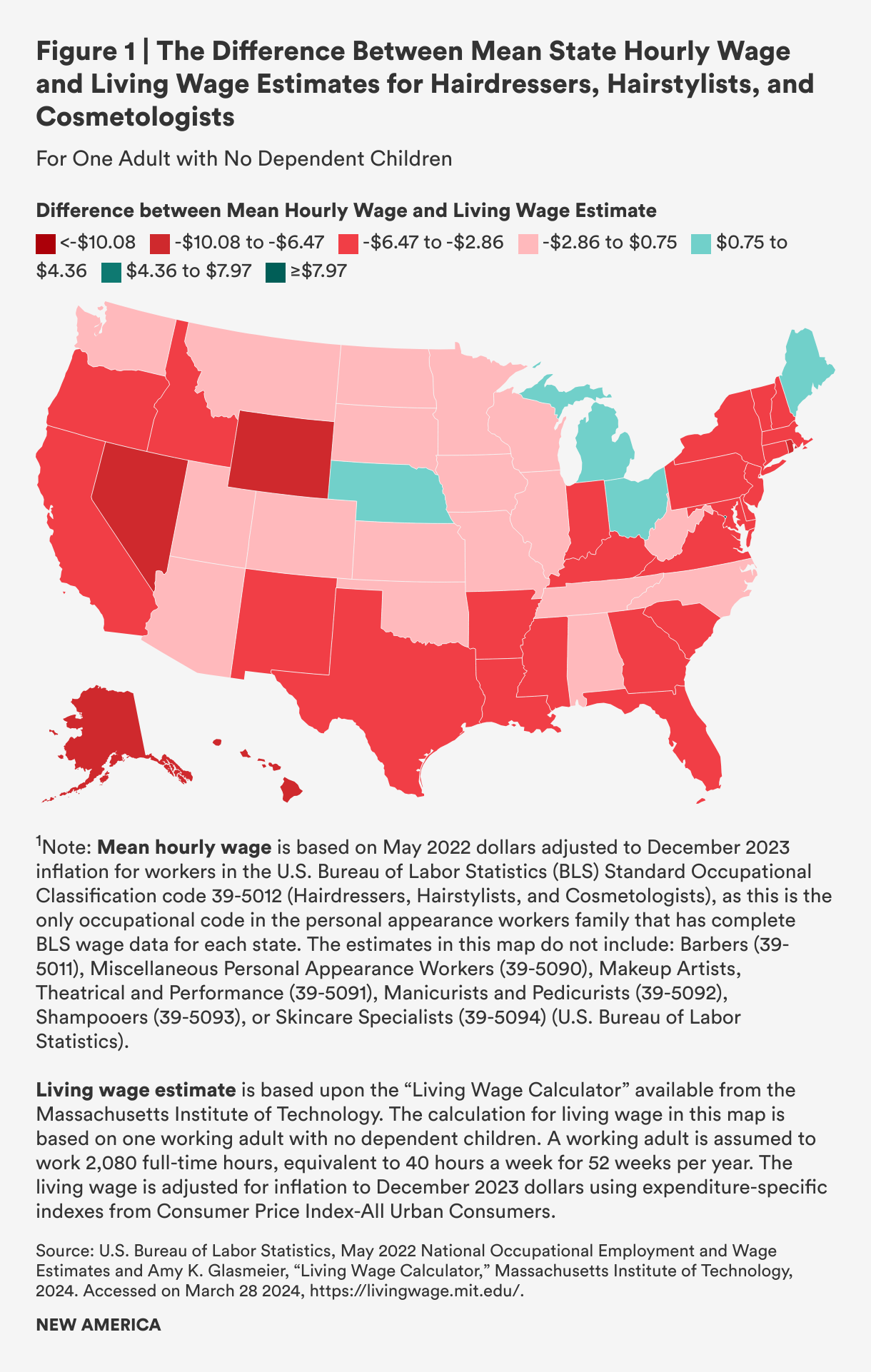
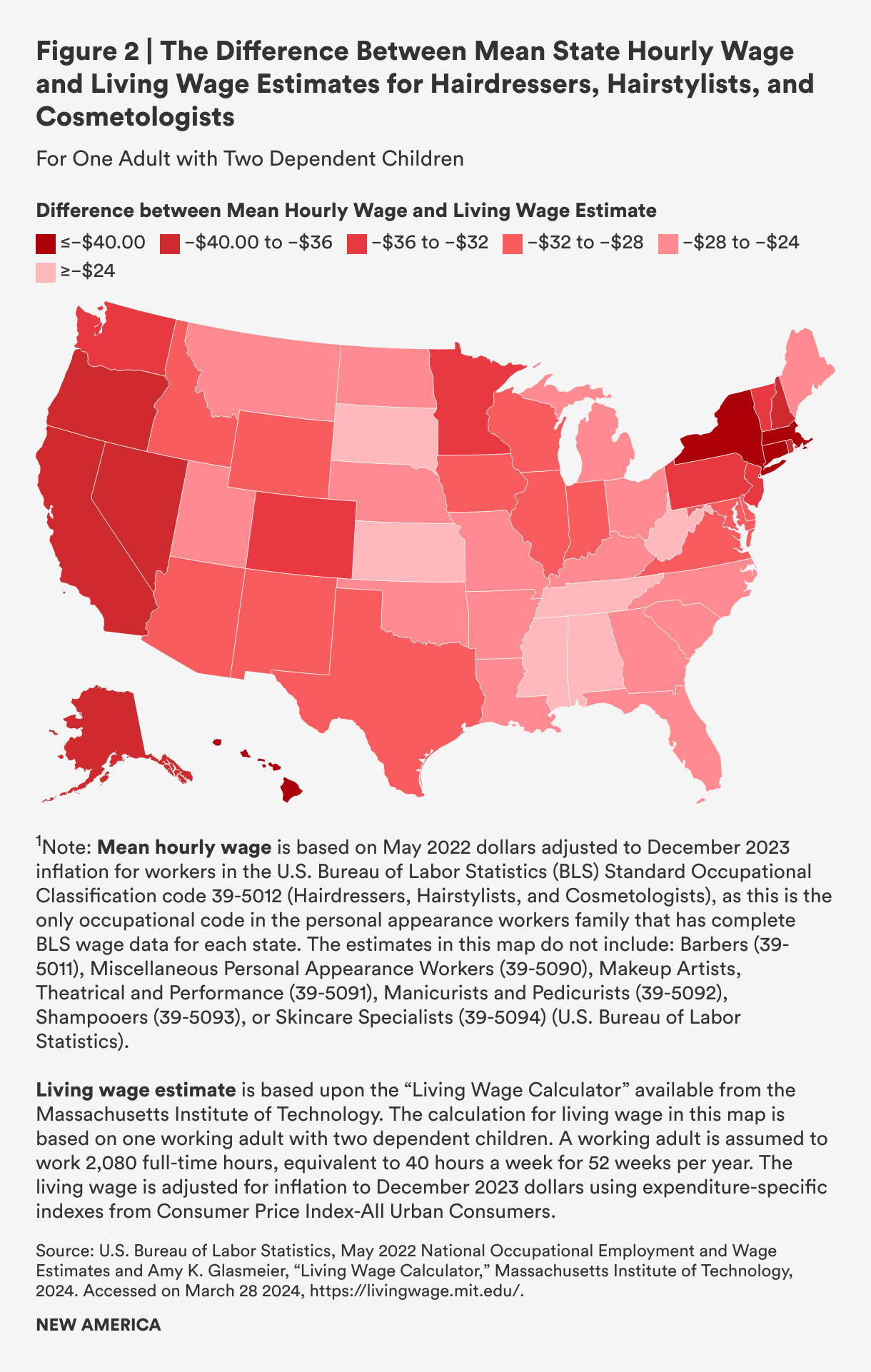
In no state does the average cosmetologist’s wage provide enough to live on for an adult with two children. And many parents chose cosmetology as their educational pathway hoping it will provide them flexibility to determine their own hours. According to a separate analysis by New America, approximately one in three of those earning certificates in “personal and consumer services”—which includes cosmetology students—are student parents.5 These students want to earn licenses that will provide economic mobility for their families, but they receive little return on their investment.
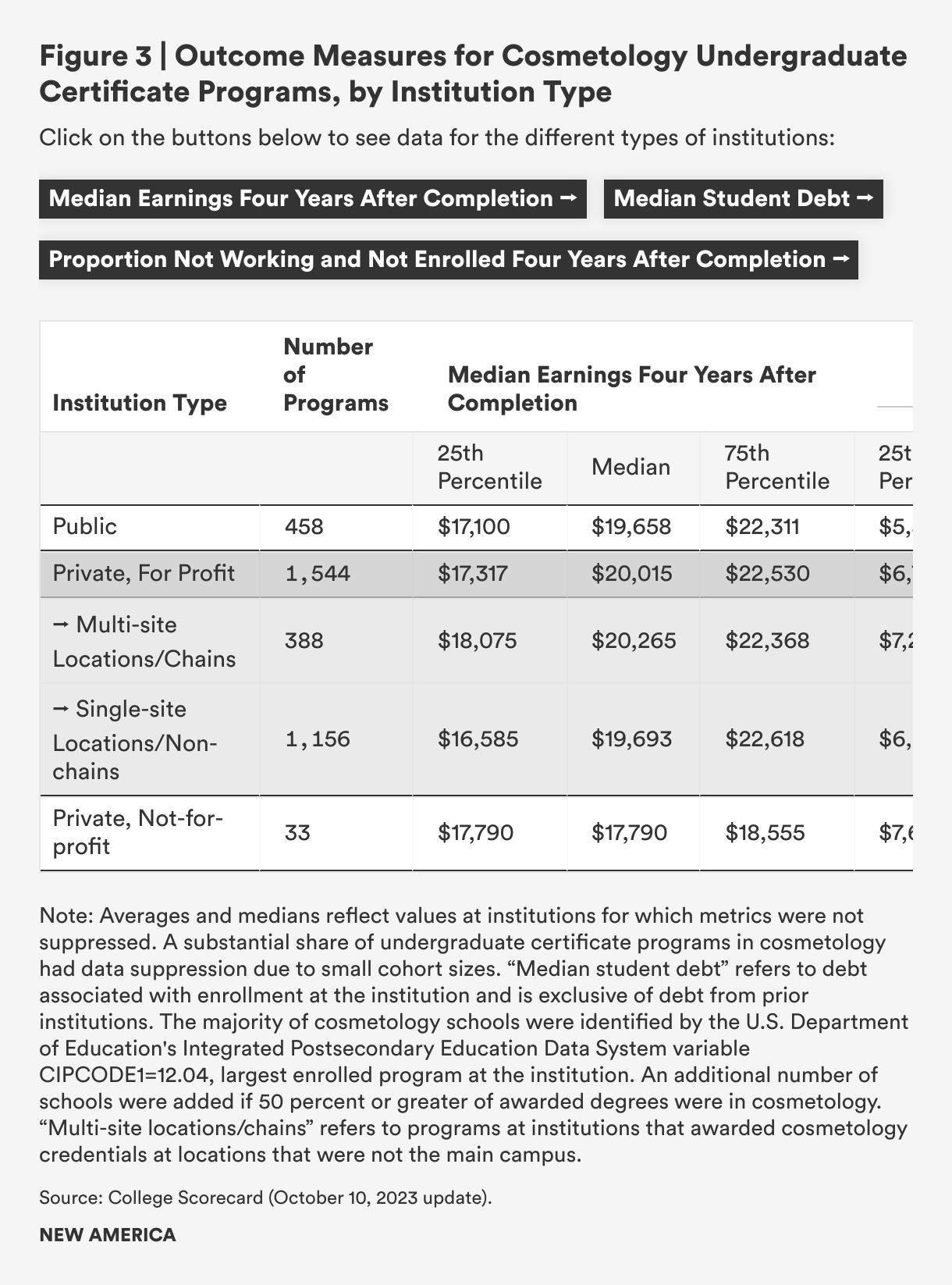
Even several years into their career cosmetologists don’t fare much better, according to the RTI analysis. A cosmetology graduate making the median salary who enrolled in a program that accepts federal aid only makes around $20,000 four years after completing a credential—well below the average for someone who is only a high school graduate (see Figure 3).
Despite those low wages, the median graduate is also repaying about $10,000 to $14,000 in student loan debt. And even with low U.S. unemployment rates overall in 2023, some graduates still can’t find a job. More than 10 percent of students who attended a for-profit cosmetology school were unemployed, almost three times the unemployment rate at the time.
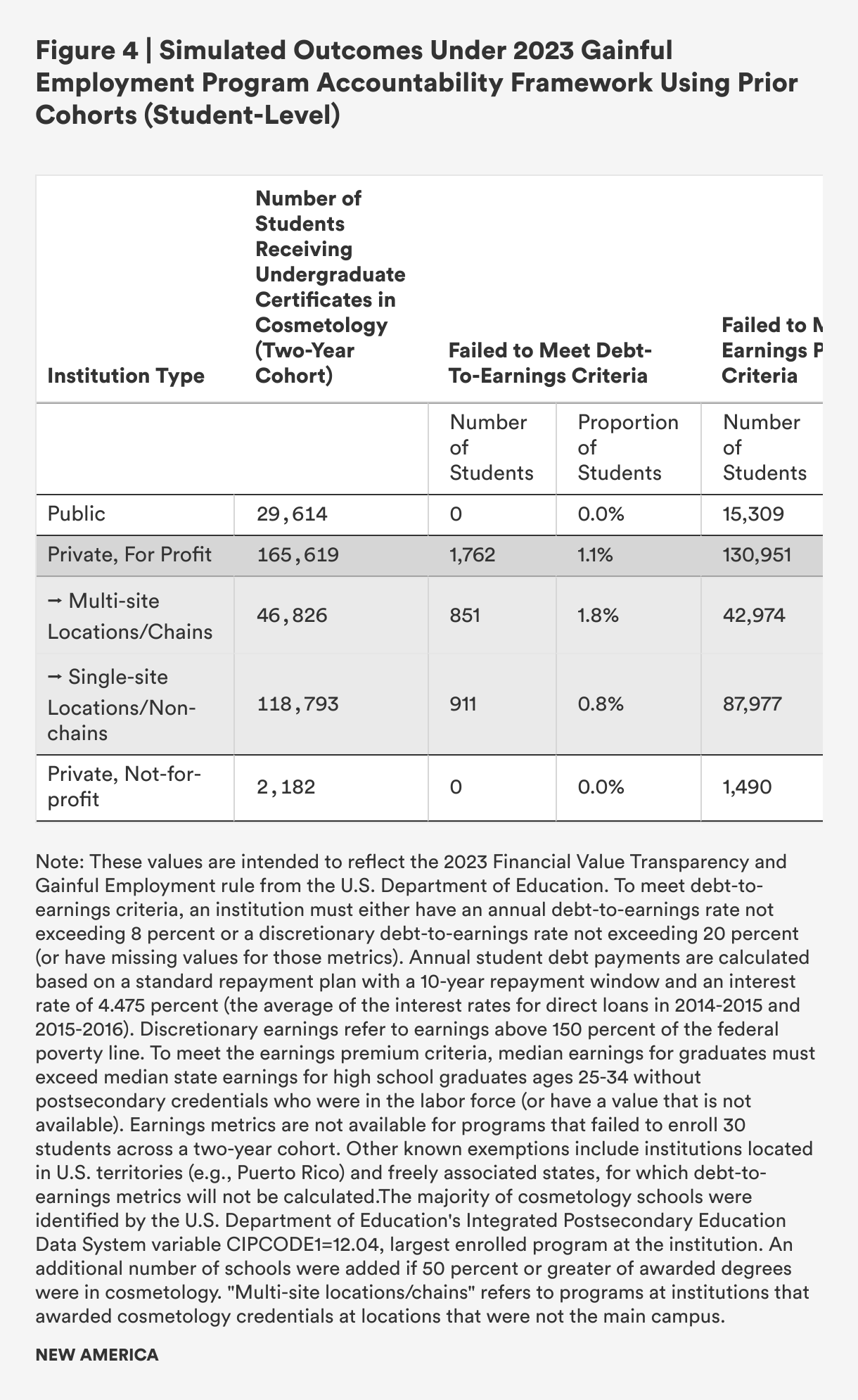
As the Education Department was putting the 2023 gainful employment rule together, it estimated many cosmetology schools couldn’t meet gainful employment standards. RTI’s own analysis of student outcomes data reveals the stark failure of cosmetology programs in ensuring graduates earn more than those with only a high school diploma. In RTI’s analysis, more than half of the cosmetology programs at for-profit cosmetology schools—54 percent—and a quarter of those at public institutions fail to meet this standard.6 At large, for-profit conglomerate beauty schools, approximately 90 percent of cosmetology graduates fail to make more than what they would have with only a high school degree (See Figure 4). And the outcomes for smaller schools may be similar due to data suppression meant to protect student privacy. For example, RTI was unable to calculate gainful employment metrics for the nearly 33 percent of students who attend smaller for-profit schools.7
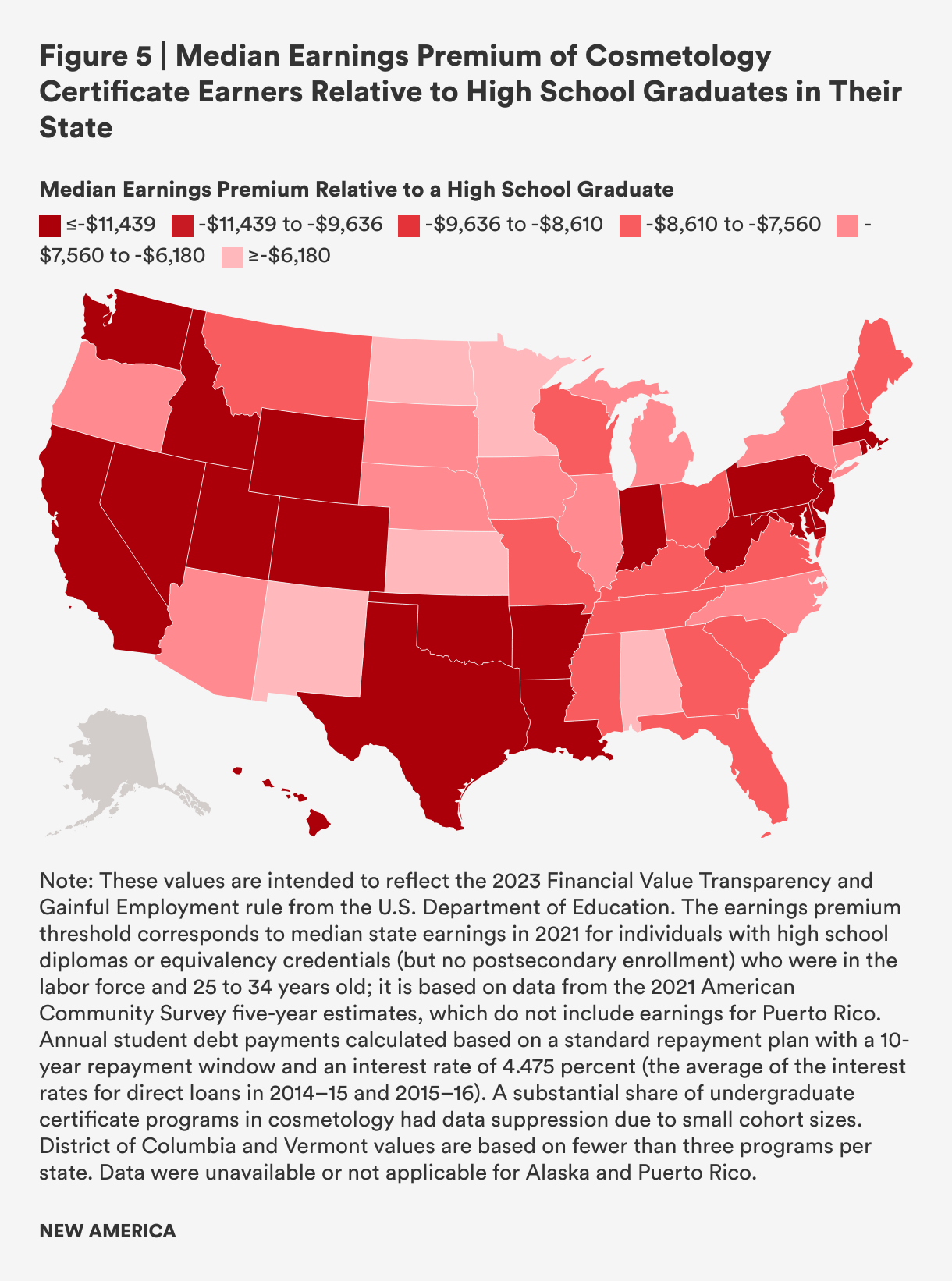
The RTI analysis of gainful employment standards shows that the median earnings of recent cosmetology graduates in all 50 states fall below the pay of a high school graduate, by between $5,000 to $14,000 (see Figure 5).
These sorts of poor outcomes are unsurprising, given that many students reported in focus groups and interviews that cosmetology schools peddle outdated training that won’t prepare them for a quality job.
Educational neglect can leave students scrambling to pay for missed lessons or retake coursework, just to keep their graduation and licensing exams from unraveling. The lackluster experiences reported in New America’s focus groups reflect an industry resistant to evolving. Students shouldn’t have to wonder whether their teachers will be in class the next day, and they shouldn’t have to pay thousands of dollars to learn current coloring and other techniques outside of school.
Another finding from New America’s focus groups and interviews, one of the most troubling, was a stark racial double standard: Black people are expected to know how to work on all types of hair. White people are not. Even though a large share of cosmetologists are people of color, few beauty schools teach about textured hair.
These deficiencies in the system are disheartening for students who view cosmetology as a calling, a method of affirming and uplifting their clients’ identities. Black clients, in particular, have long been overlooked or even derided in beauty standards, and cosmetologists can play a pivotal role in helping them feel seen and confident. A California hair braider wanted to help change the perspective of people of color about their natural hair, she told New America in a one-on-one interview. Helping young biracial children work with their hair for the first time, or a woman who has never embraced her natural hair, can be emotional. It’s part of “God’s purpose,” the hair braider said.
States are just starting to bridge this educational gap. Only a few of them, including New York, Connecticut, and Minnesota, have passed laws mandating cosmetology curricula include lessons on textured hair.8 The New York state senator who introduced the bill to require education on textured hair, Jamaal T. Bailey, a Black man, told Allure he sometimes struggled to even find a barber who could touch up his hair during the legislative session in Albany, which has a predominantly White population.9
And just practically, failing to teach proper care for textured hair presents a safety risk. Bleaching Black hair, for example, can cause serious damage.10 By overlooking education in textured hair, the industry undermines its own claims of prioritizing health and sanitation in justifying excessive licensure hours.
Citations
- Bauer-Wolf, personal interview with student number 1.
- Jeremy Bauer-Wolf, personal interview with a second Paul Mitchell Dallas student, conducted February 15, 2024. Crystal is a pseudonym.
- Bauer-Wolf, personal interview with student 2.
- New America commissioned a data analysis by RTI International, a global research firm. The analysis was completed in January 2024. RTI used several data sources for this analysis, including the U.S. Department of Education’s Integrated Postsecondary Education Data System (IPEDS) for the year 2022, the Education Department’s College Scorecard (October 2023 update), U.S. Bureau of Labor Statistics May 2022 National Occupational Employment and Wage Estimates, Massachusetts Institute of Technology’s Living Wage Calculator, California Board of Barbering & Cosmetology, Iowa Department of Public Health—Bureau of Professional Licensure, Ohio Cosmetology and Barber Board, Texas Department of Licensing and Regulation, Kansas Board of Cosmetology, and Texas Department of Licensing and Regulation. Each figure and table in this report includes relevant source information and notes.
- New America analysis of U.S. Department of Education data from the National Postsecondary Student Aid Study: 2020 Undergraduate Students.
- As a point of clarification, in the introduction to this report, we mention a New America analysis of U.S. Department of Education Program Performance 2022 data that found that 42 percent of the share of overall gainful employment failures are within the cosmetology industry. Here, we find that within cosmetology itself, 54 percent of the programs fail.
- See Figure 4, columns labeled “Unable to calculate GE metrics due to small sample sizes or other examples” to see how many students are not counted in the failure rates.
- Kayla Greaves, “A New Law Requires All Cosmetology Students in New York State Learn to Style Textured Hair,” Allure, August 7, 2024, source.
- Greaves, “A New Law Requires All Cosmetology Students in New York State Learn to Style Textured Hair,” source.
- L.D. Bloch, A.M. Goshiyama, M.F. Dario, C.C. Escudeiro, F.D. Sarruf, M.V.R. Velasco, N.Y.S. Valente, “Chemical and Physical Treatments Damage Caucasian and Afro-ethnic Hair Fibre: Analytical and Image Assays,” Journal of the European Academy of Dermatology and Venereology 33 (November 2019): 2158–2167, source.