
Chapter 2: Non–Need-Based Aid Spending at Public Universities, 2001–2017
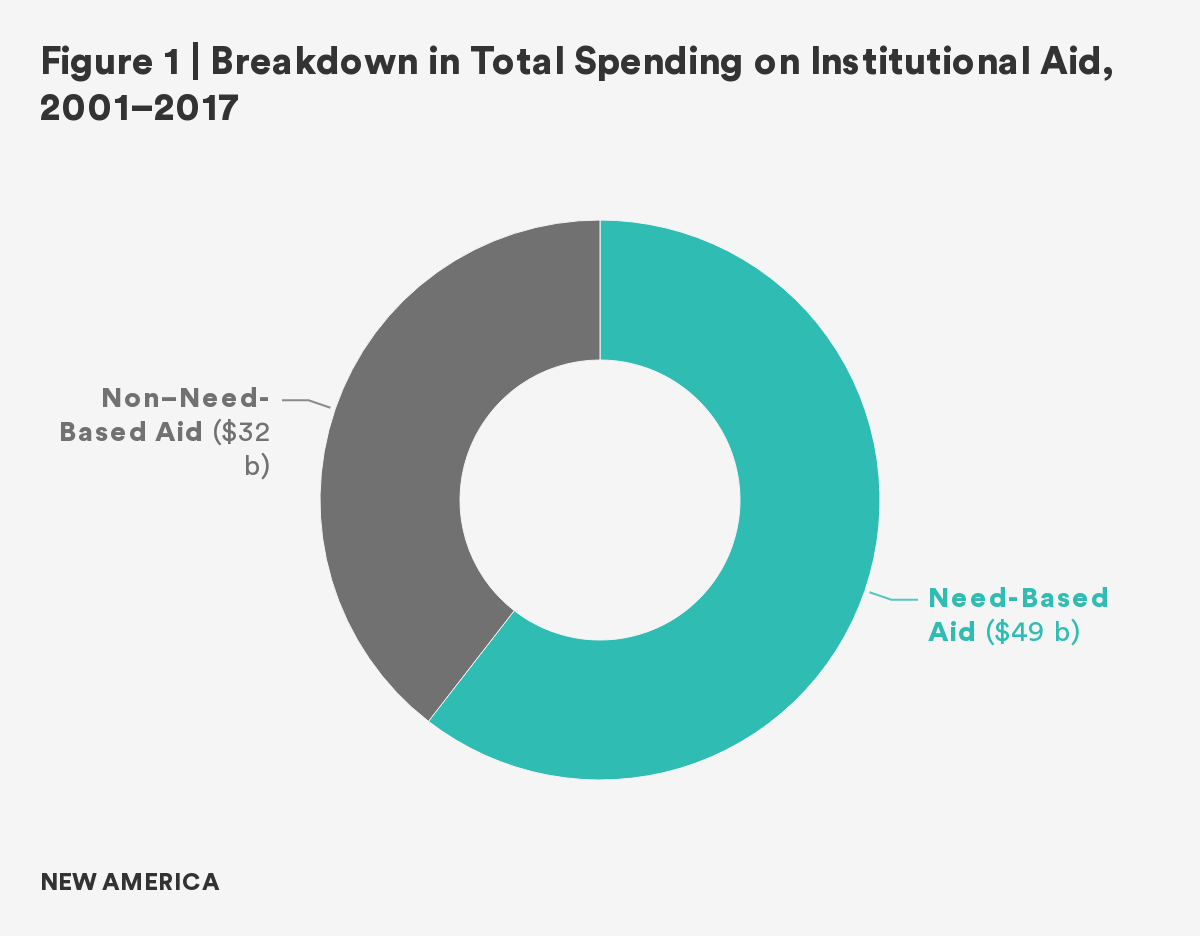
The 339 public universities this paper examines spent nearly $32 billion of their own financial aid dollars on students who lacked financial need from 2001 through 2017. During this period, $2 out of every $5 these schools provided in institutional aid went to non-needy students—those whom the federal government deems able to afford college without financial aid (see Figure 1).
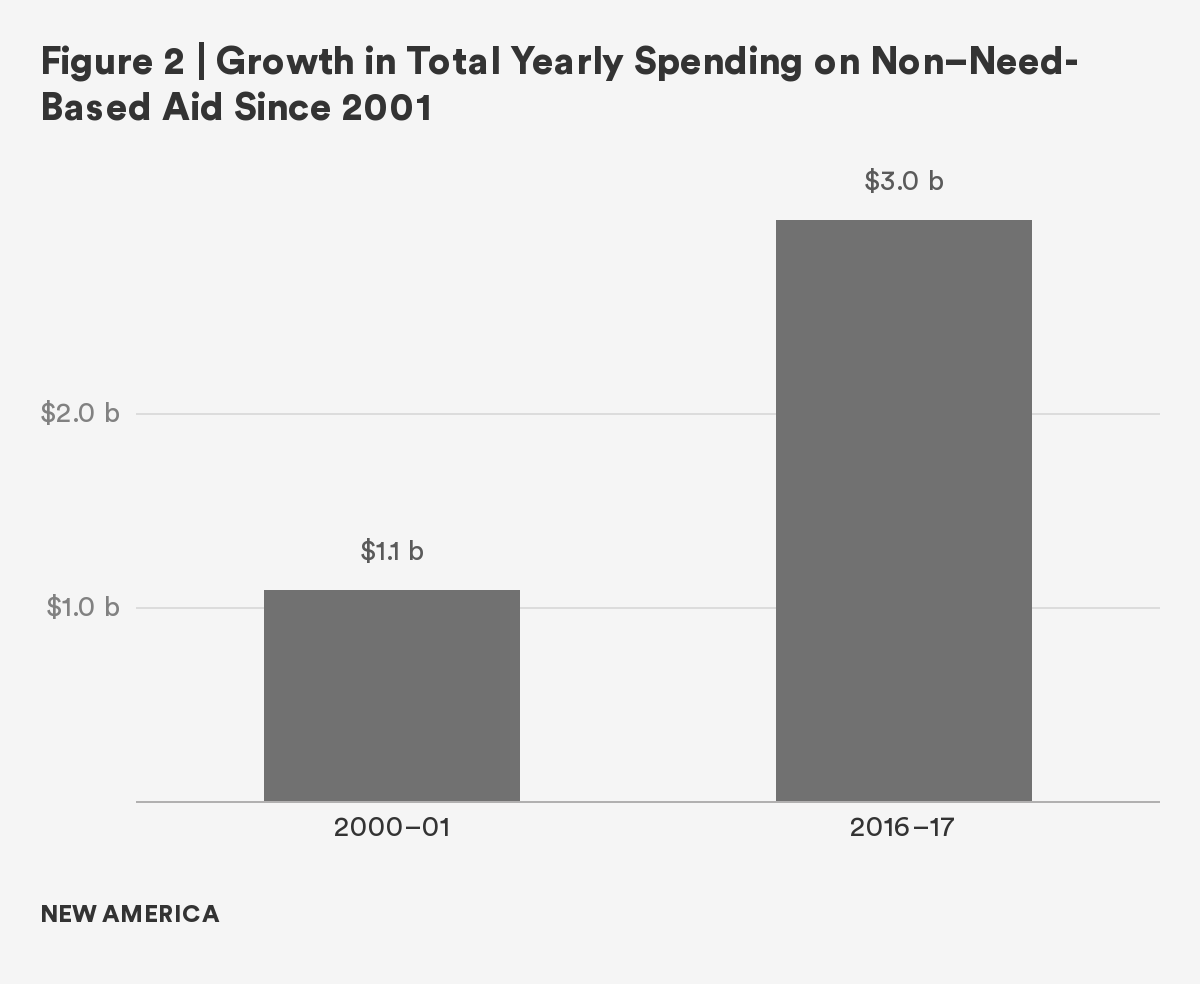
Since 2001, public universities’ use of non–need-based aid to recruit relatively affluent students has skyrocketed. At that time, the 339 public universities spent about an inflation-adjusted $1 billion annually on so-called merit aid for relatively well-off students. By 2016–2017, these schools were spending nearly $3 billion yearly on financial aid to students who lacked financial need (see Figure 2).While freshmen enrollment grew at these institutions by 42 percent over this time period, the schools' spending on non–need-based aid rose by about 173 percent.
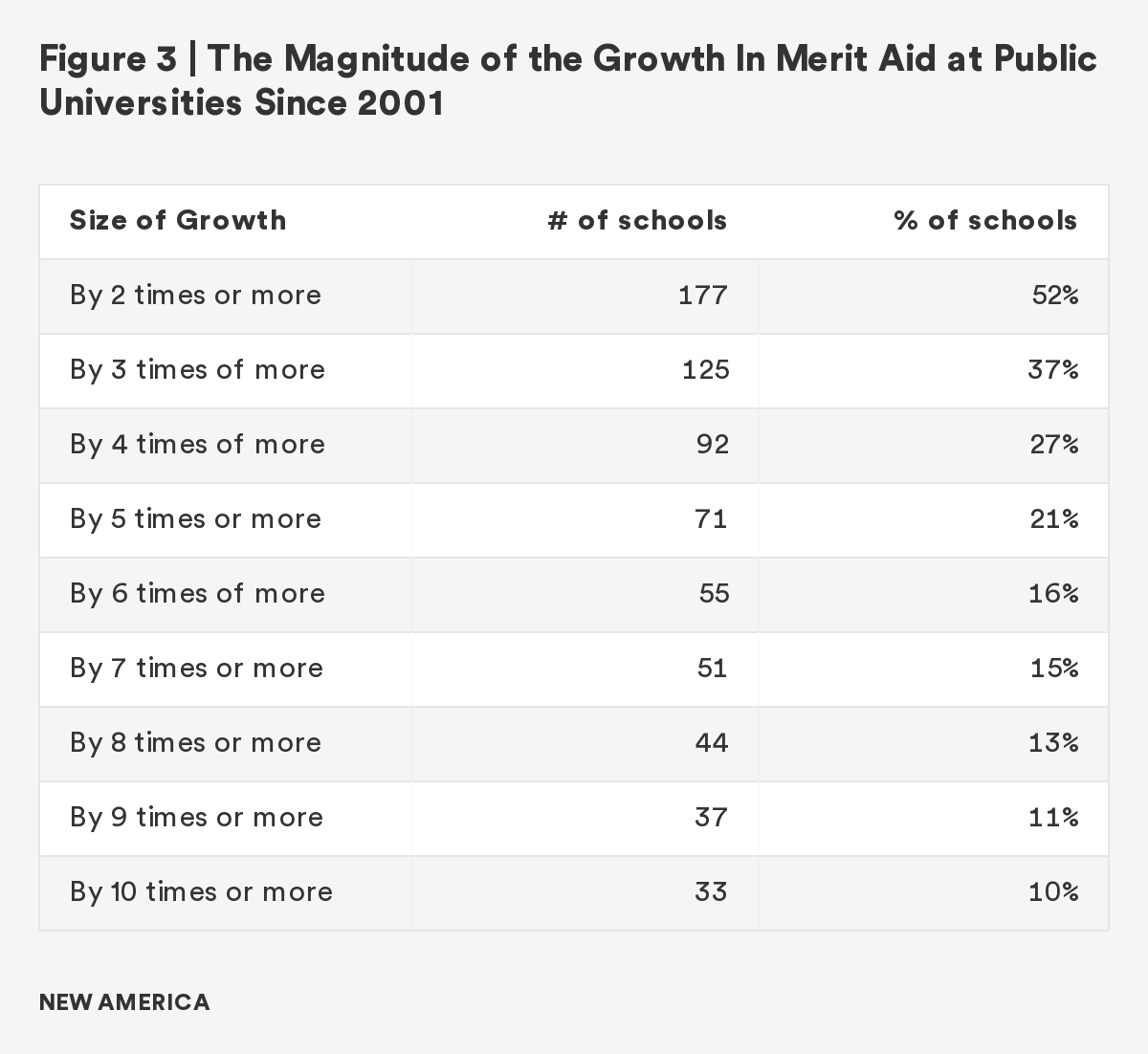
The data show how dramatically public universities’ use of non–need-based aid has ratcheted up over this time period. From 2001 to 2017, more than half of the 339 schools at least doubled the amount of money they spent on non–need-based aid, after adjusting for inflation; more than a third at least tripled the amount; and more than a quarter quadrupled the amount. About one in five schools quintupled the amount, and one in 10 increased it at least tenfold (see Figure 3).
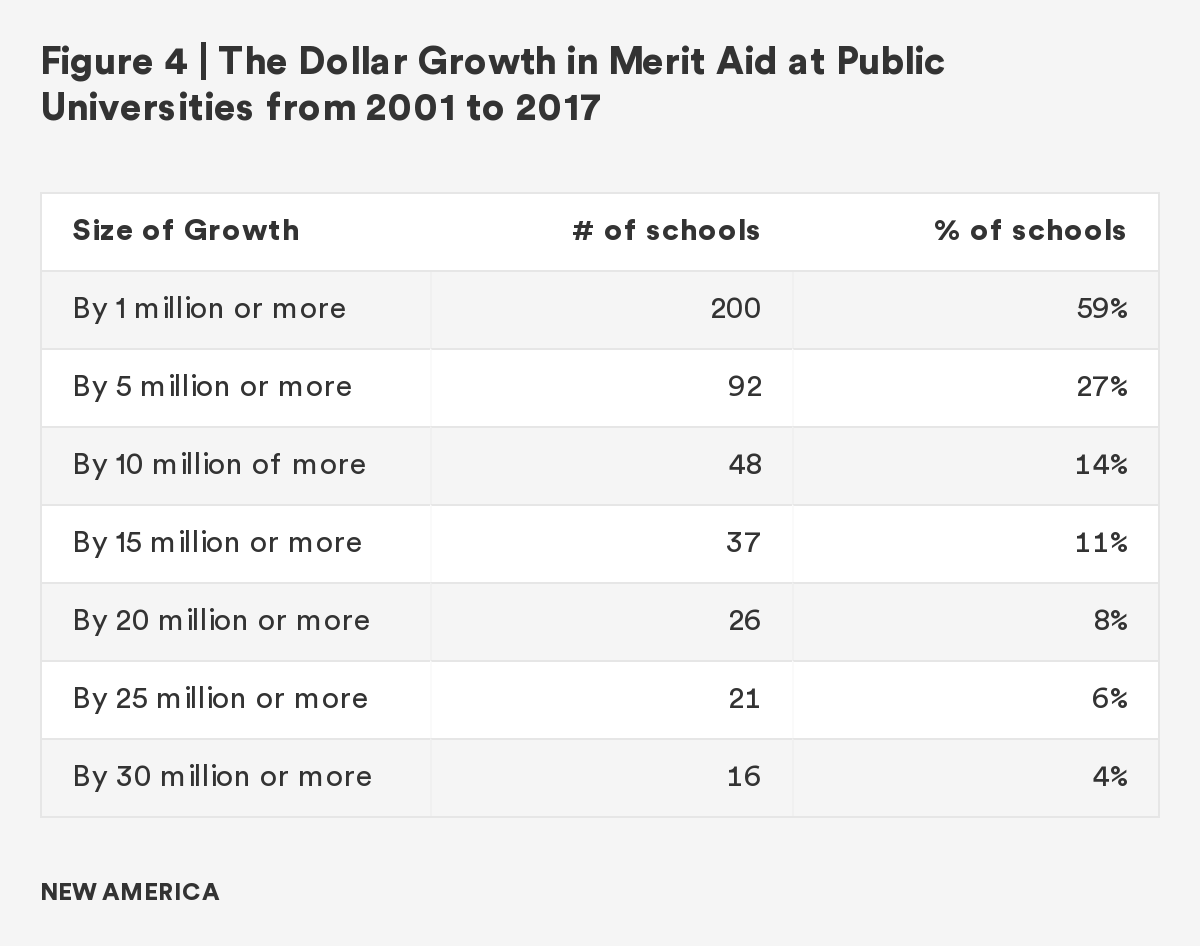
In terms of dollar figures, 200 schools, or 59 percent of those examined, increased the amount they spent on non–need-based aid over this time period by $1 million or more; 92, or 27 percent, by $5 million or more; 48, or 14 percent, by $10 million or more; 26, or 8 percent, by $20 million or more; and 16, or 4 percent, by $30 million or more (see Figures 4 and 5).
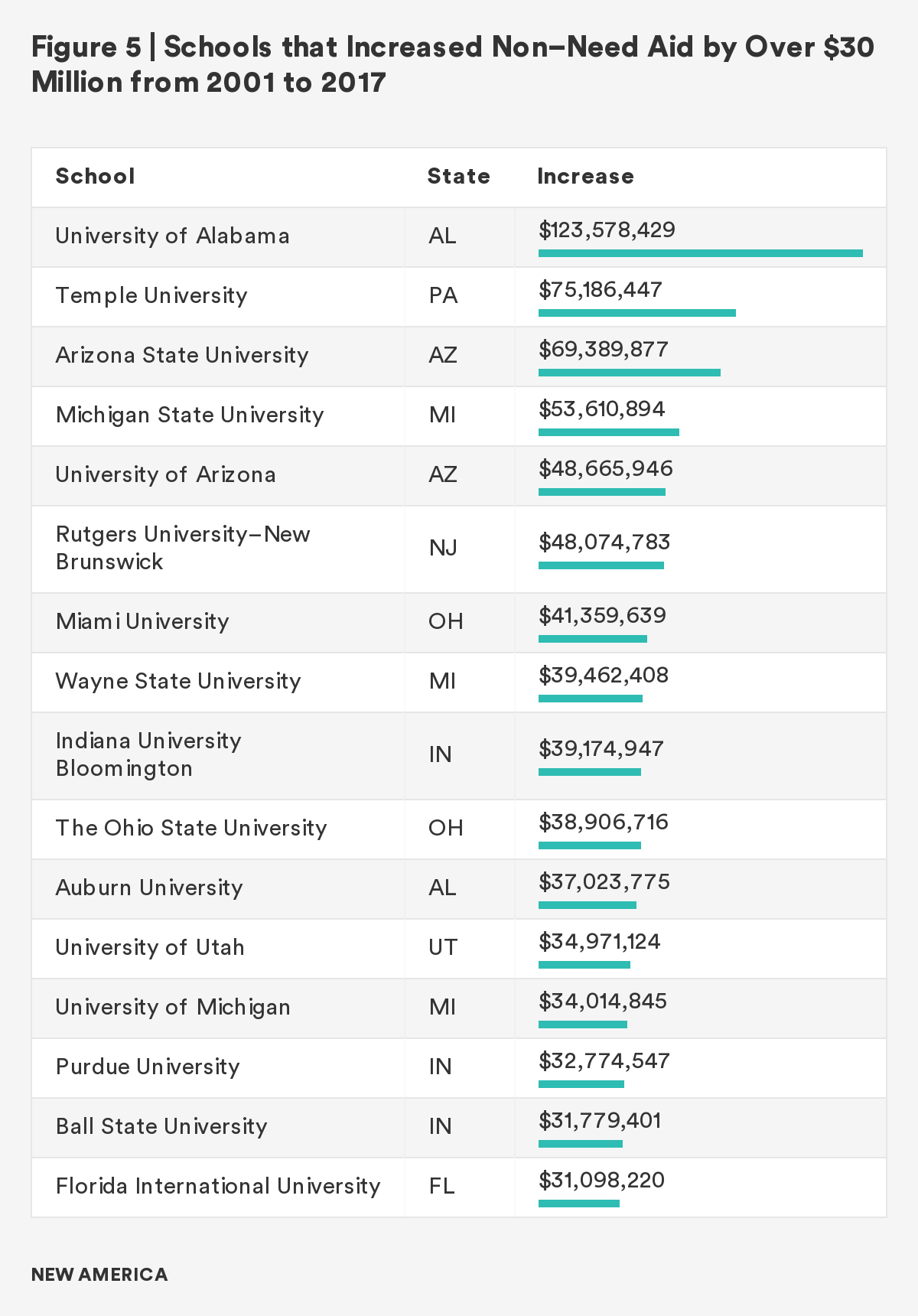
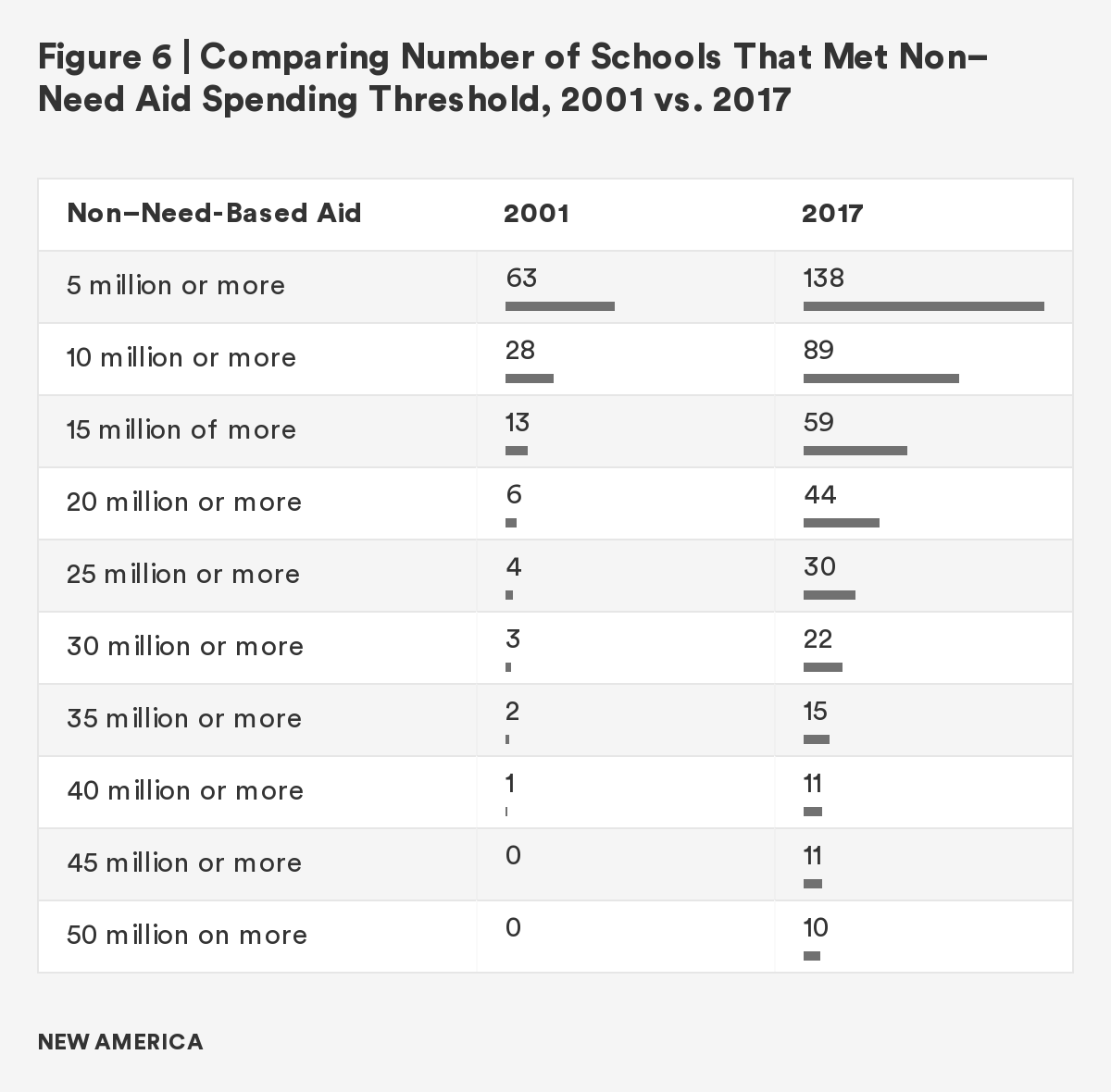
Meanwhile, the number of schools that yearly spent a total of $10 million or more, in inflation-adjusted numbers, on non–need-based aid to relatively well-off students increased by more than three times from 2001–2017, from 29 to 89; and the number that spent $20 million or more increased more than six-fold, from 7 to 44. While only one school spent more than $40 million in 2001, 11 did so in 2017, with 10 spending more than $50 million and 4 spending more than $75 million (see Figure 6).
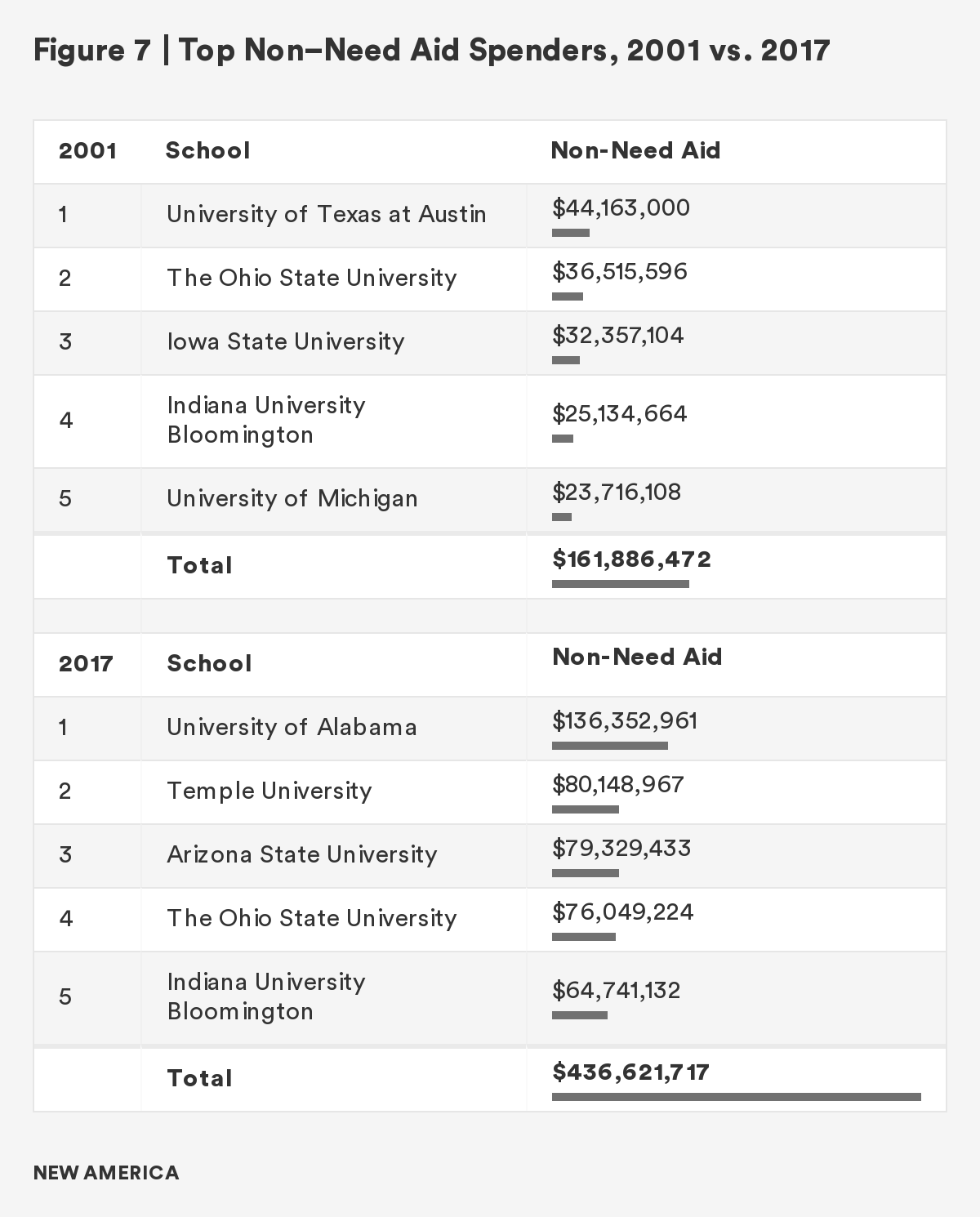
In 2001, the top five schools, in terms of non–need-based aid spending, awarded approximately $162 million in merit aid to students who lacked financial need. In 2017, the top five schools gave almost three times as much (see Figure 7).
Looking at those numbers suggests that the growth in non–need-based aid at public universities was constant and almost inevitable—that once public universities started engaging in financial aid leveraging in the late 1990s and early 2000s, there was no turning back.
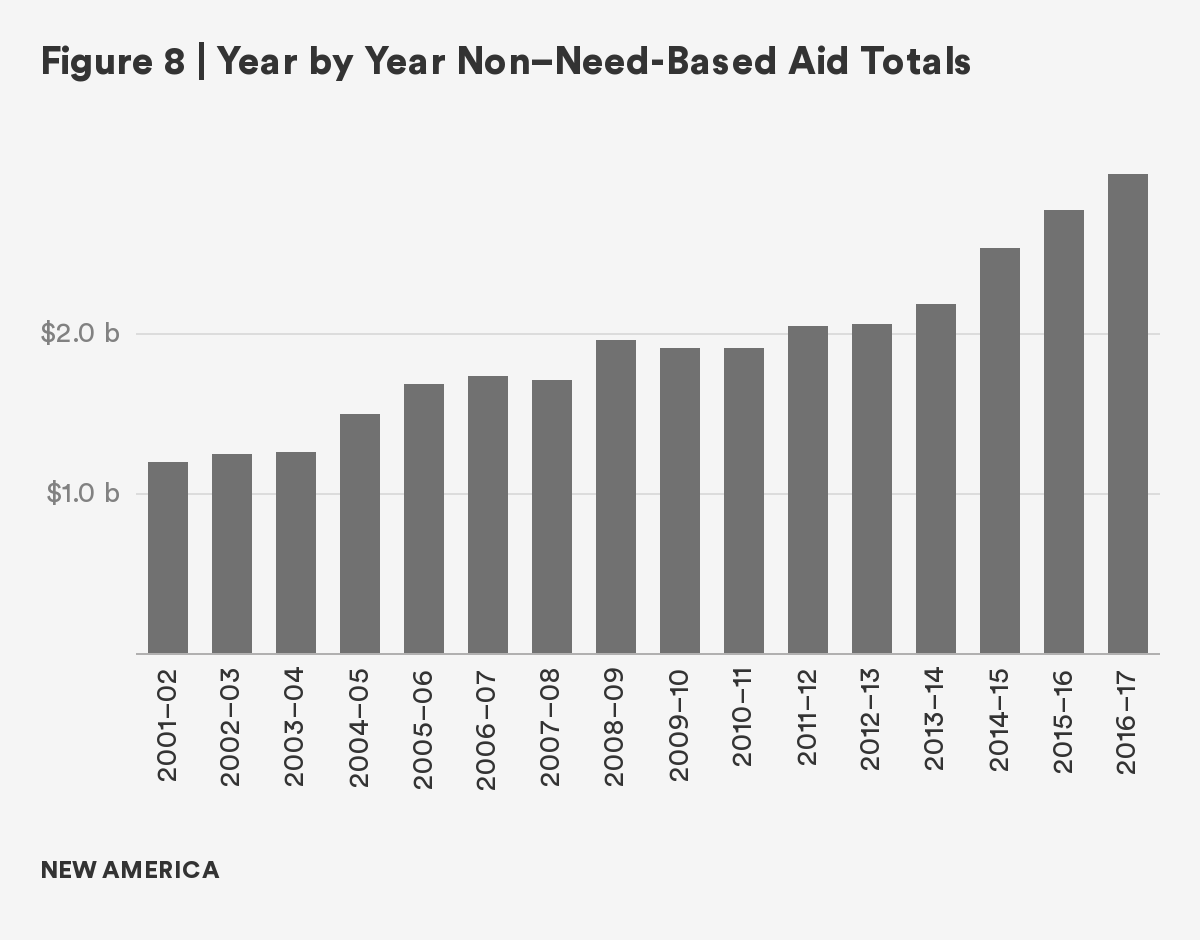
But a closer look at the data reveals a slightly more complicated picture. The schools’ yearly spending on non–need-based aid grew fairly steadily until the middle of the period, when it slowed and even took a few dips. It then recovered, at first tentatively, and then accelerated rapidly in the final few years, a time when enrollment growth in the sector slowed (see Figure 8).
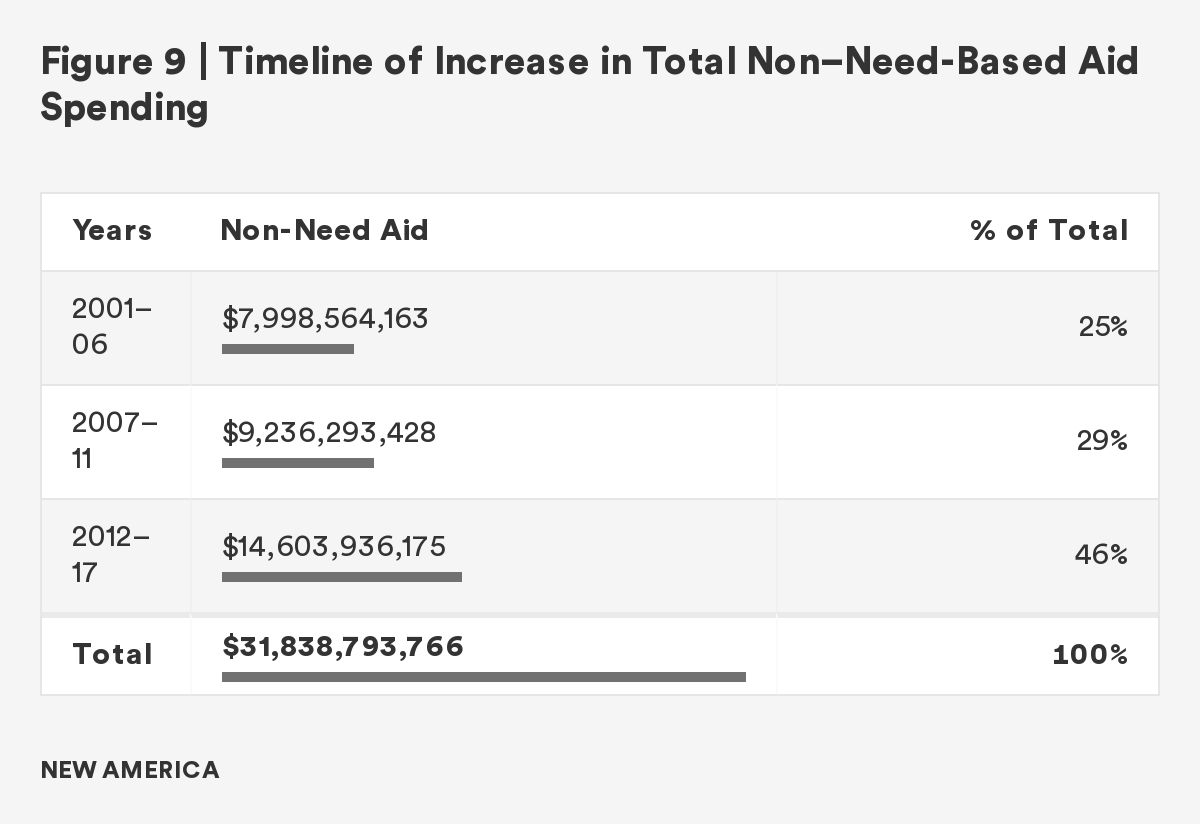
The surge in spending on non–need-based aid in the last four years of this period is stunning. While it took 11 years for the schools to increase their yearly spending on aid for relatively affluent students from $1 billion to $2 billion in inflation-adjusted numbers, it took only six more to get to nearly $3 billion. Nearly half (46%) of the $32 billion the schools spent on non–need-based aid since 2001 was awarded during the last six years of the time period, with 70 percent of that increase coming in the last four (see Figure 9).
The pivotal event that occurred during this time period was the financial crisis. It’s no coincidence that the slowdown in spending on non–need-based aid spending occurred in 2007, when the country fell into a deep recession and credit crunch that was extremely damaging to the financial fortunes of students and their families, the states, and the schools alike. While the immediate impact of the crisis at public universities was to temporarily shift the momentum back toward need-based aid, the fallout from the crisis has pushed larger numbers of public universities to embrace enrollment management and become more aggressive in using financial aid as a competitive weapon.1
To get a better idea of how the financial crisis affected the growth of non–need-based aid, it is helpful to break down the 17 years into three distinct periods: Before the Financial Crisis, 2001–2006; During the Financial Crisis and Flagging Recovery, 2007–2013; and The New Reality, 2014–2017.
Before the Financial Crisis: 2001–2006
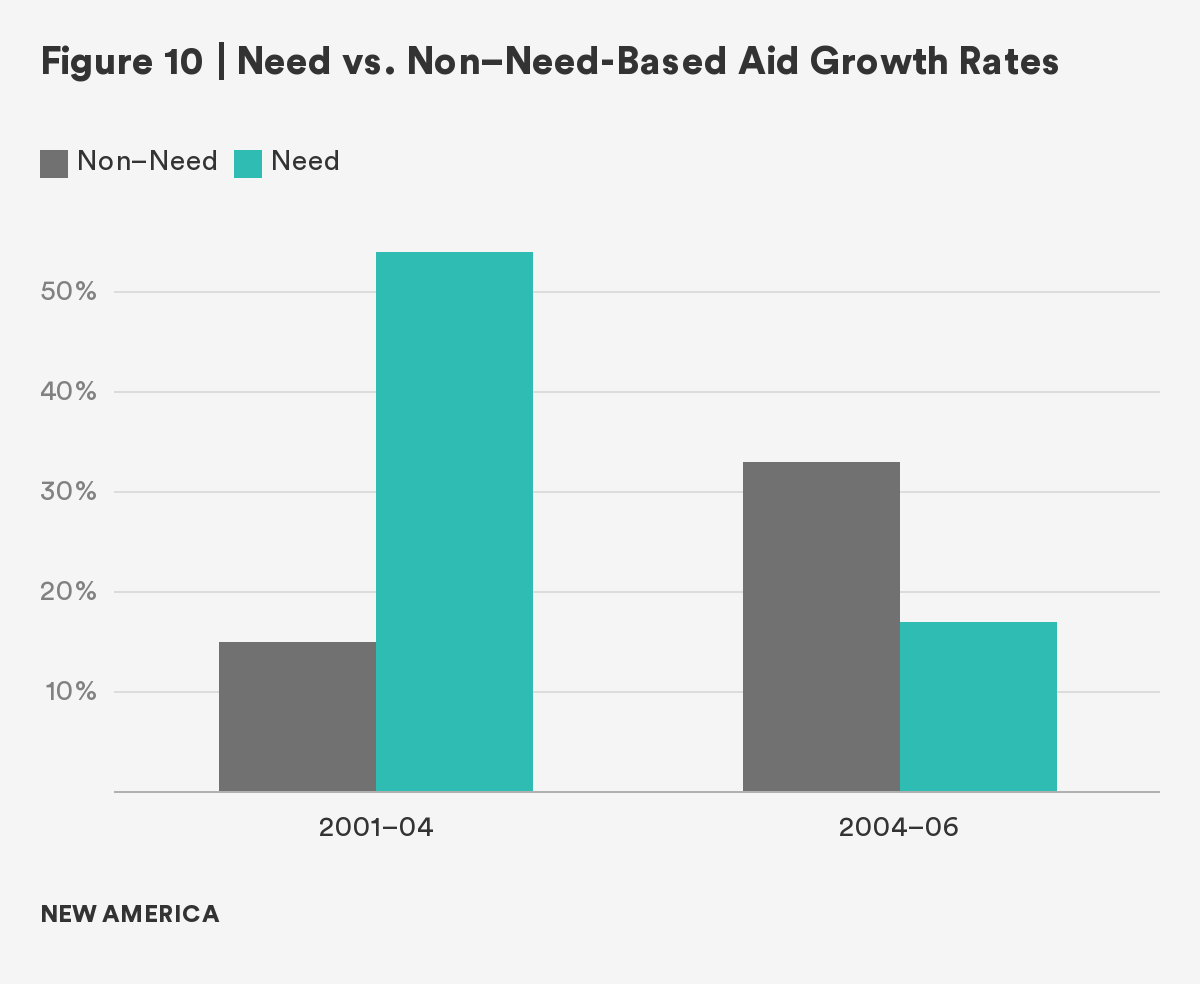
This is the period when colleges began to ratchet up the amount of institutional aid they awarded, from about $2 billion in 2001 to $3.4 billion in 2006. Spending on both need-based and non–need-based aid rose rapidly as enrollment at these schools grew significantly. For the first several years, need-based aid grew faster at these institutions. But from 2004–2006, the momentum shifted decisively in favor of non–need-based aid (see Figure 10).
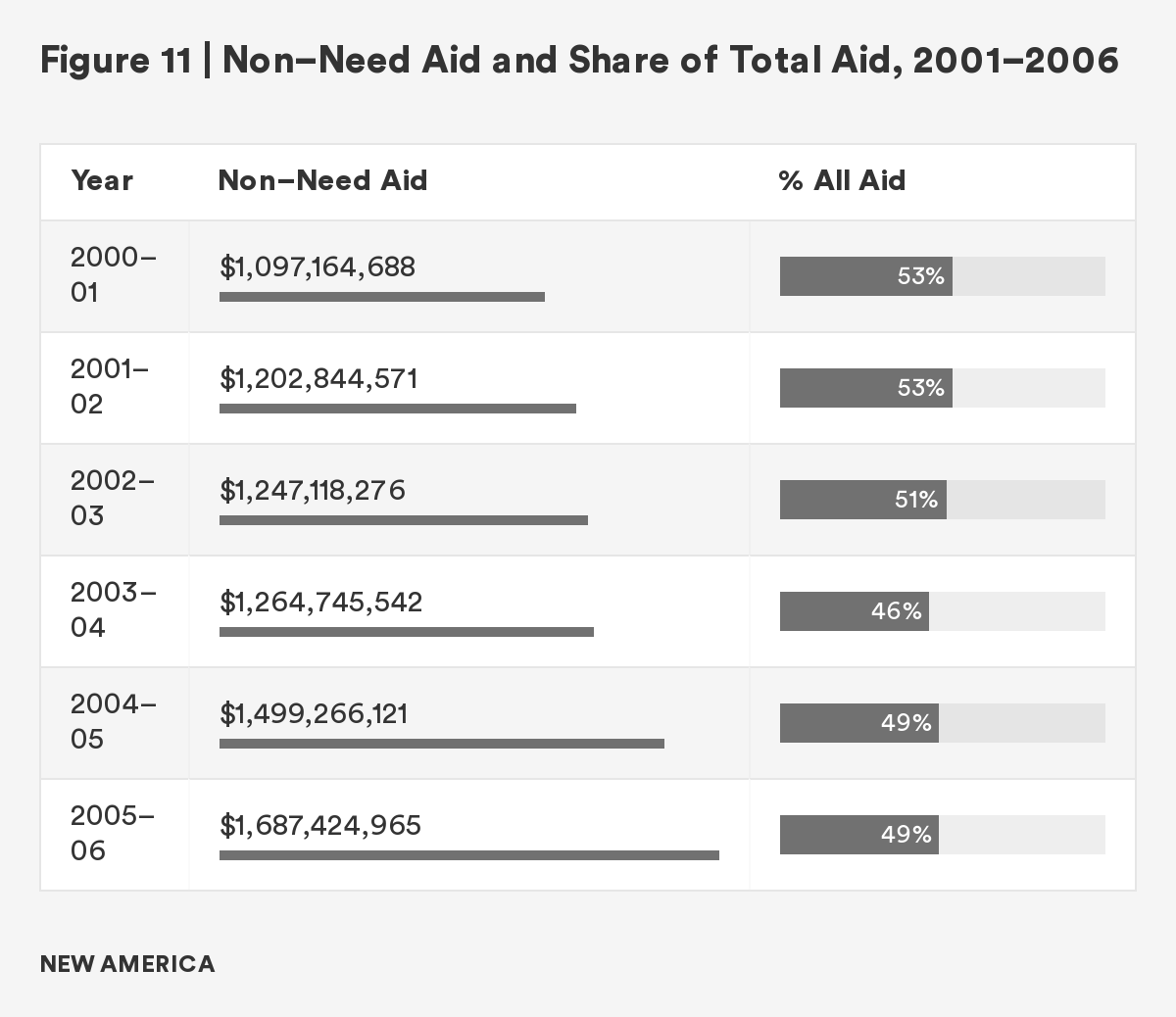
During this time period, about half of public universities’ institutional aid dollars went year after year to students without financial need (see Figure 11).
Public universities’ increasing use of tuition discounts and scholarships for well-to-do students began to raise alarms for higher education experts. In a 2009 blog post for New America, higher education economist Sandy Baum cited data from this period to note that public universities were spending a greater share of their institutional aid dollars on “relatively wealthy students” than private colleges were, even though private colleges often shouldered the criticism for engaging in such practices.2
“The policies of private colleges certainly merit examination,” she wrote. “But the policies of state colleges raise the most troubling questions” because the funds for these discounts and scholarships were coming, at least in part, from the substantial amount of state subsidies these institutions still received. “The funds of taxpayers who themselves have not gone to college—which could be used to provide opportunities to the next generation of needy students—are instead going towards increasing institutional selectivity or making the lives of the more privileged somewhat easier,” she wrote.3
During the Financial Crisis and Flagging Recovery: 2007–2013
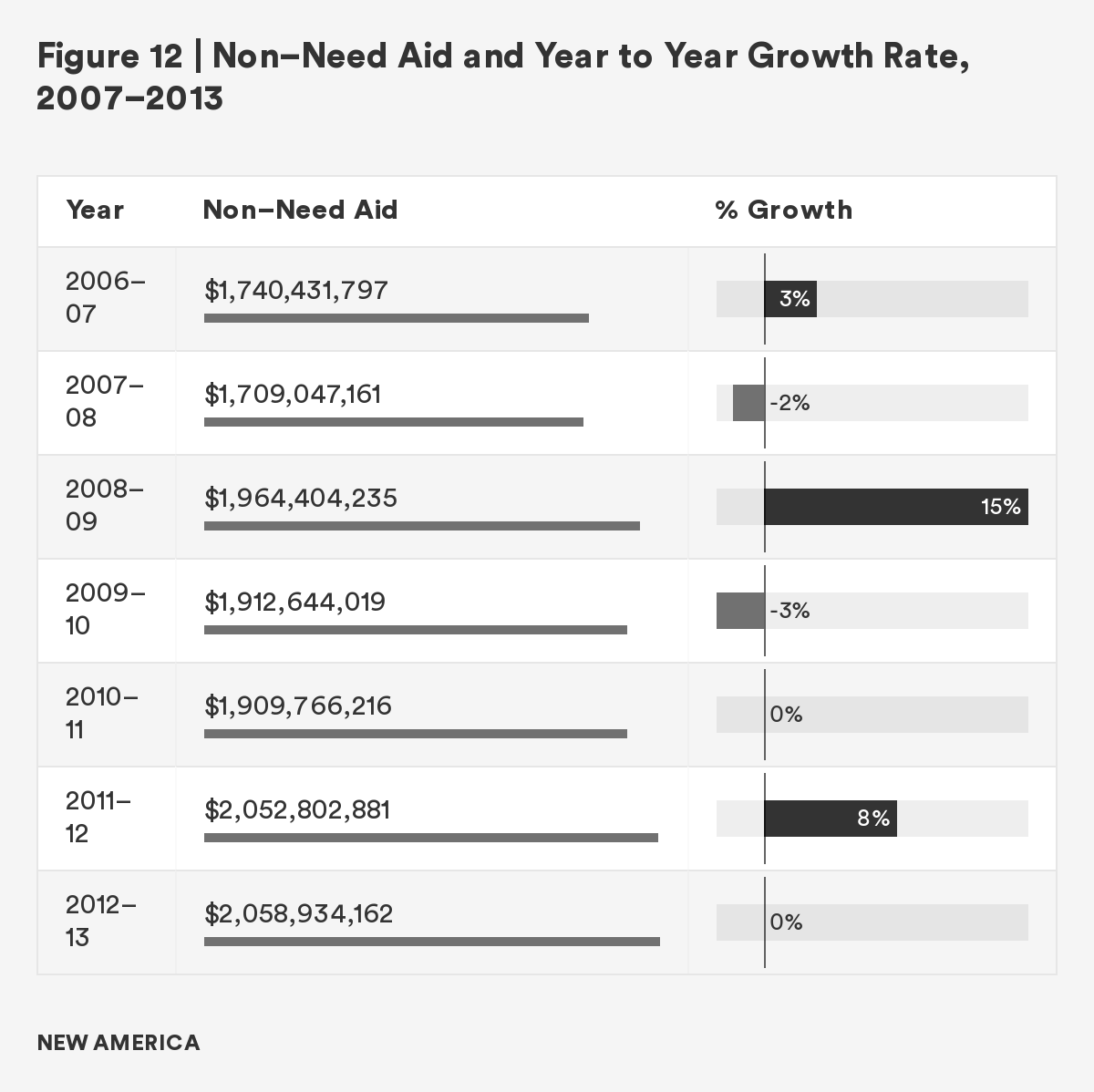
While the growth in spending on non–need-based aid had been impressive in the years leading up to the financial crisis, it slowed down considerably in 2006–2007, and dropped in 2007–2008. The only year where there was a double-digit percentage increase was in 2008–2009, when the total approached $2 billion. But it did not actually reach that threshold until 2011–2012 and then barely budged in 2012-2013 (see Figure 12).
Overall, during this period, spending on need-based aid more than doubled from $2 billion to $4.2 billion, while non–need-based aid grew overall by only 18 percent (see Figure 13).

As a result, the share of institutional aid going to non–need-based aid plunged, from nearly half to one-third (see Figure 14).
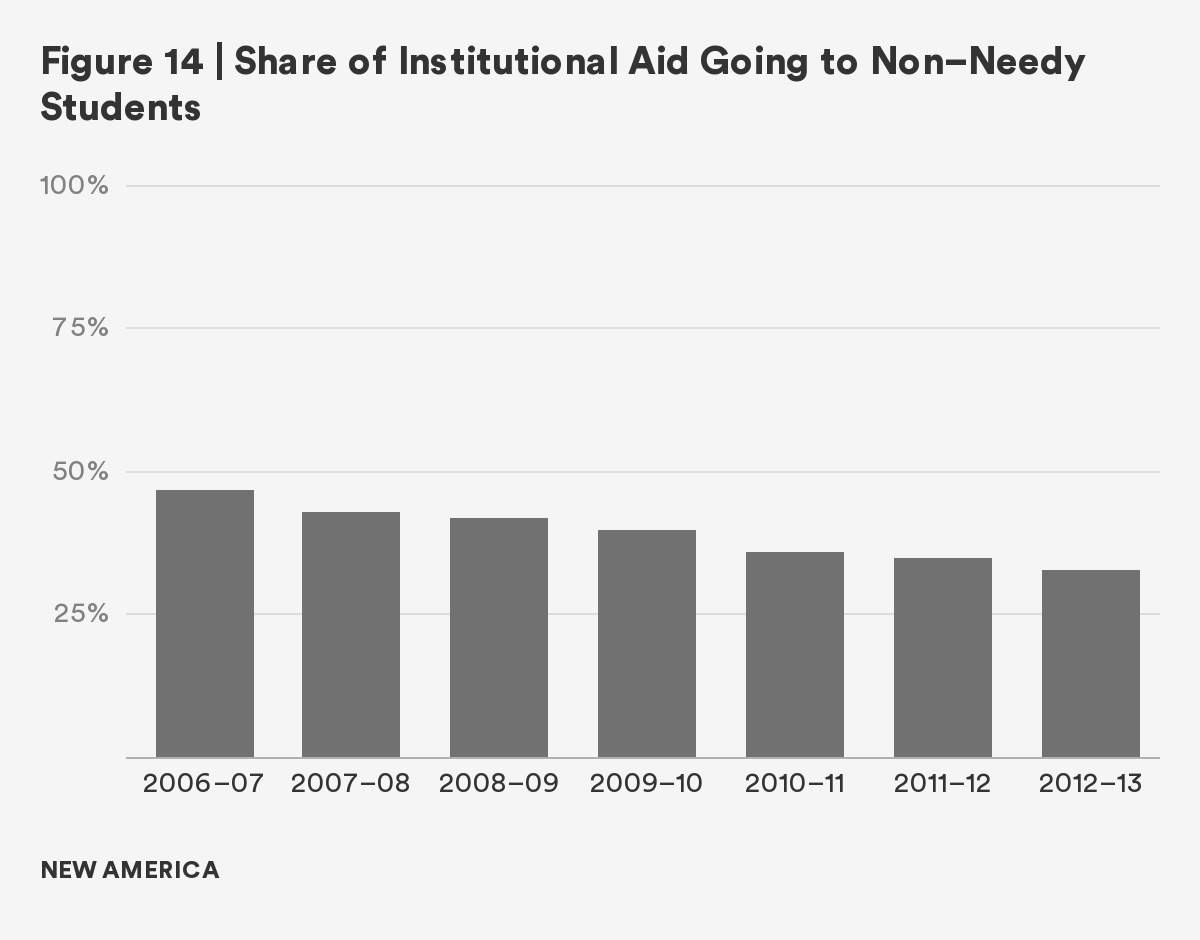
Clearly, the shift toward need-based aid is dramatic, but, as a paper that Baum co-wrote in 2010 on tuition discounting stated, it is not entirely clear why it happened.4 “It is not possible to determine from the available data how much of this increase results from changes in institutional policies and how much results from a combination of rising tuition levels and declining family ability to pay,” Baum and her colleagues wrote. “These circumstances dictate that more students have more financial need, so more of the aid distributed without regard to need is likely to end up meeting need.”5
In other words, the financial crisis both forced many public universities to increase their prices and hurt many families’ ability to pay for college. As a result, “merit” aid money that went to these students may have counted as need-based aid.6
Also, as noted in the first chapter, enrollment managers use all aid—need-based aid and non-need-based aid—strategically. For that reason also, it isn't clear how much of this aid was especially intended to fill financial need and how much was ‘merit” aid money that went to financially needy students.
Only time would tell whether the shift back to need-based aid was temporary or permanent, or even real or illusory.
The New Reality, 2014–2017
The final four years of this period showed that the real or illusory shift away from non–need-based aid had been temporary. The dramatic cutbacks that state legislators made in per-student spending during the financial crisis ultimately caused many more public universities to embrace enrollment management and financial aid leveraging. With state spending still lagging in the years after the recovery, and enrollment growth slowing, these schools became more aggressive in using non–need-based aid to pursue wealthy out-of-state students with standardized test scores high enough to help schools rise up in the rankings.7
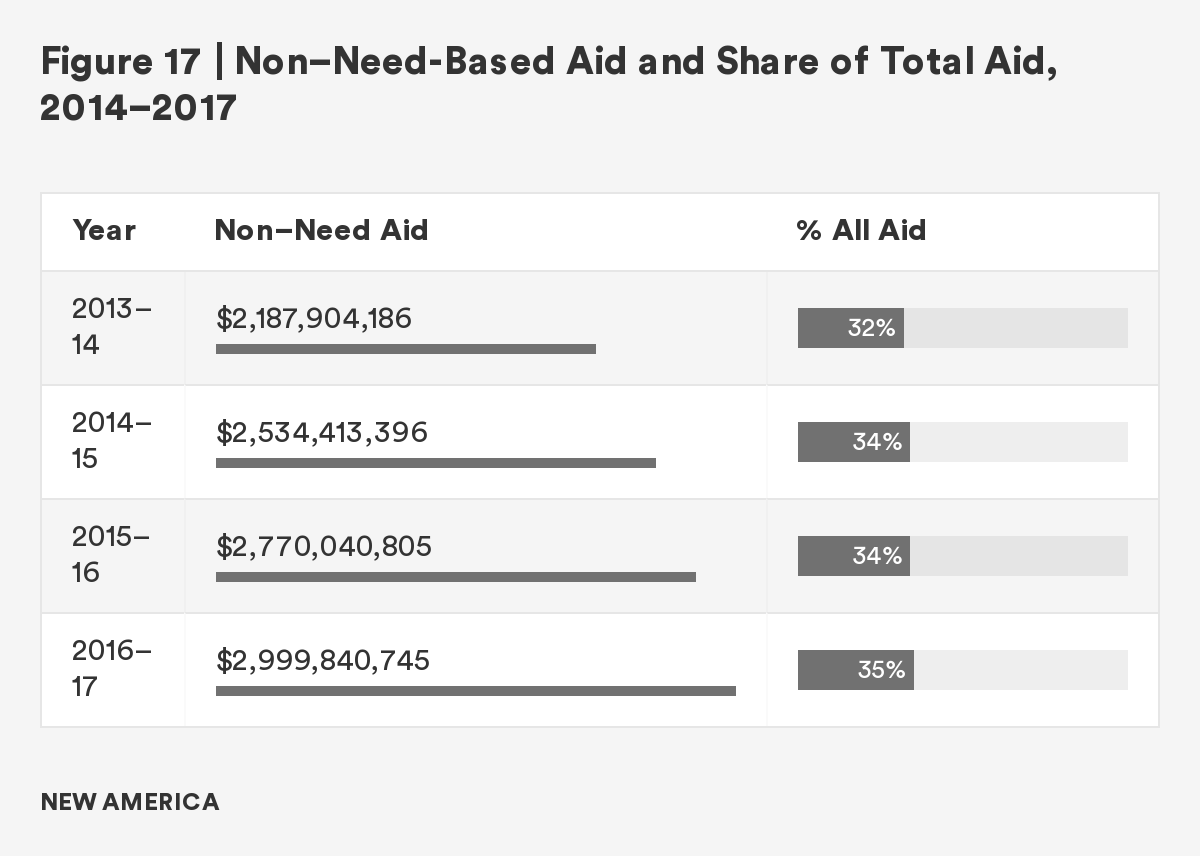
During this period, the yearly amount the 339 schools spent on non–need-based aid surged from about $2.2 billion to nearly $3 billion. Non–need-based aid spending grew faster than need-based aid three years in row, rising almost twice as fast as need-based aid for two of them (see Figures 15 and 16).
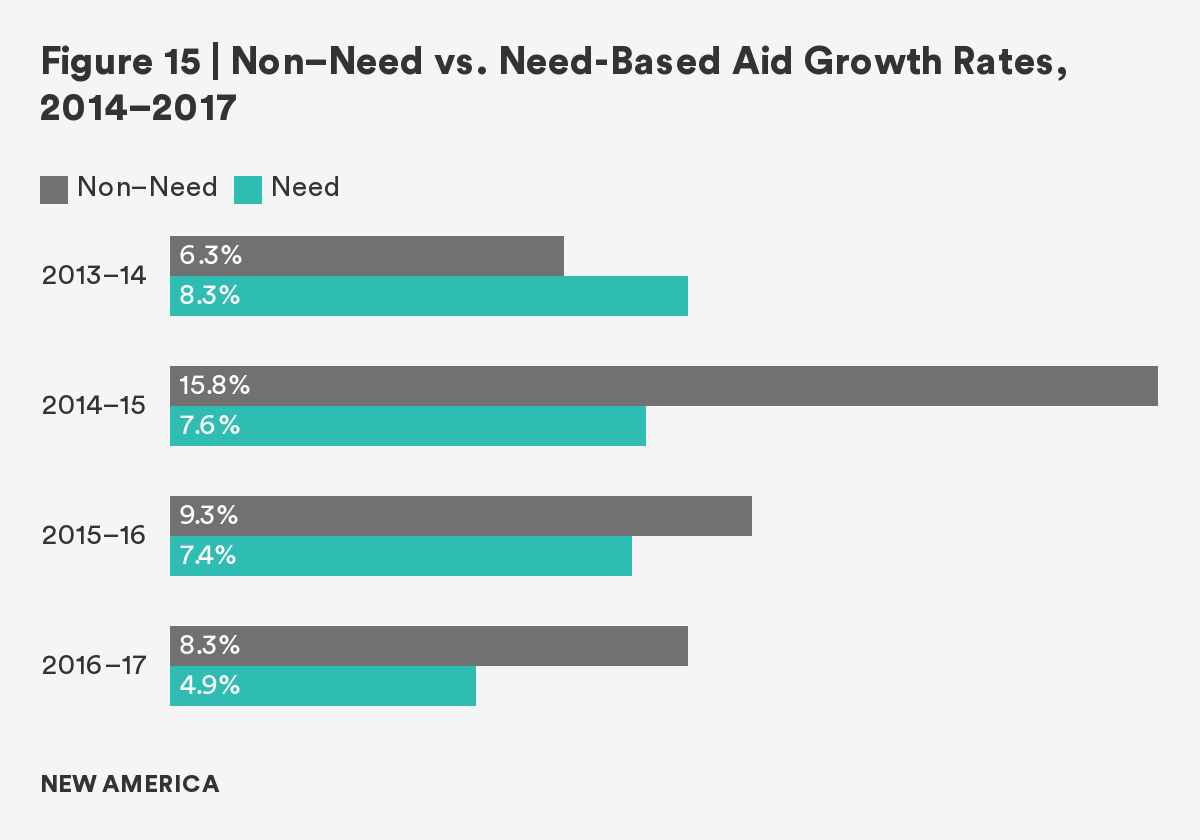
Non–need-based aid grew 1 and three-quarters times faster than need-based aid for the period overall.

The share of institutional aid dollars going to non–need-based aid began to slowly climb back up, but because of the enormous growth of need-based aid during the previous period, remained far below what it was at the beginning of the 17-year period (see Figure 17).
It would be a mistake, however, to take comfort in the fact that the overall share of aid going to non-needy students continues to lag what it was at the beginning of the period. For one thing, the very fact that total institutional aid spending has soared over these 17 years, from $2 billion in 2001 to $8.6 billion in 2017, shows that public universities have largely embraced the high-tuition, high-aid model of their private college counterparts. And as noted earlier, a significant share of the need-based aid money might not actually have been used to meet financial need but instead was simply merit aid that went to financially needy students. That point may seem academic, but it is important to remember that the purpose of financial aid under enrollment management is not to meet financial need but to achieve the institution’s strategic objectives.
Having said that, it is true that there are still a significant number of public universities that have not embraced enrollment management and are not playing the merit-aid game. But the majority of these schools are heavily concentrated in a small number of states.
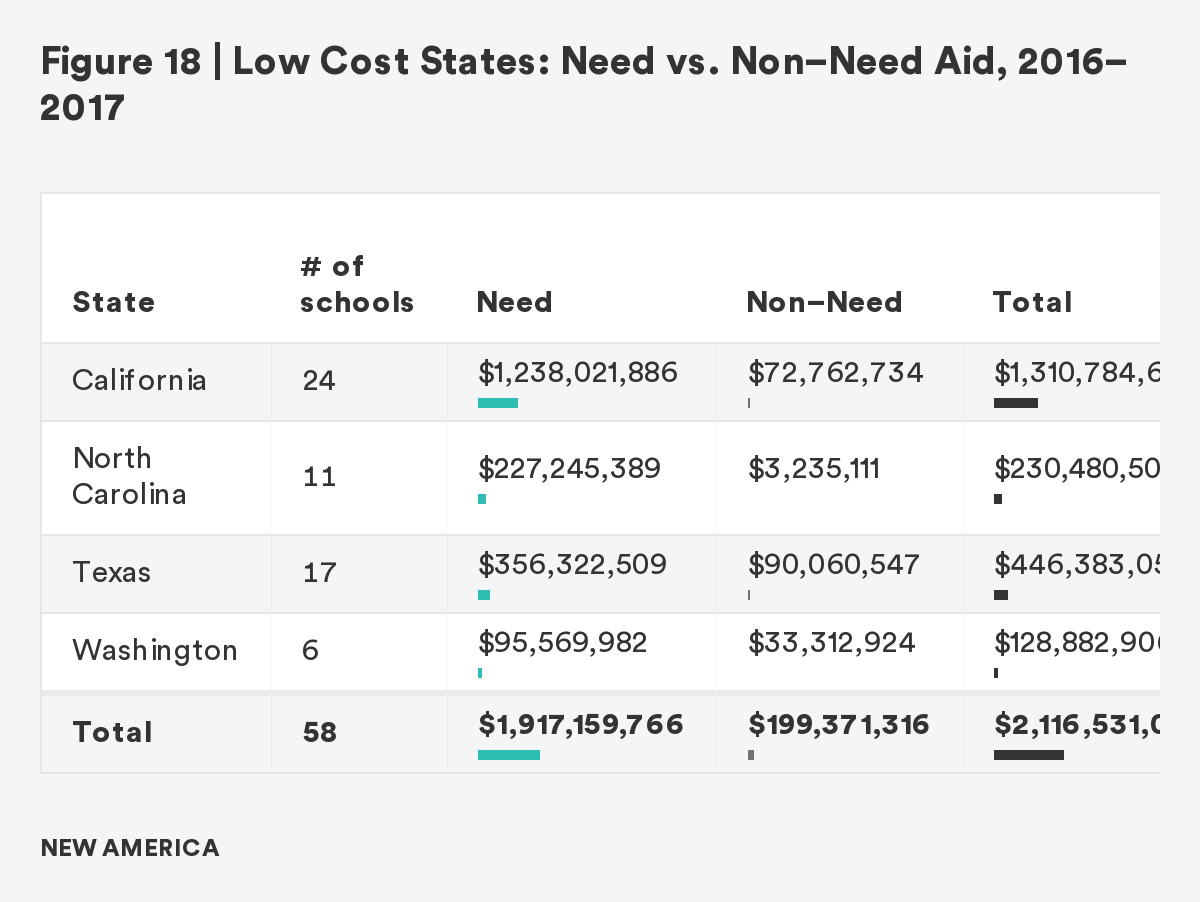
In 2016–2017, for example, nearly half (41) of the 89 schools that devoted less than 20 percent of their institutional aid to non-needy students were in just four states—California (21), North Carolina (8), Texas (8), and Washington (4). These states have one thing in common: They have generally kept their public universities affordable, particularly for low-income, in-state students.8
Of the 339 schools this paper examines, 58 hail from those four states. As a group, these schools spent more than $2 billion on institutional aid in 2016–2017. However, only 9 percent of those funds went to students without financial need (see Figure 18).
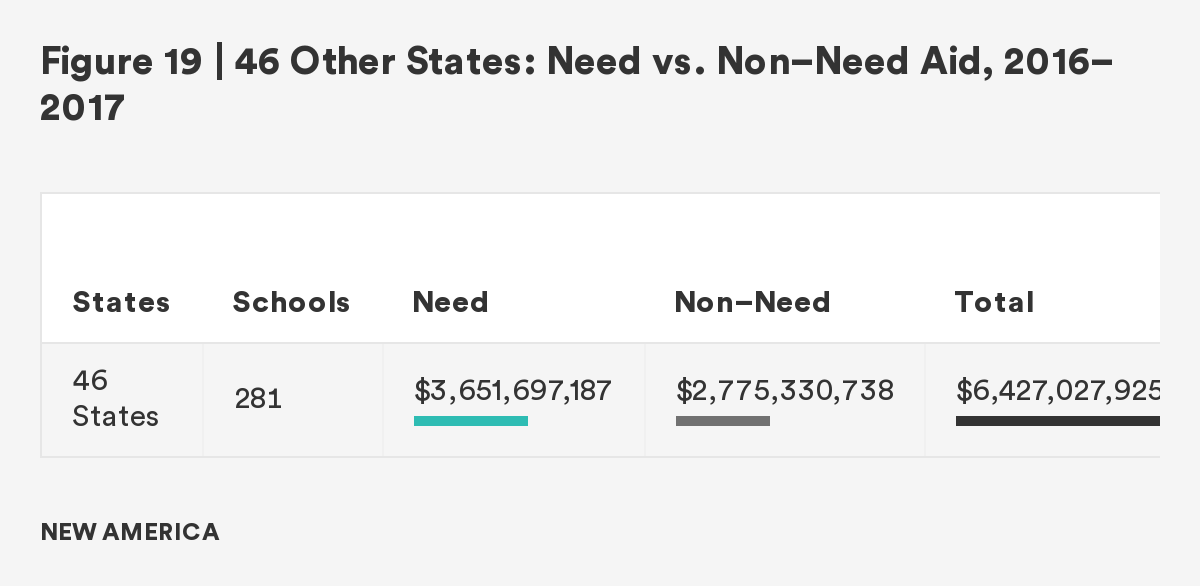
In contrast, schools from the other 46 states collectively devoted 43 percent of their institutional aid dollars to non–need-based aid (see Figure 19).
In the next chapter, this paper will take a closer look at how the privatization of much of public higher education has affected low-income and other financially needy students.
Regional State Colleges
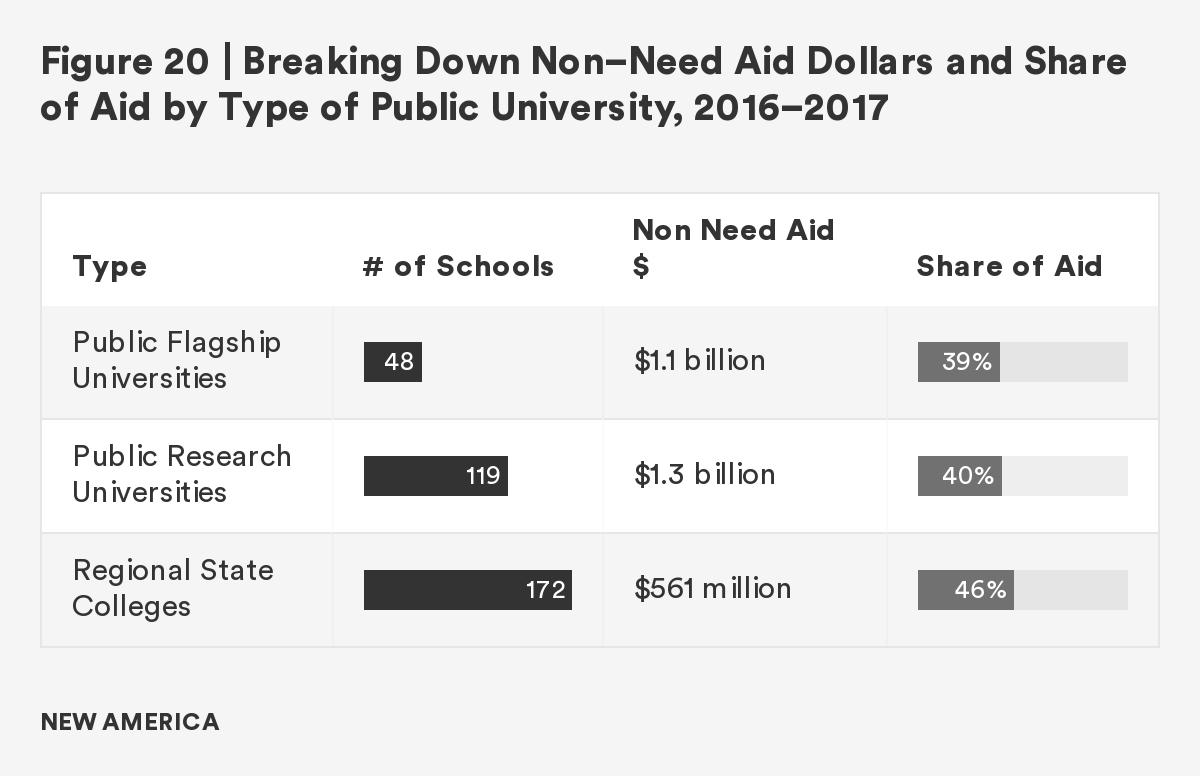
When higher education experts and journalists write about enrollment management and the merit-aid arms race, they typically focus on public flagship and research universities—as if state regional colleges and universities have remained immune from these practices. The data, however, tell a different story. They indicate that while regional state colleges have less money overall to spend on institutional aid than flagships and research universities, the schools devote, on average, an even larger share of those aid dollars to students without financial need than their more well-known and better-resourced counterparts (see Figure 20).
In the past, most state regional colleges predominantly enrolled students from their surrounding neighborhoods. But as enrollment management has spread throughout public higher education, many state colleges have had to become more aggressive in their recruiting as well.9
Take the University of Northern Alabama (UNA), for example. For much of its history, the school primarily enrolled students from just five Alabama counties. But, with other in-state and out-of-state public universities recruiting more heavily in these counties, UNA sustained enrollment declines for five years running. To better compete and make up for those losses, UNA in 2015 began to use non–need-based scholarships to try to lure students from Tennessee and other Southeastern states to the institution.10
“Everyone’s territory appears to be becoming everyone else’s territory, to the point we don’t have a territory really,” Thomas J. Calhoun, the then-vice president for enrollment management, told the TimesDaily. “Everyone is competing everywhere.”
Regional state colleges tend to serve a larger share of low-income and working-class students than flagships and research universities. The fact that many of these institutions are increasingly devoting a substantial share of their aid budgets to students who don’t necessarily need the money is a really bad sign for higher education equity in this country.
Citations
- Burd, “The Out-Of-State Student Arms Race.”
- Sandy Baum, “Guest Post: A Question of Priorities at Public Colleges,” New America (Washington, DC, January 13, 2009): source
- Ibid.
- Sandy Baum, Lucie Lapovsky, and Jennifer Ma, “Tuition Discounting: Institutional Aid Patterns at Public and Private Colleges and Universities, 2000-01 to 2008-09,” The College Board (New York, NY, September 2010): source
- Ibid.
- As stated earlier, the data that colleges report to publications like Peterson’s that rank schools count merit aid that goes to financially needy students as need-based aid.
- Jaquette, “State University No More.”
- Burd, “Undermining Pell Vol. 4.”
- Burd, “The Out-Of-State Student Arms Race.”
- Jennifer Edwards, “Fewer Alabama Students at Public, Community Colleges,” TimesDaily (Florence, AL, October 4, 2014): source