Creating Pathways to College Degrees Through Apprenticeships
Apprenticeship is a proven education and employment model that combines structured on-the-job learning with related technical or classroom instruction to prepare individuals for specific occupations. Apprentices are paid, have access to work-site mentors, and earn progressively higher wages as they advance in their programs. The rising cost of higher education, combined with the increasing skill demands from employers, is generating significant interest in apprenticeship as an educational model that can meet the needs of students and employers alike.
Community colleges are uniquely positioned to help scale up the number of high-quality apprenticeship opportunities and expand apprenticeship into industries like healthcare, information technology, business, and advanced manufacturing, where workers need educational credentials (degrees and certificates) to advance in their careers. Community colleges have a long history of developing and delivering training that is responsive to the needs of regional employers, both large and small, and providing students with affordable pathways to postsecondary credentials of value. Building high-quality apprenticeship programs requires expertise in both areas.
This brief presents an overview of the ways in which community colleges, in partnership with employers and other stakeholders, can support various apprenticeship training models, the tradeoffs to each model, and steps and strategies for building high-quality apprenticeships that culminate in postsecondary credentials and/or degrees.
Community Colleges Apprenticeship Programs
There are three primary models through which community colleges support the development, delivery, and recognition of this training: traditional apprenticeships, college-connected apprenticeships, and degree apprenticeships (as shown in Figure 1).
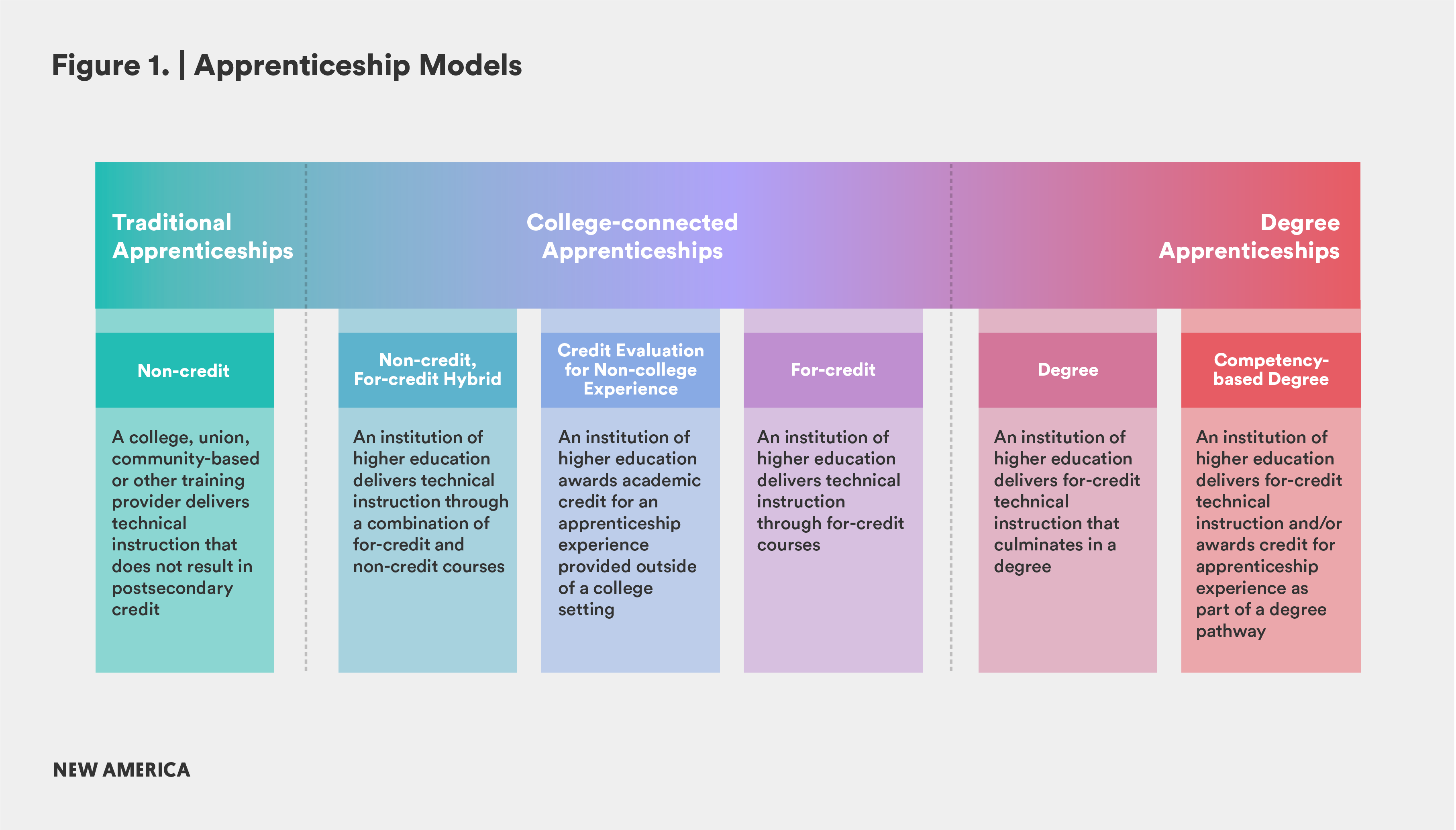
Traditional apprenticeships operate outside of the credit-bearing higher education system, with community colleges, as well as unions, community-based organizations, and other entities providing instruction. Community colleges that support traditional apprenticeships do so by offering non-credit courses through the workforce development or continuing education side of their institutions. Non-credit courses are relatively easy to stand up and can be highly responsive to the training needs of employers. They are often paid for by employers or funded through the public workforce system, making the classroom instruction free or very affordable for apprentices. Many traditional apprenticeships equip individuals with a nationally recognized journeyman’s card that prepares them to work anywhere. They are best suited for training workers for occupations that do not require a postsecondary degree for career entry or advancement.
College-connected apprenticeships offer academic credit for a portion or all of the classroom and/or on-the-job learning component of an apprenticeship. Some community colleges deliver an apprenticeship’s classroom instruction through a series of for-credit courses; others enroll student apprentices in a mix of for-credit and non-credit classes. In many instances, an institution can slot apprentices into existing course offerings or easily create a new class, provided sufficient employer demand. Although less common, some community colleges have established credit articulation agreements with apprenticeship programs or use credit for prior learning processes to facilitate the transfer of experience to college credit. While college-connected apprenticeships might help apprentices develop and earn postsecondary credit for the skills and competencies that employers demand, they do not always result in a coordinated sequence of courses that put students on a clear pathway to a degree. Youth and adults who wish or need to obtain an associate’s or bachelor degree to advance their career goals must navigate remaining degree requirements, often while working. These individuals would benefit from a more structured and integrated apprenticeship and higher education experience.
Degree apprenticeships are designed to seamlessly lead to an associate’s or bachelor degree. A community college delivers the classroom component of an apprenticeship as part of a degree pathway. A majority, if not all, of the technical instruction counts for academic credit. Degree apprenticeships can sometimes be more time-consuming to develop and costly to deliver compared to other types of apprenticeship. Aligning one with an existing degree program might only take weeks to arrange, but if an institution decides to design an entirely new degree program around an apprenticeship —either by creating and approving new courses or by bridging a substantial number of non-credit courses to the for-credit side—it must contend with faculty and departmental approval processes, accreditation reviews, and authorization from its state higher education office.
Recognizing that apprentices are not part-time students but instead full-time learners, a community college might elect to award academic credit for the competencies an apprentice gains on the job. This type of competency-based degree apprenticeship, which relies on a college’s processes for awarding credit for prior learning, could expedite degree completion and is particularly well-suited for incumbent workers. For many occupations in high-growth, high-wage industries like cybersecurity and healthcare, a college degree is the ticket to entry and advancement. Degree apprenticeships offer youth and adults that ticket alongside valuable, paid employment experience.
Degree Apprenticeships in Practice
There is no one-size-fits-all approach to the development and delivery of degree apprenticeships. A community college could make course modifications to an existing degree program to provide employers a more customized apprenticeship. For instance, Trident Technical College has built more than a dozen degree apprenticeship programs to prepare youth and adults for occupations such as industrial mechanic by adding and substituting courses in an associate’s degree pathway to be more responsive to the particular training needs of an employer. On the other hand, community colleges could use prior learning assessments to offer academic credit for competencies an apprentice has gained on the job. The Community College of Philadelphia (CCP) and Delaware County Community College (DCCC) confer academic credits to experienced child care workers in an apprenticeship program sponsored by the District 1199C Training and Upgrading Fund, for example. CCP and DCCC do so by identifying three courses in their colleges’ associate’s of arts in early childhood education degree program for which the target competencies could be acquired through on-the-job learning instead of classroom instruction. Using a combination of portfolio assessments and site visits, college faculty determine whether student apprentices have mastered the target competencies.
Strategies for Building High-Quality Degree Apprenticeships
If a college and employer partner deem that degree apprenticeship is the ideal education and training model to prepare a qualified workforce, they should consider the following guiding principles in the design of high-quality programs:
- Student-centered: Programs meet the learning and professional support needs of apprentices through the use of student success strategies
- Career-specific: Programs are designed to equip student apprentices with occupational skills that are recognized and valued across an industry
- Permeable: Programs include classroom instruction and work-based learning that counts for credit, facilitate advanced education and training, and is relevant to the field
- Portable: Programs are structured to culminate in a degree that facilitates career entry and advancement
- Accountable: Programs monitor apprentice, employer, and program outcomes using transparent metrics and rely on data to support continuous improvement
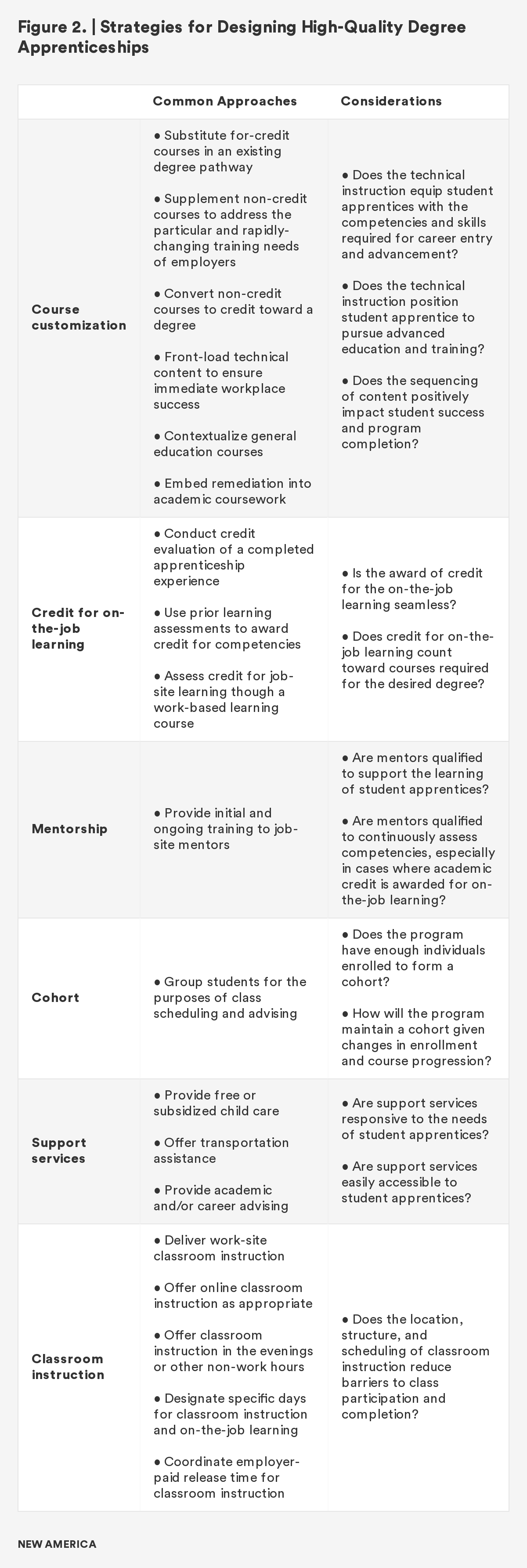
Figure 2, below, outlines several strategies for designing high-quality degree apprenticeships as well as some considerations that might influence which approach(es) a college takes.
Where to Start
Below is a summary of several key decision points to assist community colleges, employer partners, and other stakeholders in developing and delivering a high-quality degree apprenticeship:
Determine whether a degree apprenticeship is the ideal education and training model
Degree apprenticeships present an effective strategy for building a college-educated workforce. But setting up a degree program, let alone a degree apprenticeship, requires a great deal of coordination with stakeholders within and outside a college. Before your college commits to developing a program, it is important to verify that it is the most appropriate training model for a given occupation and that there is sufficient employer demand in the short and long term. The number of student apprentices an employer or consortium of employers plans to hire will dictate the size of the program, which will have implications for faculty hiring, course scheduling, and program costs.
Work with employers to articulate the competencies and skills student apprentices must master
To inform the development or modification of curricula, the sequencing of on-the-job learning, and the credentials awarded as part of the apprenticeship, your college and employer partner must first identify the skills and competencies required to be fully proficient at the job. Specialized accreditation standards or an apprenticeship work process schedule could be a helpful starting point. Understanding an occupation’s core competencies will position your college to determine whether it can leverage an existing degree program or if it must build a new pathway from scratch. It can also help your college figure out job-related competencies for which it can award academic credit through prior learning assessments.
Inventory resources to support the development and implementation of a high-quality degree apprenticeship program
Starting any new education and training program can be expensive but building an apprenticeship that culminates in a degree can have the added cost of tuition for classroom instruction, job-site mentor training and time, and coordination with prospective and partner employers. Luckily, your community likely has available resources. Degree apprenticeship partners should take stock of funding sources that may be leveraged to cover program development and implementation costs, such as employer contributions, public workforce training funds, competitive grants, state scholarships, and tuition reimbursement systems.
Identify target population(s) and determine how stakeholders will help student apprentices to and through the program
Different populations served through degree apprenticeship have different needs. Whether in-school youth, opportunity youth, incumbent workers, or low-skilled adults, the target population will determine which stakeholders a community college must engage and how to recruit student apprentices, offer supplemental support services, and structure and schedule on-the-job learning and classroom instruction. Consider the population that will be served as your partnership defines the roles and responsibilities of each stakeholder.
Establish metrics to measure student apprentice, employer, and program outcomes
To ensure that your program is supporting the academic and career success of student apprentices, meeting the training needs of employers, and helping your college achieve its postsecondary completion goals, it is critical to regularly collect and monitor data on student apprentice, employer, and program outcomes. Identifying success metrics early and examining them often will help your partnership see whether degree apprenticeship programs are student-centered, career-specific, permeable, and portable.
Decide whether to register your degree apprenticeship program
Your apprenticeship partnership has the option to register your program with either the U.S. Department of Labor’s Office of Apprenticeship or a recognized state apprenticeship agency, depending on how apprenticeship is governed in your state. Registering an apprenticeship program signals that it meets quality standards and equips program completers with a national, industry-recognized credential. It could also increase access to public workforce dollars, tax credits, and other financial incentives to support program development and implementation.
Downloads
More About the Authors

Lul Tesfai
Senior Policy Advisor, Center on Education & Labor