
Methodology
Our methodology builds upon prior Cost of Connectivity studies and has been refined to reflect changes in the market. We carefully crafted this methodology as part of our commitment to research integrity and public transparency.
City Selection
We selected 28 cities across Asia, Europe, North America to research in this year’s study.
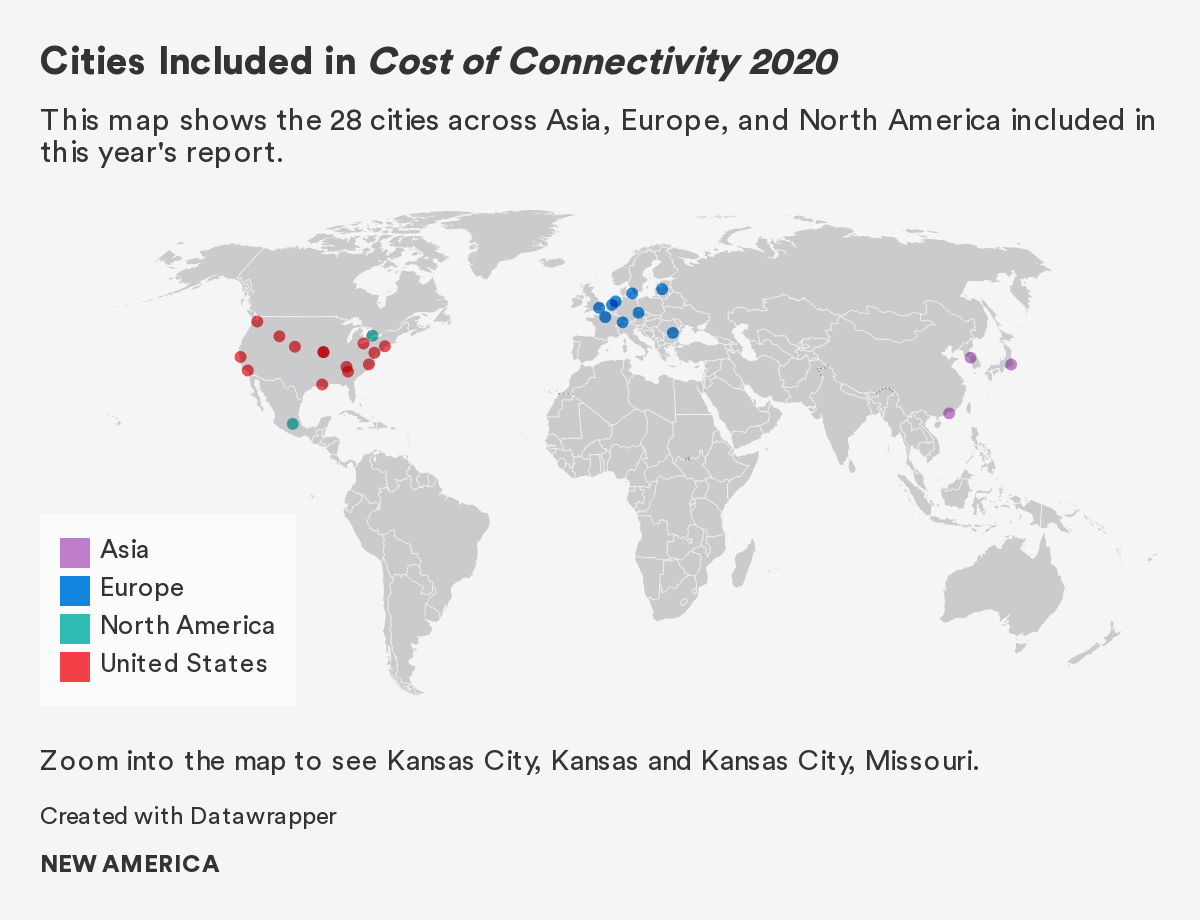
In Asia, we examined:
- Hong Kong, a Special Administrative Region of China;
- Seoul, South Korea; and
- Tokyo, Japan.
In Europe, we examined:
- Amsterdam, Netherlands;
- Bucharest, Romania;
- Copenhagen, Denmark;
- Dublin, Ireland;
- London, United Kingdom;
- Paris, France;
- Prague, Czech Republic;
- Riga, Latvia; and
- Zurich, Switzerland.
In North America, the majority are in the United States:
- Ammon, Idaho;
- Atlanta, Georgia;
- Chattanooga, Tennessee;
- Cleveland, Ohio;
- Fort Collins, Colorado;
- Kansas City, Kansas;
- Kansas City, Missouri;
- Lafayette, Louisiana;
- Los Angeles, California;
- New York, New York;
- San Francisco, California;
- Seattle, Washington;
- Washington, D.C.; and
- Wilson, North Carolina.
Outside of the United States, we also examined:
- Mexico City, Mexico; and
- Toronto, Canada.
We added six new cities to this year’s study: Ammon, Idaho; Atlanta; Cleveland; Fort Collins, Colo.; Seattle; and Wilson, N.C.1 We chose these additional cities to increase the diversity of our research sample based on geography, population density, city size, and network governance structure. We also considered unique local attributes. For instance, we added Cleveland because of local allegations of digital redlining.2
Though we may refer to metrics for Asia, Europe, North America, and the United States as a whole throughout the report, our analysis is limited to this 28-city dataset. While we expanded our city sample in this year’s report, we recognize that these cities may not be fully representative of their countries or continents.
Our dataset does not examine rural towns, as we determined the topic of rural connectivity was best examined through a separate report. In April, we published The Cost of Connectivity in West Virginia, which included extensive data collection in rural areas.3
Data Collection
This year’s report looks exclusively at standalone home internet plans available to new residential customers on providers’ websites. In the past, Cost of Connectivity included data on internet bundles that offered some combination of internet service with phone and/or television services. Bundling is still a widespread practice,4 but we focus on standalone internet plans exclusively this year to enable more robust and straightforward analysis on the costs of internet service alone. Some providers may provide clear cost breakdowns between each component of the bundle, but this level of transparency is not a uniform practice. Studying standalone internet plans enables us to make more streamlined price comparisons between plans as we take into account the lack of standard speed tiers and other plan aspects. Additionally, we do not include any mobile internet plans in this year’s report. While mobile is an important complement to fixed broadband service, it is not a substitute—an issue that we have emphasized before in our advocacy.5
We relied on a variety of publicly available sources to gather and verify data on all 760 standalone internet plans that we could locate across each city from June 2019 to March 2020. To collect this information, we navigated to available residential internet plans from the home page of the ISPs’ websites and, if prompted, manually entered addresses and zip codes corresponding to real homes in the community. For U.S. plans, we selected addresses by cross-checking the FCC’s fixed broadband deployment data with publicly available addresses in Google Maps.6 All addresses used in our data collection are included in Appendices B and C.
Many service providers operating in international regions don’t provide information on their websites in English. To collect data on these plans to the best of our ability, the research team relied on individual language proficiencies and/or Google Translate to help identify plan details.7 In some cases, information about a specific plan may be incomplete because it was not disclosed on a service provider’s website, or because researchers’ proficiency in the operative language limited our ability to collect this information.8
As in our studies from previous years, all data collected reflects advertised costs that a new consumer would pay and advertised speeds from ISPs, which does not necessarily reflect total actual costs a consumer would pay or speeds they would actually experience. In the absence of government-collected pricing data, advertising data remains one of the best, if limited, sources of public information on internet pricing. The price as advertised may in some cases include taxes, but providers did not always disclose this information. Across all of the providers’ websites, we gathered data on the following aspects if they were advertised:
- Monthly promotional and non-promotional pricing: The promotional price is a lower price offered initially before increasing to the non-promotional price after the promotion term expires. We also note the length a promotion is offered if it is disclosed; generally we record the length in months. Occasionally, ISPs advertise multiple promotions offered for different lengths. For instance, AT&T sometimes offers a $10/month promotion for 12 months, plus an ongoing $10/month stacked promotion. We notate this stacked promotion as “12/ongoing” in the “term of promo discount” column and include an explanation in the "notes" field. If the price changes during the length of a contract, the price listed reflects an average of the monthly subscription costs over the course of the contract term.9 If a provider offers a plan with a “price for life” promotion, we record the price as a promotional price and note "price for life" in “term of promo discount.” Providers often list either a promotional price or non-promotional price on a monthly basis, and we record both where available.
- Autopay/paperless billing discount: Separately from promotional pricing, providers sometimes offer a monthly discount if consumers enroll in autopay and paperless billing.
- Network technology: Our dataset records the network technology if the provider advertises the technology used. For the purposes of our report, we focus on plans that rely on DSL, cable, and fiber technologies, or some combination of the above.
- Download and upload speeds: We list all speeds in megabits per second (Mbps). We collect data on all plans listed on a provider’s website, even if it doesn’t meet the current FCC minimum definition of broadband at 25/3 Mbps.10 If a provider lists a range, we record the minimum speed. It is important to note that all internet speeds are based on advertised speeds, which does not always reflect the speeds users experience.
- Data caps and overage penalties: Data caps are limits on the amount a user, or a group of users on a shared plan, can download or upload in a single billing period. We record them in gigabytes (GB). Where the penalty for exceeding a data cap is an overage fee, we note the monetary amount and the data increment at which it occurs; for example, $10 for every 1 GB (notated as $10/GB). Where a provider may advertise unlimited data and instead implement a data cap after which a user experiences slowed speeds for a period of time—usually through the end of the billing cycle—this penalty is noted as “throttling” in the appropriate column and the point of data consumption at which throttling begins is noted in the “data cap” column. We do not record the reduced speeds when throttling occurs, though it is sometimes disclosed by the provider.
- Equipment costs and/or rental fees: We record any fees or costs associated with renting or purchasing a modem or router directly from the ISP. If providers provide the option to rent the equipment for a monthly fee or to purchase it for a one-time cost, both options and prices are recorded in our dataset. A consumer would not necessarily pay both rental and purchase fees or require both a modem and router. For example, Comcast offers consumers the option of renting a multifunctional device called a wireless gateway that combines both the functions of a modem and router.11 Providers may also offer the option for consumers to use their own equipment, but we do not account for this option in our dataset. If a provider waives such fees, we record the amount as $0 in the field, but note the amount that the fee would typically be if the provider discloses this information in “notes.”
- Installation fees: This one-time fee relates to the cost of a technician visit to set up service in a consumer’s home. We record free or waived installation fees as $0. A consumer does not have to pay an installation fee if they opt to self-install instead. Some providers charge either an installation or activation fee, or both.
- Self-installation fee: If a provider offered consumers an option to self-install, we record the one-time fee in our dataset. This option may not always be available, and requires that a consumer’s home already be wired for a provider’s service. We record free self-installation options as $0. A consumer does not have to pay a self-installation fee if they opt for professional installation instead.
- Activation fees: Activation fees are a one-time administration charge for a provider to activate a consumer’s service. Some providers charge either an installation or activation fee, or both.
- Contract lengths: Contract lengths are recorded in months. A handful of plans in our dataset require 7-day or 18-day contract lengths, which we convert to monthly increments assuming a 30-day month. Where prices vary depending on different contract lengths, we record the different contract terms as different plans. Month-to-month plans, which are often advertised as “no contract” plans, nonetheless require one month’s commitment, and thus, are notated by a “1” in the appropriate column.
- Contract termination fees: We record early termination fees if they are advertised as a one-time fee. Often, providers charge consumers a one-time fee or a certain amount for each remaining month on their contract for early termination. We record details on the latter scenario in the “notes” field for the relevant plan. If a provider requires payment for the remainder of the month upon early termination of a consumer’s contract, we record it as “not applicable.” Because internet service is billed in monthly increments, this “contract termination fee” would already have been captured in the monthly price field.
This approach means that we may not have captured all the related costs that a consumer would pay for internet access. For instance, we do not record any additional costs related to subscriptions that rely on a municipal network, such as the monthly utility fee charged by the city of Ammon, Idaho for plans on its open access network.12 We also do not include the one-time construction fee for new connections to Google Fiber.13 Some providers may also charge hidden fees that are not captured in our research.14 In addition, not every internet plan listed information on each aspect on which we were gathering data; the lack of data is signified by “no data” or a “—” in our data visualization and appendices. Some providers stated that certain aspects were not applicable to their offerings, which is noted in our dataset.
Plans are labeled by the city, ISP, and speed. If a provider offers multiple versions of a plan at the same speed, that differentiation is notated by a letter following alphabetical order after the speed in the plan label. For example, KCI offers two plans at 100 Mbps in Fort Collins, Colo. at contract terms of month-to-month and one year. Each plan is labeled as “Fort Collins, kci, 100A,” and “Fort Collins, kci, 100B.”
When prices are listed in foreign currencies, we convert prices to U.S. dollars (USD) to the nearest two decimal points based on the World Bank’s purchasing power parity (PPP) metric.15 Unlike direct exchange rates, which are often volatile and do not account for global income disparities, PPP conversion rates adjust for differences in the cost of living, price levels, and other factors that affect a consumer’s purchasing power. This conversion allows us to make more effective comparisons among the cities featured in the report. Throughout our report, dollar amounts are rounded to the nearest two decimal points, all prices are listed in USD, and all percentages are rounded to the nearest whole number.
The data we compiled is a near-comprehensive effort to include all available standalone internet plans that were listed publicly on the ISPs’ websites at the time of collection. Other internet plans may be available, but all analysis in this report is limited to the 760 plans included in our dataset and the information that was available at the time of data collection (see Appendices B and C). Our dataset does not necessarily represent the available plans for each city as a whole, as certain plans may not be available in all locations.
We do not include plans that are targeted toward Lifeline subscribers or standalone low-income internet offerings from providers in our dataset.16 Several ISPs, such as CenturyLink,17 Frontier,18 and RCN,19 offer Lifeline plans. AT&T,20 Charter (under its Spectrum brand),21 and Comcast22 do not participate in Lifeline but offer separate standalone internet plans for low-income consumers. These plans are omitted because providers shared little to no information about them on their websites. In addition, they are not located with the residential plans on providers’ websites, and required additional navigation to find. Often, we had to navigate to a provider’s discounts page or use a third-party search engine to locate these plans. Nonetheless, we discuss some of these plans for context in our findings on internet affordability.
Data Analysis
Our data analysis is divided into three parts: First, we examine international markets. Second, we examine four types of ancillary fees. Third, we examine the U.S. market.
For our analysis on international markets, we compare: (1) approximations for the total cost consumers can expect to pay for internet service; (2) monthly prices across network technology; (3) monthly prices; (4) advertised download and upload speeds; (5) value, based on average monthly costs for comparable average advertised download speeds; and (6) monthly prices for minimum advertised broadband tiers.
For our analysis on ancillary fees, we focus on four different components of internet service plans: (1) installation and activation fees; (2) equipment fees; (3) data caps and data overage penalties; and (4) contract terms and early termination fees.
For our analysis on the U.S. market, we examine: (1) municipal networks; (2) the disproportionate impact the lack of affordability has on BIPOC and low-income communities; and (3) the lack of pricing transparency.
An important caveat: All analysis is based on advertised costs and speeds, which may not reflect the actual prices consumers pay or the speeds they experience. In the absence of government collection of pricing data or ISP disclosure of their records, advertising data remains one of the best, if limited, sources of public information on internet pricing.
In the remainder of this section, we detail the methodology used to examine each component of internet service plans.
Network Technologies
The quality of internet service varies depending on network technology. DSL is not as fast or reliable as cable and fiber, and it generally provides slower speeds and higher latency than cable.23 DSL typically delivers 5 to 35 Mbps download speeds and 1 to 10 Mbps upload speeds.24 Cable and fiber, on the other hand, are capable of providing high speeds: Cable typically delivers 10 to 500 Mbps download speeds and 5 to 50 Mbps upload speeds, and fiber typically delivers 250 to 1,000 Mbps speeds.25 Fiber is also capable of providing symmetrical download and upload speeds, even at gigabit speeds, which translates to faster and larger data uploads for users.26 Higher upload speeds are particularly important in the ongoing COVID-19 pandemic because users who telework or participate in distance learning require them for stable video conference connections in real time.
To conduct our analysis, we examine the average monthly price for each network technology by group: DSL, cable, and fiber. We count ADSL, ADSL2+, and VDSL technologies as DSL. Fiber includes any services that specify fiber-to-the-home and fiber-to-the-node (FTTN) technologies. Services based on hybrids of these technologies are excluded from the single-technology groupings and this analysis. These combinations include ADSL/FTTN, DSL/fiber, cable/fiber, and fiber/copper-to-the-home.
Monthly Internet Prices
Comparative analysis of internet service plans is challenging due to a lack of standardization across providers and the complex structure of plans and pricing. In addition, our dataset includes cities of varying population density. To address these discrepancies to the best of our ability, we use a two-pronged approach in our analysis of monthly internet prices.
First, we compare monthly prices that are advertised on the provider’s website. Where only the promotional or non-promotional price is listed, we cite that number in our analysis. If providers list both a promotional and non-promotional price, we adopt the promotional price in our analysis unless specified.27
Second, we compare internet prices across cities with similar population densities. A given area’s population density affects the potential per-consumer return on internet infrastructure implementation costs, and can therefore be an important variable that impacts internet speeds and prices.28 We record population densities in population per square kilometer.
We do not include monthly or one-time autopay/paperless billing discounts, data overage penalties, equipment fees, installation fees, and activation fees in our analysis on monthly internet prices because the consumer experience varies so widely on these plan aspects. For instance, each individual consumer will choose whether to buy or rent the necessary equipment for internet service based on their own unique circumstances. Consumers can have different data overage fees, too, depending on users’ data usage. We choose to analyze these components separately from the monthly internet price. We also are unable to standardize for differences in contract terms, data caps, and upload speeds in our analysis. As a result, our analysis underestimates the monthly internet costs advertised to consumers.
In calculating the average and median prices for internet service, we omit multiple plans from the same provider with the same monthly pricing but different contract terms (i.e., contract lengths or installation fees). In the United States, we omit six plans from this analysis: three month-to-month KCI plans in Fort Collins, Colo.; the 12-month contract option for the 1,000 Mbps download speed plan advertised in Fort Collins, Colo. by Comcast under its Xfinity brand; the 24-month contract option for the 1,000 Mbps download speed plan advertised in Seattle by Comcast under its Xfinity brand; and the 200 Mbps download speed plan from Charter under its Spectrum brand advertised in Kansas City, Mo. because the plan has no monthly internet pricing data. We use the 290-plan U.S. dataset for monthly pricing analysis where applicable.
We omit 24 plans in Mexico City, and 22 plans in Toronto, and use the 706-plan U.S. and international dataset for all monthly pricing analysis where applicable. We omit the month-to-month, 3-month, 6-month, 9-month, and 18-month length plans advertised by Telmex in Mexico City, and the 12-month and 24-month plans offered by Gemstelecom in Toronto.
Advertised Download and Upload Speeds
We separately examine the average and median advertised download and upload speeds across plans in each city. We compare the “speed leaders” in each category and rank each city by the average speed of plans advertised in each city. Providers do not always advertise information on the download and/or upload speeds for each particular plan; plans in our dataset for Mexico City and Seoul have no data for upload speeds, and thus, both cities are omitted from this analysis on upload speeds.
Installation and Activation Fees
We examine installation, self-installation, and activation fees, and compare average advertised fees across continents and countries. Providers do not always disclose the fees on their websites or provide information on whether a certain fee was mandatory. Additionally, providers do not always offer an option to self-install. Plans in our dataset without the relevant information are omitted from this analysis.
Equipment Fees
We examine the average price consumers can expect to pay for one-time equipment purchase fees or monthly equipment rental fees for modem and Wi-Fi routers from the ISP across countries and continents. A consumer would not necessarily pay both monthly rental and one-time purchase fees, or require both a modem and Wi-Fi router. Providers do not always disclose the fees on their websites or provide information on whether a certain fee was mandatory, and plans in our dataset without the relevant information are omitted from this analysis. Los Angeles plans in our dataset, for instance, omit information on monthly modem rental fees, and are therefore excluded from this analysis.
Data Caps and Overage Penalties
We examine the average data cap across plans in our dataset. Data caps and their associated overage penalties impose additional costs on users should they go over their allocated data usage. We look at data overage penalties and data caps advertised by ISPs, if available. For instance, at the time of data collection, Wave advertised a data cap, but presented no information on the relevant overage penalty for users who exceed the data cap. Thus, we exclude Wave’s plans from this analysis. We conduct this analysis across cities. While we record throttling penalties in our dataset, our analysis is limited to monetary penalties for data overages. We round data caps to the nearest two decimal points in our report.
Contract Lengths and Early Termination Fees
We examine contract lengths and early termination fees, as they affect switching costs for consumers and can play an integral role in stifling competition. We compare median contract lengths and average early termination fees across cities and continents.
Citations
- The 2014 report included 24 cities, and we include all but two of these cities in this year’s report. We omit Berlin, Germany because we were unable to find any standalone internet plans advertised on providers’ websites. We omit Bristol, Virginia because the city has since sold its municipal network: Brandon Bailey, “Sunset Digital to become Point Broadband,” NBC/CW WCYB-TV, May 2, 2019, source
- Bill Callahan, “AT&T’s Digital Redlining Of Cleveland,” National Digital Inclusion Alliance (blog), March 10, 2017, source
- Claire Park, The Cost of Connectivity in West Virginia, (Washington, D.C.: New America’s Open Technology Institute, April 1, 2020), source
- For instance, Sonic, an ISP that services the San Francisco and Los Angeles areas, offered bundle options with internet and phone services at the time of data collection. This approach means that at least several ISPs are excluded from our dataset.
- See, e.g., Amir Nasr, Claire Park, Eric Null, Comments of New America’s Open Technology Institute and Access Now, GN Docket No. 19-285, (November 21, 2019), source (“Specifically, mobile broadband is not a substitute for fixed broadband due to the functional difference in how consumers use the services. Mobile broadband is typically higher cost, less reliable (especially in rural areas), slower, and subject to data caps and expensive overage fees in comparison to fixed broadband. Further, mobile broadband is increasingly reliant on fixed broadband for backhaul and offloaded traffic. It would make no sense for the Commission to deem mobile broadband a substitute for fixed broadband when the former service is dependent on the latter.”)
- “Fixed Broadband Deployment,” Federal Communications Commission, June 2019, source
- Researchers’ language proficiencies included German, Korean, and Spanish.
- As indicated below, the lack of data is signified by “no data” or a “—” in our data visualization and appendices.
- For example, if a plan advertises a two-year contract with promotional pricing for the first 12 months, we calculate the average price for the entire contract term and record it as the monthly promotional price. For this particular example, we would take the average of 12 months at the promotional price and the sum of 12 months at the non-promotional price.
- 2019 Broadband Deployment Report, Federal Communications Commission, adopted May 8, 2019, released May 29, 2019source
- We record rental fees for Comcast’s wireless gateway under “modem rental fees” throughout our dataset and note that a consumer would not have to pay an additional fee to rent a router.
- See Becky Chao and Lukas Pietrzak, The Cost of Connectivity in Ammon, Idaho, (Washington, D.C.: New America’s Open Technology Institute, January 22, 2020), source for more information.
- “Google Fiber Fee Schedule,” Google Fiber, last modified April 13, 2020, source
- WTFee Survey 2018 Nationally Representative Multi-Mode Survey, (Consumer Reports: January 3, 2019), source ; Karl Bode, “Hidden Fees Mean US Cable & Broadband Bills Can Be 45% Higher Than Advertised,” techdirt, October 1, 2019, source
- “GDP, PPP (current international $),” World Bank, source
- Lifeline is the federal subsidy program for internet and phone services. For more information, see “What is Lifeline?” in the “COVID-19 Exacerbates Affordability Problems, Particularly for BIPOC Communities and Low-income Households” section of this report.
- “Lifeline,” Community Development Program, CenturyLink, last accessed May 27, 2020, source
- “Frontier Lifeline Program,” Frontier Communications Corporation, last accessed May 27, 2020, source
- “Lifeline,” RCN telecom Services, last accessed May 27, 2020, source
- “Frequently Asked Questions,” Low-Cost Home Internet, AT&T, last accessed May 27, 2020, source
- “Spectrum Internet Assist,” Charter Communications, last accessed May 27, 2020, source
- “Internet Essentials Brings Affordable High-Speed Internet Home,” Internet Essentials, Comcast, last accessed May 27, 2020, source
- Tyler Cooper, “DSL vs Cable vs Fiber: Comparing Internet Options,” BroadbandNow, last updated December 12, 2019, source
- Cooper, “DSL vs Cable vs Fiber: Comparing Internet Options.”
- Cooper, “DSL vs Cable vs Fiber: Comparing Internet Options.”
- Cooper, “DSL vs Cable vs Fiber: Comparing Internet Options.”
- Our analysis on monthly internet prices throughout this report defaults to promotional pricing, unless no information on promotional pricing is provided, in which case, we adopt the non-promotional pricing for that plan instead. We note all other exceptions to this rule.
- Visnja Cik Krizanovic, Drago Zagar, and Kresimir Grgic, “A framework for optimal techno-economic assessment of broadband access solutions and digital inclusion of rural population in global information society,” Universal Access Information Society, 17 (2018): 517–540, source