
Youth advocates, policymakers, and grantmakers have expressed interest in better understanding whether youth apprenticeship can help young people access the guidance, relationships, and opportunities they need to grow into thriving adults. Drawing on research literature and conversations with youth apprentices, practitioners, researchers, policy experts, and funders, this report explores why youth apprenticeship could be a favorable option for keeping youth connected to school and work and what it would take to realize the promise of youth apprenticeship.
The transition from adolescence to adulthood is simultaneously exhilarating and fraught with challenges. The early adult years offer greater freedom and autonomy, provide space for young people to explore their values and identity, and open the door to new opportunities and experiences. At the same time, young adults also take on weighty responsibilities, including navigating the complex and sometimes disorienting journey to sustainable employment and financial security.
Youth apprenticeship offers a structured pathway that helps young adults develop new skills and gain work experience through a combination of paid employment, mentorship, work-based learning, and related instruction. While youth apprenticeships are relatively new to the United States, there are signs they are gaining traction. For example, Wisconsin—which is home to the nation’s oldest state youth apprenticeship system—reported record enrollment in 2025, engaging over 11,344 youth in apprenticeships across 7,447 different employers. A national peer learning network organized by the Partnership to Advance Youth Apprenticeship (PAYA) grew from 49 sites to 89 sites over six years (2019–2025) and now serves an estimated 19,500 young people.
We know that youth need high-quality education and work experiences to realize their potential, yet current U.S. policies and programs are leaving a significant number of young people behind. An estimated one in nine 16–24-year-olds is neither enrolled in school nor regularly working (they are sometimes referred to as opportunity youth), while another one in three face obstacles to opportunity that increase the odds they will become disconnected from school and work.
Youth advocates, policymakers, and grantmakers have expressed interest in better understanding whether youth apprenticeship can help these individuals access the guidance, relationships, and opportunities they need to grow into thriving adults. Drawing on research literature and conversations with youth apprentices, practitioners, researchers, policy experts, and funders, this report explores why youth apprenticeship could be a favorable option for keeping youth connected to school and work and what it would take to realize the promise of youth apprenticeship.
Getting to Know Youth Apprenticeship
As defined by PAYA, high-quality youth apprenticeship programs target high school-aged youth and feature four key components:
- Paid, on-the-job learning under the supervision of skilled mentors;
- Related classroom-based instruction;
- Ongoing assessment against established skills and competency standards; and
- Culmination in a portable, industry-recognized credential and postsecondary credit.
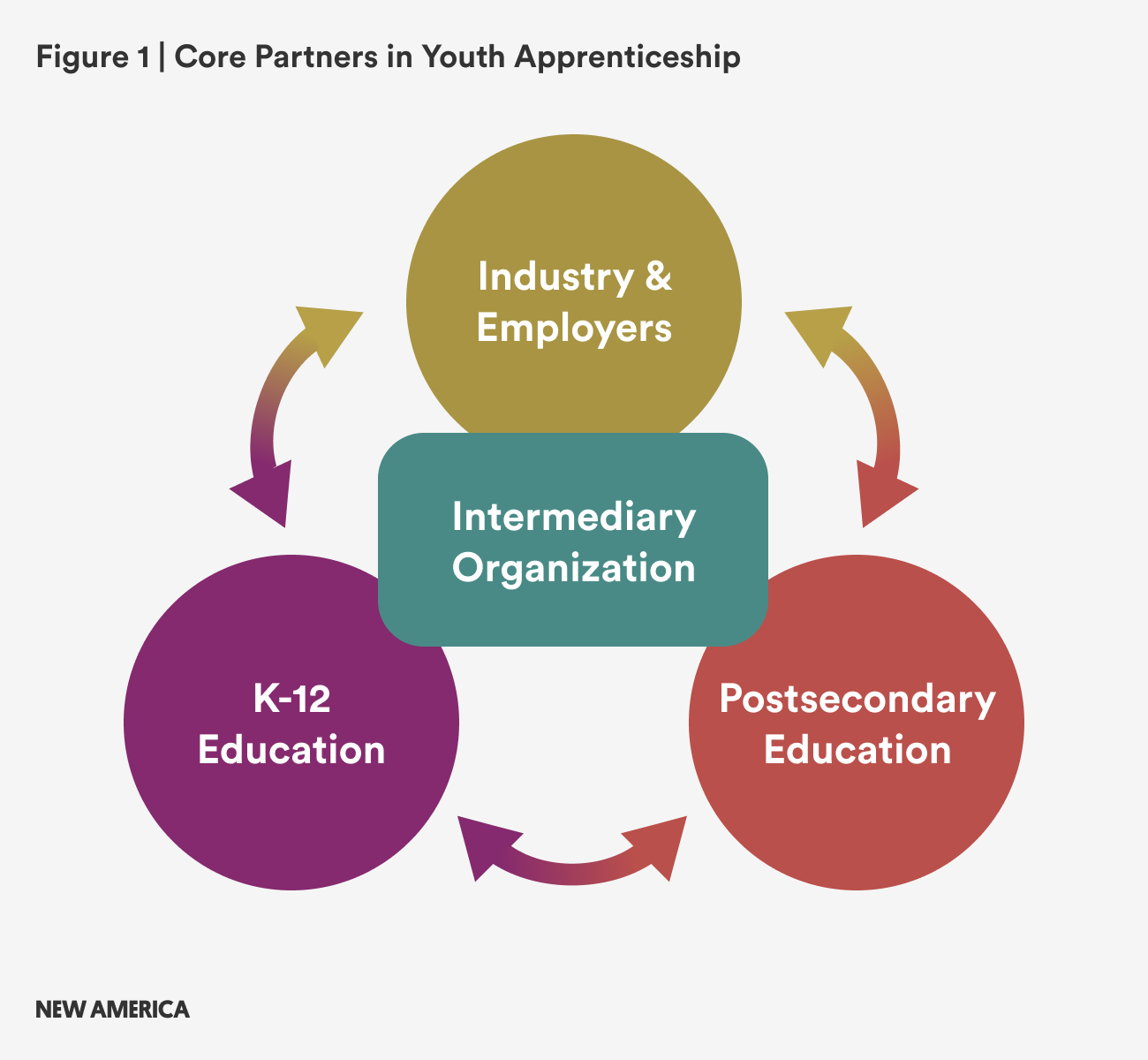
Youth apprenticeship programs are typically operated via partnerships between employers, K–12 schools, and community or technical colleges, with nonprofit organizations, public agencies, workforce boards, and industry groups sometimes bringing added capacity (Figure 1). One of these entities typically serves as the backbone organization (the apprenticeship intermediary) for the partnership, managing day-to-day operations and coordinating the partners’ efforts.
Many youth apprenticeships are Registered Apprenticeship programs. Some states have codified definitions of youth apprenticeship that set forth requirements for these programs, but in many parts of the country, youth apprenticeship intermediaries and their partners determine the structure of their programming.
High-quality youth apprenticeship programs are designed with the developmental needs of young people in mind, which makes them particularly well suited for meeting the needs of opportunity youth and other young people who need extra support. These programs have nine features in common:
- Asset-based philosophical underpinnings that posit youth are capable of authentically contributing to their employers’ mission and operations.
- Education to help young adults develop the knowledge, skills, and credentials they need to unlock college and career opportunities.
- Employment to enable young people to earn income, develop skills and work experience, and explore career interests.
- Real work experiences that are responsive to young adults’ appetite for relevancy and making a meaningful contribution.
- Social connections with caring adults via mentoring and coaching supports.
- Programming aligned with local labor market demand.
- Industry-recognized credentials that validate skill attainment and help young people market their abilities.
- Structured career pathways that lead to good jobs and help young adults explore and pursue their career interests.
- Inclusive approaches to help apprentices succeed, including supports like counseling, financial coaching, emergency cash assistance, transportation assistance, and child care.
While traditional Registered Apprenticeship programs prepare apprentices for long-term employment in a specific occupation, youth apprenticeship programs are structured with young people’s career exploration in mind. Sometimes described as an “options multiplier,” youth apprenticeship deliberately prepares young adults for a range of follow-on education and career opportunities, including full-time employment, full-time college, a mix of part-time training and employment, or a Registered Apprenticeship program leading to a more advanced occupation.
The Challenge of Maintaining Connections to School and Work
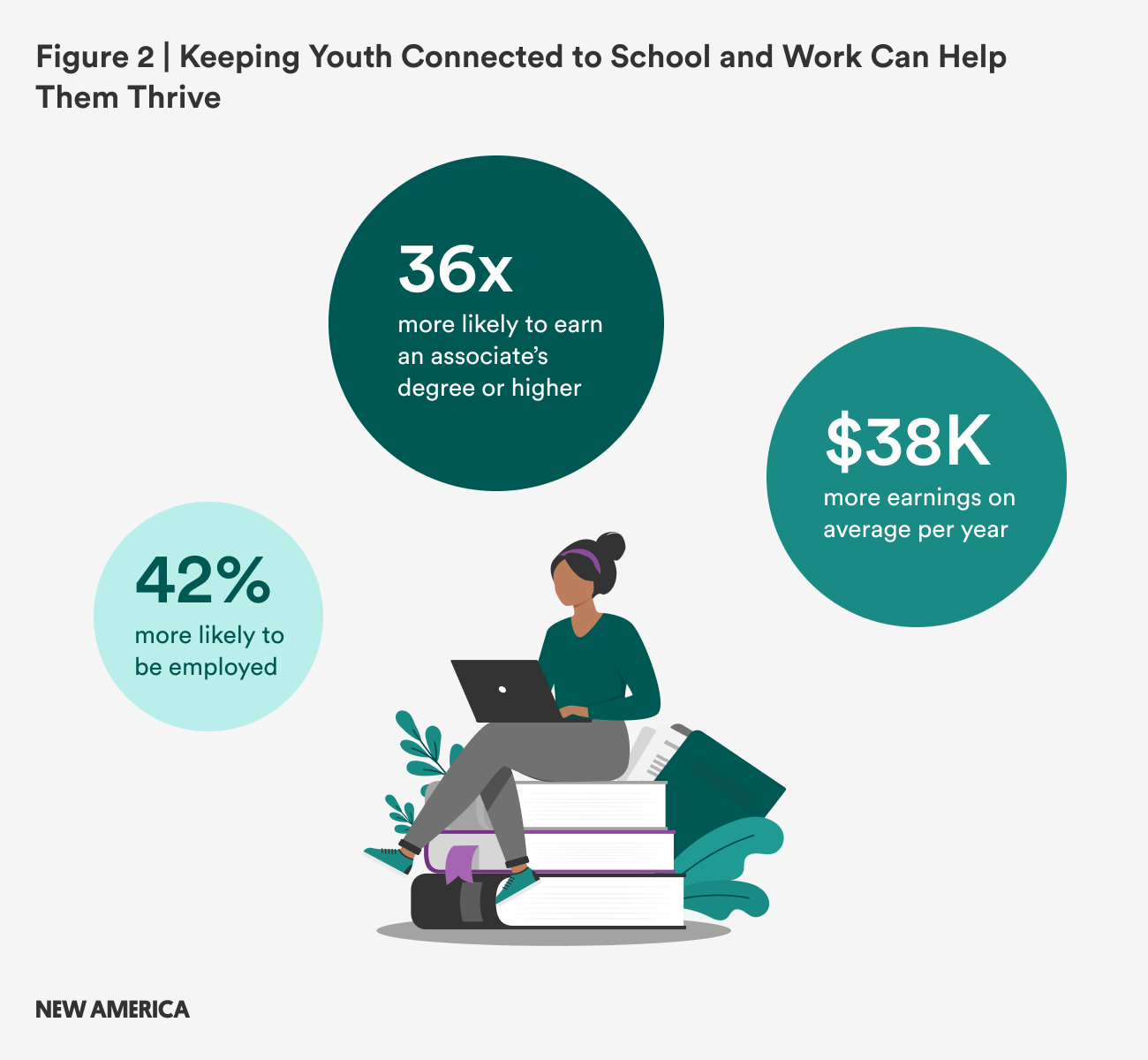
When youth stay engaged with school and work, they can better realize their potential (Figure 2).
However, many young people encounter obstacles that make it challenging for them to stay plugged in. Disengagement from school and work can take many forms and could, for example, describe a young adult who:
- Dropped out of high school or college;
- Took time off from school and work to deal with health issues or care for a new child;
- Ran away from home;
- Took a break or gap year to assess their education and employment options;
- Encountered roadblocks that prevented them from following through on college plans; or
- Had a hard time maintaining steady work after graduating from high school.
Adolescents from every background can—and do—struggle to maintain their footing along the pathway to independence. But some young people encounter a steeper climb to opportunity than others.
In 2022, an estimated 4.3 million young people ages 16–24 were neither working nor in school, or what the Organisation for Economic Co-operation and Development refers to as “NEET:” not in employment, education, or training. Native American (23 percent), Black (18 percent), Pacific Islander (17 percent), and Latino (13 percent) youth experienced disconnection at higher rates than the national average, as do young people who identify as LGBTQ+, immigrants, and refugees. Young men are more likely to be out of school and work than young women. More broadly, research has found that a wide range of factors affect young people’s ability to access and persist in the education and work experiences they need to thrive, including disability status, physical and mental health, substance use, exposure to trauma, housing instability, parenting, experience with poverty or living in a community with high rates of poverty, academic hurdles, system involvement (juvenile justice, child welfare, or behavioral/mental health), and place of residency, such as living in a southern state or rural area.
Traditionally, opportunity youth programs have sought to either prevent disconnection by helping young people sustain engagement in school and work or remedy disconnection by re-engaging individuals who are not plugged in. While most youth apprenticeship programs weren’t traditionally designed with these purposes in mind, many advocates have argued that they are well suited to do so since they connect youth to employment and typically offer school-based training (like career and technical education programs and dual enrollment offerings) for related instruction.
Responding to the Need for More Pathways
Youth from all backgrounds and circumstances need better support from caring adults to ensure they can thrive. Our prevailing strategies for helping young people transition to adulthood simply aren’t keeping up with the needs of the current generation or their potential employers. Low college completion rates and high student loan balances have led many high school students to question the wisdom of pursuing a college education. Meanwhile, businesses often report that many classroom-based training programs leave students underprepared to succeed on the job, resulting in high turnover rates and difficulty finding qualified workers.
Generation Z is also coming of age in a tumultuous labor market that makes it difficult to assess which education and training options are likely to lead to a job. Responding to economic uncertainty, geopolitical tension, and technological innovations related to artificial intelligence (AI) and automation, many employers report they are scaling back their hiring or giving preference to more experienced workers. The unemployment rate for youth (16–24) hit 10.8 percent in July 2025, compared with 4.3 percent for the overall workforce.
Several of the youth apprentices we spoke with confirmed these challenges, describing exasperating attempts to find work. One said, “Last year, I was applying to internships. I applied to maybe 30. I think that’s a pretty fair amount, right? And I thought with three years of work experience, I would be able to maybe, hopefully, right, get an internship, right? Because I think I have a crazy leg up. But none of that mattered, because I didn’t even get a response, like, from any human. And that’s just 30, you know, applications. I’ve seen people apply to hundreds.”
Another youth apprentice said, “I would apply to, like, these fast food places and, you know, really anywhere that I could go. I don’t know if it was an age thing, or like a hiring slow thing, but it would just be so hard to get a job. You would think, like, you would think it would be just a little bit easier because, well, you’re fast food! I would assume that the churn rate was probably quick. People don’t really want to work too long there. But I would never be able to get a summer job.”
Youth reported that these challenging circumstances left them frustrated, confused about where to turn for reliable advice, and—in two cases—mired in decision paralysis that led them to take a break from school and work. They are not alone: A recent study found that 45 percent of young adults reported that the job market and employment resources available to them were broken and offered little real guidance.
“One thing that’s really interesting about youth apprenticeship is giving folks a chance to try things out before they finish school, then realize that things are not for them, right?”
However, young apprentices described apprenticeship as a promising solution to these problems. One told us, “After high school, it can be hard picking one specific thing. I just didn’t know what I wanted to do. Youth apprenticeship seemed like a good opportunity to have work experience and also school experience.”
Another said, “One thing that’s really interesting about youth apprenticeship is giving folks a chance to try things out before they finish school, then realize that things are not for them, right? It’s a pretty low-pressure way to pressure test that a little bit versus getting a degree and $10,000 or $50,000 later being in debt then realizing you don’t want to do it.”
Registered Apprenticeship programs have a proven track record of helping Americans launch careers and achieve economic security. Ninety percent of apprentices retain employment after completing their training and, on average, enjoy lifetime earnings that are $300,000+ higher than their peers.
The newer field of youth apprenticeship has produced limited research on long-term participant outcomes, but emerging findings suggest it has promise for helping young people sustain productive involvement with school and work. The Wisconsin Department of Workforce Development, for example, reported that over 85 percent of the state’s youth apprentices were offered jobs by their employers at the end of their training. An assessment of the CareerWise Colorado youth apprenticeship program found that 64 percent of students successfully transitioned to postsecondary education, employment, or both after completing the program.
However, many youth apprenticeship programs focus on students currently enrolled in high school, potentially excluding opportunity youth. Meanwhile, recruiting and hiring practices don’t always offer a level playing field, potentially thwarting access for students with barriers to opportunity. Updated approaches are needed to ensure that all youth can access and succeed in apprenticeships.
Realizing the Promise of Youth Apprenticeship
Our literature review and conversations with stakeholders pointed to four key areas that practitioners, funders, and policymakers can focus on to enhance youth apprenticeship’s potential as a tool for preventing and remedying disconnection from school and work:
- Increase the number of youth apprenticeship programs.
- Expand youth apprenticeship access.
- Ensure youth apprentice success.
- Strengthen partnerships’ goals, funding, and operational practices to maximize inclusiveness.
1. Increase the Number of Youth Apprenticeships Available
Despite growth in recent decades, apprenticeship opportunities for youth are still relatively scarce. Analysis by Jobs for the Future found that an estimated 40,293 youth, ages 16–24, started Registered Apprenticeships in 2020, or about one in 1,000 of the estimated 39 million people in this age cohort. Where slots do exist, they are not equally distributed. Black youth and young women, for example, are less likely to be Registered Apprentices, while youth 18 and under make up less than 8 percent of all Registered Apprentices ages 16–24.
Youth apprenticeship is a job, and—as with any job—employers typically interview several applicants and then make employment offers to only a few prospects. In some regions, a relatively small share of the young people who express interest in youth apprenticeships are hired. As a result, there can be intense competition for limited slots.
Opportunity youth and young people with other barriers to opportunity may be at a disadvantage when competing for apprenticeships with peers from more stable, supportive, and privileged backgrounds who may have broader awareness of career options, larger social networks, and greater familiarity with the expectations of professional workplaces. In addition, many opportunity youth come from communities (e.g., Native American, Black, Latino, LGBTQ+) that have experienced employment discrimination in the United States, leaving them more exposed to potential hiring biases, even when unintentional or subconscious.
Increasing the number of youth apprenticeship slots available could help to mitigate these challenges. There are three promising options for expanding capacity, listed below.
Optimize Support for Employers
Just as young people often need extensive preparation and assistance to be successful at their first job, employers frequently require significant support from outside partners to understand their role and effectively integrate youth apprentices into their workplaces, particularly when those young people have barriers. To this end, intermediaries can help in several ways:
- Ensure that employers understand what apprenticeship is and its applicability to a wide range of occupations.
- Ask communications professionals to help develop compelling messages that speak to employer needs and concerns.
- Collaborate with employment law experts to address employer concerns about liability or misconceptions about labor laws.
- Educate employers about financial incentives like those available through federal grant initiatives and state tax credits.
- Offer structured training to mentors, supervisors, and other adults who will work closely with apprentices to ensure they understand their responsibilities and feel well prepared to host younger workers.
- Help employers assess whether their workplace policies, practices, procedures, and culture are responsive to the needs of new and early-career employees and recommend changes as needed.
- Ensure that employers are aware of young adults’ barriers, when appropriate, and how a robust bench of youth apprenticeship partners can work with them to resolve issues that come up.
- Work with employers to develop policies for how common challenges will be dealt with well in advance. For example, one program leader reported planning to have more detailed discussions about drug testing policies moving forward, noting that the legalization of cannabis has made the employment landscape more confusing.
- Maintain open lines of communication with apprentices’ mentors and supervisors to make it easier to assess when an intervention is necessary.
Develop Custom Apprenticeship Opportunities to Accommodate More Youth
Recognizing that the mainstream labor market has failed to generate an adequate number of job opportunities for early-career workers, a number of youth apprenticeship programs have created custom apprenticeship offerings, often leveraging public agencies and nonprofit organizations as employers. Here are three examples:
- Finding that many Illinois youth with developmental disabilities were not finding good job opportunities in the private sector or receiving services after graduating from high school, Madison County Employment and Training, Collinsville school district leaders, and the City of Collinsville partnered to create a supportive Registered Apprenticeship program for youth with disabilities that trains workers for jobs with the city.
- In Philadelphia, PowerCorpsPHL launched a Youth Development Practitioner Apprenticeship Program. Young adult apprentices observe and work alongside PowerCorps professionals across various roles and departments to provide support for program members and alumni focused on self-empowerment, work readiness, and economic security.
- In New Mexico, Future Focused Education seeks to leverage the insights and experiences of the young people it serves. It is currently working with community partners and schools to develop a behavioral health apprenticeship that will allow young people who have personal experiences with mental health and/or substance use challenges to provide peer support to other youth.
While the near-term outlook for the overall labor market is murky, experts pointed to human services—which has seen 89 percent growth in employment since 2000—as a sector that is well positioned to offer supportive work opportunities for young people and eager to attract talent with real-world experience relevant to its missions and programming.
Prioritize Quality
Finally, not every job is a good fit for every young adult. Some organizations and workplaces are simply a more supportive and appropriate fit for young people—particularly opportunity youth and other young people with barriers—than others. Youth apprenticeship program leaders told us that they are selective about which employers they partner with and sometimes have passed on opportunities that didn’t seem likely to offer adequate mentoring or supervision, youth-friendly work environments, or quality work experiences. One program recommended initially engaging employers at short-term career fairs or job shadowing partners to help assess whether they will be a good match.
Research affirms the wisdom of taking a cautious approach: a study published in July 2025 from the Shift Project and Annie E. Casey Foundation found that workplace environments matter a great deal for the employment success and personal well-being of youth with barriers to opportunity. Unsupportive work environments, instability, and toxic workplace cultures were all found to jeopardize young workers’ mental health and economic stability. While increasing the number of youth apprenticeship slots available can help more young people thrive, cultivating high-quality work experiences must continue to be prioritized over quantity.
2. Expand Access Through Inclusive On-Ramps
Ensuring that all youth can benefit from youth apprenticeship begins with ensuring that young people are aware programs exist, know how to access them, and don’t encounter obstacles that discourage them from applying. One practitioner told us, “Often the students that come to sign up are like highflyers, and they sort of are the people who put their hands up for everything, but when you’re trying to reach disconnected youth in particular, you need different strategies to find them.”
Explore Opportunities to Include a Wider Age Range
Over the past decade, PAYA and other national thought leaders have often described youth apprenticeship as an offering that “begins in high school.” This framing has its roots in the high school-focused structure of European youth apprenticeships and long-standing programs in states like Wisconsin and Georgia. However, some youth apprenticeship programs recruit students during their senior year and engage them in apprenticeships after high school graduation. Adding to this complexity, the U.S. Department of Labor now reports data on “youth apprentices,” a group that includes all Registered Apprentices aged 16–24, regardless of whether they’re enrolled in an apprenticeship program specifically designed for youth.
This traditional framing also obscures a major opportunity to support a wider age range of youth. Most young people who become disconnected from school and work are not teenagers: roughly 75 percent are ages 20–24, because many young adults encounter roadblocks during the transition from high school to what’s next, particularly when they aren’t interested in pursuing a four-year college degree.
While older youth can pursue traditional Registered Apprenticeship programs, many would benefit from the stronger wraparound supports, coaching, and structured career exploration that youth apprenticeship programs are designed to provide. Creating pathways that more intentionally include 19- to 24-year-olds would better align youth apprenticeship with the full age range of young people who need guided on-ramps to education and good jobs.
Increase Youth Outreach and Awareness-Building
Youth apprentices told us that programs need to do more to raise awareness of youth apprenticeship among both in-school and out-of-school youth. Several apprentices reported that their high school guidance counseling almost exclusively steered students towards four-year college pathways and offered little advice on other postsecondary options and how to access them. One said, “I had a hard time overall being motivated for high school, because people, especially teachers, kind of made it seem like the whole point of you being in high school is just to go to college. I didn’t really like that.” Another said, “I didn’t know about apprenticeships until the week that I graduated high school. So schools should probably promote that a little bit more.”
“I didn’t know about apprenticeships until the week that I graduated high school. So schools should probably promote that a little bit more.”
Youth apprenticeship advocates can address this challenge by ensuring that all guidance counselors and educators are aware of local youth apprenticeship offerings. Sharing youth apprenticeship success stories with local elected officials, school board members, and principals can build high-level buy-in for youth apprenticeship as a high-quality option for students.
Second, because the number of youth apprenticeship opportunities available is limited, programs focused on keeping youth engaged in school and work should consider prioritizing outreach to young people with obstacles to opportunity. Conversations with youth apprenticeship leaders indicated that many programs are already engaged in targeting efforts, such as focusing recruitment on high schools in underresourced communities. However, our discussions with stakeholders also indicated that it is significantly less common for programs to deliberately or exclusively target opportunity youth.
Finally, many youth apprenticeship partnerships rely heavily on K–12 partners for recruiting, which means that students who are not enrolled in traditional high schools (because they have already graduated from high school, are enrolled in alternative high schools or GED programs, or stopped out or dropped out of school) are less likely to become aware of—or in some cases, access—youth apprenticeship programs in their communities.
Programs should seek out new communication channels to reach a wider range of youth. Several youth apprentices we spoke with reported that they found out about their apprenticeship opportunities through avenues other than school, including social connections and a local American Jobs Center. Experts pointed to GED programs, re-engagement centers, alternative high schools, and youth-serving community-based organizations as trusted sources of information that could be more actively engaged in recruitment. The youth apprentices strongly suggested using social media (Instagram and TikTok) to reach young adults directly. The PAYA Youth Council recently created a peer-to-peer social media toolkit that offers additional recommendations for reaching youth.
Offer Hands-On Support Throughout the Apprenticeship Application Process
Many young adults need repeated exposure to opportunities, encouragement, coaching on how to be competitive applicants, and hands-on, specific guidance to ensure they understand apprenticeship application processes and meet all required deadlines. A program leader said,
“We had an alternative school that had many students interview for apprenticeships last year and then were selected not even for second interviews. And so we looked at that and made a plan. One of my team members went into the alternative school once every month to meet with the students [who] were interested in having apprenticeships. Like, when I come in, if you’re wearing a hoodie, your hood comes down. Teaching them kind of those basic skills while building relationships. This year, several students from that school ended up getting second interviews, and there’s at least one who’s had a position offered.”
This additional hands-on coaching and support adds durable skills that help youth show employers that they are ready for work.
Observing these needs in the early years of its program, Career Launch Chicago developed a guided process that includes staff visits to targeted high schools to educate students about youth apprenticeship; tours of manufacturing facilities and makerspaces that allow high school students to explore training facilities and programs on City Colleges of Chicago campuses; and a paid summer experience called Aim to Launch that allows students to take credit-bearing courses in their field of interest while receiving coaching to help them apply for an apprenticeship if desired.
Ensure That Academic Progress Isn’t a Barrier to Apprenticeship
Finally, many K–12 school systems require students to be on track for on-time graduation (i.e., within four years of starting ninth grade) before they can participate in school-affiliated youth apprenticeship programs. Although these policies aim to ensure that students are well positioned to succeed at both school and work, they can unintentionally limit access for the very population who might benefit most. Students who are behind on credits or who will need more time to graduate—populations that research shows are at higher risk of disengaging—may be discouraged or excluded from participating.
To broaden access and success, stakeholders recommended offering enhanced academic support (i.e., tutoring, credit recovery services, addressing undiagnosed or under-addressed learning disabilities) both before and during youth apprenticeships—services many alternative high schools and GED programs often excel in. Universal Design for Learning principles should be employed to ensure that learning is accessible, inclusive, and appropriately challenging for all. When available through local community colleges, youth apprenticeship programs may also be able to leverage integrated education and training courses for related training. These classes combine basic skills development and technical skills training into a single course and have a promising track record for improving education and employment outcomes for learners.
3. Design Apprenticeships That Ensure All Youth Can Succeed
While apprenticeship has a strong track record of delivering positive wage and employment outcomes for the individuals who complete them, it does not ensure success for every apprentice. Estimates of completion rates for Registered Apprenticeships hover around 35 to 50 percent, with similar estimates for the small number of youth apprenticeship programs that have been studied to date. This average is notably lower than the estimated average for short-term certificate programs (50 to 60 percent) and the six-year completion rate for baccalaureate degrees (61.1 percent for students who started in 2018).
If the United States wants to realize the potential of youth apprenticeship, we must build more inclusive and supportive programs. Program leaders emphasized the fact that young apprentices were more likely to be sidetracked by “life gets in the way” barriers like transportation challenges, financial emergencies, and mental health issues than by their performance on the job or in related training. These challenges can be steep hurdles for young people with financial need or demanding family circumstances, known risk factors that can undermine success at school and work. Above and beyond offering apprentices a robust array of supports, stakeholders recommended adopting the five design strategies listed below.
Offer Universal Supports
Rather than make supports available on an as-needed, by-request basis, stakeholders recommended providing wraparound services by default to every youth apprentice, whenever possible. For example, programs could automatically give apprentices a bus pass or ride-share credit. This approach reduces the stigma of receiving supports and eliminates the need for young people to self-advocate. Moreover, universalism offers a means of ensuring that all young people can access the supports they need without putting programs at risk of violating legal or funding requirements as recent mandates reverse diversity, equity, inclusion, and access initiatives.
Universal benefits have strong potential for positive spillover effects. Just as the introduction of street corner curb cuts to accommodate individuals using wheelchairs also made life easier for people pushing strollers or rolling luggage, the supports that make it possible for opportunity youth to excel in youth apprenticeships could improve access and success for a much broader population of apprentices.
Be Flexible on Work Schedules and Locations
All of the apprentices we spoke with described the flexibility of their employers as key to their success. Flexible work hour scheduling helped ensure that they could select their preferred related instruction courses and adapt their schedules to accommodate group projects, time-intensive major assignments, and exams. Apprenticeship program leaders emphasized that scheduling flexibility is critically important for apprentices who have long commutes to work because they live in underinvested communities where few jobs are available. The flexibility to work remotely was particularly valued for reducing travel time and enabling students to keep their apprenticeships if they moved to a new community (e.g., to start college), although apprentices also acknowledged that in-person face time with their employers was valuable in the first year of employment.
Facilitate Strong Social Connections
Relationships are critically important to adolescents’ success, but opportunity youth are less likely to have key social supports than their peers. Youth apprenticeships can help young people overcome this hurdle by helping cultivate strong social connections.
Apprentices noted they deeply appreciated supportive relationships with adults, including workplace mentors, supervisors, and success coaches provided by their apprenticeship programs. Program leaders, meanwhile, emphasized the importance of developing sufficient staff capacity to provide individualized support to each apprentice. They recommended formal training for coaches, including professional development on trauma-informed practices.
“I’m in high school, and nobody else at the job knows what it’s like to be a young adult who’s working part time and then also doing school.”
Young people also placed a high value on having a sense of connection with their peers. One said, “I was in a team with mainly people who were married and had kids, so it was harder for me to connect. I feel like if there was someone on my team that was around my age and more understanding about what I’m going through specifically, that would have been nice.” Another told us, “I’m in high school, and nobody else at the job knows what it’s like to be a young adult who’s working part time and then also doing school.”
Employers can help facilitate peer connections by assigning youth to worksites in pairs or cohorts and helping youth apprentices make connections to other early-career workers at their host companies. Intermediaries can foster relationships through related instruction courses, career success workshops, or youth advisory boards that bring together youth apprentices from multiple employers.
Finally, practitioners emphasized the importance of engaging family members. One said, “Families have played a really big role in keeping the students connected once they understand what the opportunity is and what it could mean for the young adults in their life.”
Including family members in initial outreach and recruitment activities, inviting them to help celebrate milestones like signing ceremonies, and offering information and updates in multiple languages were all cited as useful strategies for bolstering support for apprentices.
Ensure That Apprenticeships Offer Meaningful Work Opportunities
Youth development research has found that young adults desire self-sufficiency, dignity, and a way to meaningfully contribute to their families and communities. This need can be undermined when employers underestimate the capabilities of young people, provide training insufficient to fully integrate apprentices into work processes, treat apprenticeships as a charitable activity, or signal low expectations of their apprentices. Apprenticeship program leaders can help to meet this important developmental need by ensuring that apprenticeships are structured around well-documented, transparent skill standards; that apprentices are engaged in real work activities; and that apprentices clearly understand how their work helps their employers meet their company objectives.
Don’t Overlook the Importance of Supportive Off-Ramps
Transition points like moving to a new school, changing jobs, or graduating can be tricky to navigate and leave young people at risk of becoming disconnected. Completing a youth apprenticeship is no different. One apprentice reported that they successfully finished their apprenticeship but lacked a clear vision or game plan for their future, leading them to grow overwhelmed and take a break from school and work while they reevaluated. To help apprentices make these transitions successfully, partnerships should ensure that ongoing guidance and supports are available for several months after apprenticeships end.
Employers also have an important role to play in helping young people assess their next steps. Apprentices reported that it wasn’t always clear whether employers intended to convert apprentices to permanent, full-time employees and that supervisors were sometimes unclear on how to do so. One apprentice was left in limbo for several months before a job offer arrived. Youth apprenticeship programs should clarify employer intent at the outset of apprenticeships, including confirming benchmarks apprentices will need to meet to secure a permanent job offer and clarifying hiring timelines.
4. Build a Strong Foundation for Inclusion
Youth apprenticeship partnerships’ goals, priorities, funding requirements, and operational practices have important implications for their readiness to meet the needs of all youth. Whether launching a new program or adapting an existing one, we identified four promising strategies for optimizing youth apprenticeship infrastructure.
Assess Partners’ Capacity and Buy-In
Young people who need extra support may be excluded if youth apprenticeship partners are not equally committed—and confident in their joint ability—to meet their needs. One interviewee, for example, sensed that a K–12 partner’s doubts about some students’ potential to succeed was causing it to refer only high-performing students because it worried that an unsuccessful placement could disrupt valuable employer relationships and undermine the school’s future access to apprenticeship opportunities. Other stakeholders acknowledged hesitance to proactively recruit opportunity youth because they weren’t confident that they had the resources and capacity to effectively support them.
These are valid concerns, yet many of the youth apprentice stories stakeholders shared with us affirmed that it is possible to build programs that youth with barriers to opportunity can excel in. Creating a safe space for open dialogue, conducting a realistic assessment of what it would take to build an inclusive program, developing a plan for securing additional resources, and exploring partners’ readiness to make a shared commitment to serving all youth are important steps to ensuring a partnership is prepared to embark on this work.
Collaborate with a Broader Range of Partners
Because youth disconnection is a multifaceted challenge, young people with barriers to opportunity need a diverse range of supports. Youth apprenticeship programs can optimize their programming by familiarizing themselves with local assets and leveraging the capabilities of a broad range of partners beyond the traditional core partners (i.e., K–12, postsecondary education, or employers) of youth apprenticeship programs. Here are some other partners to consider:
- Local workforce boards can help youth apprenticeship programs tap into Workforce Innovation and Opportunity Fund dollars to support programming for out-of-school youth and other young people with barriers to opportunity.
- Alternative high schools, GED and high school equivalency programs, re-engagement centers, and adult education programs can assist with broadening recruiting pools and delivering enhanced academic supports.
- Community-based organizations are trusted messengers and can help apprenticeship partners overcome cultural competency and language barriers to engaging opportunity youth. Many have deep experience coordinating the supports youth need to be successful at school and work.
- Public agencies that administer programs like Vocational Rehabilitation Services, Medicaid, and SNAP can help facilitate access to critical supports.
- Organizations willing to step in as the employer of record for apprentices can open new doors to opportunities when liability concerns become a roadblock.
Collect, Share, and Use Data to Meet Apprentice Needs
The introduction of multiple apprenticeship partners increases the need for coordinated data sharing so that everyone has access to information about apprentices’ progress, needs, and eligibility for services. For example, one program leader described how a young person was initially ineligible for free community college tuition to cover their related instruction expenses because of residency requirements. But the program had a data-sharing agreement with local schools, so intermediary staff accessed K–12 records and discovered a documented history of homelessness, which enabled the program to bypass residency restrictions, secure tuition coverage, and enroll the apprentice—demonstrating how aligned data can be used to overcome systemic barriers.
Engage Youth in the Design, Delivery, and Refinement of Programming
Several program leaders noted that input from young people played an important role in developing strong and effective programming. Surveys, focus groups, check-in meetings, and youth advisory bodies can all be used to collect insights. For example, the Georgia-based intermediary CareerReady ATL engaged a team of youth consultants to review and provide feedback on marketing materials and intake forms, which yielded valuable insights that better equipped their partners to engage and support opportunity youth. In New Mexico, Future Forward Education is gathering input from its youth-led Behavioral Health Council to design apprenticeships for peer youth counselors. Programs that collect insights from youth constituents should always consider compensating young people for their time and expertise and demonstrate that they value their input by letting them know how their feedback was integrated into programming.
Leverage Funding Requirements to Incentivize Inclusivity
Finally, public and philanthropic funders can encourage more youth apprenticeship programs to serve opportunity youth and other young people with barriers to opportunity by setting enrollment and outcome targets for youth with specific characteristics; revisiting implementation timelines and outcomes expectations to ensure they are not creating disincentives to serve young people with significant barriers; promoting cross-system collaboration by requiring that organizations serving opportunity youth be incorporated into partnerships; ensuring programs have adequate, flexible, and stable resources to meet youth needs; and supporting policy changes that promote greater inclusion.
Looking Ahead
The strategies described in this brief are already being adopted in a growing number of communities across the United States. Jobs for the Future used an Apprenticeship Expansion and Modernization Fund contract to help partners across the country expand access to Registered Apprenticeships to opportunity youth. The California Opportunity Youth Apprenticeship grant initiative recently invested over $45 million to increase the participation of opportunity youth in pre-apprenticeship and apprenticeship programs and demonstrate the impact of apprenticeship on employment and earnings outcomes for opportunity youth. CareerReady ATL is supporting a network of local youth apprenticeship programs that target opportunity youth and other young people with barriers. And long-standing programs for opportunity youth like the LEAP initiative at Project for Pride in Living in Minnesota are embedding youth apprenticeship offerings in their programming.
Over the next several years, programs like these will grow, mature, and generate a body of new information and data on apprentices’ characteristics, experiences, and outcomes. We should seize this opportunity to learn more about how youth apprenticeship can meet the needs of young people who have become—or are at risk of becoming—disconnected from school and work. Policymakers and funders should invest in research and evaluation that leverages these programs to address key questions:
- Who is being served? Are youth apprenticeship programs reaching youth who are currently disconnected or at risk of disconnection? Do youth who are hired for apprenticeships have different characteristics than those who are not?
- What are the outcomes? What share of apprentices complete their training? Do opportunity youth complete at the same rate as their peers? Do youth apprenticeships increase sustained engagement in school and work? Do they help youth achieve their career goals and attain economic security?
- Which factors affect apprentices’ success? Are programs equitable? Do some approaches or partnership structures yield stronger results than others?
Youth apprenticeships offer structure, caring relationships, an authentic way for youth to meaningfully contribute, and well-defined pathways to further education and good jobs. With thoughtful planning, adequate resources and capacity, a strong commitment to inclusiveness among local partners, and richer data to deepen our understanding of promising practices, youth apprenticeship can become a powerful engine for expanding opportunity and helping more young people chart a path to a thriving adulthood.
About This Report
This report was compiled by PAYA between May and December of 2025. The findings and recommendations are based on the following:
- A scan of recent best practices and research literature;
- Interviews with 12 researchers, funders, and practitioners with expertise in youth development, opportunity youth, and/or youth apprenticeship;
- A videoconference call with 19 youth apprenticeship leaders who are members of the PAYA Network, a national learning collaborative;
- Interviews with six current and former youth apprentices; and
- Feedback and insights shared by nine people who reviewed drafts of this report.
Youth apprentice interviewees included:
- Individuals ranging from 18 to 23 years old;
- Two men and four women;
- Individuals who identified as Black (4), Latine (2), and white (1), including one individual who reported a multiracial background;
- Two first-generation Americans; and
- Individuals who currently reside in urban, suburban, and exurban areas in Minnesota, New York (2), New Mexico, and the District of Columbia (2).
All youth apprentice interviewees reported obstacles to sustaining stable connections to school and work, including:
- Struggling to find work (2) or a good job (1);
- Being laid off from a job (1);
- Taking a break from school for substance use treatment (1);
- Encountering enrollment barriers that disrupted college plans (1);
- Leaving a community college program prior to completing a credential (1); and
- Taking a gap year (1) or time off (1) to explore college and career options.
Two apprentices worked in the financial services sector, and four worked at nonprofit and social service organizations. The interview cohort included two recent youth apprenticeship completers and four active apprentices. Two interviewees started their apprenticeships while they were still enrolled in high school, and four began shortly after high school graduation. All of the interviewees have graduated from high school and are currently enrolled in postsecondary programs. One apprentice secured a permanent, full-time position upon completing their apprenticeship, one soon-to-complete apprentice is preparing to enter a master’s degree program, and one former apprentice is working while completing further training and pursuing a vocational license.
Stakeholder quotes have been lightly edited for clarity and brevity.
Further Reading
More information about youth development, youth apprenticeships, and opportunity youth can be found in the list of resources reviewed for this paper.
Acknowledgments
In the interest of protecting individual privacy, we are not disclosing the identities of the youth apprentices who participated in interviews for this report. We are deeply appreciative of their willingness to share their insights, perspectives, and experiences with us.
The author also wishes to express gratitude to the individuals and organizations listed below for their contributions to this study, which included participating in peer-to-peer discussions or individual or group interviews; introducing the research team to interview contacts; answering clarifying questions; and/or sharing feedback on initial findings or drafts of this paper.
Vanessa Bennett, Jobs for the Future
Laura Burgher, The Annie E. Casey Foundation
Kristopher Byam, Oakmont Education
Alexia Everett, Stuart Foundation
Anthony Fuhrmann, Madison County Employment and Training
Stephanie Gomez, CareerLaunch Chicago
Sarah Gonzalez, The Annie E. Casey Foundation
Hannah Gourgey, The Aspen Institute
Michele Jacobs, CareerReady ATL
Monica Jones, Educate Texas
Sabrina Kansara, James Irvine Foundation
Deborah Kobes, The Urban Institute
Darlene Ladd, Madison County Employment and Training
Lisa Martinez, Future Focused Education
Joyce Milling, RTI International
Jennie Niles, CareerWise DC
Kelenia Olsen, California Division of Apprenticeship Standards
Stephanie Peete, Say Yes Buffalo
Olivia Rice, RTI International
Icheiry “Shaydi” Rivera, Say Yes Buffalo
Maria Roghan, Future Focused Education
Martha Ross, Brookings
Erica Simon, New America
Shayne Spaulding, The Urban Institute
Emily Terrell, Project for Pride in Living
Rachel Werch, Project for Pride in Living
Taylor White, New America
PAYA’s work is made possible through the generous financial support of The Annie E. Casey Foundation; Bloomberg Philanthropies; Carnegie Corporation of New York; JP Morgan Chase & Co.; Siemens Foundation; Smidt Foundation; and the Walton Family Foundation.
More About the Authors