Table of Contents
Somali Regional State
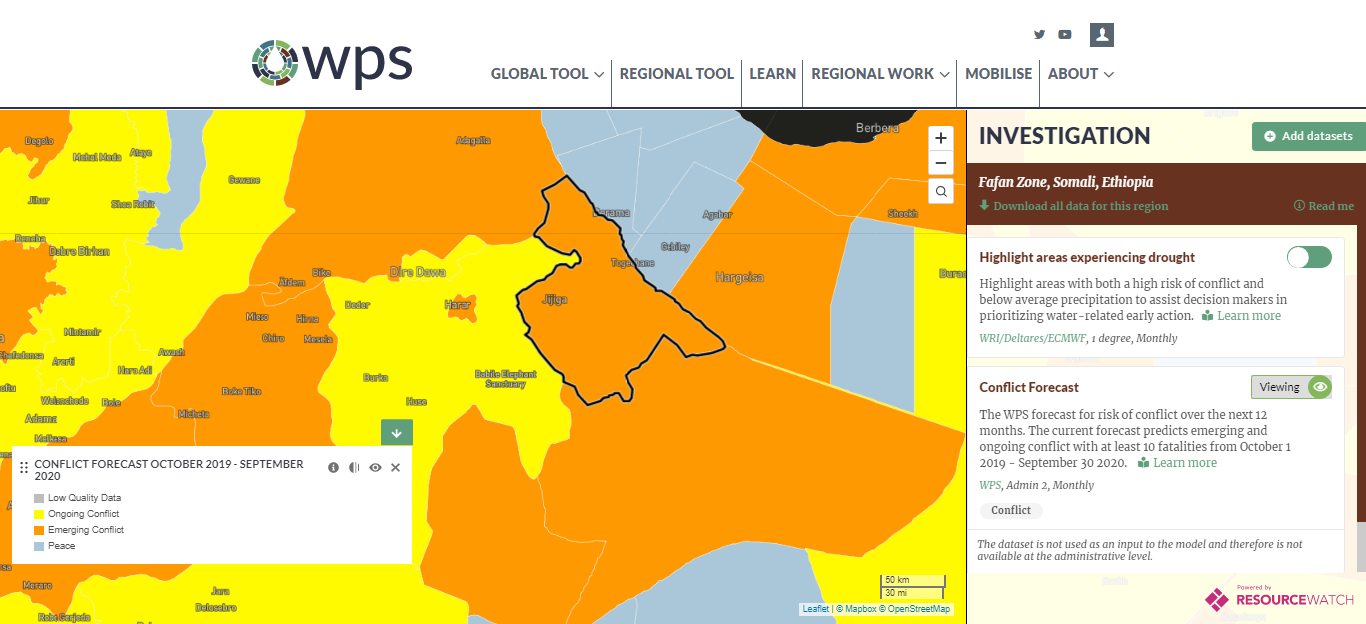
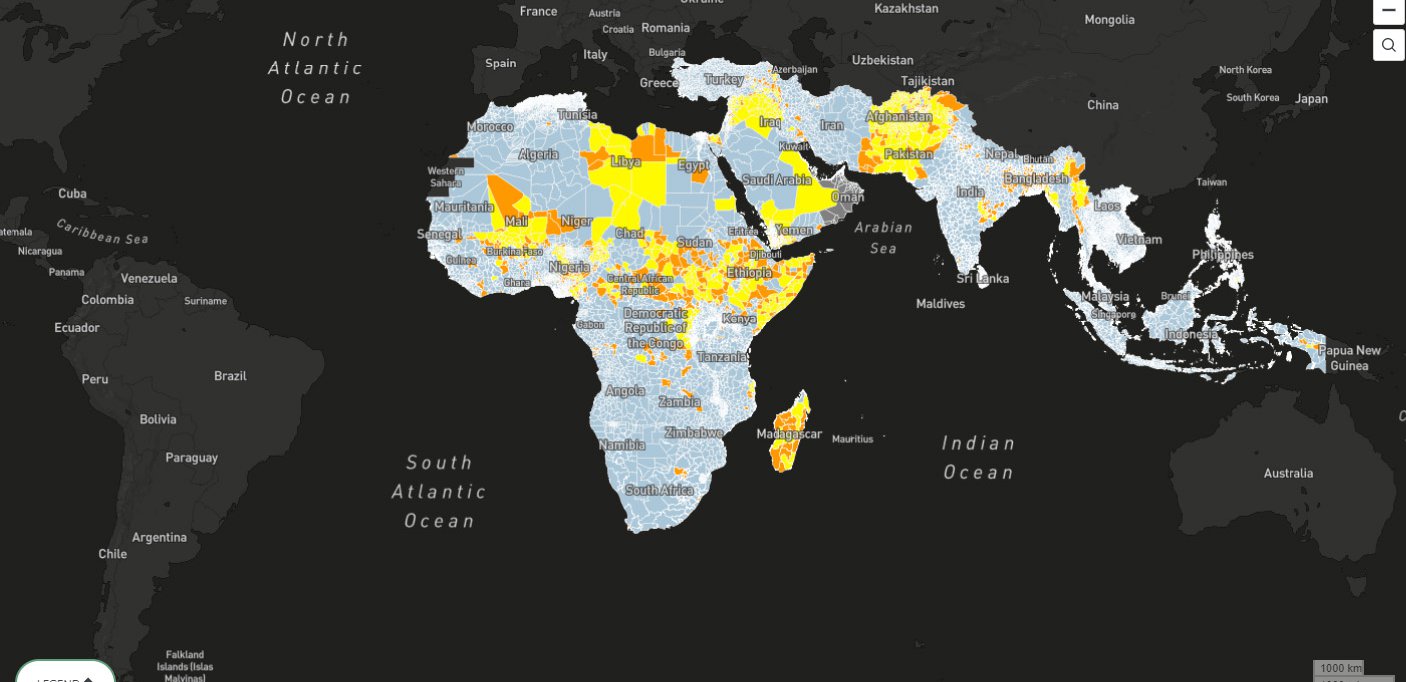
One hotspot visible in the national forecast centers around a pair of zones (second-level administrative units) in the eastern part of Ethiopia: Fafan, where the model forecasts the emergence of conflict, and Misraq Harerge, where existing conflict is forecast to continue. Downloading the full forecast dataset from the tool reveals that the ascribed risk of conflict in these zones is as high as anywhere in the entire country. Perhaps not coincidentally, both zones are centers of distinct populations at the interface between the Somali and Oromia regions (the first-level administrative units in the country). Sitting in the easternmost part of Ethiopia, Somali region's population is predominantly ethnically Somali and religiously Muslim, according to the latest available census data from 2007.1 Oromia covers much of the center of Ethiopia and is majority Oromo, with roughly equal populations of Muslims and Christians of various denominations.2
Understanding the recent conflict history of an area is a prerequisite for evaluating the prospects for future conflict, but that information may not always be easily accessible, comprehensive, or navigable. Because ACLED is a unified, global register of conflict-related events, the model is able to utilize ACLED, and the tool allows users to explore that history with ease. Users can inspect the essential details of individual events, such as battles, protests, or riots: where and when they took place, who participated, and how many people died. At the aggregate, district level, charts show the rate of incidence of different types of events over time.
In Fafan zone, some events seem to be clearly contingent on temporary political circumstances. For example, many of the 2018 events were demonstrations against the regional governor at the time, who stands accused by international groups of extensive human rights violations and is currently jailed on charges of inciting violence.3 Other events were police violence against those protesters.4 However, looking at a longer arc of events, water appears to be a common denominator and crucial element—a notion local actors confirmed to the WPS research team.
ACLED has its limitations. It spans less than two decades and is manually curated, so it has fewer entries than comparable conflict databases that are machine-coded. Such automation, however, introduces major challenges of fidelity. After a lengthy assessment of all available conflict datasets, the team selected ACLED for a number of reasons, above all the superior quality of its entries.
Citations
- source
- source
- Associated Press, Reuters, "Ethiopian Somali Region Ex-President Abdi Mohammed Omar Arrested After Prisoners Intimidated by Lions, Hyenas," August 28, 2018. source; The Economist, "Ethiopia's Most Repressive State Is Reforming," October 5, 2019. source
- James Moody, Ethiopia: Protests Shift from Oromia to Somali Province, ACLED, May 5, 2018. source