Comparing House and Senate School Facilities Programs in the Student Loan Bill

 In July we analyzed funding for K-12 school facilities in the student loan reform bill, the Student Aid and Fiscal Responsibility Act, as passed by the House Education and Labor Committee. The full House passed the bill in September and preserved the $2.0 billion per year school repair program. Although the Senate has not yet acted on a similar student loan reform bill, a version drafted by the Senate Health, Labor, Education and Pensions Committee was leaked a couple of months ago. The leaked bill suggests the Senate is headed in a different direction than the House when it comes to funding school facilities construction.
Both of these pieces of legislation provide a glimpse into the federal government’s first major foray into directly funding K-12 school facilities and neither propose an insignificant amount of money. The most striking difference between the two versions is that the House includes a two-year, formula-based investment in K-12 school facilities, and the Senate bill creates a five year competitive program for K-12 school repair, renovation, and construction.
The House bill distributes funds for repair, renovation, and modernization among states and school districts according to each state and district’s share of total federal Title I dollars. This means that every school district in the nation that receives Title I funds will receive some share of its state’s school facilities funds after the state withholds up to 1 percent for administrative purposes.
Unfortunately, the House bill spreads just over $2.0 billion in each year over more than 13,000 eligible school districts. In the end, it’s likely to amount to a drop in the bucket relative to the total expense of modernizing schools. Additionally, the House bill prohibits spending on new school construction, with the exception of $30 million each year for Louisiana, Mississippi, and Alabama.
The leaked version of the Senate bill, however, avoids the danger of spreading the funds too thin by creating a competitive program administrated by the states but funded by the federal government. Essentially, the program distributes $500 million each year from 2010 to 2014 to states according to their share of Title I funds, much like the House program. However, once states receive their funds, they must create a competitive grant program through which they will award funds to selected school districts and charter schools within the state.
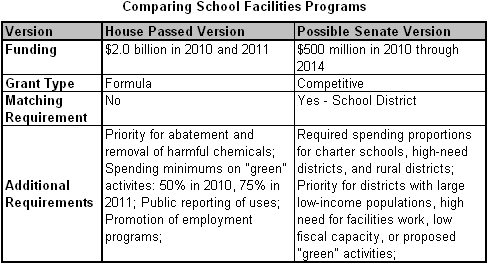
The Senate version does place some restrictions on how the funds must be divided among schools. For example, the proportion of each state’s facilities funds distributed to charter schools must reflect the proportion of funds that charter schools receive under Title I. For example, if charter schools received 30 percent of a state’s Title I allocation, then 30 percent of the state’s facilities funds must also be awarded to selected charter schools. Similarly, the Senate legislation states that the competitive grants must be awarded to both selected high-need and rural school districts in proportion to the amount of Title I funds each type of school receives. Any remaining funds can be distributed to regular, high-need, and rural districts or charter schools as the state sees fit.
Additionally, the Senate bill outlines some priorities for the competitive grants including districts with large impoverished populations, high need for school repair and construction, plans to support “green” practices, or a lack of fiscal capacity to fund construction or repair activities.
The Senate bill also requires that school districts provide matching funds for the federal grants for facilities they receive. However, the required match amounts can be determined on a sliding scale based on the relative size of the impoverished population in each district in a state. Charter schools are not required to supply matching funds.
In all, the Senate program for school facilities is much more likely to have a lasting impact on the condition of school buildings in America. It provides consistent funding over five years, rather than two, for select districts and charters identified through a competitive grant process. As a result, it will provide an infusion of funds in particularly needy schools rather than a small amount of money across the board. It also targets high-need, rural, and charter schools which typically require the most assistance with facilities. Additionally, it requires matching funds, assuring that districts and charters are committed to the facilities investments they are making and that the federal dollars go as far as possible.
The student loan legislation represents a major shift in the federal government’s role in K-12 school facilities. Past efforts have mainly involved tax credit bonds and programs for schools with large populations of students that live on military bases or Indian reservations. Although we don’t know whether the Senate version of the student loan bill has changed since it was leaked over the summer, we hope that it maintains the targeted and competitive aspects that are likely to make it more effective.
More About the Authors
Issues
Related
5 Takeaways from the Trump Plan Overhauling College Accreditation

Accreditation on the Ground: A Q&A with Heather Perfetti