
Ivy Love
Senior Policy Analyst, Center on Education & Labor

States and colleges have been getting creative about connecting students to affordable degree programs with clear labor market value. Two innovations we’ve written about are degree apprenticeships and community college bachelor’s (CCB) degrees. Each of these strategies opens the door to career entry and upward mobility through degree attainment, especially crucial for students who must work while in college and who are not open to leaving their home community. Both degree apprenticeships and CCBs focus on helping residents meet local labor market demand through education and training, but the adoption of these programs varies widely by state. And few states, it turns out, are scaling both types of programs. Below, I’ll break down the states where degree apprenticeships and CCBs are most common.
We conducted a national count of degree apprenticeships that informs this piece. We counted Registered Apprenticeships (RA) integrated with a degree program to the extent that earning a degree is essential to the RA program. Key components of RAs are paid on-the-job learning with progressive wage increases, related classroom-based instruction, and an industry-recognized credential upon program completion. In degree apprenticeships, completers also earn a college degree along with the industry-recognized credential. Since apprentices earn wages in these programs, they can make higher education more affordable for students.
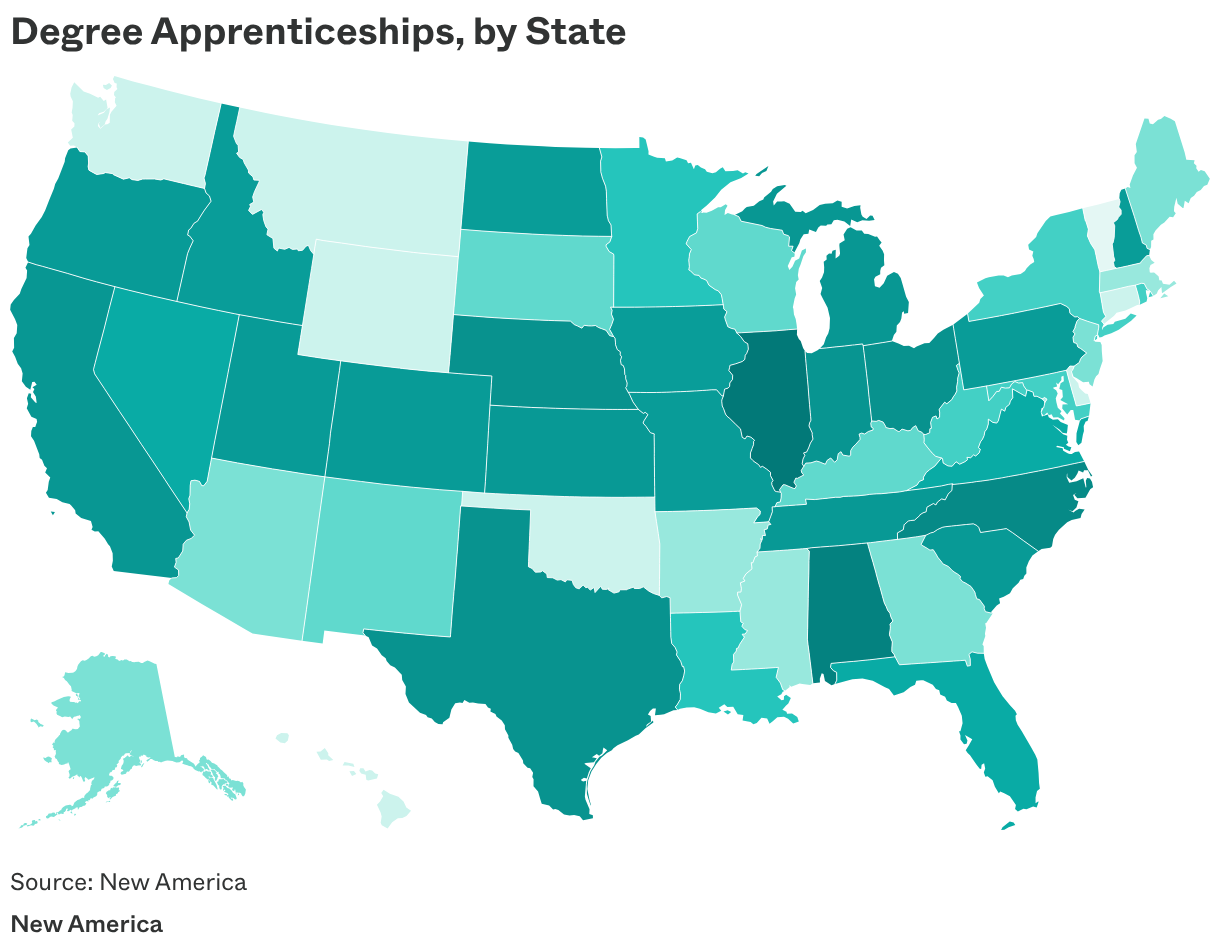
Extensive on-the-job learning with the support of a designated mentor can also help apprentices build confidence in their skills as they transition into independent work after the apprenticeship. We heard from employers in our research process that they viewed degree apprenticeships as an important leadership development strategy, a recruitment tool, and a key opportunity to ensure new employees are well-prepared and confident when they graduate and move into independent work. While these programs hold a lot of promise, a standout finding from our landscape analysis is that degree apprenticeships have taken off in a big way in some states, but not so much in others, as the map below shows.
Meanwhile, community college bachelor’s (CCB) degrees are exactly what they sound like: bachelor’s degrees conferred by a public college that predominantly awards associate degrees. CCBs are workforce-oriented programs that prepare students to enter or advance in a particular field, often stacking neatly on top of an applied associate degree. These degrees haven’t quite been around 40 years, so, on the scale of American higher education, they are still a fairly new innovation.
Currently, 24 states allow at least one community college to offer bachelor’s degree programs. Community colleges that have bachelor’s programs do so for a range of reasons. For example, when there is no nearby university offering a bachelor’s degree, CCBs offer geographic accessibility. While not always the case, upper-division classes in CCB programs may be less expensive than at even public universities, making a bachelor’s degree more affordable for students. And there are occupations where employers increasingly expect bachelor’s degrees, whereas in the past, only an associate degree may have been needed.
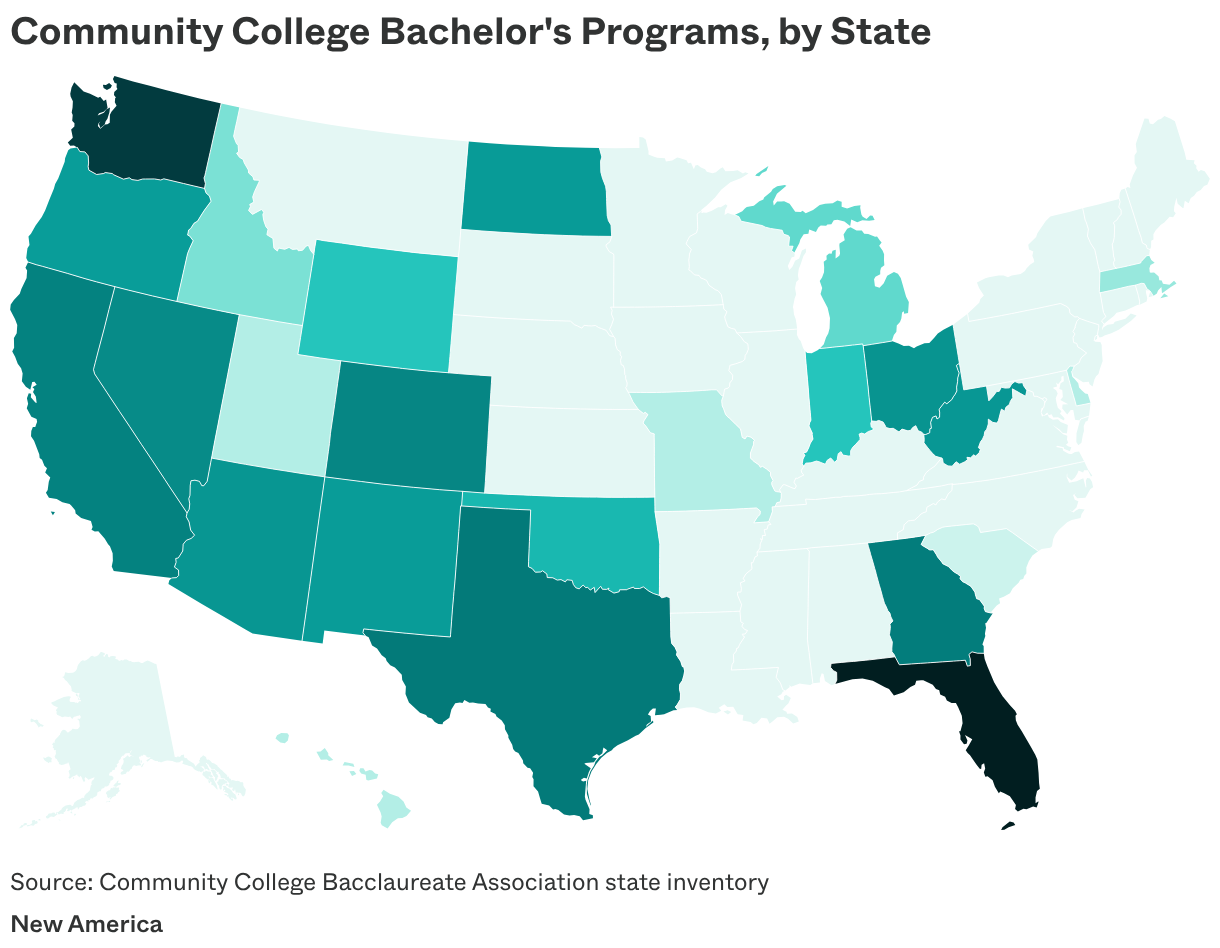
The top three states for degree apprenticeships prohibit CCB programs (Illinois, Alabama, and North Carolina). Meanwhile, three of the top five states for CCBs have fewer than 10 degree apprenticeship programs apiece (Florida, Washington, and Georgia). Texas and California may differ in many ways, but both show up in the top 10 states for these two innovative degree types. And while its population is smaller, Ohio makes an appearance on both lists as well.
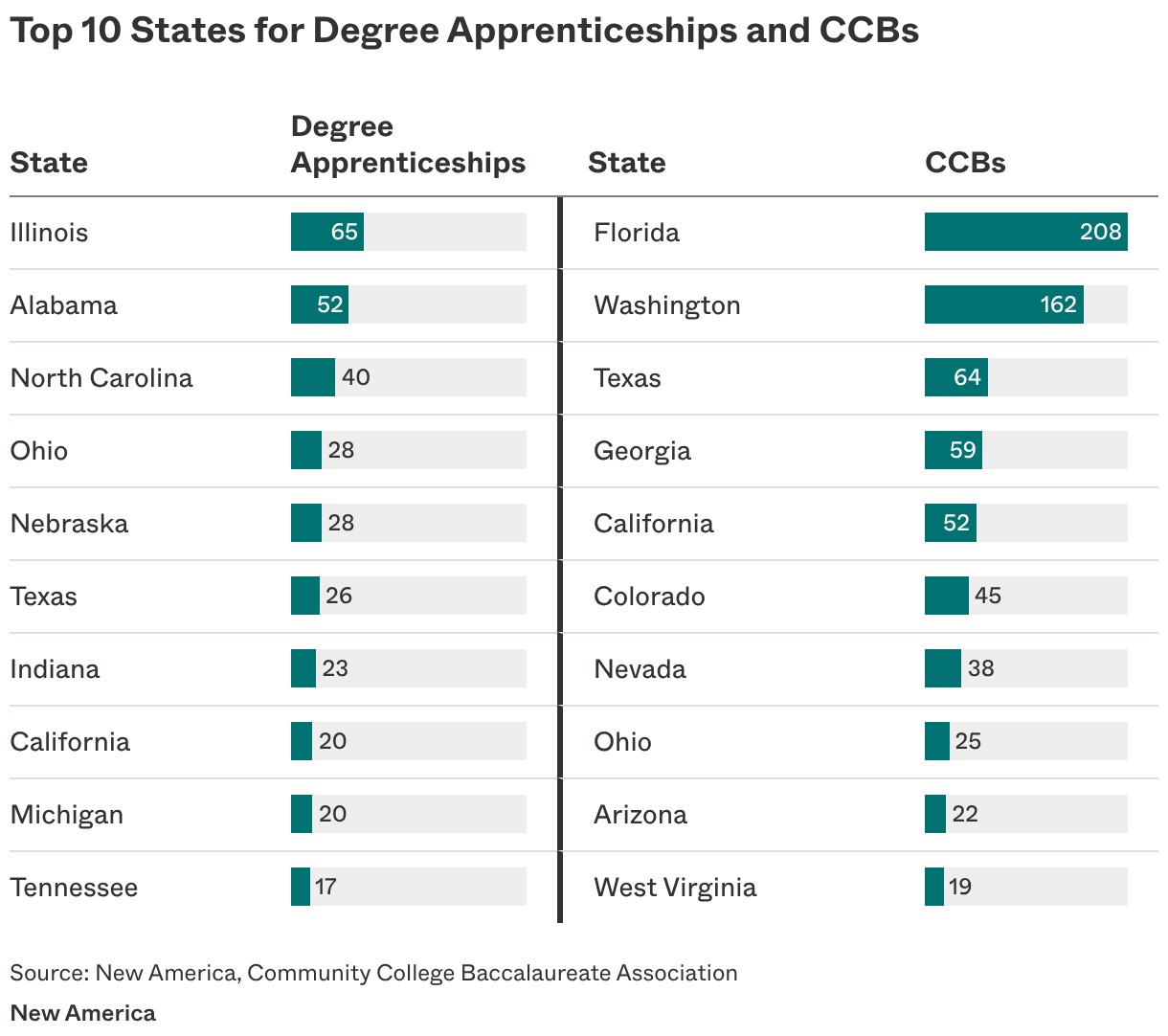
Why are some states leaning so much harder into one innovation than the other? And what’s happening in the three states that make the top ten for both degree apprenticeships and CCBs? Of course, there is much more nuance and context to the development of these two innovative program types than just a count across states. State higher education governance structures, funding and incentives available, and state workforce development priorities all play into the ways degree apprenticeships and CCBs take off (or don’t). In future pieces, I will dig into the availability of CCBs and degree apprenticeship by occupational field and how state policies play into scaling these two opportunities.
Senior Policy Analyst, Center on Education & Labor