
Legislation
The process begins with legislation that grants colleges the authority to award bachelor’s degrees. Among the 23 states that have authorized community college baccalaureates, there is considerable variability in the types of degrees that colleges can offer, the agencies responsible for approving and regulating the programs, and the funding streams available to develop and sustain the programs.
Degree Types
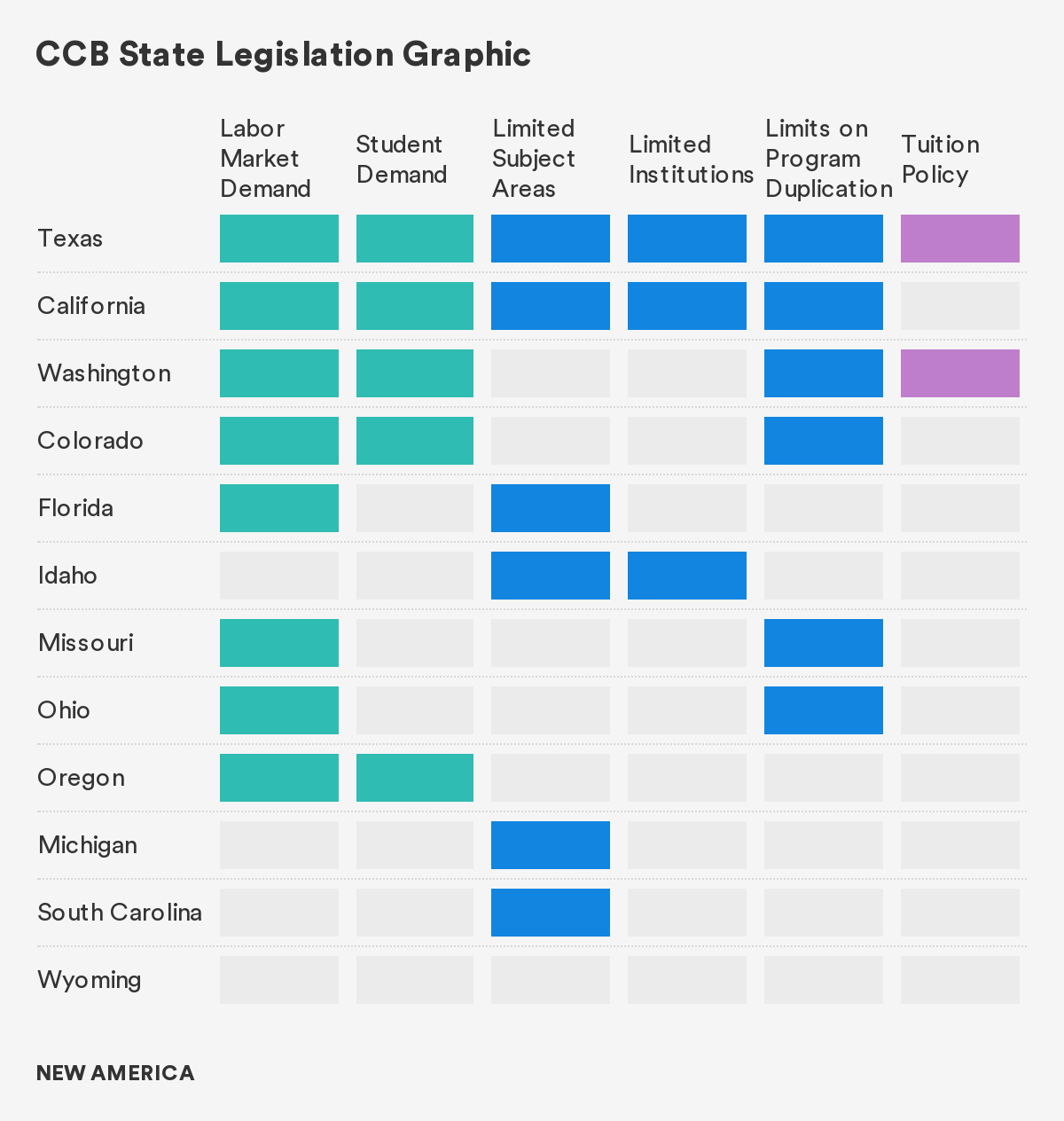
Of the 23 states with authorizing legislation, the majority specify that community college baccalaureate degrees need to have an occupational focus and prepare students for specific jobs in the regional labor market. For example, legislation in Wyoming and Washington consistently frames the community college baccalaureate in terms of “applied” degrees, such as the bachelor of applied science or bachelor of applied technology degrees, leaving more traditional, academic degrees to the purview of state universities.1 Other states identify allowable fields of study in statute, rather than limiting the type of bachelor’s degree that can be offered. For example, legislation in Michigan strictly limits community college baccalaureate programs to those in maritime technology, cement technology, and culinary arts.2
There are a number of advantages to limiting the range and types of baccalaureate programs that colleges can deliver to programs with a clear occupational focus and labor market demand. First, community colleges already deliver a wide range of career and technical education programs at the certificate and associate degree level, which distinguishes them from most four-year public universities. Building a seamless next step for students, especially those in applied and technical associate degree programs, to pursue a bachelor’s degree fills a gap in the higher education space in fields where universities may not be interested in offering a bachelor’s degree.
Second, while overly prescriptive legislation like Michigan’s limits the ability of colleges to respond to changes in the labor market, anchoring community college baccalaureate programs in labor market and student demand makes good sense. Furthermore, it may be easier for community colleges to build political support for baccalaureate authorization by tying it to local economic development needs and inclusive growth strategies. Finally, workforce-focused bachelor’s degrees fit more clearly in the mission of community colleges than those without a direct connection to the local labor market.
Pilots
A number of states, including Washington, California, and Texas, have taken an experimental approach to expanding the degree-granting authority of community colleges through pilot initiatives. In Texas, 2003 legislation authorized three community colleges to offer up to five baccalaureate programs apiece.3 In 2017, new legislation removed the pilot status of community college baccalaureates and extended the opportunity to propose limited baccalaureate programs to most community colleges.4 Similarly, Washington’s first community college baccalaureate legislation authorized a pilot at four institutions in 2005, and in 2010, the state passed additional legislation, opening the door for any community or technical college to propose a baccalaureate program.5
Pilots offer benefits and drawbacks, depending on how they are structured. On one hand, pilots give institutions and policymakers an opportunity to test program designs and recruitment strategies before expanding baccalaureate authorization across the state. Well-structured pilots with timely evaluations also generate important data about likely students and potential outcomes that can be helpful for designing future legislation and regulatory policies.
On the other hand, a pilot built around a mandatory program sunset can make it difficult to recruit students. In California, for example, authorizing legislation imposed a program sunset approximately five years after programs were to be launched.6 If prospective students know a program will disappear after they graduate, they may be less inclined to enroll. Furthermore, employers may question why a prospective hire’s bachelor’s program no longer exists. In short, states that are beginning to pursue community college baccalaureate authorization should consider a few well-structured pilots to test for student demand, labor market outcomes, and completion rates, without imposing an arbitrary program sunset date not tied to labor market demand.
Governance
Most legislation authorizing community college baccalaureate programs also identifies in statute the agency responsible for approving, monitoring, and, under the right circumstances, ending the programs. The entity varies by state: in Florida and Washington, it is the community college system, and in Texas and Ohio, the Coordinating Board and Department of Higher Education oversee all colleges in the states. While the best entity will depend on a state’s particular governance structures, it can be helpful to have a community college system in charge of the program approval process. Because four-year public universities generally resist efforts to extend baccalaureate degree-granting authority to community colleges, having them participate directly in the governance of the programs can paralyze state agencies charged with approving and monitoring the programs. An approval entity responsible for two-year institutions alone may be more flexible about program approval than a body that includes two- and four-year institutions because of internal pressure from four-year colleges. For example, in both Florida and Washington community colleges are under their own system, which has helped them expand CCB programs throughout the state. On the other hand, many states like Texas and Ohio do not have a single system of community colleges and a statewide entity makes the most sense for approving and monitoring programs.
One way to address the political pressure faced by bodies regulating both two- and four-year colleges might be for state legislation to clearly lay out goals for the number of programs approved. The program approval process could then establish standards for proposed program finance and evidence of demand and facilitate clear communication with local universities.
Funding
Baccalaureate education is generally more costly to deliver than the traditional associate degree and certificates programs offered by community colleges. The faculty required to teach the programs may be more expensive. Start-up costs, which often include reviews from regional and specialty accreditors, can be particularly steep. Meeting new accreditation requirements—around library holdings, laboratory space, and equipment, for example—imposes additional costs.
The 2019 Inside Higher Ed survey of community college presidents showed that respondents were concerned about adequately funding baccalaureate programs.7 Fifty-seven percent of those surveyed said they were worried states were not providing enough financial support to ensure that four-year degree programs are high-quality. Only 13 percent of respondents thought states were providing enough funding to adequately support bachelor’s programs at community colleges.
Start-up grants can help alleviate these costs and create stronger, more sustainable programs, particularly when colleges are just starting to offer these types of programs. In Texas, the state provided each college with $1.2 million in special funding to help cover start-up costs.8 But other states, like Ohio, did not provide start-up funding to their colleges.9
How much these programs cost students relative to bachelor’s degree programs offered by public four-year universities also needs attention. Legislation should clarify if the state will fund upper-division classes at the same level as lower-division community college classes or at the same level as upper-division classes at state universities. Depending on the program, upper-division courses can cost more than lower-division courses, so increased funding for them may be justified. As of 2014, for example, programs in Texas were reimbursed for upper-division courses at the same rate as universities.10 However, most states fund the upper-division and lower-division classes at the same, community college level.
State statute should also make clear whether institutions may use differentiated lower- and upper-division tuition rates to cover program costs. Florida charges almost exactly the same rate for lower- and upper-division courses, while in Washington, upper-division tuition at community colleges matches the average tuition at regional state universities.11 Forcing community colleges to charge the same rate for upper-division courses as that charged by public universities can help reduce some opposition to the programs from that sector and relieve some concerns around quality, but it also reduces the cost savings to students and the state. Policymakers will need to weigh those trade-offs.
Citations
- Revised Code of Washington § 28B.50.810 (2012) and Wyoming Statutes §21-16 (2019).
- Michigan Comp. Laws §389.121 (2012).
- Texas S.B. 286 (2003).
- Texas Educ. Code Ann. §130.302 (2017).
- Washington H.B. 1794 (2005) and S.B. 6355 (2010).
- Programs were to be launched by the 2017–18 academic year and sunset in the 2022–23 academic year. However, the sunset date has been extended until 2026. For political context and history of California’s baccalaureate pilot program, see Constance M. Carroll, "Pushing the Envelope: California’s Baccalaureate Pilot Program," in The Community College Baccalaureate: Supporting Regional Economic Development, ed. Constance M. Carroll and Rufus Glasper (Chandler, AZ: League for Innovation in the Community College, 2018), 27–33.
- Scott Jaschik and Doug Lederman, eds., 2019 Survey of Community College Presidents (Washington, DC: Inside Higher Ed, 2019), source
- Lindsay Daugherty, Charles A. Goldman, Lindsay Butterfield, and Trey Miller, Assessing the Potential to Expand Community College Baccalaureate Programs in Texas (Santa Monica, CA: RAND Corporation, 2014), source
- Ohio Rev. Code § 3333.051 (2018).
- Daugherty, et al.
- Revised Code of Washington § 28B.50.810 (2012).