Haley Swenson
Senior Writer and Researcher, Better Life Lab
Invisible labor has a new messenger, and he's making men laugh

Women have been sounding the alarm about the invisible load for years. Researchers, writers, and advocates have documented the disproportionate household management, emotional work, and caregiving that falls on women in most heterosexual relationships. Some capture the unbridled rage that many women feel as a result. Others push for fairer solutions, from Eve Rodsky’s Fair Play method and Kate Mangino’s Equal Partners, to a host of apps designed to help families get a handle on all the unpaid work, as well as Better Life Lab’s own behavioral science-informed experiments to help families more fairly share the load at BLLx.
Often, in largely female gatherings discussing the problem and how to solve it, someone is bound to lament, “Where are the men in this conversation?”
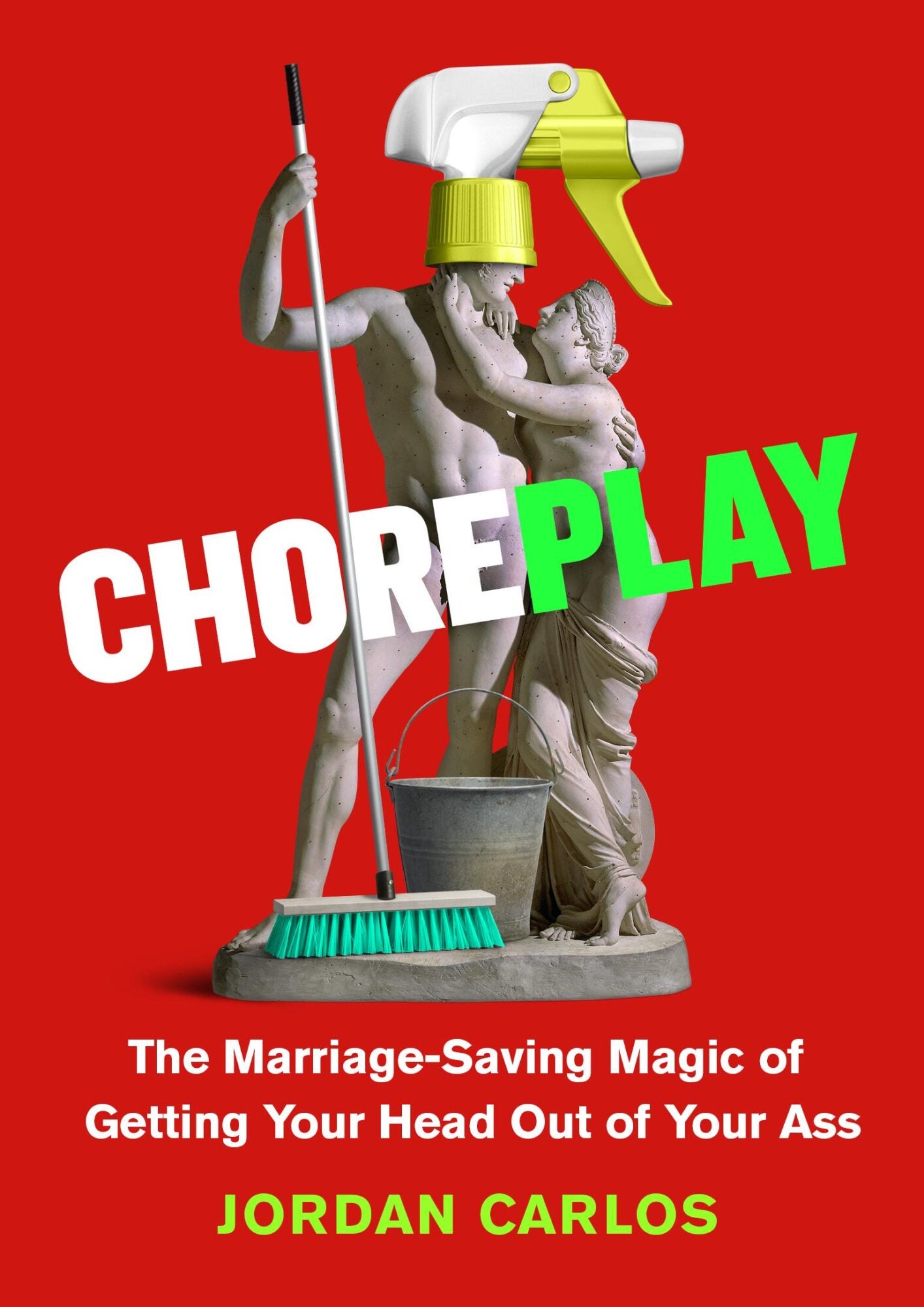
In walks comedian Jordan Carlos with his new book Choreplay: The Marriage-Saving Magic of Getting Your Head Out of Your Ass. Carlos is a long-time stand-up comedian and an actor and writer for TV shows like HBO’s Divorce and Comedy Central’s Tha God’s Honest Truth with Charlamagne Tha God. In Choreplay, Carlos explains how he saved his own faltering marriage, not through grand gestures, but by paying attention to his wife’s feelings and making the things that worried her, his problems.
When I caught up with Carlos in early May, he was driving from his New York City home to the suburbs to spend the morning with Papa, his wife’s aging father, who needed a walking companion. It was, he noted cheerfully, choreplay in action—the idea that taking on more of the unglamorous work of family life is the surest path to greater intimacy and happiness.
Our conversation has been edited for clarity.
Haley Swenson: This book is funny, but it opens with a pretty serious piece of international history—Iceland in 1975. Women decided they had had enough of sexism and being responsible for all the little things that actually kept the country running—the cooking, the child rearing, the cleaning, the laundry— with none of the credit, political power, or financial benefits. So they stayed home and shut the country down. Today, Iceland is one of the most gender-equal countries in the world. Why did you start with the story of Iceland’s Long Friday?
Jordan Carlos: That story distilled for me what happens when invisible work stays invisible for too long, when you don’t see it at your own peril. That was a society writ large having a bit of comeuppance. But it can happen all the time in households and relationships. When the burden of division of labor is so skewed, and there is no equity, so much animus and so much resentment can build up for so long that it finally blows. It might not blow in a big way—there might not be a huge fight or anything—but a relationship that otherwise would have worked goes by the wayside.
You write a lot about your parents in the book. The title comes from your mom, who would call it “choreplay,” if your dad started helping around the house. How did what you saw growing up shape how you showed up in your own relationship?
What I saw was imprinted on me—it was modeled for me. My father had what I describe in the book as a “greedy job,” meaning it consumed a lot of time, but he was rewarded for it and made great money. I wanted what my dad had. He worked, and when he came home, he was “off.” Not mom. And I see now that it came with pitfalls. Since my dad and mom retired, their division of labor has completely flipped. It’s him around the house doing all the things.
So it’s never too late to make the change. That’s what I’m hearing.
It’s never too late. As I say in the book, they’re fifty-plus years married. They’re very sweet and considerate with each other. Even more so than when I was a kid. Because my dad was super busy, my mom just covered whatever else needed to be done. It’s just tattooed on your brain: that is what the woman is doing in the relationship.
Your thesis can be captured in this line: “Heroes are made, and hearts are won via small-bore, everyday routines and tasks.” Tell me about that.
The older I get, the sexier it is to do small things without being asked. It puts my partner on a good footing, and I know she feels warm and fuzzy inside when I’ve walked the dog, made the lunches, or gotten the kids up. Flowers are great. We love flowers. But flowers die. Discipline and routine leave her feeling so good inside.
In the past, I didn’t see these practical, small gestures—the things that we take off our person’s plate—as very romantic. At the end of the day, she’s tired, she’s done it for years, and she just needs someone else to be there and think about these things with her. Being on that same page—that’s where the romance lies.
I was surprised by how much of the book is about calling on men to take care of themselves. Why is that such a big piece of the puzzle?
Because you’ll stop complaining about your family if you’re a bit more selfish. Every morning, I wake up at about five and head to the gym. From five to six is my time. If that doesn’t happen, I’d be on a complaint campaign about not having time to do what I wanted. But when I carved out that space and kept that promise to myself, it informed many other aspects of my life. And then it was: okay, I got to check under the hood and go to the doctor. I made the appointment and just had my first colonoscopy and endoscopy.
They don’t give me any stickers or toys for that. But you owe it to yourself to do these things. I took myself off my wife’s plate, in terms of things she needs to worry about.
I loved the anecdote about calling your kids’ dentist—instead of going to your wife and making it her problem, you just called to ask if they were due for cleanings. And the woman on the other line said, “Mom already knows this.” And you said, “Well, Dad wants to know.” And she asked—
“Are you guys getting divorced?”
It’s funny, but there’s something real in it, in terms of society’s expectations for men.
It is very hard to go fifty-fifty because society is structured in a way that a lot of this is pre-programmed. Like, why would you want to know these things about your kids’ health when mom is like Google Cloud right there? But it’s still worth the effort to make inroads. Even if you never reach equality, you definitely still reach a certain equity. You know the game plan. Today, I knew that somebody was probably going to have to walk with Papa. I kept my schedule loose so I could. So my partner doesn’t feel like it’s all on her.
What are you hearing from men who’ve read the book?
My favorite response was from my neighbor: “Man, where was this when I was married?” Now he’s carrying these lessons into his next relationship.
One of the things the book has going for it is—sometimes it’s the singer, not the song. Sometimes it takes a man to explain things to men.
I’ve been going into the manosphere with some of the podcasts I’ve been doing, and one very big podcaster—he’ll remain nameless, but the podcast will come out very soon—his invitation was like: “Please come over and help our wives stop hating us.” There’s a nagging immaturity—a “this isn’t fair”—in the manosphere.
If I can dispel that, I’ve done the work.
Last question: What are the benefits of all this choreplay? It might sound like a lot of work. What do you get in return?
Haley, we left out the best part. The smashing. The French always knew: ménage means to clean the house. Menage à trois means to clean the house with three—literally, that’s what it means. And if there’s a sock on the floor, my wife is just not in the mood. The more I did around the house? It’s a turn on.
I always think: you don’t have to go to Tiffany’s. You’ve got to go to Costco.
And who can afford to go to Tiffany’s anyway? In this economy?
In this economy, it pays to go to Costco and get a good price per unit.
Ask yourself if you want to go to bed with dishes in the sink. Ask yourself if you want to leave the house with a bed unmade. When you accept those standards for yourself—not hoping to get mommy’s approval, but asking what do you want—I’m telling you, she’ll be open, more open to playful connection than the way it was before. When the milk is in the fridge, and orange juice, and butter—when all those things are on hand—you don’t have to go to Tiffany’s.
Senior Writer and Researcher, Better Life Lab