
The First Try
Who are Comebackers?
The National Student Clearinghouse (NSC) defines the “some college, no degree” population as individuals with some postsecondary education and training but who have not completed and are no longer enrolled. NSC’s analysis of the entire U.S. “some college, no degree” population over five years (ending in 2018) shows 32 percent of students completed only a single term, 56 percent completed multiple terms, and 12 percent were enrolled for two years or more. NSC coined the term potential completers for students who had completed at least two years’ worth of enrollment but had not earned a degree. Among comebackers working with the Graduate! Network who fit into the “some college, no degree population,” the percent that were potential completers was nearly four times larger.
Many comebackers were ignored by higher education or experienced closed doors because they did not precisely fit a college’s recruitment profile. The Graduate! Network community programs are designed to meet them at any point, work with them through issues that are holding them back, prepare them for a successful re-enrollment, and connect them to other services as needed. This “open door” policy sheds additional light on the comebacker population. One in five students who engaged with a Graduate! program had already earned a two-year credential (22 percent), usually a certificate or an associate degree, and were seeking another degree. (See Figure 1.) The postsecondary landscape, which now includes extensive online course offerings and programs, has become increasingly complex, and these individuals wanted guidance and support to navigate it. We have found that the transition between two- and four-year institutions requires additional support, especially if an adult learner is trying to transfer credits into a four-year program.
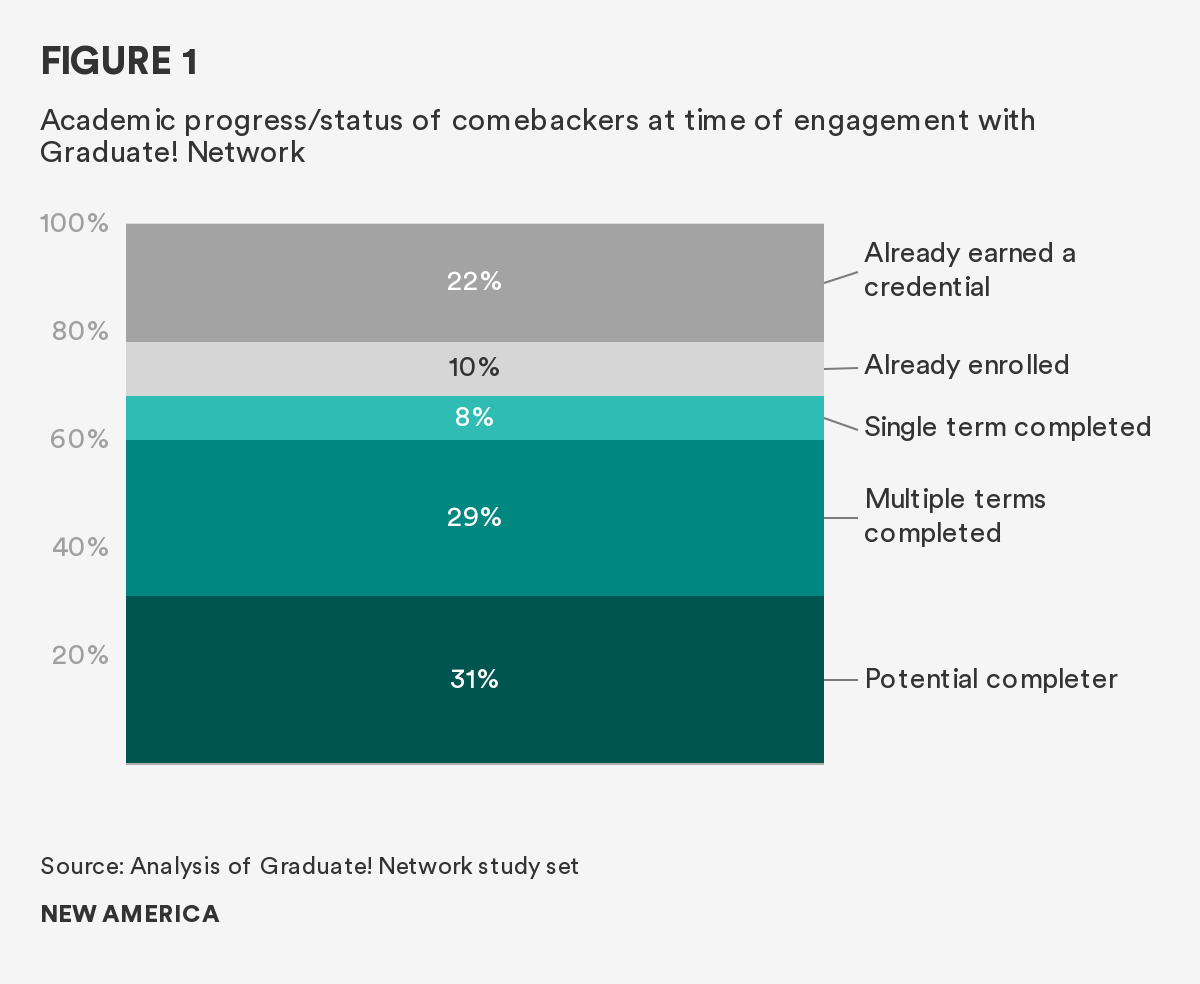
Another one in 10 adults seeking assistance were already enrolled in college but were worried about stopping out. These students were struggling academically or financially, or faced non-academic struggles related to child care, transportation, or other challenges, and were well on their way to joining the “some college, no degree” ranks without assistance from Graduate! Network programs.
The Graduate! Network also attracts subsets of the comebacker population that historically have faced barriers to postsecondary opportunity, including systemic discrimination: they are predominantly (70 percent) people of color. The ethnic breakdown we see shows a majority of Black comebackers on the east coast, Latinx and Black in the upper Midwest, and Latinx in Texas, New Mexico, and California. Sixty-four percent identify as female. Before COVID-19, forty-three percent had a family annual income of $24,000 or less, and another 40 percent earned up to $56,000 annually.
Why They Stopped Out on the First Try
Former students reported that they stopped out the first time around for a myriad of reasons, often related to structural inequities. A Black comebacker summed up her hesitation about attempting college with a systemic assessment, saying that “with all the stuff that we went through and the struggle and with poverty and the neighborhoods we lived in and schools that I attended, I just really felt like I shouldn't be here.” Another comebacker spoke of her struggles with racial bias and her own self-doubt: "I was really hesitant at first about even going into” a program to earn a B.S. in finance “because…there's not many African Americans in it. I just have to be honest about that. That in itself was intimidating.”
Some had been told that college was necessary, or a family expectation, but without a clear explanation of why. We heard from those who were the first in their family to attempt college but had no idea or guidance on how to navigate the experience or what their goals should be. One comebacker articulated it simply, echoing what we heard from many: “The first time around, I didn't know what I wanted to do. I was just told to go to school.”
Finding yourself torn between an opportunity you have been told is good and your reality that it is not working for you can be hard for young people to articulate, especially to those in perceived authority. “I just wanted to get a job and earn money” was one common refrain. Some first-time students worked part-time while attending school, attempting to “pay as they go” but then burned out. A “college degree was not at the top of my list,” said another comebacker, even though the financial aid office “people were helpful. They thought it was something else going on, but I have to be honest, there was nothing else going on. I didn't know why I was there. I was just told to go to school.”
Family expectations and the reluctance to disappoint was another strong theme, especially for lower-income students who recognized the sacrifices their families made to get them to college. “[I thought] I really hope I don't disappoint people. For some people it's a huge disappointment when you make the decision not to go back or leave school.” Especially for families with little or no understanding of postsecondary education systems, and who have made enormous sacrifices for a child, stopping out directly translates into a narrative of personal failure.
Some stop-outs were precipitated by a change in circumstance—death of a parent, pregnancy, illness, substance abuse that spiraled out of control, incarceration, an accident, or other circumstances that cut into the ability to pay for college. These stories are intense and personal. Comebackers recounted taking care of parents who are chronically ill or dying, struggling through addiction, dealing with divorces and bankruptcies.
Why They Want to Return to College
Comebackers approach the process of going back to school with life experience under their belts. Graduate! Network comebackers were mostly in their early 30s (average: 32.7 years old; median: 30 years old). An average of 3.7 years had elapsed since they stopped out from their prior college enrollment.
While it is hard to translate satisfaction and self-actualization into program metrics that influence policy and funding considerations, when asked why they wanted to finish school, the most commonly cited reason was personal achievement (41 percent). (See Figure 2.) “I think it was a combination of self-determination, for me, to graduate, because I had started school and dropped out, like I said, and I just wanted to finish. I just wanted to finish, like self-accomplishment. Accomplishment was so important,” one person told us. Another comebacker said, “I wanted to just have that tangible piece of paper that we've all just worked very hard for. Starting something and then stopping, you always have in the back of your mind. It's like, ‘I really want to complete this.’" Another said, “this is my first opportunity to really choose it for myself. There’s a real sense of satisfaction associated with completing that degree for me. That’s what motivates me right now.”

Being a role model for family was the top reason for 7 percent of comebackers. One told us, “it was definitely a combination of wanting to finish what I started, but then also—none of my immediate family members went to college, so I wanted to be that person who could be an inspiration in the family.” This person wanted to be able to say, "Look, college can work. You can do it."
Improving economic and career prospects are strong motivators as well: 22 percent of comebackers connected college completion with increased earnings potential, 13 were hoping to change careers once they graduated, and 12 percent were motivated by opportunities for better jobs. One comebacker explained his realization that “the people that started with me would have bachelor's degrees, and we'd be making the same amount of money and I'd be just as smart as they were, and my bosses would say, ‘Hey, I gave [a promotion] to so-and-so [who had a degree].’ That's really what finally made me go back,” he said, “just finally feeling like I wanted to be able to say on paper that I'm just as good as everyone else.”
With graduation comes the benefit of becoming alumni of a college and networking with peers, and comebackers are quick to recognize the power of the new network they can now access. One said: “At Moore, I'm on the board of alumni and I really did do the networking that I wanted to do, because I really believed that going to college is an opportunity for you to meet people. Because I believe that people can help you further in life, with careers and getting a job, and things like that. If you don't have any network to pull from, people you know to help you, where are you going to get that from?”
Although our interviews with comebackers happened before the massive job losses due to COVID-19, they understand the signaling power of a degree, or lack thereof, for employment. “I realized too that although today's environment doesn't guarantee you a job, showing schools in your LinkedIn profile but not having finished meant something to some employers,” one told us.
What They Are Looking For
Primarily, comebackers are looking for a signal that college is indeed an option for them, and like all consumers today, they are looking for answers now. One student emphasized that this was not a fast process:
That was actually one of the biggest challenges for me initially, I wasn't aware and could not find any one-stop shopping view of what the different universities, either online or here in the area, could offer. That was pretty labor-intensive for me, pursuing recruiters in each of those schools and finding out what it was they could offer me, submitting transcripts. That was a lengthy process. Actually, that was probably the biggest latency in me getting back into classes, was working through different schools, what it was that they would accept off of previous transcripts. That piece is still a little bit of a hassle, I think, for the student. I think that took eight months to a year to really do that.
Too often colleges create administrative hurdles that are not well explained and are exacerbated by the lack of response from admissions offices. This is the space the Graduate! Network fills. One student told us, “I just figured it was a great time [to go back to college] while I have all this work experience. Really look for a program that could fit around my schedule, working full time at two jobs….I knew if I had someone to help me be accountable that it might push me. That's when I landed upon Graduate! Philadelphia.”
College admissions processes can be challenging for any student, and many comebackers expressed frustration with offices that were only open when they were at work, sometimes necessitating taking a day off from work to go to the campus. One vividly expressed his frustration in having to “badger” people on campus, nicknaming himself “the old dude” in the process:
I would call the registrar's office and they would say, “well, that person's not in right now.” I ended up getting so frustrated. I took a day off of work and actually went onto their campus and I talked to every person in that department and they said, “go to this office and to this office and to this office.” They got to the point where like, “the old dude is coming to your office.” After I spent a whole day on campus and I finally got to this one person and he said, “okay. I heard your name’s been circling around campus.” As soon as I'm leaving the parking lot, he calls and says, “Colin, you've been accepted.” It was almost like a pledging process. They were like, “You did it. You badgered us enough, you really want this, so, welcome. Let's see if you graduate.”
In looking for the right school and program, comebackers want to build on what they have already achieved, and they are concerned about the cost. By definition, comebackers have earned college credits which should afford them advanced academic standing when they re-enroll. However, this depends on the willingness of each college or system to accept transfer credits from other institutions. Often, information about these processes, and the offices that handle them, are not clearly and easily found on college websites.
In general, recognition of prior learning is not a uniformly accepted or applied practice. A new report from the Western Interstate Commission for Higher Education highlights the promising but fragmented landscape of prior learning assessment, as does a report from New America. Credit for prior learning or prior learning assessment (PLA) is the process of evaluating and awarding college credit for the equivalent college-level learning acquired outside of a postsecondary institution, such as at a job, during military service, at corporate training, and even through some types of volunteer work.
Finally, comebackers are interested in accelerated courses that run five to eight weeks, year-round starts that are not confined to the semester or trimester or even the quarter schedule, hybrid class models (online and in-person) that allow them the flexibility to learn online as needed, and evening and weekend classes. As one comebacker said,
I needed some schedule flexibility, so I sought out a school that had evening classes and an eight-week format. That was going to be workable for me with my schedule at work. I also was looking for a way to keep costs down. I’m using my G.I. Bill to cover tuition right now, so somewhere that had reduced credit hour tuition rates for veterans was appealing because I’ll be able to make my VA dollars go a little bit further that way. I was also looking for somewhere that would accept a lot of my previously earned credits and didn’t have time limit caps on a lot of those educational requirements. I was able to take basic and general ed requirements that I had completed years and years ago and still can still apply those to the degree I’m seeking now.