
The Comeback
Getting Back on Track: Who Is Most Likely to Re-enroll
Many former students find the right school and re-enroll on their own, but others need guidance and time to prepare before they can apply to a school. Often, comebackers need advice from an unbiased source to help understand and pare down their college options and remind them to stay on task. One summed this up in these words: “Just having talked with the people at the Graduate! program, just having them here hearing me out and what I wanted to do, and providing resources to make sure I accomplish that. Then for me, just being on top of things, stuff like that and everything, and also…reaching out for help, [whether] that will be financial or just finding resources, that was something that helped me.”
Graduate! Network data show that comebackers who had a handful of meetings with a Graduate! advisor were 2.4 times more likely to re-enroll, and those who had 14 or more interactions with an advisor were four times more likely to re-enroll. Most comebackers who re-enrolled did so within six months of asking for help (59 percent); however, some took up to a year (17 percent), while close to a quarter took more than a year to re-enroll (24 percent). Financial issues topped the list of reasons why comebackers had not yet re-enrolled: being tied down by loan payments from their previous school and/or a child’s school, owing money to a previous school, or not finding a school with affordable tuition. In general, there was a strong reluctance among comebackers to take out loans, for fear of adding to an existing debt load or not being able to pay them back and then having wages garnished.
Systems and technology may have changed since they were last in school, and many comebackers benefit from personalized attention. One told us:
The coach that I had at that time was really vital. She was the one person that actually knew what I was up to. She was instrumental in helping me look at what programs there were, going on the website….By the time I called my old school, you're needing to know what your old login is. You don't even know. You're like, “how many digits was my student ID? What button do I need to press to reset? What technical assistance do I need to call now?” That sort of thing. Finding your high school diploma. Those kinds of things were, I think, the most instrumental.
More than a third (39 percent) of adults who sought help from the Graduate! Network went on to re-enroll; close to half of these re-enrollees (49 percent) were potential completers. In fact, more than one comebacker was only one course away from completion. One said: “I kept flunking this math class, and I never went back to school.” The advisor suggested contacting the college: “She's like, ‘You're so close. You just need this one class to finish up those credits, to have that degree in your hand and with that, you can use that as an upside-down degree program with Whitworth University.’ Because I told her what I want to do, and she just helped me on the path, because I was lost and frazzled, because it's just like, I don't get any sleep, I'm all over the place, and she put me on the right path.”
Persevering: Who Actually Enrolls and Their Pathways to Graduation
Comebackers have amazing stories of perseverance. One student told us, “I still had periods of homelessness at college. There was no one on campus….I could go to say, ‘I'm in this situation. What do I do?’ Instead, I was… threatened with getting charges for trespassing even though I was a student on campus because I was sleeping in a campus building.”
Our analysis shines a light on comebacker enrollment patterns and how these students progress through school once they re-enroll. Sometimes it took a lot to re-enroll. One comebacker told us of four enrollments before he found The Graduate! Network. He shared his story of connecting with a staff member at that first university: “she literally leaned over the counter and said, ‘Honey, if you can't figure out how to enroll in this school, you will never make it.’…I realized that their enrollment process…was intentionally designed to weed people out.”
In line with what we know about momentum and higher education completion, the more academic progress the student made the first time around, the more likely he or she was to be continuously enrolled or to have made it to graduation without stopping out. One comebacker said, “once you start from community college and then you go to the university…it's like, ‘you didn't start this to stop again.’ I didn't want to stop again.” While most returning students who graduated stayed continuously enrolled, close to a third of comebackers traveled a different pathway.
These pathways included the 11 percent of former students who graduated as soon as they re-enrolled. (See Figure 3.) In many of these cases, clearing administrative tangles like filing a graduation application or overcoming financial hurdles like paying off a bursar’s balance was all it took to be awarded a degree. In other instances, colleges awarded transfer credit and/or credit through prior learning assessment that allowed them to grant a degree upon a student’s re-enrollment. In still other circumstances, community colleges awarded a two-year degree based on classes completed at a four-year college.
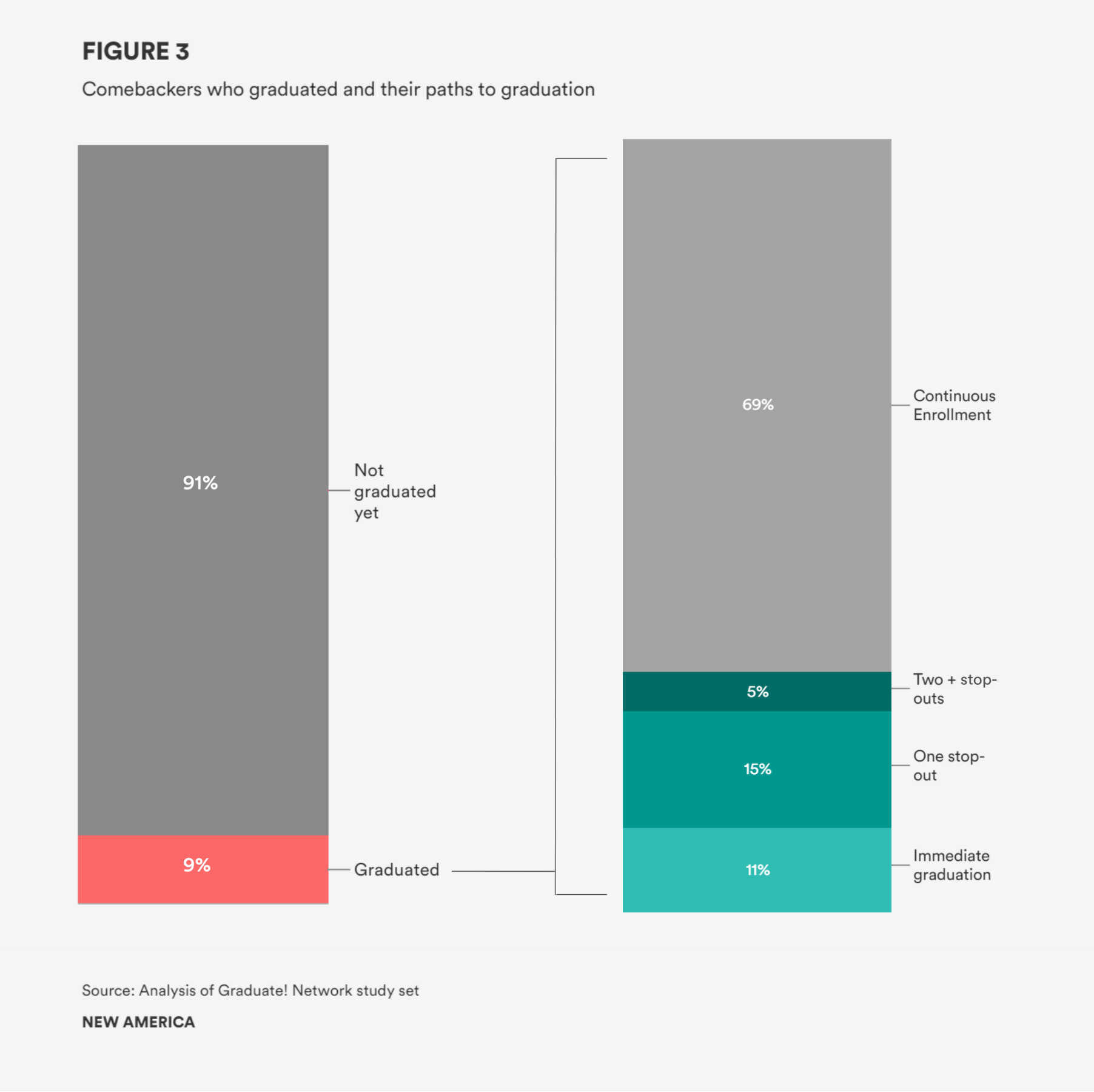
Twenty percent of comebackers had at least one period of not being enrolled before they graduated. Indeed, for many, a stop-out was not a sign of giving up, but rather a period of enrollment dormancy during which the comebacker was laying the groundwork or waiting for a more opportune time to resume their studies. In our study set, over 40 percent of comebackers who had re-enrolled after engaging with The Graduate! Network stopped out at least one more time afterwards.
This significant minority of comebackers highlights why we need to rethink persistence measures for this type of returning student. Persistence is traditionally defined as the percentage of students of any age who return to college at any institution for their second year, and it is thought to be predictive of both student retention and graduation. This definition clearly reflects the typical experience of a traditional student: it has a “seasonality” component to it, with attendance tied to the fall semester; there is an underlying assumption that enrollment will be continuous from year to year; and this continuous period of enrollment happens early in matriculation.
And yet, this definition of persistence is not very useful when applied to the entire population of adults who return to school to complete their degrees. Given that they already had accumulated college credits, the majority of comebackers who engaged with The Graduate! Network (54 percent) did not wait for fall semester to re-enroll, and only a third (34 percent) remained continuously enrolled at the same time the following year. Furthermore, attempting to adjust this definition of persistence—by changing enrollment windows or severing the tie to fall semester starts—do not result in measures that are any more meaningful.
Given that starts and stops are not unusual for the comebacker population, a more applicable term is perseverance. A comebacker who has stopped out is not necessarily a drop-out. Indeed, there may be very good reasons for a comebacker to have periods of non-enrollment on his or her way to graduation and to take more time to complete a program. We need to broaden our thinking on what it means to be persistent and allow room for these additional pathways to graduation.
Crossing the Finish Line: Who Graduates and How
As discussed earlier, potential completers are comebackers with at least two years of college experience. The reality of how to support them to completion is more nuanced.
The more academic progress a comebacker had had prior to engaging with a Graduate! Network program, the more likely it was a recent college experience–less than a year of not being in college. For potential completers, those who had completed two or more years of school prior to engaging with a Graduate! Network program, almost 70 percent had been out of school for less than a year before engaging with a Graduate! Network program. Among comebackers with fewer than two years’ worth of credits, only 43 percent had been out of school for less than a year. Of comebackers who had completed a single term, only 11 percent were recently enrolled.
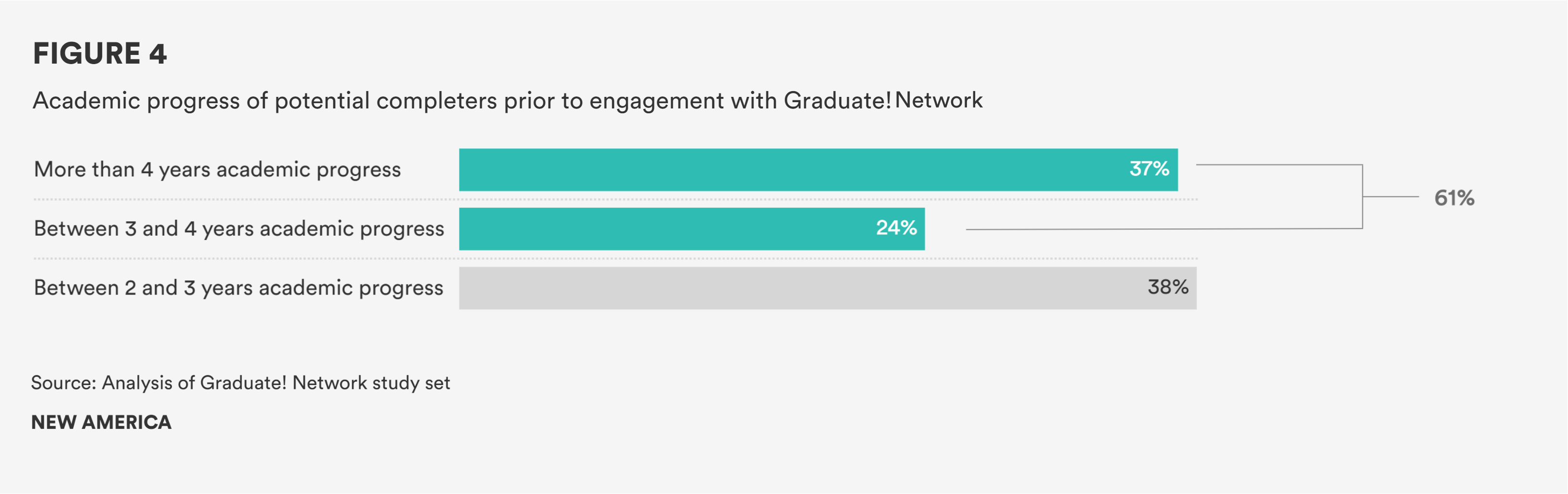
That said, this population has typically done a lot of swirling through higher education, with no degree to show for it. Many potential completers had finished significantly more than two years’ worth of academic progress prior to engaging with a Graduate! program: potential completers who engaged with a Graduate! Network program had already finished an average of 3.9 years of higher education and a median of 3.5 years. Sixty-one percent of potential completers who engaged with The Graduate! Network had earned close to or more than four years’ worth of college coursework with no degree ever conferred. (See Figure 4.) They were also much more likely to have attended more than one institution.
The data from Graduate! Philadelphia, the Network’s longest running program, allowed us to look at what other characteristics, besides credit accumulation, predicted successful graduation. We found that among the most predictive factors of graduation was the time that had elapsed since the comebacker was last enrolled (the shorter the better), not having defaulted on student loans, and the amount of time the Comebacker engaged with a Graduate! advisor. According to the predictive analysis, the longer a Comebacker engaged with a Network program, the more likely he or she was to have graduated. This finding makes sense: comebackers who take time and seek out assistance to sort out issues—finding the right program, preparing academically, addressing financial issues (including outstanding and defaulted-on debt), transferring credit—put themselves on a path to ultimate success. The same analysis also found a wide age distribution for comebackers who graduated, with similar engagement rates for all age groups (20–65) with a small but noticeable increased likelihood of completion for comebackers in their mid-40s.
Challenges to Staying Enrolled
Our interviews with students and our survey shed light on why more than a third of students stop out even after re-enrolling. Staying enrolled is hard even for the most determined.
A shift in personal situation was the most common reason cited by comebackers who are currently not taking classes, which includes things like a change in marital status, caretaking responsibilities of aging parents or children, or illness. One mother described her day: “I literally was taking my daughter to school and then I would leave to go to work and then…on my lunch, I would go to class and I would come back to work and then…I'll go get my daughter, take her to my parents, and then I would go to class or go to work depending on…the day. It was just—it’s a lot.” This type of schedule is unsustainable for many comebackers. Comebackers not currently enrolled are waiting for the right time and support to finish what they started.
Balancing school and work forced some comebackers to take a pause. Comebackers who stopped out acknowledge that work is almost always the priority. One interviewee said, “just negotiating when courses would start and work is [hard] and that's what pays bills, honestly. That's where my benefits like health insurance reside, so I had to make sure I could find a way to balance the time with my work requirements.”
Financial difficulties also came into play. Running out of financial aid, no longer being eligible for employer education benefits, job loss, or unexpected expenses such as medical bills forced many students out of college. One comebacker told us, “I went to a community college and I was working 10 jobs, and I just couldn't pay it. The bills were—I mean, they were amazing…I just gave up, and I went [and] got a job in the factory.” Financial stress significantly adds to overall stress, and we found that the lower their income bracket, the more likely comebackers were to have stopped out.
What Got Comebackers to the Finish Line
With all this stress and pressure, we wanted to investigate what gets comebackers through school and to graduation. After all, 100 percent of comebackers who responded to our survey who were not taking classes at the time of the survey said they would consider going back to college.
Eighty-eight percent of comebackers who graduated cited supportive school faculty and staff as the top factor that got them through, and this was confirmed in our focus groups and interviews. (See Figure 5.) One graduate said, “I had a very good relationship with every single professor that I've had, and because of them, I got accepted at [graduate school] because they wrote recommendation letters for me.” Returning adult students particularly appreciated instructors who valued the experience they brought to the classroom and welcomed opportunities to draw upon these experiences in class discussions and projects. One graduate told us that faculty “would even adjust some courses for me because I said, ‘Okay, I've done this part of the course for 15 years’….They would actually make adjustments for me.”
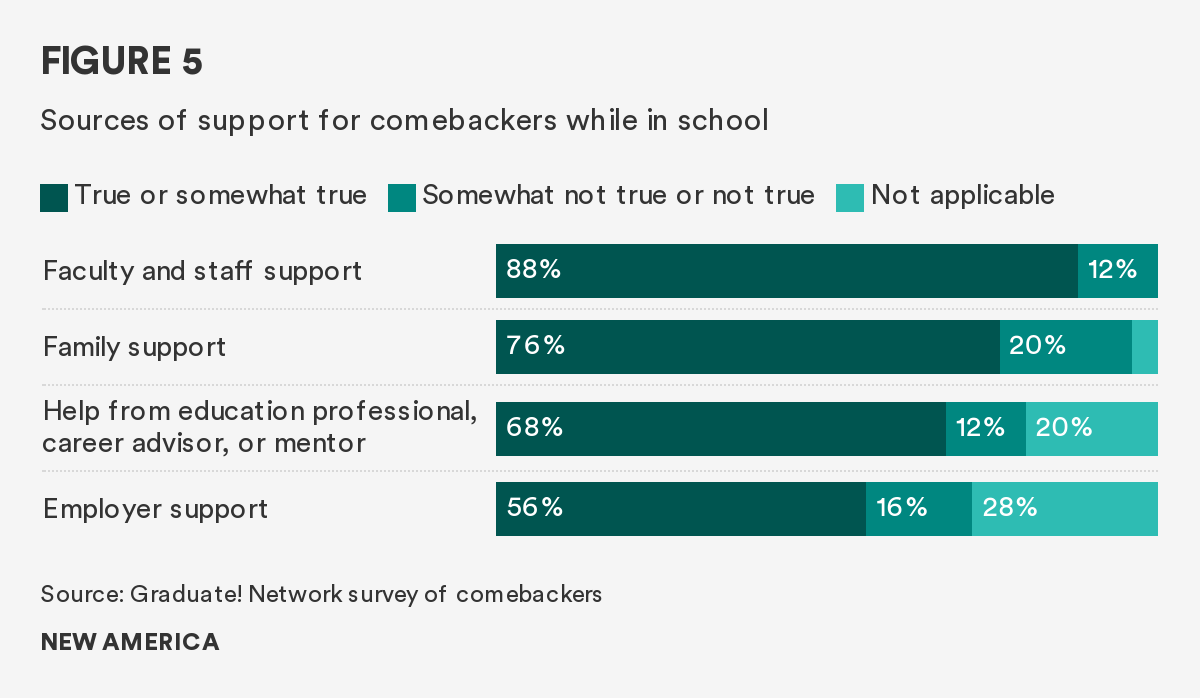
While graduates believe that faculty were key to getting them through school, other staff and supportive programs were also important to them, although feelings about the level of support were more mixed. “In terms of the university administration, yes, they would provide me with support if I reached out; however, they were not there constantly for me,” said one person we interviewed. It is also important to note that comebackers were not passive in their educational journeys. Those who had the capacity worked hard to create the supports they saw missing for returning adults. One graduate shared her story of creating those holistic supports for comebackers. She said, “I actually created a student organization basically for nontraditional students so that we could get scaffoldings that we needed because we didn't have it.”
While family commitments, particularly caregiving responsibilities, made it difficult for comebackers to re-enroll and complete their degree, family support also got comebackers through school. This support was not just encouragement from spouses, partners, children, grandchildren, or parents, but also came in the form of financial assistance with tuition or other school-related expenses. One graduate told us, “there was a lot of late nights and a lot of stress and difficulty just keeping everything together…in addition to work. Mentally and emotionally, my boyfriend and friends were very supportive because it was definitely stressful.”
As mentioned above, comebackers who graduated did not always feel they had the support of their employers. Those who did spoke of flexibility to take classes, especially when these classes were offered only at certain times of the year; time off to complete practicums or internships; and financial benefits, such as tuition assistance. One comebacker said, “my job was very supportive. I essentially came back to this job because they were going to give me the flexibility to take classes when I need them and flex my schedule.”